“Forensic odontology”
-awareness to dentists
Learning outcomes
 Describe, in detail, the full range of methods,
protocols and technologies utilized in the field of
forensic odontology
 Identify alternative methods available and their
advantages and disadvantages
 Understanding of the role of oral radiology in forensics
CONTENTS
•Introduction
•Definition
•Brief history
•Role of a forensic odontologist
•Role of a general dentist in forensic investigation
•Conclusion
Introduction
• FORENSIC IS DERIVED FROM THE LATIN WORD
FORUM WHICH MEANS COURT OF LAW
• ODONTOLOGYSTUDY OF TEETH
• DEFINED AS THAT BRANCH OF DENTISTRY WHICH ,IN
THE INTEREST OF JUSTICE ,DEALS WITH THE PROPER
HANDLING AND EXAMINATION OF DENTAL
EVIDENCE,AND WITH THE PROPER EVALUATION AND
PRESENTATION OF DENTAL FINDINGS
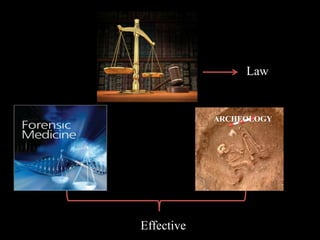
Law
Effective
ARCHEOLOGY
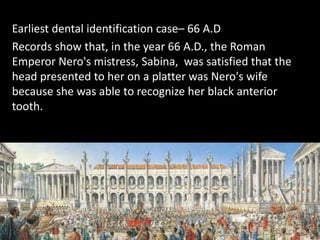
Earliest dental identification case– 66 A.D
Records show that, in the year 66 A.D., the Roman
Emperor Nero's mistress, Sabina, was satisfied that the
head presented to her on a platter was Nero's wife
because she was able to recognize her black anterior
tooth.
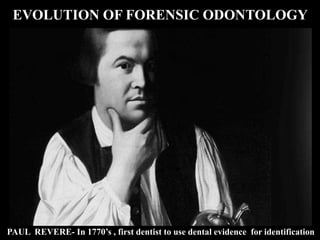
PAUL REVERE- In 1770’s , first dentist to use dental evidence for identification
EVOLUTION OF FORENSIC ODONTOLOGY
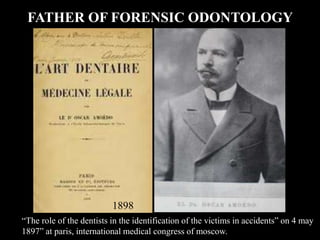
“The role of the dentists in the identification of the victims in accidents” on 4 may
1897” at paris, international medical congress of moscow.
1898
FATHER OF FORENSIC ODONTOLOGY
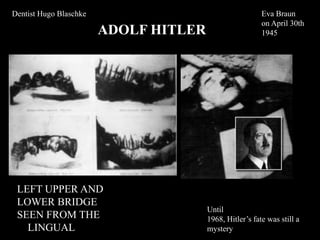
ADOLF HITLER
LEFT UPPER AND
LOWER BRIDGE
SEEN FROM THE
LINGUAL
Eva Braun
on April 30th
1945
Until
1968, Hitler’s fate was still a
mystery
Dentist Hugo Blaschke
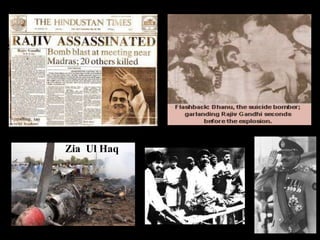
Zia Ul Haq
Forensic Odontologists
• Practicing dentists
– Specialized training to understand how to apply
forensic science to dentistry
• Most are members of a professional
organization
• DDS degree
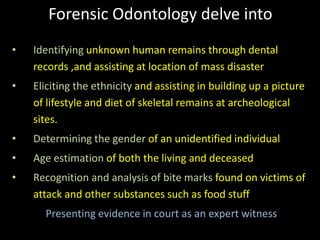
Forensic Odontology delve into
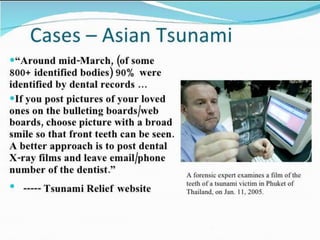
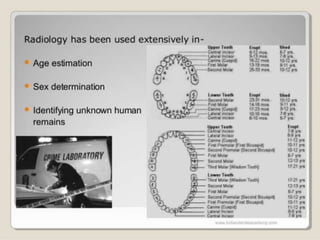
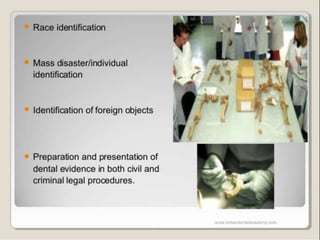
• Identifying unknown human remains through dental
records ,and assisting at location of mass disaster
• Eliciting the ethnicity and assisting in building up a picture
of lifestyle and diet of skeletal remains at archeological
sites.
• Determining the gender of an unidentified individual
• Age estimation of both the living and deceased
• Recognition and analysis of bite marks found on victims of
attack and other substances such as food stuff
Presenting evidence in court as an expert witness
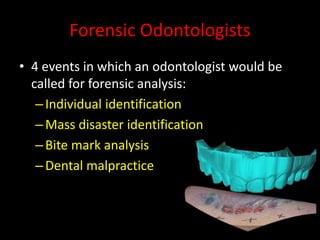
Forensic Odontologists
• 4 events in which an odontologist would be
called for forensic analysis:
–Individual identification
–Mass disaster identification
–Bite mark analysis
–Dental malpractice
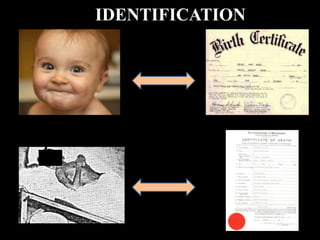
IDENTIFICATION
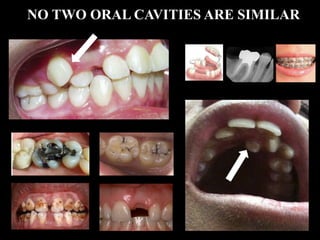
NO TWO ORAL CAVITIES ARE SIMILAR
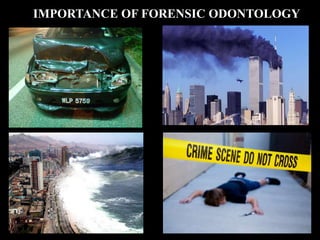
IMPORTANCE OF FORENSIC ODONTOLOGY
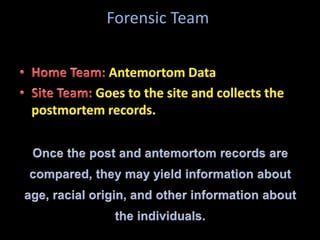
Forensic Team
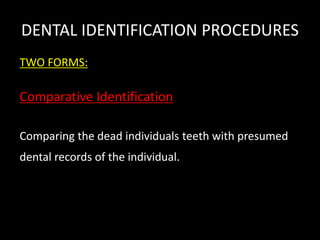
DENTAL IDENTIFICATION PROCEDURES
TWO FORMS:
Comparative Identification
Comparing the dead individuals teeth with presumed
dental records of the individual.
DENTAL IDENTIFICATION PROCEDURES
Reconstructive Identification (Dental Profiling):
Attempts to elicit the ethnicity or race, gender, age and
occupation of the dead individual.
Undertaken when virtually no clue exists
Comparative dental identification
Includes four steps
STEP 1: Oral autopsy
STEP 2: Obtaining dental records
STEP 3: Comparing postmortom and antemortom
dental data
STEP 4: Writing a report and drawing conclusion
Usually done by:
• Assessing the Craniofacial morphology and
dimension
• Gender differences in tooth size
• Dental index (profiling)
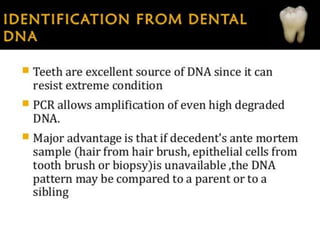
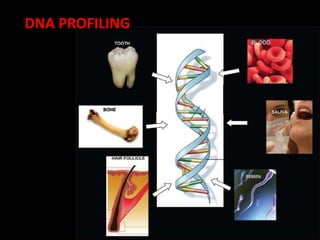
• Determination by DNA analysis
Reconstructive Identification
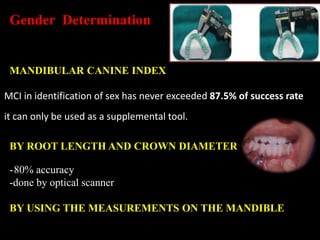
Gender Determination
MCI in identification of sex has never exceeded 87.5% of success rate
it can only be used as a supplemental tool.
MANDIBULAR CANINE INDEX
BY ROOT LENGTH AND CROWN DIAMETER
-80% accuracy
-done by optical scanner
BY USING THE MEASUREMENTS ON THE MANDIBLE
Gender Determination
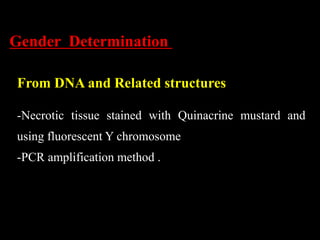
From DNA and Related structures
-Necrotic tissue stained with Quinacrine mustard and
using fluorescent Y chromosome
-PCR amplification method .
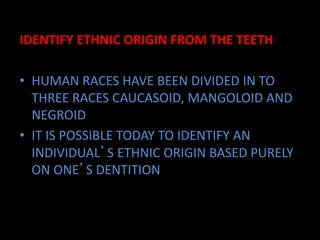
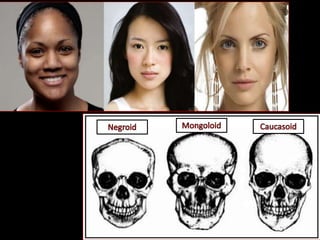
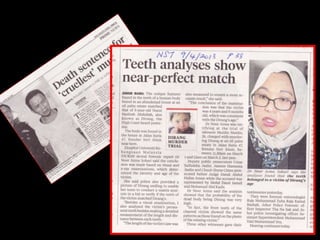
IDENTIFY ETHNIC ORIGIN FROM THE TEETH
• HUMAN RACES HAVE BEEN DIVIDED IN TO
THREE RACES CAUCASOID, MANGOLOID AND
NEGROID
• IT IS POSSIBLE TODAY TO IDENTIFY AN
INDIVIDUAL’S ETHNIC ORIGIN BASED PURELY
ON ONE’S DENTITION
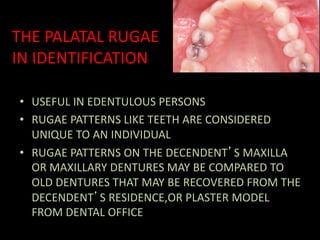
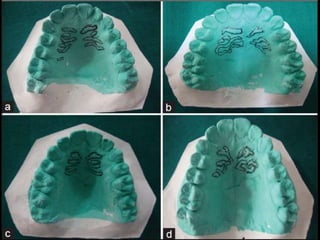
THE PALATAL RUGAE
IN IDENTIFICATION
• USEFUL IN EDENTULOUS PERSONS
• RUGAE PATTERNS LIKE TEETH ARE CONSIDERED
UNIQUE TO AN INDIVIDUAL
• RUGAE PATTERNS ON THE DECENDENT’S MAXILLA
OR MAXILLARY DENTURES MAY BE COMPARED TO
OLD DENTURES THAT MAY BE RECOVERED FROM THE
DECENDENT’S RESIDENCE,OR PLASTER MODEL
FROM DENTAL OFFICE
DNA PROFILING
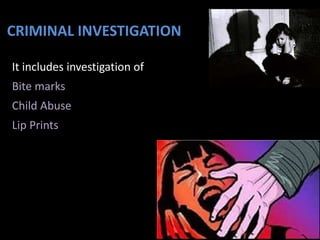
CRIMINAL INVESTIGATION
It includes investigation of
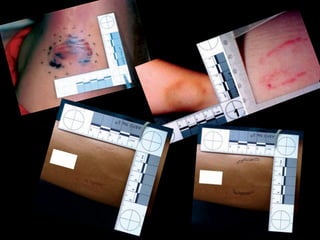
Bite marks
Child Abuse
Lip Prints
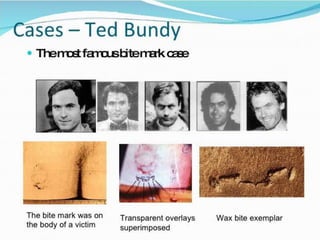
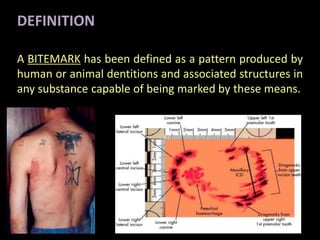
A BITEMARK has been defined as a pattern produced by
human or animal dentitions and associated structures in
any substance capable of being marked by these means.
DEFINITION
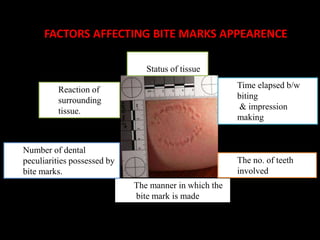
FACTORS AFFECTING BITE MARKS APPEARENCE
Status of tissue
Time elapsed b/w
biting
& impression
making
The manner in which the
bite mark is made
The no. of teeth
involved
Number of dental
peculiarities possessed by
bite marks.
Reaction of
surrounding
tissue.
Collection Protocols
Dental records: Whenever possible, the dental records of the individual should be
obtained. This will aid in establishing the suspect's dental profile and record of
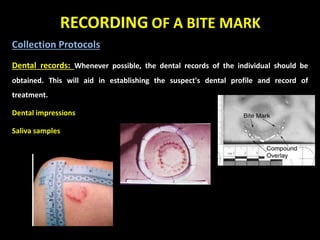
treatment.
Dental impressions
Saliva samples
Photographic documentation of the dentition:
Extra oral photographs: A frontal full-face view and a view with the teeth in
centric should be taken.. mouth opening/evidence of trauma or surgery/muscle
tone
Intraoral photographs: maxillary and mandibular occlusal views of the
dentition..
• Missing and misaligned, broken and restored of teeth should be noted.
• The periodontal condition and tooth mobility should be noted whenever
possible.
• Occlusal disharmonies should be noted whenever possible.
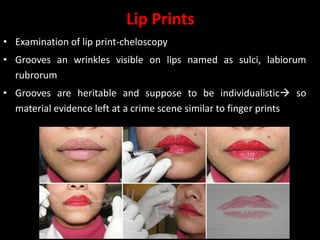
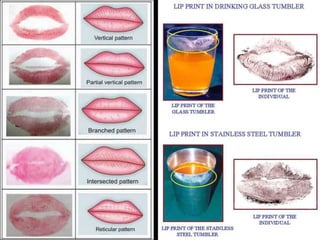
Lip Prints
• Examination of lip print-cheloscopy
• Grooves an wrinkles visible on lips named as sulci, labiorum
rubrorum
• Grooves are heritable and suppose to be individualistic so
material evidence left at a crime scene similar to finger prints
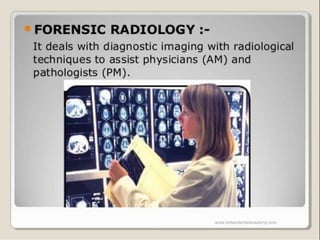
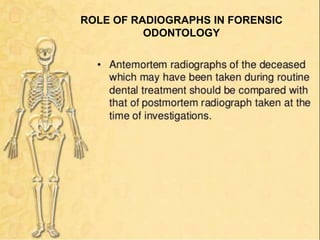
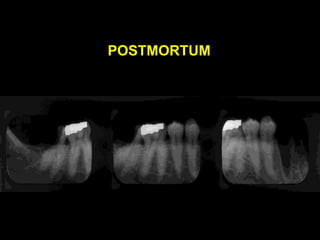
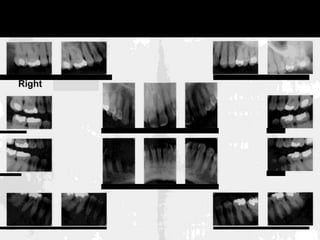
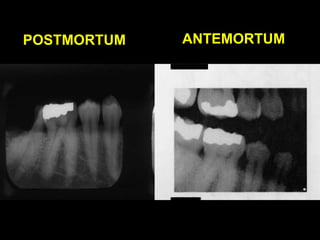
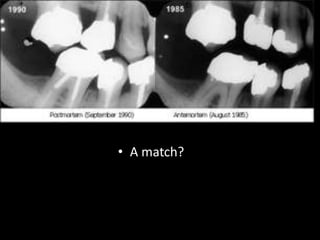
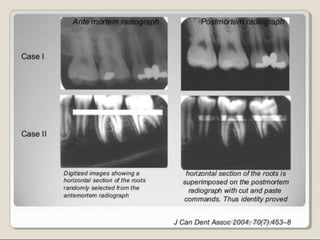
ROLE OF RADIOGRAPHS IN FORENSIC
ODONTOLOGY
POSTMORTUM
ANTEMORTUM
POSTMORTUM ANTEMORTUM
• A match?
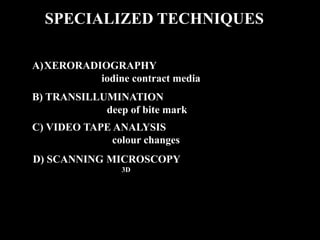
SPECIALIZED TECHNIQUES
A)XERORADIOGRAPHY
iodine contract media
B) TRANSILLUMINATION
deep of bite mark
C) VIDEO TAPE ANALYSIS
colour changes
D) SCANNING MICROSCOPY
3D
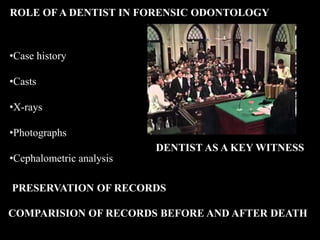
ROLE OF A DENTIST IN FORENSIC ODONTOLOGY
•Case history
•Casts
•X-rays
•Photographs
•Cephalometric analysis
DENTIST AS A KEY WITNESS
PRESERVATION OF RECORDS
COMPARISION OF RECORDS BEFORE AND AFTER DEATH
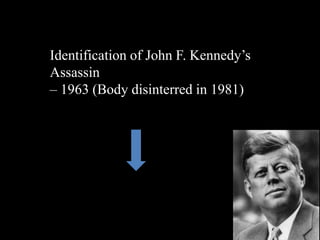
Identification of John F. Kennedy’s
Assassin
– 1963 (Body disinterred in 1981)
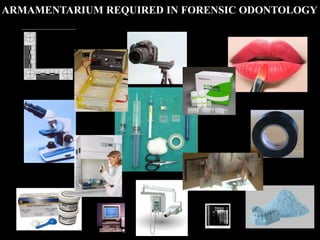
ARMAMENTARIUM REQUIRED IN FORENSIC ODONTOLOGY
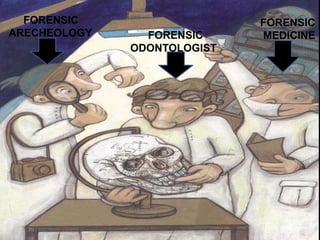
FORENSIC
ODONTOLOGIST
FORENSIC
ARECHEOLOGY
FORENSIC
MEDICINE
DENTIST AS AN EXPERT WITNESS
• Expert witness are those whose training,
qualification or experience enables them to give an
opinion on relevant matter where the ordinary
person is not so enabled.
• To become dental expert to forensic dental expert
need additional knowledge and experience
57
Thank
?

LECTURE ON FORENSICS.ppt

  • 1.
  • 2.
    Learning outcomes  Describe,in detail, the full range of methods, protocols and technologies utilized in the field of forensic odontology  Identify alternative methods available and their advantages and disadvantages  Understanding of the role of oral radiology in forensics
  • 3.
    CONTENTS •Introduction •Definition •Brief history •Role ofa forensic odontologist •Role of a general dentist in forensic investigation •Conclusion
  • 4.
    Introduction • FORENSIC ISDERIVED FROM THE LATIN WORD FORUM WHICH MEANS COURT OF LAW • ODONTOLOGYSTUDY OF TEETH • DEFINED AS THAT BRANCH OF DENTISTRY WHICH ,IN THE INTEREST OF JUSTICE ,DEALS WITH THE PROPER HANDLING AND EXAMINATION OF DENTAL EVIDENCE,AND WITH THE PROPER EVALUATION AND PRESENTATION OF DENTAL FINDINGS
  • 5.
  • 6.
    Earliest dental identificationcase– 66 A.D Records show that, in the year 66 A.D., the Roman Emperor Nero's mistress, Sabina, was satisfied that the head presented to her on a platter was Nero's wife because she was able to recognize her black anterior tooth.
  • 7.
    PAUL REVERE- In1770’s , first dentist to use dental evidence for identification EVOLUTION OF FORENSIC ODONTOLOGY
  • 8.
    “The role ofthe dentists in the identification of the victims in accidents” on 4 may 1897” at paris, international medical congress of moscow. 1898 FATHER OF FORENSIC ODONTOLOGY
  • 9.
    ADOLF HITLER LEFT UPPERAND LOWER BRIDGE SEEN FROM THE LINGUAL Eva Braun on April 30th 1945 Until 1968, Hitler’s fate was still a mystery Dentist Hugo Blaschke
  • 10.
  • 11.
    Forensic Odontologists • Practicingdentists – Specialized training to understand how to apply forensic science to dentistry • Most are members of a professional organization • DDS degree
  • 12.
    Forensic Odontology delveinto • Identifying unknown human remains through dental records ,and assisting at location of mass disaster • Eliciting the ethnicity and assisting in building up a picture of lifestyle and diet of skeletal remains at archeological sites. • Determining the gender of an unidentified individual • Age estimation of both the living and deceased • Recognition and analysis of bite marks found on victims of attack and other substances such as food stuff Presenting evidence in court as an expert witness
  • 13.
    Forensic Odontologists • 4events in which an odontologist would be called for forensic analysis: –Individual identification –Mass disaster identification –Bite mark analysis –Dental malpractice
  • 14.
  • 15.
    NO TWO ORALCAVITIES ARE SIMILAR
  • 16.
  • 18.
  • 19.
    DENTAL IDENTIFICATION PROCEDURES TWOFORMS: Comparative Identification Comparing the dead individuals teeth with presumed dental records of the individual.
  • 20.
    DENTAL IDENTIFICATION PROCEDURES ReconstructiveIdentification (Dental Profiling): Attempts to elicit the ethnicity or race, gender, age and occupation of the dead individual. Undertaken when virtually no clue exists
  • 21.
    Comparative dental identification Includesfour steps STEP 1: Oral autopsy STEP 2: Obtaining dental records STEP 3: Comparing postmortom and antemortom dental data STEP 4: Writing a report and drawing conclusion
  • 22.
    Usually done by: •Assessing the Craniofacial morphology and dimension • Gender differences in tooth size • Dental index (profiling) • Determination by DNA analysis Reconstructive Identification
  • 23.
    Gender Determination MCI inidentification of sex has never exceeded 87.5% of success rate it can only be used as a supplemental tool. MANDIBULAR CANINE INDEX BY ROOT LENGTH AND CROWN DIAMETER -80% accuracy -done by optical scanner BY USING THE MEASUREMENTS ON THE MANDIBLE
  • 24.
    Gender Determination From DNAand Related structures -Necrotic tissue stained with Quinacrine mustard and using fluorescent Y chromosome -PCR amplification method .
  • 25.
    IDENTIFY ETHNIC ORIGINFROM THE TEETH • HUMAN RACES HAVE BEEN DIVIDED IN TO THREE RACES CAUCASOID, MANGOLOID AND NEGROID • IT IS POSSIBLE TODAY TO IDENTIFY AN INDIVIDUAL’S ETHNIC ORIGIN BASED PURELY ON ONE’S DENTITION
  • 30.
    THE PALATAL RUGAE INIDENTIFICATION • USEFUL IN EDENTULOUS PERSONS • RUGAE PATTERNS LIKE TEETH ARE CONSIDERED UNIQUE TO AN INDIVIDUAL • RUGAE PATTERNS ON THE DECENDENT’S MAXILLA OR MAXILLARY DENTURES MAY BE COMPARED TO OLD DENTURES THAT MAY BE RECOVERED FROM THE DECENDENT’S RESIDENCE,OR PLASTER MODEL FROM DENTAL OFFICE
  • 33.
  • 34.
    CRIMINAL INVESTIGATION It includesinvestigation of Bite marks Child Abuse Lip Prints
  • 35.
    A BITEMARK hasbeen defined as a pattern produced by human or animal dentitions and associated structures in any substance capable of being marked by these means. DEFINITION
  • 36.
    FACTORS AFFECTING BITEMARKS APPEARENCE Status of tissue Time elapsed b/w biting & impression making The manner in which the bite mark is made The no. of teeth involved Number of dental peculiarities possessed by bite marks. Reaction of surrounding tissue.
  • 38.
    Collection Protocols Dental records:Whenever possible, the dental records of the individual should be obtained. This will aid in establishing the suspect's dental profile and record of treatment. Dental impressions Saliva samples
  • 39.
    Photographic documentation ofthe dentition: Extra oral photographs: A frontal full-face view and a view with the teeth in centric should be taken.. mouth opening/evidence of trauma or surgery/muscle tone Intraoral photographs: maxillary and mandibular occlusal views of the dentition.. • Missing and misaligned, broken and restored of teeth should be noted. • The periodontal condition and tooth mobility should be noted whenever possible. • Occlusal disharmonies should be noted whenever possible.
  • 40.
    Lip Prints • Examinationof lip print-cheloscopy • Grooves an wrinkles visible on lips named as sulci, labiorum rubrorum • Grooves are heritable and suppose to be individualistic so material evidence left at a crime scene similar to finger prints
  • 45.
    ROLE OF RADIOGRAPHSIN FORENSIC ODONTOLOGY
  • 46.
  • 47.
  • 48.
  • 49.
  • 51.
    SPECIALIZED TECHNIQUES A)XERORADIOGRAPHY iodine contractmedia B) TRANSILLUMINATION deep of bite mark C) VIDEO TAPE ANALYSIS colour changes D) SCANNING MICROSCOPY 3D
  • 52.
    ROLE OF ADENTIST IN FORENSIC ODONTOLOGY •Case history •Casts •X-rays •Photographs •Cephalometric analysis DENTIST AS A KEY WITNESS PRESERVATION OF RECORDS COMPARISION OF RECORDS BEFORE AND AFTER DEATH
  • 53.
    Identification of JohnF. Kennedy’s Assassin – 1963 (Body disinterred in 1981)
  • 54.
    ARMAMENTARIUM REQUIRED INFORENSIC ODONTOLOGY
  • 55.
  • 56.
    DENTIST AS ANEXPERT WITNESS • Expert witness are those whose training, qualification or experience enables them to give an opinion on relevant matter where the ordinary person is not so enabled. • To become dental expert to forensic dental expert need additional knowledge and experience
  • 57.