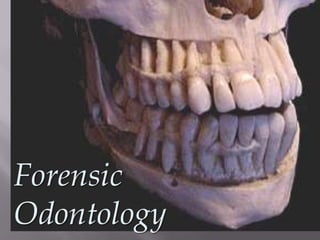
Forensic
Odontology
By
      Prof.Pervaiz A Rana
Deprtment of Forensic Medicine &
           Toxicology
  CMH Lahore Medical College
   Forensic Medicine and Odontology deals with the
    professional handling , examination, interpretation
    and presentation of medical and dental evidences
    that come before legal authorities
   Forensic Odontology is one of the fastest emerging
    sub disciplines within the broader subject of dental
    science.
   It requires special dental expertise not possessed
    by ordinary pathologist qualified only in medicine.
   It encompasses ethical issues and events related to
    the claim of negligence and malpractice by
    dentists and paradental professionals.
   History and status of Forensic Odontology
   Working of Forensic dental section
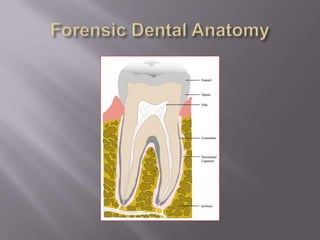
   Forensic Dental Anatomy
   Main applications
   Case discussion
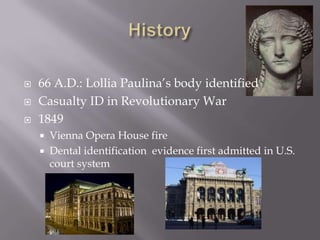
   66 A.D.: Lollia Paulina’s body identified
   Casualty ID in Revolutionary War
   1849
       Vienna Opera House fire
       Dental identification evidence first admitted in U.S.
        court system
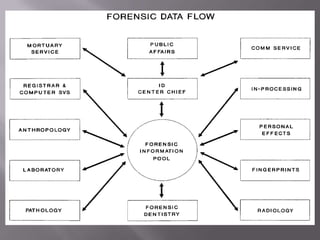
   The department is divided into sub divisions
    like record section, cold storage, autopsy
    section, analytical, serologic and chemical
    examiner, they are interlinked with a chain of
    custody .
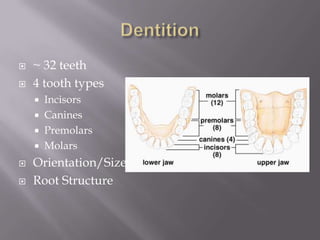
   ~ 32 teeth
   4 tooth types
       Incisors
       Canines
       Premolars
       Molars
   Orientation/Size
   Root Structure
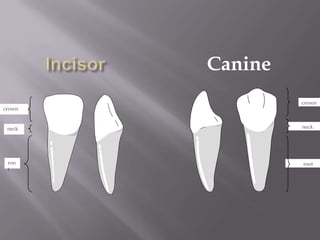
Canine
                 crown
crown


 neck            neck


 roo             root
 t
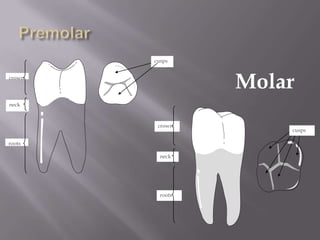
cusps


crown
                  Molar
neck


         crown
                      cusps

roots

          neck


          roots
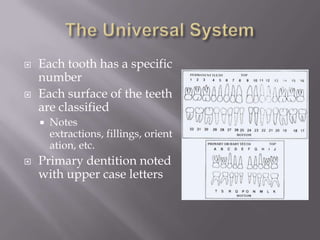
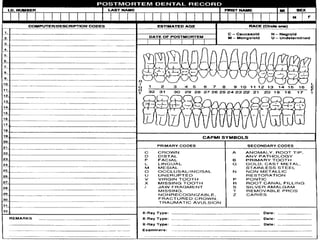
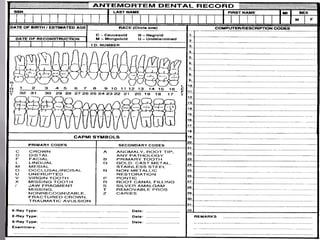
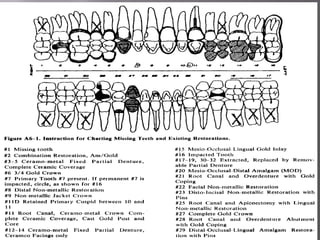
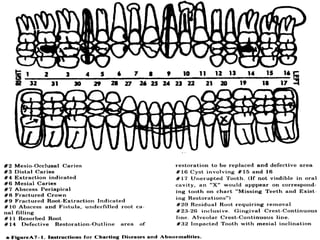
   Each tooth has a specific
    number
   Each surface of the teeth
    are classified
       Notes
        extractions, fillings, orient
        ation, etc.
   Primary dentition noted
    with upper case letters
   Are the remains human?

   If so, what are the sex, age, and race of the
    individual?

   Who is the person?
   Is it a tooth, or a portion of a tooth?
   Is it an animal tooth, or a human tooth?
   If human, what type of tooth is it, i.e., incisor,
    canine, premolar, or molar?
   Is it deciduous/primary, or permanent?
   Which quadrant does it come from, i.e., right
    upper, left lower, etc?
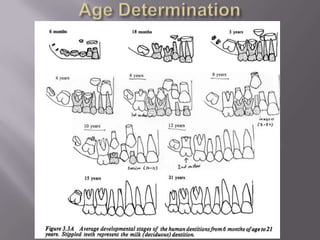
   Some variation is developmental, i.e., the tooth
    in question developed abnormally.
   Other variations are acquired at some time
    after birth. Such acquired variations can be the
    result of
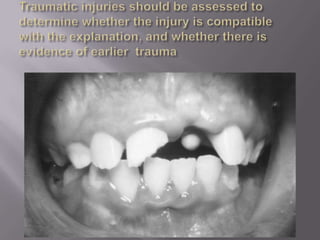
       trauma
       erosion
       occupational insult
       dental work in a clinical setting.
   Abnormalities of eruption patterns.
   Abnormalities of shape (morphology). Any
    given tooth can have missing features, extra
    features, or atypical features. This can include
    bent teeth, anomalies in the number of cusps or
    roots, abnormal enamel deposition, etc.
   Abnormalities in the number of teeth. This
    can range from complete absence of teeth
    (adontia), to extra teeth, known as polydontia.
    Any given tooth may be absent in any given
    individual, a condition known as partial
    adontia. The presence of additional individual
    teeth is sometimes known as supernumerary
    teeth.
   Abnormalities in the spacing or position of
    teeth. Teeth can be crowded, have gaps
    (diastema) between them, or be rotated or
    misaligned. Long-term bulimics often have
    the appearance of teeth that are spreading
    apart – as the space between the teeth increases
    over time..
   Abnormalities in the size of teeth. It is quite
    rare to have abnormally small (microdontia),
    or abnormally large teeth (macrodontia) –
    either as a complete set, or individually.
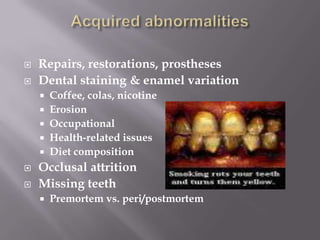
   Repairs, restorations, prostheses
   Dental staining & enamel variation
     Coffee, colas, nicotine
     Erosion
     Occupational
     Health-related issues
     Diet composition
   Occlusal attrition
   Missing teeth
       Premortem vs. peri/postmortem
Main Applications

 Individual  Identification
 Mass Disaster
  Identification
 Bite mark Analysis
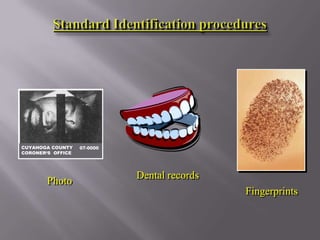
CUYAHOGA COUNTY    07-0000
CORONER‘S OFFICE


                             Dental records
        Photo
                                              Fingerprints
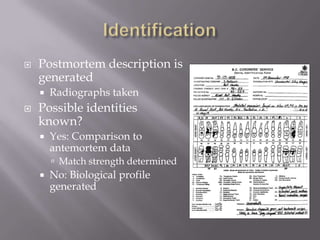
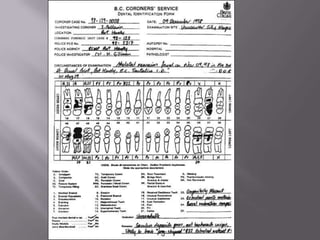
   Postmortem description is
    generated
       Radiographs taken
   Possible identities
    known?
       Yes: Comparison to
        antemortem data
         Match strength determined
       No: Biological profile
        generated
   Postmortem description is generated
       Radiographs taken
   Possible identities known?
       Yes: Comparison to antemortem data
         Match strength determined
       No: Biological profile generated
   Completed in the same manner as individual
    identification
   Organization of antemortem and postmortem
    data is essential
   Large scale problems can occur if no record
    available (radiological, DNA)
   Postmortem Team
       Generates dental profile and radiographs
   Antemortem Team
       Collects/organizes antemortem data
   Records Comparison Team
       Compares postmortem and antemortem data
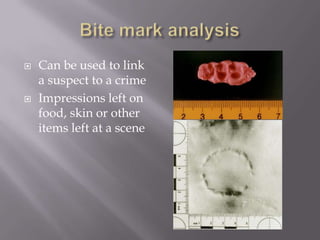
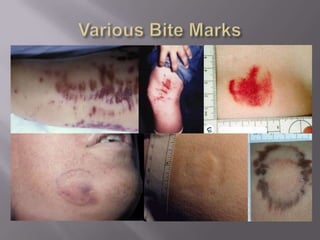
   Can be used to link
    a suspect to a crime
   Impressions left on
    food, skin or other
    items left at a scene
“Every         contact leaves it’s
                    trace”
Said professor Edmond Locard (1877),
founder and director of the institute of
  Criminalistics,
University of Lyons,
France
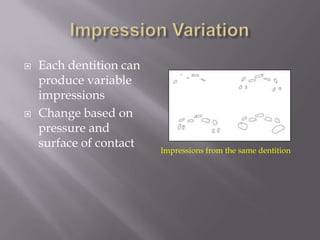
   Each dentition can
    produce variable
    impressions
   Change based on
    pressure and
    surface of contact
                         Impressions from the same dentition
   Bite marks are photographed with a scale
       Bite marks on skin are taken over repeated intervals
   Casts of impression are taken
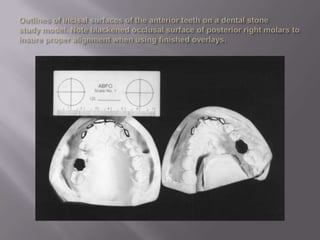
   Impression traced onto transparencies
   Casts of suspects teeth are taken
   Comparison between suspect cast and bite
    mark
   Assailants Saliva
   Collection
   preservation &
   dispatch of saliva collected from bite site
   DNA profiling & Blood Grouping
   3D Bite mark analysis
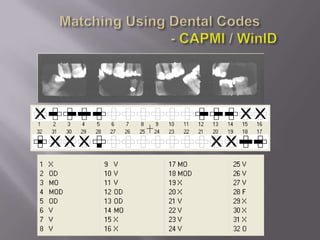
   Automatic dental code matching
   OdontoSearch
   Automatic dental identification system
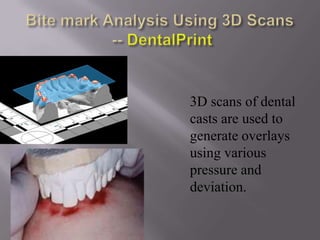
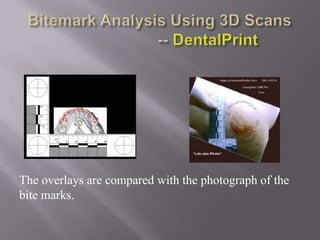
3D scans of dental
casts are used to
generate overlays
using various
pressure and
deviation.
The overlays are compared with the photograph of the
bite marks.
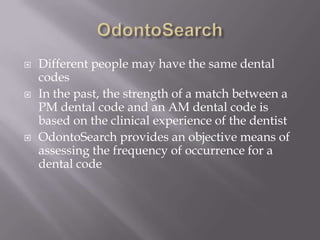
   Different people may have the same dental
    codes
   In the past, the strength of a match between a
    PM dental code and an AM dental code is
    based on the clinical experience of the dentist
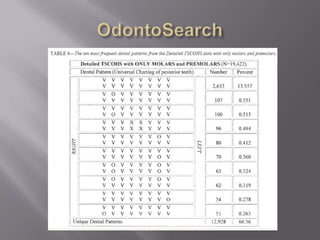
   OdontoSearch provides an objective means of
    assessing the frequency of occurrence for a
    dental code
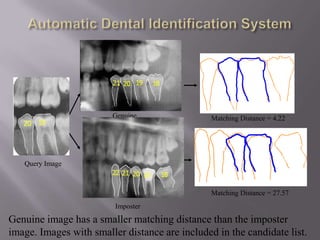
Genuine                 Matching Distance = 4.22


   Query Image


                                                Matching Distance = 27.57
                         Imposter
Genuine image has a smaller matching distance than the imposter
image. Images with smaller distance are included in the candidate list.
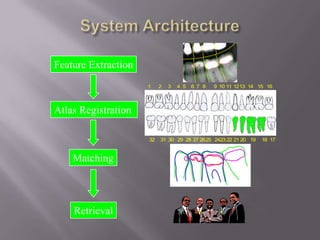
Feature Extraction
                     1    2   3   4 5   6 7 8   9 10 11 1213 14 15 16


Atlas Registration

                     32   31 30 29 28 27 2625 2423 22 21 20 19   18 17


    Matching


    Retrieval
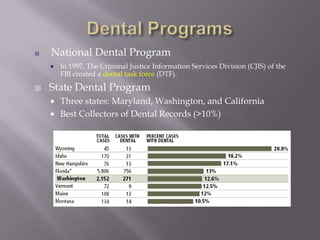
   National Dental Program
       In 1997, The Criminal Justice Information Services Division (CJIS) of the
        FBI created a dental task force (DTF).

   State Dental Program
       Three states: Maryland, Washington, and California
       Best Collectors of Dental Records (>10%)
 Bite mark analysis
 Identification

 Serological analysis of bite mark
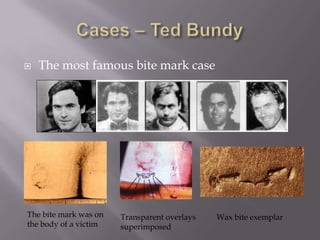
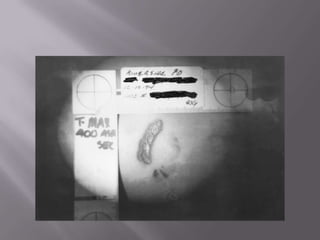
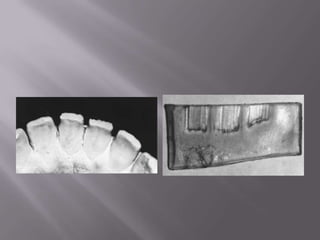
   The most famous bite mark case


The bite mark was on   Transparent overlays   Wax bite exemplar
the body of a victim   superimposed
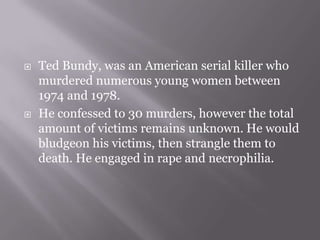
   Ted Bundy, was an American serial killer who
    murdered numerous young women between
    1974 and 1978.
   He confessed to 30 murders, however the total
    amount of victims remains unknown. He would
    bludgeon his victims, then strangle them to
    death. He engaged in rape and necrophilia.
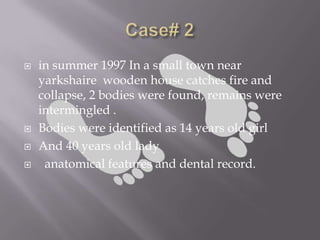
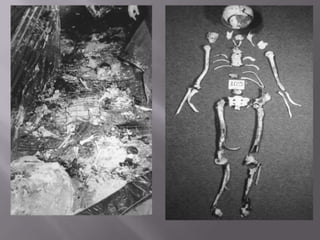
   in summer 1997 In a small town near
    yarkshaire wooden house catches fire and
    collapse, 2 bodies were found, remains were
    intermingled .
   Bodies were identified as 14 years old girl
   And 40 years old lady
    anatomical features and dental record.
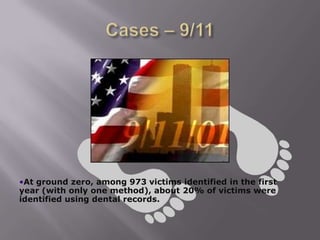
•At ground zero, among 973 victims identified in the first
year (with only one method), about 20% of victims were
identified using dental records.
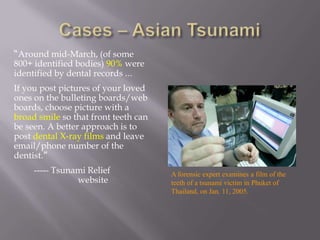
“Around mid-March, (of some
800+ identified bodies) 90% were
identified by dental records …
If you post pictures of your loved
ones on the bulleting boards/web
boards, choose picture with a
broad smile so that front teeth can
be seen. A better approach is to
post dental X-ray films and leave
email/phone number of the
dentist.”
     ----- Tsunami Relief             A forensic expert examines a film of the
                website               teeth of a tsunami victim in Phuket of
                                      Thailand, on Jan. 11, 2005.
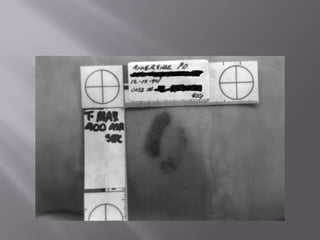
   A bite mark was
        identified and preserved
        impression was obtained
       reconstruction of assailants teeth was done
       Impression was compared with the record of
        suspects and finally the assailant was arrested .
State of Indiana v.
  Jeffery Jones
   Indianapolis
Police Department
case no. 5610144G
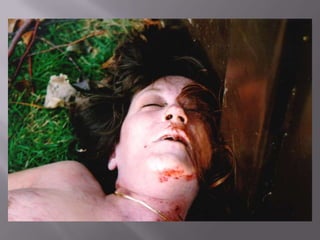
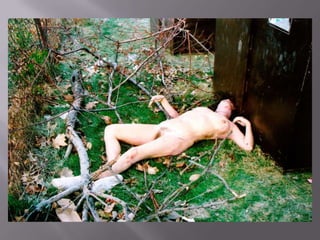
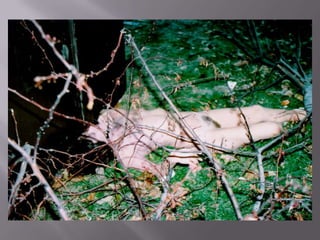
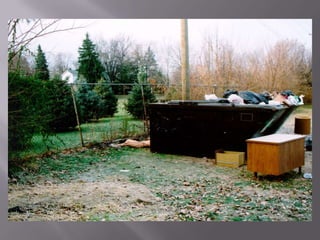
   A naked dead body of 38 years old lady was
    found near garbage container near her
    residence.
   Crime scene investigators (CSI) closely analyze
    the body and found a bite mark on her neck
    and left breast.
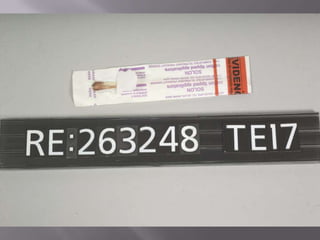
   Saliva sample was collected from bite mark
   Sample send for DNA profile analysis .
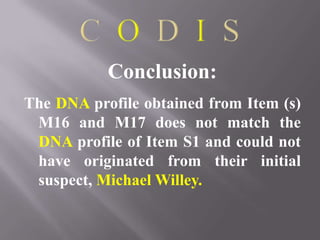
Conclusion:
The DNA profile obtained from Item (s)
 M16 and M17 does not match the
 DNA profile of Item S1 and could not
 have originated from their initial
 suspect, Michael Willey.
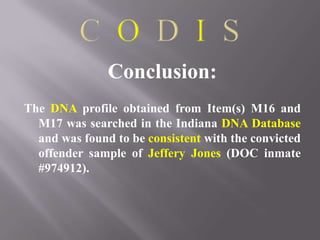
Conclusion:
The DNA profile obtained from Item(s) M16 and
  M17 was searched in the Indiana DNA Database
  and was found to be consistent with the convicted
  offender sample of Jeffery Jones (DOC inmate
  #974912).
Conclusion:
In the absence of an identical twin, Jeffery Jones is
   the source of the DNA obtained from Items M16
   and M17 to a reasonable degree of scientific
  certainty   .
THANK YOU

49075554 forensic-odontology-dr-rizwan

  • 1.
  • 2.
    By Prof.Pervaiz A Rana Deprtment of Forensic Medicine & Toxicology CMH Lahore Medical College
  • 3.
    Forensic Medicine and Odontology deals with the professional handling , examination, interpretation and presentation of medical and dental evidences that come before legal authorities  Forensic Odontology is one of the fastest emerging sub disciplines within the broader subject of dental science.  It requires special dental expertise not possessed by ordinary pathologist qualified only in medicine.  It encompasses ethical issues and events related to the claim of negligence and malpractice by dentists and paradental professionals.
  • 4.
    History and status of Forensic Odontology  Working of Forensic dental section  Forensic Dental Anatomy  Main applications  Case discussion
  • 5.
    66 A.D.: Lollia Paulina’s body identified  Casualty ID in Revolutionary War  1849  Vienna Opera House fire  Dental identification evidence first admitted in U.S. court system
  • 6.
    The department is divided into sub divisions like record section, cold storage, autopsy section, analytical, serologic and chemical examiner, they are interlinked with a chain of custody .
  • 10.
    ~ 32 teeth  4 tooth types  Incisors  Canines  Premolars  Molars  Orientation/Size  Root Structure
  • 11.
    Canine crown crown neck neck roo root t
  • 12.
    cusps crown Molar neck crown cusps roots neck roots
  • 13.
    Each tooth has a specific number  Each surface of the teeth are classified  Notes extractions, fillings, orient ation, etc.  Primary dentition noted with upper case letters
  • 20.
    Are the remains human?  If so, what are the sex, age, and race of the individual?  Who is the person?
  • 21.
    Is it a tooth, or a portion of a tooth?  Is it an animal tooth, or a human tooth?  If human, what type of tooth is it, i.e., incisor, canine, premolar, or molar?  Is it deciduous/primary, or permanent?  Which quadrant does it come from, i.e., right upper, left lower, etc?
  • 22.
    Some variation is developmental, i.e., the tooth in question developed abnormally.  Other variations are acquired at some time after birth. Such acquired variations can be the result of  trauma  erosion  occupational insult  dental work in a clinical setting.
  • 23.
    Abnormalities of eruption patterns.  Abnormalities of shape (morphology). Any given tooth can have missing features, extra features, or atypical features. This can include bent teeth, anomalies in the number of cusps or roots, abnormal enamel deposition, etc.  Abnormalities in the number of teeth. This can range from complete absence of teeth (adontia), to extra teeth, known as polydontia. Any given tooth may be absent in any given individual, a condition known as partial adontia. The presence of additional individual teeth is sometimes known as supernumerary teeth.
  • 24.
    Abnormalities in the spacing or position of teeth. Teeth can be crowded, have gaps (diastema) between them, or be rotated or misaligned. Long-term bulimics often have the appearance of teeth that are spreading apart – as the space between the teeth increases over time..  Abnormalities in the size of teeth. It is quite rare to have abnormally small (microdontia), or abnormally large teeth (macrodontia) – either as a complete set, or individually.
  • 25.
    Repairs, restorations, prostheses  Dental staining & enamel variation  Coffee, colas, nicotine  Erosion  Occupational  Health-related issues  Diet composition  Occlusal attrition  Missing teeth  Premortem vs. peri/postmortem
  • 27.
    Main Applications  Individual Identification  Mass Disaster Identification  Bite mark Analysis
  • 28.
    CUYAHOGA COUNTY 07-0000 CORONER‘S OFFICE Dental records Photo Fingerprints
  • 29.
    Postmortem description is generated  Radiographs taken  Possible identities known?  Yes: Comparison to antemortem data  Match strength determined  No: Biological profile generated
  • 31.
    Postmortem description is generated  Radiographs taken  Possible identities known?  Yes: Comparison to antemortem data  Match strength determined  No: Biological profile generated
  • 35.
    Completed in the same manner as individual identification  Organization of antemortem and postmortem data is essential  Large scale problems can occur if no record available (radiological, DNA)
  • 36.
    Postmortem Team  Generates dental profile and radiographs  Antemortem Team  Collects/organizes antemortem data  Records Comparison Team  Compares postmortem and antemortem data
  • 37.
    Can be used to link a suspect to a crime  Impressions left on food, skin or other items left at a scene
  • 39.
    “Every contact leaves it’s trace” Said professor Edmond Locard (1877), founder and director of the institute of Criminalistics, University of Lyons, France
  • 40.
    Each dentition can produce variable impressions  Change based on pressure and surface of contact Impressions from the same dentition
  • 41.
    Bite marks are photographed with a scale  Bite marks on skin are taken over repeated intervals  Casts of impression are taken  Impression traced onto transparencies  Casts of suspects teeth are taken  Comparison between suspect cast and bite mark
  • 42.
    Assailants Saliva  Collection  preservation &  dispatch of saliva collected from bite site  DNA profiling & Blood Grouping
  • 43.
    3D Bite mark analysis  Automatic dental code matching  OdontoSearch  Automatic dental identification system
  • 44.
    3D scans ofdental casts are used to generate overlays using various pressure and deviation.
  • 45.
    The overlays arecompared with the photograph of the bite marks.
  • 47.
    Different people may have the same dental codes  In the past, the strength of a match between a PM dental code and an AM dental code is based on the clinical experience of the dentist  OdontoSearch provides an objective means of assessing the frequency of occurrence for a dental code
  • 49.
    Genuine Matching Distance = 4.22 Query Image Matching Distance = 27.57 Imposter Genuine image has a smaller matching distance than the imposter image. Images with smaller distance are included in the candidate list.
  • 50.
    Feature Extraction 1 2 3 4 5 6 7 8 9 10 11 1213 14 15 16 Atlas Registration 32 31 30 29 28 27 2625 2423 22 21 20 19 18 17 Matching Retrieval
  • 51.
    National Dental Program  In 1997, The Criminal Justice Information Services Division (CJIS) of the FBI created a dental task force (DTF).  State Dental Program  Three states: Maryland, Washington, and California  Best Collectors of Dental Records (>10%)
  • 52.
     Bite markanalysis  Identification  Serological analysis of bite mark
  • 53.
    The most famous bite mark case The bite mark was on Transparent overlays Wax bite exemplar the body of a victim superimposed
  • 54.
    Ted Bundy, was an American serial killer who murdered numerous young women between 1974 and 1978.  He confessed to 30 murders, however the total amount of victims remains unknown. He would bludgeon his victims, then strangle them to death. He engaged in rape and necrophilia.
  • 55.
    in summer 1997 In a small town near yarkshaire wooden house catches fire and collapse, 2 bodies were found, remains were intermingled .  Bodies were identified as 14 years old girl  And 40 years old lady  anatomical features and dental record.
  • 57.
    •At ground zero,among 973 victims identified in the first year (with only one method), about 20% of victims were identified using dental records.
  • 58.
    “Around mid-March, (ofsome 800+ identified bodies) 90% were identified by dental records … If you post pictures of your loved ones on the bulleting boards/web boards, choose picture with a broad smile so that front teeth can be seen. A better approach is to post dental X-ray films and leave email/phone number of the dentist.” ----- Tsunami Relief A forensic expert examines a film of the website teeth of a tsunami victim in Phuket of Thailand, on Jan. 11, 2005.
  • 59.
    A bite mark was  identified and preserved  impression was obtained  reconstruction of assailants teeth was done  Impression was compared with the record of suspects and finally the assailant was arrested .
  • 64.
    State of Indianav. Jeffery Jones Indianapolis Police Department case no. 5610144G
  • 65.
    A naked dead body of 38 years old lady was found near garbage container near her residence.  Crime scene investigators (CSI) closely analyze the body and found a bite mark on her neck and left breast.  Saliva sample was collected from bite mark  Sample send for DNA profile analysis .
  • 71.
    Conclusion: The DNA profileobtained from Item (s) M16 and M17 does not match the DNA profile of Item S1 and could not have originated from their initial suspect, Michael Willey.
  • 72.
    Conclusion: The DNA profileobtained from Item(s) M16 and M17 was searched in the Indiana DNA Database and was found to be consistent with the convicted offender sample of Jeffery Jones (DOC inmate #974912).
  • 73.
    Conclusion: In the absenceof an identical twin, Jeffery Jones is the source of the DNA obtained from Items M16 and M17 to a reasonable degree of scientific certainty .
  • 74.