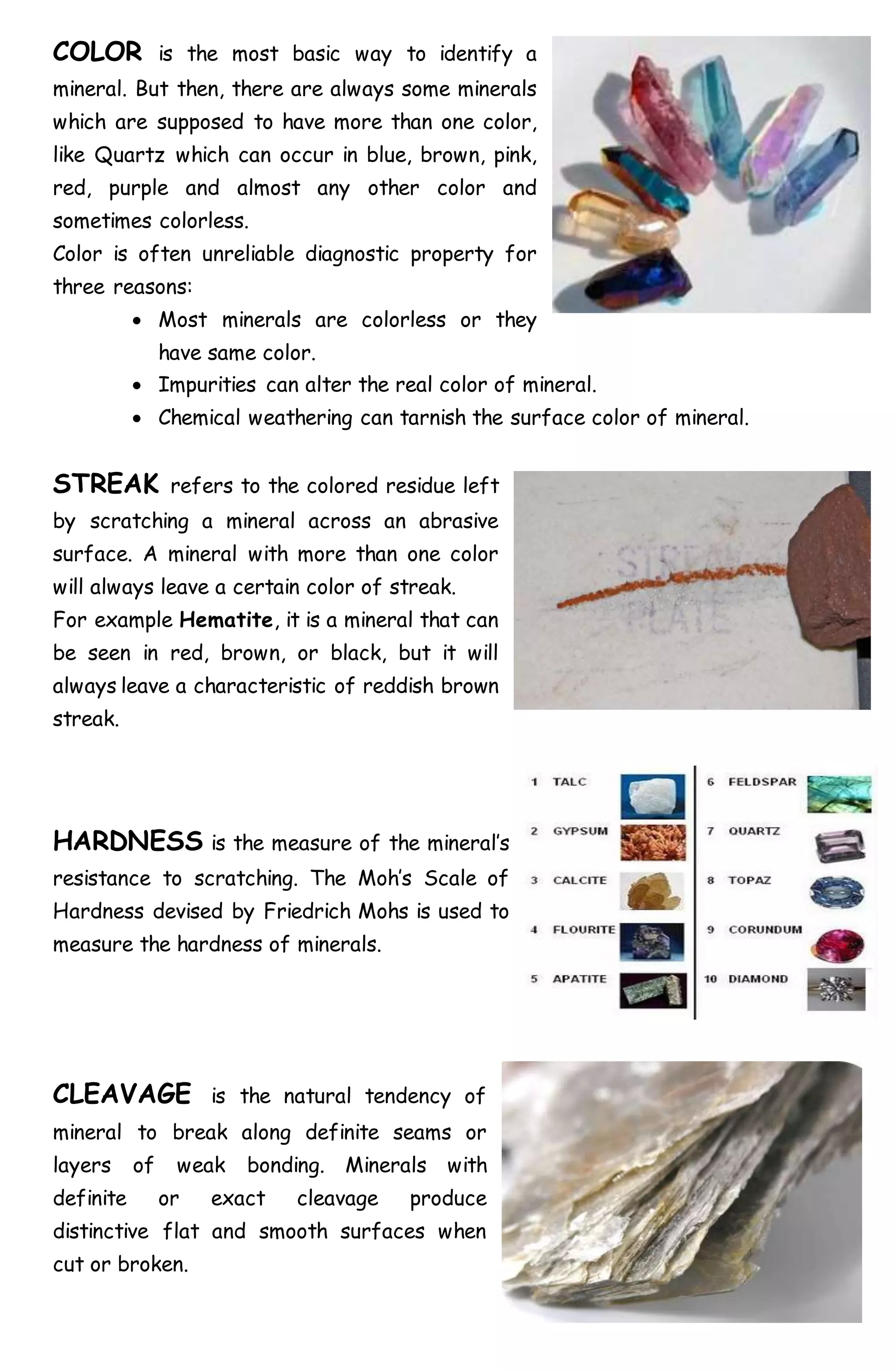
COLOR is the most basic way to identify a
mineral. But then, there are always some minerals
which are supposed to have more than one color,
like Quartz which can occur in blue, brown, pink,
red, purple and almost any other color and
sometimes colorless.
Color is often unreliable diagnostic property for
three reasons:
 Most minerals are colorless or they
have same color.
 Impurities can alter the real color of mineral.
 Chemical weathering can tarnish the surface color of mineral.
STREAK refers to the colored residue left
by scratching a mineral across an abrasive
surface. A mineral with more than one color
will always leave a certain color of streak.
For example Hematite, it is a mineral that can
be seen in red, brown, or black, but it will
always leave a characteristic of reddish brown
streak.
HARDNESS is the measure of the mineral’s
resistance to scratching. The Moh’s Scale of
Hardness devised by Friedrich Mohs is used to
measure the hardness of minerals.
CLEAVAGE is the natural tendency of
mineral to break along definite seams or
layers of weak bonding. Minerals with
definite or exact cleavage produce
distinctive flat and smooth surfaces when
cut or broken.
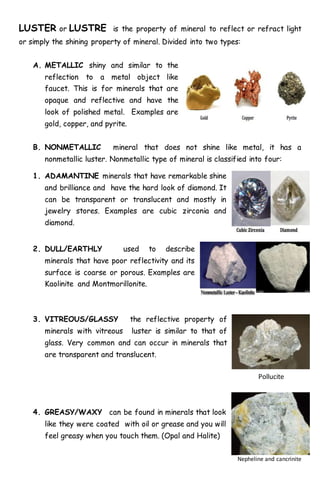
LUSTER or LUSTRE is the property of mineral to reflect or refract light
or simply the shining property of mineral. Divided into two types:
A. METALLIC shiny and similar to the
reflection to a metal object like
faucet. This is for minerals that are
opaque and reflective and have the
look of polished metal. Examples are
gold, copper, and pyrite.
B. NONMETALLIC mineral that does not shine like metal, it has a
nonmetallic luster. Nonmetallic type of mineral is classified into four:
1. ADAMANTINE minerals that have remarkable shine
and brilliance and have the hard look of diamond. It
can be transparent or translucent and mostly in
jewelry stores. Examples are cubic zirconia and
diamond.
2. DULL/EARTHLY used to describe
minerals that have poor reflectivity and its
surface is coarse or porous. Examples are
Kaolinite and Montmorillonite.
3. VITREOUS/GLASSY the reflective property of
minerals with vitreous luster is similar to that of
glass. Very common and can occur in minerals that
are transparent and translucent.
4. GREASY/WAXY can be found in minerals that look
like they were coated with oil or grease and you will
feel greasy when you touch them. (Opal and Halite)
Nepheline and cancrinite
Pollucite

Identifying Minerals

  • 1.
    COLOR is themost basic way to identify a mineral. But then, there are always some minerals which are supposed to have more than one color, like Quartz which can occur in blue, brown, pink, red, purple and almost any other color and sometimes colorless. Color is often unreliable diagnostic property for three reasons:  Most minerals are colorless or they have same color.  Impurities can alter the real color of mineral.  Chemical weathering can tarnish the surface color of mineral. STREAK refers to the colored residue left by scratching a mineral across an abrasive surface. A mineral with more than one color will always leave a certain color of streak. For example Hematite, it is a mineral that can be seen in red, brown, or black, but it will always leave a characteristic of reddish brown streak. HARDNESS is the measure of the mineral’s resistance to scratching. The Moh’s Scale of Hardness devised by Friedrich Mohs is used to measure the hardness of minerals. CLEAVAGE is the natural tendency of mineral to break along definite seams or layers of weak bonding. Minerals with definite or exact cleavage produce distinctive flat and smooth surfaces when cut or broken.
  • 2.
    LUSTER or LUSTREis the property of mineral to reflect or refract light or simply the shining property of mineral. Divided into two types: A. METALLIC shiny and similar to the reflection to a metal object like faucet. This is for minerals that are opaque and reflective and have the look of polished metal. Examples are gold, copper, and pyrite. B. NONMETALLIC mineral that does not shine like metal, it has a nonmetallic luster. Nonmetallic type of mineral is classified into four: 1. ADAMANTINE minerals that have remarkable shine and brilliance and have the hard look of diamond. It can be transparent or translucent and mostly in jewelry stores. Examples are cubic zirconia and diamond. 2. DULL/EARTHLY used to describe minerals that have poor reflectivity and its surface is coarse or porous. Examples are Kaolinite and Montmorillonite. 3. VITREOUS/GLASSY the reflective property of minerals with vitreous luster is similar to that of glass. Very common and can occur in minerals that are transparent and translucent. 4. GREASY/WAXY can be found in minerals that look like they were coated with oil or grease and you will feel greasy when you touch them. (Opal and Halite) Nepheline and cancrinite Pollucite