February 18, 2016
‘CLIMATE vs.
WEATHER”
CLIMATE WEATHER
WEATHER is the state of the
atmosphere at a given time and
place with regard to temperature,
air pressure, humidity, wind,
cloudiness, and precipitation. The
term weather is restricted to
conditions over short periods of
time; conditions over long periods
are referred to as climate.
CLIMATE is the common,
average weather conditions at
a particular place over a long
period of time. We learn about
different climates around the
world. Deserts have a hot and
dry climate while the Antarctic
has a very cold and dry climate.
METEOROLOGY is the study of weather.
CLIMATOLOGY is the study of climate.
TEMPERATURE is a measure of the degree of
hotness of the air. It is generally highest in
the tropics and lowest near the poles. It’s the
measure of how cold or hot somewhere is.
What are the
WEATHER
INSTRUMENT
S?
WEATHER INSTRUMENTS
WEATHER
INSTRUMENTS
FUNCTIONS/USES
1.
2.
3.
4.
5.
6.
7.
Please take-note of the
uses/functions of the
different weather
instruments.
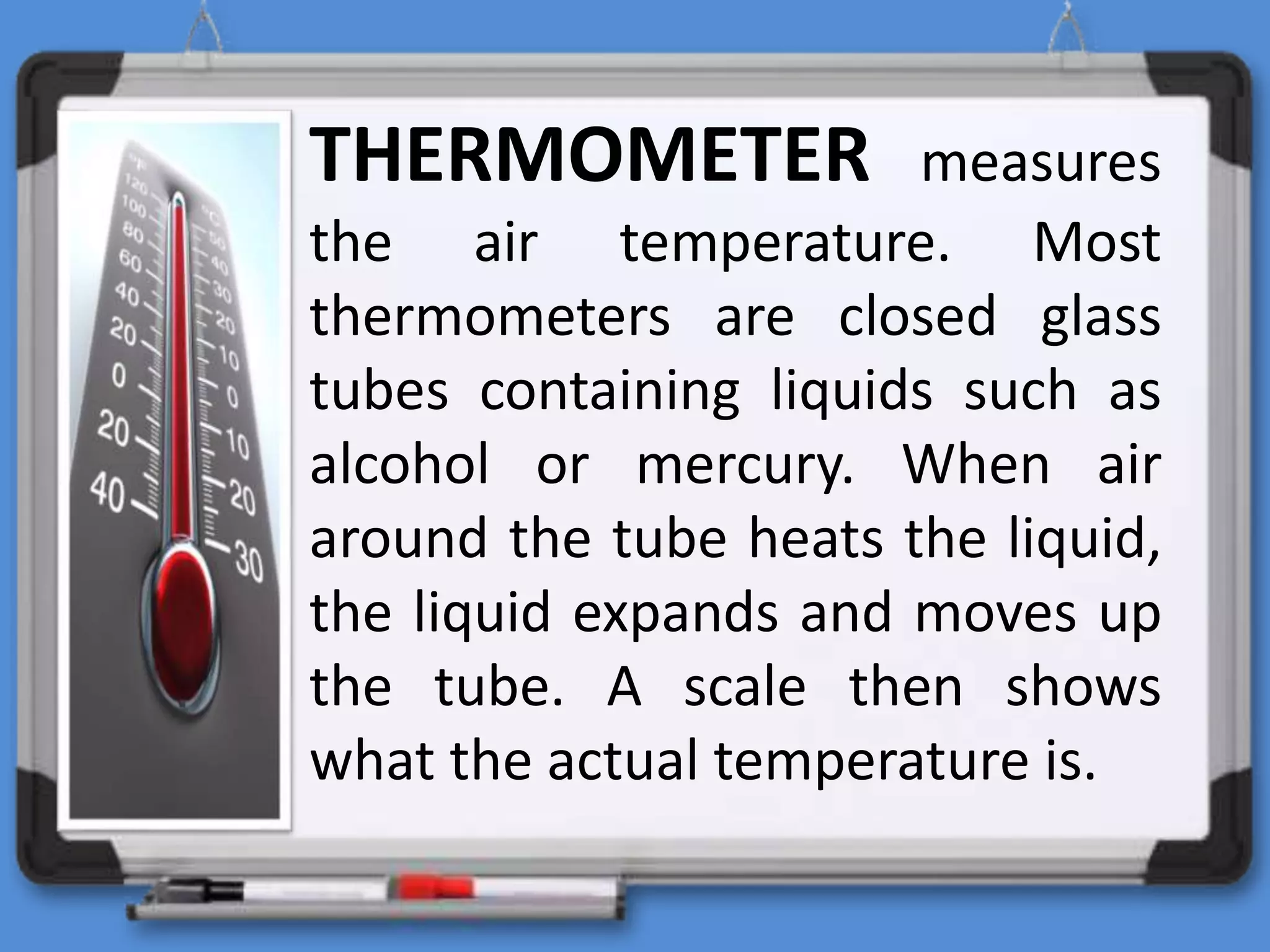
THERMOMETER measures
the air temperature. Most
thermometers are closed glass
tubes containing liquids such as
alcohol or mercury. When air
around the tube heats the liquid,
the liquid expands and moves up
the tube. A scale then shows
what the actual temperature is.
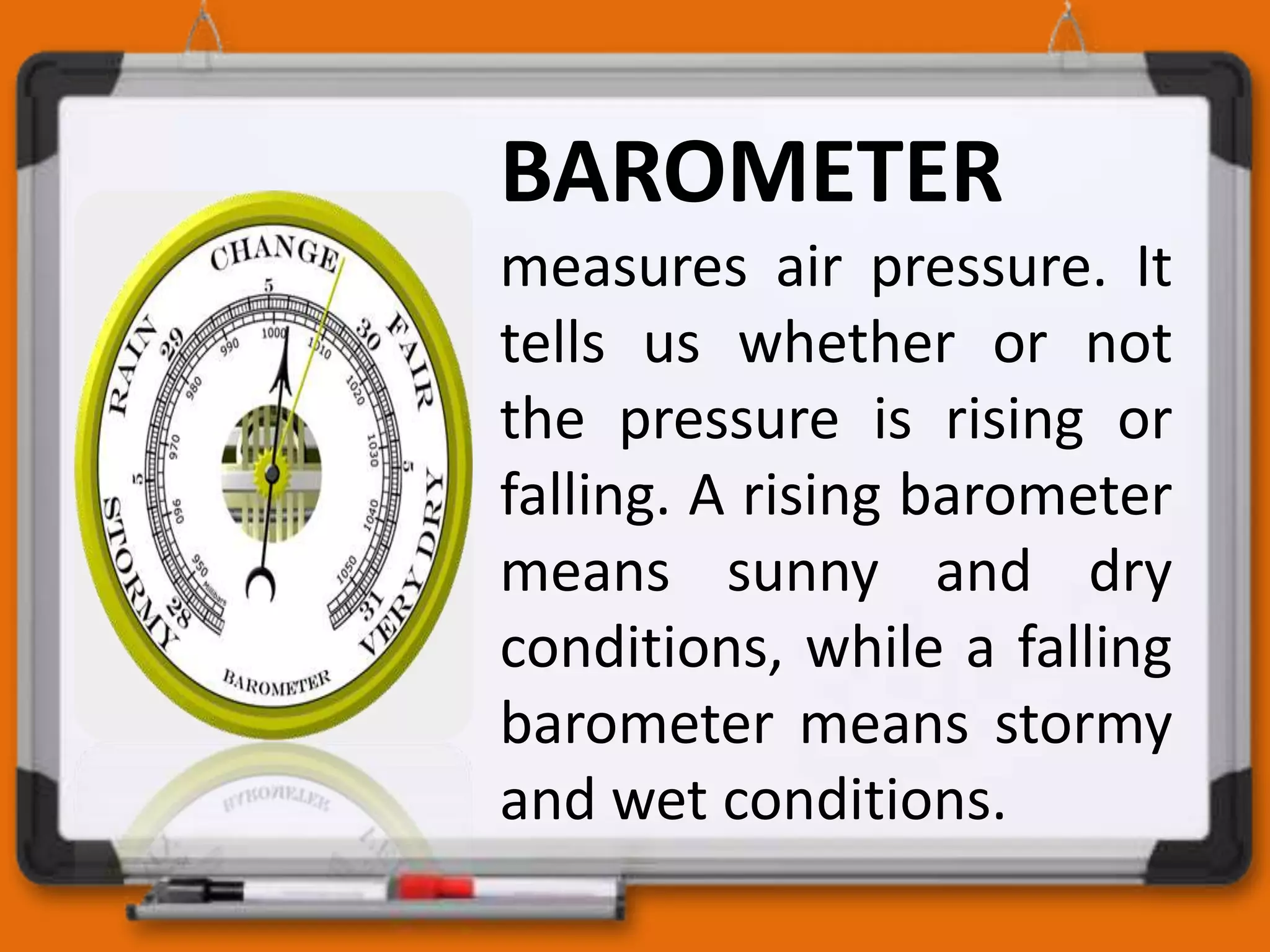
BAROMETER
measures air pressure. It
tells us whether or not
the pressure is rising or
falling. A rising barometer
means sunny and dry
conditions, while a falling
barometer means stormy
and wet conditions.
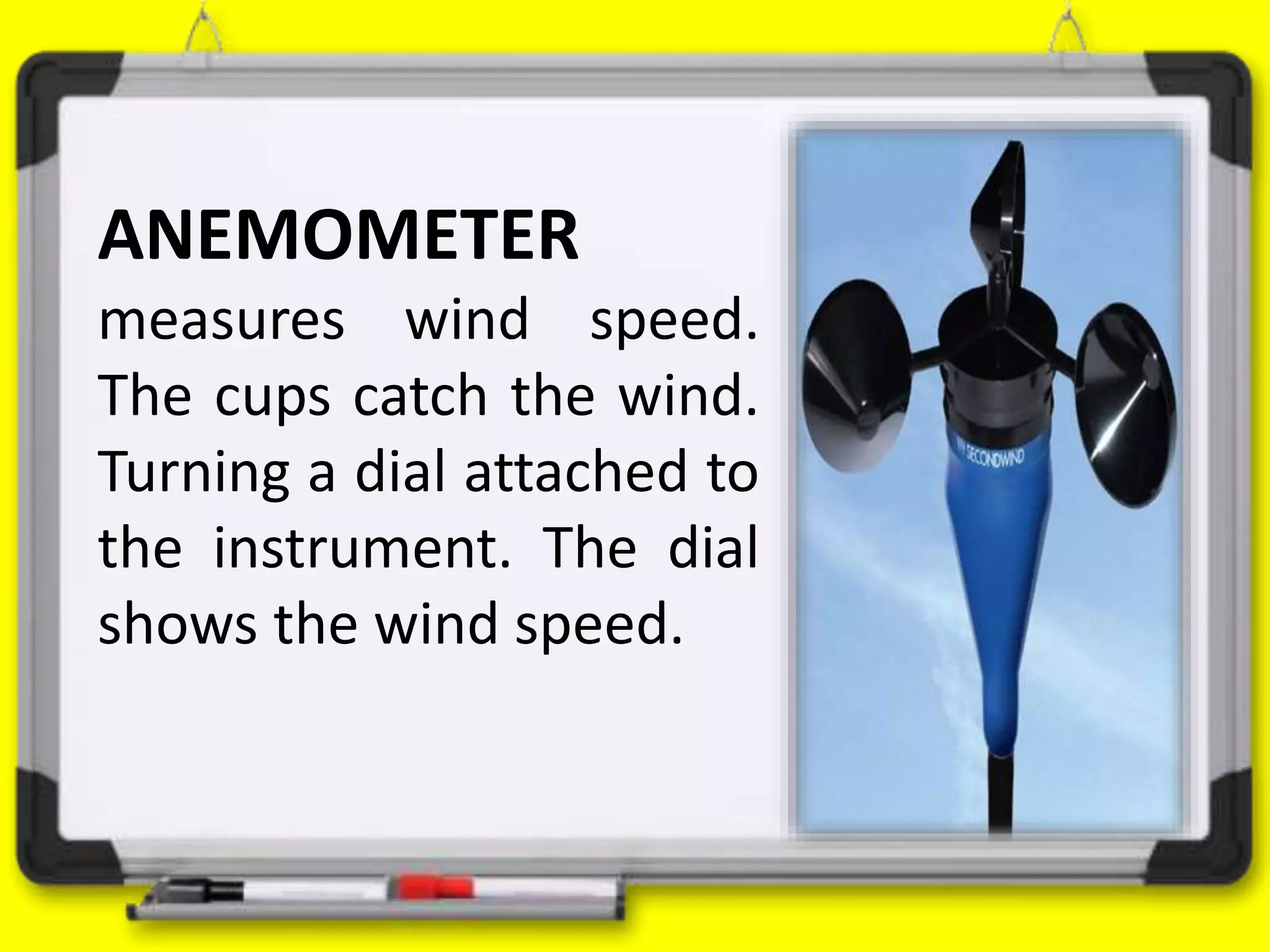
ANEMOMETER
measures wind speed.
The cups catch the wind.
Turning a dial attached to
the instrument. The dial
shows the wind speed.
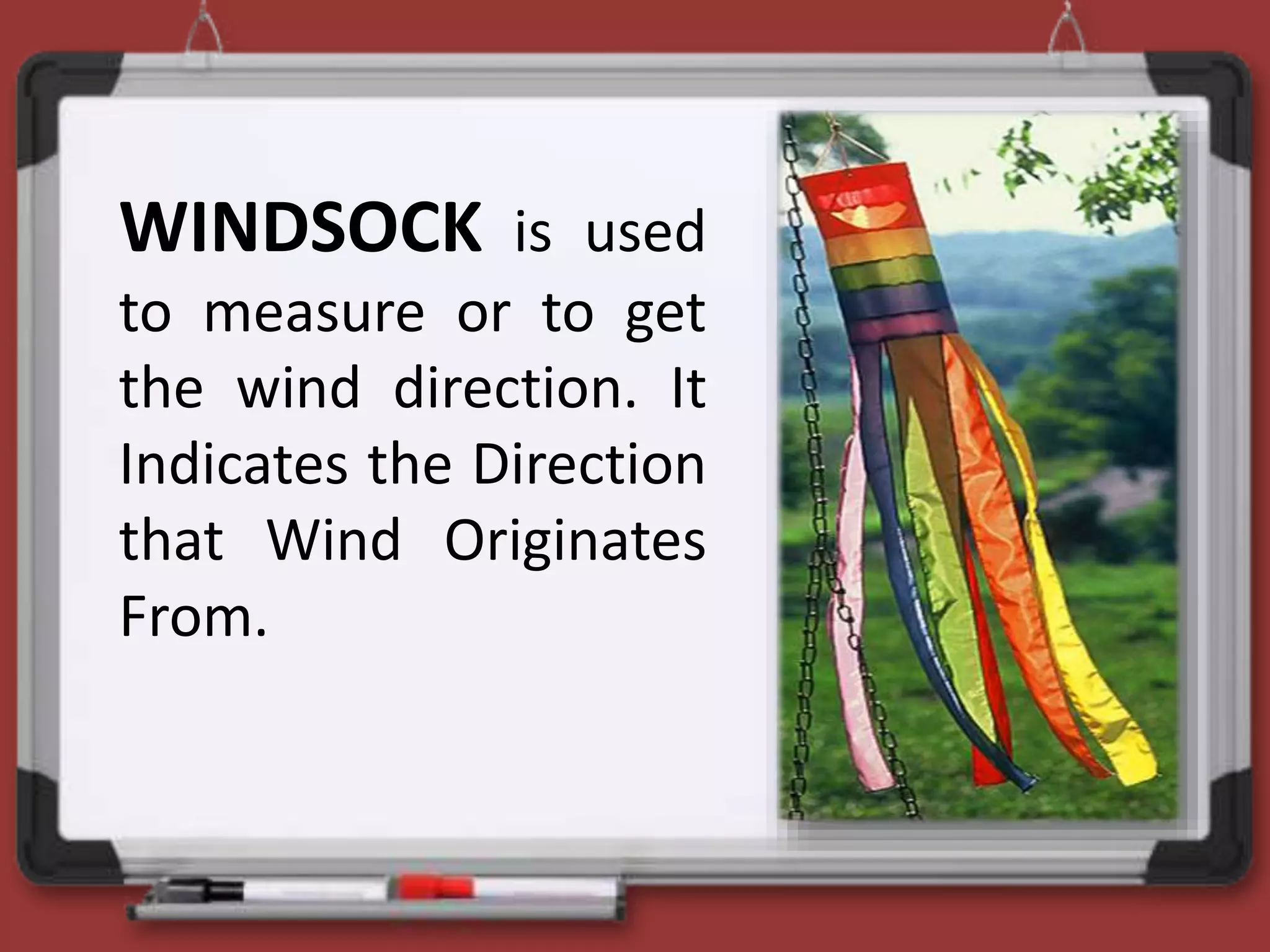
WINDSOCK is used
to measure or to get
the wind direction. It
Indicates the Direction
that Wind Originates
From.
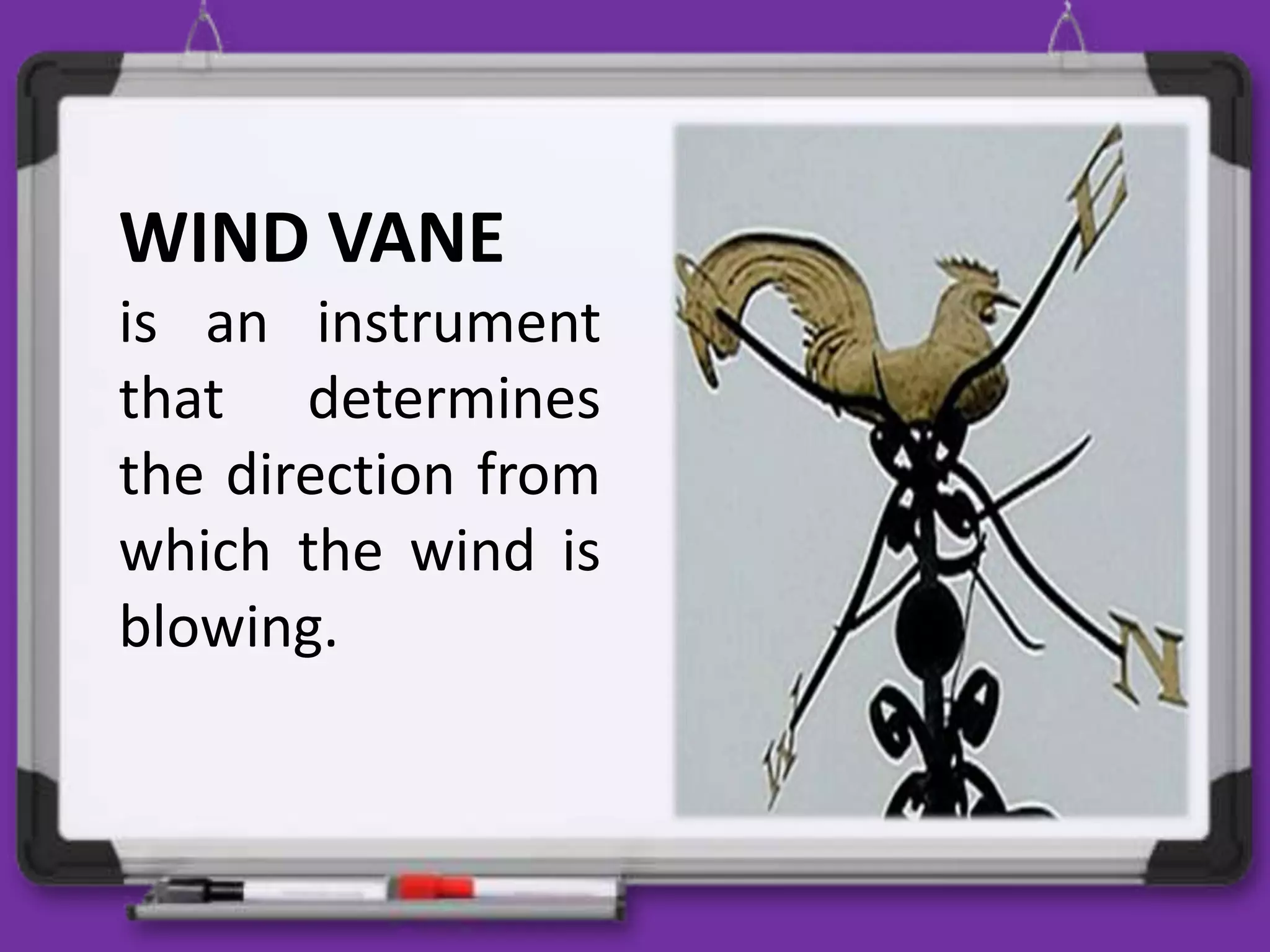
WIND VANE
is an instrument
that determines
the direction from
which the wind is
blowing.
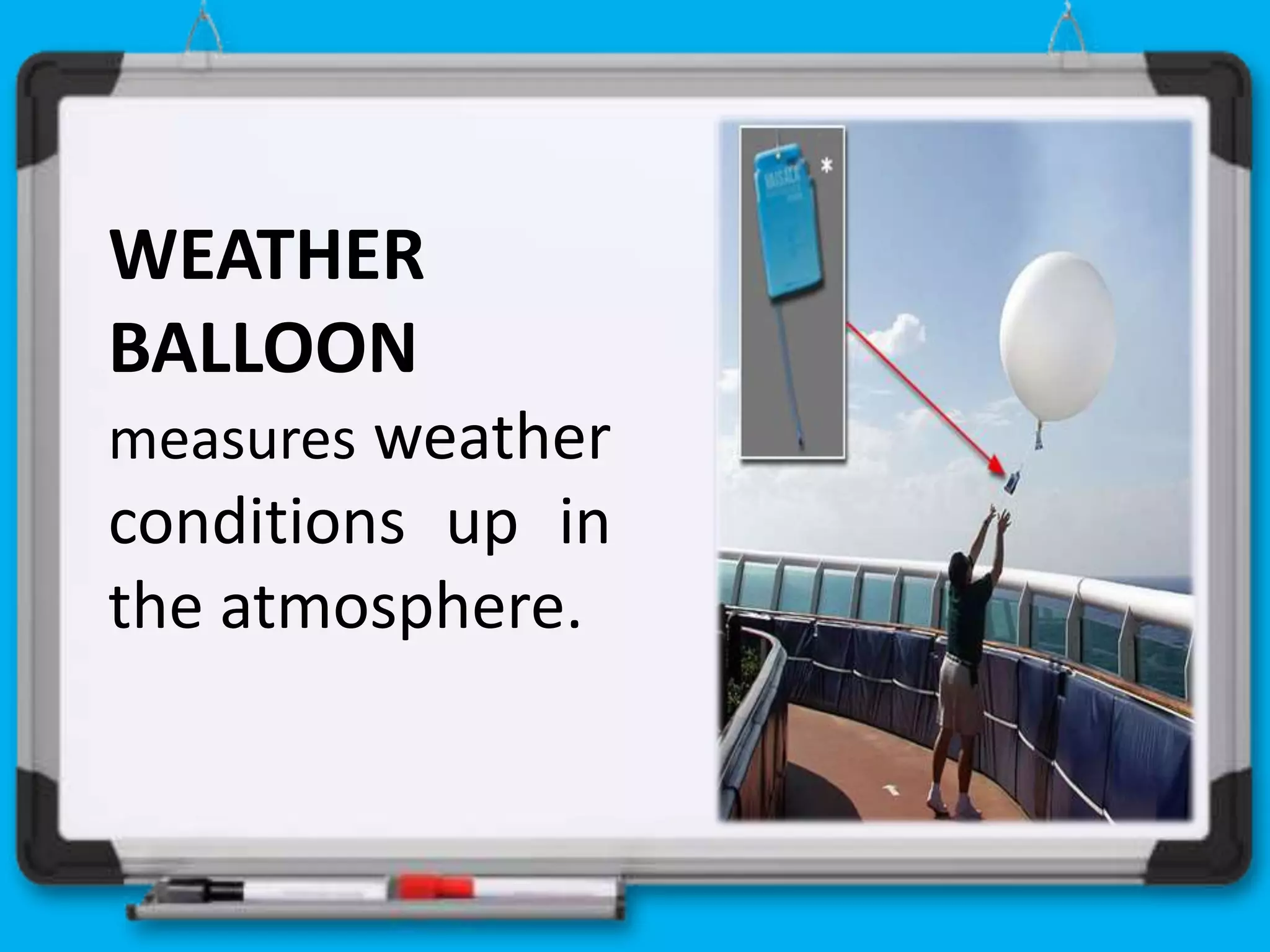
WEATHER
BALLOON
measures weather
conditions up in
the atmosphere.
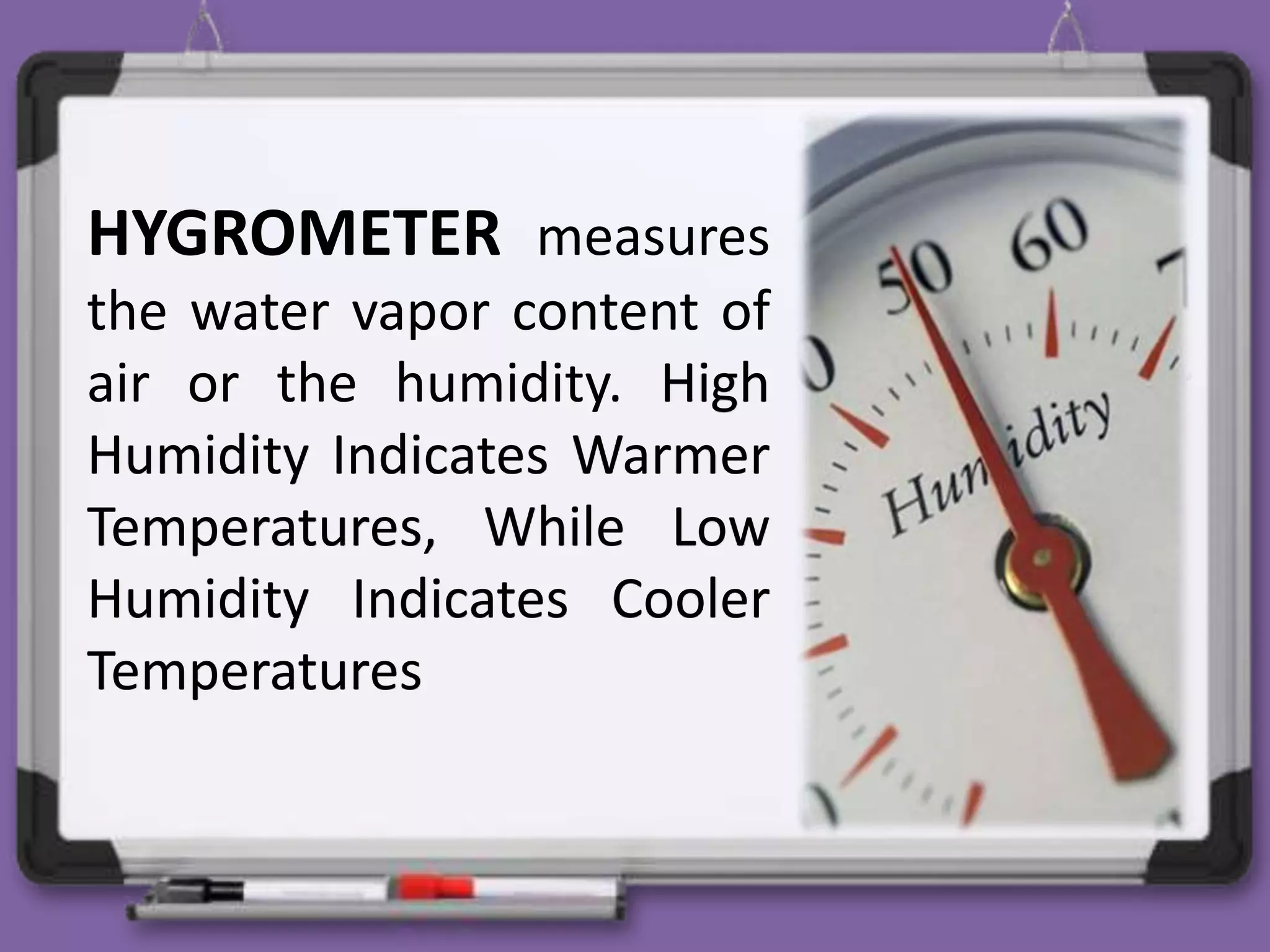
HYGROMETER measures
the water vapor content of
air or the humidity. High
Humidity Indicates Warmer
Temperatures, While Low
Humidity Indicates Cooler
Temperatures
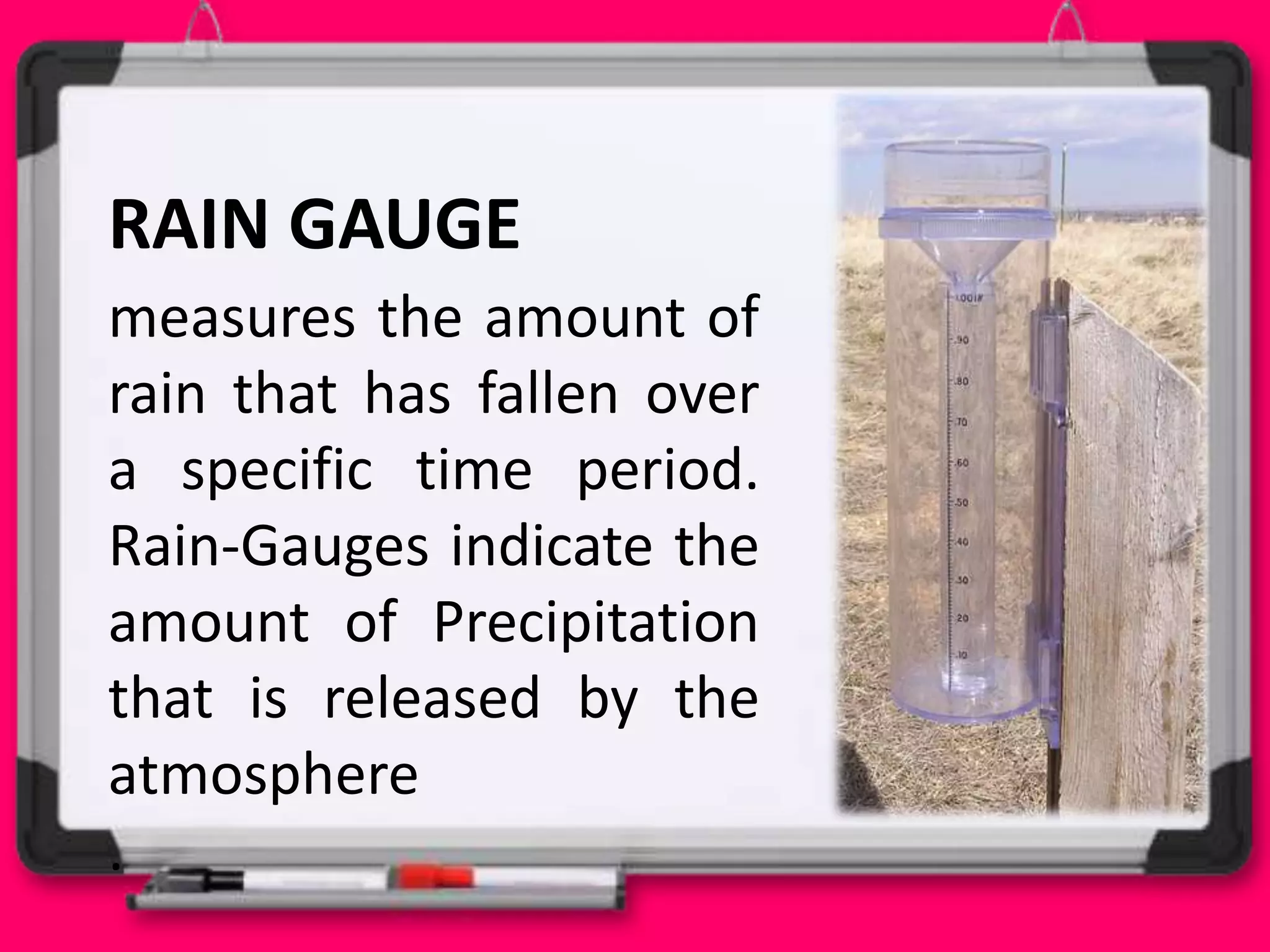
RAIN GAUGE
measures the amount of
rain that has fallen over
a specific time period.
Rain-Gauges indicate the
amount of Precipitation
that is released by the
atmosphere
.
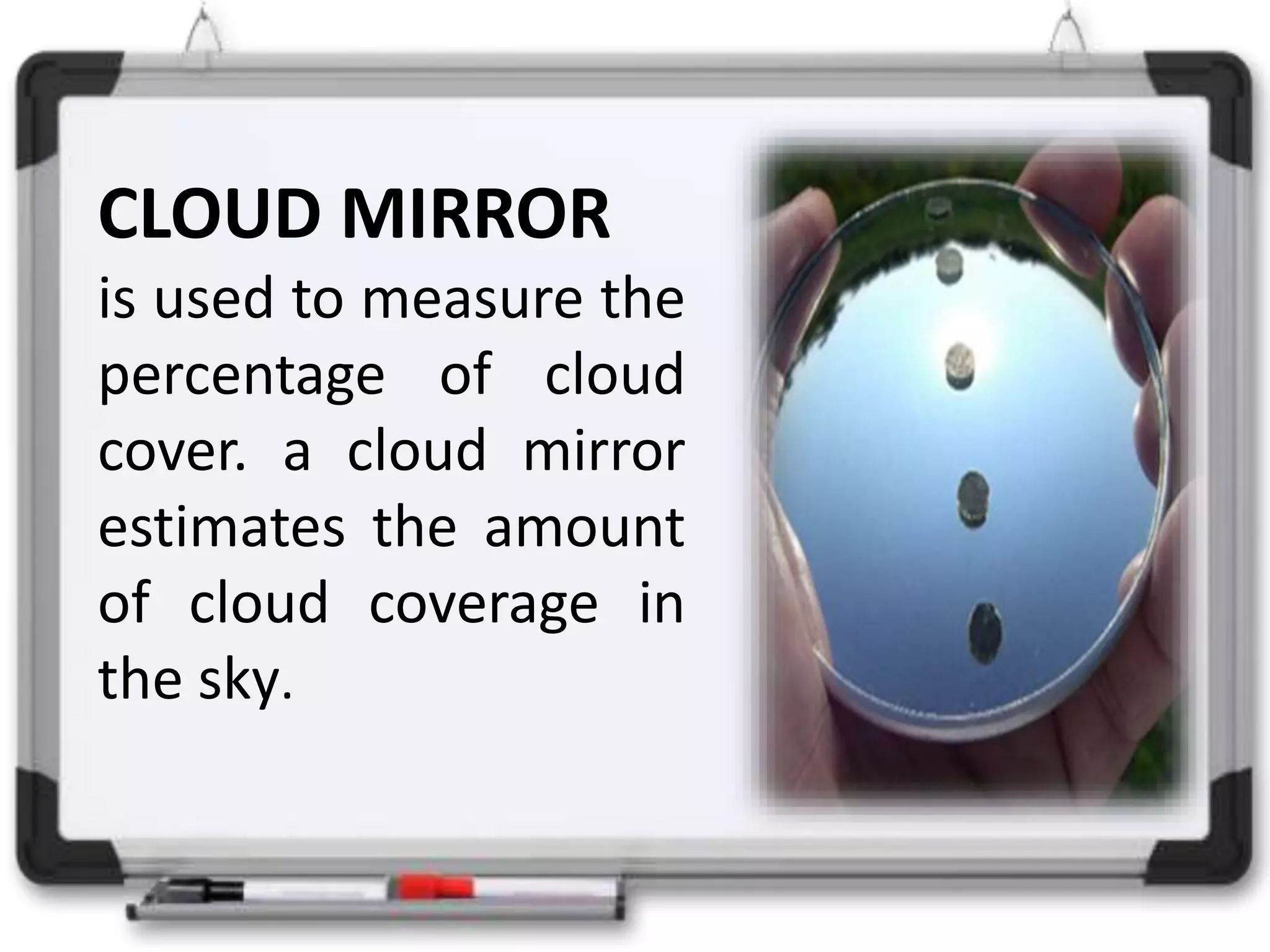
CLOUD MIRROR
is used to measure the
percentage of cloud
cover. a cloud mirror
estimates the amount
of cloud coverage in
the sky.
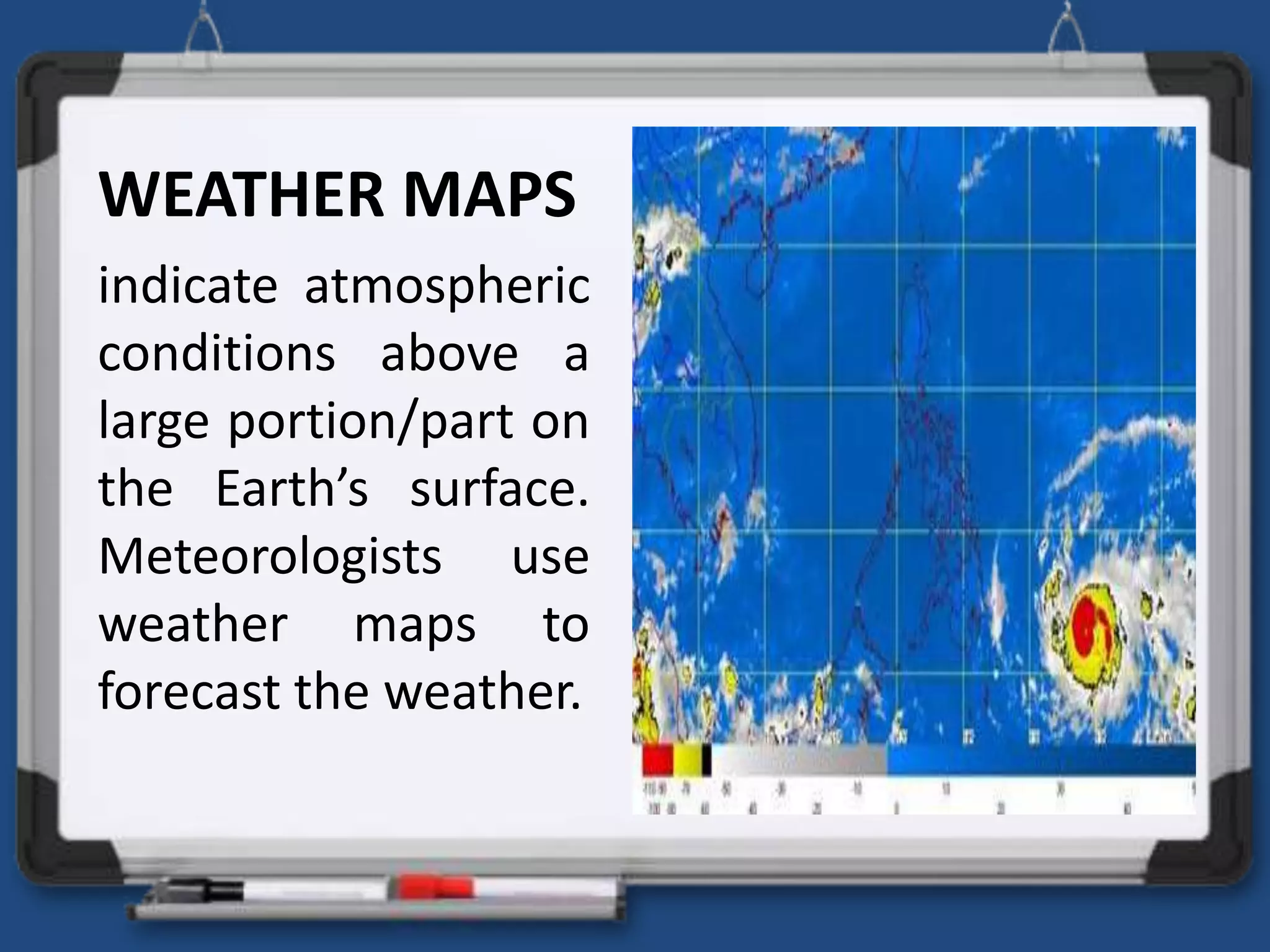
WEATHER MAPS
indicate atmospheric
conditions above a
large portion/part on
the Earth’s surface.
Meteorologists use
weather maps to
forecast the weather.
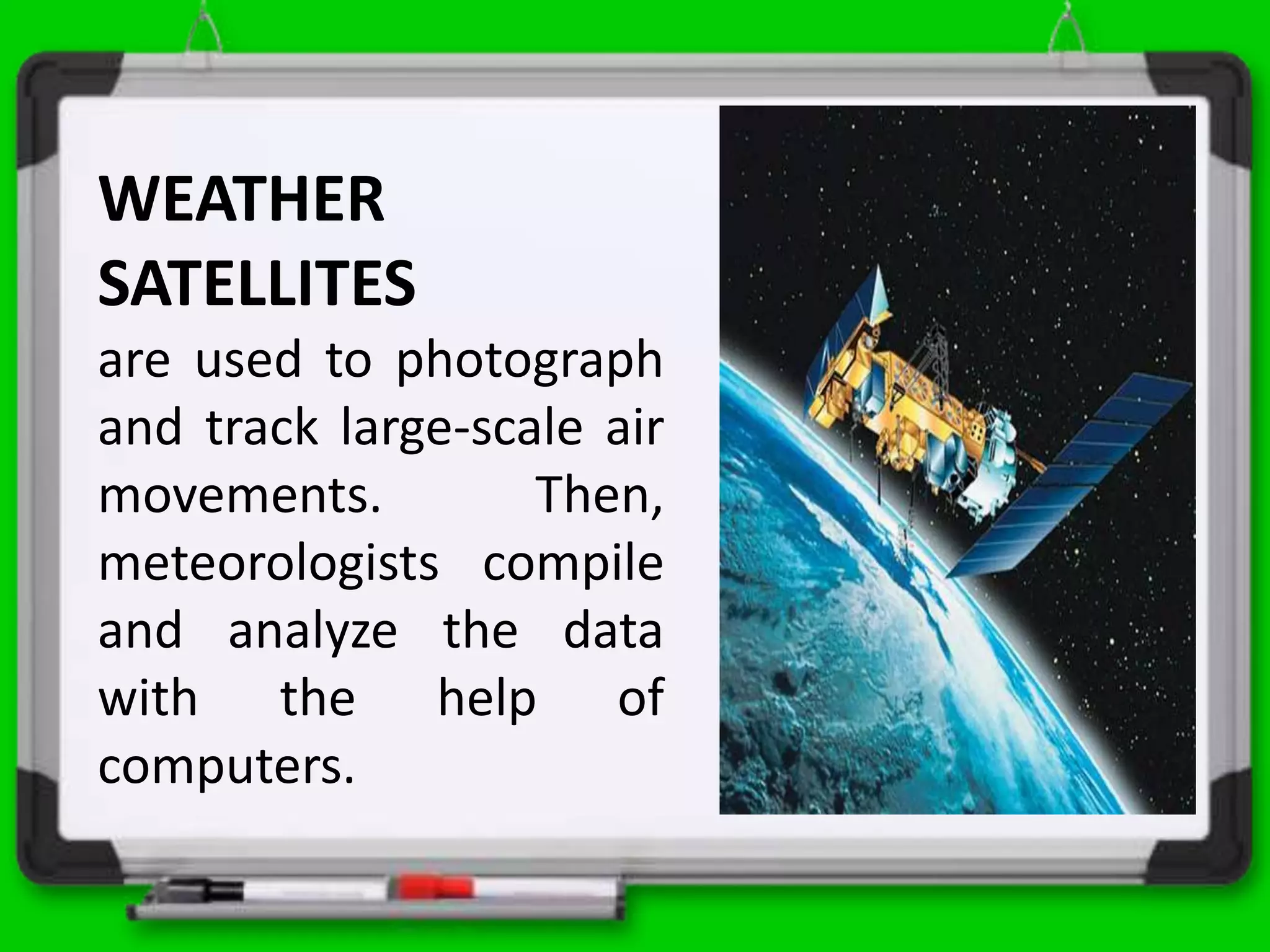
WEATHER
SATELLITES
are used to photograph
and track large-scale air
movements. Then,
meteorologists compile
and analyze the data
with the help of
computers.
OUR EYES. These
are one of the best
ways to help detect
the weather. Keep an
eye at the sky and we’ll
usually be on top of
weather conditions.
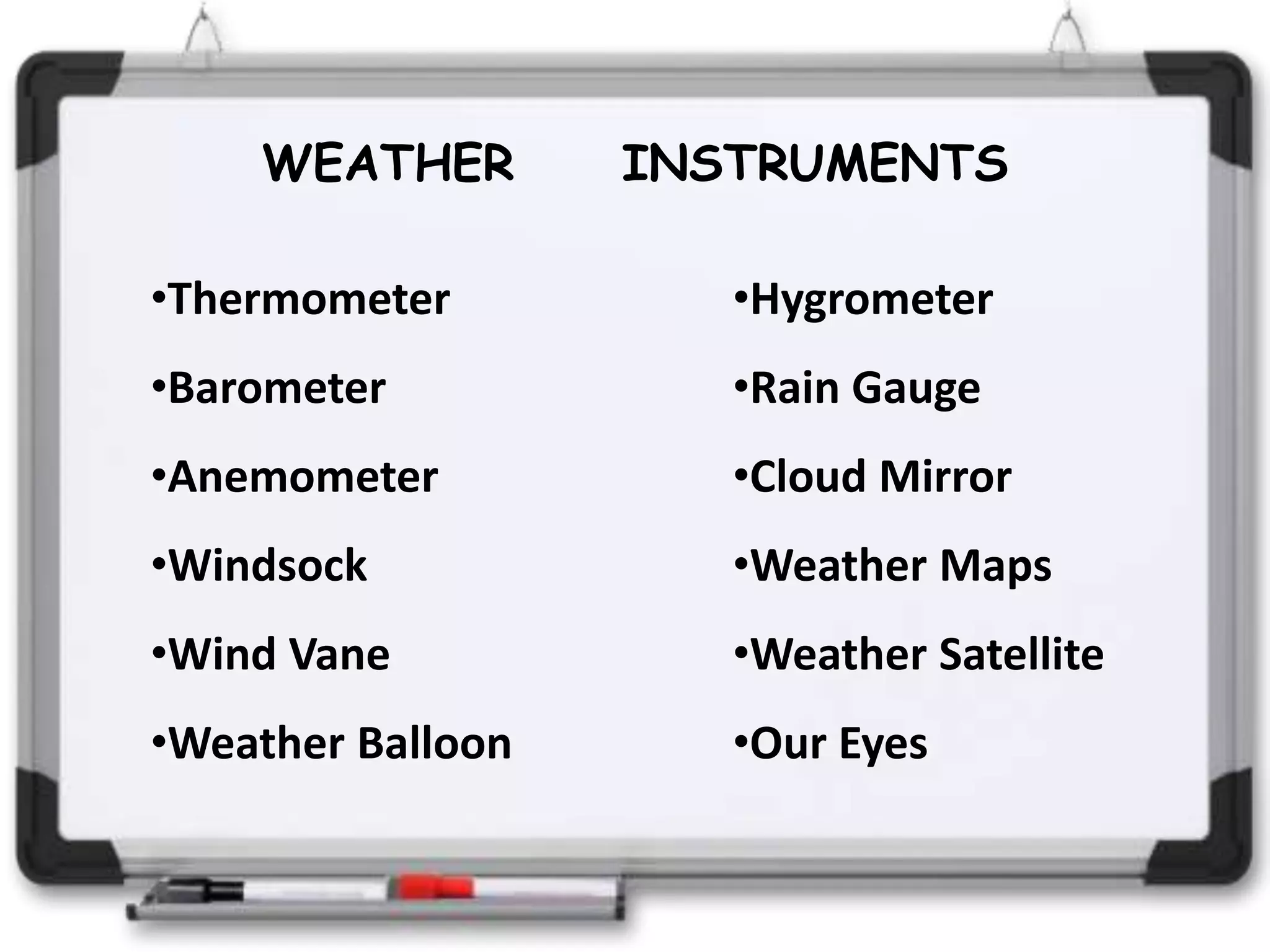
•Thermometer
•Barometer
•Anemometer
•Windsock
•Wind Vane
•Weather Balloon
•Hygrometer
•Rain Gauge
•Cloud Mirror
•Weather Maps
•Weather Satellite
•Our Eyes
WEATHER INSTRUMENTS
WEATHER STATION is the place where all
data about the weather are being gathered
and evaluated. They are also the one who is
responsible in informing the people about the
daily weather condition of the country.
In the Philippines we also have our own
weather station. Do you know what is it?
PHILIPPINE
ATMOSPHERIC
GEOPHYSICAL AND
ASTRONOMICAL
SERVICES
ADMINISTRATION.
PAGASA is a Philippine national institution
dedicated to provide flood and typhoon warnings,
public weather forecasts and advisories,
meteorological, astronomical, climatological, and
other specialized information and services
primarily for the protection of life and property and
in support of economic, productivity and
sustainable development.
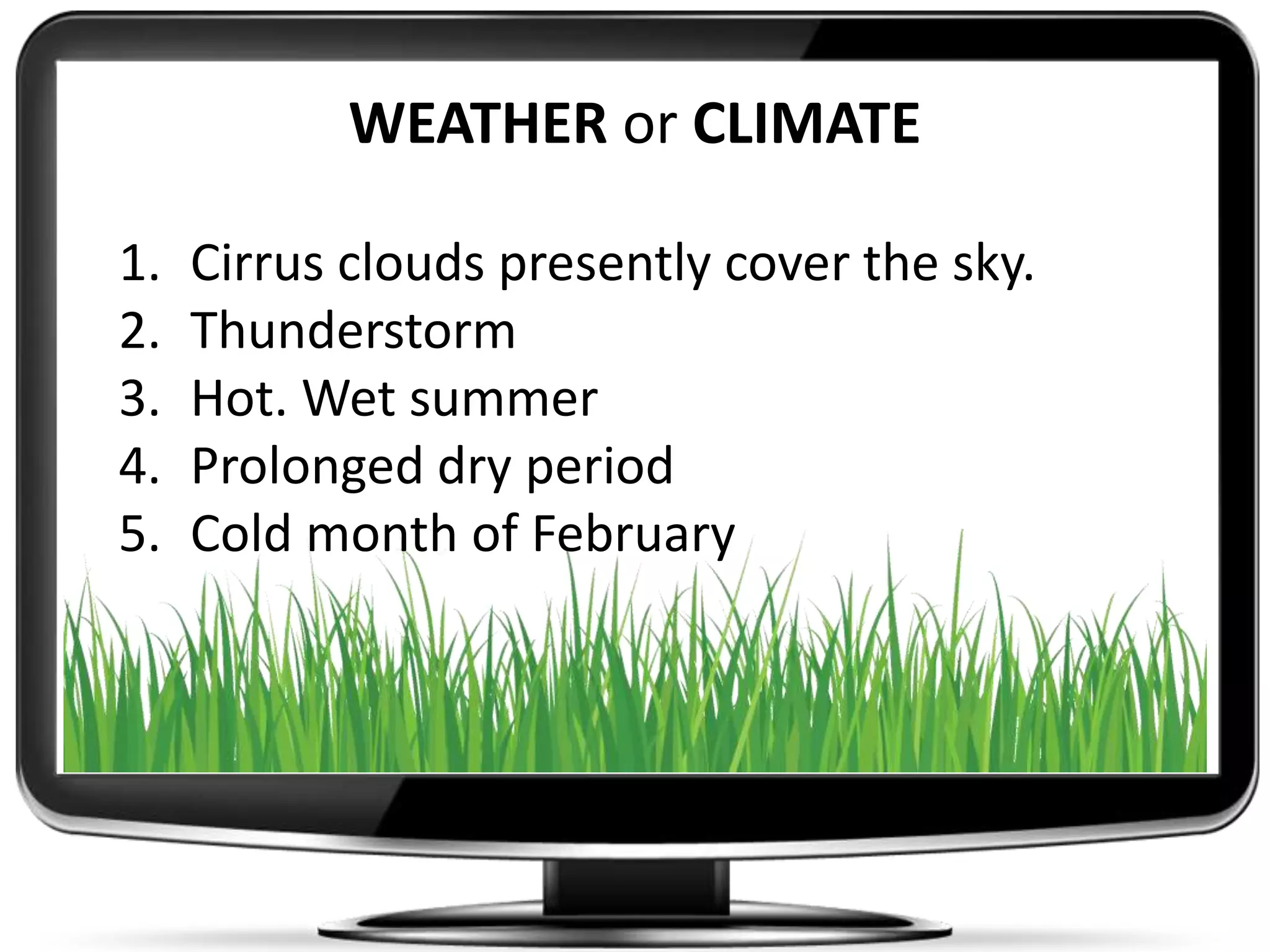
WEATHER or CLIMATE
1. Cirrus clouds presently cover the sky.
2. Thunderstorm
3. Hot. Wet summer
4. Prolonged dry period
5. Cold month of February
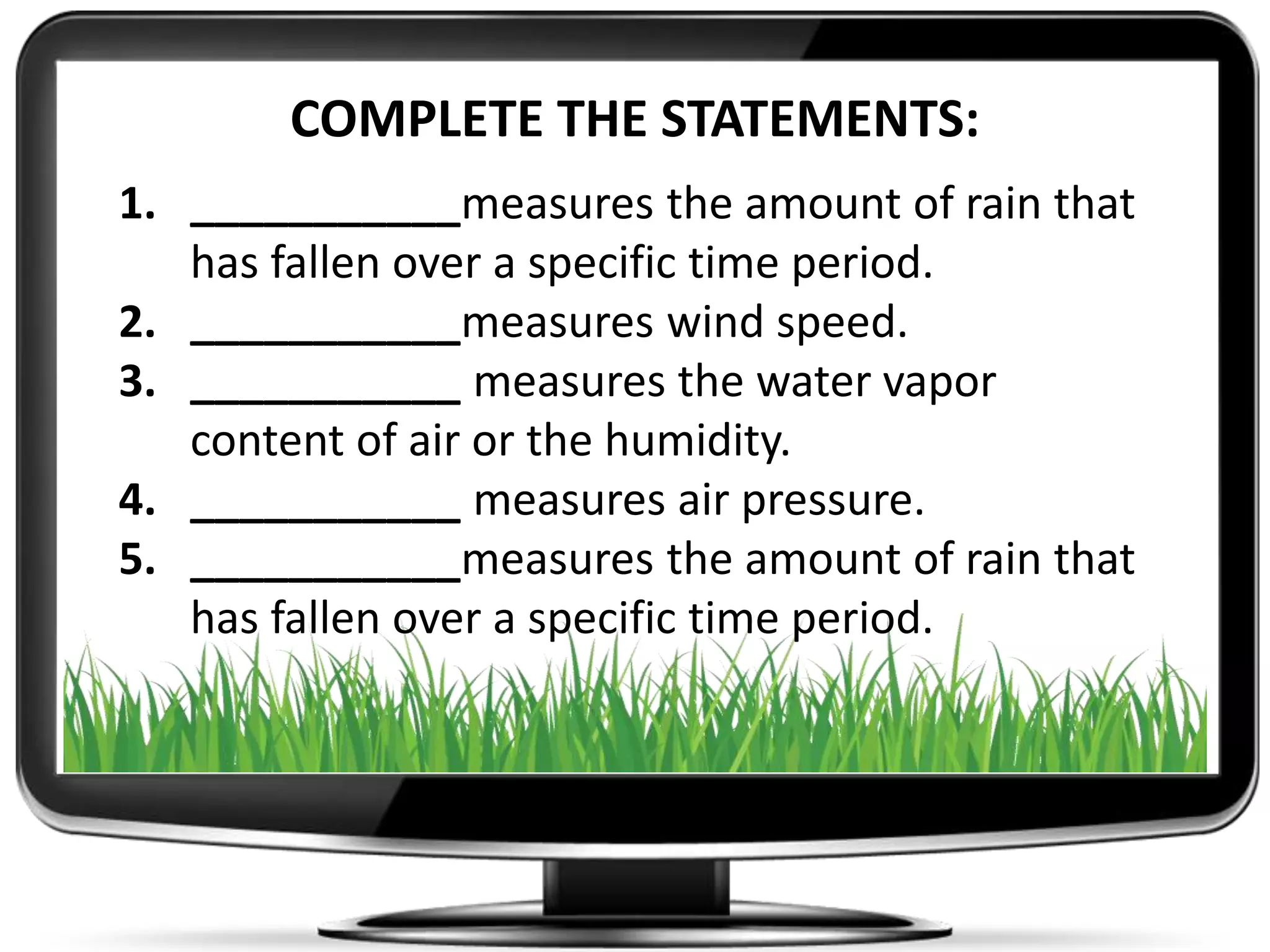
COMPLETE THE STATEMENTS:
1. ___________measures the amount of rain that
has fallen over a specific time period.
2. ___________measures wind speed.
3. ___________ measures the water vapor
content of air or the humidity.
4. ___________ measures air pressure.
5. ___________measures the amount of rain that
has fallen over a specific time period.
Weather and weather instruments (thursday)

Weather and weather instruments (thursday)

  • 2.
    February 18, 2016 ‘CLIMATEvs. WEATHER” CLIMATE WEATHER
  • 3.
    WEATHER is thestate of the atmosphere at a given time and place with regard to temperature, air pressure, humidity, wind, cloudiness, and precipitation. The term weather is restricted to conditions over short periods of time; conditions over long periods are referred to as climate.
  • 4.
    CLIMATE is thecommon, average weather conditions at a particular place over a long period of time. We learn about different climates around the world. Deserts have a hot and dry climate while the Antarctic has a very cold and dry climate.
  • 5.
    METEOROLOGY is thestudy of weather. CLIMATOLOGY is the study of climate.
  • 6.
    TEMPERATURE is ameasure of the degree of hotness of the air. It is generally highest in the tropics and lowest near the poles. It’s the measure of how cold or hot somewhere is.
  • 7.
  • 8.
  • 9.
    THERMOMETER measures the airtemperature. Most thermometers are closed glass tubes containing liquids such as alcohol or mercury. When air around the tube heats the liquid, the liquid expands and moves up the tube. A scale then shows what the actual temperature is.
  • 10.
    BAROMETER measures air pressure.It tells us whether or not the pressure is rising or falling. A rising barometer means sunny and dry conditions, while a falling barometer means stormy and wet conditions.
  • 11.
    ANEMOMETER measures wind speed. Thecups catch the wind. Turning a dial attached to the instrument. The dial shows the wind speed.
  • 12.
    WINDSOCK is used tomeasure or to get the wind direction. It Indicates the Direction that Wind Originates From.
  • 13.
    WIND VANE is aninstrument that determines the direction from which the wind is blowing.
  • 14.
  • 15.
    HYGROMETER measures the watervapor content of air or the humidity. High Humidity Indicates Warmer Temperatures, While Low Humidity Indicates Cooler Temperatures
  • 16.
    RAIN GAUGE measures theamount of rain that has fallen over a specific time period. Rain-Gauges indicate the amount of Precipitation that is released by the atmosphere .
  • 17.
    CLOUD MIRROR is usedto measure the percentage of cloud cover. a cloud mirror estimates the amount of cloud coverage in the sky.
  • 18.
    WEATHER MAPS indicate atmospheric conditionsabove a large portion/part on the Earth’s surface. Meteorologists use weather maps to forecast the weather.
  • 19.
    WEATHER SATELLITES are used tophotograph and track large-scale air movements. Then, meteorologists compile and analyze the data with the help of computers.
  • 20.
    OUR EYES. These areone of the best ways to help detect the weather. Keep an eye at the sky and we’ll usually be on top of weather conditions.
  • 21.
    •Thermometer •Barometer •Anemometer •Windsock •Wind Vane •Weather Balloon •Hygrometer •RainGauge •Cloud Mirror •Weather Maps •Weather Satellite •Our Eyes WEATHER INSTRUMENTS
  • 22.
    WEATHER STATION isthe place where all data about the weather are being gathered and evaluated. They are also the one who is responsible in informing the people about the daily weather condition of the country. In the Philippines we also have our own weather station. Do you know what is it?
  • 23.
  • 24.
    PAGASA is aPhilippine national institution dedicated to provide flood and typhoon warnings, public weather forecasts and advisories, meteorological, astronomical, climatological, and other specialized information and services primarily for the protection of life and property and in support of economic, productivity and sustainable development.
  • 25.
    WEATHER or CLIMATE 1.Cirrus clouds presently cover the sky. 2. Thunderstorm 3. Hot. Wet summer 4. Prolonged dry period 5. Cold month of February
  • 26.
    COMPLETE THE STATEMENTS: 1.___________measures the amount of rain that has fallen over a specific time period. 2. ___________measures wind speed. 3. ___________ measures the water vapor content of air or the humidity. 4. ___________ measures air pressure. 5. ___________measures the amount of rain that has fallen over a specific time period.