Biology Midterm Review
You do not have to write the questions down as I will post this on  www.slideshare.com  . You should write down the number of the question and try to answer each question. The correct answer will be provided.
1 1. Molecules of ____________________ inside cells encode information to direct their growth and development .
DNA
2 The study of the interactions of living organisms with one another and with the nonliving part of their environment is called ____________________.
ecology
3 All cells have the same basic ____________________.
structure
4 ____________________ is the sum of all chemical reactions carried out in an organism.
Metabolism
5 To function properly, all living things maintain a constant internal environment through the process of ____________________.
homeostasis
6 Genetic engineers are transplanting plant ____________________ into other plants to create crops that are resistant to frost damage.
genes or DNA
7 Frogs, toads, and salamanders are all examples of ____________________.
amphibians
8 An educated guess, or ____________________, may be tested by experimentation.
hypothesis
9 In a controlled experiment, the ____________________ group is the group that receives some type of experimental treatment.
experimental or  the manipulated
10 A unifying explanation for a broad range of observations is a(n) ____________________.
theory
11 A(n) ____________________ is a group of atoms held together by covalent bonds.
molecule
12 The attraction between oppositely charged ions results in the formation of a(n) ____________________ _______________.
ionic bond
13 Substances with a pH lower than 7 are ____________________.
acidic
14 Long chains of nucleotides are called ____________________ ____________________.
nucleic acids
15 The starting materials for chemical reactions are called ____________________, while the new substances that are formed are called ____________________.
reactants, products
16 The energy needed to start a chemical reaction is called ____________________ ____________________.
activation energy
17 The portion of an enzyme molecule into which a specific substrate can fit is called the ____________________ ____________________.
active site
18 Scientists use ____________________ units when taking measurements.
metric or SI
19 ____________________ is a measure of the clarity of an image.
Resolution
20 While a light microscope uses light to visualize a specimen, electron microscopes use an ____________________ beam and a vacuum chamber.
electron
21 The basic unit of structure and function in an organism is the ____________________.
cell
22 Modern prokaryotes are generally known as ____________________.
bacteria
23 Scientists think that ____________________ cells evolved about 1.5 billion years ago.
eukaryotic
24 A phospholipid is a molecule with a(n) ____________________ head.
polar
25 Rough endoplasmic reticulum has ____________________ embedded on its surface.
ribosomes
26 The ultimate source of energy for all life on Earth is the ____________________.
Sun
27 Organisms that harvest energy from sunlight or inorganic substances in order to make food molecules are called ____________________.
autotrophs
28 When a phosphate group is removed from an ATP molecule, energy is ____________________.
released
29 The electron transport chain produces molecules that temporarily store ____________________ in the cell.
energy
30 The transfer of carbon dioxide to organic compounds is called carbon dioxide ____________________.
fixation
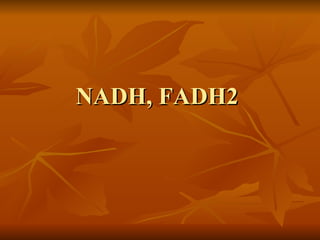
31 Electrons that provide the energy for the production of most of a cell’s ATP are carried to the electron transport chain by ____________________ and ____________________ molecules.
NADH, FADH2
32 Hydrogen ions combine with electrons and oxygen forming ____________________ at the end of the electron transport chain.
water
33 ____________________ ____________________ is the process by which bacteria split asexually into two identical organisms.
Binary fission
34 The DNA in eukaryotic cells is packaged into structures that are called ____________________.
chromosomes
35 In humans, the genotype XX results in a ____________________.
female
36 Somatic cells containing two sets of 23 chromosomes are always ____________________.
diploid
37 The sequence of events that occurs in a cell from one mitotic division to the next is called the ____________________ ____________________.
cell cycle
38 The cell cycle is controlled in eukaryotes at three principal ____________________.
checkpoints
39 “ Cables” made of microtubules that extend from the poles of a cell to the centromeres during cell division are called ____________________ ____________________.
spindle fibers
40 Chromosomes coil up and become visible during ____________________.
prophase
41 After a new nuclear membrane forms during telophase of mitosis or meiosis, the ____________________ divides, resulting in two cells.
cytoplasm
42 The four haploid cells formed in the male at the end of meiosis II develop a tail and are called ____________________.
sperm
43 A spore is a haploid reproductive cell produced by ____________________.
meiosis
44 The diploid phase in the life cycle of plants is called the ____________________.
sporophyte
45 The patterns that Mendel discovered form the basis of ____________________, the branch of biology that deals with heredity.
genetics
46 A(n) ____________________ cross is a cross that involves one pair of contrasting traits.
monohybrid
47 Different forms of a particular gene are called ____________________.
alleles
48 The external appearance of an organism is its ____________________.
phenotype
49 In pea plants, tallness ( T ) is dominant to shortness ( t ). Crosses between plants with these traits can be analyzed using a Punnett square similar to the one shown below. TtT12t34 49. Refer to the illustration on the board. Box 2 and box ____________________ in the Punnett square represent plants that would be heterozygous for the trait for tallness.
3
50 Identifying patterns of inheritance within a family over several generations is possible by studying a diagram called a(n) ____________________.
pedigree
51 A genetic disorder resulting in defective blood clotting is ____________________.
hemophilia
52 Viruses that infect bacteria are called ____________________.
bacteriophages
53 Due to the strict pairing of nitrogen bases in DNA molecules, the two strands are said to be ____________________ to each other.
complementary
54 The circular DNA molecules in prokaryotes usually contain ____________________ replication forks during replication, while linear eukaryotic DNA contains many more.
two
55 The process by which a foreign gene is replicated by insertion into a bacterium is called ____________________ ____________________.
gene cloning
56 A large number of genetically identical cells grown from a single cell are called ____________________.
clones
57 Transferring normal human genes into human cells that lack them is called ____________________ ____________________.
gene therapy
58 Crop plants have recently been developed that are resistant to the chemical ____________________, a powerful weedkiller.
glyphosate
59 Biologists have introduced extra copies of the genes that code for ____________________ ____________________ into the chromosomes of cows and hogs to create leaner, faster-growing animals.
growth hormone
60 The study of radioactive decay in rocks indicates that the Earth is about ____________________ years old.
4.5 billion
61 By determining the number of half-lives that have passed since the formation of a rock containing radioisotopes and their stable daughter elements, scientists are able to determine the approximate ____________________ of the rock.
age
62 Cyanobacteria produced the ____________________ that is now present in our atmosphere.
oxygen
63 Both mitochondria and chloroplasts have their own ____________________.
DNA
64 Having more than one cell is known as ____________________.
multicellularity
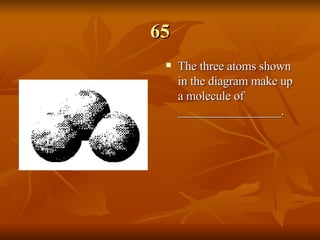
65 The three atoms shown in the diagram make up a molecule of _________________.
ozone
66 Flying insects carry ____________________ from a flowering plant to other flowers of the same species.
pollen
67 Insects developed important relationships with ____________________ plants.
flowering
68 The first vertebrates on land were ____________________.
amphibians
All questions from the test bank on the Holt, Rinehart and Winston CD-ROM,  Teachers Resource. 2001

Biology Midterm Review