TESLA Report 
-A Rare Success Story in EV Industry 
By Nishat 
2014.03.25 
해외영업팀 1
 Contents 
Executive Summary 
Company Overview 
Financial Review 
Corporate Strategy 
Business Overview 
Strategic Positioning 
Business Growth Strategies 
Model & Expansion Plans 
Partnership 
Success Factor of Tesla 
Daesung Scope and Conclusion
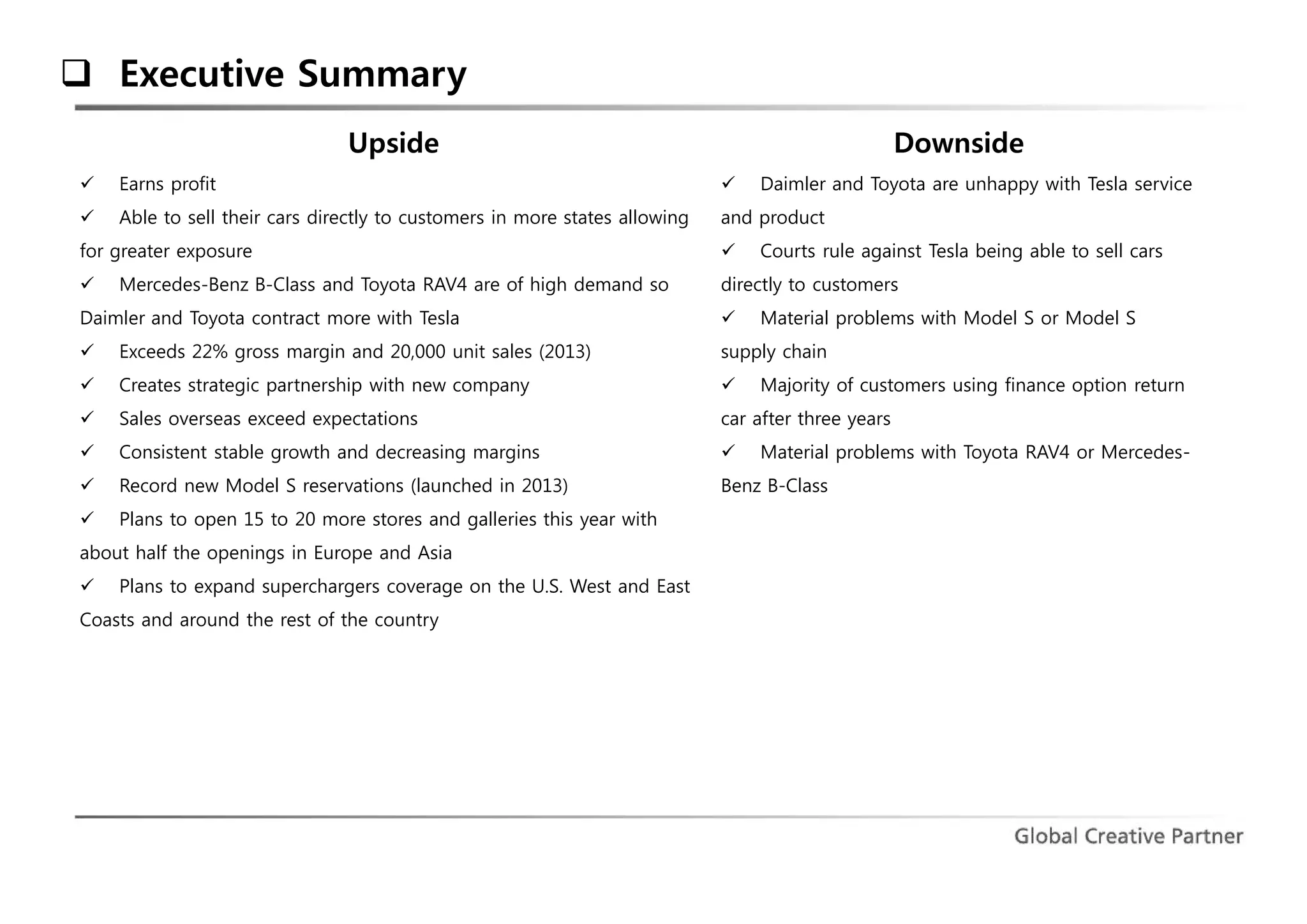
 Executive Summary 
Upside 
 Earns profit 
 Able to sell their cars directly to customers in more states allowing 
for greater exposure 
 Mercedes-Benz B-Class and Toyota RAV4 are of high demand so 
Daimler and Toyota contract more with Tesla 
 Exceeds 22% gross margin and 20,000 unit sales (2013) 
 Creates strategic partnership with new company 
 Sales overseas exceed expectations 
 Consistent stable growth and decreasing margins 
 Record new Model S reservations (launched in 2013) 
 Plans to open 15 to 20 more stores and galleries this year with 
about half the openings in Europe and Asia 
 Plans to expand superchargers coverage on the U.S. West and East 
Coasts and around the rest of the country 
Downside 
 Daimler and Toyota are unhappy with Tesla service 
and product 
 Courts rule against Tesla being able to sell cars 
directly to customers 
 Material problems with Model S or Model S 
supply chain 
 Majority of customers using finance option return 
car after three years 
 Material problems with Toyota RAV4 or Mercedes- 
Benz B-Class
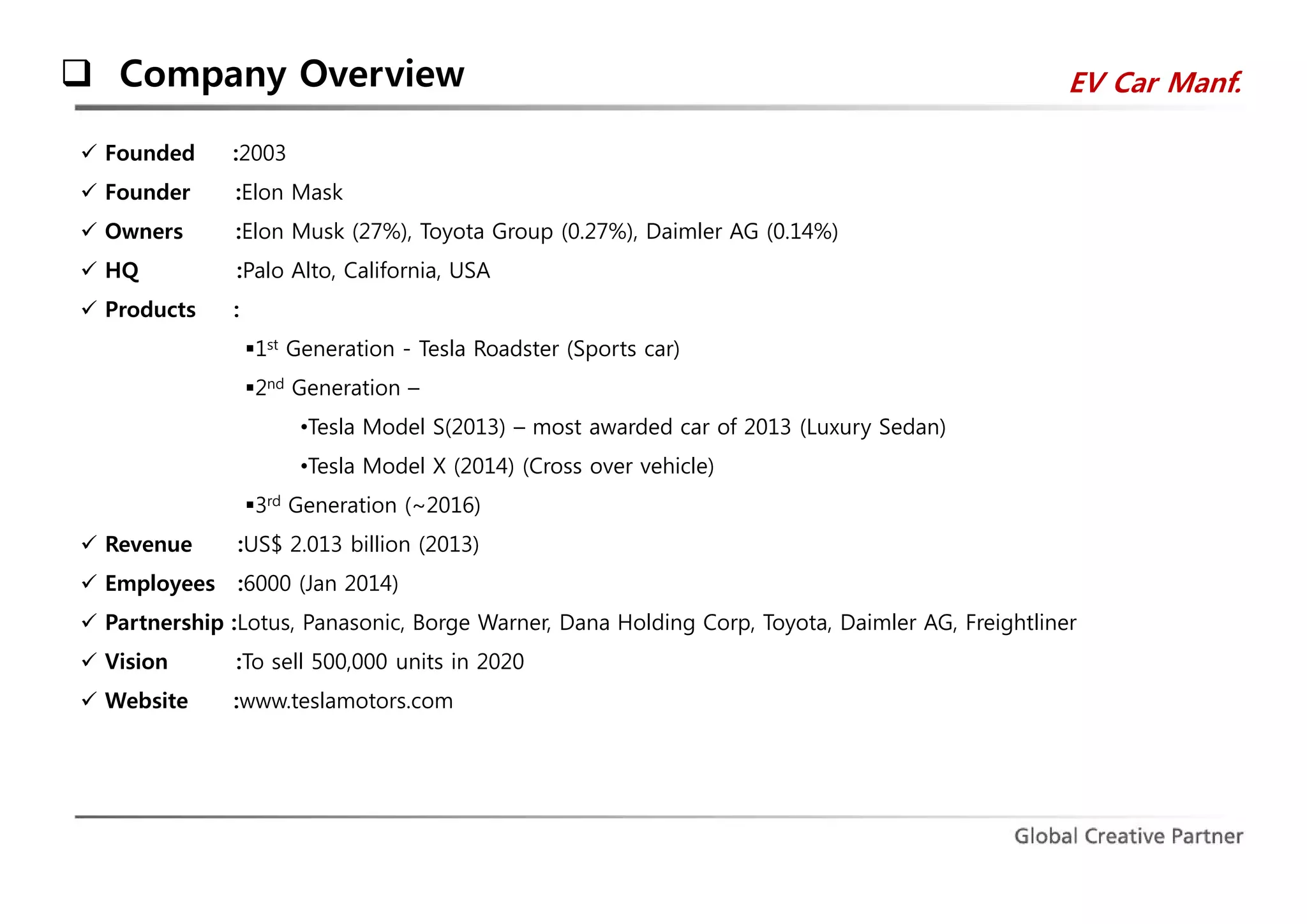
 Company Overview 
 Founded :2003 
 Founder :Elon Mask 
 Owners :Elon Musk (27%), Toyota Group (0.27%), Daimler AG (0.14%) 
 HQ :Palo Alto, California, USA 
 Products : 
1st Generation - Tesla Roadster (Sports car) 
2nd Generation – 
•Tesla Model S(2013) – most awarded car of 2013 (Luxury Sedan) 
•Tesla Model X (2014) (Cross over vehicle) 
3rd Generation (~2016) 
EV Car Manf. 
 Revenue :US$ 2.013 billion (2013) 
 Employees :6000 (Jan 2014) 
 Partnership :Lotus, Panasonic, Borge Warner, Dana Holding Corp, Toyota, Daimler AG, Freightliner 
 Vision :To sell 500,000 units in 2020 
 Website :www.teslamotors.com
 Financial Review 
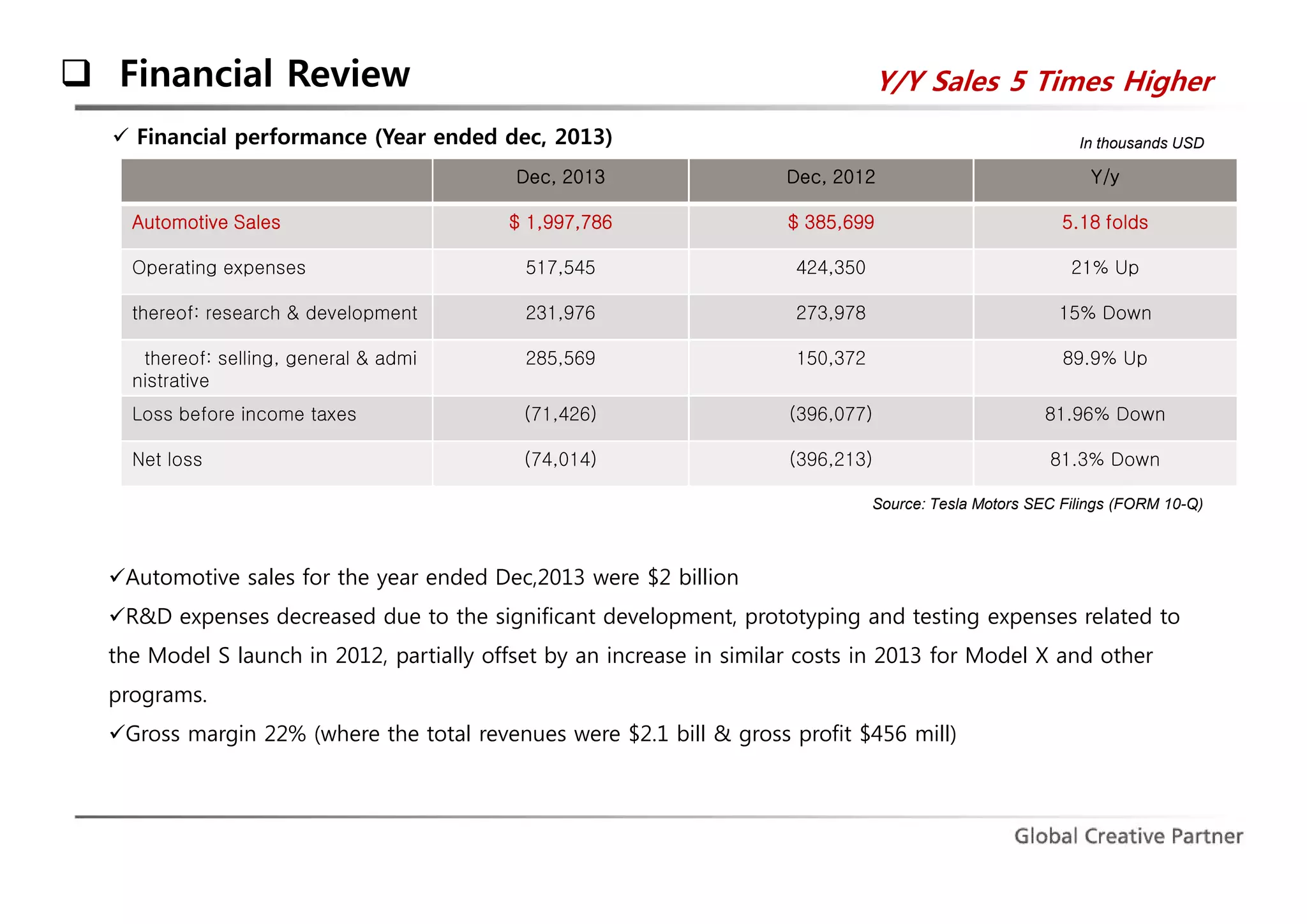
 Financial performance (Year ended dec, 2013) 
Y/Y Sales 5 Times Higher 
In thousands USD 
Dec, 2013 Dec, 2012 Y/y 
Automotive Sales $ 1,997,786 $ 385,699 5.18 folds 
Operating expenses 517,545 424,350 21% Up 
thereof: research & development 231,976 273,978 15% Down 
thereof: selling, general & admi 
nistrative 
285,569 150,372 89.9% Up 
Loss before income taxes (71,426) (396,077) 81.96% Down 
Net loss (74,014) (396,213) 81.3% Down 
Source: Tesla Motors SEC Filings (FORM 10-Q) 
Automotive sales for the year ended Dec,2013 were $2 billion 
R&D expenses decreased due to the significant development, prototyping and testing expenses related to 
the Model S launch in 2012, partially offset by an increase in similar costs in 2013 for Model X and other 
programs. 
Gross margin 22% (where the total revenues were $2.1 bill & gross profit $456 mill)
 Corporate Strategy 
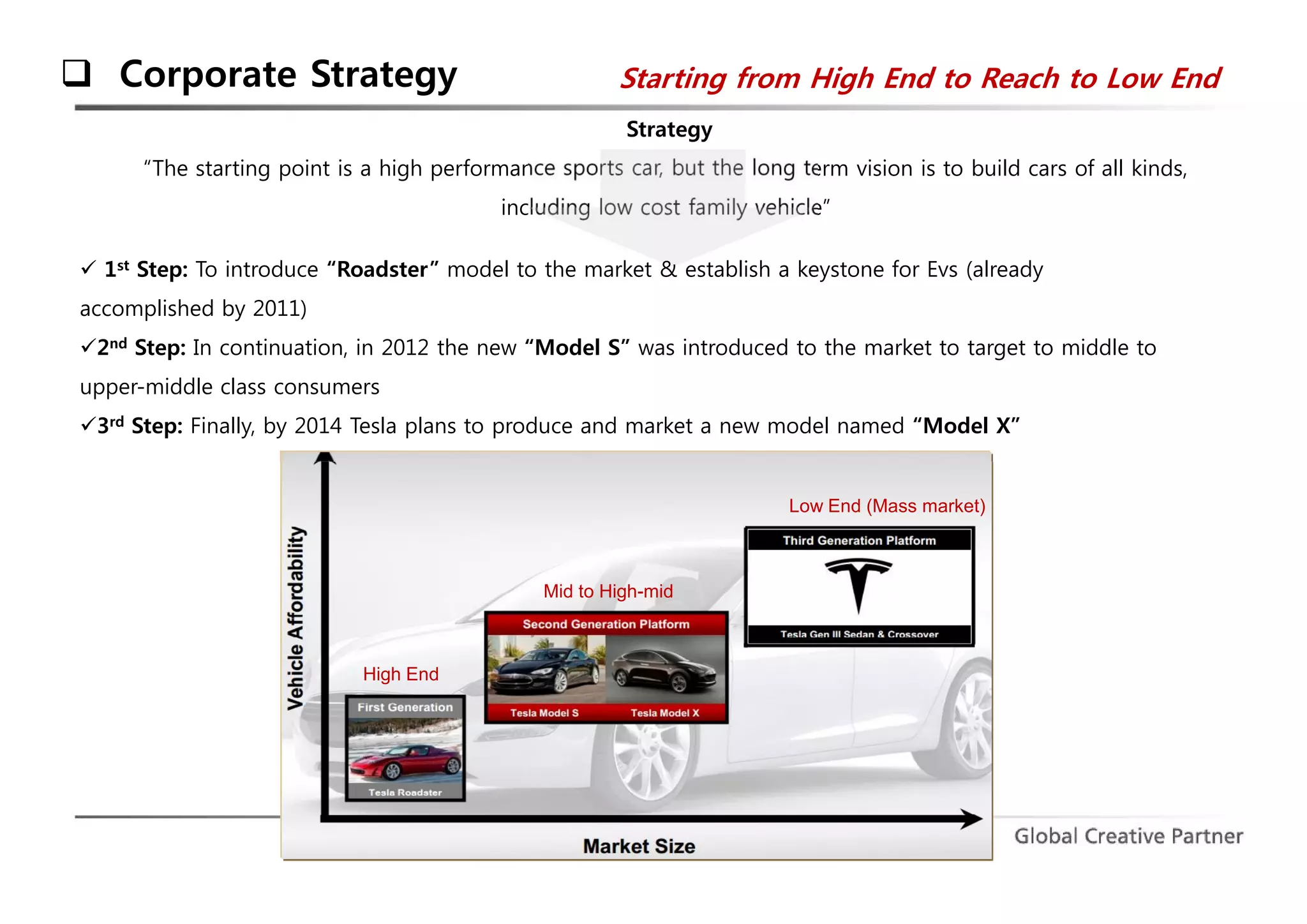
Starting from High End to Reach to Low End 
Strategy 
“The starting point is a high performance sports car, but the long term vision is to build cars of all kinds, 
including low cost family vehicle” 
 1st Step: To introduce “Roadster” model to the market & establish a keystone for Evs (already 
accomplished by 2011) 
2nd Step: In continuation, in 2012 the new “Model S” was introduced to the market to target to middle to 
upper-middle class consumers 
3rd Step: Finally, by 2014 Tesla plans to produce and market a new model named “Model X” 
Low End (Mass market) 
High End 
Mid to High-mid
 Business Overview 
Silicon Valley Based Company 
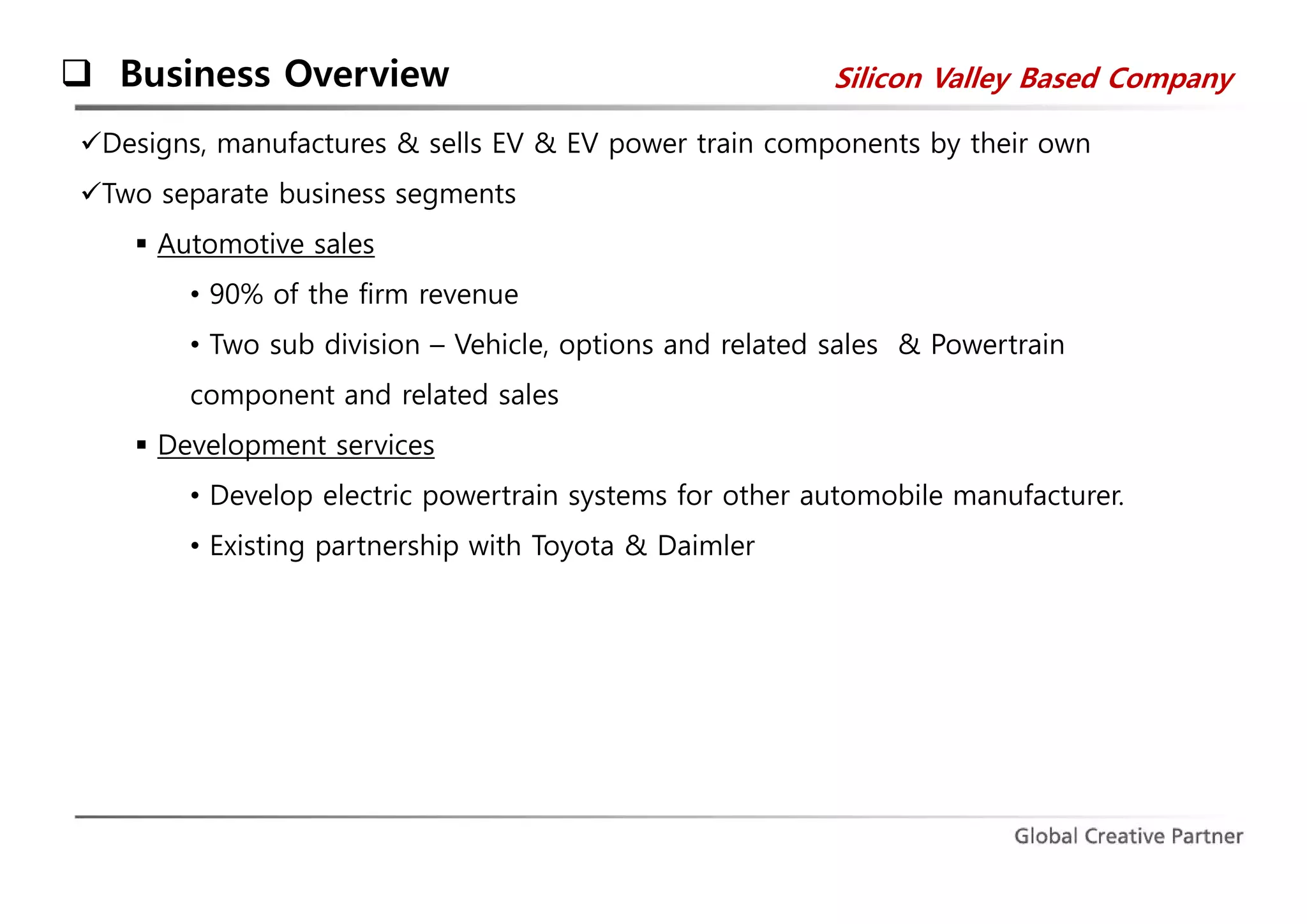
Designs, manufactures & sells EV & EV power train components by their own 
Two separate business segments 
 Automotive sales 
• 90% of the firm revenue 
• Two sub division – Vehicle, options and related sales & Powertrain 
component and related sales 
 Development services 
• Develop electric powertrain systems for other automobile manufacturer. 
• Existing partnership with Toyota & Daimler
 Strategic Positioning 
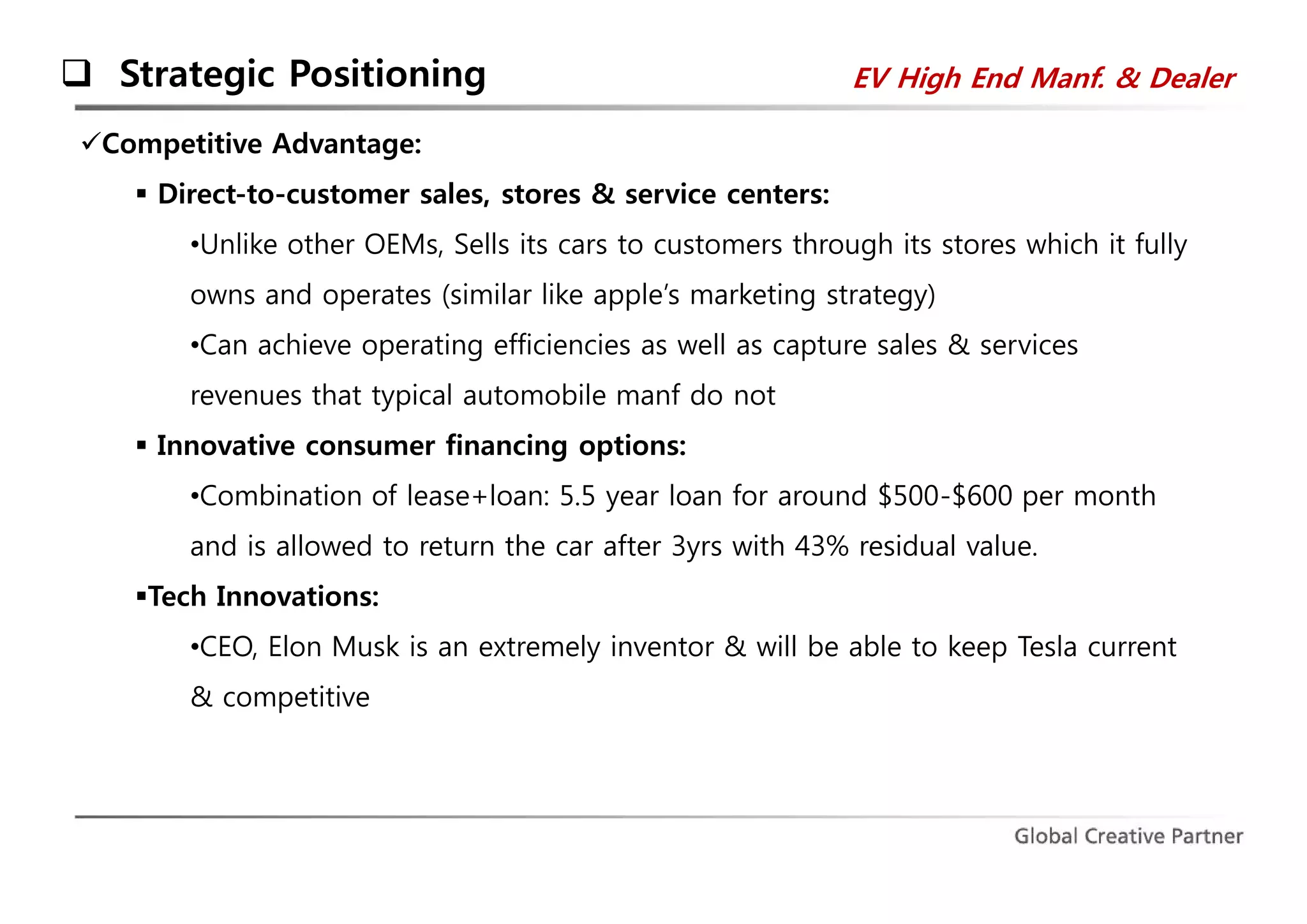
Competitive Advantage: 
 Direct-to-customer sales, stores & service centers: 
EV High End Manf. & Dealer 
•Unlike other OEMs, Sells its cars to customers through its stores which it fully 
owns and operates (similar like apple’s marketing strategy) 
•Can achieve operating efficiencies as well as capture sales & services 
revenues that typical automobile manf do not 
 Innovative consumer financing options: 
•Combination of lease+loan: 5.5 year loan for around $500-$600 per month 
and is allowed to return the car after 3yrs with 43% residual value. 
Tech Innovations: 
•CEO, Elon Musk is an extremely inventor & will be able to keep Tesla current 
& competitive
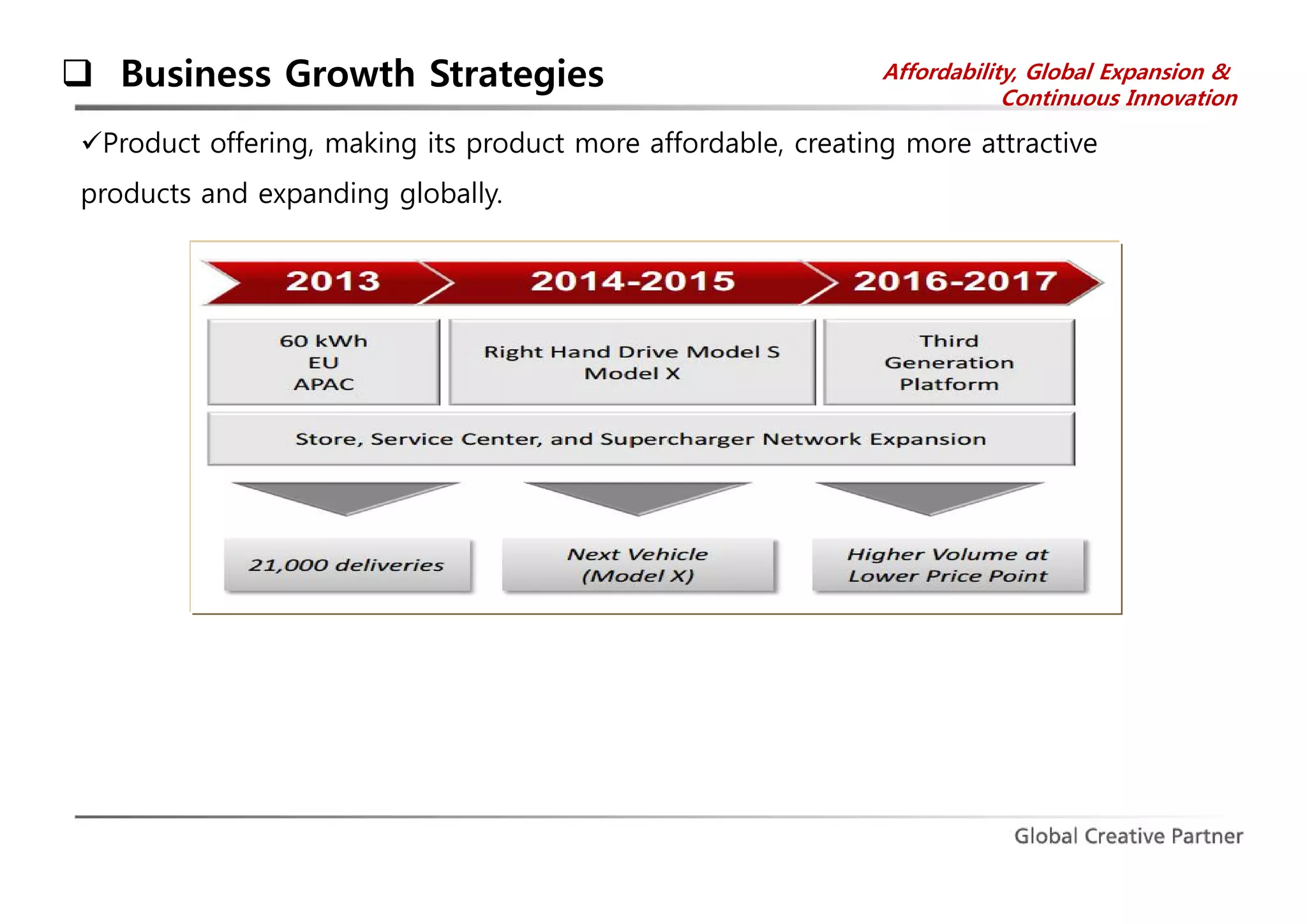
 Business Growth Strategies 
Affordability, Global Expansion & 
Continuous Innovation 
Product offering, making its product more affordable, creating more attractive 
products and expanding globally.
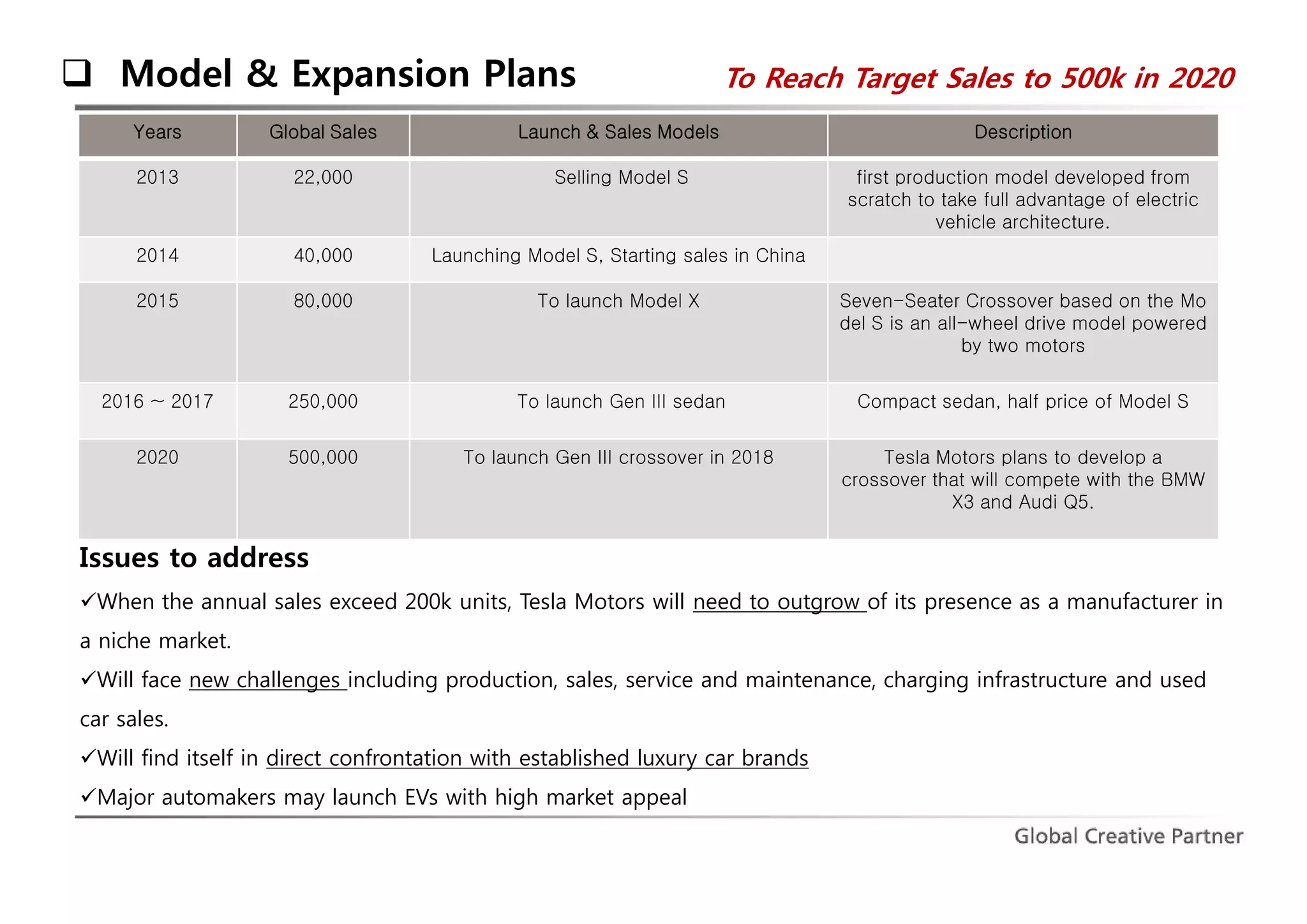
 Model & Expansion Plans To Reach Target Sales to 500k in 2020 
Years Global Sales Launch & Sales Models Description 
2013 22,000 Selling Model S first production model developed from 
scratch to take full advantage of electric 
vehicle architecture. 
2014 40,000 Launching Model S, Starting sales in China 
2015 80,000 To launch Model X Seven-Seater Crossover based on the Mo 
del S is an all-wheel drive model powered 
by two motors 
2016 ~ 2017 250,000 To launch Gen III sedan Compact sedan, half price of Model S 
2020 500,000 To launch Gen III crossover in 2018 Tesla Motors plans to develop a 
crossover that will compete with the BMW 
X3 and Audi Q5. 
Issues to address 
When the annual sales exceed 200k units, Tesla Motors will need to outgrow of its presence as a manufacturer in 
a niche market. 
Will face new challenges including production, sales, service and maintenance, charging infrastructure and used 
car sales. 
Will find itself in direct confrontation with established luxury car brands 
Major automakers may launch EVs with high market appeal
 Partnership 
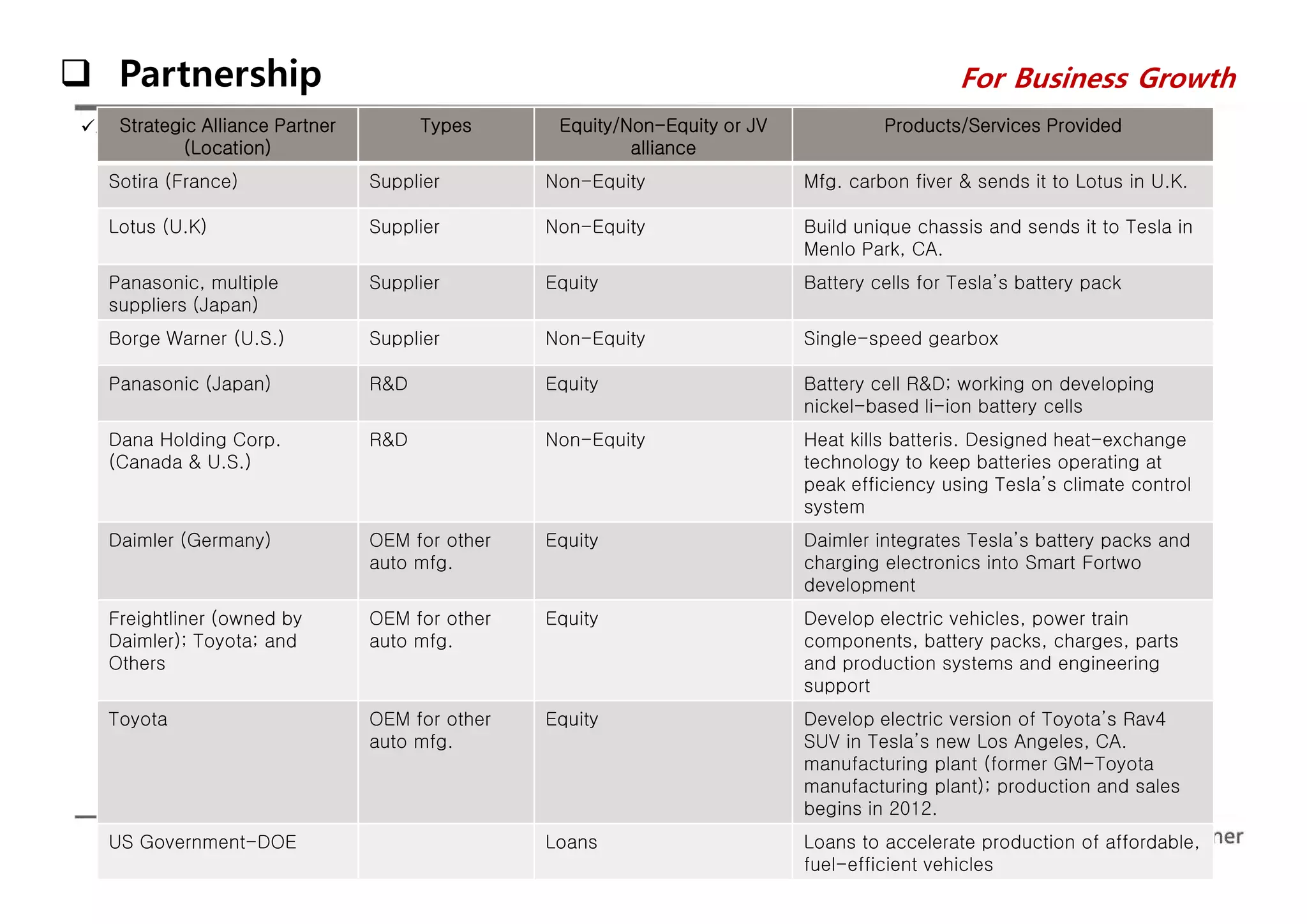
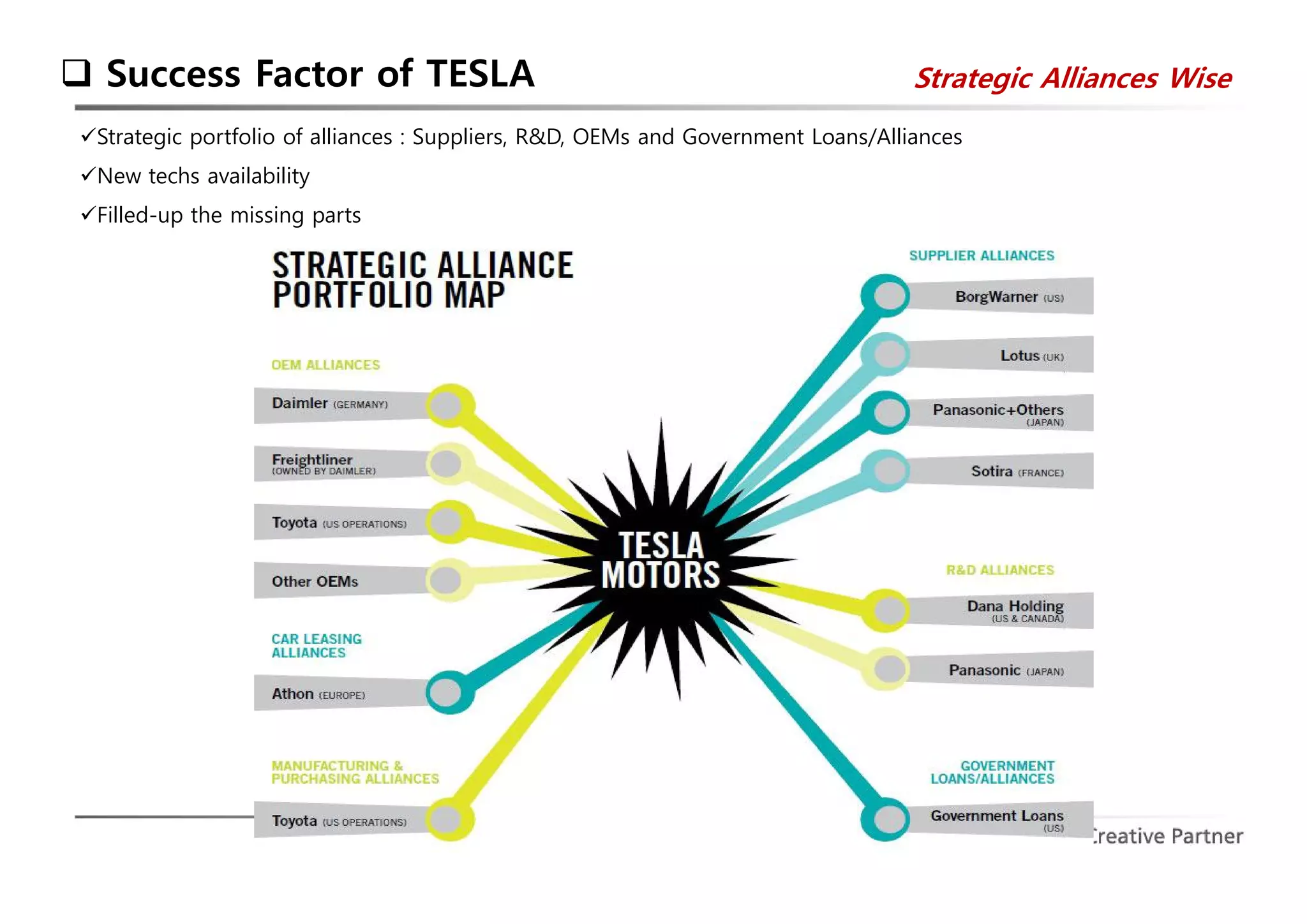
3 types: Suppliers, R&D alliances, OEM alliances with other automotive manufacturers 
For Business Growth 
Strategic Alliance Partner 
(Location) 
Types Equity/Non-Equity or JV 
alliance 
Products/Services Provided 
Sotira (France) Supplier Non-Equity Mfg. carbon fiver & sends it to Lotus in U.K. 
Lotus (U.K) Supplier Non-Equity Build unique chassis and sends it to Tesla in 
Menlo Park, CA. 
Panasonic, multiple 
suppliers (Japan) 
Supplier Equity Battery cells for Tesla’s battery pack 
Borge Warner (U.S.) Supplier Non-Equity Single-speed gearbox 
Panasonic (Japan) R&D Equity Battery cell R&D; working on developing 
nickel-based li-ion battery cells 
Dana Holding Corp. 
(Canada & U.S.) 
R&D Non-Equity Heat kills batteris. Designed heat-exchange 
technology to keep batteries operating at 
peak efficiency using Tesla’s climate control 
system 
Daimler (Germany) OEM for other 
auto mfg. 
Equity Daimler integrates Tesla’s battery packs and 
charging electronics into Smart Fortwo 
development 
Freightliner (owned by 
Daimler); Toyota; and 
Others 
OEM for other 
auto mfg. 
Equity Develop electric vehicles, power train 
components, battery packs, charges, parts 
and production systems and engineering 
support 
Toyota OEM for other 
auto mfg. 
Equity Develop electric version of Toyota’s Rav4 
SUV in Tesla’s new Los Angeles, CA. 
manufacturing plant (former GM-Toyota 
manufacturing plant); production and sales 
begins in 2012. 
US Government-DOE Loans Loans to accelerate production of affordable, 
fuel-efficient vehicles
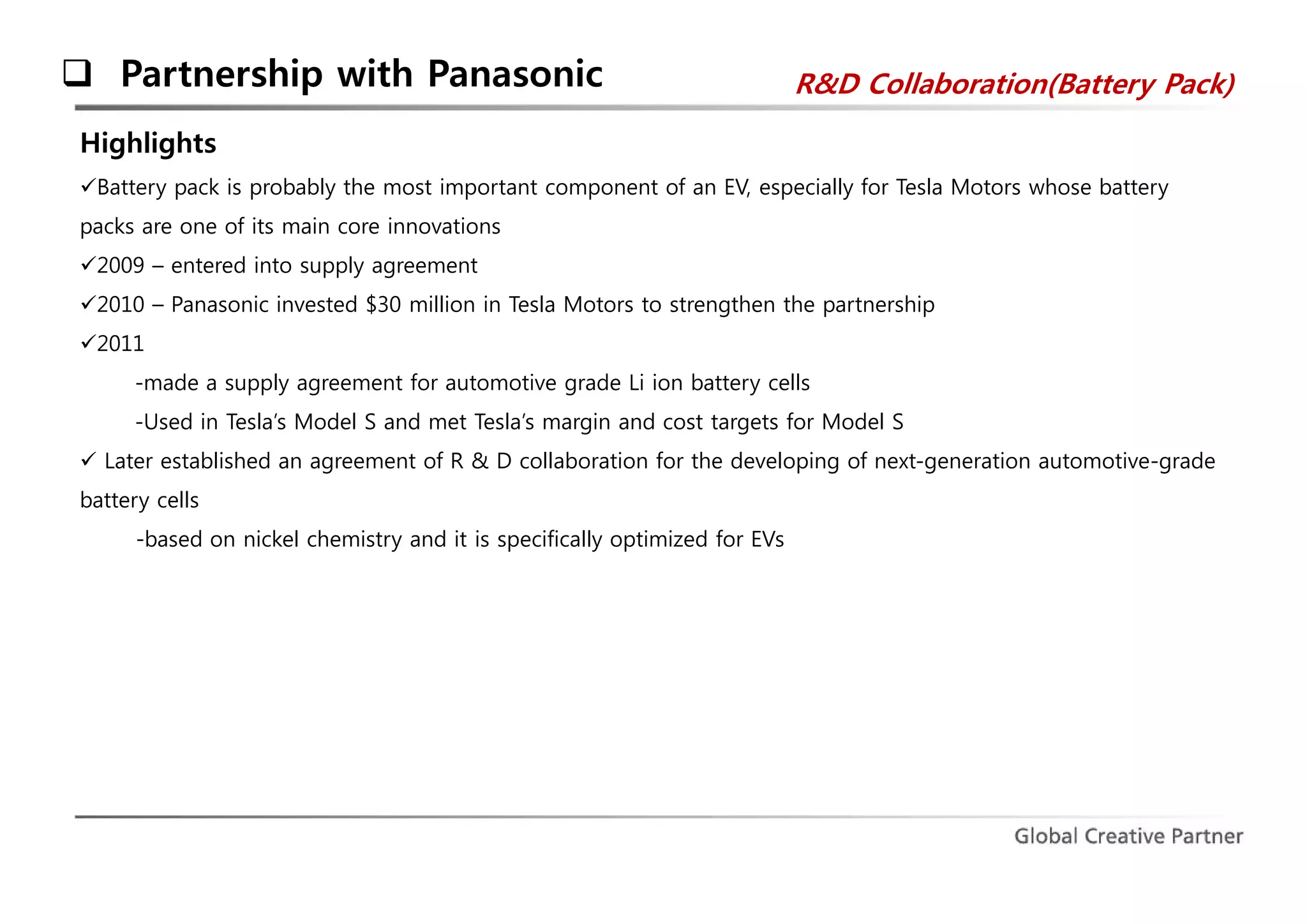
 Partnership with Panasonic R&D Collaboration(Battery Pack) 
Highlights 
Battery pack is probably the most important component of an EV, especially for Tesla Motors whose battery 
packs are one of its main core innovations 
2009 – entered into supply agreement 
2010 – Panasonic invested $30 million in Tesla Motors to strengthen the partnership 
2011 
-made a supply agreement for automotive grade Li ion battery cells 
-Used in Tesla’s Model S and met Tesla’s margin and cost targets for Model S 
 Later established an agreement of R & D collaboration for the developing of next-generation automotive-grade 
battery cells 
-based on nickel chemistry and it is specifically optimized for EVs
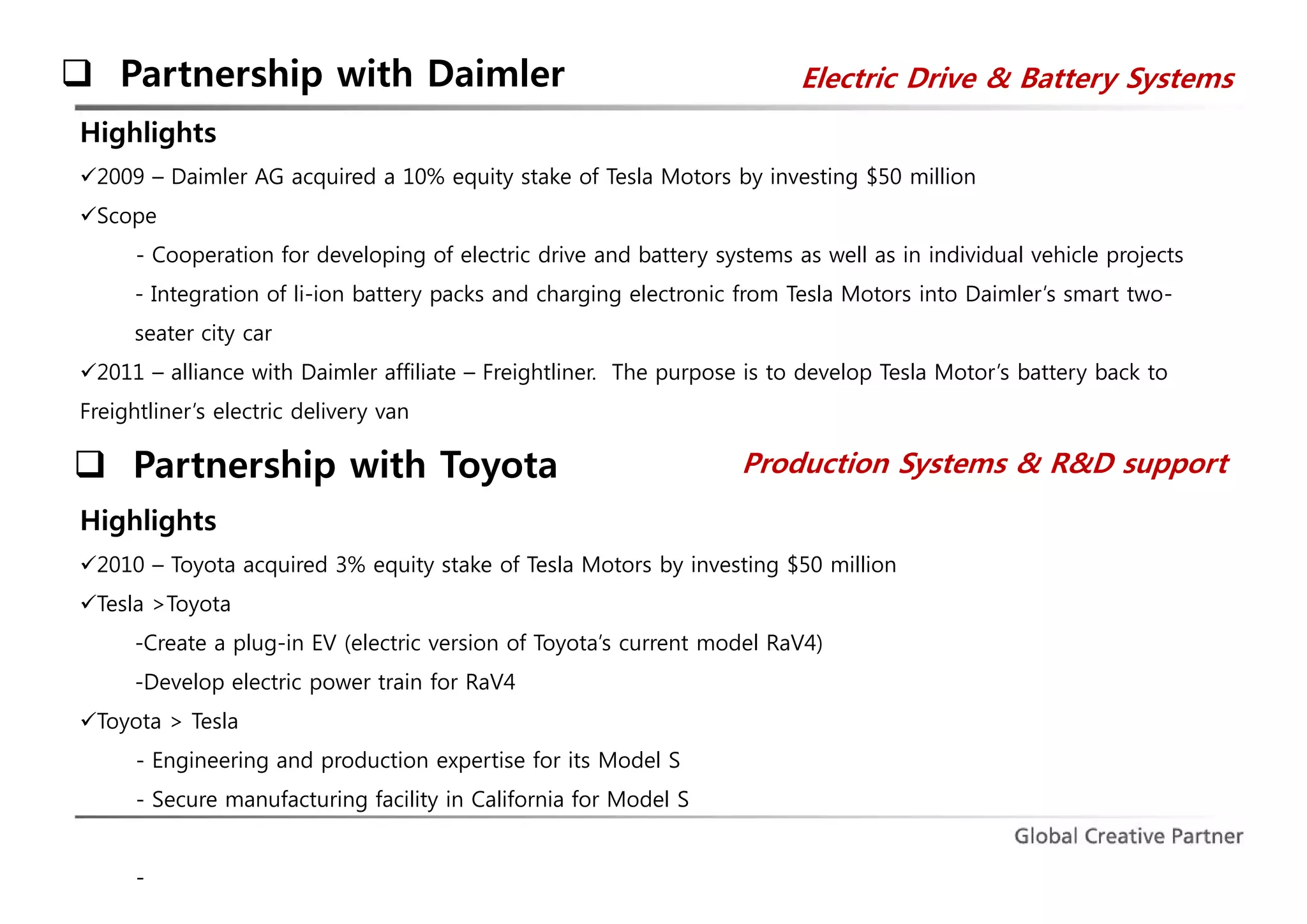
 Partnership with Daimler Electric Drive & Battery Systems 
Highlights 
2009 – Daimler AG acquired a 10% equity stake of Tesla Motors by investing $50 million 
Scope 
- Cooperation for developing of electric drive and battery systems as well as in individual vehicle projects 
- Integration of li-ion battery packs and charging electronic from Tesla Motors into Daimler’s smart two-seater 
city car 
2011 – alliance with Daimler affiliate – Freightliner. The purpose is to develop Tesla Motor’s battery back to 
Freightliner’s electric delivery van 
 Partnership with Toyota Production Systems & R&D support 
Highlights 
2010 – Toyota acquired 3% equity stake of Tesla Motors by investing $50 million 
Tesla >Toyota 
-Create a plug-in EV (electric version of Toyota’s current model RaV4) 
-Develop electric power train for RaV4 
Toyota > Tesla 
- Engineering and production expertise for its Model S 
- Secure manufacturing facility in California for Model S 
-
 Success Factor of TESLA Strategic Alliances Wise 
Strategic portfolio of alliances : Suppliers, R&D, OEMs and Government Loans/Alliances 
New techs availability 
Filled-up the missing parts
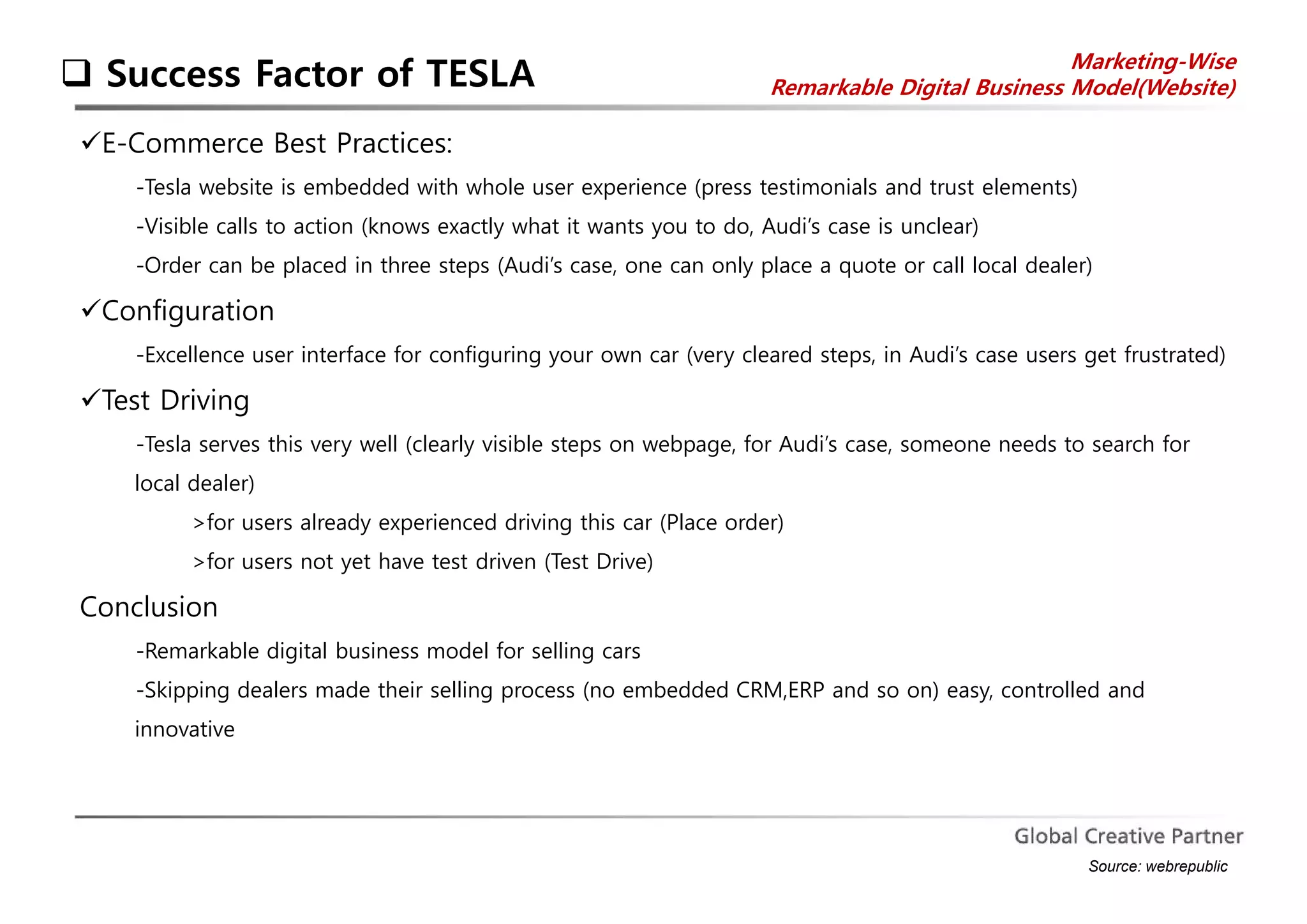
 Success Factor of TESLA Marketing-Wise 
Remarkable Digital Business Model(Website) 
E-Commerce Best Practices: 
-Tesla website is embedded with whole user experience (press testimonials and trust elements) 
-Visible calls to action (knows exactly what it wants you to do, Audi’s case is unclear) 
-Order can be placed in three steps (Audi’s case, one can only place a quote or call local dealer) 
Configuration 
-Excellence user interface for configuring your own car (very cleared steps, in Audi’s case users get frustrated) 
Test Driving 
-Tesla serves this very well (clearly visible steps on webpage, for Audi’s case, someone needs to search for 
local dealer) 
>for users already experienced driving this car (Place order) 
>for users not yet have test driven (Test Drive) 
Conclusion 
-Remarkable digital business model for selling cars 
-Skipping dealers made their selling process (no embedded CRM,ERP and so on) easy, controlled and 
innovative 
Source: webrepublic
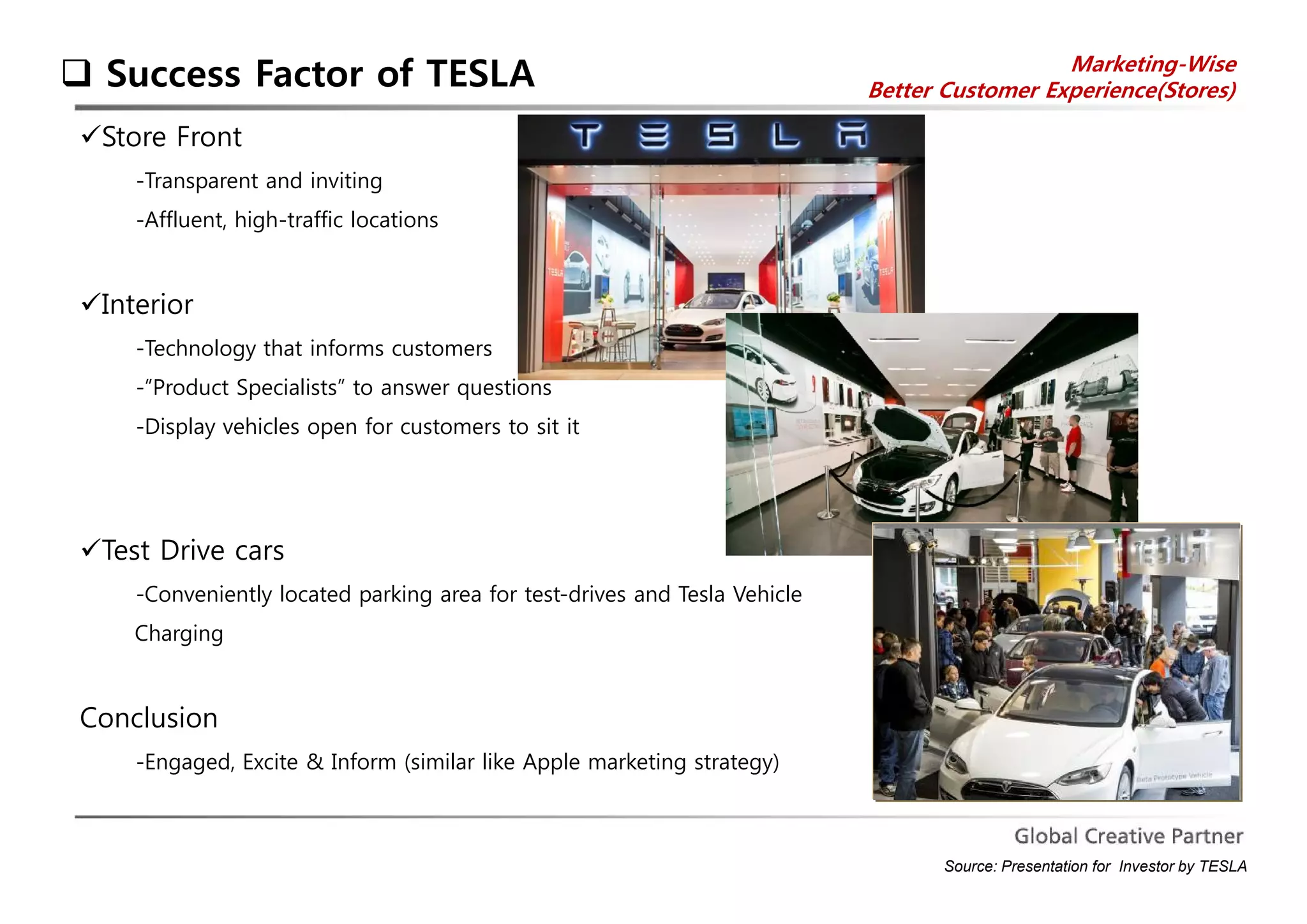
 Success Factor of TESLA Marketing-Wise 
Better Customer Experience(Stores) 
Store Front 
-Transparent and inviting 
-Affluent, high-traffic locations 
Interior 
-Technology that informs customers 
-”Product Specialists” to answer questions 
-Display vehicles open for customers to sit it 
Test Drive cars 
-Conveniently located parking area for test-drives and Tesla Vehicle 
Charging 
Conclusion 
-Engaged, Excite & Inform (similar like Apple marketing strategy) 
Source: Presentation for Investor by TESLA
 Success Factor of TESLA Tech-Wise 
Flat Battery Packing 
Battery Tech-Competitive advantage over competitors: 
-Bigger Storage Capacity: 
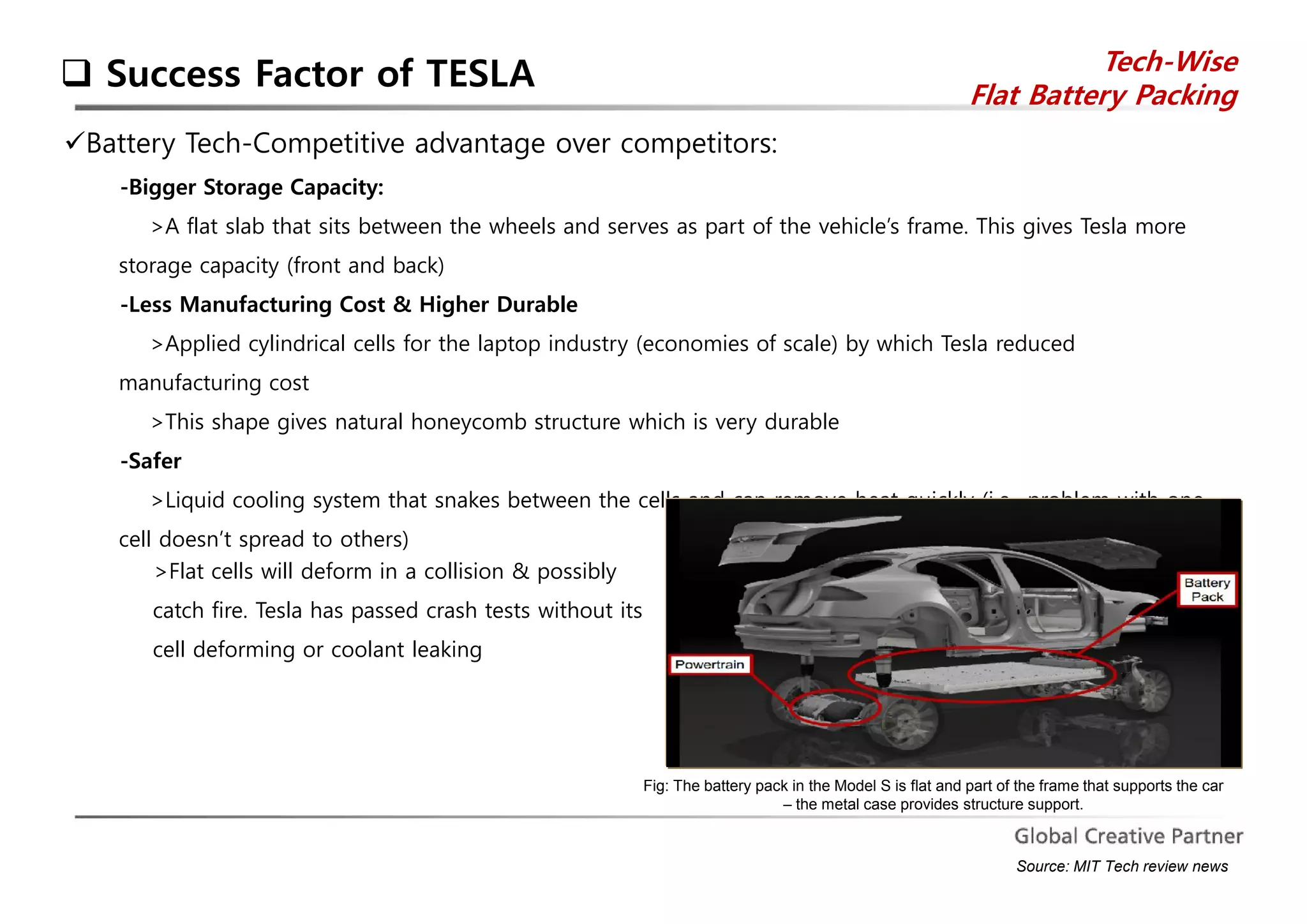
>A flat slab that sits between the wheels and serves as part of the vehicle’s frame. This gives Tesla more 
storage capacity (front and back) 
-Less Manufacturing Cost & Higher Durable 
>Applied cylindrical cells for the laptop industry (economies of scale) by which Tesla reduced 
manufacturing cost 
>This shape gives natural honeycomb structure which is very durable 
-Safer 
>Liquid cooling system that snakes between the cells and can remove heat quickly (i.e., problem with one 
cell doesn’t spread to others) 
Fig: The battery pack in the Model S is flat and part of the frame that supports the car 
– the metal case provides structure support. 
Source: MIT Tech review news 
>Flat cells will deform in a collision & possibly 
catch fire. Tesla has passed crash tests without its 
cell deforming or coolant leaking
 Success Factor of TESLA Tech-Wise 
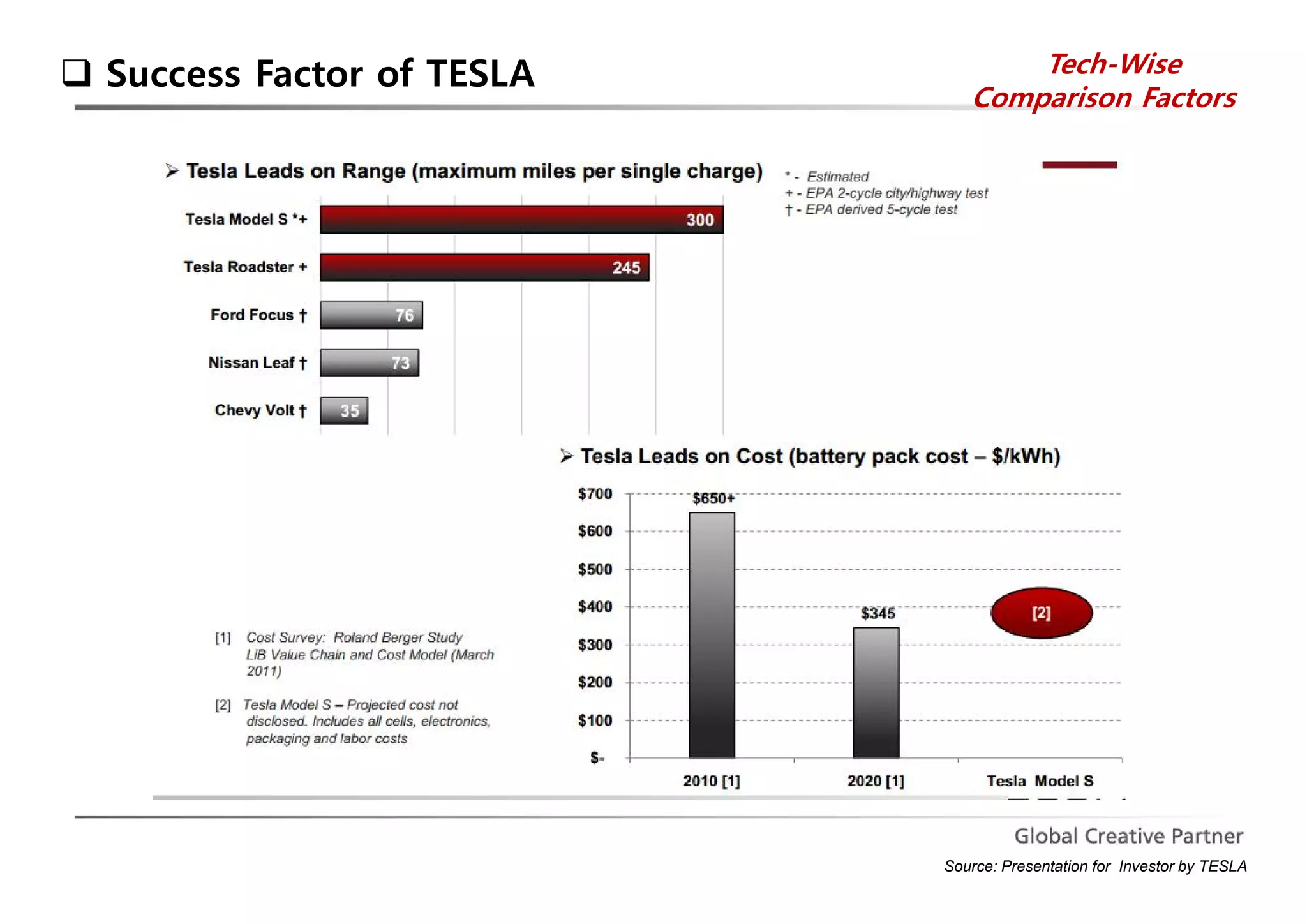
Comparison Factors 
Source: Presentation for Investor by TESLA
 Daesung Scope & Conclusion Only EV Products 
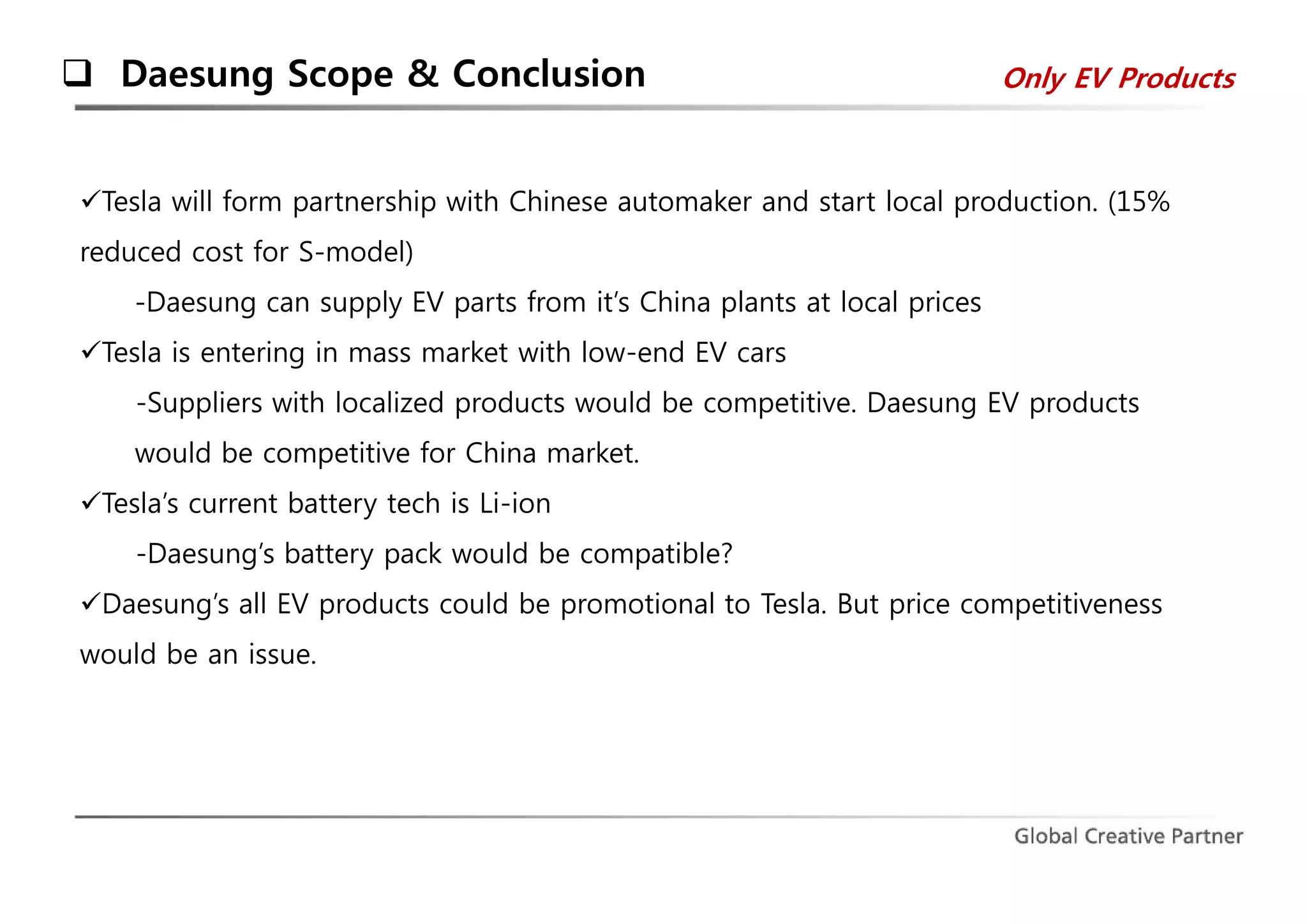
Tesla will form partnership with Chinese automaker and start local production. (15% 
reduced cost for S-model) 
-Daesung can supply EV parts from it’s China plants at local prices 
Tesla is entering in mass market with low-end EV cars 
-Suppliers with localized products would be competitive. Daesung EV products 
would be competitive for China market. 
Tesla’s current battery tech is Li-ion 
-Daesung’s battery pack would be compatible? 
Daesung’s all EV products could be promotional to Tesla. But price competitiveness 
would be an issue.

Tesla analysis 2014

  • 1.
    TESLA Report -ARare Success Story in EV Industry By Nishat 2014.03.25 해외영업팀 1
  • 2.
     Contents ExecutiveSummary Company Overview Financial Review Corporate Strategy Business Overview Strategic Positioning Business Growth Strategies Model & Expansion Plans Partnership Success Factor of Tesla Daesung Scope and Conclusion
  • 3.
     Executive Summary Upside  Earns profit  Able to sell their cars directly to customers in more states allowing for greater exposure  Mercedes-Benz B-Class and Toyota RAV4 are of high demand so Daimler and Toyota contract more with Tesla  Exceeds 22% gross margin and 20,000 unit sales (2013)  Creates strategic partnership with new company  Sales overseas exceed expectations  Consistent stable growth and decreasing margins  Record new Model S reservations (launched in 2013)  Plans to open 15 to 20 more stores and galleries this year with about half the openings in Europe and Asia  Plans to expand superchargers coverage on the U.S. West and East Coasts and around the rest of the country Downside  Daimler and Toyota are unhappy with Tesla service and product  Courts rule against Tesla being able to sell cars directly to customers  Material problems with Model S or Model S supply chain  Majority of customers using finance option return car after three years  Material problems with Toyota RAV4 or Mercedes- Benz B-Class
  • 4.
     Company Overview  Founded :2003  Founder :Elon Mask  Owners :Elon Musk (27%), Toyota Group (0.27%), Daimler AG (0.14%)  HQ :Palo Alto, California, USA  Products : 1st Generation - Tesla Roadster (Sports car) 2nd Generation – •Tesla Model S(2013) – most awarded car of 2013 (Luxury Sedan) •Tesla Model X (2014) (Cross over vehicle) 3rd Generation (~2016) EV Car Manf.  Revenue :US$ 2.013 billion (2013)  Employees :6000 (Jan 2014)  Partnership :Lotus, Panasonic, Borge Warner, Dana Holding Corp, Toyota, Daimler AG, Freightliner  Vision :To sell 500,000 units in 2020  Website :www.teslamotors.com
  • 5.
     Financial Review  Financial performance (Year ended dec, 2013) Y/Y Sales 5 Times Higher In thousands USD Dec, 2013 Dec, 2012 Y/y Automotive Sales $ 1,997,786 $ 385,699 5.18 folds Operating expenses 517,545 424,350 21% Up thereof: research & development 231,976 273,978 15% Down thereof: selling, general & admi nistrative 285,569 150,372 89.9% Up Loss before income taxes (71,426) (396,077) 81.96% Down Net loss (74,014) (396,213) 81.3% Down Source: Tesla Motors SEC Filings (FORM 10-Q) Automotive sales for the year ended Dec,2013 were $2 billion R&D expenses decreased due to the significant development, prototyping and testing expenses related to the Model S launch in 2012, partially offset by an increase in similar costs in 2013 for Model X and other programs. Gross margin 22% (where the total revenues were $2.1 bill & gross profit $456 mill)
  • 6.
     Corporate Strategy Starting from High End to Reach to Low End Strategy “The starting point is a high performance sports car, but the long term vision is to build cars of all kinds, including low cost family vehicle”  1st Step: To introduce “Roadster” model to the market & establish a keystone for Evs (already accomplished by 2011) 2nd Step: In continuation, in 2012 the new “Model S” was introduced to the market to target to middle to upper-middle class consumers 3rd Step: Finally, by 2014 Tesla plans to produce and market a new model named “Model X” Low End (Mass market) High End Mid to High-mid
  • 7.
     Business Overview Silicon Valley Based Company Designs, manufactures & sells EV & EV power train components by their own Two separate business segments  Automotive sales • 90% of the firm revenue • Two sub division – Vehicle, options and related sales & Powertrain component and related sales  Development services • Develop electric powertrain systems for other automobile manufacturer. • Existing partnership with Toyota & Daimler
  • 8.
     Strategic Positioning Competitive Advantage:  Direct-to-customer sales, stores & service centers: EV High End Manf. & Dealer •Unlike other OEMs, Sells its cars to customers through its stores which it fully owns and operates (similar like apple’s marketing strategy) •Can achieve operating efficiencies as well as capture sales & services revenues that typical automobile manf do not  Innovative consumer financing options: •Combination of lease+loan: 5.5 year loan for around $500-$600 per month and is allowed to return the car after 3yrs with 43% residual value. Tech Innovations: •CEO, Elon Musk is an extremely inventor & will be able to keep Tesla current & competitive
  • 9.
     Business GrowthStrategies Affordability, Global Expansion & Continuous Innovation Product offering, making its product more affordable, creating more attractive products and expanding globally.
  • 10.
     Model &Expansion Plans To Reach Target Sales to 500k in 2020 Years Global Sales Launch & Sales Models Description 2013 22,000 Selling Model S first production model developed from scratch to take full advantage of electric vehicle architecture. 2014 40,000 Launching Model S, Starting sales in China 2015 80,000 To launch Model X Seven-Seater Crossover based on the Mo del S is an all-wheel drive model powered by two motors 2016 ~ 2017 250,000 To launch Gen III sedan Compact sedan, half price of Model S 2020 500,000 To launch Gen III crossover in 2018 Tesla Motors plans to develop a crossover that will compete with the BMW X3 and Audi Q5. Issues to address When the annual sales exceed 200k units, Tesla Motors will need to outgrow of its presence as a manufacturer in a niche market. Will face new challenges including production, sales, service and maintenance, charging infrastructure and used car sales. Will find itself in direct confrontation with established luxury car brands Major automakers may launch EVs with high market appeal
  • 11.
     Partnership 3types: Suppliers, R&D alliances, OEM alliances with other automotive manufacturers For Business Growth Strategic Alliance Partner (Location) Types Equity/Non-Equity or JV alliance Products/Services Provided Sotira (France) Supplier Non-Equity Mfg. carbon fiver & sends it to Lotus in U.K. Lotus (U.K) Supplier Non-Equity Build unique chassis and sends it to Tesla in Menlo Park, CA. Panasonic, multiple suppliers (Japan) Supplier Equity Battery cells for Tesla’s battery pack Borge Warner (U.S.) Supplier Non-Equity Single-speed gearbox Panasonic (Japan) R&D Equity Battery cell R&D; working on developing nickel-based li-ion battery cells Dana Holding Corp. (Canada & U.S.) R&D Non-Equity Heat kills batteris. Designed heat-exchange technology to keep batteries operating at peak efficiency using Tesla’s climate control system Daimler (Germany) OEM for other auto mfg. Equity Daimler integrates Tesla’s battery packs and charging electronics into Smart Fortwo development Freightliner (owned by Daimler); Toyota; and Others OEM for other auto mfg. Equity Develop electric vehicles, power train components, battery packs, charges, parts and production systems and engineering support Toyota OEM for other auto mfg. Equity Develop electric version of Toyota’s Rav4 SUV in Tesla’s new Los Angeles, CA. manufacturing plant (former GM-Toyota manufacturing plant); production and sales begins in 2012. US Government-DOE Loans Loans to accelerate production of affordable, fuel-efficient vehicles
  • 12.
     Partnership withPanasonic R&D Collaboration(Battery Pack) Highlights Battery pack is probably the most important component of an EV, especially for Tesla Motors whose battery packs are one of its main core innovations 2009 – entered into supply agreement 2010 – Panasonic invested $30 million in Tesla Motors to strengthen the partnership 2011 -made a supply agreement for automotive grade Li ion battery cells -Used in Tesla’s Model S and met Tesla’s margin and cost targets for Model S  Later established an agreement of R & D collaboration for the developing of next-generation automotive-grade battery cells -based on nickel chemistry and it is specifically optimized for EVs
  • 13.
     Partnership withDaimler Electric Drive & Battery Systems Highlights 2009 – Daimler AG acquired a 10% equity stake of Tesla Motors by investing $50 million Scope - Cooperation for developing of electric drive and battery systems as well as in individual vehicle projects - Integration of li-ion battery packs and charging electronic from Tesla Motors into Daimler’s smart two-seater city car 2011 – alliance with Daimler affiliate – Freightliner. The purpose is to develop Tesla Motor’s battery back to Freightliner’s electric delivery van  Partnership with Toyota Production Systems & R&D support Highlights 2010 – Toyota acquired 3% equity stake of Tesla Motors by investing $50 million Tesla >Toyota -Create a plug-in EV (electric version of Toyota’s current model RaV4) -Develop electric power train for RaV4 Toyota > Tesla - Engineering and production expertise for its Model S - Secure manufacturing facility in California for Model S -
  • 14.
     Success Factorof TESLA Strategic Alliances Wise Strategic portfolio of alliances : Suppliers, R&D, OEMs and Government Loans/Alliances New techs availability Filled-up the missing parts
  • 15.
     Success Factorof TESLA Marketing-Wise Remarkable Digital Business Model(Website) E-Commerce Best Practices: -Tesla website is embedded with whole user experience (press testimonials and trust elements) -Visible calls to action (knows exactly what it wants you to do, Audi’s case is unclear) -Order can be placed in three steps (Audi’s case, one can only place a quote or call local dealer) Configuration -Excellence user interface for configuring your own car (very cleared steps, in Audi’s case users get frustrated) Test Driving -Tesla serves this very well (clearly visible steps on webpage, for Audi’s case, someone needs to search for local dealer) >for users already experienced driving this car (Place order) >for users not yet have test driven (Test Drive) Conclusion -Remarkable digital business model for selling cars -Skipping dealers made their selling process (no embedded CRM,ERP and so on) easy, controlled and innovative Source: webrepublic
  • 16.
     Success Factorof TESLA Marketing-Wise Better Customer Experience(Stores) Store Front -Transparent and inviting -Affluent, high-traffic locations Interior -Technology that informs customers -”Product Specialists” to answer questions -Display vehicles open for customers to sit it Test Drive cars -Conveniently located parking area for test-drives and Tesla Vehicle Charging Conclusion -Engaged, Excite & Inform (similar like Apple marketing strategy) Source: Presentation for Investor by TESLA
  • 17.
     Success Factorof TESLA Tech-Wise Flat Battery Packing Battery Tech-Competitive advantage over competitors: -Bigger Storage Capacity: >A flat slab that sits between the wheels and serves as part of the vehicle’s frame. This gives Tesla more storage capacity (front and back) -Less Manufacturing Cost & Higher Durable >Applied cylindrical cells for the laptop industry (economies of scale) by which Tesla reduced manufacturing cost >This shape gives natural honeycomb structure which is very durable -Safer >Liquid cooling system that snakes between the cells and can remove heat quickly (i.e., problem with one cell doesn’t spread to others) Fig: The battery pack in the Model S is flat and part of the frame that supports the car – the metal case provides structure support. Source: MIT Tech review news >Flat cells will deform in a collision & possibly catch fire. Tesla has passed crash tests without its cell deforming or coolant leaking
  • 18.
     Success Factorof TESLA Tech-Wise Comparison Factors Source: Presentation for Investor by TESLA
  • 19.
     Daesung Scope& Conclusion Only EV Products Tesla will form partnership with Chinese automaker and start local production. (15% reduced cost for S-model) -Daesung can supply EV parts from it’s China plants at local prices Tesla is entering in mass market with low-end EV cars -Suppliers with localized products would be competitive. Daesung EV products would be competitive for China market. Tesla’s current battery tech is Li-ion -Daesung’s battery pack would be compatible? Daesung’s all EV products could be promotional to Tesla. But price competitiveness would be an issue.