2018
By: Muhammad Eddieb
Supervised by: Dr. Reham Moawad
12/21/2018
Tesla Marketing Case Study
1
Tesla Case Study
‘TESLA’S MISSION IS TO ACCELERATE THE WORLD’S TRANSITION TO SUSTAINABLE ENERGY’.
Tesla was founded in 2003 by a group of engineers who wanted to prove that people didn’t need
to compromise to drive electric – that electric vehicles can be better, quicker and more fun to drive
than gasoline cars. Today, Tesla builds not only all-electric vehicles but also infinitely scalable
clean energy generation and storage products. Tesla believes the faster the world stops relying on
fossil fuels and moves towards a zero-emission future, the better.
Launched in 2008, the Roadster unveiled Tesla’s cutting-edge battery technology and electric
powertrain. From there, Tesla designed the world’s first ever premium all-electric sedan from the
ground up – Model S – which has become the best car in its class in every category. Combining
safety, performance, and efficiency, Model S has reset the world’s expectations for the car of the
21st century with the longest range of any electric vehicle, over-the-air software updates that make
it better over time, and a record 0-60 mph acceleration time of 2.28 seconds as measured by Motor
Trend. In 2015, Tesla expanded its product line with Model X, the safest, quickest and most
capable sport utility vehicle in history that holds 5-star safety ratings across every category from
the National Highway Traffic Safety Administration. Completing CEO Elon Musk’s “Secret
Master Plan,” in 2016, Tesla introduced Model 3, a low-priced, high-volume electric vehicle that
began production in 2017. Soon after, Tesla unveiled the safest, most comfortable truck ever
– Tesla Semi – which is designed to save owners at least $200,000 over a million miles based on
fuel costs alone.
All Tesla vehicles are produced at its factory in Fremont, California, where the vast majority of
the vehicle’s components are also made. To achieve our goal of having the safest factories in the
world, Tesla is taking a proactive approach to safety, requiring production employees to participate
in a multi-day training program before ever setting foot on the factory floor. From there, Tesla
continues to provide on-the-job training and track performance daily so that improvements can be
made quickly. The result is that Tesla’s safety rate continues to improve while Model 3 production
ramps.
To create an entire sustainable energy ecosystem, Tesla also manufactures a unique set of energy
solutions, Powerwall, Powerpack and Solar Roof, enabling homeowners, businesses, and utilities
to manage renewable energy generation, storage, and consumption. Supporting Tesla’s automotive
and energy products is Gigafactory 1 – a facility designed to significantly reduce battery cell costs.
By bringing cell production in-house, Tesla manufactures batteries at the volumes required to meet
production goals, while creating thousands of jobs.
And this is just the beginning. With Tesla building its most affordable car yet, Tesla continues to
make products accessible and affordable to more and more people, ultimately accelerating the
2
advent of clean transport and clean energy production. Electric cars, batteries, and renewable
energy generation and storage already exist independently, but when combined, they become even
more powerful – that’s the future we want.
Marketing Strategy of Tesla
Mission and Vision:
The vision and mission statement of Tesla reflect the company’s aim for dominance in the
global electric vehicles and battery market.
Tesla’s mission statement: “to accelerate the world’s transition to sustainable energy”.
It believes that the faster the world stops relying on fossil fuels and moves towards a zero-emission future,
the better it will be for the world.
The vision statement: “to create the most compelling car company of the 21st century by driving the
world’s transition to electric vehicles”.
Tesla wants to accelerate the advent of sustainable transport by making products accessible and affordable
to more and more people ultimately leading to clean transport and clean energy production. Tesla focuses
on bringing compelling mass market electric cars to market as soon as possible.
Market analysis in the marketing strategy of Tesla:
Tesla Internal Analysis
SWOT analysis of Tesla Motors
Tesla Motors is a new age automotive company which manufactures alternative energy vehicles like solar-
powered cars, hybrid vehicles, and battery-operated vehicles. A pioneer of sustainable energy options Tesla
Motors is backed by a very strong research and development team and is considered to be a benchmark in
green technologies.
Strengths in the SWOT analysis of Tesla Motors
The following are the strengths of Tesla:
Technology: Tesla has always been associated with cutting-edge technologies and many companies have
adopted the technologies introduced by Tesla. Some examples of top brands which have used Tesla
technologies include Daimler which uses Tesla’s battery packs; Mercedes-Benz a user of Tesla
powertrain; Toyota with Tesla motor. In fact, pioneers like GE have set up trackers which keep track of
Tesla’s innovations.
3
• Political and government support: The company has ample support from the government. The
company had obtained a USD 465 billion for energy management projects under the US Department
of Energy. Tesla started its operations at the right time when Obama had launched the clean tech
initiative and this resulted in the company gaining a lot of advantages from the government.
• Monopoly: Tesla Motors started off targeting a very niche segment which was electric and alternate
energy cars. The strategy was to move deeper into the existing segment and it would not be wrong
to say that the company operates in a monopoly market. This has helped it gain steeper growth than
most of its counterparts.
• Great leadership and team spirit: The CEO of the company Elon Musk is extremely passionate
about engineering and an astute salesman. This makes equally proficient in the engineering as well
as the commercial side of the business. The CEO is backed by a team that is highly spirited and as
passionate about the cause as their leader. The leadership style of Musk which is motivating and
inspirational along with a highly self-driven team is a success factor for Tesla.
• Distribution channel: Tesla understand how critical distribution may be for the business and this
makes Tesla own their own distribution channel. There are also some capacity expansion plans from
Tesla which has been triggered by Giga factory.
Weaknesses in the SWOT analysis of Tesla Motors
Some of the key weaknesses of Tesla Motors are:
• Poor liquidity: In comparison to competitors like Ford which has USD 20 billion, General
Motors with USD 25billion or Fiat Chrysler Automobiles USD 40 billion which are cash rich from
years and years of operations. In comparison to this Tesla has only USD 3 billion which will not be
sufficient for it to survive.
• Capacity Issues: Tesla manufactures cars in just one plant which is located in Fremont, California.
The plant has a capacity to make 500,000 vehicles and the maximum production of the company is
limited to this figure making it difficult for the company to target higher volumes.
• Poor customer awareness: Tesla makes very specialized products which are essential for
the environment because of their sustainability angle. But these products are highly futuristic and
most customers are still not sure about whether or not they need to invest in these technologies which
are expensive as well.
Opportunities in the SWOT analysis of Tesla Motors
Some of the opportunities include:
• Preference for new technologies: Vehicle technology is taking a whole new turn and there are a
host of new technologies like hybrid vehicles, green cars, electric cars, battery operated cars and
self-driven autonomous cars. Tesla has researched and launched many products in these emerging
technology areas.
Threats in the SWOT analysis of Tesla Motors
Threats are those factors in the environment which can be detrimental to the growth of the business. Some
of the threats include:
4
• Competition: Tesla faces a lot of competition from various car companies like Ford, General
Motors, Fiat Chrysler Automobiles, as well as technology companies like Google.
Tesla External Analysis (PESTEL)
The PESTEL Analysis is a strategic management tool that determines the effects of the industry’s remote
or macro-environment on the company. Tesla’s case involves the remote or macro-environment of the
automotive industry, the energy generation industry, and the energy storage industry. These industries’
external factors influence other determinants of the business, such as customers and community-based
organizations. For example, Tesla Inc.’s customer base and market share depend on factors like the cost-
effectiveness of technologies in the transportation sector. With a strong brand image and improving
profitability, the company can enhance its long-term success by including the results of its PESTEL analysis
in strategic formulation. Tesla, Inc.’s electric automobile, battery, and solar panel sales revenues are
increasing, despite competition with large firms, such as automobile manufacturers like General Motors
Company, Honda Motor Company, Toyota Motor Corporation, Volkswagen, Nissan Motor Company, and
BMW (Bavarian Motor Works). This condition indicates effectiveness in addressing the external factors in
the remote or macro-environment of the business.
Political Factors Affecting Tesla’s Business
1. Governmental incentives for electric automobiles (opportunity)
2. New global trade agreements (opportunity)
3. Political stability in the majority of major markets (opportunity)
Tesla, Inc. has the opportunity to strengthen its financial performance through incentives from
governments. This external factor directly relates with the minimized carbon emissions of the company’s
operations and products. In addition, this PESTEL analysis determines that expanding free trade agreements
open opportunities for the company to expand its operations internationally. On the other hand, the political
stability of major markets makes the remote or macro-environment favorable to Tesla’s generic competitive
strategy and intensive growth strategies, which include market penetration. In this part of the PESTEL
analysis of Tesla, political external factors present opportunities for growing the automotive business.
Economic Factors
1. Decreasing battery costs (opportunity)
2. Decreasing renewable energy costs (opportunity)
3. Economic stability issues (threat)
Tesla’s business performance benefits from lower battery costs. For example, this external factor translates
to affordability of the company’s electric automobile products. This PESTEL analysis also considers
decreasing renewable energy costs as an external factor that makes Tesla’s products more attractive. The
business improves as renewable energy solutions become more popular. However, economic stability issues
threaten the company’s financial performance, especially in Europe and Asia. This part of the PESTEL
analysis of Tesla, Inc. highlights major opportunities for growth, despite the threat of economic instability
in the remote or macro-environment of the automotive industry.
5
Social Factors
1. Increasingly popularity of low-carbon lifestyles (opportunity)
2. Increasing preference for renewable energy (opportunity)
3. Improving wealth distribution in developing markets (opportunity)
This company analysis shows opportunities to grow the multinational automotive business. For example,
Tesla Inc. has growth opportunities based on the rising popularity of low-carbon lifestyles and increasing
preference for renewable energy. In the PESTEL analysis framework, these external factors improve market
demand for the company’s electric vehicles and related products. In addition, Tesla has an opportunity to
boost its financial performance based on the increasing wealth distribution in developing markets. This
wealth distribution trend increases the population of potential buyers of the company’s relatively expensive
cars. In this part of the PESTEL analysis, Tesla Inc. can grow its business internationally, based on
sociocultural opportunities in its remote or macro-environment and it already started to enter global markets
as well as developing markets such as Egypt.
Technological Factors
1. High rate of technological change (opportunity & threat)
2. Increasing automation in business (opportunity)
3. Increasing popularity of online mobile systems (opportunity)
The high rate of technological change is an opportunity and threat in this business analysis. The high rate
presents opportunity for Tesla to enhance its products’ technologies. However, the same external factor
threatens the company in terms of the potential rapid obsolescence of technologies used in its products.
Nonetheless, increasing business automation is a trend that creates opportunities in this PESTEL analysis
case. For example, Tesla has growth opportunities through further automation of its business processes. In
addition, the increasing popularity of online mobile systems should prompt the company to increasingly
integrate these systems in its automobiles. The technological condition of the remote or macro-environment,
as shown in this part of the PESTEL analysis of Tesla, Inc. emphasizes opportunities for growth based on
technological enhancement.
Environmental Factors
1. Climate change (opportunity)
2. Expanding environmental programs (opportunity)
3. Rising standards on waste disposal (opportunity)
This PESTEL analysis considers ecological factors as significant forces on Tesla, Inc.’s industry
environment. For example, the company has opportunities to promote its electric vehicles based on
concerns on climate change, expanding environmental programs, and rising standards on waste disposal.
The company’s electric vehicles, batteries and solar panels are considered suitable in directly addressing
these external factors linked to business sustainability and environmentally friendly products. This part of
the PESTEL analysis shows that Tesla has significant growth opportunities based on the nature of its
products.
6
Legal Factors
1. Expanding international patent protection (opportunity)
2. Energy consumption regulations (opportunity)
3. Dealership sales regulation in the United States (opportunity & threat)
Tesla has opportunities to safely expand its business overseas, considering expanding international patent
protection. In addition, this PESTEL analysis identifies the opportunity to promote the company’s electric
vehicles and energy solutions products, based on energy consumption regulations that client organizations
must follow. Also, the business has an opportunity to grow through direct sales, which is allowed in many
states in the U.S. However, based on the SWOT Analysis of Tesla, Inc., this external factor is also a threat,
considering that other states do not allow direct sales and, instead, require dealerships to transact with
customers in the automotive market. The legal conditions of the remote or macro-environment shown in
this part of the PESTEL analysis point out that Tesla can expect growth opportunities.
Competition Analysis
The global EV market is predicted to grow at a compound annual growth rate of 21.4% between 2018 &
2026 according to ReportBuyer. Tesla still rules the EV market in the USA, Tesla sold three of the country’s
five best-selling EV’s first four months of 2018. Tesla’s competitors are Toyota’s Prius Prime plug-in
hybrid and General Motors’ Chevy Volt. Both lack Tesla’s brand appeal, however, Tesla is struggling with
a production bottleneck. According to McKinsey Research, China has increased its lead in EV production
and the country has the largest fleet of EV on the road and has overtaken US market for the first time. China
now accounts for half of the EV sold worldwide. Even though Tesla is not able to meet its production goals
it is predicted to account for over 605 of all EV sales in the US. In order to understand the volume of
competition and its effects on TESLA Inc its urgent to discuss Porter’s Five Forces Analysis.
Porter’s Five Forces Analysis
Michael Porter developed the Five Forces Analysis model as a strategic management tool to understand the
impact of external factors on firms and the competitive landscape of their industry environment. This Five
Forces analysis of Tesla looks into the external factors significant in the automotive industry and the energy
solutions industry, and how such factors affect the company. As one of the biggest players in the electric
vehicle market, Tesla must effectively address such external factors to ensure its long-term competence and
resilience in the face of competitive rivalry involving automakers like Honda Motor Company, General
Motors Company, Ford Motor Company, Volkswagen, Toyota Motor Corporation, Nissan Motor
Company, and BMW (Bavarian Motor Works).
Tesla must ensure that it addresses external factors according to the intensity of the forces impacting the
business, as shown in this Five Forces analysis:
1. Competitive rivalry or competition (Strong Force)
2. Bargaining power of buyers or customers (Moderate Force)
3. Bargaining power of suppliers (Moderate Force)
4. Threat of substitutes or substitution (Moderate Force)
5. Threat of new entrants or new entry (Weak Force)
7
Competitive Rivalry or Competition with Tesla, Inc. (Strong Force)
Tesla, Inc. operates in a highly competitive market. This aspect of the Five Forces Analysis outlines the
influence of competition on the automotive and energy solutions industry environment. In this case of
Tesla, the external factors and their intensities responsible for the strong force of competitive rivalry are
as follows:
• Small number of firms (weak force)
• High aggressiveness of firms (strong force)
• Low switching costs (strong force)
There are only a small number of firms operating in the automotive market. In Porter’s Five Forces analysis
framework, this external factor limits the effect of competition on companies like Tesla, Inc. However,
these firms are generally aggressive in innovating and promoting their products. For example, large
automotive companies have aggressive marketing campaigns. Tesla’s marketing mix or 4Ps partly meets
such aggressiveness, which strengthens the effects of competitors against the business. Also, the low
impediments for customers to buy cars from other manufacturers (low switching costs) further strengthen
the force of competition. This aspect of the Five Forces analysis of Tesla Inc. points to competitive rivalry
as a high-priority strategic management consideration in the automotive and energy solutions industry
environment.
Bargaining Power of Tesla’s Customers/Buyers (Moderate Force)
Tesla’s customers are a direct factor that determines the company’s sales revenues. The following external
factors and their intensities maintain the moderate force of the bargaining power of customers on the
company:
• Low switching costs (strong force)
• Moderate substitute availability (moderate force)
• Low volume of purchases (weak force)
Low switching costs reduce barriers for Tesla customers to purchase cars from other providers. In the
context of this Porter’s Five Forces analysis, this external factor imposes a strong force against the
company and other players in the automotive industry environment. However, the availability of
substitutes is only moderate in many cases, thereby limiting customers’ bargaining power against Tesla
Inc. For example, many customers in suburban areas have limited access to public transportation, making
it more practical to drive their own car. In addition, the low volume of purchases (each customer buys and
keeps only one or a few cars) reduces the influence of customers on Tesla. Thus, the intensities of the
external factors in this aspect of the Five Forces analysis reflect the bargaining power of customers as a
moderate force and a secondary management priority.
Bargaining Power of Tesla’s Suppliers (Moderate Force)
Tesla Inc.’s business depends on the reliability of suppliers. This aspect of the Five Forces Analysis
shows how suppliers shape the industry environment by influencing the availability of materials that
firms need. The intensities of the external factors that create the moderate force of the bargaining power
of Tesla’s suppliers are as follows:
• Moderate forward integration (moderate force)
• Moderate size of suppliers (moderate force)
8
• Moderate supply level (moderate force)
Tesla Inc.’s suppliers have a low level of forward integration. This external factor refers to suppliers’ limited
control in the distribution and sale of their products. For example, some suppliers use third parties to sell
their materials to Tesla, while others directly transact with the company. In the framework of Porter’s Five
Forces analysis, this external factor imposes a moderate force on the corporation. In addition, most of these
suppliers are moderately sized, thereby having limited influence on the automotive industry environment.
Another external factor is the moderate level of supply, which empowers suppliers to affect Tesla, but only
to a limited degree. This aspect of this Porter’s Five Forces analysis of Tesla Inc. indicates the bargaining
power of suppliers as a secondary strategic management priority.
Threat of Substitutes or Substitution (Moderate Force)
Tesla, Inc. experiences the impact of substitutes on the automotive and energy solutions industry
environment. In this aspect of the Five Forces Analysis, the intensities of the external factors that
lead to the moderate force of the threat of substitution against the company are considered, as
follows:
• Low switching costs (strong force)
• Moderate substitute availability (moderate force)
• Moderate performance of substitutes (moderate force)
As pointed out in the other aspects of this Porter’s Five Forces analysis of Tesla Inc., low switching
costs enable competition. In this external analysis case, the low switching costs enable substitutes,
such as public transportation, to easily attract customers. This external factor imposes a strong
force against Tesla’s industry environment. However, the moderate availability of substitutes
limits such influence of suppliers. For example, customers have only a moderate and limited
number of substitute options in the market. In relation, many substitutes have only a moderate
level of performance in satisfying customers’ practical needs. For instance, public transportation
is not as versatile as a private car. This condition further limits substitutes’ force against Tesla. In
this aspect of the Five Forces analysis of Tesla, Inc., the external factors point to the threat of
substitution as a secondary management consideration in the company’s strategies.
Threat of New Entrants or New Entry (Weak Force)
New entrants are new firms, which impact the industry environment and determine the performance of
companies like Tesla Inc. This aspect of the Five Forces analysis identifies the intensities of the external
factors that create the weak force of the threat of new entry, as follows:
• High cost of brand development (weak force)
• High cost of doing business (weak force)
• High economies of scale (weak force)
Tesla’s business is difficult to compete with, especially because of the high cost of brand development,
along with the popularity of Elon Musk. For example, it is difficult for new entrants to match the company’s
strong brand, which is one of the strengths enumerated in the SWOT analysis of Tesla Inc. This external
factor is an entry barrier in the context of Porter’s Five Forces analysis. In addition, automobile
manufacturing has high costs, which impose a barrier to new firms. Also, established players like Tesla
9
benefit from increasing economies of scale, which new entrants can only achieve upon exceeding a
production threshold. Based on the external factors in this aspect of the Five Forces Analysis, the threat of
new entry is only a minor strategic management concern in Tesla Inc.’s industry environment.
Competitive advantage in the marketing strategy of Tesla:
1) Driven by Technology:
More than an automotive company, Tesla is a technology company building technology platforms. Betting
on Tesla technology is betting on new technology. The company not only sells cars but has also built the
infrastructure necessary to support the operation of those cars. It has built the network of superchargers,
battery swap stations, and service stations. Tesla is on track to deliver full autonomous driving capability
earlier than many cars manufactures by leveraging the billions of miles’ worth of driving data that Tesla
has been gathering.
2) Tesla’s reputation:
This can be considered as one of the intangible strengths of the company. Tesla’s Roadster transformed the
image of electronic vehicles from small slow vehicles, into blindingly fast vehicles of desire. It provided
an acceleration with a 0 to 60 mph that could beat superior cars. Tesla then produced the cheaper Model S
sedan that ended up winning just about every big auto award. With the reputation for excellence, it has
created an impressive brand image.
3) Diversifying its business:
Tesla seems to be diversifying its business and entering into the market of Solar roof tiles as it complements
with the business of rechargeable lithium-ion battery which provides homes with the storage of solar
captured energy.
BCG Matrix in the marketing strategy of Tesla:
Model 3 is the combination of design, style, convenience, and
moreover safety. It has been priced as the least expensive model
developed. The official launch and delivery of the first 30 cars
said to be on July 28, 2018. So, the Model 3 belongs to the
question mark category of the BCG matrix.
Model S is a beautiful model which is packed with functionality,
convenience, and safety along with style and energy. It is said
that it has crushed large luxury car competition in the USA. Out
of 10 large luxury car models, the Tesla Model S gobbled up a notable 34% of sales. Thus, it belongs to the
star category of the BCG Matrix.
10
Model X is a long-range SUV. It has unique designs with falcon wings that give the vehicle a unique and
luxurious look and feel. Tesla is said to be pushing back its production schedule for the Model 3. The sales
for Model X and Model S sales are soaring but Tesla is still struggling with Model 3 production. This puts
the Model 3 in the Dog category of the BCG matrix.
Tesla Segmentation, targeting, positioning
While segmenting the market Tesla didn’t ask which segment is the most fuel-conscious but which segment
enabled the company to build long-term and innovative model vehicles. It didn’t choose the small car
segment. The segment of choice was the lower volume, the price-insensitive performance-car segment
which enabled them to create a brand identity, establish premium pricing and earn significant unit gross
margins by targeting the rich and affluent who are willing to spend more compared to their vehicles.
Since 2015, Tesla has been selling an all-electric luxury SUV, which has done relatively well in the market
and has delivered the record of 100,000 vehicles for 2017. Tesla’s unique positioning in the car market is
one of its biggest strengths. Tesla not only sells cars but also sells technology. It positioning statement was
“the only stylish car that can go from 0 to 100 in 3 seconds without a drop of oil”.
Customer analysis in the marketing strategy of Tesla:
The typical customers of the brand are business executives and entrepreneurs who are tech-savvy, green-
friendly and wealthy. The customers are mostly males looking for luxury cars. According to Investopedia,
the buyer’s profile are around 83.9% male and 16.1% female. 77% of the buyers have income over
$100,000. According to the registration data of Model X, it tells that wealthy and younger customers are
buying Tesla’s crossover SUV. It is predicted that the Model X, will have even wider consumer reach due
to its affordability factor.
Marketing mix of Tesla Motors
Tesla Motors, currently known as Tesla Inc is a public limited company of American origin. It deals in
energy storage products and is associated with the automotive industry. Tesla Motors was founded in the
year 2003, 1st
July by its esteemed co-founders JB Straubel, Elon Musk, Ian Wright, Marc
Tarpenning and Martin Eberhard. The company faces stiff competition in automobile sector from several
rival companies and some of them are as follows- GM, Nissan, Volkswagen, SAIC, FAW Group, Dongfeng,
BAIC, NIO, Federal Signal, and WBC.
1. Product in the Marketing mix of Tesla Motors
Tesla Motors is an independent automaker that offers a wide range of products made from the
latest technology. It adheres to a B2B model which encourages partnership with other companies by
supplying products as well as services and also the B2C model by offering luxury, family and mass market
vehicles. It is a well-known distributor, manufacturer, developer and designer of eco-friendly products and
also offers related services to other automotive companies. Major product manufactured by
this international corporation is electric-sedan powered by the battery. Besides this, it also produces
sustainable-energy technologies and supercharging stations.
11
2. Place in the Marketing mix of Tesla Motors
Tesla Motors caters to a worldwide audience via its headquarters based in Palo Alto in the United States. It
has a wide sales and distribution network of its own that includes stores in Asia, Europe, Australia, South
Korea, Dubai and North America. One of the largest markets of Tesla for electric vehicles is in China and
in October 2017 in an agreement with the government of China, a manufacturing plant was to be opened at
Shanghai. By May 2017, this international company operates via eight outlets in Canada including cities
like Montreal and Ontario.
Tesla laid its foundation from San Carlos in California and later built retail outlets in Los Angeles and
Manhattan. By October 2016, there were two hundred and sixty retail locations in the United States alone.
June 2016 saw a store-within-store in Los Angeles. In the United States, several galleries and stores are set
up at shopping malls to gain maximum brand exposure. Tesla Motors has its own website for selling
products to interested customers.
The company has followed a direct-to-consumer sales approach via its service centers and stores.
Inspections and services are offered at their own service stations. Its manufacturing facility is at Fremont,
situated in California. Other assembly plants are spread far and wide like Gigafactory 1in Nevada and Giga
factory 2 in Buffalo at New York. Instead of using a typical dealer system, Tesla has decided to market its
vehicles through online portals and via company showrooms. One of its important R&D department is at
Athens in Greece.
3. Price in the Marketing mix of Tesla Motors
At the end of the fiscal year 2017, Tesla Motors posted revenues of 11.76 billion US$ with its net income
at -2.24 billion US$ and total assets of 28.66 billion US$. Tesla Motors initially decided to target wealthy
buyers making a conscious decision to capture larger markets later on with lower-pricings. Hence at its
onset, it adopted a premium pricing strategy and maintained high prices for its premium products. This was
for a niche market that was more interested in high-quality products with the latest technology irrespective
of its price range because they could easily afford such products.
Later on, the company launched affordable products keeping in mind the mid-scale general consumers. It
wanted to capture a large part of the consumer market and hence adopted a reasonable pricing strategy.
This was a huge success as it was able to sell a greater number of products and this resulted in higher profit
margins and greater revenues.
4. Promotions in the Marketing mix of Tesla Motors
In the year 2017, Tesla Motors approved a budget of 52 US dollars for marketing purposes and used word
of mouth and referral program to attract buyers. It has adopted a unique strategy for promoting its products
amongst customers. This multinational company also takes the help of media releases and its PR team to
create positive brand awareness. As part of its PR activities, its surcharging stations on highways and
charging ports at malls, hotels, and restaurants have brand name Tesla written over them.
In order to create mass awareness, Tesla has taken the help of social platform. It deals highly via its website,
blog, forums and hence uses online platforms for marketing purposes. It always creates a viral buzz at the
12
launch of any new product. More than one hundred and fifty videos are uploaded on its official channel via
YouTube with nearly 364k followers showing great features of their vehicles.
Latest information along with features, specifications, safety measures, warranty, new software is updated
at regular intervals on its official website for interested customers. Tesla uses its Facebook page for
maximum benefit and has more than 2.2 million followers. Discussions are held periodically on this social
medium about various products and technology. The company also connects with its fans via Twitter
successfully as it has more than 1.73 million followers on its Twitter account.
CEO Elon Musk is the public face of the company and he actively participates in several interviews and
talk shows. This helps in gaining positive visibility and recall value of the brand name.
Brand equity in the marketing strategy of Tesla:
Tesla has a market cap of nearly 60 billion even though it consistently failed to meet production targets and
spends billions of dollars a year. Tesla as a brand is more than just a car manufacturer, it is a vision of the
future. The face of the brand for Tesla is the CEO himself, Elon Musk, who is a noted entrepreneur and an
influencer. Part of a reason why it is impossible to separate Elon Musk’s brand from Tesla is that of how
responsive he is to the Tesla users who reach out to him and his presence is largely felt on the social media.
Tesla has consistently proven to care about user experience which has helped shape a public perception
about the brand. Word of mouth has been a powerful driver for Tesla’s growth with fervent supporters who
don’t even own a Tesla but support the idea and vision of Tesla. Tesla used several channels to reach its
customers and make them aware of the TESLA brand. These are examples of channels and strategies used
by Tesla which include: Mobile Videos, Mobile Apps, Social Media, and Showrooms.
1. Mobile Videos
While Tesla does not currently "advertise" their products in the tradition sense, they have done a marvelous
job marketing their vehicles. Through viral videos, word-of-mouth, their unique storefronts, and their
overall superior product, Tesla has quickly placed its name amongst the luxury automotive titans.
2. Mobile Application
Tesla's mobile application is just another example of the innovative technology coming out of this company.
With the application in your mobile you have the full control over Tesla Car and can track every small info
which is not available with other competitors and that gives Tesla a competitive edge over their rivals a
Tesla is not only selling cars but Technology.
3. Social Media
An example of unique marketing is CEO Elon Musk's twitter page, and the massive amount of support he
receives and awareness he creates there. After a string of mysterious tweets about the new "D" Tesla, Musk
sat down to discuss the innovations they are bringing to the auto market in the coming years.
13
4. Showrooms
Tesla is the only major car producer in the world who does not sell their cars through third party vendors
(this is one of the ways they keep cost down). Instead of selling their vehicles to dealerships who then in-
turn sell them for a profit, Tesla are exclusively purchased from their online store. For those potential
customers who want to look at the product in person, Tesla has reached an alternative. Across the country
in malls, and various retail locations, Tesla has set up show rooms to showcase their vehicles. Here there
are trained Tesla employees that will answer any questions about their products.
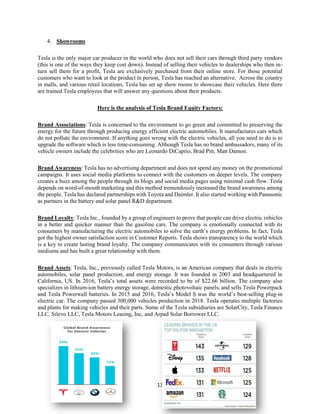
Here is the analysis of Tesla Brand Equity Factors:
Brand Associations: Tesla is concerned to the environment to go green and committed to preserving the
energy for the future through producing energy efficient electric automobiles. It manufactures cars which
do not pollute the environment. If anything goes wrong with the electric vehicles, all you need to do is to
upgrade the software which is less time-consuming. Although Tesla has no brand ambassadors, many of its
vehicle owners include the celebrities who are Leonardo DiCaprio, Brad Pitt, Matt Damon.
Brand Awareness: Tesla has no advertising department and does not spend any money on the promotional
campaigns. It uses social media platforms to connect with the customers on deeper levels. The company
creates a buzz among the people through its blogs and social media pages using minimal cash flow. Tesla
depends on word-of-mouth marketing and this method tremendously increased the brand awareness among
the people. Tesla has declared partnerships with Toyota and Daimler. It also started working with Panasonic
as partners in the battery and solar panel R&D department.
Brand Loyalty: Tesla Inc., founded by a group of engineers to prove that people can drive electric vehicles
in a better and quicker manner than the gasoline cars. The company is emotionally connected with its
consumers by manufacturing the electric automobiles to solve the earth’s energy problems. In fact, Tesla
got the highest owner satisfaction score in Customer Reports. Tesla shows transparency to the world which
is a key to create lasting brand loyalty. The company communicates with its consumers through various
mediums and has built a great relationship with them.
Brand Assets: Tesla, Inc., previously called Tesla Motors, is an American company that deals in electric
automobiles, solar panel production, and energy storage. It was founded in 2003 and headquartered in
California, US. In 2016, Tesla’s total assets were recorded to be of $22.66 billion. The company also
specializes in lithium-ion battery energy storage, domestic photovoltaic panels, and sells Tesla Powerpack
and Tesla Powerwall batteries. In 2015 and 2016, Tesla’s Model S was the world’s best-selling plug-in
electric car. The company passed 300,000 vehicles production in 2018. Tesla operates multiple factories
and plants for making vehicles and their parts. Some of the Tesla subsidiaries are SolarCity, Tesla Finance
LLC, Silevo LLC, Tesla Motors Leasing, Inc, and Arpad Solar Borrower LLC.
14
References:
1) https://www.tesla.com
2) https://www.brand-equity.net
3) www.finance.yahoo.com
4) www.marketwatch.com
5) www.marketing91.com
6) www.warc.com
7) www.statista.com
8) www.brandastic.com
9) www.teslabrand.weebly.com
10) www.forums.tesla.com
11) www.studylib.net
12) www.research-methodology.net
13) http://panmore.com

Tesla Marketing Strategy case study

  • 1.
    2018 By: Muhammad Eddieb Supervisedby: Dr. Reham Moawad 12/21/2018 Tesla Marketing Case Study
  • 2.
    1 Tesla Case Study ‘TESLA’SMISSION IS TO ACCELERATE THE WORLD’S TRANSITION TO SUSTAINABLE ENERGY’. Tesla was founded in 2003 by a group of engineers who wanted to prove that people didn’t need to compromise to drive electric – that electric vehicles can be better, quicker and more fun to drive than gasoline cars. Today, Tesla builds not only all-electric vehicles but also infinitely scalable clean energy generation and storage products. Tesla believes the faster the world stops relying on fossil fuels and moves towards a zero-emission future, the better. Launched in 2008, the Roadster unveiled Tesla’s cutting-edge battery technology and electric powertrain. From there, Tesla designed the world’s first ever premium all-electric sedan from the ground up – Model S – which has become the best car in its class in every category. Combining safety, performance, and efficiency, Model S has reset the world’s expectations for the car of the 21st century with the longest range of any electric vehicle, over-the-air software updates that make it better over time, and a record 0-60 mph acceleration time of 2.28 seconds as measured by Motor Trend. In 2015, Tesla expanded its product line with Model X, the safest, quickest and most capable sport utility vehicle in history that holds 5-star safety ratings across every category from the National Highway Traffic Safety Administration. Completing CEO Elon Musk’s “Secret Master Plan,” in 2016, Tesla introduced Model 3, a low-priced, high-volume electric vehicle that began production in 2017. Soon after, Tesla unveiled the safest, most comfortable truck ever – Tesla Semi – which is designed to save owners at least $200,000 over a million miles based on fuel costs alone. All Tesla vehicles are produced at its factory in Fremont, California, where the vast majority of the vehicle’s components are also made. To achieve our goal of having the safest factories in the world, Tesla is taking a proactive approach to safety, requiring production employees to participate in a multi-day training program before ever setting foot on the factory floor. From there, Tesla continues to provide on-the-job training and track performance daily so that improvements can be made quickly. The result is that Tesla’s safety rate continues to improve while Model 3 production ramps. To create an entire sustainable energy ecosystem, Tesla also manufactures a unique set of energy solutions, Powerwall, Powerpack and Solar Roof, enabling homeowners, businesses, and utilities to manage renewable energy generation, storage, and consumption. Supporting Tesla’s automotive and energy products is Gigafactory 1 – a facility designed to significantly reduce battery cell costs. By bringing cell production in-house, Tesla manufactures batteries at the volumes required to meet production goals, while creating thousands of jobs. And this is just the beginning. With Tesla building its most affordable car yet, Tesla continues to make products accessible and affordable to more and more people, ultimately accelerating the
  • 3.
    2 advent of cleantransport and clean energy production. Electric cars, batteries, and renewable energy generation and storage already exist independently, but when combined, they become even more powerful – that’s the future we want. Marketing Strategy of Tesla Mission and Vision: The vision and mission statement of Tesla reflect the company’s aim for dominance in the global electric vehicles and battery market. Tesla’s mission statement: “to accelerate the world’s transition to sustainable energy”. It believes that the faster the world stops relying on fossil fuels and moves towards a zero-emission future, the better it will be for the world. The vision statement: “to create the most compelling car company of the 21st century by driving the world’s transition to electric vehicles”. Tesla wants to accelerate the advent of sustainable transport by making products accessible and affordable to more and more people ultimately leading to clean transport and clean energy production. Tesla focuses on bringing compelling mass market electric cars to market as soon as possible. Market analysis in the marketing strategy of Tesla: Tesla Internal Analysis SWOT analysis of Tesla Motors Tesla Motors is a new age automotive company which manufactures alternative energy vehicles like solar- powered cars, hybrid vehicles, and battery-operated vehicles. A pioneer of sustainable energy options Tesla Motors is backed by a very strong research and development team and is considered to be a benchmark in green technologies. Strengths in the SWOT analysis of Tesla Motors The following are the strengths of Tesla: Technology: Tesla has always been associated with cutting-edge technologies and many companies have adopted the technologies introduced by Tesla. Some examples of top brands which have used Tesla technologies include Daimler which uses Tesla’s battery packs; Mercedes-Benz a user of Tesla powertrain; Toyota with Tesla motor. In fact, pioneers like GE have set up trackers which keep track of Tesla’s innovations.
  • 4.
    3 • Political andgovernment support: The company has ample support from the government. The company had obtained a USD 465 billion for energy management projects under the US Department of Energy. Tesla started its operations at the right time when Obama had launched the clean tech initiative and this resulted in the company gaining a lot of advantages from the government. • Monopoly: Tesla Motors started off targeting a very niche segment which was electric and alternate energy cars. The strategy was to move deeper into the existing segment and it would not be wrong to say that the company operates in a monopoly market. This has helped it gain steeper growth than most of its counterparts. • Great leadership and team spirit: The CEO of the company Elon Musk is extremely passionate about engineering and an astute salesman. This makes equally proficient in the engineering as well as the commercial side of the business. The CEO is backed by a team that is highly spirited and as passionate about the cause as their leader. The leadership style of Musk which is motivating and inspirational along with a highly self-driven team is a success factor for Tesla. • Distribution channel: Tesla understand how critical distribution may be for the business and this makes Tesla own their own distribution channel. There are also some capacity expansion plans from Tesla which has been triggered by Giga factory. Weaknesses in the SWOT analysis of Tesla Motors Some of the key weaknesses of Tesla Motors are: • Poor liquidity: In comparison to competitors like Ford which has USD 20 billion, General Motors with USD 25billion or Fiat Chrysler Automobiles USD 40 billion which are cash rich from years and years of operations. In comparison to this Tesla has only USD 3 billion which will not be sufficient for it to survive. • Capacity Issues: Tesla manufactures cars in just one plant which is located in Fremont, California. The plant has a capacity to make 500,000 vehicles and the maximum production of the company is limited to this figure making it difficult for the company to target higher volumes. • Poor customer awareness: Tesla makes very specialized products which are essential for the environment because of their sustainability angle. But these products are highly futuristic and most customers are still not sure about whether or not they need to invest in these technologies which are expensive as well. Opportunities in the SWOT analysis of Tesla Motors Some of the opportunities include: • Preference for new technologies: Vehicle technology is taking a whole new turn and there are a host of new technologies like hybrid vehicles, green cars, electric cars, battery operated cars and self-driven autonomous cars. Tesla has researched and launched many products in these emerging technology areas. Threats in the SWOT analysis of Tesla Motors Threats are those factors in the environment which can be detrimental to the growth of the business. Some of the threats include:
  • 5.
    4 • Competition: Teslafaces a lot of competition from various car companies like Ford, General Motors, Fiat Chrysler Automobiles, as well as technology companies like Google. Tesla External Analysis (PESTEL) The PESTEL Analysis is a strategic management tool that determines the effects of the industry’s remote or macro-environment on the company. Tesla’s case involves the remote or macro-environment of the automotive industry, the energy generation industry, and the energy storage industry. These industries’ external factors influence other determinants of the business, such as customers and community-based organizations. For example, Tesla Inc.’s customer base and market share depend on factors like the cost- effectiveness of technologies in the transportation sector. With a strong brand image and improving profitability, the company can enhance its long-term success by including the results of its PESTEL analysis in strategic formulation. Tesla, Inc.’s electric automobile, battery, and solar panel sales revenues are increasing, despite competition with large firms, such as automobile manufacturers like General Motors Company, Honda Motor Company, Toyota Motor Corporation, Volkswagen, Nissan Motor Company, and BMW (Bavarian Motor Works). This condition indicates effectiveness in addressing the external factors in the remote or macro-environment of the business. Political Factors Affecting Tesla’s Business 1. Governmental incentives for electric automobiles (opportunity) 2. New global trade agreements (opportunity) 3. Political stability in the majority of major markets (opportunity) Tesla, Inc. has the opportunity to strengthen its financial performance through incentives from governments. This external factor directly relates with the minimized carbon emissions of the company’s operations and products. In addition, this PESTEL analysis determines that expanding free trade agreements open opportunities for the company to expand its operations internationally. On the other hand, the political stability of major markets makes the remote or macro-environment favorable to Tesla’s generic competitive strategy and intensive growth strategies, which include market penetration. In this part of the PESTEL analysis of Tesla, political external factors present opportunities for growing the automotive business. Economic Factors 1. Decreasing battery costs (opportunity) 2. Decreasing renewable energy costs (opportunity) 3. Economic stability issues (threat) Tesla’s business performance benefits from lower battery costs. For example, this external factor translates to affordability of the company’s electric automobile products. This PESTEL analysis also considers decreasing renewable energy costs as an external factor that makes Tesla’s products more attractive. The business improves as renewable energy solutions become more popular. However, economic stability issues threaten the company’s financial performance, especially in Europe and Asia. This part of the PESTEL analysis of Tesla, Inc. highlights major opportunities for growth, despite the threat of economic instability in the remote or macro-environment of the automotive industry.
  • 6.
    5 Social Factors 1. Increasinglypopularity of low-carbon lifestyles (opportunity) 2. Increasing preference for renewable energy (opportunity) 3. Improving wealth distribution in developing markets (opportunity) This company analysis shows opportunities to grow the multinational automotive business. For example, Tesla Inc. has growth opportunities based on the rising popularity of low-carbon lifestyles and increasing preference for renewable energy. In the PESTEL analysis framework, these external factors improve market demand for the company’s electric vehicles and related products. In addition, Tesla has an opportunity to boost its financial performance based on the increasing wealth distribution in developing markets. This wealth distribution trend increases the population of potential buyers of the company’s relatively expensive cars. In this part of the PESTEL analysis, Tesla Inc. can grow its business internationally, based on sociocultural opportunities in its remote or macro-environment and it already started to enter global markets as well as developing markets such as Egypt. Technological Factors 1. High rate of technological change (opportunity & threat) 2. Increasing automation in business (opportunity) 3. Increasing popularity of online mobile systems (opportunity) The high rate of technological change is an opportunity and threat in this business analysis. The high rate presents opportunity for Tesla to enhance its products’ technologies. However, the same external factor threatens the company in terms of the potential rapid obsolescence of technologies used in its products. Nonetheless, increasing business automation is a trend that creates opportunities in this PESTEL analysis case. For example, Tesla has growth opportunities through further automation of its business processes. In addition, the increasing popularity of online mobile systems should prompt the company to increasingly integrate these systems in its automobiles. The technological condition of the remote or macro-environment, as shown in this part of the PESTEL analysis of Tesla, Inc. emphasizes opportunities for growth based on technological enhancement. Environmental Factors 1. Climate change (opportunity) 2. Expanding environmental programs (opportunity) 3. Rising standards on waste disposal (opportunity) This PESTEL analysis considers ecological factors as significant forces on Tesla, Inc.’s industry environment. For example, the company has opportunities to promote its electric vehicles based on concerns on climate change, expanding environmental programs, and rising standards on waste disposal. The company’s electric vehicles, batteries and solar panels are considered suitable in directly addressing these external factors linked to business sustainability and environmentally friendly products. This part of the PESTEL analysis shows that Tesla has significant growth opportunities based on the nature of its products.
  • 7.
    6 Legal Factors 1. Expandinginternational patent protection (opportunity) 2. Energy consumption regulations (opportunity) 3. Dealership sales regulation in the United States (opportunity & threat) Tesla has opportunities to safely expand its business overseas, considering expanding international patent protection. In addition, this PESTEL analysis identifies the opportunity to promote the company’s electric vehicles and energy solutions products, based on energy consumption regulations that client organizations must follow. Also, the business has an opportunity to grow through direct sales, which is allowed in many states in the U.S. However, based on the SWOT Analysis of Tesla, Inc., this external factor is also a threat, considering that other states do not allow direct sales and, instead, require dealerships to transact with customers in the automotive market. The legal conditions of the remote or macro-environment shown in this part of the PESTEL analysis point out that Tesla can expect growth opportunities. Competition Analysis The global EV market is predicted to grow at a compound annual growth rate of 21.4% between 2018 & 2026 according to ReportBuyer. Tesla still rules the EV market in the USA, Tesla sold three of the country’s five best-selling EV’s first four months of 2018. Tesla’s competitors are Toyota’s Prius Prime plug-in hybrid and General Motors’ Chevy Volt. Both lack Tesla’s brand appeal, however, Tesla is struggling with a production bottleneck. According to McKinsey Research, China has increased its lead in EV production and the country has the largest fleet of EV on the road and has overtaken US market for the first time. China now accounts for half of the EV sold worldwide. Even though Tesla is not able to meet its production goals it is predicted to account for over 605 of all EV sales in the US. In order to understand the volume of competition and its effects on TESLA Inc its urgent to discuss Porter’s Five Forces Analysis. Porter’s Five Forces Analysis Michael Porter developed the Five Forces Analysis model as a strategic management tool to understand the impact of external factors on firms and the competitive landscape of their industry environment. This Five Forces analysis of Tesla looks into the external factors significant in the automotive industry and the energy solutions industry, and how such factors affect the company. As one of the biggest players in the electric vehicle market, Tesla must effectively address such external factors to ensure its long-term competence and resilience in the face of competitive rivalry involving automakers like Honda Motor Company, General Motors Company, Ford Motor Company, Volkswagen, Toyota Motor Corporation, Nissan Motor Company, and BMW (Bavarian Motor Works). Tesla must ensure that it addresses external factors according to the intensity of the forces impacting the business, as shown in this Five Forces analysis: 1. Competitive rivalry or competition (Strong Force) 2. Bargaining power of buyers or customers (Moderate Force) 3. Bargaining power of suppliers (Moderate Force) 4. Threat of substitutes or substitution (Moderate Force) 5. Threat of new entrants or new entry (Weak Force)
  • 8.
    7 Competitive Rivalry orCompetition with Tesla, Inc. (Strong Force) Tesla, Inc. operates in a highly competitive market. This aspect of the Five Forces Analysis outlines the influence of competition on the automotive and energy solutions industry environment. In this case of Tesla, the external factors and their intensities responsible for the strong force of competitive rivalry are as follows: • Small number of firms (weak force) • High aggressiveness of firms (strong force) • Low switching costs (strong force) There are only a small number of firms operating in the automotive market. In Porter’s Five Forces analysis framework, this external factor limits the effect of competition on companies like Tesla, Inc. However, these firms are generally aggressive in innovating and promoting their products. For example, large automotive companies have aggressive marketing campaigns. Tesla’s marketing mix or 4Ps partly meets such aggressiveness, which strengthens the effects of competitors against the business. Also, the low impediments for customers to buy cars from other manufacturers (low switching costs) further strengthen the force of competition. This aspect of the Five Forces analysis of Tesla Inc. points to competitive rivalry as a high-priority strategic management consideration in the automotive and energy solutions industry environment. Bargaining Power of Tesla’s Customers/Buyers (Moderate Force) Tesla’s customers are a direct factor that determines the company’s sales revenues. The following external factors and their intensities maintain the moderate force of the bargaining power of customers on the company: • Low switching costs (strong force) • Moderate substitute availability (moderate force) • Low volume of purchases (weak force) Low switching costs reduce barriers for Tesla customers to purchase cars from other providers. In the context of this Porter’s Five Forces analysis, this external factor imposes a strong force against the company and other players in the automotive industry environment. However, the availability of substitutes is only moderate in many cases, thereby limiting customers’ bargaining power against Tesla Inc. For example, many customers in suburban areas have limited access to public transportation, making it more practical to drive their own car. In addition, the low volume of purchases (each customer buys and keeps only one or a few cars) reduces the influence of customers on Tesla. Thus, the intensities of the external factors in this aspect of the Five Forces analysis reflect the bargaining power of customers as a moderate force and a secondary management priority. Bargaining Power of Tesla’s Suppliers (Moderate Force) Tesla Inc.’s business depends on the reliability of suppliers. This aspect of the Five Forces Analysis shows how suppliers shape the industry environment by influencing the availability of materials that firms need. The intensities of the external factors that create the moderate force of the bargaining power of Tesla’s suppliers are as follows: • Moderate forward integration (moderate force) • Moderate size of suppliers (moderate force)
  • 9.
    8 • Moderate supplylevel (moderate force) Tesla Inc.’s suppliers have a low level of forward integration. This external factor refers to suppliers’ limited control in the distribution and sale of their products. For example, some suppliers use third parties to sell their materials to Tesla, while others directly transact with the company. In the framework of Porter’s Five Forces analysis, this external factor imposes a moderate force on the corporation. In addition, most of these suppliers are moderately sized, thereby having limited influence on the automotive industry environment. Another external factor is the moderate level of supply, which empowers suppliers to affect Tesla, but only to a limited degree. This aspect of this Porter’s Five Forces analysis of Tesla Inc. indicates the bargaining power of suppliers as a secondary strategic management priority. Threat of Substitutes or Substitution (Moderate Force) Tesla, Inc. experiences the impact of substitutes on the automotive and energy solutions industry environment. In this aspect of the Five Forces Analysis, the intensities of the external factors that lead to the moderate force of the threat of substitution against the company are considered, as follows: • Low switching costs (strong force) • Moderate substitute availability (moderate force) • Moderate performance of substitutes (moderate force) As pointed out in the other aspects of this Porter’s Five Forces analysis of Tesla Inc., low switching costs enable competition. In this external analysis case, the low switching costs enable substitutes, such as public transportation, to easily attract customers. This external factor imposes a strong force against Tesla’s industry environment. However, the moderate availability of substitutes limits such influence of suppliers. For example, customers have only a moderate and limited number of substitute options in the market. In relation, many substitutes have only a moderate level of performance in satisfying customers’ practical needs. For instance, public transportation is not as versatile as a private car. This condition further limits substitutes’ force against Tesla. In this aspect of the Five Forces analysis of Tesla, Inc., the external factors point to the threat of substitution as a secondary management consideration in the company’s strategies. Threat of New Entrants or New Entry (Weak Force) New entrants are new firms, which impact the industry environment and determine the performance of companies like Tesla Inc. This aspect of the Five Forces analysis identifies the intensities of the external factors that create the weak force of the threat of new entry, as follows: • High cost of brand development (weak force) • High cost of doing business (weak force) • High economies of scale (weak force) Tesla’s business is difficult to compete with, especially because of the high cost of brand development, along with the popularity of Elon Musk. For example, it is difficult for new entrants to match the company’s strong brand, which is one of the strengths enumerated in the SWOT analysis of Tesla Inc. This external factor is an entry barrier in the context of Porter’s Five Forces analysis. In addition, automobile manufacturing has high costs, which impose a barrier to new firms. Also, established players like Tesla
  • 10.
    9 benefit from increasingeconomies of scale, which new entrants can only achieve upon exceeding a production threshold. Based on the external factors in this aspect of the Five Forces Analysis, the threat of new entry is only a minor strategic management concern in Tesla Inc.’s industry environment. Competitive advantage in the marketing strategy of Tesla: 1) Driven by Technology: More than an automotive company, Tesla is a technology company building technology platforms. Betting on Tesla technology is betting on new technology. The company not only sells cars but has also built the infrastructure necessary to support the operation of those cars. It has built the network of superchargers, battery swap stations, and service stations. Tesla is on track to deliver full autonomous driving capability earlier than many cars manufactures by leveraging the billions of miles’ worth of driving data that Tesla has been gathering. 2) Tesla’s reputation: This can be considered as one of the intangible strengths of the company. Tesla’s Roadster transformed the image of electronic vehicles from small slow vehicles, into blindingly fast vehicles of desire. It provided an acceleration with a 0 to 60 mph that could beat superior cars. Tesla then produced the cheaper Model S sedan that ended up winning just about every big auto award. With the reputation for excellence, it has created an impressive brand image. 3) Diversifying its business: Tesla seems to be diversifying its business and entering into the market of Solar roof tiles as it complements with the business of rechargeable lithium-ion battery which provides homes with the storage of solar captured energy. BCG Matrix in the marketing strategy of Tesla: Model 3 is the combination of design, style, convenience, and moreover safety. It has been priced as the least expensive model developed. The official launch and delivery of the first 30 cars said to be on July 28, 2018. So, the Model 3 belongs to the question mark category of the BCG matrix. Model S is a beautiful model which is packed with functionality, convenience, and safety along with style and energy. It is said that it has crushed large luxury car competition in the USA. Out of 10 large luxury car models, the Tesla Model S gobbled up a notable 34% of sales. Thus, it belongs to the star category of the BCG Matrix.
  • 11.
    10 Model X isa long-range SUV. It has unique designs with falcon wings that give the vehicle a unique and luxurious look and feel. Tesla is said to be pushing back its production schedule for the Model 3. The sales for Model X and Model S sales are soaring but Tesla is still struggling with Model 3 production. This puts the Model 3 in the Dog category of the BCG matrix. Tesla Segmentation, targeting, positioning While segmenting the market Tesla didn’t ask which segment is the most fuel-conscious but which segment enabled the company to build long-term and innovative model vehicles. It didn’t choose the small car segment. The segment of choice was the lower volume, the price-insensitive performance-car segment which enabled them to create a brand identity, establish premium pricing and earn significant unit gross margins by targeting the rich and affluent who are willing to spend more compared to their vehicles. Since 2015, Tesla has been selling an all-electric luxury SUV, which has done relatively well in the market and has delivered the record of 100,000 vehicles for 2017. Tesla’s unique positioning in the car market is one of its biggest strengths. Tesla not only sells cars but also sells technology. It positioning statement was “the only stylish car that can go from 0 to 100 in 3 seconds without a drop of oil”. Customer analysis in the marketing strategy of Tesla: The typical customers of the brand are business executives and entrepreneurs who are tech-savvy, green- friendly and wealthy. The customers are mostly males looking for luxury cars. According to Investopedia, the buyer’s profile are around 83.9% male and 16.1% female. 77% of the buyers have income over $100,000. According to the registration data of Model X, it tells that wealthy and younger customers are buying Tesla’s crossover SUV. It is predicted that the Model X, will have even wider consumer reach due to its affordability factor. Marketing mix of Tesla Motors Tesla Motors, currently known as Tesla Inc is a public limited company of American origin. It deals in energy storage products and is associated with the automotive industry. Tesla Motors was founded in the year 2003, 1st July by its esteemed co-founders JB Straubel, Elon Musk, Ian Wright, Marc Tarpenning and Martin Eberhard. The company faces stiff competition in automobile sector from several rival companies and some of them are as follows- GM, Nissan, Volkswagen, SAIC, FAW Group, Dongfeng, BAIC, NIO, Federal Signal, and WBC. 1. Product in the Marketing mix of Tesla Motors Tesla Motors is an independent automaker that offers a wide range of products made from the latest technology. It adheres to a B2B model which encourages partnership with other companies by supplying products as well as services and also the B2C model by offering luxury, family and mass market vehicles. It is a well-known distributor, manufacturer, developer and designer of eco-friendly products and also offers related services to other automotive companies. Major product manufactured by this international corporation is electric-sedan powered by the battery. Besides this, it also produces sustainable-energy technologies and supercharging stations.
  • 12.
    11 2. Place inthe Marketing mix of Tesla Motors Tesla Motors caters to a worldwide audience via its headquarters based in Palo Alto in the United States. It has a wide sales and distribution network of its own that includes stores in Asia, Europe, Australia, South Korea, Dubai and North America. One of the largest markets of Tesla for electric vehicles is in China and in October 2017 in an agreement with the government of China, a manufacturing plant was to be opened at Shanghai. By May 2017, this international company operates via eight outlets in Canada including cities like Montreal and Ontario. Tesla laid its foundation from San Carlos in California and later built retail outlets in Los Angeles and Manhattan. By October 2016, there were two hundred and sixty retail locations in the United States alone. June 2016 saw a store-within-store in Los Angeles. In the United States, several galleries and stores are set up at shopping malls to gain maximum brand exposure. Tesla Motors has its own website for selling products to interested customers. The company has followed a direct-to-consumer sales approach via its service centers and stores. Inspections and services are offered at their own service stations. Its manufacturing facility is at Fremont, situated in California. Other assembly plants are spread far and wide like Gigafactory 1in Nevada and Giga factory 2 in Buffalo at New York. Instead of using a typical dealer system, Tesla has decided to market its vehicles through online portals and via company showrooms. One of its important R&D department is at Athens in Greece. 3. Price in the Marketing mix of Tesla Motors At the end of the fiscal year 2017, Tesla Motors posted revenues of 11.76 billion US$ with its net income at -2.24 billion US$ and total assets of 28.66 billion US$. Tesla Motors initially decided to target wealthy buyers making a conscious decision to capture larger markets later on with lower-pricings. Hence at its onset, it adopted a premium pricing strategy and maintained high prices for its premium products. This was for a niche market that was more interested in high-quality products with the latest technology irrespective of its price range because they could easily afford such products. Later on, the company launched affordable products keeping in mind the mid-scale general consumers. It wanted to capture a large part of the consumer market and hence adopted a reasonable pricing strategy. This was a huge success as it was able to sell a greater number of products and this resulted in higher profit margins and greater revenues. 4. Promotions in the Marketing mix of Tesla Motors In the year 2017, Tesla Motors approved a budget of 52 US dollars for marketing purposes and used word of mouth and referral program to attract buyers. It has adopted a unique strategy for promoting its products amongst customers. This multinational company also takes the help of media releases and its PR team to create positive brand awareness. As part of its PR activities, its surcharging stations on highways and charging ports at malls, hotels, and restaurants have brand name Tesla written over them. In order to create mass awareness, Tesla has taken the help of social platform. It deals highly via its website, blog, forums and hence uses online platforms for marketing purposes. It always creates a viral buzz at the
  • 13.
    12 launch of anynew product. More than one hundred and fifty videos are uploaded on its official channel via YouTube with nearly 364k followers showing great features of their vehicles. Latest information along with features, specifications, safety measures, warranty, new software is updated at regular intervals on its official website for interested customers. Tesla uses its Facebook page for maximum benefit and has more than 2.2 million followers. Discussions are held periodically on this social medium about various products and technology. The company also connects with its fans via Twitter successfully as it has more than 1.73 million followers on its Twitter account. CEO Elon Musk is the public face of the company and he actively participates in several interviews and talk shows. This helps in gaining positive visibility and recall value of the brand name. Brand equity in the marketing strategy of Tesla: Tesla has a market cap of nearly 60 billion even though it consistently failed to meet production targets and spends billions of dollars a year. Tesla as a brand is more than just a car manufacturer, it is a vision of the future. The face of the brand for Tesla is the CEO himself, Elon Musk, who is a noted entrepreneur and an influencer. Part of a reason why it is impossible to separate Elon Musk’s brand from Tesla is that of how responsive he is to the Tesla users who reach out to him and his presence is largely felt on the social media. Tesla has consistently proven to care about user experience which has helped shape a public perception about the brand. Word of mouth has been a powerful driver for Tesla’s growth with fervent supporters who don’t even own a Tesla but support the idea and vision of Tesla. Tesla used several channels to reach its customers and make them aware of the TESLA brand. These are examples of channels and strategies used by Tesla which include: Mobile Videos, Mobile Apps, Social Media, and Showrooms. 1. Mobile Videos While Tesla does not currently "advertise" their products in the tradition sense, they have done a marvelous job marketing their vehicles. Through viral videos, word-of-mouth, their unique storefronts, and their overall superior product, Tesla has quickly placed its name amongst the luxury automotive titans. 2. Mobile Application Tesla's mobile application is just another example of the innovative technology coming out of this company. With the application in your mobile you have the full control over Tesla Car and can track every small info which is not available with other competitors and that gives Tesla a competitive edge over their rivals a Tesla is not only selling cars but Technology. 3. Social Media An example of unique marketing is CEO Elon Musk's twitter page, and the massive amount of support he receives and awareness he creates there. After a string of mysterious tweets about the new "D" Tesla, Musk sat down to discuss the innovations they are bringing to the auto market in the coming years.
  • 14.
    13 4. Showrooms Tesla isthe only major car producer in the world who does not sell their cars through third party vendors (this is one of the ways they keep cost down). Instead of selling their vehicles to dealerships who then in- turn sell them for a profit, Tesla are exclusively purchased from their online store. For those potential customers who want to look at the product in person, Tesla has reached an alternative. Across the country in malls, and various retail locations, Tesla has set up show rooms to showcase their vehicles. Here there are trained Tesla employees that will answer any questions about their products. Here is the analysis of Tesla Brand Equity Factors: Brand Associations: Tesla is concerned to the environment to go green and committed to preserving the energy for the future through producing energy efficient electric automobiles. It manufactures cars which do not pollute the environment. If anything goes wrong with the electric vehicles, all you need to do is to upgrade the software which is less time-consuming. Although Tesla has no brand ambassadors, many of its vehicle owners include the celebrities who are Leonardo DiCaprio, Brad Pitt, Matt Damon. Brand Awareness: Tesla has no advertising department and does not spend any money on the promotional campaigns. It uses social media platforms to connect with the customers on deeper levels. The company creates a buzz among the people through its blogs and social media pages using minimal cash flow. Tesla depends on word-of-mouth marketing and this method tremendously increased the brand awareness among the people. Tesla has declared partnerships with Toyota and Daimler. It also started working with Panasonic as partners in the battery and solar panel R&D department. Brand Loyalty: Tesla Inc., founded by a group of engineers to prove that people can drive electric vehicles in a better and quicker manner than the gasoline cars. The company is emotionally connected with its consumers by manufacturing the electric automobiles to solve the earth’s energy problems. In fact, Tesla got the highest owner satisfaction score in Customer Reports. Tesla shows transparency to the world which is a key to create lasting brand loyalty. The company communicates with its consumers through various mediums and has built a great relationship with them. Brand Assets: Tesla, Inc., previously called Tesla Motors, is an American company that deals in electric automobiles, solar panel production, and energy storage. It was founded in 2003 and headquartered in California, US. In 2016, Tesla’s total assets were recorded to be of $22.66 billion. The company also specializes in lithium-ion battery energy storage, domestic photovoltaic panels, and sells Tesla Powerpack and Tesla Powerwall batteries. In 2015 and 2016, Tesla’s Model S was the world’s best-selling plug-in electric car. The company passed 300,000 vehicles production in 2018. Tesla operates multiple factories and plants for making vehicles and their parts. Some of the Tesla subsidiaries are SolarCity, Tesla Finance LLC, Silevo LLC, Tesla Motors Leasing, Inc, and Arpad Solar Borrower LLC.
  • 15.
    14 References: 1) https://www.tesla.com 2) https://www.brand-equity.net 3)www.finance.yahoo.com 4) www.marketwatch.com 5) www.marketing91.com 6) www.warc.com 7) www.statista.com 8) www.brandastic.com 9) www.teslabrand.weebly.com 10) www.forums.tesla.com 11) www.studylib.net 12) www.research-methodology.net 13) http://panmore.com