Tesla Motors
Samantha Hoffer
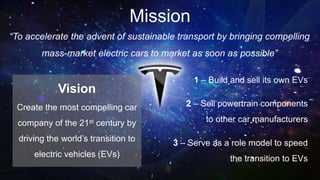
Mission
“To accelerate the advent of sustainable transport by bringing compelling
mass-market electric cars to market as soon as possible”
3 – Serve as a role model to speed
the transition to EVs
1 – Build and sell its own EVs
2 – Sell powertrain components
to other car manufacturers
Vision
Create the most compelling car
company of the 21st century by
driving the world’s transition to
electric vehicles (EVs)
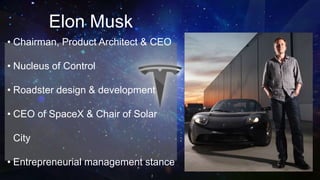
Elon Musk
• Chairman, Product Architect & CEO
• Nucleus of Control
• Roadster design & development
• CEO of SpaceX & Chair of Solar
City
• Entrepreneurial management stance
Top Management
Deepak Ahuja
Chief Financial Officer
Ford - Kennametal
JB Straubel
Chief Technology Officer
2008 MIT TR35
Franz von Holzhausen
Chief Designer
Mazda - Audi - GM
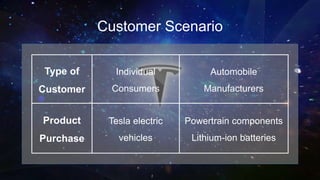
Customer Scenario
Type of
Customer
Individual
Consumers
Automobile
Manufacturers
Product
Purchase
Tesla electric
vehicles
Powertrain components
Lithium-ion batteries
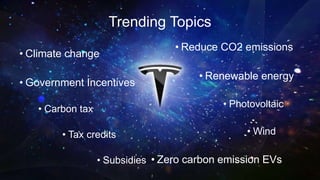
Trending Topics
• Climate change
• Government Incentives
• Carbon tax
• Tax credits
• Subsidies
• Reduce CO2 emissions
• Renewable energy
• Photovoltaic
• Wind
• Zero carbon emission EVs
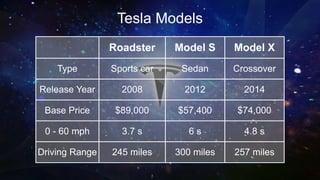
Tesla Models
Roadster Model S Model X
Type Sports car Sedan Crossover
Release Year 2008 2012 2014
Base Price $89,000 $57,400 $74,000
0 - 60 mph 3.7 s 6 s 4.8 s
Driving Range 245 miles 300 miles 257 miles
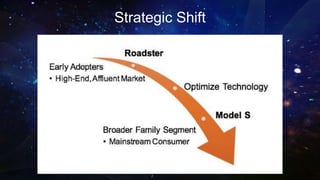
Strategic Shift
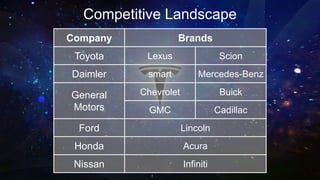
Competitive Landscape
Company Brands
Toyota Lexus Scion
Daimler smart Mercedes-Benz
General
Motors
Chevrolet Buick
GMC Cadillac
Ford Lincoln
Honda Acura
Nissan Infiniti
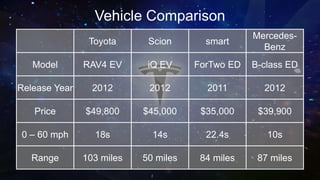
Vehicle Comparison
Toyota Scion smart
Mercedes-
Benz
Model RAV4 EV iQ EV ForTwo ED B-class ED
Release Year 2012 2012 2011 2012
Price $49,800 $45,000 $35,000 $39,900
0 – 60 mph 18s 14s 22.4s 10s
Range 103 miles 50 miles 84 miles 87 miles
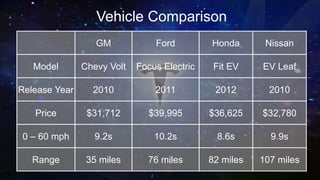
Vehicle Comparison
GM Ford Honda Nissan
Model Chevy Volt Focus Electric Fit EV EV Leaf
Release Year 2010 2011 2012 2010
Price $31,712 $39,995 $36,625 $32,780
0 – 60 mph 9.2s 10.2s 8.6s 9.9s
Range 35 miles 76 miles 82 miles 107 miles
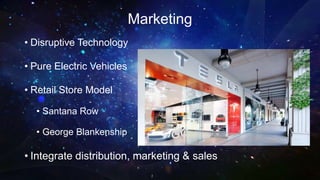
Marketing
• Disruptive Technology
• Pure Electric Vehicles
• Retail Store Model
• Santana Row
• George Blankenship
• Integrate distribution, marketing & sales
Operations
• 3 Pronged Product-Market Approach
• Sell own vehicles in company-owned showrooms & online
• Sell patented electric powertrain components to other automakers
• Serve as catalyst & positive example to automakers
• Inventory Control
• JIT & Customization practices
• Inefficient use of assets
• Strong use of partnership agreements
Partnerships
• Three major agreements
• Panasonic
• Toyota
• Daimler
• Increase demand for Tesla EV components & expertise
• Create potential competitors with more resources
Panasonic
• $30 Million
• Collaborative partnership
• Develop high-efficiency nickel-based lithium-ion batteries
Toyota
• $60 Million
• Electric powertrains
• Mass-produce RAV4 EV
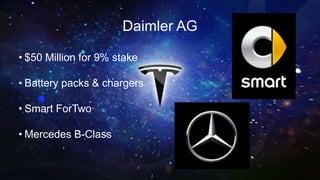
Daimler AG
• $50 Million for 9% stake
• Battery packs & chargers
• Smart ForTwo
• Mercedes B-Class
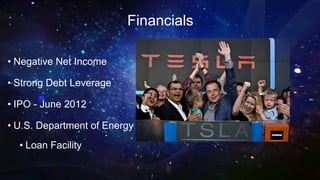
Financials
• Negative Net Income
• Strong Debt Leverage
• IPO - June 2012
• U.S. Department of Energy
• Loan Facility
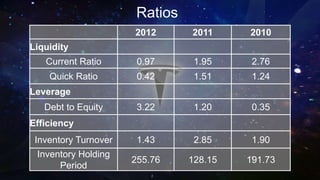
Ratios
2012 2011 2010
Liquidity
Current Ratio 0.97 1.95 2.76
Quick Ratio 0.42 1.51 1.24
Leverage
Debt to Equity 3.22 1.20 0.35
Efficiency
Inventory Turnover 1.43 2.85 1.90
Inventory Holding
Period
255.76 128.15 191.73
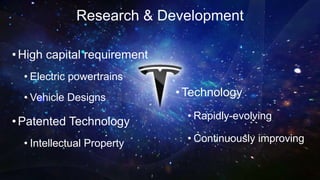
Research & Development
•High capital requirement
• Electric powertrains
• Vehicle Designs
•Patented Technology
• Intellectual Property
• Technology
• Rapidly-evolving
• Continuously improving
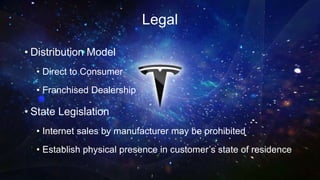
Legal
• Distribution Model
• Direct to Consumer
• Franchised Dealership
• State Legislation
• Internet sales by manufacturer may be prohibited
• Establish physical presence in customer’s state of residence
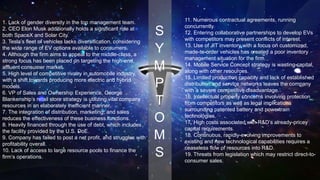
11. Numerous contractual agreements, running
concurrently.
12. Entering collaborative partnerships to develop EVs
with competitors may present conflicts of interest.
13. Use of JIT inventory with a focus on customized,
made-to-order vehicles has created a poor inventory
management situation for the firm.
14. Mobile Service Concept strategy is wasting capital,
along with other resources.
15. Limited production capacity and lack of established
distribution and service networks leaves the company
with a severe competitive disadvantage.
16. Intellectual property concerns involving protection
from competitors as well as legal implications
surrounding patented battery and powertrain
technologies.
17. High costs associated with R&D’s already-pricey
capital requirements.
18. Continuous, rapidly-evolving improvements to
existing and new technological capabilities requires a
ceaseless flow of resources into R&D.
19. Threats from legislation which may restrict direct-to-
consumer sales.
1. Lack of gender diversity in the top management team.
2. CEO Elon Musk additionally holds a significant role at
both SpaceX and Solar City.
3. Tesla’s fleet of vehicles lacks diversification, considering
the wide range of EV options available to consumers.
4. Although the firm aims to appeal to the middle-class, a
strong focus has been placed on targeting the high-end,
affluent consumer market.
5. High level of competitive rivalry in automobile industry,
with a shift towards producing more electric and hybrid
models.
6. VP of Sales and Ownership Experience, George
Blankenship’s retail store strategy is utilizing vital company
resources in an elaborately inefficient manner.
7. The integration of distribution, marketing, and sales
reduces the effectiveness of these business functions.
8. Heavily financed through the use of debt, which includes
the facility provided by the U.S. DoE.
9. Company has failed to post a net profit, and struggles with
profitability overall.
10. Lack of access to large resource pools to finance the
firm’s operations.
S
Y
M
P
T
O
M
S
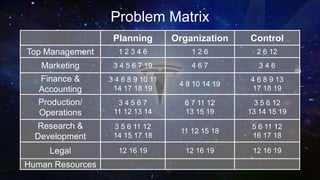
Problem Matrix
Planning Organization Control
Top Management 1 2 3 4 6 1 2 6 2 6 12
Marketing 3 4 5 6 7 19 4 6 7 3 4 6
Finance &
Accounting
3 4 6 8 9 10 11
14 17 18 19
4 8 10 14 19
4 6 8 9 13
17 18 19
Production/
Operations
3 4 5 6 7
11 12 13 14
6 7 11 12
13 15 19
3 5 6 12
13 14 15 19
Research &
Development
3 5 6 11 12
14 15 17 18
11 12 15 18
5 6 11 12
16 17 18
Legal 12 16 19 12 16 19 12 16 19
Human Resources
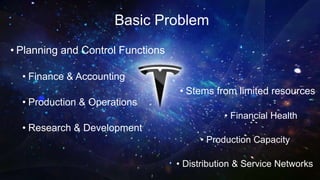
Basic Problem
• Planning and Control Functions
• Finance & Accounting
• Production & Operations
• Research & Development
• Stems from limited resources
• Financial Health
• Production Capacity
• Distribution & Service Networks
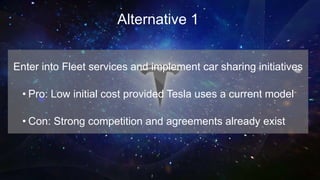
Alternative 1
Enter into Fleet services and implement car sharing initiatives
• Pro: Low initial cost provided Tesla uses a current model
• Con: Strong competition and agreements already exist
Alternative 2
Diversification of product offerings through partnerships that
will develop Hybrid Electric & Plug-in Hybrid Models
• Pro: Expand portfolio of eco-friendly vehicles
• Con: Late-Mover following competition
Alternative 3
Introduce new product lines that include trucks and SUVs
• Pro: Expand into greater automobile market & diversify fleet
• Con: Model X crossover SUV may closely compete
Recommendation: Alternative 2
Diversification of product offerings through partnerships that
will develop Hybrid Electric & Plug-in Hybrid Tesla Models
• Expand product portfolio while mitigating potential risks
• Remain true to Tesla’s Mission of sustainability by providing
another eco-friendly vehicle option at a lower price point
Implementation
• Late-Mover to Hybrid Vehicle Manufacturing
• Current battery technologies may prove relevant within this segment
• Lowest cost battery per kWh than competitors
• Transition away from differentiation with its previous EVs
• Integrated Cost Leadership / Differentiation Strategy
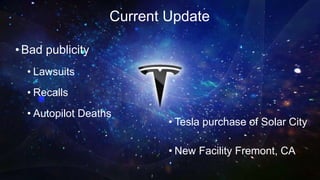
Current Update
•Bad publicity
• Lawsuits
• Recalls
• Autopilot Deaths
• Tesla purchase of Solar City
• New Facility Fremont, CA

Tesla Motors

  • 1.
  • 2.
    Mission “To accelerate theadvent of sustainable transport by bringing compelling mass-market electric cars to market as soon as possible” 3 – Serve as a role model to speed the transition to EVs 1 – Build and sell its own EVs 2 – Sell powertrain components to other car manufacturers Vision Create the most compelling car company of the 21st century by driving the world’s transition to electric vehicles (EVs)
  • 3.
    Elon Musk • Chairman,Product Architect & CEO • Nucleus of Control • Roadster design & development • CEO of SpaceX & Chair of Solar City • Entrepreneurial management stance
  • 4.
    Top Management Deepak Ahuja ChiefFinancial Officer Ford - Kennametal JB Straubel Chief Technology Officer 2008 MIT TR35 Franz von Holzhausen Chief Designer Mazda - Audi - GM
  • 5.
  • 6.
    Trending Topics • Climatechange • Government Incentives • Carbon tax • Tax credits • Subsidies • Reduce CO2 emissions • Renewable energy • Photovoltaic • Wind • Zero carbon emission EVs
  • 7.
    Tesla Models Roadster ModelS Model X Type Sports car Sedan Crossover Release Year 2008 2012 2014 Base Price $89,000 $57,400 $74,000 0 - 60 mph 3.7 s 6 s 4.8 s Driving Range 245 miles 300 miles 257 miles
  • 8.
  • 9.
    Competitive Landscape Company Brands ToyotaLexus Scion Daimler smart Mercedes-Benz General Motors Chevrolet Buick GMC Cadillac Ford Lincoln Honda Acura Nissan Infiniti
  • 10.
    Vehicle Comparison Toyota Scionsmart Mercedes- Benz Model RAV4 EV iQ EV ForTwo ED B-class ED Release Year 2012 2012 2011 2012 Price $49,800 $45,000 $35,000 $39,900 0 – 60 mph 18s 14s 22.4s 10s Range 103 miles 50 miles 84 miles 87 miles
  • 11.
    Vehicle Comparison GM FordHonda Nissan Model Chevy Volt Focus Electric Fit EV EV Leaf Release Year 2010 2011 2012 2010 Price $31,712 $39,995 $36,625 $32,780 0 – 60 mph 9.2s 10.2s 8.6s 9.9s Range 35 miles 76 miles 82 miles 107 miles
  • 12.
    Marketing • Disruptive Technology •Pure Electric Vehicles • Retail Store Model • Santana Row • George Blankenship • Integrate distribution, marketing & sales
  • 13.
    Operations • 3 ProngedProduct-Market Approach • Sell own vehicles in company-owned showrooms & online • Sell patented electric powertrain components to other automakers • Serve as catalyst & positive example to automakers • Inventory Control • JIT & Customization practices • Inefficient use of assets • Strong use of partnership agreements
  • 14.
    Partnerships • Three majoragreements • Panasonic • Toyota • Daimler • Increase demand for Tesla EV components & expertise • Create potential competitors with more resources
  • 15.
    Panasonic • $30 Million •Collaborative partnership • Develop high-efficiency nickel-based lithium-ion batteries
  • 16.
    Toyota • $60 Million •Electric powertrains • Mass-produce RAV4 EV
  • 17.
    Daimler AG • $50Million for 9% stake • Battery packs & chargers • Smart ForTwo • Mercedes B-Class
  • 18.
    Financials • Negative NetIncome • Strong Debt Leverage • IPO - June 2012 • U.S. Department of Energy • Loan Facility
  • 19.
    Ratios 2012 2011 2010 Liquidity CurrentRatio 0.97 1.95 2.76 Quick Ratio 0.42 1.51 1.24 Leverage Debt to Equity 3.22 1.20 0.35 Efficiency Inventory Turnover 1.43 2.85 1.90 Inventory Holding Period 255.76 128.15 191.73
  • 20.
    Research & Development •Highcapital requirement • Electric powertrains • Vehicle Designs •Patented Technology • Intellectual Property • Technology • Rapidly-evolving • Continuously improving
  • 21.
    Legal • Distribution Model •Direct to Consumer • Franchised Dealership • State Legislation • Internet sales by manufacturer may be prohibited • Establish physical presence in customer’s state of residence
  • 22.
    11. Numerous contractualagreements, running concurrently. 12. Entering collaborative partnerships to develop EVs with competitors may present conflicts of interest. 13. Use of JIT inventory with a focus on customized, made-to-order vehicles has created a poor inventory management situation for the firm. 14. Mobile Service Concept strategy is wasting capital, along with other resources. 15. Limited production capacity and lack of established distribution and service networks leaves the company with a severe competitive disadvantage. 16. Intellectual property concerns involving protection from competitors as well as legal implications surrounding patented battery and powertrain technologies. 17. High costs associated with R&D’s already-pricey capital requirements. 18. Continuous, rapidly-evolving improvements to existing and new technological capabilities requires a ceaseless flow of resources into R&D. 19. Threats from legislation which may restrict direct-to- consumer sales. 1. Lack of gender diversity in the top management team. 2. CEO Elon Musk additionally holds a significant role at both SpaceX and Solar City. 3. Tesla’s fleet of vehicles lacks diversification, considering the wide range of EV options available to consumers. 4. Although the firm aims to appeal to the middle-class, a strong focus has been placed on targeting the high-end, affluent consumer market. 5. High level of competitive rivalry in automobile industry, with a shift towards producing more electric and hybrid models. 6. VP of Sales and Ownership Experience, George Blankenship’s retail store strategy is utilizing vital company resources in an elaborately inefficient manner. 7. The integration of distribution, marketing, and sales reduces the effectiveness of these business functions. 8. Heavily financed through the use of debt, which includes the facility provided by the U.S. DoE. 9. Company has failed to post a net profit, and struggles with profitability overall. 10. Lack of access to large resource pools to finance the firm’s operations. S Y M P T O M S
  • 23.
    Problem Matrix Planning OrganizationControl Top Management 1 2 3 4 6 1 2 6 2 6 12 Marketing 3 4 5 6 7 19 4 6 7 3 4 6 Finance & Accounting 3 4 6 8 9 10 11 14 17 18 19 4 8 10 14 19 4 6 8 9 13 17 18 19 Production/ Operations 3 4 5 6 7 11 12 13 14 6 7 11 12 13 15 19 3 5 6 12 13 14 15 19 Research & Development 3 5 6 11 12 14 15 17 18 11 12 15 18 5 6 11 12 16 17 18 Legal 12 16 19 12 16 19 12 16 19 Human Resources
  • 24.
    Basic Problem • Planningand Control Functions • Finance & Accounting • Production & Operations • Research & Development • Stems from limited resources • Financial Health • Production Capacity • Distribution & Service Networks
  • 25.
    Alternative 1 Enter intoFleet services and implement car sharing initiatives • Pro: Low initial cost provided Tesla uses a current model • Con: Strong competition and agreements already exist
  • 26.
    Alternative 2 Diversification ofproduct offerings through partnerships that will develop Hybrid Electric & Plug-in Hybrid Models • Pro: Expand portfolio of eco-friendly vehicles • Con: Late-Mover following competition
  • 27.
    Alternative 3 Introduce newproduct lines that include trucks and SUVs • Pro: Expand into greater automobile market & diversify fleet • Con: Model X crossover SUV may closely compete
  • 28.
    Recommendation: Alternative 2 Diversificationof product offerings through partnerships that will develop Hybrid Electric & Plug-in Hybrid Tesla Models • Expand product portfolio while mitigating potential risks • Remain true to Tesla’s Mission of sustainability by providing another eco-friendly vehicle option at a lower price point
  • 29.
    Implementation • Late-Mover toHybrid Vehicle Manufacturing • Current battery technologies may prove relevant within this segment • Lowest cost battery per kWh than competitors • Transition away from differentiation with its previous EVs • Integrated Cost Leadership / Differentiation Strategy
  • 30.
    Current Update •Bad publicity •Lawsuits • Recalls • Autopilot Deaths • Tesla purchase of Solar City • New Facility Fremont, CA