STRATEGIC MANAGEMENT ANALYSIS
Dhruv Parekh, Sheryl (Qianru) Wang, Manas Thakre,
Shiyi Luo, Jacob Kovacs, Vaibhavi Rangarajan
Contents
Introduction
Who is Tesla Motors?
Snapshot
History
Leadership
Organizational Structure
Culture
Innovation
Corporate Social Responsibility
Social Role
IT Strategy
Strategic Management Analysis
PESTEL Analysis
Porter Five Forces Analysis
SWOT Analysis
Recommendations
References
Introduction
Greetings!
We are pleased to share our strategic management
analysis of Tesla Motors, an inspiring company with a
bold vision: to “accelerate the world’s transition to
sustainable energy” (Tesla, n.d.).
In this report, we provide an in-depth picture of Tesla’s
operations, followed by a comprehensive analysis of the
landscape Tesla faces at present. We conclude with
several strategic recommendations for Tesla.
We enjoyed working together to understand this complex
and exciting company. We all brought strong ideas to the
table and negotiated to form a common vision. We
learned to apply management principles to a real-world
case, and also built more appreciation for the tremendous
good a business can do under principled leadership.
— Team Six
Dhruv
Parekh
Tesla’s Corporate Social
Responsibility is what I
admire.
Shiyi
Luo
Cool company, cool CEO,
cool cars!
Sheryl
(Qianru)
Wang
I am now a big fan of
Tesla.
Jacob
Kovacs
Who knew a car
company could be so
interesting?
Manas
Thakre
We got to know a true
leader.
Vaibhavi
Rangarajan
Tesla shows it’s possible
to dream big and
achieve those goals.
Who is Tesla Motors?
An in-depth portrait of the company
“We're running the most dangerous experiment in history right now,
which is to see how much carbon dioxide the atmosphere can handle
before there is an environmental catastrophe.”
— Elon Musk
Snapshot
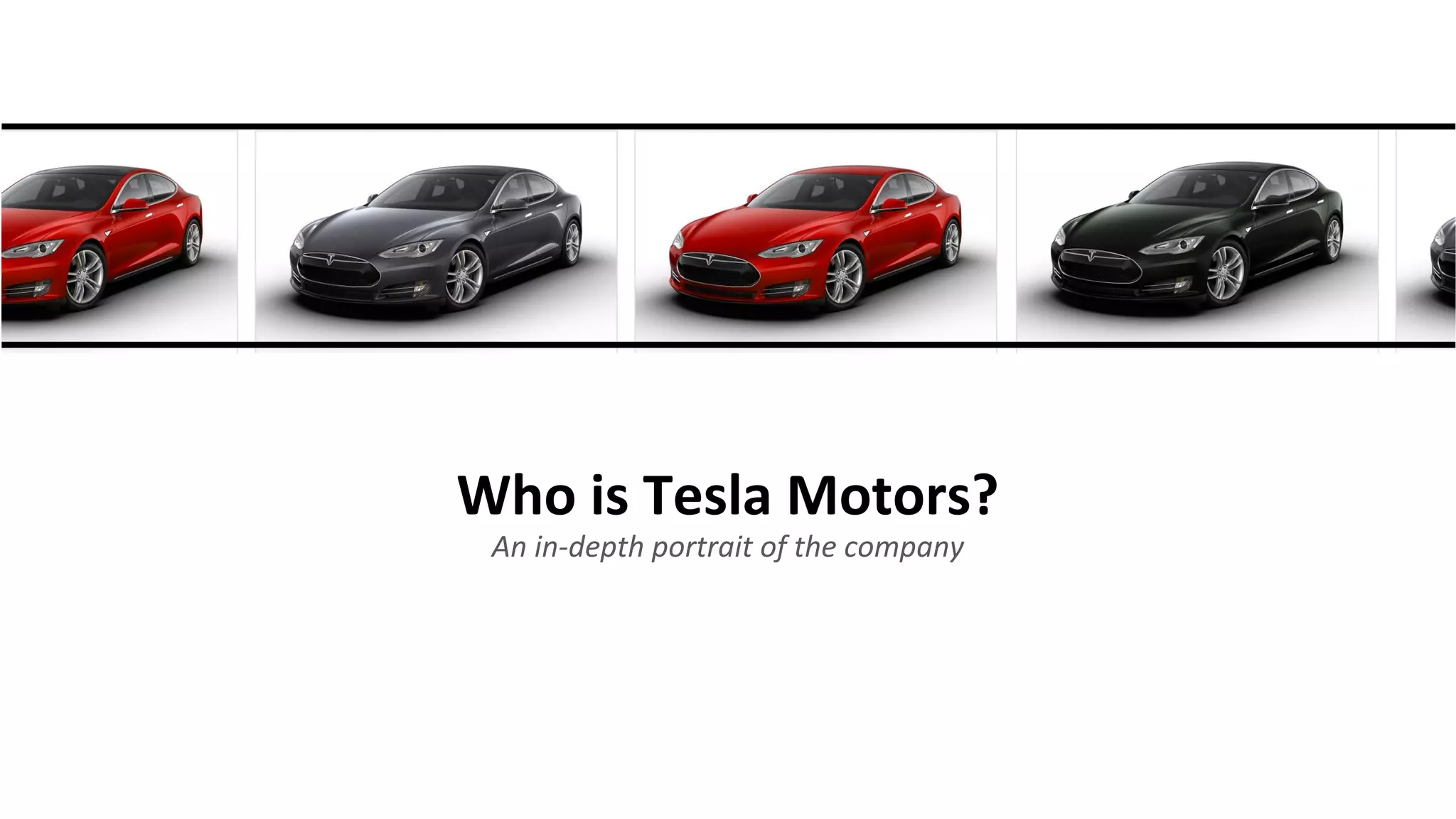
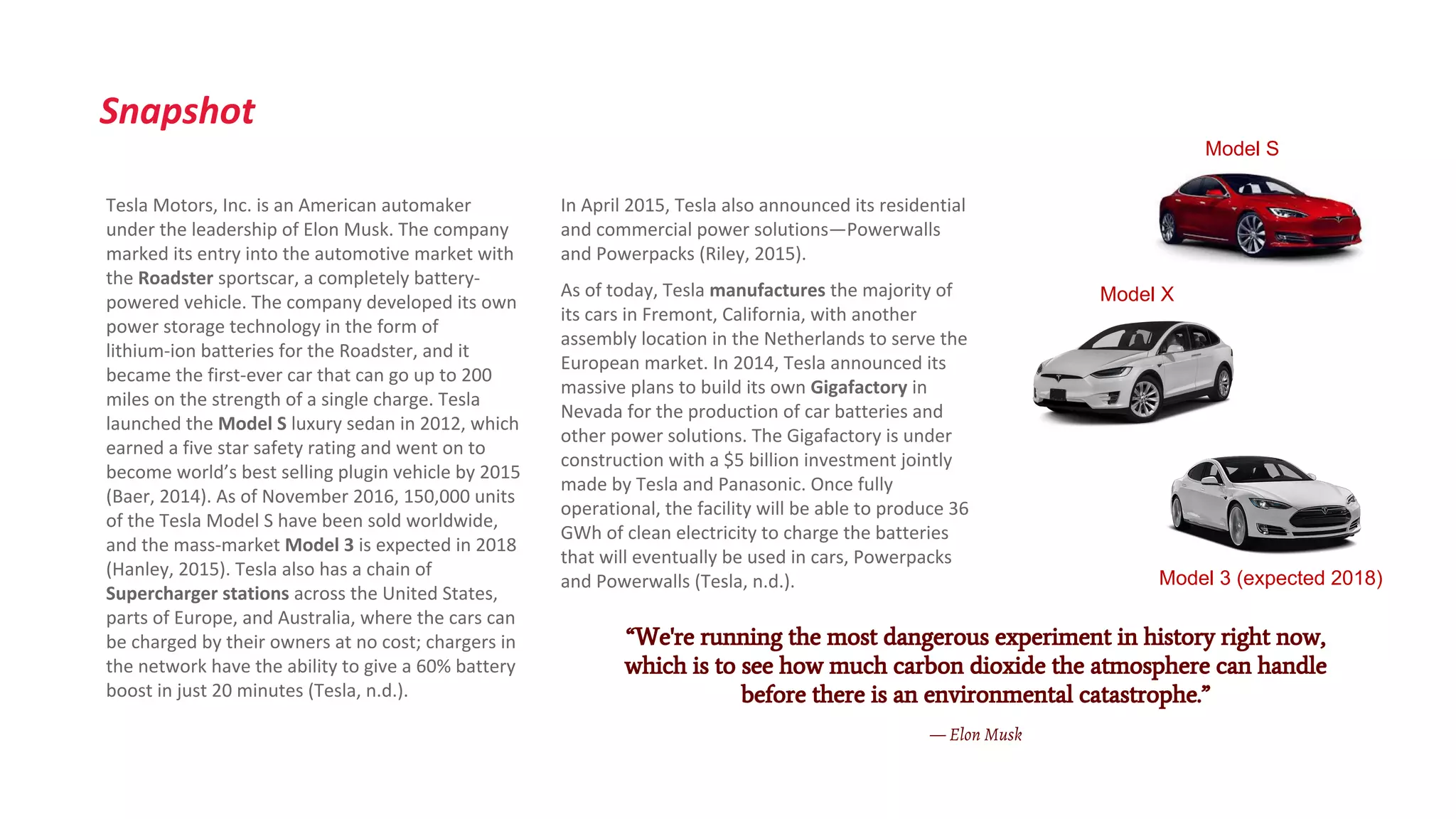
Tesla Motors, Inc. is an American automaker
under the leadership of Elon Musk. The company
marked its entry into the automotive market with
the Roadster sportscar, a completely battery-
powered vehicle. The company developed its own
power storage technology in the form of
lithium-ion batteries for the Roadster, and it
became the first-ever car that can go up to 200
miles on the strength of a single charge. Tesla
launched the Model S luxury sedan in 2012, which
earned a five star safety rating and went on to
become world’s best selling plugin vehicle by 2015
(Baer, 2014). As of November 2016, 150,000 units
of the Tesla Model S have been sold worldwide,
and the mass-market Model 3 is expected in 2018
(Hanley, 2015). Tesla also has a chain of
Supercharger stations across the United States,
parts of Europe, and Australia, where the cars can
be charged by their owners at no cost; chargers in
the network have the ability to give a 60% battery
boost in just 20 minutes (Tesla, n.d.).
In April 2015, Tesla also announced its residential
and commercial power solutions—Powerwalls
and Powerpacks (Riley, 2015).
As of today, Tesla manufactures the majority of
its cars in Fremont, California, with another
assembly location in the Netherlands to serve the
European market. In 2014, Tesla announced its
massive plans to build its own Gigafactory in
Nevada for the production of car batteries and
other power solutions. The Gigafactory is under
construction with a $5 billion investment jointly
made by Tesla and Panasonic. Once fully
operational, the facility will be able to produce 36
GWh of clean electricity to charge the batteries
that will eventually be used in cars, Powerpacks
and Powerwalls (Tesla, n.d.).
Model X
Model S
Model 3 (expected 2018)
Snapshot
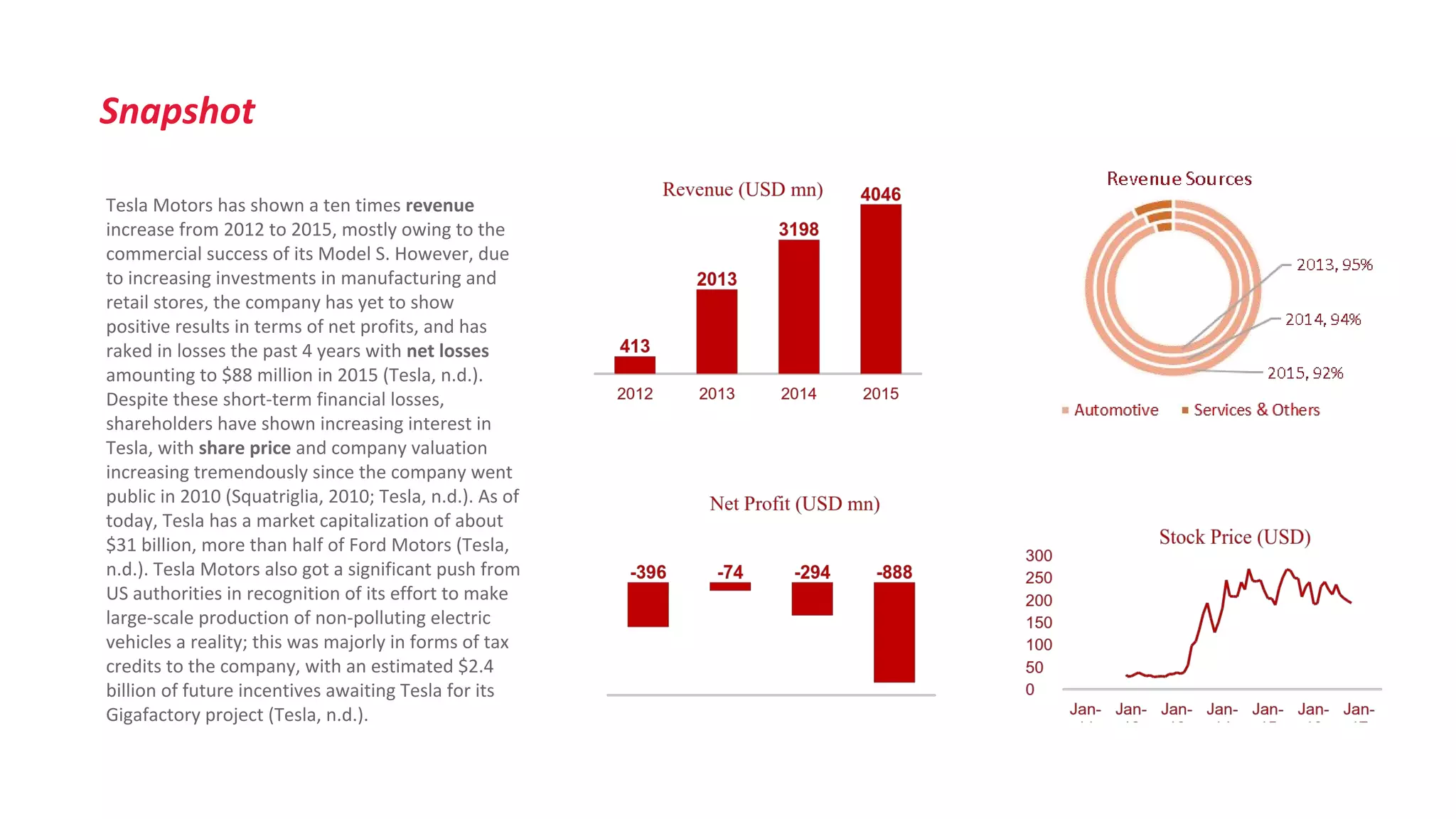
Tesla Motors has shown a ten times revenue
increase from 2012 to 2015, mostly owing to the
commercial success of its Model S. However, due
to increasing investments in manufacturing and
retail stores, the company has yet to show
positive results in terms of net profits, and has
raked in losses the past 4 years with net losses
amounting to $88 million in 2015 (Tesla, n.d.).
Despite these short-term financial losses,
shareholders have shown increasing interest in
Tesla, with share price and company valuation
increasing tremendously since the company went
public in 2010 (Squatriglia, 2010; Tesla, n.d.). As of
today, Tesla has a market capitalization of about
$31 billion, more than half of Ford Motors (Tesla,
n.d.). Tesla Motors also got a significant push from
US authorities in recognition of its effort to make
large-scale production of non-polluting electric
vehicles a reality; this was majorly in forms of tax
credits to the company, with an estimated $2.4
billion of future incentives awaiting Tesla for its
Gigafactory project (Tesla, n.d.).
History
“I was thinking I should do what
every guy does and buy a sports car …”
— Martin Eberhard
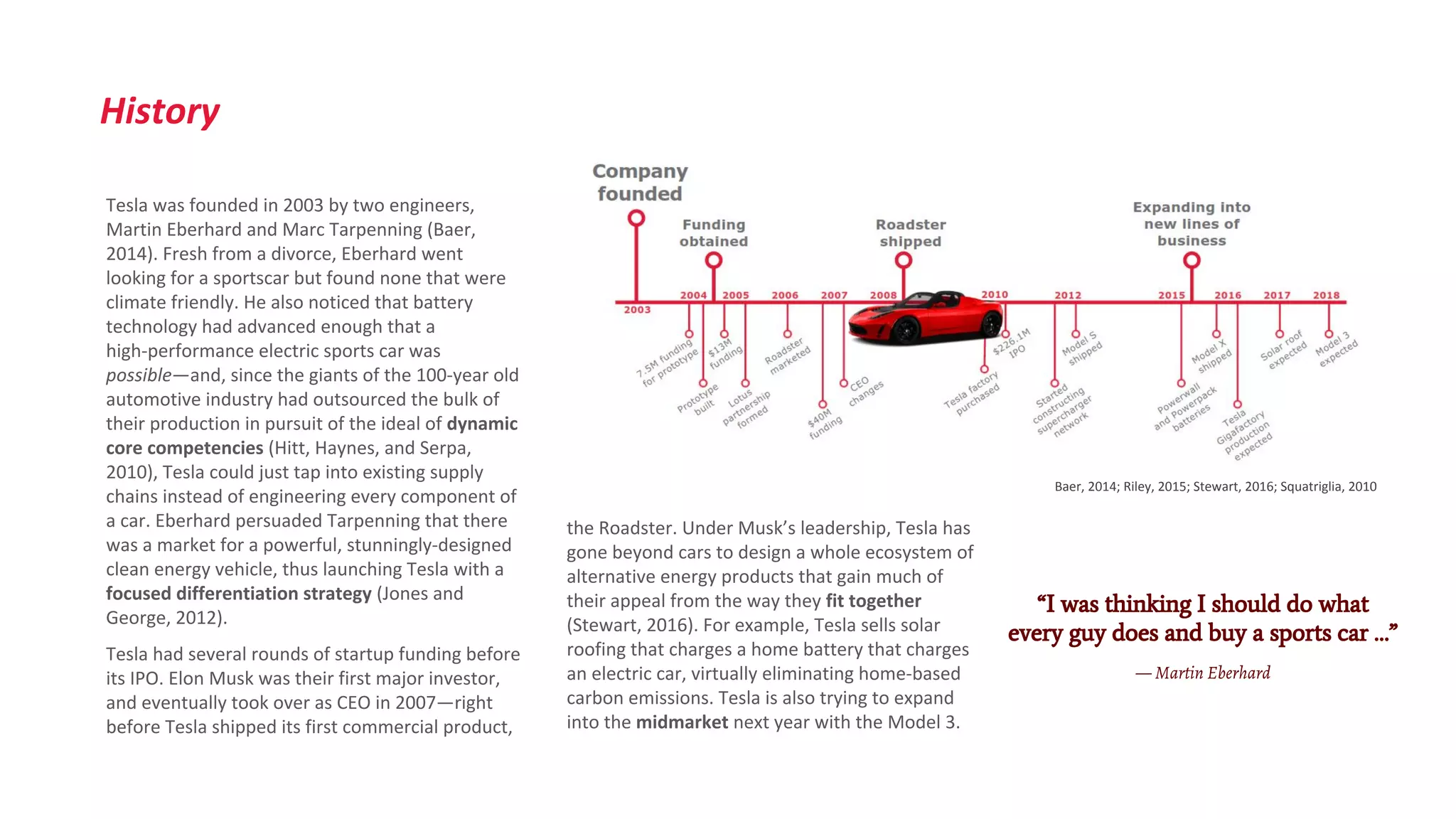
Tesla was founded in 2003 by two engineers,
Martin Eberhard and Marc Tarpenning (Baer,
2014). Fresh from a divorce, Eberhard went
looking for a sportscar but found none that were
climate friendly. He also noticed that battery
technology had advanced enough that a
high-performance electric sports car was
possible—and, since the giants of the 100-year old
automotive industry had outsourced the bulk of
their production in pursuit of the ideal of dynamic
core competencies (Hitt, Haynes, and Serpa,
2010), Tesla could just tap into existing supply
chains instead of engineering every component of
a car. Eberhard persuaded Tarpenning that there
was a market for a powerful, stunningly-designed
clean energy vehicle, thus launching Tesla with a
focused differentiation strategy (Jones and
George, 2012).
Tesla had several rounds of startup funding before
its IPO. Elon Musk was their first major investor,
and eventually took over as CEO in 2007—right
before Tesla shipped its first commercial product,
the Roadster. Under Musk’s leadership, Tesla has
gone beyond cars to design a whole ecosystem of
alternative energy products that gain much of
their appeal from the way they fit together
(Stewart, 2016). For example, Tesla sells solar
roofing that charges a home battery that charges
an electric car, virtually eliminating home-based
carbon emissions. Tesla is also trying to expand
into the midmarket next year with the Model 3.
Baer, 2014; Riley, 2015; Stewart, 2016; Squatriglia, 2010
Leadership Traits: Elon Musk
Tesla CEO Elon Musk has a clear vision of
accelerating the world towards sustainable
sources of energy. This vision is clearly reflected in
all the work he does, whether at Tesla Motors or
the other companies he leads—like SolarCity
(recently merged with Tesla; Stewart, 2016) and
SpaceX. To evolve and contribute towards the
mainstream usage of sustainable energy, Musk
has been the central force developing
cutting-edge technologies by employing the best
minds in the field. He has heavily invested human
capital and money into developing these in-house
technologies, whether it is high-efficiency cars or
establishment of the Tesla Gigafactory. Musk
leads by example: he has created several
companies that showcase success in such a short
time that he is definitely among the top leaders in
the world. Musk’s creativity and transformational
leadership has played a pivotal role in the success
and progress of Tesla, which is now seen as the
world’s most prominent brand in the automotive
industry.
Elon musk’s leadership traits are a mix
of opinionated and adaptable leaders,
putting him in the quadrant of the most
successful and continuously innovating
leaders like Steve Jobs. While he has
has a strong persona reflecting his
opinions, he is adaptable in nature and
ready to accept the many failures in the
process of innovation—which is the
most significant trait of
transformational leadership.
impartial opinionated
adaptable
stalwart
2008
Martin Eberhard, founder
Marc Tarpenning, founder
Daryll Siry, chief of marketing
2009
Michael van der Sanda, chief of marketing
Michael Donoughe, chief vehicle engineer
2010
2011
2012
Ricardo Reyes, VP global communications
2013
2014
Simon Sproule, head of comms. department left
2015
2016
Michael Zanoni, VP finance
James Chen, VP regulatory affairs
Josh Ensign, VP manufacturing
Greg Reichow, VP production
TESLA’S SENIOR
LEADERSHIP EXODUS
Musk’s communication style has been described as
authentic, down-to-earth, and exceptionally clear,
with four times more use of the present tense than
average (Goldberger, n.d.; Crabtree, 2016;
Schwartz, 2016). These traits help him rally people
behind a very bold vision and motivate them to
pursue it. His aggressive focus, though, can make
him conflict- prone, blind to his employees’ hard
work, and defensive against complaints instead of
learning from them (Vance, 2015; Newcomb, 2016).
One apparent consequence of Musk’s style is
perpetual senior leadership turnover (Morrisson,
2008; Volecker, 2009; Shall, 2016; Lambert, 2016;
Korosec, 2016, “Model 3 event”; Korosec, 2016,
“Tesla loses”; see sidebar). Such turnover is costly
(Lucas, 2013) for reasons including training costs,
lost knowledge, and potential negative morale.
As another consequence, employee reviews are
frank about the long hours and poor work-life
balance—though they overwhelmingly state that
the company’s mission makes the personal sacrifice
worthwhile (Glassdoor.com, n.d.; Indeed.com, n.d.;
Leadership
Jones, 2016). Meanwhile, after reports of low
contractor pay, UAW is attempting to unionize
production workers (Bloomberg View, 2016).
Tensions have also come to the surface in
Tesla’s supply chain. As a newcomer to the
intricacies of automotive manufacturing, Tesla
depends on suppliers to build its cars. In fact,
Tesla and would never have come into
existence at as a company without Eberhard,
Tarpenning, and Musk’s diplomatic in-person
efforts to persuade potential suppliers (Baer,
2014). Recently, some suppliers have struggled
to meet Musk’s purposefully optimistic
production targets, and the company Mobileye
ended its relationship with Tesla by publicly
citing its concerns that Tesla’s deadlines posed
a safety risk (Rosevear, 2016).
“Even by the turbulent standards of Silicon Valley's venture-funded
startups, Telsa [has] garnered more than its share of attention for
missteps, multiple CEOs, layoffs, and lawsuits … ”
(Voelcker, 2009)
Organizational Structure
“Starting and growing a business is as much
about the innovation, drive, and
determination of the people behind it as
the product they sell.”
— Elon Musk
Tesla has a functional form of organizational
structure that enables it to exercise strong
control of the business (Meyer, 2016,
“Structure”). The various functional
departments are Human Resources, Business
Development, Engineering, Processes and
Autopilot, Manufacturing, Design Through,
Global Sales and Services (see sidebar).
Through this structure, Tesla is able to
maximize its ability to implement new
strategies and manage its operational
activities.
Tesla also maintains minimal regional
divisions, specifically four: the USA, Norway,
China, and a catch-all division for operations in
other locations. These divisions allow Tesla to
tailor their strategies, marketing campaigns,
and financial reporting to different
geographies with different customer
populations and legal requirements.
Despite maintaining regional divisions,
Tesla’s emphasis of global centralization
means that their entire organization is
controlled through decisions that a central
group or team generates. Tesla’s central
headquarters includes the head of each
office of its global hierarchy; the company
does not support autonomy of its regional or
overseas offices. Instead, Tesla’s
headquarter makes the majority of
operational decisions for overseas
operations.
Organizational Culture
Think like owners
We are ALL IN
Do the impossible
Reason from ‘first principles’
Constantly innovate
Move fast
TESLA’S CULTURE
PROS & CONS
+ Open and direct communication
+ Highly innovative products
+ Employees unafraid to take risks
+ Rapid, responsive problem solving
+ Suitable rewards for employees
- Pressure of innovation
- Employee burn-out
- Poor work-life balance
Tesla’s organization structure is one of the key
factors that influences its culture. The six core
features of Tesla’s culture (Meyer, 2016; see
below) contribute to making Tesla a learning
organization that is able to surmount a turbulent
business environment (Jones and George, 2016).
As a learning organization, Tesla believes in
personal mastery (“Think like owners”); employees
are encouraged to think out of the box and bring
innovative ideas (“Constantly innovate”). The
company tries to reward innovative employee
contributions.
Because of strong executive leadership, Tesla
employees share a common vision (“Do the
impossible”) that unifies them and reduces conflicts.
The global scope of this vision is an example of bold
systems thinking, and, in addition, Tesla managers
encourage their employees to use complex mental
models (“Reason from ‘first principles’”) to find the
root cause of issues and respond to problems very
quickly and effectively (“Move fast”). Tesla has
training programs to orient its human resources to
this feature of its organizational culture.
Finally, from its roots in Silicon Valley’s software
development culture and practices (High, 2014),
Tesla places a high value on team learning and
effective teamwork (“We are ALL IN”).
Core features of Tesla’s organizational culture
(Meyer, 2016).
INNOVATION
AT TESLA MOTORS
Integrative innovation is part of the fabric of
Tesla’s culture; in 2016, Forbes Magazine (n.d.)
rated it the World’s Most Innovative Company.
The following aspects of Tesla’s culture, structure
and daily work are what makes it different
(Nielson, 2016):
Tesla has idealistic goals of a greener planet. The
company approaches this vision by integrating
decades of sustainable energy research in many
fields into a viable form.
Tesla makes unique products—like connected
cars that have self-driving abilities, can be
upgraded over the air or monitored via phone,
and charge for free on the nationwide Tesla
Supercharger network.
Tesla is known for placing risky bets on
technology and itself. After all, it is a startup in the
over 100 years old automotive industry.
Employees are encouraged to set stretch goals in
keeping with the informal Musk Doctrine: “Never
set a deadline you are likely to keep”.
.
Innovation
Mission
and Vision
Products
and Services
Appetite
for Risk
View of
competitors
Business
Practices
“Failure IS an option here. If things are
not failing, you are not innovating enough.”
— Elon Musk
Tesla treats its competitors—traditional auto
companies—as potential allies, and formed
strategic alliances early for its battery recycling
program. Tesla also “models the way” with open
patents, as Elon Musk believes that such
knowledge should be shared widely for the
common good.
Tesla’s business strategies are a unique case
study in themselves. No other auto company
takes capital from customers upfront before
building the car. Tesla also focuses on engineering
and design over marketing. Finally, their decision
to retail directly customers has upended the
traditional dealership- based automotive supply
chain.With such innovation, for the first time in
automotive history a vehicle has been created
whose price can appreciate over time.
Corporate Social Responsibility
“If something is important enough, even if the
odds are against you, you should still do it.”
— Elon Musk
Tesla Motors can be characterized as a company
that takes a proactive approach (Jones and
George, 2016) its social responsibilities. Tesla is at
the forefront of several pressing social causes.
Thus far its short life as a company can be divided
into two stages: environmental protection, and
energy conservation.
From 2003 to 2015, Tesla included the
responsibility of environmental protection in its
organizational strategies. In addition to lessening
the dependence of transportation on petroleum
and manufacturing its own electric vehicles with
zero emissions, Tesla also instituted a closed loop
for battery recycling to make its production
process more environmentally friendly (Kelty,
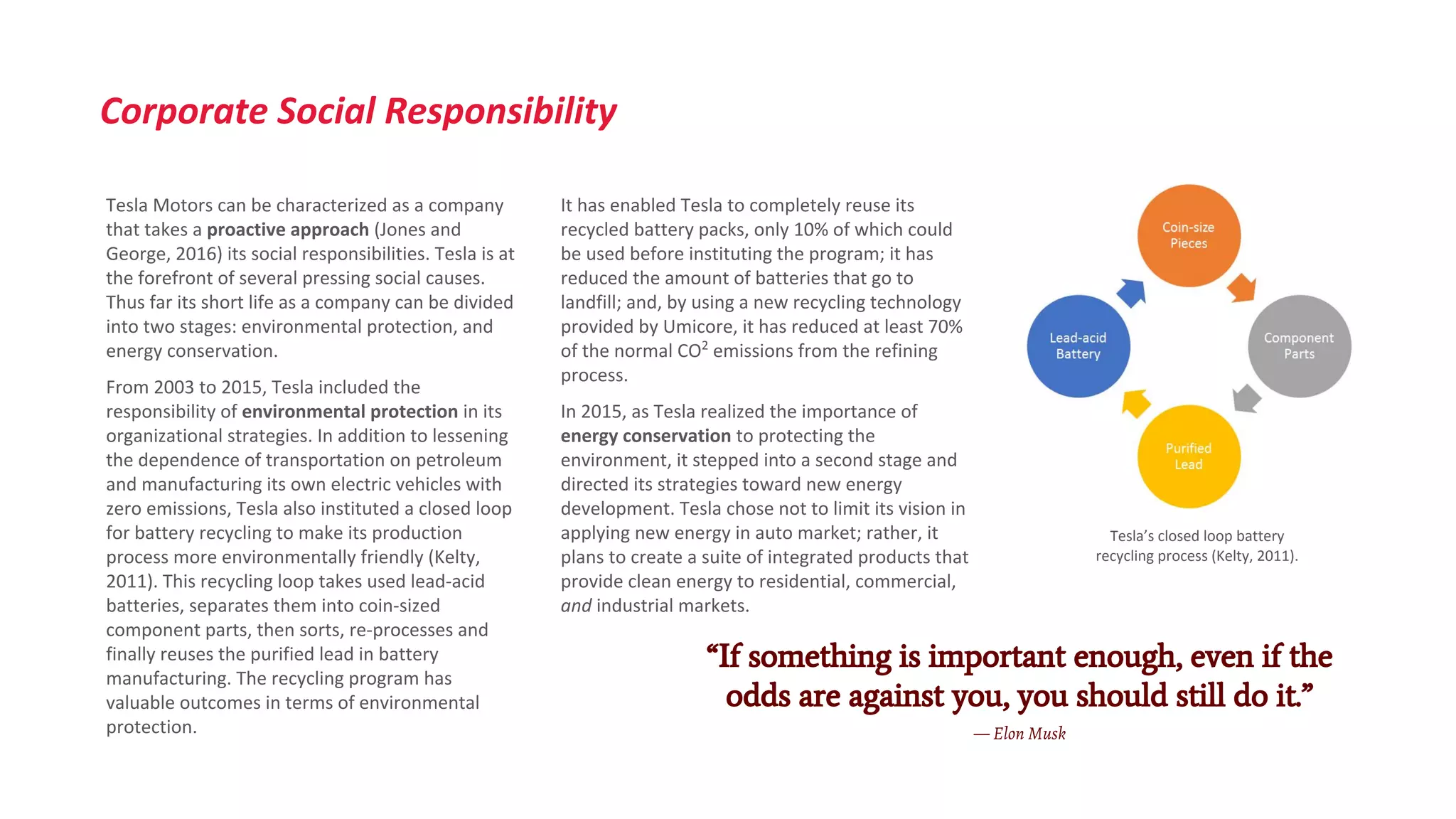
2011). This recycling loop takes used lead-acid
batteries, separates them into coin-sized
component parts, then sorts, re-processes and
finally reuses the purified lead in battery
manufacturing. The recycling program has
valuable outcomes in terms of environmental
protection.
It has enabled Tesla to completely reuse its
recycled battery packs, only 10% of which could
be used before instituting the program; it has
reduced the amount of batteries that go to
landfill; and, by using a new recycling technology
provided by Umicore, it has reduced at least 70%
of the normal CO2
emissions from the refining
process.
In 2015, as Tesla realized the importance of
energy conservation to protecting the
environment, it stepped into a second stage and
directed its strategies toward new energy
development. Tesla chose not to limit its vision in
applying new energy in auto market; rather, it
plans to create a suite of integrated products that
provide clean energy to residential, commercial,
and industrial markets.
Tesla’s closed loop battery
recycling process (Kelty, 2011).
Tesla’s energy conservation stage started by bringing
solar power into people’s daily life with the
Powerwall, a rechargeable lithium-ion battery
product that stores and provides electricity to homes
and small businesses (Riley, 2015). With the
Powerwall, people could sustainably use solar power:
they store the surplus electricity produced by the
solar panel system during a sunny day, and use it at
night or in a rainy day when there is not enough
electricity generated. After that, Tesla unveiled
another energy product—the Solar Roof—that works
directly with the Powerwall to collect solar power
and convert it to electricity. Moreover, in order to
deepen its expertise in the energy field, Tesla
purchased SolarCity in November (Stewart, 2016)
and consequently strengthened its capability to
integrate electric vehicles, Powerwall, and Solar
Roofing in an end-to-end energy plan. It has
proposed very specific details in the plan, including
embedding the solar panel system in walls by taking
advantage of Tesla’s manufacturing strength. When
Tesla’s idea is realized, humans will move a major
step forward towards independence from fossil fuel.
Corporate Social Responsibility
An important lesson we learn from Tesla is
how it perfectly combines organizational
development and implementation of social
responsibilities. When focusing on electric
vehicles manufacturing, Tesla combines the
responsibility for decreasing environmental
pollution with its strategy of expanding market
share in the automotive industry. It aims at
developing cars with more outstanding
performances than gasoline cars, in order to
encourage customers to purchase great cars
that happen to be electric. In this way, its
market share increases and emissions from
gasoline cars are reduced simultaneously.
And, after entering the energy industry, Tesla
has developed an integrative product chain
that could greatly increase its profit margins
while, at the same time, providing society with
a conveniently packaged way to utilize solar
power.
PowerWall
(2015)
Solar Roof
(2016)
SolarCity
(2016)
Tesla is an excellent example of the potential for a
company to have a major impact on society by
tackling ambitious problems.
As a pioneer in the automotive industry, Tesla is
very strictly focused on innovation to the extent
that it ignores short-term losses and often misses
product launch deadlines. It has even worked to
improve seemingly less needed technologies—for
instance, autonomous falcon wing doors—to
appeal to customer desires for convenience and
breathtakingly well-designed products. CEO Elon
Musk is often criticized for decreasing the profit
margin by spending an overwhelming amount of
costs on R&D (AmigoBulls, n.d.). According to the
newest statistic, Tesla’s expenses on R&D has
surpassed 200 million dollars in the third quarter
of 2016, which represents 10% of its quarterly
revenue and one third of its gross profit
(AmigoBulls, n.d.). Nevertheless, with its heavy
investment, Tesla has acquired unparalleled
strengths in both quantity and quality of
Social Role
technological innovation in charging and energy
storage. According to FreshPatents (n.d.), Tesla
has applied for over 200 patents between 2010
and 2016, almost all of which depends on the
efforts of its R&D teams. Tesla’s innovation is
recognized by the public, as well as being named
the number one Innovative Company by Forbes in
2015 and 2016.
In addition to promote innovation inside the
organization, Tesla also contributes to innovation
in the entire industry. In 2014, Tesla announced
that it would make its patents ‘open source’ by
sharing them with its peers and promising not to
initiate patent lawsuit against anyone who wants
to use their technology (Musk, 2014). Musk
recognized that there is only a tiny proportion of
electric vehicles in the automotive market, while
the enormous amount of gasoline cars
flooding into the market year after year
has become the largest barrier to
developing transport independent from
fossil fuels and reducing carbon emissions.
Musk attributed the low market share of
electric vehicles to closed patents that hold
back and limit innovation (Masnick, 2015).
Therefore, Tesla hopes to move barriers
that lie in front of startup peers who have
been struggling to innovate technology and
establish a quickly-evolving platform of
technologies in order to encourage and
compel industrial development. Tesla also
hopes to promote the involvement of more
traditional automotive manufacturers in the
electric vehicle market.
“Tesla is not just an automaker,
but also a technology and design company
with a focus on energy innovation.”
— “About Tesla” (n.d.)
IT Strategy
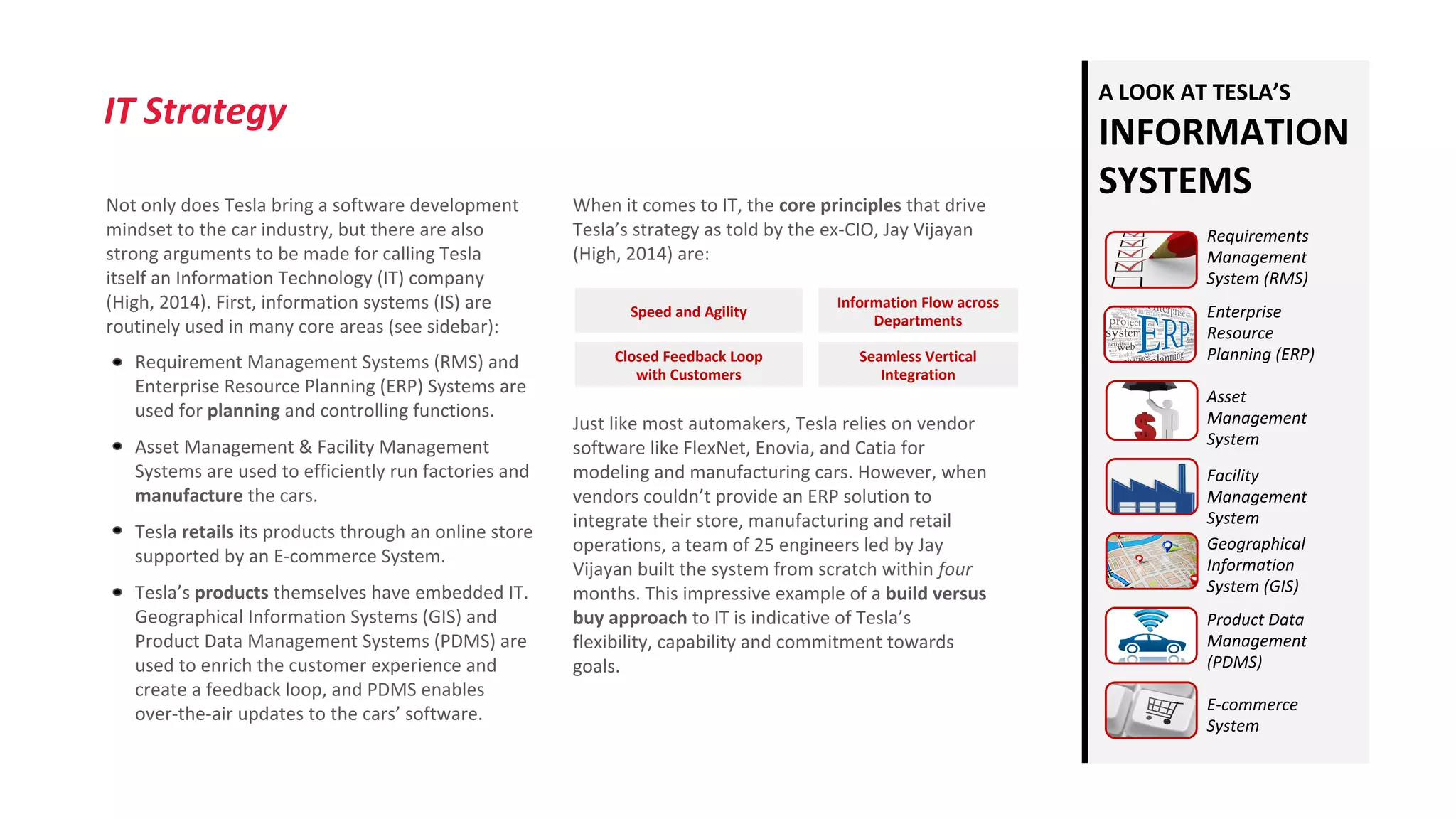
Not only does Tesla bring a software development
mindset to the car industry, but there are also
strong arguments to be made for calling Tesla
itself an Information Technology (IT) company
(High, 2014). First, information systems (IS) are
routinely used in many core areas (see sidebar):
When it comes to IT, the core principles that drive
Tesla’s strategy as told by the ex-CIO, Jay Vijayan
(High, 2014) are:
Just like most automakers, Tesla relies on vendor
software like FlexNet, Enovia, and Catia for
modeling and manufacturing cars. However, when
vendors couldn’t provide an ERP solution to
integrate their store, manufacturing and retail
operations, a team of 25 engineers led by Jay
Vijayan built the system from scratch within four
months. This impressive example of a build versus
buy approach to IT is indicative of Tesla’s
flexibility, capability and commitment towards
goals.
Speed and Agility
Seamless Vertical
Integration
Information Flow across
Departments
Closed Feedback Loop
with Customers
Requirements
Management
System (RMS)
Enterprise
Resource
Planning (ERP)
Asset
Management
System
Facility
Management
System
Geographical
Information
System (GIS)
Product Data
Management
(PDMS)
E-commerce
System
A LOOK AT TESLA’S
INFORMATION
SYSTEMS
Requirement Management Systems (RMS) and
Enterprise Resource Planning (ERP) Systems are
used for planning and controlling functions.
Asset Management & Facility Management
Systems are used to efficiently run factories and
manufacture the cars.
Tesla retails its products through an online store
supported by an E-commerce System.
Tesla’s products themselves have embedded IT.
Geographical Information Systems (GIS) and
Product Data Management Systems (PDMS) are
used to enrich the customer experience and
create a feedback loop, and PDMS enables
over-the-air updates to the cars’ software.
Strategic Management Analysis:
A review of Tesla’s challenges and opportunities
SOCIAL Tesla has growth opportunities based on
the rising popularity of low-carbon lifestyles and
increasing preference for renewable energy
(Kissinger, 2016). Moreover, Tesla has great
potential to boost its financial performance
because of higher customer purchasing power in
developing and developed countries.
TECHNOLOGICAL The high rate of technological
change presents opportunity for Tesla to enhance
its products’ technologies accordingly (Kissinger,
2016). However, the increasing popularity of
online B2B platforms and marketplaces have also
given increased opportunities to the car industry
that, in turn, have increased efficiencies and
reduced costs.
ENVIRONMENTAL As awareness and support for
environmentalism increased, the company has
opportunities to promote its electric vehicles
based on concerns on climate change, energy
saving programs, and rising standards for waste
disposal (Kissinger, 2016).
POLITICAL Tesla has an opportunity to strengthen
its financial performance through incentives from
governments. Expanding free trade agreements
open opportunities for Tesla to grow its
operations internationally. Tesla is expected to
increase their sales in environmentally friendly
countries like Norway, as these countries’
governments provide more incentives to
encourage Tesla to sell more cars there.
ECONOMIC Tesla’s business performance
benefits from lower battery costs (Kissinger,
2016). The affordability of the company’s electric
automobile products will decrease manufacturing
costs and increase profitability. In relation, the
decreasing renewable energy costs make Tesla’s
products more attractive, considering that their
business improves as renewable energy solutions
become more popular.
PESTEL Analysis
LEGAL Tesla has opportunities to safely
grow its business overseas, considering
expansions in international patent law;
free trade protocols also help Tesla to
emerge in international markets.
However, dealership regulations are
causing problems as Tesla expands the
domestic market (Kissinger, 2016).
NEW
ENTRANTS
(weak
factor)
Tesla’s SUPPLIERS have a low level of forward
integration. This external factor refers to suppliers’
limited control in the distribution and sale of their
products. For example, some suppliers use third parties
to sell their materials to Tesla (Kissinger, 2016). In
addition, most of these suppliers are moderately sized,
thereby having limited influence on the automotive
industry environment.
The moderate availability of SUBSTITUTES
limits the influence of suppliers. In relation,
many substitutes have only a moderate level of
performance in satisfying customers’ practical
needs, thereby further limiting the threat of this
factor against Tesla.
In general, cars have low switching costs which means
that BUYERS have considerable bargaining power. This
factors is ameliorated by the fact that each customer
buys and keeps only one or a few cars (Kissinger, 2016).
Porter Five Forces Analysis
Tesla already has a strong brand that NEW
ENTRANTS find difficult to match. In addition,
automobile manufacturing has high costs, which
impose a barrier to new firms.
There are only a small number of significant
COMPETITORS operating in the automotive market.
However, these firms are generally aggressive in
innovating and promoting their products (Kissinger,
2016). Such conditions strengthen the effects of
competitors against Tesla.
SUPPLIERS
(moderate
factor)
SUBSTITUTE
S
(moderate
factor)
CUSTOMERS
(moderate
factor)
INDUSTRY
COMPETITORS
(strong factor)
WEAKNESSES
• Target market too small: At present,
Tesla only sells electric luxury cars, so
Tesla is targeting customers who are
upper-middle class with a typical
income of over $100,000 and strong
awareness of environmentalism as
well. The current target market is too
narrow to permit growth.
• Limited revenues and profitability:
Tesla's lack of experience in car
manufacturing shows up in frequent
production delays; moreover,
production cost is high due to
expensive battery technology.
• Turnover in senior leadership: This
raises questions that weaken the
confidence of the stock market and,
most likely, also contribute internally
to production delays (Shall,2016).
STRENGTHS
• Outstanding leader: Elon Musk is
CEO of other successful companies,
which means Tesla can borrow
ideas from its sibling SpaceX—
including extensive use of
aluminum in the body and chassis
of the Model S (Dyer and
Gregersen, 2016).
• Effective communication: So far
employees, venture capitalists,
shareholders, and suppliers have
been strongly motivated by Musk's
bold vision, which he conveys very
effectively. He has a rare ability to
motivate people to pursue
"impossible" goals.
• First mover advantage: Tesla is the
first company to produce fully
electric cars. This has allowed the
company to acquire superior brand
recognition and customer loyalty.
SWOT Analysis
THREATS
• Highly competitive market: more
and more auto manufacturers are
releasing their own
environmental friendly cars, such
as Volkswagen.
• President elect Donald Trump
has declared his intention to
increase American energy
production in his first 100 days
(Kelly, 2016). This will make other
energy cheaper and reduce
people's incentives to switch to
solar energy.
• Dealership regulations: About
half of American states require
automakers to sell through
dealerships, a model Tesla rejects
(Kumparak, Burns & Escher,
2016). They will have to fight this
legislatively if they want to
expand their market.
OPPORTUNITIES
• Increasing environmentalism: Tesla
is trying to produce a suite of
products that people are likely to
use in combination: solar roofing,
home battery, and car.
• New segment of market: The Model
3 will have “strong performance”
like the Model S, but will be half of
the price at $35,000.
• Emerging global market: Due to the
rapid GDP growth in developing
countries, Tesla just massively
increased its potential sales by
adding pre-orders in China, India,
Brazil, and potentially others
(Kissinger, 2016).
Recommendations
Recommendations
Innovation and R&D: The results of our Five
Forces analysis of Tesla show that competition is
the most significant force impacting the
business. Thus, the company must prioritize this
force in its strategic formulation. Our first
recommendation is for Tesla to continue
strengthening its competitiveness. Stronger
competitive advantage is achievable through
innovation and increased market presence; for
example, in terms of innovation, Tesla can boost
its research and development (R&D) investment
to outpace competitors’ rate of innovation.
Stronger market presence: We also recommend
Tesla pursue a stronger market presence globally
by international expansion. In fact, many
Europeans don’t even know Tesla exist! Thus, the
company should seek to increase its brand
visibility, especially in countries where electric
vehicle infrastructure exists and in countries like
Finland and Sweden that offer incentives for
sustainable businesses.
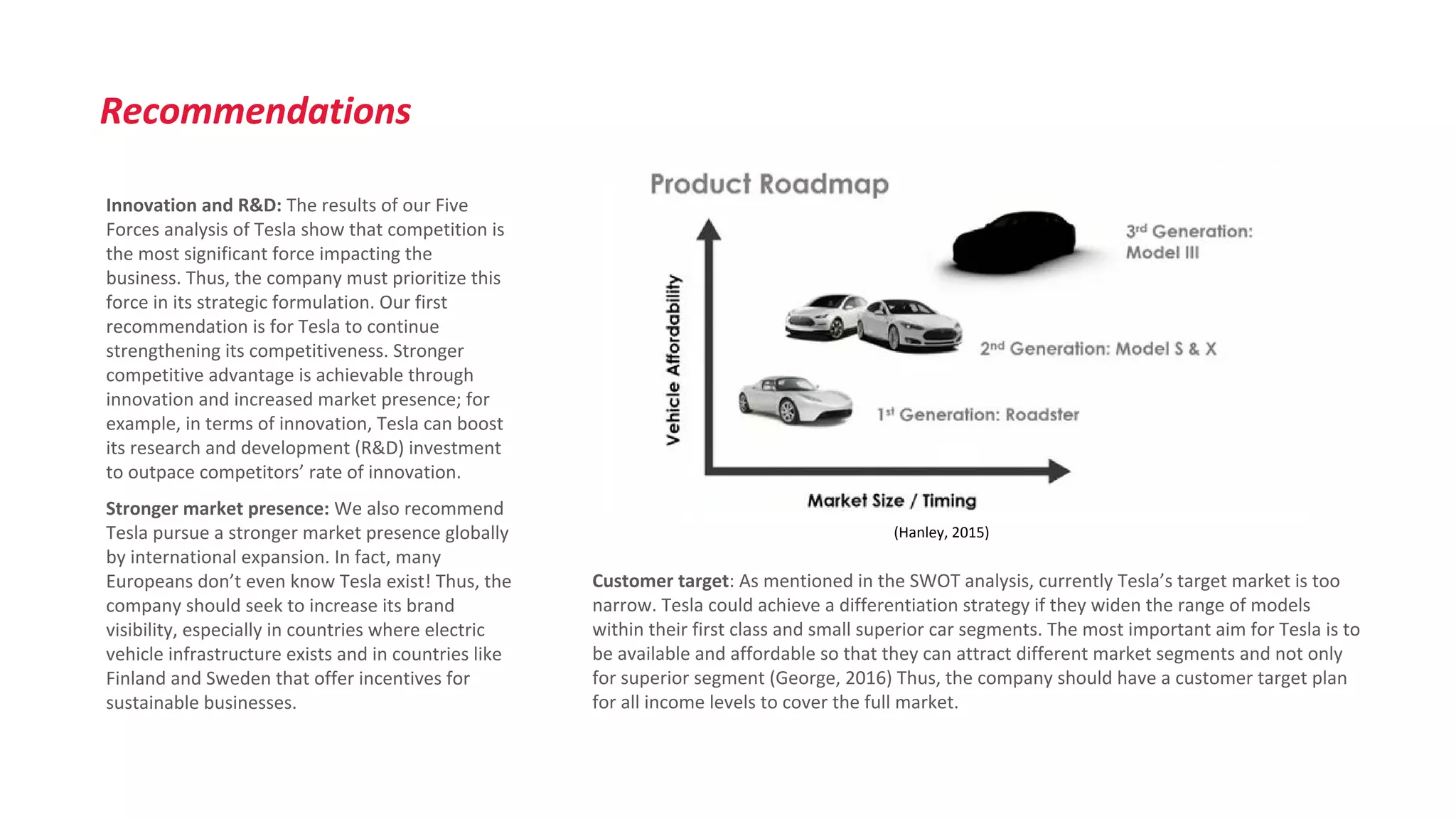
Customer target: As mentioned in the SWOT analysis, currently Tesla’s target market is too
narrow. Tesla could achieve a differentiation strategy if they widen the range of models
within their first class and small superior car segments. The most important aim for Tesla is to
be available and affordable so that they can attract different market segments and not only
for superior segment (George, 2016) Thus, the company should have a customer target plan
for all income levels to cover the full market.
(Hanley, 2015)
References
AmigoBulls. (n.d.) Tesla income statement - quarterly (NASDAQ:TSLA). Retrieved from http://amigobulls.com/stocks/TSLA/income-statement/quarterly
Baer, D. (2014, November 11). The making Of Tesla: Invention, betrayal, and the birth of the Roadster. Business Insider. Retrieved from
http://www.businessinsider.com/
tesla-the-origin-story-2014-10
Bloomberg View. (2016, May 26). Worker discontent makes Tesla a union target. Retrieved from http://www.industryweek.com/labor-employment-policy/worker-
discontent-makes-tesla-union-target
Crabtree, J. (2016, August 2). Elon Musk’s vision is a masterclass in communication. Financial Times. Retrieved from https://www.ft.com/content/b5aebe64-5888
-11e6-9f70-badea1b336d4
Forbes. (n.d.). The world’s most innovative companies list. Forbes. Retrieved from http://www.forbes.com/innovative-companies/list/
FreshPatents. (n.d.). Tesla Motors Inc patents list. Retrieved from http://stks.freshpatents.com/Tesla-Motors-Inc-nm1.php
George, J. (2016, February 7). TESLA Motors - External analysis using PESTLE & Porter's 5 analysis. SpherePress. Retrieved from
http://spherepress.com/tesla-motors- external-analysis-using-pestle-porters-5-analysis/
Glassdoor.com. (n.d.). Tesla Motors reviews. Retrieved from https://www.glassdoor.com/Reviews/Tesla-Motors-Reviews-E43129.htm
Goldberger, C. (n.d.). Are Elon Musk's public speaking skills as visionary as his cars? Quantified Communications Blog. Retrieved from http://www.quantified
communications.com/blog/elon-musk-communication-analysis
Hanley, S. (2015). Pedal to the metal on Tesla Model 3 - Gas 2. Retrieved rom http://gas2.org/2015/10/19/pedal-to-the-metal-on-tesla-model-3/
High, P. (2014, November 5). Tesla CIO builds IT that keeps pace with its cars. CIO Insight. Retrieved from http://www.cioinsight.com/it-management/tesla-
cio-builds-it-that-keeps-pace-with-its-cars.html
Hitt, M. A., Haynes, K. T., & Serpa, R. (2010). Strategic leadership for the 21st century. Business Horizons, 53, 437-444.
Indeed.com. (n.d.). Jobs at Tesla Motors. Retrieved from http://www.indeed.com/cmp/Tesla-Motors/jobs
Jones, G. R. & George, J. M. (2016). Contemporary management (9th ed.). New York City, NY: McGraw Hill Education.
Jones, M. (2016, February 10). Former Tesla Motors Inc. employee sparks Reddit debate about work. Retrieved from http://www.valuewalk.com/2016/02/
former-tesla-employee-reddit/
Kelly, A. (n.d.). Here is what Donald Trump wants to do in his first 100 Days. Retrieved from http://www.npr.org/2016/11/09/501451368/here-is-what-donald-
trump-wants-to-do-in-his-first-100-days
Kelty, K. (2011, January 26). Tesla’s closed loop battery recycling program. Retrieved from https://www.tesla.com/blog/teslas-closed-loop-battery-recycling-program
Kissinger, D. (2016). Tesla Motors, Inc. PESTEL/PESTLE analysis & recommendations. Panmore Institute. Retrieved from http://panmore.com/tesla-motors-inc-pestel-
pestle-analysis-recommendations
Kissinger, D. (2016). Tesla Motors, Inc.'s five forces analysis & recommendations (Porter's model). Panmore Institute. Retrieved from http://panmore.com/tesla-
motors-inc-five-forces-analysis-recommendations-porters-model
Kissinger, D. (2016). Tesla Motors, Inc. SWOT analysis & recommendations. Panmore Institute. Retrieved from http://panmore.com/tesla-motors-inc-swot-analysis-
recommendations
Korosec, K. (2016, March 16). Tesla's Model 3 event will have driveable prototypes. Fortune. Retrieved from http://fortune.com/2016/03/16/teslas-model-
driveable-prototype/
Korosec, K. (2016, May 4). Tesla loses two more top executives. Fortune. Retrieved from http://fortune.com/2016/05/04/tesla-production-chiefs/
Kumparak, G., Burns, M., & Escher, A. (n.d.). A brief history of Tesla. Retrieved from https://techcrunch.com/gallery/a-brief-history-of-tesla/slide/24/
Lambert, F. (2016, April 13). Tesla loses another executive as its VP of Regulatory Affairs leaves [Updated]. ElectricTrek. Retrieved from https://electrek.co/2016/
04/13/tesla-executive-vp-regulatory-affairs/
Lucas, S. (2013, August 30). How much employee turnover really costs you. Inc. Retrieved from http://www.inc.com/suzanne-lucas/why-employee-turnover-is
-so-costly.html
Masnick, M. (2015, February 18). Elon Musk clarifies that Tesla's patents really are free; Investor absolutely freaks out. TechDirt. Retrieved from
https://www.techdirt.com/articles/20150217/06182930052/elon-musk-clarifies-that-teslas-patents-really-are-free-investor-absolutely-freaks-out.shtml
Meyer, P. (2016, July 27). Tesla Motors, Inc.’s organizational culture, characteristics (an analysis). Panmore Institute. Retrieved from http://panmore.com/tesla-
motors-inc-organizational-culture-characteristics-analysis
Meyer, P. (2016, July 26). Tesla Motors, Inc.’s organizational structure, characteristics (an analysis) Panmore Institute. Retrieved from http://panmore.com/tesla-
motors-inc-organizational-structure-characteristics-analysis
Morrisson, C. (2008, October 15). Elon Musk steps in as CEO at Tesla, lays off staff. VentureBeat. Retrieved from http://www.nytimes.com/external/venturebeat/
2008/10/15/15venturebeat-elon-musk-steps-in-as-ceo-at-tesla-lays-off-99182.html
Musk, E. (2014, June 12). All our patent are belong to you. https://www.tesla.com/blog/all-our-patent-are-belong-you
Newcomb, A. (2016, July 7). Tesla CEO Elon Musk fires back against 'BS' reports after autopilot crash. ABC News. Retrieved from http://abcnews.go.com/Technology/
tesla-ceo-elon-musk-fires-back-bs-reports/story?id=40399864
Nielson, J. (2016, April 8). Tesla Model 3: An integrative innovation case study. Retrieved from http://www.theinnovativemanager.com/tesla-model-3-integrative-
innovation-case-study/
Riley, C. (2015, May 1). Tesla's new product is a battery for your home. CNN. Retrieved from http://money.cnn.com/2015/05/01/technology/tesla-powerwall
-battery-product/
Rosevear, . (2016, September 15). Will other suppliers follow Mobileye and split with Tesla Motors? Retrieved from http://www.fool.com/investing/2016/09/15/
mobileye-we-quit-tesla-motors-because-of-safety-co.aspx
Schwartz, A. (2016, February 4). There's one simple reason why Elon Musk is so convincing. Business Insider. Retrieved from http://www.businessinsider.com/
why-elon-musk-is-such-a-great-communicator-2016-2
Shall, P. (2016, March 28). Is there something fishy at Tesla? Seeking Alpha. Retrieved from http://seekingalpha.com/article/3961463-something-fishy-tesl
Stewart, J. (2016, October 28). Tesla unveils its new line of camouflaged solar panels. Wired. Retrieved from https://www.wired.com/2016/10/tesla-unveils-new-
line-camouflaged-solar-panels/
Squatriglia, C. (2010, June 29). Tesla IPO raises $226.1M, stock surges 41 percent. Retrieved from https://www.wired.com/2010/06/tesla-ipo-raises-226-1-million/
Tesla. (n.d.). About Tesla. Retrieved from tesla.com/about
Tesla. (n.d.). SEC filings | Tesla Motors. Retrieved from http://ir.tesla.com/sec.cfm?view=all
Vance, A. (2015). Elon Musk: Tesla, SpaceX, and the quest for a fantastic future. New York City, NY: Ecco Press.
Volecker, J. (2009, October 2). More Tesla turmoil? Executive turnover continues. Retrieved from http://www.greencarreports.com/news/1036034_more-tesla-
turmoil-executive-turnover-continues

Tesla-management-analysis.pdf

  • 1.
    STRATEGIC MANAGEMENT ANALYSIS DhruvParekh, Sheryl (Qianru) Wang, Manas Thakre, Shiyi Luo, Jacob Kovacs, Vaibhavi Rangarajan
  • 2.
    Contents Introduction Who is TeslaMotors? Snapshot History Leadership Organizational Structure Culture Innovation Corporate Social Responsibility Social Role IT Strategy Strategic Management Analysis PESTEL Analysis Porter Five Forces Analysis SWOT Analysis Recommendations References
  • 3.
    Introduction Greetings! We are pleasedto share our strategic management analysis of Tesla Motors, an inspiring company with a bold vision: to “accelerate the world’s transition to sustainable energy” (Tesla, n.d.). In this report, we provide an in-depth picture of Tesla’s operations, followed by a comprehensive analysis of the landscape Tesla faces at present. We conclude with several strategic recommendations for Tesla. We enjoyed working together to understand this complex and exciting company. We all brought strong ideas to the table and negotiated to form a common vision. We learned to apply management principles to a real-world case, and also built more appreciation for the tremendous good a business can do under principled leadership. — Team Six Dhruv Parekh Tesla’s Corporate Social Responsibility is what I admire. Shiyi Luo Cool company, cool CEO, cool cars! Sheryl (Qianru) Wang I am now a big fan of Tesla. Jacob Kovacs Who knew a car company could be so interesting? Manas Thakre We got to know a true leader. Vaibhavi Rangarajan Tesla shows it’s possible to dream big and achieve those goals.
  • 4.
    Who is TeslaMotors? An in-depth portrait of the company
  • 5.
    “We're running themost dangerous experiment in history right now, which is to see how much carbon dioxide the atmosphere can handle before there is an environmental catastrophe.” — Elon Musk Snapshot Tesla Motors, Inc. is an American automaker under the leadership of Elon Musk. The company marked its entry into the automotive market with the Roadster sportscar, a completely battery- powered vehicle. The company developed its own power storage technology in the form of lithium-ion batteries for the Roadster, and it became the first-ever car that can go up to 200 miles on the strength of a single charge. Tesla launched the Model S luxury sedan in 2012, which earned a five star safety rating and went on to become world’s best selling plugin vehicle by 2015 (Baer, 2014). As of November 2016, 150,000 units of the Tesla Model S have been sold worldwide, and the mass-market Model 3 is expected in 2018 (Hanley, 2015). Tesla also has a chain of Supercharger stations across the United States, parts of Europe, and Australia, where the cars can be charged by their owners at no cost; chargers in the network have the ability to give a 60% battery boost in just 20 minutes (Tesla, n.d.). In April 2015, Tesla also announced its residential and commercial power solutions—Powerwalls and Powerpacks (Riley, 2015). As of today, Tesla manufactures the majority of its cars in Fremont, California, with another assembly location in the Netherlands to serve the European market. In 2014, Tesla announced its massive plans to build its own Gigafactory in Nevada for the production of car batteries and other power solutions. The Gigafactory is under construction with a $5 billion investment jointly made by Tesla and Panasonic. Once fully operational, the facility will be able to produce 36 GWh of clean electricity to charge the batteries that will eventually be used in cars, Powerpacks and Powerwalls (Tesla, n.d.). Model X Model S Model 3 (expected 2018)
  • 6.
    Snapshot Tesla Motors hasshown a ten times revenue increase from 2012 to 2015, mostly owing to the commercial success of its Model S. However, due to increasing investments in manufacturing and retail stores, the company has yet to show positive results in terms of net profits, and has raked in losses the past 4 years with net losses amounting to $88 million in 2015 (Tesla, n.d.). Despite these short-term financial losses, shareholders have shown increasing interest in Tesla, with share price and company valuation increasing tremendously since the company went public in 2010 (Squatriglia, 2010; Tesla, n.d.). As of today, Tesla has a market capitalization of about $31 billion, more than half of Ford Motors (Tesla, n.d.). Tesla Motors also got a significant push from US authorities in recognition of its effort to make large-scale production of non-polluting electric vehicles a reality; this was majorly in forms of tax credits to the company, with an estimated $2.4 billion of future incentives awaiting Tesla for its Gigafactory project (Tesla, n.d.).
  • 7.
    History “I was thinkingI should do what every guy does and buy a sports car …” — Martin Eberhard Tesla was founded in 2003 by two engineers, Martin Eberhard and Marc Tarpenning (Baer, 2014). Fresh from a divorce, Eberhard went looking for a sportscar but found none that were climate friendly. He also noticed that battery technology had advanced enough that a high-performance electric sports car was possible—and, since the giants of the 100-year old automotive industry had outsourced the bulk of their production in pursuit of the ideal of dynamic core competencies (Hitt, Haynes, and Serpa, 2010), Tesla could just tap into existing supply chains instead of engineering every component of a car. Eberhard persuaded Tarpenning that there was a market for a powerful, stunningly-designed clean energy vehicle, thus launching Tesla with a focused differentiation strategy (Jones and George, 2012). Tesla had several rounds of startup funding before its IPO. Elon Musk was their first major investor, and eventually took over as CEO in 2007—right before Tesla shipped its first commercial product, the Roadster. Under Musk’s leadership, Tesla has gone beyond cars to design a whole ecosystem of alternative energy products that gain much of their appeal from the way they fit together (Stewart, 2016). For example, Tesla sells solar roofing that charges a home battery that charges an electric car, virtually eliminating home-based carbon emissions. Tesla is also trying to expand into the midmarket next year with the Model 3. Baer, 2014; Riley, 2015; Stewart, 2016; Squatriglia, 2010
  • 8.
    Leadership Traits: ElonMusk Tesla CEO Elon Musk has a clear vision of accelerating the world towards sustainable sources of energy. This vision is clearly reflected in all the work he does, whether at Tesla Motors or the other companies he leads—like SolarCity (recently merged with Tesla; Stewart, 2016) and SpaceX. To evolve and contribute towards the mainstream usage of sustainable energy, Musk has been the central force developing cutting-edge technologies by employing the best minds in the field. He has heavily invested human capital and money into developing these in-house technologies, whether it is high-efficiency cars or establishment of the Tesla Gigafactory. Musk leads by example: he has created several companies that showcase success in such a short time that he is definitely among the top leaders in the world. Musk’s creativity and transformational leadership has played a pivotal role in the success and progress of Tesla, which is now seen as the world’s most prominent brand in the automotive industry. Elon musk’s leadership traits are a mix of opinionated and adaptable leaders, putting him in the quadrant of the most successful and continuously innovating leaders like Steve Jobs. While he has has a strong persona reflecting his opinions, he is adaptable in nature and ready to accept the many failures in the process of innovation—which is the most significant trait of transformational leadership. impartial opinionated adaptable stalwart
  • 9.
    2008 Martin Eberhard, founder MarcTarpenning, founder Daryll Siry, chief of marketing 2009 Michael van der Sanda, chief of marketing Michael Donoughe, chief vehicle engineer 2010 2011 2012 Ricardo Reyes, VP global communications 2013 2014 Simon Sproule, head of comms. department left 2015 2016 Michael Zanoni, VP finance James Chen, VP regulatory affairs Josh Ensign, VP manufacturing Greg Reichow, VP production TESLA’S SENIOR LEADERSHIP EXODUS Musk’s communication style has been described as authentic, down-to-earth, and exceptionally clear, with four times more use of the present tense than average (Goldberger, n.d.; Crabtree, 2016; Schwartz, 2016). These traits help him rally people behind a very bold vision and motivate them to pursue it. His aggressive focus, though, can make him conflict- prone, blind to his employees’ hard work, and defensive against complaints instead of learning from them (Vance, 2015; Newcomb, 2016). One apparent consequence of Musk’s style is perpetual senior leadership turnover (Morrisson, 2008; Volecker, 2009; Shall, 2016; Lambert, 2016; Korosec, 2016, “Model 3 event”; Korosec, 2016, “Tesla loses”; see sidebar). Such turnover is costly (Lucas, 2013) for reasons including training costs, lost knowledge, and potential negative morale. As another consequence, employee reviews are frank about the long hours and poor work-life balance—though they overwhelmingly state that the company’s mission makes the personal sacrifice worthwhile (Glassdoor.com, n.d.; Indeed.com, n.d.; Leadership Jones, 2016). Meanwhile, after reports of low contractor pay, UAW is attempting to unionize production workers (Bloomberg View, 2016). Tensions have also come to the surface in Tesla’s supply chain. As a newcomer to the intricacies of automotive manufacturing, Tesla depends on suppliers to build its cars. In fact, Tesla and would never have come into existence at as a company without Eberhard, Tarpenning, and Musk’s diplomatic in-person efforts to persuade potential suppliers (Baer, 2014). Recently, some suppliers have struggled to meet Musk’s purposefully optimistic production targets, and the company Mobileye ended its relationship with Tesla by publicly citing its concerns that Tesla’s deadlines posed a safety risk (Rosevear, 2016). “Even by the turbulent standards of Silicon Valley's venture-funded startups, Telsa [has] garnered more than its share of attention for missteps, multiple CEOs, layoffs, and lawsuits … ” (Voelcker, 2009)
  • 10.
    Organizational Structure “Starting andgrowing a business is as much about the innovation, drive, and determination of the people behind it as the product they sell.” — Elon Musk Tesla has a functional form of organizational structure that enables it to exercise strong control of the business (Meyer, 2016, “Structure”). The various functional departments are Human Resources, Business Development, Engineering, Processes and Autopilot, Manufacturing, Design Through, Global Sales and Services (see sidebar). Through this structure, Tesla is able to maximize its ability to implement new strategies and manage its operational activities. Tesla also maintains minimal regional divisions, specifically four: the USA, Norway, China, and a catch-all division for operations in other locations. These divisions allow Tesla to tailor their strategies, marketing campaigns, and financial reporting to different geographies with different customer populations and legal requirements. Despite maintaining regional divisions, Tesla’s emphasis of global centralization means that their entire organization is controlled through decisions that a central group or team generates. Tesla’s central headquarters includes the head of each office of its global hierarchy; the company does not support autonomy of its regional or overseas offices. Instead, Tesla’s headquarter makes the majority of operational decisions for overseas operations.
  • 11.
    Organizational Culture Think likeowners We are ALL IN Do the impossible Reason from ‘first principles’ Constantly innovate Move fast TESLA’S CULTURE PROS & CONS + Open and direct communication + Highly innovative products + Employees unafraid to take risks + Rapid, responsive problem solving + Suitable rewards for employees - Pressure of innovation - Employee burn-out - Poor work-life balance Tesla’s organization structure is one of the key factors that influences its culture. The six core features of Tesla’s culture (Meyer, 2016; see below) contribute to making Tesla a learning organization that is able to surmount a turbulent business environment (Jones and George, 2016). As a learning organization, Tesla believes in personal mastery (“Think like owners”); employees are encouraged to think out of the box and bring innovative ideas (“Constantly innovate”). The company tries to reward innovative employee contributions. Because of strong executive leadership, Tesla employees share a common vision (“Do the impossible”) that unifies them and reduces conflicts. The global scope of this vision is an example of bold systems thinking, and, in addition, Tesla managers encourage their employees to use complex mental models (“Reason from ‘first principles’”) to find the root cause of issues and respond to problems very quickly and effectively (“Move fast”). Tesla has training programs to orient its human resources to this feature of its organizational culture. Finally, from its roots in Silicon Valley’s software development culture and practices (High, 2014), Tesla places a high value on team learning and effective teamwork (“We are ALL IN”). Core features of Tesla’s organizational culture (Meyer, 2016).
  • 12.
    INNOVATION AT TESLA MOTORS Integrativeinnovation is part of the fabric of Tesla’s culture; in 2016, Forbes Magazine (n.d.) rated it the World’s Most Innovative Company. The following aspects of Tesla’s culture, structure and daily work are what makes it different (Nielson, 2016): Tesla has idealistic goals of a greener planet. The company approaches this vision by integrating decades of sustainable energy research in many fields into a viable form. Tesla makes unique products—like connected cars that have self-driving abilities, can be upgraded over the air or monitored via phone, and charge for free on the nationwide Tesla Supercharger network. Tesla is known for placing risky bets on technology and itself. After all, it is a startup in the over 100 years old automotive industry. Employees are encouraged to set stretch goals in keeping with the informal Musk Doctrine: “Never set a deadline you are likely to keep”. . Innovation Mission and Vision Products and Services Appetite for Risk View of competitors Business Practices “Failure IS an option here. If things are not failing, you are not innovating enough.” — Elon Musk Tesla treats its competitors—traditional auto companies—as potential allies, and formed strategic alliances early for its battery recycling program. Tesla also “models the way” with open patents, as Elon Musk believes that such knowledge should be shared widely for the common good. Tesla’s business strategies are a unique case study in themselves. No other auto company takes capital from customers upfront before building the car. Tesla also focuses on engineering and design over marketing. Finally, their decision to retail directly customers has upended the traditional dealership- based automotive supply chain.With such innovation, for the first time in automotive history a vehicle has been created whose price can appreciate over time.
  • 13.
    Corporate Social Responsibility “Ifsomething is important enough, even if the odds are against you, you should still do it.” — Elon Musk Tesla Motors can be characterized as a company that takes a proactive approach (Jones and George, 2016) its social responsibilities. Tesla is at the forefront of several pressing social causes. Thus far its short life as a company can be divided into two stages: environmental protection, and energy conservation. From 2003 to 2015, Tesla included the responsibility of environmental protection in its organizational strategies. In addition to lessening the dependence of transportation on petroleum and manufacturing its own electric vehicles with zero emissions, Tesla also instituted a closed loop for battery recycling to make its production process more environmentally friendly (Kelty, 2011). This recycling loop takes used lead-acid batteries, separates them into coin-sized component parts, then sorts, re-processes and finally reuses the purified lead in battery manufacturing. The recycling program has valuable outcomes in terms of environmental protection. It has enabled Tesla to completely reuse its recycled battery packs, only 10% of which could be used before instituting the program; it has reduced the amount of batteries that go to landfill; and, by using a new recycling technology provided by Umicore, it has reduced at least 70% of the normal CO2 emissions from the refining process. In 2015, as Tesla realized the importance of energy conservation to protecting the environment, it stepped into a second stage and directed its strategies toward new energy development. Tesla chose not to limit its vision in applying new energy in auto market; rather, it plans to create a suite of integrated products that provide clean energy to residential, commercial, and industrial markets. Tesla’s closed loop battery recycling process (Kelty, 2011).
  • 14.
    Tesla’s energy conservationstage started by bringing solar power into people’s daily life with the Powerwall, a rechargeable lithium-ion battery product that stores and provides electricity to homes and small businesses (Riley, 2015). With the Powerwall, people could sustainably use solar power: they store the surplus electricity produced by the solar panel system during a sunny day, and use it at night or in a rainy day when there is not enough electricity generated. After that, Tesla unveiled another energy product—the Solar Roof—that works directly with the Powerwall to collect solar power and convert it to electricity. Moreover, in order to deepen its expertise in the energy field, Tesla purchased SolarCity in November (Stewart, 2016) and consequently strengthened its capability to integrate electric vehicles, Powerwall, and Solar Roofing in an end-to-end energy plan. It has proposed very specific details in the plan, including embedding the solar panel system in walls by taking advantage of Tesla’s manufacturing strength. When Tesla’s idea is realized, humans will move a major step forward towards independence from fossil fuel. Corporate Social Responsibility An important lesson we learn from Tesla is how it perfectly combines organizational development and implementation of social responsibilities. When focusing on electric vehicles manufacturing, Tesla combines the responsibility for decreasing environmental pollution with its strategy of expanding market share in the automotive industry. It aims at developing cars with more outstanding performances than gasoline cars, in order to encourage customers to purchase great cars that happen to be electric. In this way, its market share increases and emissions from gasoline cars are reduced simultaneously. And, after entering the energy industry, Tesla has developed an integrative product chain that could greatly increase its profit margins while, at the same time, providing society with a conveniently packaged way to utilize solar power. PowerWall (2015) Solar Roof (2016) SolarCity (2016)
  • 15.
    Tesla is anexcellent example of the potential for a company to have a major impact on society by tackling ambitious problems. As a pioneer in the automotive industry, Tesla is very strictly focused on innovation to the extent that it ignores short-term losses and often misses product launch deadlines. It has even worked to improve seemingly less needed technologies—for instance, autonomous falcon wing doors—to appeal to customer desires for convenience and breathtakingly well-designed products. CEO Elon Musk is often criticized for decreasing the profit margin by spending an overwhelming amount of costs on R&D (AmigoBulls, n.d.). According to the newest statistic, Tesla’s expenses on R&D has surpassed 200 million dollars in the third quarter of 2016, which represents 10% of its quarterly revenue and one third of its gross profit (AmigoBulls, n.d.). Nevertheless, with its heavy investment, Tesla has acquired unparalleled strengths in both quantity and quality of Social Role technological innovation in charging and energy storage. According to FreshPatents (n.d.), Tesla has applied for over 200 patents between 2010 and 2016, almost all of which depends on the efforts of its R&D teams. Tesla’s innovation is recognized by the public, as well as being named the number one Innovative Company by Forbes in 2015 and 2016. In addition to promote innovation inside the organization, Tesla also contributes to innovation in the entire industry. In 2014, Tesla announced that it would make its patents ‘open source’ by sharing them with its peers and promising not to initiate patent lawsuit against anyone who wants to use their technology (Musk, 2014). Musk recognized that there is only a tiny proportion of electric vehicles in the automotive market, while the enormous amount of gasoline cars flooding into the market year after year has become the largest barrier to developing transport independent from fossil fuels and reducing carbon emissions. Musk attributed the low market share of electric vehicles to closed patents that hold back and limit innovation (Masnick, 2015). Therefore, Tesla hopes to move barriers that lie in front of startup peers who have been struggling to innovate technology and establish a quickly-evolving platform of technologies in order to encourage and compel industrial development. Tesla also hopes to promote the involvement of more traditional automotive manufacturers in the electric vehicle market. “Tesla is not just an automaker, but also a technology and design company with a focus on energy innovation.” — “About Tesla” (n.d.)
  • 16.
    IT Strategy Not onlydoes Tesla bring a software development mindset to the car industry, but there are also strong arguments to be made for calling Tesla itself an Information Technology (IT) company (High, 2014). First, information systems (IS) are routinely used in many core areas (see sidebar): When it comes to IT, the core principles that drive Tesla’s strategy as told by the ex-CIO, Jay Vijayan (High, 2014) are: Just like most automakers, Tesla relies on vendor software like FlexNet, Enovia, and Catia for modeling and manufacturing cars. However, when vendors couldn’t provide an ERP solution to integrate their store, manufacturing and retail operations, a team of 25 engineers led by Jay Vijayan built the system from scratch within four months. This impressive example of a build versus buy approach to IT is indicative of Tesla’s flexibility, capability and commitment towards goals. Speed and Agility Seamless Vertical Integration Information Flow across Departments Closed Feedback Loop with Customers Requirements Management System (RMS) Enterprise Resource Planning (ERP) Asset Management System Facility Management System Geographical Information System (GIS) Product Data Management (PDMS) E-commerce System A LOOK AT TESLA’S INFORMATION SYSTEMS Requirement Management Systems (RMS) and Enterprise Resource Planning (ERP) Systems are used for planning and controlling functions. Asset Management & Facility Management Systems are used to efficiently run factories and manufacture the cars. Tesla retails its products through an online store supported by an E-commerce System. Tesla’s products themselves have embedded IT. Geographical Information Systems (GIS) and Product Data Management Systems (PDMS) are used to enrich the customer experience and create a feedback loop, and PDMS enables over-the-air updates to the cars’ software.
  • 17.
    Strategic Management Analysis: Areview of Tesla’s challenges and opportunities
  • 18.
    SOCIAL Tesla hasgrowth opportunities based on the rising popularity of low-carbon lifestyles and increasing preference for renewable energy (Kissinger, 2016). Moreover, Tesla has great potential to boost its financial performance because of higher customer purchasing power in developing and developed countries. TECHNOLOGICAL The high rate of technological change presents opportunity for Tesla to enhance its products’ technologies accordingly (Kissinger, 2016). However, the increasing popularity of online B2B platforms and marketplaces have also given increased opportunities to the car industry that, in turn, have increased efficiencies and reduced costs. ENVIRONMENTAL As awareness and support for environmentalism increased, the company has opportunities to promote its electric vehicles based on concerns on climate change, energy saving programs, and rising standards for waste disposal (Kissinger, 2016). POLITICAL Tesla has an opportunity to strengthen its financial performance through incentives from governments. Expanding free trade agreements open opportunities for Tesla to grow its operations internationally. Tesla is expected to increase their sales in environmentally friendly countries like Norway, as these countries’ governments provide more incentives to encourage Tesla to sell more cars there. ECONOMIC Tesla’s business performance benefits from lower battery costs (Kissinger, 2016). The affordability of the company’s electric automobile products will decrease manufacturing costs and increase profitability. In relation, the decreasing renewable energy costs make Tesla’s products more attractive, considering that their business improves as renewable energy solutions become more popular. PESTEL Analysis LEGAL Tesla has opportunities to safely grow its business overseas, considering expansions in international patent law; free trade protocols also help Tesla to emerge in international markets. However, dealership regulations are causing problems as Tesla expands the domestic market (Kissinger, 2016).
  • 19.
    NEW ENTRANTS (weak factor) Tesla’s SUPPLIERS havea low level of forward integration. This external factor refers to suppliers’ limited control in the distribution and sale of their products. For example, some suppliers use third parties to sell their materials to Tesla (Kissinger, 2016). In addition, most of these suppliers are moderately sized, thereby having limited influence on the automotive industry environment. The moderate availability of SUBSTITUTES limits the influence of suppliers. In relation, many substitutes have only a moderate level of performance in satisfying customers’ practical needs, thereby further limiting the threat of this factor against Tesla. In general, cars have low switching costs which means that BUYERS have considerable bargaining power. This factors is ameliorated by the fact that each customer buys and keeps only one or a few cars (Kissinger, 2016). Porter Five Forces Analysis Tesla already has a strong brand that NEW ENTRANTS find difficult to match. In addition, automobile manufacturing has high costs, which impose a barrier to new firms. There are only a small number of significant COMPETITORS operating in the automotive market. However, these firms are generally aggressive in innovating and promoting their products (Kissinger, 2016). Such conditions strengthen the effects of competitors against Tesla. SUPPLIERS (moderate factor) SUBSTITUTE S (moderate factor) CUSTOMERS (moderate factor) INDUSTRY COMPETITORS (strong factor)
  • 20.
    WEAKNESSES • Target markettoo small: At present, Tesla only sells electric luxury cars, so Tesla is targeting customers who are upper-middle class with a typical income of over $100,000 and strong awareness of environmentalism as well. The current target market is too narrow to permit growth. • Limited revenues and profitability: Tesla's lack of experience in car manufacturing shows up in frequent production delays; moreover, production cost is high due to expensive battery technology. • Turnover in senior leadership: This raises questions that weaken the confidence of the stock market and, most likely, also contribute internally to production delays (Shall,2016). STRENGTHS • Outstanding leader: Elon Musk is CEO of other successful companies, which means Tesla can borrow ideas from its sibling SpaceX— including extensive use of aluminum in the body and chassis of the Model S (Dyer and Gregersen, 2016). • Effective communication: So far employees, venture capitalists, shareholders, and suppliers have been strongly motivated by Musk's bold vision, which he conveys very effectively. He has a rare ability to motivate people to pursue "impossible" goals. • First mover advantage: Tesla is the first company to produce fully electric cars. This has allowed the company to acquire superior brand recognition and customer loyalty. SWOT Analysis THREATS • Highly competitive market: more and more auto manufacturers are releasing their own environmental friendly cars, such as Volkswagen. • President elect Donald Trump has declared his intention to increase American energy production in his first 100 days (Kelly, 2016). This will make other energy cheaper and reduce people's incentives to switch to solar energy. • Dealership regulations: About half of American states require automakers to sell through dealerships, a model Tesla rejects (Kumparak, Burns & Escher, 2016). They will have to fight this legislatively if they want to expand their market. OPPORTUNITIES • Increasing environmentalism: Tesla is trying to produce a suite of products that people are likely to use in combination: solar roofing, home battery, and car. • New segment of market: The Model 3 will have “strong performance” like the Model S, but will be half of the price at $35,000. • Emerging global market: Due to the rapid GDP growth in developing countries, Tesla just massively increased its potential sales by adding pre-orders in China, India, Brazil, and potentially others (Kissinger, 2016).
  • 21.
    Recommendations Recommendations Innovation and R&D:The results of our Five Forces analysis of Tesla show that competition is the most significant force impacting the business. Thus, the company must prioritize this force in its strategic formulation. Our first recommendation is for Tesla to continue strengthening its competitiveness. Stronger competitive advantage is achievable through innovation and increased market presence; for example, in terms of innovation, Tesla can boost its research and development (R&D) investment to outpace competitors’ rate of innovation. Stronger market presence: We also recommend Tesla pursue a stronger market presence globally by international expansion. In fact, many Europeans don’t even know Tesla exist! Thus, the company should seek to increase its brand visibility, especially in countries where electric vehicle infrastructure exists and in countries like Finland and Sweden that offer incentives for sustainable businesses. Customer target: As mentioned in the SWOT analysis, currently Tesla’s target market is too narrow. Tesla could achieve a differentiation strategy if they widen the range of models within their first class and small superior car segments. The most important aim for Tesla is to be available and affordable so that they can attract different market segments and not only for superior segment (George, 2016) Thus, the company should have a customer target plan for all income levels to cover the full market. (Hanley, 2015)
  • 22.
  • 23.
    AmigoBulls. (n.d.) Teslaincome statement - quarterly (NASDAQ:TSLA). Retrieved from http://amigobulls.com/stocks/TSLA/income-statement/quarterly Baer, D. (2014, November 11). The making Of Tesla: Invention, betrayal, and the birth of the Roadster. Business Insider. Retrieved from http://www.businessinsider.com/ tesla-the-origin-story-2014-10 Bloomberg View. (2016, May 26). Worker discontent makes Tesla a union target. Retrieved from http://www.industryweek.com/labor-employment-policy/worker- discontent-makes-tesla-union-target Crabtree, J. (2016, August 2). Elon Musk’s vision is a masterclass in communication. Financial Times. Retrieved from https://www.ft.com/content/b5aebe64-5888 -11e6-9f70-badea1b336d4 Forbes. (n.d.). The world’s most innovative companies list. Forbes. Retrieved from http://www.forbes.com/innovative-companies/list/ FreshPatents. (n.d.). Tesla Motors Inc patents list. Retrieved from http://stks.freshpatents.com/Tesla-Motors-Inc-nm1.php George, J. (2016, February 7). TESLA Motors - External analysis using PESTLE & Porter's 5 analysis. SpherePress. Retrieved from http://spherepress.com/tesla-motors- external-analysis-using-pestle-porters-5-analysis/ Glassdoor.com. (n.d.). Tesla Motors reviews. Retrieved from https://www.glassdoor.com/Reviews/Tesla-Motors-Reviews-E43129.htm Goldberger, C. (n.d.). Are Elon Musk's public speaking skills as visionary as his cars? Quantified Communications Blog. Retrieved from http://www.quantified communications.com/blog/elon-musk-communication-analysis Hanley, S. (2015). Pedal to the metal on Tesla Model 3 - Gas 2. Retrieved rom http://gas2.org/2015/10/19/pedal-to-the-metal-on-tesla-model-3/ High, P. (2014, November 5). Tesla CIO builds IT that keeps pace with its cars. CIO Insight. Retrieved from http://www.cioinsight.com/it-management/tesla- cio-builds-it-that-keeps-pace-with-its-cars.html
  • 24.
    Hitt, M. A.,Haynes, K. T., & Serpa, R. (2010). Strategic leadership for the 21st century. Business Horizons, 53, 437-444. Indeed.com. (n.d.). Jobs at Tesla Motors. Retrieved from http://www.indeed.com/cmp/Tesla-Motors/jobs Jones, G. R. & George, J. M. (2016). Contemporary management (9th ed.). New York City, NY: McGraw Hill Education. Jones, M. (2016, February 10). Former Tesla Motors Inc. employee sparks Reddit debate about work. Retrieved from http://www.valuewalk.com/2016/02/ former-tesla-employee-reddit/ Kelly, A. (n.d.). Here is what Donald Trump wants to do in his first 100 Days. Retrieved from http://www.npr.org/2016/11/09/501451368/here-is-what-donald- trump-wants-to-do-in-his-first-100-days Kelty, K. (2011, January 26). Tesla’s closed loop battery recycling program. Retrieved from https://www.tesla.com/blog/teslas-closed-loop-battery-recycling-program Kissinger, D. (2016). Tesla Motors, Inc. PESTEL/PESTLE analysis & recommendations. Panmore Institute. Retrieved from http://panmore.com/tesla-motors-inc-pestel- pestle-analysis-recommendations Kissinger, D. (2016). Tesla Motors, Inc.'s five forces analysis & recommendations (Porter's model). Panmore Institute. Retrieved from http://panmore.com/tesla- motors-inc-five-forces-analysis-recommendations-porters-model Kissinger, D. (2016). Tesla Motors, Inc. SWOT analysis & recommendations. Panmore Institute. Retrieved from http://panmore.com/tesla-motors-inc-swot-analysis- recommendations Korosec, K. (2016, March 16). Tesla's Model 3 event will have driveable prototypes. Fortune. Retrieved from http://fortune.com/2016/03/16/teslas-model- driveable-prototype/ Korosec, K. (2016, May 4). Tesla loses two more top executives. Fortune. Retrieved from http://fortune.com/2016/05/04/tesla-production-chiefs/
  • 25.
    Kumparak, G., Burns,M., & Escher, A. (n.d.). A brief history of Tesla. Retrieved from https://techcrunch.com/gallery/a-brief-history-of-tesla/slide/24/ Lambert, F. (2016, April 13). Tesla loses another executive as its VP of Regulatory Affairs leaves [Updated]. ElectricTrek. Retrieved from https://electrek.co/2016/ 04/13/tesla-executive-vp-regulatory-affairs/ Lucas, S. (2013, August 30). How much employee turnover really costs you. Inc. Retrieved from http://www.inc.com/suzanne-lucas/why-employee-turnover-is -so-costly.html Masnick, M. (2015, February 18). Elon Musk clarifies that Tesla's patents really are free; Investor absolutely freaks out. TechDirt. Retrieved from https://www.techdirt.com/articles/20150217/06182930052/elon-musk-clarifies-that-teslas-patents-really-are-free-investor-absolutely-freaks-out.shtml Meyer, P. (2016, July 27). Tesla Motors, Inc.’s organizational culture, characteristics (an analysis). Panmore Institute. Retrieved from http://panmore.com/tesla- motors-inc-organizational-culture-characteristics-analysis Meyer, P. (2016, July 26). Tesla Motors, Inc.’s organizational structure, characteristics (an analysis) Panmore Institute. Retrieved from http://panmore.com/tesla- motors-inc-organizational-structure-characteristics-analysis Morrisson, C. (2008, October 15). Elon Musk steps in as CEO at Tesla, lays off staff. VentureBeat. Retrieved from http://www.nytimes.com/external/venturebeat/ 2008/10/15/15venturebeat-elon-musk-steps-in-as-ceo-at-tesla-lays-off-99182.html Musk, E. (2014, June 12). All our patent are belong to you. https://www.tesla.com/blog/all-our-patent-are-belong-you Newcomb, A. (2016, July 7). Tesla CEO Elon Musk fires back against 'BS' reports after autopilot crash. ABC News. Retrieved from http://abcnews.go.com/Technology/ tesla-ceo-elon-musk-fires-back-bs-reports/story?id=40399864 Nielson, J. (2016, April 8). Tesla Model 3: An integrative innovation case study. Retrieved from http://www.theinnovativemanager.com/tesla-model-3-integrative- innovation-case-study/
  • 26.
    Riley, C. (2015,May 1). Tesla's new product is a battery for your home. CNN. Retrieved from http://money.cnn.com/2015/05/01/technology/tesla-powerwall -battery-product/ Rosevear, . (2016, September 15). Will other suppliers follow Mobileye and split with Tesla Motors? Retrieved from http://www.fool.com/investing/2016/09/15/ mobileye-we-quit-tesla-motors-because-of-safety-co.aspx Schwartz, A. (2016, February 4). There's one simple reason why Elon Musk is so convincing. Business Insider. Retrieved from http://www.businessinsider.com/ why-elon-musk-is-such-a-great-communicator-2016-2 Shall, P. (2016, March 28). Is there something fishy at Tesla? Seeking Alpha. Retrieved from http://seekingalpha.com/article/3961463-something-fishy-tesl Stewart, J. (2016, October 28). Tesla unveils its new line of camouflaged solar panels. Wired. Retrieved from https://www.wired.com/2016/10/tesla-unveils-new- line-camouflaged-solar-panels/ Squatriglia, C. (2010, June 29). Tesla IPO raises $226.1M, stock surges 41 percent. Retrieved from https://www.wired.com/2010/06/tesla-ipo-raises-226-1-million/ Tesla. (n.d.). About Tesla. Retrieved from tesla.com/about Tesla. (n.d.). SEC filings | Tesla Motors. Retrieved from http://ir.tesla.com/sec.cfm?view=all Vance, A. (2015). Elon Musk: Tesla, SpaceX, and the quest for a fantastic future. New York City, NY: Ecco Press. Volecker, J. (2009, October 2). More Tesla turmoil? Executive turnover continues. Retrieved from http://www.greencarreports.com/news/1036034_more-tesla- turmoil-executive-turnover-continues