Tesla
Graham MacWilliams and Aloke Desai
History
 Founded in 2003 by Elon Musk, Martin
Eberhard, and Marc Tarpenning
 March 2008- Tesla begins production of Roadster.
Eventually sells 2,150 of Roadsters.

 June 2008- Announce Model S
 Jan 2010- Tesla registers for an IPO
 May 2010- Tesla buys former GM factory in
Fremont, CA and Toyota signs deal to cooperate
in EV development
The Macro Outlook
 Electric car sales have increased 228% in last
year alone
 17,000 in 2011 compared to $38,000 in 2012

 Tesla essentially started the electric car market in
the United States (Volt and Leaf didn’t exist
before)
 EV market has been trailing off
 $10,000 tax rebate for EV cars this next year
under the Obama administration
 Makes EV cars more competitive
Why Tesla?
 Biggest opportunity for growth
 Elon Musk’s proven leadership (PayPal and
SpaceX)
 Appleizing the car industry
 New form of selling cars with no dealerships
 Prove to transform the market, first to produce
electric cars relatively cheaply
Model S
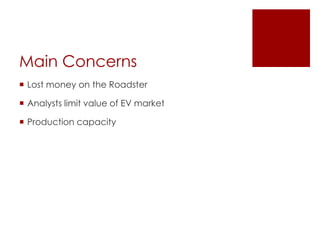
 Announced in 2008
 Released this past summer
 The specs of a sports car
while still being completely
electric
 Competitively price—starts
at $49,000
 Equipped with some of most
the advanced technology—
17’’ screen
 Voted car of the year by
Autmobile.com
Room for Growth
 Stock is so low because Tesla lost $1
billion on the Roadster
 Most don’t know it was planned

 Competitive price can allow for
unlimited growth, especially in
countries like China
 EV market is constantly
expanding, Tesla leads the market
with very few legitimate competitors

 Tesla plans to release Model X
(cheaper, mini-SUV) where they start
making profits
Valuation Measures
Historical Information
Comparison with Market
Competitors
 Main competitor is Fisker
 Karma starts at $96,000
 Repeated troubles
safety-wise

 Chevy and Nissan both
have Evs, but neither are
sports cars
 Sales of both are down
Main Concerns
 Lost money on the Roadster
 Analysts limit value of EV market
 Production capacity
Questions

?

Tesla ppt

  • 1.
  • 2.
    History  Founded in2003 by Elon Musk, Martin Eberhard, and Marc Tarpenning  March 2008- Tesla begins production of Roadster. Eventually sells 2,150 of Roadsters.  June 2008- Announce Model S  Jan 2010- Tesla registers for an IPO  May 2010- Tesla buys former GM factory in Fremont, CA and Toyota signs deal to cooperate in EV development
  • 3.
    The Macro Outlook Electric car sales have increased 228% in last year alone  17,000 in 2011 compared to $38,000 in 2012  Tesla essentially started the electric car market in the United States (Volt and Leaf didn’t exist before)  EV market has been trailing off  $10,000 tax rebate for EV cars this next year under the Obama administration  Makes EV cars more competitive
  • 5.
    Why Tesla?  Biggestopportunity for growth  Elon Musk’s proven leadership (PayPal and SpaceX)  Appleizing the car industry  New form of selling cars with no dealerships  Prove to transform the market, first to produce electric cars relatively cheaply
  • 6.
    Model S  Announcedin 2008  Released this past summer  The specs of a sports car while still being completely electric  Competitively price—starts at $49,000  Equipped with some of most the advanced technology— 17’’ screen  Voted car of the year by Autmobile.com
  • 7.
    Room for Growth Stock is so low because Tesla lost $1 billion on the Roadster  Most don’t know it was planned  Competitive price can allow for unlimited growth, especially in countries like China  EV market is constantly expanding, Tesla leads the market with very few legitimate competitors  Tesla plans to release Model X (cheaper, mini-SUV) where they start making profits
  • 8.
  • 9.
  • 10.
  • 11.
    Competitors  Main competitoris Fisker  Karma starts at $96,000  Repeated troubles safety-wise  Chevy and Nissan both have Evs, but neither are sports cars  Sales of both are down
  • 12.
    Main Concerns  Lostmoney on the Roadster  Analysts limit value of EV market  Production capacity
  • 13.

Editor's Notes

  • #4 First year Hybrids came out (2000, they only sold 9,000. Now they sell 2 million plus every year. GM and Toyota had electric cars a long in the 90s but they died out quickly mainly because their range was only 60-80 miles per charge. Tesla Model S has a range as high as 300 miles per full charge.
  • #5 Going through period of transition. Last year it was on a downward slope, this year it’s on an upward slope. The reason total revenue is down this year is because of the transition to the Model S from the Roadster
  • #6 Biggest opportunity for growth, can actually competitor to existing American car companies even though it’s been founded this decade.Elon Musk’s leadership“Applieizing the car industry”New form of selling cars (talk about the lawsuit)Proven to transform the market—first to produce Evs cheaply
  • #7 People associate electric cars with weakness and pathetic cars, they’re dispelling this idea. Can go faster a porche in 0-60 all while still being entirely electric
  • #8 Not really that it’s undervalued, more so that it can grow immensely. The loss was entirely planned.
  • #11 Clearly undervalued, because they’ve lost so much money on sales from Roadster. Will make that up on Model S and Model X.