SUB TOPICS
• Introduction
• FMCG products.
• Global scenario.
• Major players.
• Foreign players.
• Domestic players.
• Sectoral opportunities.
• Market structure.
• FMCG’s GDP contribution in India.
• FDI policy.
• Growth drivers.
• Sales
• 3 major Indian companies.
• Top 3 FMCG companies in India.
• Market shares.
• FMCG growth drivers.
• Impact of FMCG sector in India.
• FMCG v/s other marketing.
• Latest scenario in FMCG market.
• Impact of modern retail on FMCG sector.
• Marketing strategy process.
• Major challenges to the industry.
• Market scenario.
• Market distribution.
• Soft drinks brand market share.
• SWOT Analysis.
• Conclusion.
INTRODUCTION
Fast moving consumer goods (FMCG) or consumer packaged
goods (CPG) are products that are sold quickly and at relatively
low cost.
FMCG products have a quick turnover and relatively low cost.
India’s FMCG sector is fourth largest sector in the economy and
contribute to around 3 million employment opportunities.
FMCG market is in excess of Rs.85,000 crores.
 It includes household care, personal care, food & beverages.
FMCG industry is characterized by a well established
distribution network, low operating cost, lower per capital
consumption and intense competition between the organized and
un organized segments.
FMCG PRODUCTS
Beverages -- Rs. 4,000 Cr.
Confectionaries -- Rs. 2,100 Cr.
Creams -- Rs. 3,400 Cr.
GLOBAL SCENARIO
Per capita consumption in (US$)
0
2
4
6
8
10
12
LAUNDRY
SHAMPOO
SKIN CARE
DEODRANTS
MAJOR PLAYERS
Hindustan unilever Ltd.
ITC ( Indian tobacco company)
Nestle India
GCMMF ( AMUL)
Dabur India Ltd
Asian paints ( India)
Cadbury India
Britannia Industries Ltd.
Procter & Gamble Hygiene & Health Care.
Marico Industries Ltd.
Colgate – Palmolive ( India ) Ltd.
Gillettte India Ltd.
Godfrey Phillips
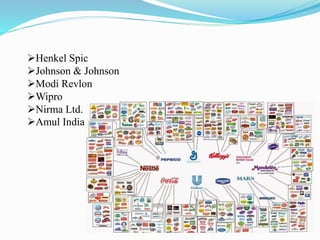
Henkel Spic
Johnson & Johnson
Modi Revlon
Wipro
Nirma Ltd.
Amul India
FOREIGN PLAYERS
 CADBURY INDIA LTD. (CIL)
 CARGILL
 COCA – COLA
 COLGATE PALMOLIVE INDIA
 H.J. HEINZ CO.
 HINDUSTAN LEVER LTD. (HLL)
 NESTLE INDIA LTD.
 PROCTER & GAMBLE
DOMESTIC PLAYERS
 BRITANNIA INDIA LTD.(BIL)
 DABUR INDIA LTD.
 INDIAN TOBACCO CORPORATION LTD. ( ITCL)
 NIRMA LTD.
SECTORAL OPPORTUNITIES
There are 4 major key sectoral opportunities for Indian FMCG
Sector are:
* Dairy Based Products.
* Packaged Food.
* Oral Care.
* Beverages.
FMCG’S GDP CONTRIBUTION IN INDIA
 FMCG sector ’s contribution to the country’s GDP
stood at 2.15% with the market size of US$25billion on
2007-2008.
 India is 12th largest consuming country in the world
( 2010 ).
 In 2010,India had the market size of US$353billion .
 It is projected to grow at 11.5% by 2014 with the
market size of US$543billion.
FDI POLICY
100% FDI in all Retail Sector.
24% foreign equity is permitted in the small- scale sector.
It helps all FMCG companies to grow up at higher level.
GROWTH DRIVERS
 Increasing per capita income of urban population .
 Changing profit and mind set of consumer.
 Growing popularity of organized retail.
 Rise of rural consumer.
 Large market.
 FDI support.
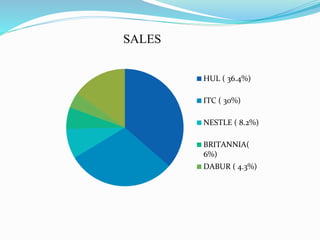
SALES
HUL ( 36.4%)
ITC ( 30%)
NESTLE ( 8.2%)
BRITANNIA(
6%)
DABUR ( 4.3%)
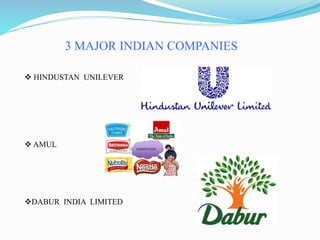
3 MAJOR INDIAN COMPANIES
 HINDUSTAN UNILEVER
 AMUL
DABUR INDIA LIMITED
HINDUSTAN UNILEVER
 HUL was formed in 1973 as Lever Brothers India
Limited & came into being 1956 as Hindustan Lever
Limited .
 It was recognized as golden super star trading house by
government.
 The mission – add vitality to life.
 The company was renamed in June 2007 as Hindustan
Unilever Limited.
 No.1 company in India.
 Sales turnover of Rs. 3,700.8 crores.
 Produces 35 different brands with 15,000 employes.
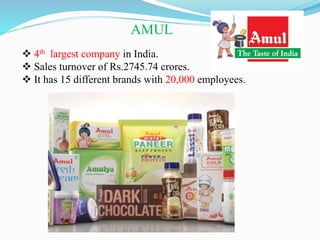
AMUL
 4th largest company in India.
 Sales turnover of Rs.2745.74 crores.
 It has 15 different brands with 20,000 employees.
DABUR
 6th largest company in India.
 Sales turnover of 2,396 crores.
 It has 32 different brands with 6,500 employees.
TOP 3 FMCG COMPANIES IN INDIA
 Hindustan Unilever Limited
 P&G
 ITC
P&G
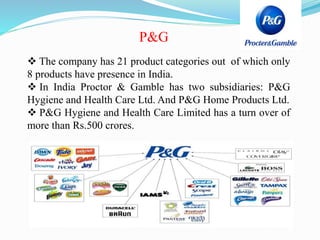
 The company has 21 product categories out of which only
8 products have presence in India.
 In India Proctor & Gamble has two subsidiaries: P&G
Hygiene and Health Care Ltd. And P&G Home Products Ltd.
 P&G Hygiene and Health Care Limited has a turn over of
more than Rs.500 crores.
ITC
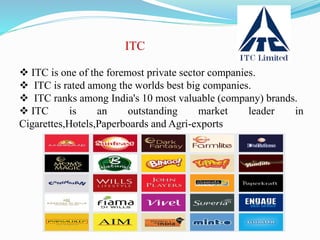
 ITC is one of the foremost private sector companies.
 ITC is rated among the worlds best big companies.
 ITC ranks among India's 10 most valuable (company) brands.
 ITC is an outstanding market leader in
Cigarettes,Hotels,Paperboards and Agri-exports
MARKET SHARES
0%
10%
20%
30%
40%
50%
60%
FMCG GROWTH DRIVERS
 New product launches.
 Rising incomes driving purchases.
 Desire to experiment with brands.
 Growing rural markets.
 Growth of modern trades.
 Strong distribution channel.
 Availability of strong grocery stores.
 Increasing consumer demand.
 Greater awareness of products, brands.
 Government reforms to encourage FDI inflow and market
sentiment.
 Evolving consumer life style.
IMPACT OF FMCG SECTOR IN INDIA.
Employment:
Direct employment is estimated at approximately 6% of turnover.
Approx 12-13 million retail stores in India, out of which 9 million are
FMCG.
Fiscal contribution:
Cascading multiple taxes by the FMG sector.
30% of the revenue sector goes into both direct & indirect taxes.
Social contribution:
Create employment for people with lower educational qualifications.
Contribution to other sectors:
Agriculture – Its intake of agricultural output as raw material is estimated
to constitute roughly 9% of total turn over.
FMCG V/S INDUSTRIAL MARKETING.
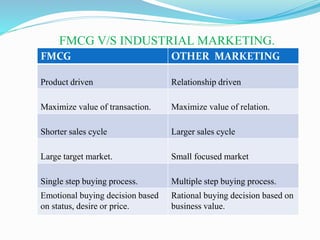
FMCG OTHER MARKETING
Product driven Relationship driven
Maximize value of transaction. Maximize value of relation.
Shorter sales cycle Larger sales cycle
Large target market. Small focused market
Single step buying process. Multiple step buying process.
Emotional buying decision based
on status, desire or price.
Rational buying decision based on
business value.
LATEST SCENARIO IN FMCG MARKET:
 Increasing per year with the growth rate of 9%.
 Price of raw material is decreasing.
 Cost of machinery required for consumer goods are less than
durable goods.
IMPACT OF MODERN RETAIL ON FMCG SECTOR
It has many benefits for different product categories
 Including greater penetration
 Wider product range
 The ability to display the range
 Direct interaction with the consumer & with the product
MARKETING STRATEGY PROCESS
7. Review &
revise
1.Understand
customer
2. Analyze
market
3.Analyze
competition
4. Research
distribution
5. Define
marketing
6. Financial
analysis
Major challenges to the industry
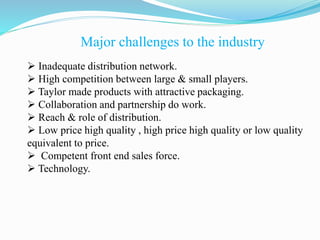
 Inadequate distribution network.
 High competition between large & small players.
 Taylor made products with attractive packaging.
 Collaboration and partnership do work.
 Reach & role of distribution.
 Low price high quality , high price high quality or low quality
equivalent to price.
 Competent front end sales force.
 Technology.
MARKET SCENARIO
FOOD
&BEVERAGES(53%
)
TOBACCO(15%)
PERSONAL
CARE(20%)
HOUSEHOLD(10)
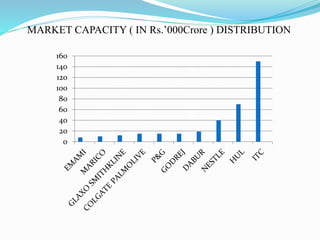
MARKET CAPACITY ( IN Rs.’000Crore ) DISTRIBUTION
0
20
40
60
80
100
120
140
160
SOFT DRINK BRANDS MARKET SHARE
COKE (26%)
DIET COKE(15%)
PEPSI(15%)
MOUNTAIN
DEW(10%)
Dr.PEPPER(9%)
DIET PEPSI(8%)
SPRITE(8%)
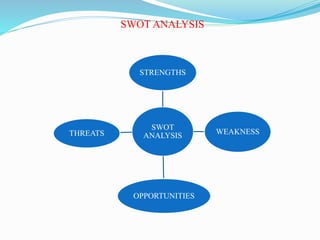
SWOT
ANALYSIS
STRENGTHS
WEAKNESS
OPPORTUNITIES
THREATS
SWOT ANALYSIS
STRENGTHS
Low operational cost
Well established distribution
network.
Strong brand and large market.
WEAKNESS
High advertisement cost
Low export level
Lower scope of investing in technology.
OPPORTUNITIES
Large domestic market
Rising income level.
Online social network.
THREATS
Tax and regulatory structure.
Rural demand In cyclical in nature.
Different monsoon.
CONCLUSION
 More and more people these days have started involving
themselves in this field as; it creates tremendous job
opportunities for them. It is a steady, diverse and a highly
profitable industry where a person can do a lot of work.
 It also allows you to trade directly with the various traders
online.
REFERENCE:
1.Ramanuj Majumdar(2004).Product management in
india.PHI learning .pp.26-27.ISBN 978-81-203-
1252.Retrived 2010-06-19.
2.Sean Brierley (2002).The advertising handbook by Sean
Brierley.(2,illusterated ed.).Routledge.p.
3.ASSOCHAM, New age tech research pvt.Ltd.
4.IBEF ( Indian brand equity foundation.(ERNST &
YOUNG)
Fmcg

Fmcg

  • 2.
    SUB TOPICS • Introduction •FMCG products. • Global scenario. • Major players. • Foreign players. • Domestic players. • Sectoral opportunities. • Market structure. • FMCG’s GDP contribution in India. • FDI policy. • Growth drivers.
  • 3.
    • Sales • 3major Indian companies. • Top 3 FMCG companies in India. • Market shares. • FMCG growth drivers. • Impact of FMCG sector in India. • FMCG v/s other marketing. • Latest scenario in FMCG market. • Impact of modern retail on FMCG sector. • Marketing strategy process. • Major challenges to the industry. • Market scenario. • Market distribution. • Soft drinks brand market share. • SWOT Analysis. • Conclusion.
  • 4.
    INTRODUCTION Fast moving consumergoods (FMCG) or consumer packaged goods (CPG) are products that are sold quickly and at relatively low cost. FMCG products have a quick turnover and relatively low cost. India’s FMCG sector is fourth largest sector in the economy and contribute to around 3 million employment opportunities. FMCG market is in excess of Rs.85,000 crores.  It includes household care, personal care, food & beverages. FMCG industry is characterized by a well established distribution network, low operating cost, lower per capital consumption and intense competition between the organized and un organized segments.
  • 5.
    FMCG PRODUCTS Beverages --Rs. 4,000 Cr. Confectionaries -- Rs. 2,100 Cr. Creams -- Rs. 3,400 Cr.
  • 6.
    GLOBAL SCENARIO Per capitaconsumption in (US$) 0 2 4 6 8 10 12 LAUNDRY SHAMPOO SKIN CARE DEODRANTS
  • 7.
    MAJOR PLAYERS Hindustan unileverLtd. ITC ( Indian tobacco company) Nestle India GCMMF ( AMUL) Dabur India Ltd Asian paints ( India) Cadbury India Britannia Industries Ltd. Procter & Gamble Hygiene & Health Care. Marico Industries Ltd. Colgate – Palmolive ( India ) Ltd. Gillettte India Ltd. Godfrey Phillips
  • 8.
    Henkel Spic Johnson &Johnson Modi Revlon Wipro Nirma Ltd. Amul India
  • 9.
    FOREIGN PLAYERS  CADBURYINDIA LTD. (CIL)  CARGILL  COCA – COLA  COLGATE PALMOLIVE INDIA  H.J. HEINZ CO.  HINDUSTAN LEVER LTD. (HLL)  NESTLE INDIA LTD.  PROCTER & GAMBLE
  • 10.
    DOMESTIC PLAYERS  BRITANNIAINDIA LTD.(BIL)  DABUR INDIA LTD.  INDIAN TOBACCO CORPORATION LTD. ( ITCL)  NIRMA LTD.
  • 11.
    SECTORAL OPPORTUNITIES There are4 major key sectoral opportunities for Indian FMCG Sector are: * Dairy Based Products. * Packaged Food. * Oral Care. * Beverages.
  • 12.
    FMCG’S GDP CONTRIBUTIONIN INDIA  FMCG sector ’s contribution to the country’s GDP stood at 2.15% with the market size of US$25billion on 2007-2008.  India is 12th largest consuming country in the world ( 2010 ).  In 2010,India had the market size of US$353billion .  It is projected to grow at 11.5% by 2014 with the market size of US$543billion.
  • 13.
    FDI POLICY 100% FDIin all Retail Sector. 24% foreign equity is permitted in the small- scale sector. It helps all FMCG companies to grow up at higher level.
  • 14.
    GROWTH DRIVERS  Increasingper capita income of urban population .  Changing profit and mind set of consumer.  Growing popularity of organized retail.  Rise of rural consumer.  Large market.  FDI support.
  • 15.
    SALES HUL ( 36.4%) ITC( 30%) NESTLE ( 8.2%) BRITANNIA( 6%) DABUR ( 4.3%)
  • 16.
    3 MAJOR INDIANCOMPANIES  HINDUSTAN UNILEVER  AMUL DABUR INDIA LIMITED
  • 17.
    HINDUSTAN UNILEVER  HULwas formed in 1973 as Lever Brothers India Limited & came into being 1956 as Hindustan Lever Limited .  It was recognized as golden super star trading house by government.  The mission – add vitality to life.  The company was renamed in June 2007 as Hindustan Unilever Limited.  No.1 company in India.  Sales turnover of Rs. 3,700.8 crores.  Produces 35 different brands with 15,000 employes.
  • 18.
    AMUL  4th largestcompany in India.  Sales turnover of Rs.2745.74 crores.  It has 15 different brands with 20,000 employees.
  • 19.
    DABUR  6th largestcompany in India.  Sales turnover of 2,396 crores.  It has 32 different brands with 6,500 employees.
  • 20.
    TOP 3 FMCGCOMPANIES IN INDIA  Hindustan Unilever Limited  P&G  ITC
  • 21.
    P&G  The companyhas 21 product categories out of which only 8 products have presence in India.  In India Proctor & Gamble has two subsidiaries: P&G Hygiene and Health Care Ltd. And P&G Home Products Ltd.  P&G Hygiene and Health Care Limited has a turn over of more than Rs.500 crores.
  • 22.
    ITC  ITC isone of the foremost private sector companies.  ITC is rated among the worlds best big companies.  ITC ranks among India's 10 most valuable (company) brands.  ITC is an outstanding market leader in Cigarettes,Hotels,Paperboards and Agri-exports
  • 23.
  • 24.
    FMCG GROWTH DRIVERS New product launches.  Rising incomes driving purchases.  Desire to experiment with brands.  Growing rural markets.  Growth of modern trades.  Strong distribution channel.  Availability of strong grocery stores.  Increasing consumer demand.  Greater awareness of products, brands.  Government reforms to encourage FDI inflow and market sentiment.  Evolving consumer life style.
  • 25.
    IMPACT OF FMCGSECTOR IN INDIA. Employment: Direct employment is estimated at approximately 6% of turnover. Approx 12-13 million retail stores in India, out of which 9 million are FMCG. Fiscal contribution: Cascading multiple taxes by the FMG sector. 30% of the revenue sector goes into both direct & indirect taxes. Social contribution: Create employment for people with lower educational qualifications. Contribution to other sectors: Agriculture – Its intake of agricultural output as raw material is estimated to constitute roughly 9% of total turn over.
  • 26.
    FMCG V/S INDUSTRIALMARKETING. FMCG OTHER MARKETING Product driven Relationship driven Maximize value of transaction. Maximize value of relation. Shorter sales cycle Larger sales cycle Large target market. Small focused market Single step buying process. Multiple step buying process. Emotional buying decision based on status, desire or price. Rational buying decision based on business value.
  • 27.
    LATEST SCENARIO INFMCG MARKET:  Increasing per year with the growth rate of 9%.  Price of raw material is decreasing.  Cost of machinery required for consumer goods are less than durable goods. IMPACT OF MODERN RETAIL ON FMCG SECTOR It has many benefits for different product categories  Including greater penetration  Wider product range  The ability to display the range  Direct interaction with the consumer & with the product
  • 28.
    MARKETING STRATEGY PROCESS 7.Review & revise 1.Understand customer 2. Analyze market 3.Analyze competition 4. Research distribution 5. Define marketing 6. Financial analysis
  • 29.
    Major challenges tothe industry  Inadequate distribution network.  High competition between large & small players.  Taylor made products with attractive packaging.  Collaboration and partnership do work.  Reach & role of distribution.  Low price high quality , high price high quality or low quality equivalent to price.  Competent front end sales force.  Technology.
  • 30.
  • 31.
    MARKET CAPACITY (IN Rs.’000Crore ) DISTRIBUTION 0 20 40 60 80 100 120 140 160
  • 32.
    SOFT DRINK BRANDSMARKET SHARE COKE (26%) DIET COKE(15%) PEPSI(15%) MOUNTAIN DEW(10%) Dr.PEPPER(9%) DIET PEPSI(8%) SPRITE(8%)
  • 33.
  • 34.
    STRENGTHS Low operational cost Wellestablished distribution network. Strong brand and large market. WEAKNESS High advertisement cost Low export level Lower scope of investing in technology.
  • 35.
    OPPORTUNITIES Large domestic market Risingincome level. Online social network. THREATS Tax and regulatory structure. Rural demand In cyclical in nature. Different monsoon.
  • 36.
    CONCLUSION  More andmore people these days have started involving themselves in this field as; it creates tremendous job opportunities for them. It is a steady, diverse and a highly profitable industry where a person can do a lot of work.  It also allows you to trade directly with the various traders online.
  • 37.
    REFERENCE: 1.Ramanuj Majumdar(2004).Product managementin india.PHI learning .pp.26-27.ISBN 978-81-203- 1252.Retrived 2010-06-19. 2.Sean Brierley (2002).The advertising handbook by Sean Brierley.(2,illusterated ed.).Routledge.p. 3.ASSOCHAM, New age tech research pvt.Ltd. 4.IBEF ( Indian brand equity foundation.(ERNST & YOUNG)