RISK ASSESSMENT OF BOT PROJECT
By,
Mr. Hajare Vinayak Sambhaji
Mr. Chavan Sagar Subhash
Mr. Danke Amol Bajrang
Mr. Danole Rohit Chandrakant
Mr. Bhosale Sujaysingh Ashokrav
Under the guidance of,
Ms. A.S. Manjarekar
Asst. Professor
Civil Engineering Department
Sanjay Ghodawat Institution (2013-14)
INTRODUCTION
 Infrastructure is an essential part of our society as it helps in improving
standard of living, productivity of nation and competitiveness. But actually,
the infrastructure development has limitations due to scarcity of funds and
scarce budgetary resources. Hence government has allowed participation of
private firm in public beneficial program, with the help of contract such as
BOT contract( Build -Operate -Transfer).
 An infrastructure project typically faces risks throughout project period,
which has to mitigate to enable financing on a limited project recourse basis.
The types of risks are several at the different at each stage of the project and
hence need to be mitigated appropriately.
 In the BOT approach, the government grants a private sector the rights to
finance, develop, and operate a revenue producing toll road for a defined
time period (i.e. concession period) after which the facility is transferred
back to the government.
 From the private sector's viewpoint, the main concern is profit maximization,
while under the government's perspective, social welfare maximization for
the society is of interest.
 Many of the countries including India have adopted the BOT approach, so
that the private sector has to finance and construct the project facility and
then transfer the owner ship to Government after a specified concession
period.
Need for study
 The experience of private investment in infrastructure in India over past years
indicates that risks and uncertainties go together with opportunities. Proper
identification of the risks associated with investment in infrastructure in India is
essential for the private investors to be successful.
 In general, in order to be successful all capital projects shall meet the criteria and
consider some of the common causes for their failures as shown below:
1. Delay in completion and delay in revenue flow.
2. Capital cost overrun.
3. Technical failure.
4. Financial failure of the contractor.
5. Government interference and inactions.
6. Uninsured casualty losses.
7. Increased price or shortages of raw materials.
8. Technical obsolescence of the plant.
9. Loss of competitive position in the market place.
10. Poor management.
11. Financial insolvency of the host government.
 In particular, for private investors to be successful in their infrastructure projects,
these risks must be properly considered, assessed and avoided throughout the life
of the projects.
METHODOLOGY
 The aim of present project is to find out various critical risks and to study
problems due to insufficient assessment of BOT projects and to suggest possible
remedial measures This project work is explained with the help of following
points:
1. Define the BOT project and various risks in BOT project.
2. Identify the factors affecting to the risks associated with BOT projects.
3. Develop structured questionnaire.
4. Collect data.
5. Analyze data.
6. Develop guidelines for mitigation for critical risks associated with BOT projects.
LITERATURE REVIEW
1. “Risk Analysis for a BOT Project”, by Swapan Kumar Bagui and Ambarish Ghosh published in
Jordan Journal of Civil Engineering, Volume 5, No. 3, 2011.
This paper describes Sensitivity analysis to determine the uncertainty of a project with a real case
study.
2. “Risk Analysis of Infrastructure Projects – A Case Study on Build Operate Transfer Projects in
India”, by Dr. Hiren M Maniar L&T Institute of Project Management, Vadodara, Gujarat, India
published in the in International Journal “The IUP Journal of Financial Risk Management” Vol. II No.4
December 2010.
This paper include the factors affecting on BOT projects and also suggests measures for mitigations of
them.
3. “Risks and Mitigation Measures in Build-Operate-Transfer Projects", Syed Kamarul Bakri , Syed
Ahmad Bokharey, Kalaikumar Vallyutham, Narayanan Sambu Potty and Nabilah Abu Bakar published
in world academy of science , engineering & technology (2010)
This paper describes the types of risks,its sources and measures for mitigation of risks.
4. “Risk Assessment of BOT Road Projects”, by Engineer Sharmila Mane & Prof. Dr. S. S. Pimplikar
(Civil Department, M.I.T. College of Engineering, Pune) published in International Journal of
Computational Engg. Research( vol.III, issue 8)
this paper includes the need of assessment of risks in BOT project and mainly aims towards financial
risk. Also describes measures for mitigation of risks.
5. “Evaluation And Management Of Political Risks In China”,s BOT Projects”, by Shou Qing Wang,
Robert L. K. Tiong, Member, ASCE, S. K. Ting, and D. Ashley, Member, ASCE.
This paper is based on the findings from an international survey on risk management of build-operate-
transfer (BOT) projects in developing countries. The measures for mitigating each of these risks are also
discussed.
6. “Identifying Key Risks in Construction Projects: Life Cycle and Stakeholder Perspectives", by Dr
Patrick. X.W. Zou, Dr. Guomin Zhang and Professor Jia-Yuan Wang and: Faculty of Built
Environment, Australia; College of Architecture and Civil Engineering, China published in risk
management journal ( Dec. 2007 , vol. II).
This paper aims to, to identify and analyze the risks associated with the development of BOT projects
7. “Traffic revenue risk management through Annuity Model of PPP road projects in India”, by L.
Boeing Singh, Satyanarayana N. Kalidind Published in International Journal of Project Management
(July, 2006). This paper describes annuity based BOT model.
8. “Prototype Model for Build-Operate-Transfer Risk Assessment”,by Tarek M. Zayed, S. M. and
Luh-Maan Chang M. published in ASCE journal (vol. II2002).
This paper includes, the BOT risk prototype model which provides a logical, reliable, and consistent
procedure for assessing the BOT project risk.
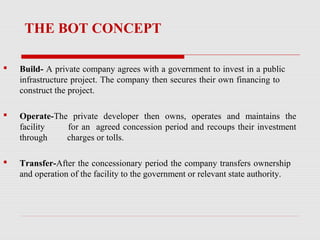
THE BOT CONCEPT
 Build- A private company agrees with a government to invest in a public
infrastructure project. The company then secures their own financing to
construct the project.
 Operate-The private developer then owns, operates and maintains the
facility for an agreed concession period and recoups their investment
through charges or tolls.
 Transfer-After the concessionary period the company transfers ownership
and operation of the facility to the government or relevant state authority.
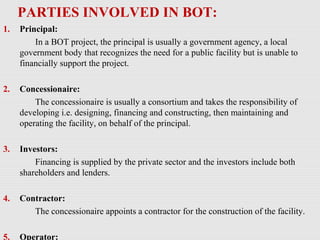
PARTIES INVOLVED IN BOT:
1. Principal:
In a BOT project, the principal is usually a government agency, a local
government body that recognizes the need for a public facility but is unable to
financially support the project.
2. Concessionaire:
The concessionaire is usually a consortium and takes the responsibility of
developing i.e. designing, financing and constructing, then maintaining and
operating the facility, on behalf of the principal.
3. Investors:
Financing is supplied by the private sector and the investors include both
shareholders and lenders.
4. Contractor:
The concessionaire appoints a contractor for the construction of the facility.
5. Operator:
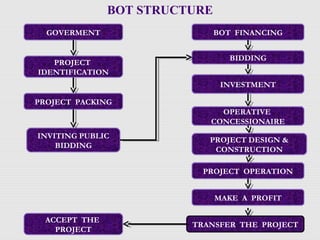
BOT FINANCING
BIDDING
INVESTMENT
OPERATIVE
CONCESSIONAIRE
PROJECT DESIGN &
CONSTRUCTION
PROJECT OPERATION
MAKE A PROFIT
TRANSFER THE PROJECT
GOVERMENT
PROJECT
IDENTIFICATION
PROJECT PACKING
INVITING PUBLIC
BIDDING
ACCEPT THE
PROJECT
BOT STRUCTURE
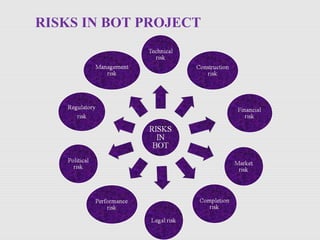
RISKS IN BOT PROJECT
Causes of risk in BOT projects
1. Land Acquisition
2. Force Majeure
3. Problems of local
4. Interest Rate
5. RBI policy
6. Price Escalation
7. Misunderstandings about the clauses
8. Extra Cost
METHODS OF RISK ANALYSIS
1. QUANTITATIVE METHOD
– Needs a lot of work for the analysis.
– Suitable for medium and large projects
2. QUALITATIVE METHOD
– Based on descriptive scales and used for describing the impact of a risk.
– Suitable for small and medium size projects.
3. RISK RATING METHOD
– Applicable for large, medium and small size projects.
– Critical risks going to occur are evaluated.
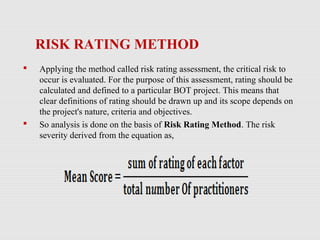
RISK RATING METHOD
 Applying the method called risk rating assessment, the critical risk to
occur is evaluated. For the purpose of this assessment, rating should be
calculated and defined to a particular BOT project. This means that
clear definitions of rating should be drawn up and its scope depends on
the project's nature, criteria and objectives.
 So analysis is done on the basis of Risk Rating Method. The risk
severity derived from the equation as,
QUESTIONNAIREQUESTIONNAIRE
FORMATFORMAT
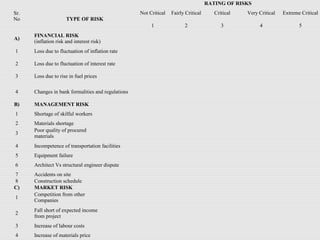
Sr.
No TYPE OF RISK
RATING OF RISKS
Not Critical Fairly Critical Critical Very Critical Extreme Critical
1 2 3 4 5
A)
FINANCIAL RISK
(inflation risk and interest risk)
1 Loss due to fluctuation of inflation rate
2 Loss due to fluctuation of interest rate
3 Loss due to rise in fuel prices
4 Changes in bank formalities and regulations
B) MANAGEMENT RISK
1 Shortage of skilful workers
2 Materials shortage
3
Poor quality of procured
materials
4 Incompetence of transportation facilities
5 Equipment failure
6 Architect Vs structural engineer dispute
7 Accidents on site
8 Construction schedule
C) MARKET RISK
1
Competition from other
Companies
2
Fall short of expected income
from project
3 Increase of labour costs
4 Increase of materials price
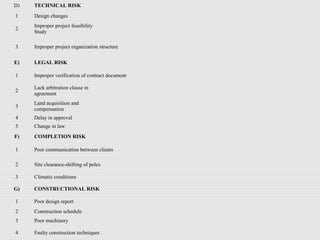
D) TECHNICAL RISK
1 Design changes
2
Improper project feasibility
Study
3 Improper project organization structure
E) LEGAL RISK
1 Improper verification of contract document
2
Lack arbitration clause in
agreement
3
Land acquisition and
compensation
4 Delay in approval
5 Change in law
F) COMPLETION RISK
1 Poor communication between clients
2 Site clearance-shifting of poles
3 Climatic conditions
G) CONSTRUCTIONAL RISK
1 Poor design report
2 Construction schedule
3 Poor machinery
4 Faulty construction techniques
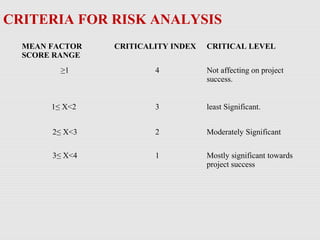
MEAN FACTOR
SCORE RANGE
CRITICALITY INDEX CRITICAL LEVEL
≥1 4 Not affecting on project
success.
1≤ X<2 3 least Significant.
2≤ X<3 2 Moderately Significant
3≤ X<4 1 Mostly significant towards
project success
CRITERIA FOR RISK ANALYSIS
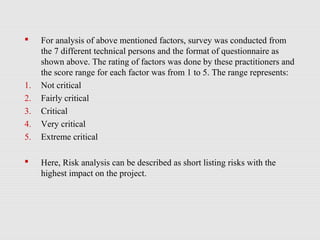
 For analysis of above mentioned factors, survey was conducted from
the 7 different technical persons and the format of questionnaire as
shown above. The rating of factors was done by these practitioners and
the score range for each factor was from 1 to 5. The range represents:
1. Not critical
2. Fairly critical
3. Critical
4. Very critical
5. Extreme critical
 Here, Risk analysis can be described as short listing risks with the
highest impact on the project.
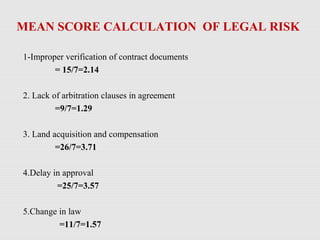
MEAN SCORE CALCULATION OF LEGAL RISK
1-Improper verification of contract documents
= 15/7=2.14
2. Lack of arbitration clauses in agreement
=9/7=1.29
3. Land acquisition and compensation
=26/7=3.71
4.Delay in approval
=25/7=3.57
5.Change in law
=11/7=1.57
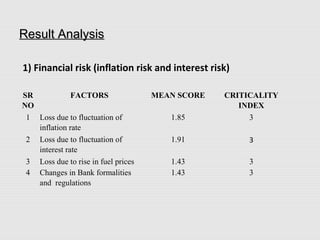
1) Financial risk (inflation risk and interest risk)
SR
NO
FACTORS MEAN SCORE CRITICALITY
INDEX
1 Loss due to fluctuation of
inflation rate
1.85 3
2 Loss due to fluctuation of
interest rate
1.91 3
3 Loss due to rise in fuel prices 1.43 3
4 Changes in Bank formalities
and regulations
1.43 3
  
Result AnalysisResult Analysis
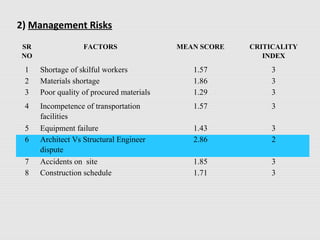
2) Management Risks
SR
NO
FACTORS MEAN SCORE CRITICALITY
INDEX
1 Shortage of skilful workers 1.57 3
2 Materials shortage 1.86 3
3 Poor quality of procured materials 1.29 3
4 Incompetence of transportation
facilities
1.57 3
5 Equipment failure 1.43 3
6 Architect Vs Structural Engineer
dispute
2.86 2
7 Accidents on site 1.85 3
8 Construction schedule 1.71 3
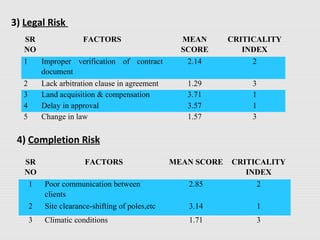
3) Legal Risk
SR
NO
FACTORS MEAN
SCORE
CRITICALITY
INDEX
1 Improper verification of contract
document
2.14 2
2 Lack arbitration clause in agreement 1.29 3
3 Land acquisition & compensation 3.71 1
4 Delay in approval 3.57 1
5 Change in law 1.57 3
4) Completion Risk
SR
NO
FACTORS MEAN SCORE CRITICALITY
INDEX
1 Poor communication between
clients
2.85 2
2 Site clearance-shifting of poles,etc 3.14 1
3 Climatic conditions 1.71 3
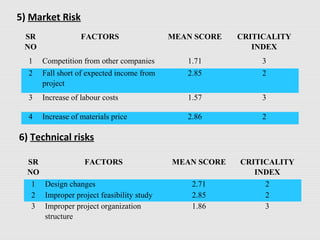
5) Market Risk
SR
NO
FACTORS MEAN SCORE CRITICALITY
INDEX
1 Competition from other companies 1.71 3
2 Fall short of expected income from
project
2.85 2
3 Increase of labour costs 1.57 3
4 Increase of materials price 2.86 2
6) Technical risks
SR
NO
FACTORS MEAN SCORE CRITICALITY
INDEX
1 Design changes 2.71 2
2 Improper project feasibility study 2.85 2
3 Improper project organization
structure
1.86 3
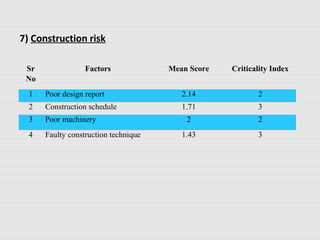
7) Construction risk
Sr
No
Factors Mean Score Criticality Index
1 Poor design report 2.14 2
2 Construction schedule 1.71 3
3 Poor machinery 2 2
4 Faulty construction technique 1.43 3
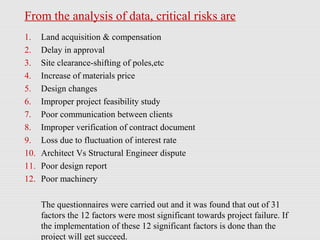
From the analysis of data, critical risks are
1. Land acquisition & compensation
2. Delay in approval
3. Site clearance-shifting of poles,etc
4. Increase of materials price
5. Design changes
6. Improper project feasibility study
7. Poor communication between clients
8. Improper verification of contract document
9. Loss due to fluctuation of interest rate
10. Architect Vs Structural Engineer dispute
11. Poor design report
12. Poor machinery
The questionnaires were carried out and it was found that out of 31
factors the 12 factors were most significant towards project failure. If
the implementation of these 12 significant factors is done than the
project will get succeed.
CASE STUDY-I
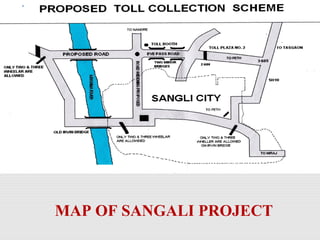
“CONSTRUCTION OF BRIDGE ACROSS KRISHNA RIVER
NEAR SHERI NALLA & ALTERNATE ROUTE OUTSIDE
SANGLI CITY TO MIRAJ WITH TOLL RIGHT”.
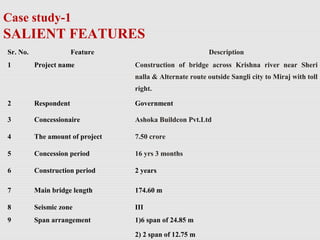
Case study-1
SALIENT FEATURES
Sr. No. Feature Description
1 Project name Construction of bridge across Krishna river near Sheri
nalla & Alternate route outside Sangli city to Miraj with toll
right.
2 Respondent Government
3 Concessionaire Ashoka Buildcon Pvt.Ltd
4 The amount of project 7.50 crore
5 Concession period 16 yrs 3 months
6 Construction period 2 years
7 Main bridge length 174.60 m
8 Seismic zone III
9 Span arrangement 1)6 span of 24.85 m
2) 2 span of 12.75 m
MAP OF SANGALI PROJECT
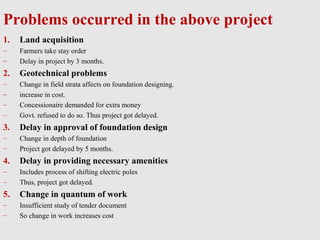
Problems occurred in the above project
1. Land acquisition
– Farmers take stay order
– Delay in project by 3 months.
2. Geotechnical problems
– Change in field strata affects on foundation designing.
– increase in cost.
– Concessionaire demanded for extra money
– Govt. refused to do so. Thus project got delayed.
3. Delay in approval of foundation design
– Change in depth of foundation
– Project got delayed by 5 months.
4. Delay in providing necessary amenities
– Includes process of shifting electric poles
– Thus, project got delayed.
5. Change in quantum of work
– Insufficient study of tender document
– So change in work increases cost
CASE STUDY-II
“IMPLEMENTATION OF INTEGRATED ROAD
DEVELOPMENT PROGRAMME IN THE CITY OF
KOLHAPUR ON BUILD OPERATE TRANSFER
BASIS.”
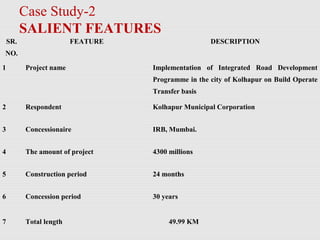
Case Study-2
SALIENT FEATURES
SR.
NO.
FEATURE DESCRIPTION
1 Project name Implementation of Integrated Road Development
Programme in the city of Kolhapur on Build Operate
Transfer basis
2 Respondent Kolhapur Municipal Corporation
3 Concessionaire IRB, Mumbai.
4 The amount of project 4300 millions
5 Construction period 24 months
6 Concession period 30 years
7 Total length 49.99 KM
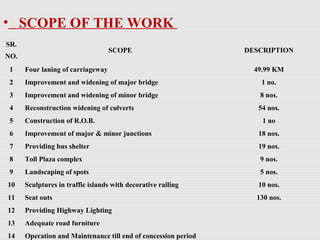
• SCOPE OF THE WORK
SR.
NO.
SCOPE DESCRIPTION
1 Four laning of carriageway 49.99 KM
2 Improvement and widening of major bridge 1 no.
3 Improvement and widening of minor bridge 8 nos.
4 Reconstruction widening of culverts 54 nos.
5 Construction of R.O.B. 1 no
6 Improvement of major & minor junctions 18 nos.
7 Providing bus shelter 19 nos.
8 Toll Plaza complex 9 nos.
9 Landscaping of spots 5 nos.
10 Sculptures in traffic islands with decorative railing 10 nos.
11 Seat outs 130 nos.
12 Providing Highway Lighting
13 Adequate road furniture
14 Operation and Maintenance till end of concession period
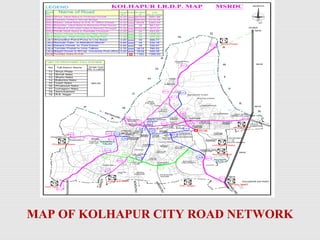
MAP OF KOLHAPUR CITY ROAD NETWORK
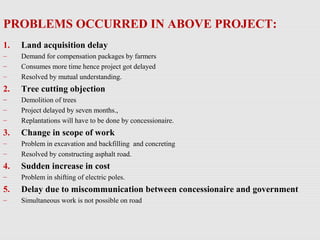
PROBLEMS OCCURRED IN ABOVE PROJECT:
1. Land acquisition delay
– Demand for compensation packages by farmers
– Consumes more time hence project got delayed
– Resolved by mutual understanding.
2. Tree cutting objection
– Demolition of trees
– Project delayed by seven months.,
– Replantations will have to be done by concessionaire.
3. Change in scope of work
– Problem in excavation and backfilling and concreting
– Resolved by constructing asphalt road.
4. Sudden increase in cost
– Problem in shifting of electric poles.
5. Delay due to miscommunication between concessionaire and government
– Simultaneous work is not possible on road
CONCLUSION
 Every BOT project is subjected to multiple risks. Thus it has become
the responsibility and liability of the promoter to mitigate the risks to
ensure the success of a BOT project by recruiting a strong management
team.
 It always recommended to the lender and investor to conduct feasibility
studies before they finance a BOT project similarly to the promoter
before the commencement of the project.
 It can be concluded that risk assessment for any BOT project should be
conducted and the mitigation plan must be followed strictly in ensuring
the success of the project.
 From the questionnaire on basis of 31 factors categorized with various risk, 12 no.
of factors have to be consider as critical risks and these risks are essential to be
taken into consideration for the success of BOT project.
 In this project, the identified critical risks in order of importance are Land
acquisition & compensation, Delay in approval, Site clearance-shifting of poles,
etc., Increase of materials price, Design changes, Improper project feasibility
study, Poor communication between clients, Improper verification of contract
document , Loss due to fluctuation of interest rate, Architect Vs Structural
Engineer dispute, Poor design report, Poor machinery.
 The measures for mitigation of all risks have been evaluated. Most of the measures
are regarded as effective and only a few of them are regarded as fairly effective.
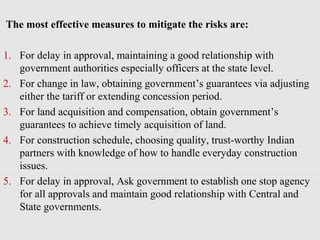
The most effective measures to mitigate the risks are:
1. For delay in approval, maintaining a good relationship with
government authorities especially officers at the state level.
2. For change in law, obtaining government’s guarantees via adjusting
either the tariff or extending concession period.
3. For land acquisition and compensation, obtain government’s
guarantees to achieve timely acquisition of land.
4. For construction schedule, choosing quality, trust-worthy Indian
partners with knowledge of how to handle everyday construction
issues.
5. For delay in approval, Ask government to establish one stop agency
for all approvals and maintain good relationship with Central and
State governments.
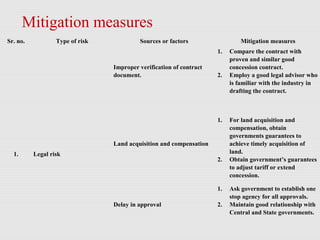
Mitigation measures
Sr. no. Type of risk Sources or factors Mitigation measures
1. Legal risk
Improper verification of contract
document.
1. Compare the contract with
proven and similar good
concession contract.
2. Employ a good legal advisor who
is familiar with the industry in
drafting the contract.
Land acquisition and compensation
1. For land acquisition and
compensation, obtain
governments guarantees to
achieve timely acquisition of
land.
2. Obtain government’s guarantees
to adjust tariff or extend
concession.
Delay in approval
1. Ask government to establish one
stop agency for all approvals.
2. Maintain good relationship with
Central and State governments.
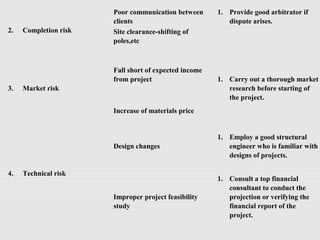
2. Completion risk
Poor communication between
clients
1. Provide good arbitrator if
dispute arises.
Site clearance-shifting of
poles,etc
3. Market risk
Fall short of expected income
from project 1. Carry out a thorough market
research before starting of
the project.
Increase of materials price
4. Technical risk
Design changes
1. Employ a good structural
engineer who is familiar with
designs of projects.
Improper project feasibility
study
1. Consult a top financial
consultant to conduct the
projection or verifying the
financial report of the
project.
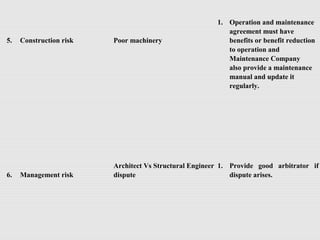
5. Construction risk Poor machinery
1. Operation and maintenance
agreement must have
benefits or benefit reduction
to operation and
Maintenance Company
also provide a maintenance
manual and update it
regularly.
6. Management risk
Architect Vs Structural Engineer
dispute
1. Provide good arbitrator if
dispute arises.
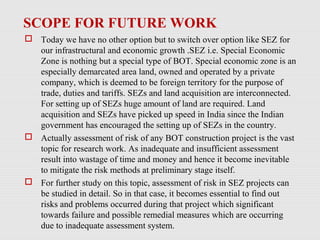
SCOPE FOR FUTURE WORK
 Today we have no other option but to switch over option like SEZ for
our infrastructural and economic growth .SEZ i.e. Special Economic
Zone is nothing but a special type of BOT. Special economic zone is an
especially demarcated area land, owned and operated by a private
company, which is deemed to be foreign territory for the purpose of
trade, duties and tariffs. SEZs and land acquisition are interconnected.
For setting up of SEZs huge amount of land are required. Land
acquisition and SEZs have picked up speed in India since the Indian
government has encouraged the setting up of SEZs in the country.
 Actually assessment of risk of any BOT construction project is the vast
topic for research work. As inadequate and insufficient assessment
result into wastage of time and money and hence it become inevitable
to mitigate the risk methods at preliminary stage itself.
 For further study on this topic, assessment of risk in SEZ projects can
be studied in detail. So in that case, it becomes essential to find out
risks and problems occurred during that project which significant
towards failure and possible remedial measures which are occurring
due to inadequate assessment system.
REFERENCES
BOOKS:
1. Jeffrey Delmon “Project finance, BOT projects and risks”
2. Ursula Katharine Walter “BOT project in Asia: impact study of an efficient
risk management during BOT in infrastructure sector”
TECHNICAL PAPERS:
1. A Mubin and A Ghaffer, “BOT contract: Applicability for science infrastructure development”
published in Indian journal engineering and application of science (vol.III, July, 08).
2. Dey. P. K. Ogunlana, S. O. and Takehiko N; “Risk assessment management” (ijram), (2002) 23-24.
Published in international journal.’’
3. Dr. Hiren M Maniar L&T institute of project management, Vadodara, Gujarat, India ,“Risk analysis of
infrastructure projects – A case study on build operate transfer projects in India” published in the
in international journal “The IUP journal of financial risk management” vol. II no.4 December 2010.
4. K. C. Lyer & Mohammad Sagheer “Risk assessment in BOT infrastructure” published in, Indian
institute of technology Madras, Chennai.
5. Llanto, Gilberto M. (2002). “Infrastructure development: Experience and
policy options for the future.” Discussion paper series No.2002-26. Philippine
institute for policy studies (PIDS).
6. Mary an Gonzalez Issue paper on “Success of private sector participation in
infrastructure.”
7. R.C. Sinha, “BOT –As a model for infrastructure investment with reference to
roads and bridges”, NICMAR-JCM, vol. XIV, Oct-Dec 1999.
INTERVIEWS WITH EXPERTS-:
1. Mr. Mulla Salim, Executive Engineer, PWD, Sangli District, Maharashtra, India.
2. Mr. Jadhav Atul, Independent Consultant Engineer, MSRDC, Kolhapur Zone,
Maharashtra, India.
3. Mr. Mane S.S., Executive Engineer, PWD, Kolhapur District, Maharashtra, India.
4. Mr. Kadam Pravin., Sectional Engineer, IRB, Kolhapur District, Maharashtra,
India.
5. Mr. Chavan Lucky., highway Engineer, Supreme Infrastructure, Hatkanangale,
Kolhapur District, Maharashtra.
WEBSITES
1. http://www.asceonlinejournals.com
2. http://www.nhai.org
final pptbot

final pptbot

  • 1.
    RISK ASSESSMENT OFBOT PROJECT By, Mr. Hajare Vinayak Sambhaji Mr. Chavan Sagar Subhash Mr. Danke Amol Bajrang Mr. Danole Rohit Chandrakant Mr. Bhosale Sujaysingh Ashokrav Under the guidance of, Ms. A.S. Manjarekar Asst. Professor Civil Engineering Department Sanjay Ghodawat Institution (2013-14)
  • 2.
    INTRODUCTION  Infrastructure isan essential part of our society as it helps in improving standard of living, productivity of nation and competitiveness. But actually, the infrastructure development has limitations due to scarcity of funds and scarce budgetary resources. Hence government has allowed participation of private firm in public beneficial program, with the help of contract such as BOT contract( Build -Operate -Transfer).  An infrastructure project typically faces risks throughout project period, which has to mitigate to enable financing on a limited project recourse basis. The types of risks are several at the different at each stage of the project and hence need to be mitigated appropriately.
  • 3.
     In theBOT approach, the government grants a private sector the rights to finance, develop, and operate a revenue producing toll road for a defined time period (i.e. concession period) after which the facility is transferred back to the government.  From the private sector's viewpoint, the main concern is profit maximization, while under the government's perspective, social welfare maximization for the society is of interest.  Many of the countries including India have adopted the BOT approach, so that the private sector has to finance and construct the project facility and then transfer the owner ship to Government after a specified concession period. Need for study
  • 4.
     The experienceof private investment in infrastructure in India over past years indicates that risks and uncertainties go together with opportunities. Proper identification of the risks associated with investment in infrastructure in India is essential for the private investors to be successful.  In general, in order to be successful all capital projects shall meet the criteria and consider some of the common causes for their failures as shown below: 1. Delay in completion and delay in revenue flow. 2. Capital cost overrun. 3. Technical failure. 4. Financial failure of the contractor. 5. Government interference and inactions. 6. Uninsured casualty losses.
  • 5.
    7. Increased priceor shortages of raw materials. 8. Technical obsolescence of the plant. 9. Loss of competitive position in the market place. 10. Poor management. 11. Financial insolvency of the host government.  In particular, for private investors to be successful in their infrastructure projects, these risks must be properly considered, assessed and avoided throughout the life of the projects.
  • 6.
    METHODOLOGY  The aimof present project is to find out various critical risks and to study problems due to insufficient assessment of BOT projects and to suggest possible remedial measures This project work is explained with the help of following points: 1. Define the BOT project and various risks in BOT project. 2. Identify the factors affecting to the risks associated with BOT projects. 3. Develop structured questionnaire. 4. Collect data. 5. Analyze data. 6. Develop guidelines for mitigation for critical risks associated with BOT projects.
  • 7.
    LITERATURE REVIEW 1. “RiskAnalysis for a BOT Project”, by Swapan Kumar Bagui and Ambarish Ghosh published in Jordan Journal of Civil Engineering, Volume 5, No. 3, 2011. This paper describes Sensitivity analysis to determine the uncertainty of a project with a real case study. 2. “Risk Analysis of Infrastructure Projects – A Case Study on Build Operate Transfer Projects in India”, by Dr. Hiren M Maniar L&T Institute of Project Management, Vadodara, Gujarat, India published in the in International Journal “The IUP Journal of Financial Risk Management” Vol. II No.4 December 2010. This paper include the factors affecting on BOT projects and also suggests measures for mitigations of them. 3. “Risks and Mitigation Measures in Build-Operate-Transfer Projects", Syed Kamarul Bakri , Syed Ahmad Bokharey, Kalaikumar Vallyutham, Narayanan Sambu Potty and Nabilah Abu Bakar published in world academy of science , engineering & technology (2010) This paper describes the types of risks,its sources and measures for mitigation of risks. 4. “Risk Assessment of BOT Road Projects”, by Engineer Sharmila Mane & Prof. Dr. S. S. Pimplikar (Civil Department, M.I.T. College of Engineering, Pune) published in International Journal of Computational Engg. Research( vol.III, issue 8) this paper includes the need of assessment of risks in BOT project and mainly aims towards financial risk. Also describes measures for mitigation of risks.
  • 8.
    5. “Evaluation AndManagement Of Political Risks In China”,s BOT Projects”, by Shou Qing Wang, Robert L. K. Tiong, Member, ASCE, S. K. Ting, and D. Ashley, Member, ASCE. This paper is based on the findings from an international survey on risk management of build-operate- transfer (BOT) projects in developing countries. The measures for mitigating each of these risks are also discussed. 6. “Identifying Key Risks in Construction Projects: Life Cycle and Stakeholder Perspectives", by Dr Patrick. X.W. Zou, Dr. Guomin Zhang and Professor Jia-Yuan Wang and: Faculty of Built Environment, Australia; College of Architecture and Civil Engineering, China published in risk management journal ( Dec. 2007 , vol. II). This paper aims to, to identify and analyze the risks associated with the development of BOT projects 7. “Traffic revenue risk management through Annuity Model of PPP road projects in India”, by L. Boeing Singh, Satyanarayana N. Kalidind Published in International Journal of Project Management (July, 2006). This paper describes annuity based BOT model. 8. “Prototype Model for Build-Operate-Transfer Risk Assessment”,by Tarek M. Zayed, S. M. and Luh-Maan Chang M. published in ASCE journal (vol. II2002). This paper includes, the BOT risk prototype model which provides a logical, reliable, and consistent procedure for assessing the BOT project risk.
  • 9.
    THE BOT CONCEPT Build- A private company agrees with a government to invest in a public infrastructure project. The company then secures their own financing to construct the project.  Operate-The private developer then owns, operates and maintains the facility for an agreed concession period and recoups their investment through charges or tolls.  Transfer-After the concessionary period the company transfers ownership and operation of the facility to the government or relevant state authority.
  • 10.
    PARTIES INVOLVED INBOT: 1. Principal: In a BOT project, the principal is usually a government agency, a local government body that recognizes the need for a public facility but is unable to financially support the project. 2. Concessionaire: The concessionaire is usually a consortium and takes the responsibility of developing i.e. designing, financing and constructing, then maintaining and operating the facility, on behalf of the principal. 3. Investors: Financing is supplied by the private sector and the investors include both shareholders and lenders. 4. Contractor: The concessionaire appoints a contractor for the construction of the facility. 5. Operator:
  • 11.
    BOT FINANCING BIDDING INVESTMENT OPERATIVE CONCESSIONAIRE PROJECT DESIGN& CONSTRUCTION PROJECT OPERATION MAKE A PROFIT TRANSFER THE PROJECT GOVERMENT PROJECT IDENTIFICATION PROJECT PACKING INVITING PUBLIC BIDDING ACCEPT THE PROJECT BOT STRUCTURE
  • 12.
    RISKS IN BOTPROJECT
  • 13.
    Causes of riskin BOT projects 1. Land Acquisition 2. Force Majeure 3. Problems of local 4. Interest Rate 5. RBI policy 6. Price Escalation 7. Misunderstandings about the clauses 8. Extra Cost
  • 14.
    METHODS OF RISKANALYSIS 1. QUANTITATIVE METHOD – Needs a lot of work for the analysis. – Suitable for medium and large projects 2. QUALITATIVE METHOD – Based on descriptive scales and used for describing the impact of a risk. – Suitable for small and medium size projects. 3. RISK RATING METHOD – Applicable for large, medium and small size projects. – Critical risks going to occur are evaluated.
  • 15.
    RISK RATING METHOD Applying the method called risk rating assessment, the critical risk to occur is evaluated. For the purpose of this assessment, rating should be calculated and defined to a particular BOT project. This means that clear definitions of rating should be drawn up and its scope depends on the project's nature, criteria and objectives.  So analysis is done on the basis of Risk Rating Method. The risk severity derived from the equation as,
  • 16.
  • 17.
    Sr. No TYPE OFRISK RATING OF RISKS Not Critical Fairly Critical Critical Very Critical Extreme Critical 1 2 3 4 5 A) FINANCIAL RISK (inflation risk and interest risk) 1 Loss due to fluctuation of inflation rate 2 Loss due to fluctuation of interest rate 3 Loss due to rise in fuel prices 4 Changes in bank formalities and regulations B) MANAGEMENT RISK 1 Shortage of skilful workers 2 Materials shortage 3 Poor quality of procured materials 4 Incompetence of transportation facilities 5 Equipment failure 6 Architect Vs structural engineer dispute 7 Accidents on site 8 Construction schedule C) MARKET RISK 1 Competition from other Companies 2 Fall short of expected income from project 3 Increase of labour costs 4 Increase of materials price
  • 18.
    D) TECHNICAL RISK 1Design changes 2 Improper project feasibility Study 3 Improper project organization structure E) LEGAL RISK 1 Improper verification of contract document 2 Lack arbitration clause in agreement 3 Land acquisition and compensation 4 Delay in approval 5 Change in law F) COMPLETION RISK 1 Poor communication between clients 2 Site clearance-shifting of poles 3 Climatic conditions G) CONSTRUCTIONAL RISK 1 Poor design report 2 Construction schedule 3 Poor machinery 4 Faulty construction techniques
  • 19.
    MEAN FACTOR SCORE RANGE CRITICALITYINDEX CRITICAL LEVEL ≥1 4 Not affecting on project success. 1≤ X<2 3 least Significant. 2≤ X<3 2 Moderately Significant 3≤ X<4 1 Mostly significant towards project success CRITERIA FOR RISK ANALYSIS
  • 20.
     For analysisof above mentioned factors, survey was conducted from the 7 different technical persons and the format of questionnaire as shown above. The rating of factors was done by these practitioners and the score range for each factor was from 1 to 5. The range represents: 1. Not critical 2. Fairly critical 3. Critical 4. Very critical 5. Extreme critical  Here, Risk analysis can be described as short listing risks with the highest impact on the project.
  • 21.
    MEAN SCORE CALCULATIONOF LEGAL RISK 1-Improper verification of contract documents = 15/7=2.14 2. Lack of arbitration clauses in agreement =9/7=1.29 3. Land acquisition and compensation =26/7=3.71 4.Delay in approval =25/7=3.57 5.Change in law =11/7=1.57
  • 22.
    1) Financial risk(inflation risk and interest risk) SR NO FACTORS MEAN SCORE CRITICALITY INDEX 1 Loss due to fluctuation of inflation rate 1.85 3 2 Loss due to fluctuation of interest rate 1.91 3 3 Loss due to rise in fuel prices 1.43 3 4 Changes in Bank formalities and regulations 1.43 3    Result AnalysisResult Analysis
  • 23.
    2) Management Risks SR NO FACTORSMEAN SCORE CRITICALITY INDEX 1 Shortage of skilful workers 1.57 3 2 Materials shortage 1.86 3 3 Poor quality of procured materials 1.29 3 4 Incompetence of transportation facilities 1.57 3 5 Equipment failure 1.43 3 6 Architect Vs Structural Engineer dispute 2.86 2 7 Accidents on site 1.85 3 8 Construction schedule 1.71 3
  • 24.
    3) Legal Risk SR NO FACTORSMEAN SCORE CRITICALITY INDEX 1 Improper verification of contract document 2.14 2 2 Lack arbitration clause in agreement 1.29 3 3 Land acquisition & compensation 3.71 1 4 Delay in approval 3.57 1 5 Change in law 1.57 3 4) Completion Risk SR NO FACTORS MEAN SCORE CRITICALITY INDEX 1 Poor communication between clients 2.85 2 2 Site clearance-shifting of poles,etc 3.14 1 3 Climatic conditions 1.71 3
  • 25.
    5) Market Risk SR NO FACTORSMEAN SCORE CRITICALITY INDEX 1 Competition from other companies 1.71 3 2 Fall short of expected income from project 2.85 2 3 Increase of labour costs 1.57 3 4 Increase of materials price 2.86 2 6) Technical risks SR NO FACTORS MEAN SCORE CRITICALITY INDEX 1 Design changes 2.71 2 2 Improper project feasibility study 2.85 2 3 Improper project organization structure 1.86 3
  • 26.
    7) Construction risk Sr No FactorsMean Score Criticality Index 1 Poor design report 2.14 2 2 Construction schedule 1.71 3 3 Poor machinery 2 2 4 Faulty construction technique 1.43 3
  • 27.
    From the analysisof data, critical risks are 1. Land acquisition & compensation 2. Delay in approval 3. Site clearance-shifting of poles,etc 4. Increase of materials price 5. Design changes 6. Improper project feasibility study 7. Poor communication between clients 8. Improper verification of contract document 9. Loss due to fluctuation of interest rate 10. Architect Vs Structural Engineer dispute 11. Poor design report 12. Poor machinery The questionnaires were carried out and it was found that out of 31 factors the 12 factors were most significant towards project failure. If the implementation of these 12 significant factors is done than the project will get succeed.
  • 28.
    CASE STUDY-I “CONSTRUCTION OFBRIDGE ACROSS KRISHNA RIVER NEAR SHERI NALLA & ALTERNATE ROUTE OUTSIDE SANGLI CITY TO MIRAJ WITH TOLL RIGHT”.
  • 29.
    Case study-1 SALIENT FEATURES Sr.No. Feature Description 1 Project name Construction of bridge across Krishna river near Sheri nalla & Alternate route outside Sangli city to Miraj with toll right. 2 Respondent Government 3 Concessionaire Ashoka Buildcon Pvt.Ltd 4 The amount of project 7.50 crore 5 Concession period 16 yrs 3 months 6 Construction period 2 years 7 Main bridge length 174.60 m 8 Seismic zone III 9 Span arrangement 1)6 span of 24.85 m 2) 2 span of 12.75 m
  • 30.
  • 31.
    Problems occurred inthe above project 1. Land acquisition – Farmers take stay order – Delay in project by 3 months. 2. Geotechnical problems – Change in field strata affects on foundation designing. – increase in cost. – Concessionaire demanded for extra money – Govt. refused to do so. Thus project got delayed. 3. Delay in approval of foundation design – Change in depth of foundation – Project got delayed by 5 months. 4. Delay in providing necessary amenities – Includes process of shifting electric poles – Thus, project got delayed. 5. Change in quantum of work – Insufficient study of tender document – So change in work increases cost
  • 32.
    CASE STUDY-II “IMPLEMENTATION OFINTEGRATED ROAD DEVELOPMENT PROGRAMME IN THE CITY OF KOLHAPUR ON BUILD OPERATE TRANSFER BASIS.”
  • 33.
    Case Study-2 SALIENT FEATURES SR. NO. FEATUREDESCRIPTION 1 Project name Implementation of Integrated Road Development Programme in the city of Kolhapur on Build Operate Transfer basis 2 Respondent Kolhapur Municipal Corporation 3 Concessionaire IRB, Mumbai. 4 The amount of project 4300 millions 5 Construction period 24 months 6 Concession period 30 years 7 Total length 49.99 KM
  • 34.
    • SCOPE OFTHE WORK SR. NO. SCOPE DESCRIPTION 1 Four laning of carriageway 49.99 KM 2 Improvement and widening of major bridge 1 no. 3 Improvement and widening of minor bridge 8 nos. 4 Reconstruction widening of culverts 54 nos. 5 Construction of R.O.B. 1 no 6 Improvement of major & minor junctions 18 nos. 7 Providing bus shelter 19 nos. 8 Toll Plaza complex 9 nos. 9 Landscaping of spots 5 nos. 10 Sculptures in traffic islands with decorative railing 10 nos. 11 Seat outs 130 nos. 12 Providing Highway Lighting 13 Adequate road furniture 14 Operation and Maintenance till end of concession period
  • 35.
    MAP OF KOLHAPURCITY ROAD NETWORK
  • 36.
    PROBLEMS OCCURRED INABOVE PROJECT: 1. Land acquisition delay – Demand for compensation packages by farmers – Consumes more time hence project got delayed – Resolved by mutual understanding. 2. Tree cutting objection – Demolition of trees – Project delayed by seven months., – Replantations will have to be done by concessionaire. 3. Change in scope of work – Problem in excavation and backfilling and concreting – Resolved by constructing asphalt road. 4. Sudden increase in cost – Problem in shifting of electric poles. 5. Delay due to miscommunication between concessionaire and government – Simultaneous work is not possible on road
  • 37.
    CONCLUSION  Every BOTproject is subjected to multiple risks. Thus it has become the responsibility and liability of the promoter to mitigate the risks to ensure the success of a BOT project by recruiting a strong management team.  It always recommended to the lender and investor to conduct feasibility studies before they finance a BOT project similarly to the promoter before the commencement of the project.  It can be concluded that risk assessment for any BOT project should be conducted and the mitigation plan must be followed strictly in ensuring the success of the project.
  • 38.
     From thequestionnaire on basis of 31 factors categorized with various risk, 12 no. of factors have to be consider as critical risks and these risks are essential to be taken into consideration for the success of BOT project.  In this project, the identified critical risks in order of importance are Land acquisition & compensation, Delay in approval, Site clearance-shifting of poles, etc., Increase of materials price, Design changes, Improper project feasibility study, Poor communication between clients, Improper verification of contract document , Loss due to fluctuation of interest rate, Architect Vs Structural Engineer dispute, Poor design report, Poor machinery.  The measures for mitigation of all risks have been evaluated. Most of the measures are regarded as effective and only a few of them are regarded as fairly effective.
  • 39.
    The most effectivemeasures to mitigate the risks are: 1. For delay in approval, maintaining a good relationship with government authorities especially officers at the state level. 2. For change in law, obtaining government’s guarantees via adjusting either the tariff or extending concession period. 3. For land acquisition and compensation, obtain government’s guarantees to achieve timely acquisition of land. 4. For construction schedule, choosing quality, trust-worthy Indian partners with knowledge of how to handle everyday construction issues. 5. For delay in approval, Ask government to establish one stop agency for all approvals and maintain good relationship with Central and State governments.
  • 40.
    Mitigation measures Sr. no.Type of risk Sources or factors Mitigation measures 1. Legal risk Improper verification of contract document. 1. Compare the contract with proven and similar good concession contract. 2. Employ a good legal advisor who is familiar with the industry in drafting the contract. Land acquisition and compensation 1. For land acquisition and compensation, obtain governments guarantees to achieve timely acquisition of land. 2. Obtain government’s guarantees to adjust tariff or extend concession. Delay in approval 1. Ask government to establish one stop agency for all approvals. 2. Maintain good relationship with Central and State governments.
  • 41.
    2. Completion risk Poorcommunication between clients 1. Provide good arbitrator if dispute arises. Site clearance-shifting of poles,etc 3. Market risk Fall short of expected income from project 1. Carry out a thorough market research before starting of the project. Increase of materials price 4. Technical risk Design changes 1. Employ a good structural engineer who is familiar with designs of projects. Improper project feasibility study 1. Consult a top financial consultant to conduct the projection or verifying the financial report of the project.
  • 42.
    5. Construction riskPoor machinery 1. Operation and maintenance agreement must have benefits or benefit reduction to operation and Maintenance Company also provide a maintenance manual and update it regularly. 6. Management risk Architect Vs Structural Engineer dispute 1. Provide good arbitrator if dispute arises.
  • 43.
    SCOPE FOR FUTUREWORK  Today we have no other option but to switch over option like SEZ for our infrastructural and economic growth .SEZ i.e. Special Economic Zone is nothing but a special type of BOT. Special economic zone is an especially demarcated area land, owned and operated by a private company, which is deemed to be foreign territory for the purpose of trade, duties and tariffs. SEZs and land acquisition are interconnected. For setting up of SEZs huge amount of land are required. Land acquisition and SEZs have picked up speed in India since the Indian government has encouraged the setting up of SEZs in the country.  Actually assessment of risk of any BOT construction project is the vast topic for research work. As inadequate and insufficient assessment result into wastage of time and money and hence it become inevitable to mitigate the risk methods at preliminary stage itself.  For further study on this topic, assessment of risk in SEZ projects can be studied in detail. So in that case, it becomes essential to find out risks and problems occurred during that project which significant towards failure and possible remedial measures which are occurring due to inadequate assessment system.
  • 44.
    REFERENCES BOOKS: 1. Jeffrey Delmon“Project finance, BOT projects and risks” 2. Ursula Katharine Walter “BOT project in Asia: impact study of an efficient risk management during BOT in infrastructure sector” TECHNICAL PAPERS: 1. A Mubin and A Ghaffer, “BOT contract: Applicability for science infrastructure development” published in Indian journal engineering and application of science (vol.III, July, 08). 2. Dey. P. K. Ogunlana, S. O. and Takehiko N; “Risk assessment management” (ijram), (2002) 23-24. Published in international journal.’’ 3. Dr. Hiren M Maniar L&T institute of project management, Vadodara, Gujarat, India ,“Risk analysis of infrastructure projects – A case study on build operate transfer projects in India” published in the in international journal “The IUP journal of financial risk management” vol. II no.4 December 2010. 4. K. C. Lyer & Mohammad Sagheer “Risk assessment in BOT infrastructure” published in, Indian institute of technology Madras, Chennai.
  • 45.
    5. Llanto, GilbertoM. (2002). “Infrastructure development: Experience and policy options for the future.” Discussion paper series No.2002-26. Philippine institute for policy studies (PIDS). 6. Mary an Gonzalez Issue paper on “Success of private sector participation in infrastructure.” 7. R.C. Sinha, “BOT –As a model for infrastructure investment with reference to roads and bridges”, NICMAR-JCM, vol. XIV, Oct-Dec 1999. INTERVIEWS WITH EXPERTS-: 1. Mr. Mulla Salim, Executive Engineer, PWD, Sangli District, Maharashtra, India. 2. Mr. Jadhav Atul, Independent Consultant Engineer, MSRDC, Kolhapur Zone, Maharashtra, India. 3. Mr. Mane S.S., Executive Engineer, PWD, Kolhapur District, Maharashtra, India. 4. Mr. Kadam Pravin., Sectional Engineer, IRB, Kolhapur District, Maharashtra, India. 5. Mr. Chavan Lucky., highway Engineer, Supreme Infrastructure, Hatkanangale, Kolhapur District, Maharashtra.
  • 46.