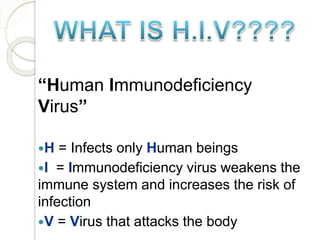




“Human Immunodeficiency
Virus”
H = Infects only Human beings
I = Immunodeficiency virus weakens the
immune system and increases the risk of
infection
V = Virus that attacks the body
“Acquired Immune Deficiency
Syndrome”
A = Acquired, not inherited
I = Weakens the Immune system
D = Creates a Deficiency of CD4+ cells in
the immune system
S = Syndrome, or a group of illnesses
taking place at the same time
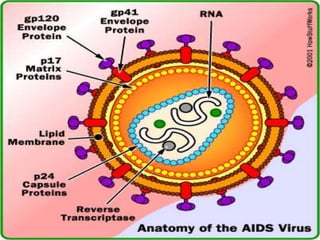
 H.I.V (Human Immunodeficiency
Virus) is a unique type of virus (i.e. a
retrovirus) that invades the T- helper
cells (CD4 cells) in the body of the
host (defense mechanism of a
person).
AIDS (Acquired Immunodeficiency
Syndrome) can be defined as
opportunistic infections and malignancies
that rarely occur in the absence of severe
immunodeficiency.
 Persons with positive HIV serology who
have ever had a CD4 lymphocyte count
below 200 cells/mcL or a CD4 lymphocyte
percentage below 14% are considered to
have AIDS.
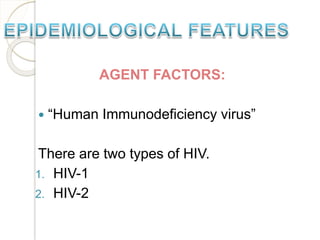
AGENT FACTORS:
 “Human Immunodeficiency virus”
There are two types of HIV.
1. HIV-1
2. HIV-2
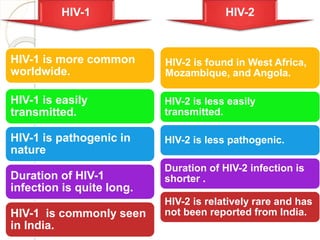
HIV-1 HIV-2
HIV-1 is more common
worldwide.
HIV-1 is easily
transmitted.
HIV-1 is pathogenic in
nature
Duration of HIV-1
infection is quite long.
HIV-1 is commonly seen
in India.
HIV-2 is found in West Africa,
Mozambique, and Angola.
HIV-2 is less easily
transmitted.
HIV-2 is less pathogenic.
Duration of HIV-2 infection is
shorter .
HIV-2 is relatively rare and has
not been reported from India.
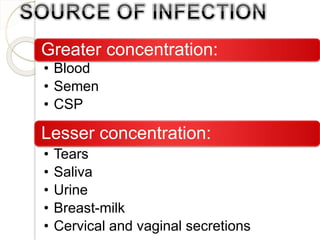
Greater concentration:
• Blood
• Semen
• CSP
Lesser concentration:
• Tears
• Saliva
• Urine
• Breast-milk
• Cervical and vaginal secretions
HOST
FACTORS:
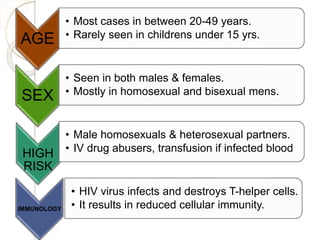
AGE
• Most cases in between 20-49 years.
• Rarely seen in childrens under 15 yrs.
SEX
• Seen in both males & females.
• Mostly in homosexual and bisexual mens.
HIGH
RISK
• Male homosexuals & heterosexual partners.
• IV drug abusers, transfusion if infected blood
IMMUNOLOGY
• HIV virus infects and destroys T-helper cells.
• It results in reduced cellular immunity.
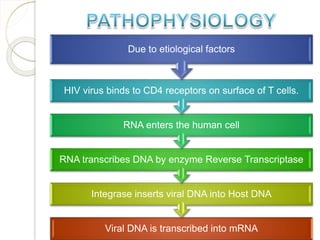
Viral DNA is transcribed into mRNA
Integrase inserts viral DNA into Host DNA
RNA transcribes DNA by enzyme Reverse Transcriptase
RNA enters the human cell
HIV virus binds to CD4 receptors on surface of T cells.
Due to etiological factors
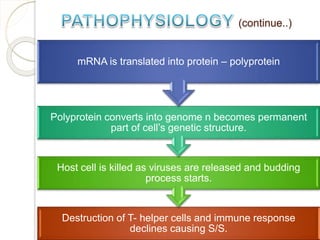
(continue..)
Destruction of T- helper cells and immune response
declines causing S/S.
Host cell is killed as viruses are released and budding
process starts.
Polyprotein converts into genome n becomes permanent
part of cell’s genetic structure.
mRNA is translated into protein – polyprotein
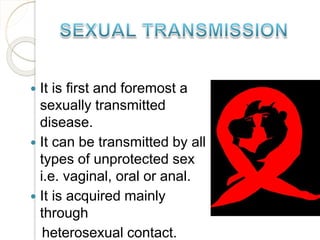
 It is first and foremost a
sexually transmitted
disease.
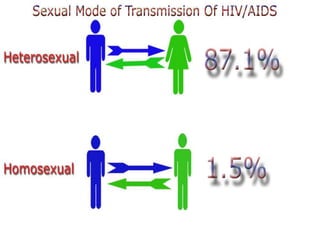
 It can be transmitted by all
types of unprotected sex
i.e. vaginal, oral or anal.
 It is acquired mainly
through
heterosexual contact.
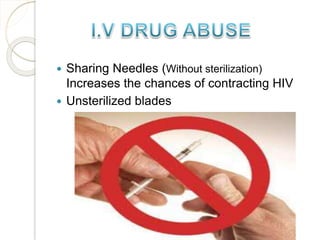
 Sharing Needles (Without sterilization)
Increases the chances of contracting HIV
 Unsterilized blades
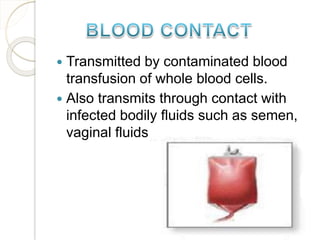
 Transmitted by contaminated blood
transfusion of whole blood cells.
 Also transmits through contact with
infected bodily fluids such as semen,
vaginal fluids.
 During pregnancy (through placenta)
 During birth
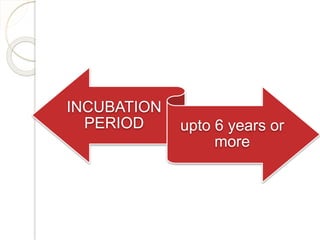
INCUBATION
PERIOD upto 6 years or
more
The clinical features of HIV infection is
classified into four stages:
1. Initial infection
2. Asymptomatic stage
3. Symptomatic stage
4. AIDS
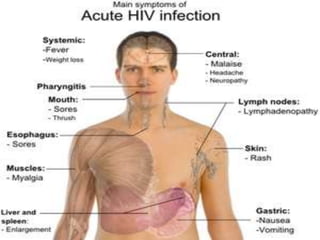
 Short, flu-like illness - occurs one to six
weeks after infection
 Mild symptoms
 Infected person can infect other people
 Lasts for an average of ten years
 This stage is free from symptoms
 There may be swollen glands
 The level of HIV in the blood drops to
low levels
 HIV antibodies are detectable in the
blood
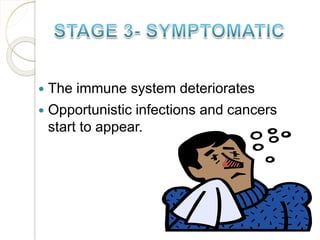
 The immune system deteriorates
 Opportunistic infections and cancers
start to appear.
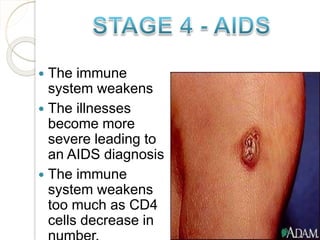
 The immune
system weakens
 The illnesses
become more
severe leading to
an AIDS diagnosis
 The immune
system weakens
too much as CD4
cells decrease in
OPPURTUNISTIC
ORGANISMS
 Bacterial infections
 Tuberculosis (TB)
 Herpes Simplex
 Herpes Zoster
 Vaginal candidiasis
 Hairy leukoplakia
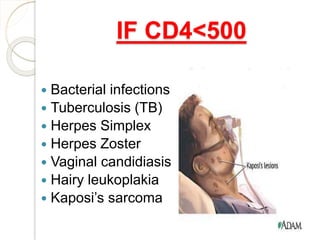
 Kaposi’s sarcoma
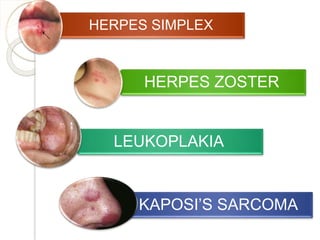
IF CD4<500
HERPES SIMPLEX
HERPES ZOSTER
LEUKOPLAKIA
KAPOSI’S SARCOMA
IF CD4< 200
 Pneumocystic carinii
 Toxoplasmosis
 Cryptococcosis
 Coccidiodomycosis
 Cryptosporiosis
 Non hodgkin’s lymphoma
IF CD4 <50
 Disseminated mycobacterium avium
complex (MAC) infection
 Histoplasmosis
 CMV retinitis
 CNS lymphoma
 Progressive multifocal
leukoencephalopathy
 HIV dementia
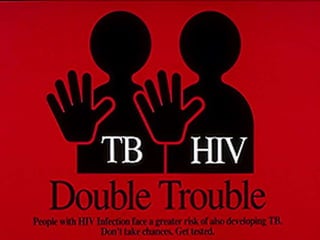
 TB is the most common opportunistic
infection in HIV and the first cause of
mortality in HIV infected patients (10-
30%)
 10 million patients co-infected in the
world.
 Immunosuppression induced by HIV
modifies the clinical presentation of TB
CLINICAL:
The WHO clinical case defines adult
AIDS if the existence of at least two
major signs associated with at least
one minor sign in the absence of other
known cases of immunosupression
such as cancer or severe malnutrition
or other recognized etiologies.
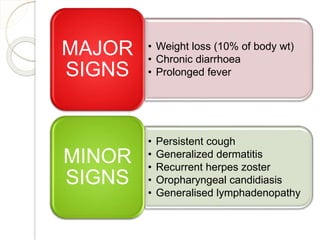
• Weight loss (10% of body wt)
• Chronic diarrhoea
• Prolonged fever
MAJOR
SIGNS
• Persistent cough
• Generalized dermatitis
• Recurrent herpes zoster
• Oropharyngeal candidiasis
• Generalised lymphadenopathy
MINOR
SIGNS
SCREENING
TESTS
Enzyme Linked Immunosorbent
Assay (ELISA)
• Screening test for HIV
• Sensitivity > 99.9%
Western blot
• Confirmatory test
• Specificity > 99.9% (when combined with ELIZA)
Absolute CD4 lymphocyte count
• Predictor of HIV progression
• Risk of opportunistic infections and AIDS when
<200
HIV viral load tests
• Best test for diagnosis of acute HIV infection
• Correlates with disease progression and response
to HAART
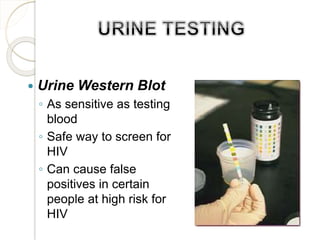
 Urine Western Blot
◦ As sensitive as testing
blood
◦ Safe way to screen for
HIV
◦ Can cause false
positives in certain
people at high risk for
HIV
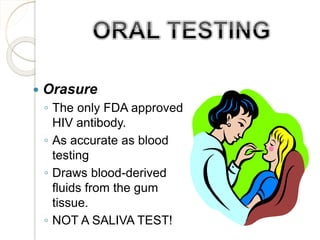
 Orasure
◦ The only FDA approved
HIV antibody.
◦ As accurate as blood
testing
◦ Draws blood-derived
fluids from the gum
tissue.
◦ NOT A SALIVA TEST!
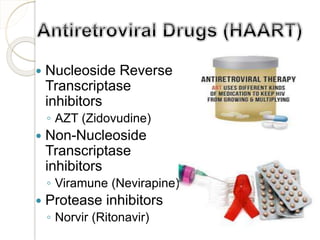
 Nucleoside Reverse
Transcriptase
inhibitors
◦ AZT (Zidovudine)
 Non-Nucleoside
Transcriptase
inhibitors
◦ Viramune (Nevirapine)
 Protease inhibitors
◦ Norvir (Ritonavir)
PREVENTION
 Abstinence
 Monogamous Relationship
 Protected Sex
 Sterile needles
 It is the only 100 % effective method
of not acquiring HIV/AIDS.
 Refraining from sexual contact: oral,
anal, or vaginal.
 Refraining from intravenous drug use
 A mutually monogamous (only one sex
partner) relationship with a person who is
not infected with HIV
 HIV testing before intercourse is necessary
to prove your partner is not infected
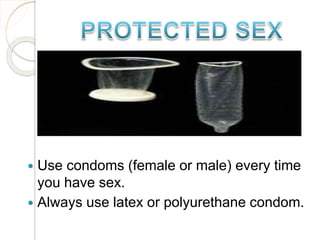
 Use condoms (female or male) every time
you have sex.
 Always use latex or polyurethane condom.
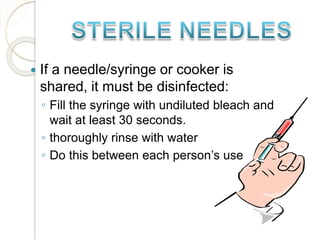
 If a needle/syringe or cooker is
shared, it must be disinfected:
◦ Fill the syringe with undiluted bleach and
wait at least 30 seconds.
◦ thoroughly rinse with water
◦ Do this between each person’s use
Final ppt
Final ppt

Final ppt

  • 4.
    “Human Immunodeficiency Virus” H =Infects only Human beings I = Immunodeficiency virus weakens the immune system and increases the risk of infection V = Virus that attacks the body
  • 5.
    “Acquired Immune Deficiency Syndrome” A= Acquired, not inherited I = Weakens the Immune system D = Creates a Deficiency of CD4+ cells in the immune system S = Syndrome, or a group of illnesses taking place at the same time
  • 6.
     H.I.V (HumanImmunodeficiency Virus) is a unique type of virus (i.e. a retrovirus) that invades the T- helper cells (CD4 cells) in the body of the host (defense mechanism of a person).
  • 7.
    AIDS (Acquired Immunodeficiency Syndrome)can be defined as opportunistic infections and malignancies that rarely occur in the absence of severe immunodeficiency.  Persons with positive HIV serology who have ever had a CD4 lymphocyte count below 200 cells/mcL or a CD4 lymphocyte percentage below 14% are considered to have AIDS.
  • 9.
    AGENT FACTORS:  “HumanImmunodeficiency virus” There are two types of HIV. 1. HIV-1 2. HIV-2
  • 10.
    HIV-1 HIV-2 HIV-1 ismore common worldwide. HIV-1 is easily transmitted. HIV-1 is pathogenic in nature Duration of HIV-1 infection is quite long. HIV-1 is commonly seen in India. HIV-2 is found in West Africa, Mozambique, and Angola. HIV-2 is less easily transmitted. HIV-2 is less pathogenic. Duration of HIV-2 infection is shorter . HIV-2 is relatively rare and has not been reported from India.
  • 11.
    Greater concentration: • Blood •Semen • CSP Lesser concentration: • Tears • Saliva • Urine • Breast-milk • Cervical and vaginal secretions
  • 12.
  • 13.
    AGE • Most casesin between 20-49 years. • Rarely seen in childrens under 15 yrs. SEX • Seen in both males & females. • Mostly in homosexual and bisexual mens. HIGH RISK • Male homosexuals & heterosexual partners. • IV drug abusers, transfusion if infected blood IMMUNOLOGY • HIV virus infects and destroys T-helper cells. • It results in reduced cellular immunity.
  • 14.
    Viral DNA istranscribed into mRNA Integrase inserts viral DNA into Host DNA RNA transcribes DNA by enzyme Reverse Transcriptase RNA enters the human cell HIV virus binds to CD4 receptors on surface of T cells. Due to etiological factors
  • 15.
    (continue..) Destruction of T-helper cells and immune response declines causing S/S. Host cell is killed as viruses are released and budding process starts. Polyprotein converts into genome n becomes permanent part of cell’s genetic structure. mRNA is translated into protein – polyprotein
  • 17.
     It isfirst and foremost a sexually transmitted disease.  It can be transmitted by all types of unprotected sex i.e. vaginal, oral or anal.  It is acquired mainly through heterosexual contact.
  • 19.
     Sharing Needles(Without sterilization) Increases the chances of contracting HIV  Unsterilized blades
  • 20.
     Transmitted bycontaminated blood transfusion of whole blood cells.  Also transmits through contact with infected bodily fluids such as semen, vaginal fluids.
  • 21.
     During pregnancy(through placenta)  During birth
  • 22.
  • 23.
    The clinical featuresof HIV infection is classified into four stages: 1. Initial infection 2. Asymptomatic stage 3. Symptomatic stage 4. AIDS
  • 24.
     Short, flu-likeillness - occurs one to six weeks after infection  Mild symptoms  Infected person can infect other people
  • 26.
     Lasts foran average of ten years  This stage is free from symptoms  There may be swollen glands  The level of HIV in the blood drops to low levels  HIV antibodies are detectable in the blood
  • 27.
     The immunesystem deteriorates  Opportunistic infections and cancers start to appear.
  • 28.
     The immune systemweakens  The illnesses become more severe leading to an AIDS diagnosis  The immune system weakens too much as CD4 cells decrease in
  • 29.
  • 30.
     Bacterial infections Tuberculosis (TB)  Herpes Simplex  Herpes Zoster  Vaginal candidiasis  Hairy leukoplakia  Kaposi’s sarcoma IF CD4<500
  • 31.
  • 32.
    IF CD4< 200 Pneumocystic carinii  Toxoplasmosis  Cryptococcosis  Coccidiodomycosis  Cryptosporiosis  Non hodgkin’s lymphoma
  • 33.
    IF CD4 <50 Disseminated mycobacterium avium complex (MAC) infection  Histoplasmosis  CMV retinitis  CNS lymphoma  Progressive multifocal leukoencephalopathy  HIV dementia
  • 34.
     TB isthe most common opportunistic infection in HIV and the first cause of mortality in HIV infected patients (10- 30%)  10 million patients co-infected in the world.  Immunosuppression induced by HIV modifies the clinical presentation of TB
  • 36.
    CLINICAL: The WHO clinicalcase defines adult AIDS if the existence of at least two major signs associated with at least one minor sign in the absence of other known cases of immunosupression such as cancer or severe malnutrition or other recognized etiologies.
  • 37.
    • Weight loss(10% of body wt) • Chronic diarrhoea • Prolonged fever MAJOR SIGNS • Persistent cough • Generalized dermatitis • Recurrent herpes zoster • Oropharyngeal candidiasis • Generalised lymphadenopathy MINOR SIGNS
  • 38.
  • 39.
    Enzyme Linked Immunosorbent Assay(ELISA) • Screening test for HIV • Sensitivity > 99.9% Western blot • Confirmatory test • Specificity > 99.9% (when combined with ELIZA)
  • 40.
    Absolute CD4 lymphocytecount • Predictor of HIV progression • Risk of opportunistic infections and AIDS when <200 HIV viral load tests • Best test for diagnosis of acute HIV infection • Correlates with disease progression and response to HAART
  • 41.
     Urine WesternBlot ◦ As sensitive as testing blood ◦ Safe way to screen for HIV ◦ Can cause false positives in certain people at high risk for HIV
  • 42.
     Orasure ◦ Theonly FDA approved HIV antibody. ◦ As accurate as blood testing ◦ Draws blood-derived fluids from the gum tissue. ◦ NOT A SALIVA TEST!
  • 44.
     Nucleoside Reverse Transcriptase inhibitors ◦AZT (Zidovudine)  Non-Nucleoside Transcriptase inhibitors ◦ Viramune (Nevirapine)  Protease inhibitors ◦ Norvir (Ritonavir)
  • 45.
  • 46.
     Abstinence  MonogamousRelationship  Protected Sex  Sterile needles
  • 47.
     It isthe only 100 % effective method of not acquiring HIV/AIDS.  Refraining from sexual contact: oral, anal, or vaginal.  Refraining from intravenous drug use
  • 48.
     A mutuallymonogamous (only one sex partner) relationship with a person who is not infected with HIV  HIV testing before intercourse is necessary to prove your partner is not infected
  • 49.
     Use condoms(female or male) every time you have sex.  Always use latex or polyurethane condom.
  • 50.
     If aneedle/syringe or cooker is shared, it must be disinfected: ◦ Fill the syringe with undiluted bleach and wait at least 30 seconds. ◦ thoroughly rinse with water ◦ Do this between each person’s use