{5 THINGS}
  should know about
                      every
                      comm.
                      student

ARGUMENTATION
*THEORY
#1    WHAT THE
     HECK IS IT?
>>>>
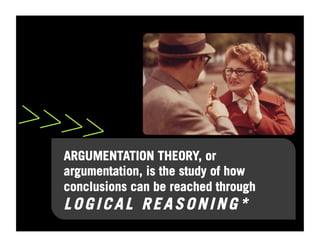
  ARGUMENTATION THEORY, or
  argumentation, is the study of how
  conclusions can be reached through
  LOGICAL REASONING*
*	
  
   which means

   CLAIMS
   (sound or not)
   are based on
   premises
IT INCLUDES
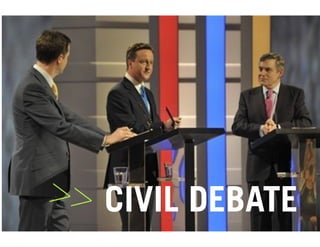
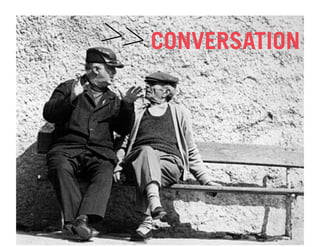
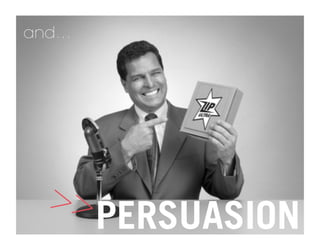
the arts and sciences of
>> CIVIL DEBATE
>> CONVERSATION
DIALOGUE	
  
and…


  >>
     PERSUASION
WHO USES IT?


#2
{ the truth is }

EVERYBODY
                   *
ARGUES
>>>>>>> the difference is the TYPE of argument >>>>>>>>>> 	
  
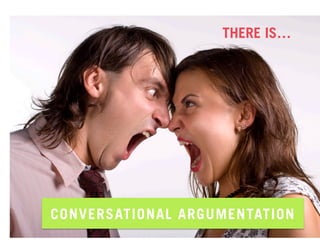
THERE IS…


CONVERSATIONAL ARGUMENTATION
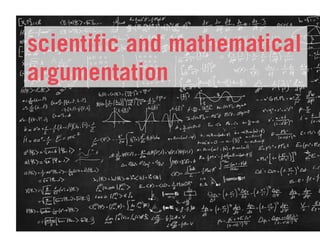
scientific and mathematical
argumentation
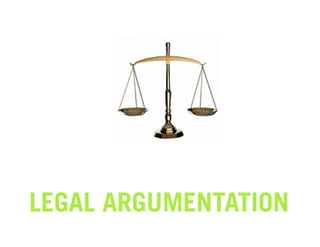
LEGAL ARGUMENTATION
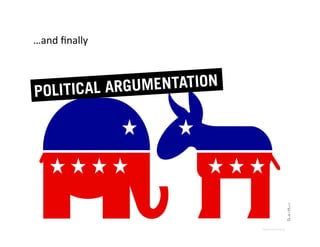
…and	
  nally	


POLITICAL A RGUMENTATION
#3   SO WHAT?
why argue?
 >>   when	
  it	
  comes	
  down	
  to	
  it,	
  we	
  
             argue	
  because	
  we	
  want	
  
                               something…	
  
n or der
…a   nd i
            ha t you
to g  et w
             un  eed
 wan   t, yo       with
       ego   tiate
 to n           ple…
  o ther   peo
>>
 Improving your communication skills, i.e.,
 improving your arguing skills, will help

so, to ‘GET WHAT YOU WANT’ is one reason for arguing
{ }
  Other reasons to
argue are to find out
what you believe and
 what other people
  believe and why.
CRITICISM


   #4
*
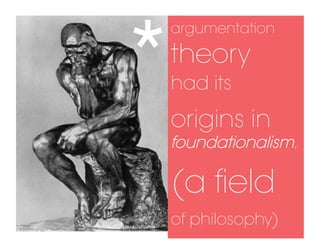
    argumentation

    theory
    had its
    origins in
    foundationalism,

    (a field
    of philosophy)
>>>>>
It sought to find the
grounds for claims
in the forms (logic)
and materials
(factual laws) of a
universal system of
knowledge
BUT…
phy
                              phi loso
                    em atic
                syst
          tle's
A risto
*
They QUESTIONED and
ultimately DISCARDED the
idea that argument
premises take their
soundness from formal
PHILOSOPHICAL systems
THUS THE FIELD BROADENED
and this caused an ongoing debate


                                    >>>>>>>
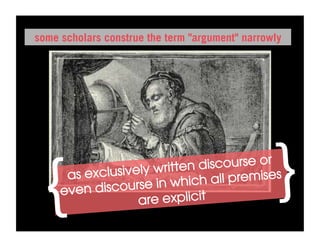
some scholars construe the term "argument" narrowly


  {   as exclu
     even disco
               sively written
                 urse in which
                              discourse or

                   are explicit
                                all premises
                                                  }
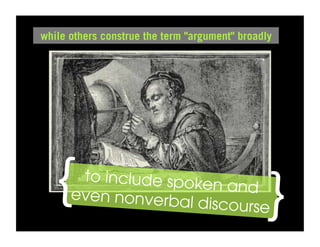
while others construe the term "argument" broadly


     to include spok


  {
                     en and even


                                                }
          nonverbal disco
       to include spok    urse
                       en and
      even nonverba
                     l discourse
*
The dispute between
broad and narrow
theorists is of long
standing and is
unlikely to be settled.
#5
 HOW TO ARGUE
        BETTER
“   Unlike arming
  people with guns
or bombs, no one will
    die from being
      armed with
  the techniques of


                   ”
      argument.
              -Michael Gilbert
*
 >>> KEY POINTERS
for arguing effectively
{
know why you are arguing
                                 }
    What is your purpose?

             Do you believe you
                                can
             achieve your purp
                              ose?
{know
 WHAT
  you
  are
arguing
          }
              What is YOUR claim?
              What is your co-arguer’s claim?

 about        What reasons support your
              claim?
>>
DON’T ARGUE WITH FANATICS!
    (Assume that people have
    reasons for their beliefs: Do
   not argue with people who
   don’t, and limit your arguing
     when people don’t have
         "good" reasons)
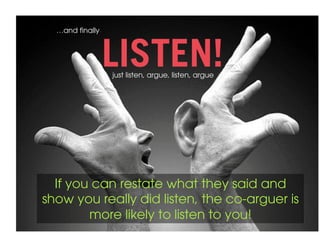
…and finally


                 LISTEN!
                 just listen, argue, listen, argue


  If you can restate what they said and
show you really did listen, the co-arguer is
        more likely to listen to you!
Image	
  credit	
  in	
  order	
  of	
  which	
  they	
  appear	
  

Chu,	
  H.	
  (Photographer).	
  (2010).	
  Associated	
  press.	
  [Web	
  Graphic].	
  Retrieved	
  from	


       h8p://www.cleveland.com/world/index.ssf/2010/04/tv_poliDcal_debates_for_1st_t.html	
  

(2008).	
  Two	
  men	
  engaged	
  in	
  conversaDon.	
  (2008).	
  [Web	
  Photo].	
  Retrieved	
  from	


     h8p://web.expasy.org/spotlight/back_issues/091/	
  

(2011).	
  argument.	
  (2011).	
  [Web	
  Photo].	
  Retrieved	
  from	
  	
  
     h8p://www.pickthebrain.com/blog/5-­‐ways-­‐to-­‐win-­‐an-­‐argument/	
  

(2010).	
  logo	
  poliDcs.	
  (2010).	
  [Web	
  Photo].	
  Retrieved	
  from	


     h8p://thebrandbuilder.files.wordpress.com/2008/09/logo-­‐poliDcs1.jpg	
  

(2012).	
  chalkboard	
  formula.	
  (2012).	
  [Web	
  Photo].	
  Retrieved	
  from	
  
     h8p://www.niemanlab.org/2012/03/the-­‐newsonomics-­‐of-­‐crossover/	
  

(2008).	
  Retro	
  tv	
  commercial.	
  (2008).	
  [Web	
  Photo].	
  Retrieved	
  from	
  
     h8p://potenDal2success.com/the-­‐persuasion-­‐experiment-­‐5-­‐persuasion-­‐techniques-­‐tested.html/
     trackback	
  

(2011).	
  law.	
  (2011).	
  [Web	
  Photo].	
  Retrieved	
  from	
  
     h8p://blog.thansys.com/wp-­‐content/uploads/2011/07/law.jpg	
  

(2007).	
  loving	
  divorce.	
  (2007).	
  [Web	
  Photo].	
  Retrieved	
  from	
  
    h8p://community.servicenow.com/blog/slightlyloony/argal-­‐argument-­‐puzzler	
  

Argumentation Theory

  • 1.
    {5 THINGS} should know about every comm. student ARGUMENTATION *THEORY
  • 2.
    #1 WHAT THE HECK IS IT?
  • 3.
    >>>> ARGUMENTATIONTHEORY, or argumentation, is the study of how conclusions can be reached through LOGICAL REASONING*
  • 4.
    *   which means CLAIMS (sound or not) are based on premises
  • 5.
    IT INCLUDES the artsand sciences of
  • 6.
  • 7.
  • 8.
  • 9.
    and… >> PERSUASION
  • 10.
  • 11.
    { the truthis } EVERYBODY * ARGUES
  • 12.
    >>>>>>> the differenceis the TYPE of argument >>>>>>>>>>  
  • 13.
  • 14.
  • 15.
  • 16.
  • 17.
    #3 SO WHAT?
  • 18.
    why argue? >> when  it  comes  down  to  it,  we   argue  because  we  want   something…  
  • 19.
    n or der …a nd i ha t you to g et w un eed wan t, yo with ego tiate to n ple… o ther peo
  • 20.
    >> Improving yourcommunication skills, i.e., improving your arguing skills, will help so, to ‘GET WHAT YOU WANT’ is one reason for arguing
  • 21.
    { } Other reasons to argue are to find out what you believe and what other people believe and why.
  • 22.
  • 23.
    * argumentation theory had its origins in foundationalism, (a field of philosophy)
  • 24.
    >>>>> It sought tofind the grounds for claims in the forms (logic) and materials (factual laws) of a universal system of knowledge
  • 25.
  • 26.
    phy phi loso em atic syst tle's A risto
  • 27.
    * They QUESTIONED and ultimatelyDISCARDED the idea that argument premises take their soundness from formal PHILOSOPHICAL systems
  • 28.
    THUS THE FIELDBROADENED and this caused an ongoing debate >>>>>>>
  • 29.
    some scholars construethe term "argument" narrowly { as exclu even disco sively written urse in which discourse or are explicit all premises }
  • 30.
    while others construethe term "argument" broadly to include spok { en and even } nonverbal disco to include spok urse en and even nonverba l discourse
  • 31.
    * The dispute between broadand narrow theorists is of long standing and is unlikely to be settled.
  • 32.
    #5 HOW TOARGUE BETTER
  • 33.
    “ Unlike arming people with guns or bombs, no one will die from being armed with the techniques of ” argument. -Michael Gilbert
  • 34.
    * >>> KEYPOINTERS for arguing effectively
  • 35.
    { know why youare arguing } What is your purpose? Do you believe you can achieve your purp ose?
  • 36.
    {know WHAT you are arguing } What is YOUR claim? What is your co-arguer’s claim? about What reasons support your claim?
  • 37.
    >> DON’T ARGUE WITHFANATICS! (Assume that people have reasons for their beliefs: Do not argue with people who don’t, and limit your arguing when people don’t have "good" reasons)
  • 38.
    …and finally LISTEN! just listen, argue, listen, argue If you can restate what they said and show you really did listen, the co-arguer is more likely to listen to you!
  • 39.
    Image  credit  in  order  of  which  they  appear   Chu,  H.  (Photographer).  (2010).  Associated  press.  [Web  Graphic].  Retrieved  from         h8p://www.cleveland.com/world/index.ssf/2010/04/tv_poliDcal_debates_for_1st_t.html   (2008).  Two  men  engaged  in  conversaDon.  (2008).  [Web  Photo].  Retrieved  from       h8p://web.expasy.org/spotlight/back_issues/091/   (2011).  argument.  (2011).  [Web  Photo].  Retrieved  from     h8p://www.pickthebrain.com/blog/5-­‐ways-­‐to-­‐win-­‐an-­‐argument/   (2010).  logo  poliDcs.  (2010).  [Web  Photo].  Retrieved  from       h8p://thebrandbuilder.les.wordpress.com/2008/09/logo-­‐poliDcs1.jpg   (2012).  chalkboard  formula.  (2012).  [Web  Photo].  Retrieved  from   h8p://www.niemanlab.org/2012/03/the-­‐newsonomics-­‐of-­‐crossover/   (2008).  Retro  tv  commercial.  (2008).  [Web  Photo].  Retrieved  from   h8p://potenDal2success.com/the-­‐persuasion-­‐experiment-­‐5-­‐persuasion-­‐techniques-­‐tested.html/ trackback   (2011).  law.  (2011).  [Web  Photo].  Retrieved  from   h8p://blog.thansys.com/wp-­‐content/uploads/2011/07/law.jpg   (2007).  loving  divorce.  (2007).  [Web  Photo].  Retrieved  from   h8p://community.servicenow.com/blog/slightlyloony/argal-­‐argument-­‐puzzler Â