Parts of ArgumentParts of Argument
An Introduction to ArgumentativeAn Introduction to Argumentative
WritingWriting
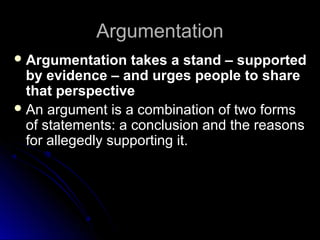
ArgumentationArgumentation
 Argumentation takes a stand – supportedArgumentation takes a stand – supported
by evidence – and urges people to shareby evidence – and urges people to share
that perspectivethat perspective
 An argument is a combination of two formsAn argument is a combination of two forms
of statements: a conclusion and the reasonsof statements: a conclusion and the reasons
for allegedly supporting it.for allegedly supporting it.
Parts of ArgumentParts of Argument
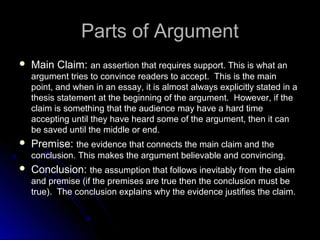
 Main Claim:Main Claim: an assertion that requires support. This is what an
argument tries to convince readers to accept. This is the main
point, and when in an essay, it is almost always explicitly stated in a
thesis statement at the beginning of the argument. However, if the
claim is something that the audience may have a hard time
accepting until they have heard some of the argument, then it can
be saved until the middle or end.
 Premise:Premise: the evidence that connects the main claim and the
conclusion. This makes the argument believable and convincing.
 Conclusion: the assumption that follows inevitably from the claim
and premise (if the premises are true then the conclusion must be
true). The conclusion explains why the evidence justifies the claim.
ArgumentationArgumentation
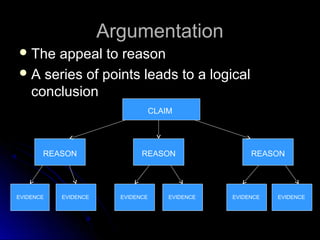
 The appeal to reasonThe appeal to reason
 A series of points leads to a logicalA series of points leads to a logical
conclusionconclusion
CLAIM
REASON REASON REASON
EVIDENCE EVIDENCE EVIDENCE EVIDENCE EVIDENCE EVIDENCE
ArgumentationArgumentation
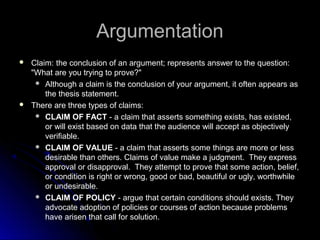
 Claim:Claim: the conclusion of an argument; represents answer to the question:
"What are you trying to prove?"
 Although a claim is the conclusion of your argument, it often appears as
the thesis statement.
 There are three types of claims:
 CLAIM OF FACT - a claim that asserts something exists, has existed,
or will exist based on data that the audience will accept as objectively
verifiable.
 CLAIM OF VALUE - a claim that asserts some things are more or less
desirable than others. Claims of value make a judgment. They express
approval or disapproval. They attempt to prove that some action, belief,
or condition is right or wrong, good or bad, beautiful or ugly, worthwhile
or undesirable.
 CLAIM OF POLICY - argue that certain conditions should exists. They
advocate adoption of policies or courses of action because problems
have arisen that call for solution.
ArgumentationArgumentation
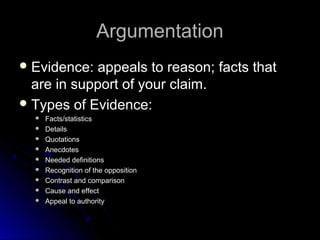
 Evidence: appeals to reason; facts thatEvidence: appeals to reason; facts that
are in support of your claim.are in support of your claim.
 Types of Evidence:Types of Evidence:
 Facts/statisticsFacts/statistics
 DetailsDetails
 QuotationsQuotations
 AnecdotesAnecdotes
 Needed definitionsNeeded definitions
 Recognition of the oppositionRecognition of the opposition
 Contrast and comparisonContrast and comparison
 Cause and effectCause and effect
 Appeal to authorityAppeal to authority
Stereotype and BiasStereotype and Bias
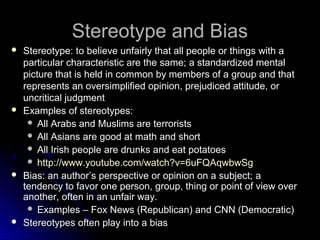
 Stereotype:Stereotype: to believe unfairly that all people or things with a
particular characteristic are the same; a standardized mental
picture that is held in common by members of a group and that
represents an oversimplified opinion, prejudiced attitude, or
uncritical judgment
 Examples of stereotypes:Examples of stereotypes:
 All Arabs and Muslims are terroristsAll Arabs and Muslims are terrorists
 All Asians are good at math and shortAll Asians are good at math and short
 All Irish people are drunks and eat potatoesAll Irish people are drunks and eat potatoes
 http://www.youtube.com/watch?v=6uFQAqwbwSghttp://www.youtube.com/watch?v=6uFQAqwbwSg
 Bias: an authorBias: an author’s perspective or opinion on a subject;’s perspective or opinion on a subject; a
tendency to favor one person, group, thing or point of view over
another, often in an unfair way.
 Examples – Fox News (Republican) and CNN (Democratic)Examples – Fox News (Republican) and CNN (Democratic)
 Stereotypes often play into a biasStereotypes often play into a bias
Argument vs PersuasionArgument vs Persuasion
 While argument and persuasion overlap, theWhile argument and persuasion overlap, the
difference between the two is the goal of thedifference between the two is the goal of the
text:text:
 ArgumentArgument: aims to win a reader’s: aims to win a reader’s
agreement upon an assertion or claim (logicagreement upon an assertion or claim (logic
based)based)
 PersuasionPersuasion: aims to influence a reader’s: aims to influence a reader’s
actions or support for an action (emotionactions or support for an action (emotion
based)based)

Argument Intro

  • 1.
    Parts of ArgumentPartsof Argument An Introduction to ArgumentativeAn Introduction to Argumentative WritingWriting
  • 2.
    ArgumentationArgumentation  Argumentation takesa stand – supportedArgumentation takes a stand – supported by evidence – and urges people to shareby evidence – and urges people to share that perspectivethat perspective  An argument is a combination of two formsAn argument is a combination of two forms of statements: a conclusion and the reasonsof statements: a conclusion and the reasons for allegedly supporting it.for allegedly supporting it.
  • 3.
    Parts of ArgumentPartsof Argument  Main Claim:Main Claim: an assertion that requires support. This is what an argument tries to convince readers to accept. This is the main point, and when in an essay, it is almost always explicitly stated in a thesis statement at the beginning of the argument. However, if the claim is something that the audience may have a hard time accepting until they have heard some of the argument, then it can be saved until the middle or end.  Premise:Premise: the evidence that connects the main claim and the conclusion. This makes the argument believable and convincing.  Conclusion: the assumption that follows inevitably from the claim and premise (if the premises are true then the conclusion must be true). The conclusion explains why the evidence justifies the claim.
  • 4.
    ArgumentationArgumentation  The appealto reasonThe appeal to reason  A series of points leads to a logicalA series of points leads to a logical conclusionconclusion CLAIM REASON REASON REASON EVIDENCE EVIDENCE EVIDENCE EVIDENCE EVIDENCE EVIDENCE
  • 5.
    ArgumentationArgumentation  Claim:Claim: theconclusion of an argument; represents answer to the question: "What are you trying to prove?"  Although a claim is the conclusion of your argument, it often appears as the thesis statement.  There are three types of claims:  CLAIM OF FACT - a claim that asserts something exists, has existed, or will exist based on data that the audience will accept as objectively verifiable.  CLAIM OF VALUE - a claim that asserts some things are more or less desirable than others. Claims of value make a judgment. They express approval or disapproval. They attempt to prove that some action, belief, or condition is right or wrong, good or bad, beautiful or ugly, worthwhile or undesirable.  CLAIM OF POLICY - argue that certain conditions should exists. They advocate adoption of policies or courses of action because problems have arisen that call for solution.
  • 6.
    ArgumentationArgumentation  Evidence: appealsto reason; facts thatEvidence: appeals to reason; facts that are in support of your claim.are in support of your claim.  Types of Evidence:Types of Evidence:  Facts/statisticsFacts/statistics  DetailsDetails  QuotationsQuotations  AnecdotesAnecdotes  Needed definitionsNeeded definitions  Recognition of the oppositionRecognition of the opposition  Contrast and comparisonContrast and comparison  Cause and effectCause and effect  Appeal to authorityAppeal to authority
  • 7.
    Stereotype and BiasStereotypeand Bias  Stereotype:Stereotype: to believe unfairly that all people or things with a particular characteristic are the same; a standardized mental picture that is held in common by members of a group and that represents an oversimplified opinion, prejudiced attitude, or uncritical judgment  Examples of stereotypes:Examples of stereotypes:  All Arabs and Muslims are terroristsAll Arabs and Muslims are terrorists  All Asians are good at math and shortAll Asians are good at math and short  All Irish people are drunks and eat potatoesAll Irish people are drunks and eat potatoes  http://www.youtube.com/watch?v=6uFQAqwbwSghttp://www.youtube.com/watch?v=6uFQAqwbwSg  Bias: an authorBias: an author’s perspective or opinion on a subject;’s perspective or opinion on a subject; a tendency to favor one person, group, thing or point of view over another, often in an unfair way.  Examples – Fox News (Republican) and CNN (Democratic)Examples – Fox News (Republican) and CNN (Democratic)  Stereotypes often play into a biasStereotypes often play into a bias
  • 8.
    Argument vs PersuasionArgumentvs Persuasion  While argument and persuasion overlap, theWhile argument and persuasion overlap, the difference between the two is the goal of thedifference between the two is the goal of the text:text:  ArgumentArgument: aims to win a reader’s: aims to win a reader’s agreement upon an assertion or claim (logicagreement upon an assertion or claim (logic based)based)  PersuasionPersuasion: aims to influence a reader’s: aims to influence a reader’s actions or support for an action (emotionactions or support for an action (emotion based)based)