Evidence By Adriene Ghiasian
Terms to Know Source:   One, such as a person or document, that supplies information. Falsified:  To make up evidence. Testimonial:  A statement in support of a particular truth, fact, or claim. Eyewitness:  A person who can bear witness to the fact. Audience:  The spectator or listeners for a speech. Circumstantial:  Incidental, no primary significance.
What is Evidence? Evidence is referring to specific instances, testimony and proof that will support the claim that you are making. Evidence will help to establish your credibility and will help sway your audience to your cause.
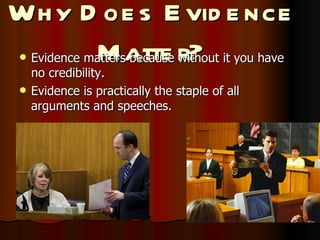
Why Does Evidence Matter? Evidence matters because without it you have no credibility. Evidence is practically the staple of all arguments and speeches.
Types of Evidence There are three main types of evidence -Statistical Evidence -Testimony Evidence -Legal Precedent Evidence
Statistical Evidence To report on a specific instance This type of evidence is to help to communicate a vast number of instances related to your topic without having to cite in detail each and everyone. It is also a way to help describe the facts to your audience.
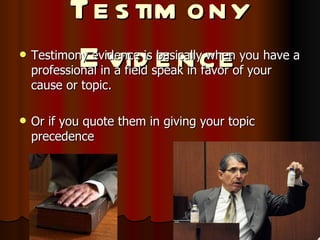
Testimony Evidence Testimony evidence is basically when you have a professional in a field speak in favor of your cause or topic. Or if you quote them in giving your topic precedence
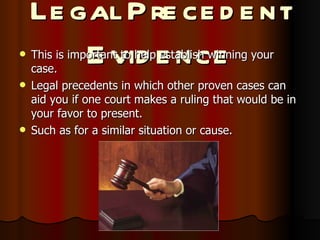
Legal Precedent Evidence This is important to help establish winning your case. Legal precedents in which other proven cases can aid you if one court makes a ruling that would be in your favor to present. Such as for a similar situation or cause.
Tests of Evidence This will help make your evidence strong In order to do that you need to make sure you comply with the following: -Have you falsified any of your evidence? (can it prove you lied?) -Does it come from a reliable source? (I.E, from a doctor of expert in their field?) -Is it not enough? (will it still leave your audience with questions?)
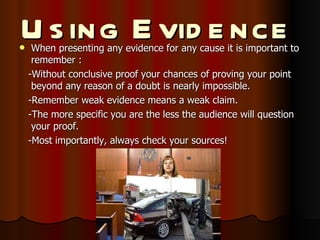
Using Evidence When presenting any evidence for any cause it is important to remember : -Without conclusive proof your chances of proving your point beyond any reason of a doubt is nearly impossible. -Remember weak evidence means a weak claim. -The more specific you are the less the audience will question your proof. -Most importantly, always check your sources!

Evidence

  • 1.
  • 2.
    Terms to KnowSource: One, such as a person or document, that supplies information. Falsified: To make up evidence. Testimonial: A statement in support of a particular truth, fact, or claim. Eyewitness: A person who can bear witness to the fact. Audience: The spectator or listeners for a speech. Circumstantial: Incidental, no primary significance.
  • 3.
    What is Evidence?Evidence is referring to specific instances, testimony and proof that will support the claim that you are making. Evidence will help to establish your credibility and will help sway your audience to your cause.
  • 4.
    Why Does EvidenceMatter? Evidence matters because without it you have no credibility. Evidence is practically the staple of all arguments and speeches.
  • 5.
    Types of EvidenceThere are three main types of evidence -Statistical Evidence -Testimony Evidence -Legal Precedent Evidence
  • 6.
    Statistical Evidence Toreport on a specific instance This type of evidence is to help to communicate a vast number of instances related to your topic without having to cite in detail each and everyone. It is also a way to help describe the facts to your audience.
  • 7.
    Testimony Evidence Testimonyevidence is basically when you have a professional in a field speak in favor of your cause or topic. Or if you quote them in giving your topic precedence
  • 8.
    Legal Precedent EvidenceThis is important to help establish winning your case. Legal precedents in which other proven cases can aid you if one court makes a ruling that would be in your favor to present. Such as for a similar situation or cause.
  • 9.
    Tests of EvidenceThis will help make your evidence strong In order to do that you need to make sure you comply with the following: -Have you falsified any of your evidence? (can it prove you lied?) -Does it come from a reliable source? (I.E, from a doctor of expert in their field?) -Is it not enough? (will it still leave your audience with questions?)
  • 10.
    Using Evidence Whenpresenting any evidence for any cause it is important to remember : -Without conclusive proof your chances of proving your point beyond any reason of a doubt is nearly impossible. -Remember weak evidence means a weak claim. -The more specific you are the less the audience will question your proof. -Most importantly, always check your sources!