Scientific
Method
1)Observation
2)Hypothesis
3)Experiment
4)Conclusion
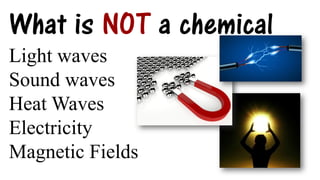
What is NOT a chemical
Light waves
Sound waves
Heat Waves
Electricity
Magnetic Fields
Physical Change
Chemical Change
Physical
Cutting
Grinding
Chopping
Boiling
Sugar dissolving
NOT REVERSIBLE
Burning
Rusting
Frying
Baking
Density
Density =
𝑚𝑎𝑠𝑠 𝑜𝑓 𝑠𝑢𝑏𝑠𝑡𝑎𝑛𝑐𝑒
𝑣𝑜𝑙𝑢𝑚𝑒 𝑜𝑓 𝑠𝑢𝑏𝑠𝑡𝑎𝑛𝑐𝑒
Small density Float
Heavy density Sink
m
D V
Matter
Matter
Mixture
Homogenous
Heterogeneous
Pure
substances
Elements
Compounds
Silver
Iron
Aluminum
H2O
H2O2
NaCl
Cookie w/ Raisins
Pulp w/Orange Juice
Air
Seawater
Tea
Chemistry Calculation SkillsSignificant Figures
Decimal ABSENT to the
Right
Decimal PRESENT to the
Left
Multiplication & Division
Lowest Sig Fig
Addition & Subtraction
Lowest Decimal
Scientific Notation
Calculator Results in Scientific Notation:
2nd Drg SCI FLO
Plug in Scientific Notation 2nd E
Metric Units & SI unitsMetric Units
Meter (m)
Liter 9L)
Gram (g)
Degree (ºC)
Seconds (s)
SI units
Meter (m)
Cubic meter (M3)
Kilogram (Kg)
Kelvin (K)
Second (s)
Metric & SI prefixes & suffixes
Tera T 1012
Giga G 109
Mega M 106
Kilo K 103
Deci d 10-1
Centi c 10-2
Milli m 10-3
Micro 10-6
Nano n 10-9
Pico p 10-12
Energy
Q=mCsp▲T
Q: Energy (joules)
M: mass (grams)
Csp: Specific Heat (J/gºC)
▲T: Change in Temperature (ºC)
Energy
1cal =4.184J
1kcal=100J
1KJ=1000J
1Cal=1Kal =1000cal
1Cal =4.184J=4184J
Carbohydrates 4calories
kcal/g
Proteins 4calories Kcal/g
Fats 9calories Kcal/g
Heat of Fusion
Heat = Mass * Heat of fusion
80cal/g or 334J/g
Heat of Vaporization
Heat= Mass * Heat of vaporization
540cal/g or 2260J/g
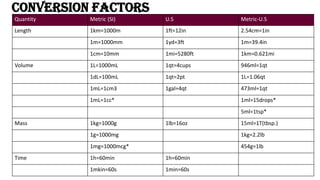
Quantity Metric (SI) U.S Metric-U.S
Length 1km=1000m 1ft=12in 2.54cm=1in
1m=1000mm 1yd=3ft 1m=39.4in
1cm=10mm 1mi=5280ft 1km=0.621mi
Volume 1L=1000mL 1qt=4cups 946ml=1qt
1dL=100mL 1qt=2pt 1L=1.06qt
1mL=1cm3 1gal=4qt 473ml=1qt
1mL=1cc* 1ml=15drops*
5ml=1tsp*
Mass 1kg=1000g 1lb=16oz 15ml=1T(tbsp.)
1g=1000mg 1kg=2.2lb
1mg=1000mcg* 454g=1lb
Time 1h=60min 1h=60min
1mkin=60s 1min=60s
Conversion Factors
Solid Liquid Gas
Endothermic
Exothermic
Melting Evaporation
sublimation
Deposition
Freezing
Condensation
0ºC
100ºCFreezing
&
Heat absorbed
Celsius= (F-32)/1.8
Fahrenheit= (C*1.8)+32
Kelvin= C+ 273 “Absolute zero”
Temperature is a measure of
Kinetic Energy.. Hot air Faster & Cold air Slower
Atom
Protons: + [1amu]
Electrons: - [0amu]
Neutrons: neutral [1amu]
Atomic mass: P +N
Atomic Weight: Weighted
average of isotopes
Isotopes: elements vary in neutrons
Ions: elements vary in electrons
Periodic Table: How to Read
Column: Group
Row: Period
Alkali Metals [group 1]
Alkaline Earth Metals [group 2]
Transition Metals [group 3-12]
Halogens [Group 17]
Noble gases [Group 18]
Metals shiny, good conductors, ductile
Nonmetals NOT
Metalloids Semiconductors
Periodic Table Trends
Ionization &
Electronegativity
Atomic Size
& metallic
Increase: Left to Right
Increase: Bottom to Top
Increase: Right to Left
Increase: Top to Bottom
Gamma Rays infraredUltravioletX-rays Radio waves
Visible Light
400nm
700nm
Frequency: Higher
Wavelength: shorter
Frequency: lower
Wavelength: longer
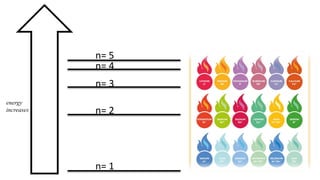
n= 5
n= 4
n= 3
n= 2
n= 1
energy
increases
Energy
KE=1/2mv2
PE=mgh
Kinetic EnergyMotion
(Example Running)
Potential Energy
Stored Energy
(Example chemical bonds as in ATP)
Electrical Electrons along a conductor
(Example a electrons moving across a neuron)
Chemical Energy released when bonds are broken
(Example breaking the bonds of glucose or ATP)
Thermal internal energy resulting from the
movement of atoms and molecules within it
(Example: Thyroid not working cold, burning building..)
Mechanical
Summation of PE &KE
(Example the heart contraction or
windmill)
1st law of Thermodynamics:
Energy cannot be created
nor destroyed, just
transferred from one form
to another
Bonding &
Nomenclature
Ionic (Type I Binary
compounds)
Transfer of Electrons:
Metal transfers electrons
to nonmetal
BIG difference in
Electronegativity
Example: NaCl (sodium
Chloride), KI (Potassium
Iodide)
Ionic (Type II Binary
Compounds)
Transition metals vary in
oxidation number and
roman numerals indicate
the oxidation number
used
Example Iron (III) Oxide
(Fe2O3)
Ionic Compounds with
polyatomic ions
Ammonium NH4+
Acetate CH3COO-
Cyanide CN-
Hypochlorite ClO-
Clhorite ClO2-
Chlorate ClO3-
Perchlorate ClO4-
Nitrate NO3-
Hydroxide OH-
Phosphate PO43-
Sulfate SO42-
Example: Ammonium
Sulfate (NH4SO4)
Covalent
Polar (Binary Type III)
Uneven Sharing of
Electrons
Moderate Difference in
Electronegativity
Example: H2O
(dihydrogen monoxide)
Polar dissolves polar &
universal solvent
Covalent nonpolar (Binary
Type III)
Even sharing of electrons
Low or no difference in
electronegativity
Ex. CO2, (Carbon
dioxide), O2
Fats, oils, lipids, gasoline,
carbon monoxide
Insoluble in water &
other solvents
Hydrogen Bond
Extra-molecular
(intermolecular) Between
2 or more molecules
Hydrogen can bond to
FON
Water properties: H2O,
High BP, High surface
tension, High specific
HEAT
Inter- molecular
(between the two)2Nonmetals
1 metal +
1nonmetal
Mono: 1
Di; 2
Tri: 3
Tetra: 4
Penta : 5
Hexa: 6
Hepta: 7
Octo: 8
Classifying Type of Attractions
Ionic Bonding
Metal + Nonmetal [Greater than 1.8]
Hydrogen Bonding
FON
Dipole- Dipole
Polar [0.5-1.8]
Dispersian
Temporary Dipole Nonpolar [0-0.4]
1. Increase in melting point (ºC)
2. Increase in force of attraction
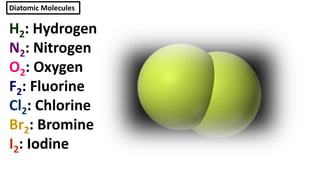
Diatomic Molecules
H2: Hydrogen
N2: Nitrogen
O2: Oxygen
F2: Fluorine
Cl2: Chlorine
Br2: Bromine
I2: Iodine
Electron Configuration
1s
2s
3s
4s
5s
6s
7s
2p
3p
4p
5p
6p
7p
3d
4d
5d
6d
4f
5f
s: 2
p: 6
d: 10
f: 14
VSEPR: Geometry
Linear 180º
Trigonal Planar 120º
Bent 120º
Tetrahedral 109º
Trigonal Pyramid 109º
Bent 109º
2 3 4
nonpolar
nonpolar nonpolar
polar
polar
polar
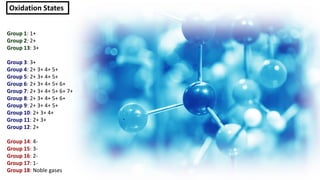
Oxidation States
Group 1: 1+
Group 2: 2+
Group 13: 3+
Group 3: 3+
Group 4: 2+ 3+ 4+ 5+
Group 5: 2+ 3+ 4+ 5+
Group 6: 2+ 3+ 4+ 5+ 6+
Group 7: 2+ 3+ 4+ 5+ 6+ 7+
Group 8: 2+ 3+ 4+ 5+ 6+
Group 9: 2+ 3+ 4+ 5+
Group 10: 2+ 3+ 4+
Group 11: 2+ 3+
Group 12: 2+
Group 14: 4-
Group 15: 3-
Group 16: 2-
Group 17: 1-
Group 18: Noble gases
Oxidation- Reduction
OIL
Oxidation Is Loss
RIG
Reduction Is Gain
Atmospheric Pressure
Atmospheric pressure increase at lower
altitudes
[Less air inside chip bag]
Pressure in Bag < Atmospheric pressure
Atmospheric pressure decrease at higher
altitudes
[more air inside chip bag]
Pressure in Bag > Atmospheric pressure
Conversians
Moles
÷
÷×
×
Grams Particles
(atoms, molecules)
Molar
mass
6.022 * 1023
STP
1. Grams  22.4L/1mole
2. Liters  1mole/22.4L  molar mass
Reaction Types
A + B  AB
Combination
AB  A + B
Decomposition
A + BC  AC + B
Single Replacement
AB + CD  AD + CB
Double Replacement
CxHy + ZO2(g)  XCO2 + YH2O + Energy
Combustion
Endothermic & Exothermic
Kinetic Molecular Theory of Gases
1. A gas consist of small particles (atoms or
molecules that move randomly with high
velocities)
2. The attractive forces between the particles of a
gas are usually very small
3. The actual volume occupied by gas molecules is
extremely small compacted with the volume gas
occupies
4. Gas particles are in constant motion moving
rapidly in straight paths
5. The average kinetic energy of gas molecules is
proportional to the kelvin temperature
Gases Laws
Gay Lussac’s:
𝑷𝟏
𝑻𝟏
=
𝑷𝟐
𝑻𝟐
Charles:
𝑽𝟏
𝑻𝟏
=
𝑽𝟐
𝑻𝟐
Boyles:P1V1=P2V2
Combined Gas Laws:
𝑷𝟐𝑽𝟐
𝑻𝟐
=
𝑷𝟐𝑽𝟐
𝑻𝟐
Avagadros Law:
𝑽𝟏
𝒏𝟏
=
𝑽𝟐
𝒏𝟐
Dalton Law: Ptotal = P1 + P2 + P3
Measurement of Gas
Pressure (P) =
𝒇𝒐𝒓𝒄𝒆
𝑨𝒓𝒆𝒂
Conversian Factors
1atm=760mmHg=760torr
1mmHg=1torr
1atm = 1.01325*10^5Pa=101.325kPa
1atm=14.7lb/in2
Property Description Units
Pressure (P) The force exerted by a
gas against the walls of
the container
(atm)
(mmHg)(Pa)
Volume(V) The space occupied by
a gas
(L) (ml)
Temperature(T) The determining factor
of the kinetic energy
and rate of motion of
gas particles
(ºC) (K)
Amount (n) The quantity of gas
present in a container
(g) (n)
Properties that describe gas
Molarity (M)
Given: Grams & Molarity
Find: Volume
Technique
Grams molar mass  molarity
Given: Volume & Molarity
Find: Grams
Technique
1. Molarity * Volume = moles
2. Moles  molar mass
M =
𝑚𝑜𝑙𝑒𝑠
𝐿𝑖𝑡𝑒𝑟
Concentration
Dilution of Solutions
C1V1=C2V2
Concentrated
solution
Diluted
Concentration
Concentration of Solution
m/m
V/V
m/V
Mass % =
𝑔𝑟𝑎𝑚𝑠 𝑜𝑓 𝑠𝑜𝑙𝑢𝑡𝑒
𝑔𝑟𝑎𝑚𝑠 𝑜𝑓 𝑠𝑜𝑙𝑢𝑡𝑖𝑜𝑛 * 100
Volume % =
𝑔𝑟𝑎𝑚𝑠 𝑜𝑓 𝑠𝑜𝑙𝑢𝑡𝑒
𝑔𝑟𝑎𝑚𝑠 𝑜𝑓 𝑠𝑜𝑙𝑢𝑡𝑖𝑜𝑛* 100
Mass/Volume % =
𝑔𝑟𝑎𝑚𝑠 𝑜𝑓 𝑠𝑜𝑙𝑢𝑡𝑒
𝑔𝑟𝑎𝑚𝑠 𝑜𝑓 𝑠𝑜𝑙𝑢𝑡𝑖𝑜𝑛* 100
Effect concentrations changes on
Equilibrium Le chateliers principles
Add a reactant Froward reaction rate Products
Remove a reactant Forward reaction rate Reactants
Add a Product Reverse reaction rate Reactants
Remove a product Reverse reaction rate Products
Reactants  Products
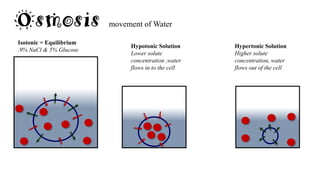
Osmosis movement of Water
Hypotonic Solution
Lower solute
concentration ,water
flows in to the cell
Hypertonic Solution
Higher solute
concentration, water
flows out of the cell
Isotonic = Equilibrium
.9% NaCl & 5% Glucose
solutions
Solutions
Homogenous
Solution
[transparent]
Goes through
filters & semi-
permeable
membranes
Colloids
Do not separate
or settle
Pass through
filters NOT
semipermeable
membrane
Suspensions
Seen by naked Eye
Trapped by filters
& semipermeable
membrane
[Heterogeneous]
Solutions: Solvents + Solutes
Solutions (Homogeneous Mixtures)
 Solvents > Solutes
 H2O [universal Solvent
 Like dissolves in Like
polar  polar
Nonpolar  Nonpolar
 Solutes & Solvents = solid, Liquid or
Gas
Olive Oil & Vinegar Cannot mix due
to polar and nonpolar properties
Unsaturated
[NOT full capacity]
Saturated
[Full capacity]
Solute dissolves
Solute Recrystallizes
Solvent + Solute Saturated Solution
Solubility Rules
PO4
3-
Co3
2-
S2-
NH4
+
Na+
K+
NO3
-
Li+
All Soluble
C2H3O2
-
Cl-
Br-
I-
SO4
2- OH-
All Soluble
Except
Iron (III) Acetate
Fe(CaH3O2)3
All Soluble
Except
Ag+, Pb2+, Hg+
PbCl2, PbBr2 [slightly]
All Soluble
Except
Ba2+, Pb2+, Ca2+,
Sr2+, CO32-, S2+,
PO43-, OH-, Ag+
Only Alkali
Metals
& NH4+
Only Alkali Metals
& NH4+
Ca2+, Ba2+, Sr2+ [slightly]
Solubility
Effects of
temperature
on Solubility
Solids
Gases
Increase in Temperature
Increase in Solubility
Decrease in Solubility
NaCl dissolves faster
in boiling water
CO2 escapes warm coke
bottle
Electrolytes
Strong
Electrolytes
Disassociates
completely
Ions only Yes Ionic compound
NaCl, KBr,
MgCl2, NaNO3,
Bases: NaOH
Acids: HCl
Weak
Electrolytes
Ionizes Partially Mostly
molecules & few
ions
Weak HF, H2O,
NH3,HC2H3O2
Nonelectrolytes No ionization Molecules only No Carbon
Compound,
CH3OH,
C12,H22O11 C12,H22O11 (s) C12,H22O11 (aq)
H2O
HF (s)
NaCl(s) Na+
(aq) + Cl-
(aq)
H+
(aq) F-
(aq)
H2O
ionization
Recombination
Strong Acids Weak Acids
Hydroiodic Acid HI
Hydrobromic Acid HBr
Perchloric Acid HClO4
Sulfuric Acid H2SO4
Nitric Acid HNO3
Hydronium ion H3O+
Hydrogen sulfate ion HSO4-
Phosphoric acid H3PO4
Hydrofluoric acid HF
Nitrous acid HNO2
Acetic acid HC2H3O2
Carbonic acid H2CO3
Hydrosulfuric acid H2S
Dihydrogen phosphate H2PO42-
Ammonium ion NH4+
Hydrocyanic acid HCN
Bicarbonate ion HCO3-
Hydrogen sulfide ion HS-
Water H2O
Conjugate Base  Acids DONATE
loose a hydrogen
Conjugate Acid  Base ACCEPTS
gain a hydrogen
Water
Acids & Bases
H2O
HCO3-
H3O+
H2C03
OH-
CO3
2-
Acids & Bases
Acid + metal  H2+ salt
Acid + carbonates/bicarbonate Co2 +H2O + Salt
Acids + Base (Hydroxides)  Acid + Base  Water + Salt
“Neutralization”
[H3O+] > [OH-] Acidic
[H3O+] = [OH-] neutral
[H3O+] < [OH-] Basic
How to define pH
7 More [Basic]Less [Acidic]
Calculation:
[H3O+]=10-ph
1) Whole number Plug in as pH
2) NOT whole number & switch to negative 10(-ph)
pH=-log[H3O+]
1) Plug in H3O+ number
2) -log (#)
3) Make sure setting scientific notation
BuffersMaintain pH
Acid  Weak Base
Base  Weak Acid
Radioactive
spontaneously emits small particles of energy called radiation to become more stable
Alpha Decay
Mass # decrease by 4
Atomic # decrease by 2
2 protons & 2 neutrons
emitted as alpha
particles
Beta Decay
Neutrons decreased by 1
Protons increase by 1
Transmutation mass SAME!!
Gamma Decay
Mass number same
Atomic # same
Stable nucleus of same element
Energy is lost to stabilize nucleus
Travel: 2-4cm
Tisssue depth: .05mm
Shielding: paper clothing
Typical source: Radium 226
Travel: 200-300cm
Tisssue depth: 4-5mm
Shielding: heavy clothing, Lab coats
& gloves
Typical source: carbon-14
Travel: 200-300cm
Tisssue depth: 50cm< or more
Shielding: lead thick concrete
Typical source: Technetium -99
Electrical Chemistry(I) Current: Ampere
(V) Voltage measured: Voltage
(R) Resistance: Ohms
(P) power: watts
P= V*I
I=V/R

General overview

  • 2.
  • 3.
    What is NOTa chemical Light waves Sound waves Heat Waves Electricity Magnetic Fields
  • 4.
    Physical Change Chemical Change Physical Cutting Grinding Chopping Boiling Sugardissolving NOT REVERSIBLE Burning Rusting Frying Baking
  • 5.
    Density Density = 𝑚𝑎𝑠𝑠 𝑜𝑓𝑠𝑢𝑏𝑠𝑡𝑎𝑛𝑐𝑒 𝑣𝑜𝑙𝑢𝑚𝑒 𝑜𝑓 𝑠𝑢𝑏𝑠𝑡𝑎𝑛𝑐𝑒 Small density Float Heavy density Sink m D V
  • 6.
  • 7.
    Chemistry Calculation SkillsSignificantFigures Decimal ABSENT to the Right Decimal PRESENT to the Left Multiplication & Division Lowest Sig Fig Addition & Subtraction Lowest Decimal Scientific Notation Calculator Results in Scientific Notation: 2nd Drg SCI FLO Plug in Scientific Notation 2nd E
  • 8.
    Metric Units &SI unitsMetric Units Meter (m) Liter 9L) Gram (g) Degree (ºC) Seconds (s) SI units Meter (m) Cubic meter (M3) Kilogram (Kg) Kelvin (K) Second (s) Metric & SI prefixes & suffixes Tera T 1012 Giga G 109 Mega M 106 Kilo K 103 Deci d 10-1 Centi c 10-2 Milli m 10-3 Micro 10-6 Nano n 10-9 Pico p 10-12
  • 9.
    Energy Q=mCsp▲T Q: Energy (joules) M:mass (grams) Csp: Specific Heat (J/gºC) ▲T: Change in Temperature (ºC) Energy 1cal =4.184J 1kcal=100J 1KJ=1000J 1Cal=1Kal =1000cal 1Cal =4.184J=4184J Carbohydrates 4calories kcal/g Proteins 4calories Kcal/g Fats 9calories Kcal/g
  • 10.
    Heat of Fusion Heat= Mass * Heat of fusion 80cal/g or 334J/g Heat of Vaporization Heat= Mass * Heat of vaporization 540cal/g or 2260J/g
  • 11.
    Quantity Metric (SI)U.S Metric-U.S Length 1km=1000m 1ft=12in 2.54cm=1in 1m=1000mm 1yd=3ft 1m=39.4in 1cm=10mm 1mi=5280ft 1km=0.621mi Volume 1L=1000mL 1qt=4cups 946ml=1qt 1dL=100mL 1qt=2pt 1L=1.06qt 1mL=1cm3 1gal=4qt 473ml=1qt 1mL=1cc* 1ml=15drops* 5ml=1tsp* Mass 1kg=1000g 1lb=16oz 15ml=1T(tbsp.) 1g=1000mg 1kg=2.2lb 1mg=1000mcg* 454g=1lb Time 1h=60min 1h=60min 1mkin=60s 1min=60s Conversion Factors
  • 12.
    Solid Liquid Gas Endothermic Exothermic MeltingEvaporation sublimation Deposition Freezing Condensation
  • 13.
  • 14.
    Celsius= (F-32)/1.8 Fahrenheit= (C*1.8)+32 Kelvin=C+ 273 “Absolute zero” Temperature is a measure of Kinetic Energy.. Hot air Faster & Cold air Slower
  • 15.
    Atom Protons: + [1amu] Electrons:- [0amu] Neutrons: neutral [1amu] Atomic mass: P +N Atomic Weight: Weighted average of isotopes Isotopes: elements vary in neutrons Ions: elements vary in electrons
  • 17.
    Periodic Table: Howto Read Column: Group Row: Period Alkali Metals [group 1] Alkaline Earth Metals [group 2] Transition Metals [group 3-12] Halogens [Group 17] Noble gases [Group 18] Metals shiny, good conductors, ductile Nonmetals NOT Metalloids Semiconductors
  • 18.
    Periodic Table Trends Ionization& Electronegativity Atomic Size & metallic Increase: Left to Right Increase: Bottom to Top Increase: Right to Left Increase: Top to Bottom
  • 19.
    Gamma Rays infraredUltravioletX-raysRadio waves Visible Light 400nm 700nm Frequency: Higher Wavelength: shorter Frequency: lower Wavelength: longer
  • 20.
    n= 5 n= 4 n=3 n= 2 n= 1 energy increases
  • 21.
    Energy KE=1/2mv2 PE=mgh Kinetic EnergyMotion (Example Running) PotentialEnergy Stored Energy (Example chemical bonds as in ATP) Electrical Electrons along a conductor (Example a electrons moving across a neuron) Chemical Energy released when bonds are broken (Example breaking the bonds of glucose or ATP) Thermal internal energy resulting from the movement of atoms and molecules within it (Example: Thyroid not working cold, burning building..) Mechanical Summation of PE &KE (Example the heart contraction or windmill) 1st law of Thermodynamics: Energy cannot be created nor destroyed, just transferred from one form to another
  • 22.
    Bonding & Nomenclature Ionic (TypeI Binary compounds) Transfer of Electrons: Metal transfers electrons to nonmetal BIG difference in Electronegativity Example: NaCl (sodium Chloride), KI (Potassium Iodide) Ionic (Type II Binary Compounds) Transition metals vary in oxidation number and roman numerals indicate the oxidation number used Example Iron (III) Oxide (Fe2O3) Ionic Compounds with polyatomic ions Ammonium NH4+ Acetate CH3COO- Cyanide CN- Hypochlorite ClO- Clhorite ClO2- Chlorate ClO3- Perchlorate ClO4- Nitrate NO3- Hydroxide OH- Phosphate PO43- Sulfate SO42- Example: Ammonium Sulfate (NH4SO4) Covalent Polar (Binary Type III) Uneven Sharing of Electrons Moderate Difference in Electronegativity Example: H2O (dihydrogen monoxide) Polar dissolves polar & universal solvent Covalent nonpolar (Binary Type III) Even sharing of electrons Low or no difference in electronegativity Ex. CO2, (Carbon dioxide), O2 Fats, oils, lipids, gasoline, carbon monoxide Insoluble in water & other solvents Hydrogen Bond Extra-molecular (intermolecular) Between 2 or more molecules Hydrogen can bond to FON Water properties: H2O, High BP, High surface tension, High specific HEAT Inter- molecular (between the two)2Nonmetals 1 metal + 1nonmetal Mono: 1 Di; 2 Tri: 3 Tetra: 4 Penta : 5 Hexa: 6 Hepta: 7 Octo: 8
  • 23.
    Classifying Type ofAttractions Ionic Bonding Metal + Nonmetal [Greater than 1.8] Hydrogen Bonding FON Dipole- Dipole Polar [0.5-1.8] Dispersian Temporary Dipole Nonpolar [0-0.4] 1. Increase in melting point (ºC) 2. Increase in force of attraction
  • 24.
    Diatomic Molecules H2: Hydrogen N2:Nitrogen O2: Oxygen F2: Fluorine Cl2: Chlorine Br2: Bromine I2: Iodine
  • 25.
  • 26.
    VSEPR: Geometry Linear 180º TrigonalPlanar 120º Bent 120º Tetrahedral 109º Trigonal Pyramid 109º Bent 109º 2 3 4 nonpolar nonpolar nonpolar polar polar polar
  • 27.
    Oxidation States Group 1:1+ Group 2: 2+ Group 13: 3+ Group 3: 3+ Group 4: 2+ 3+ 4+ 5+ Group 5: 2+ 3+ 4+ 5+ Group 6: 2+ 3+ 4+ 5+ 6+ Group 7: 2+ 3+ 4+ 5+ 6+ 7+ Group 8: 2+ 3+ 4+ 5+ 6+ Group 9: 2+ 3+ 4+ 5+ Group 10: 2+ 3+ 4+ Group 11: 2+ 3+ Group 12: 2+ Group 14: 4- Group 15: 3- Group 16: 2- Group 17: 1- Group 18: Noble gases
  • 28.
    Oxidation- Reduction OIL Oxidation IsLoss RIG Reduction Is Gain
  • 29.
    Atmospheric Pressure Atmospheric pressureincrease at lower altitudes [Less air inside chip bag] Pressure in Bag < Atmospheric pressure Atmospheric pressure decrease at higher altitudes [more air inside chip bag] Pressure in Bag > Atmospheric pressure
  • 30.
    Conversians Moles ÷ ÷× × Grams Particles (atoms, molecules) Molar mass 6.022* 1023 STP 1. Grams  22.4L/1mole 2. Liters  1mole/22.4L  molar mass
  • 31.
    Reaction Types A +B  AB Combination AB  A + B Decomposition A + BC  AC + B Single Replacement AB + CD  AD + CB Double Replacement CxHy + ZO2(g)  XCO2 + YH2O + Energy Combustion
  • 32.
  • 33.
    Kinetic Molecular Theoryof Gases 1. A gas consist of small particles (atoms or molecules that move randomly with high velocities) 2. The attractive forces between the particles of a gas are usually very small 3. The actual volume occupied by gas molecules is extremely small compacted with the volume gas occupies 4. Gas particles are in constant motion moving rapidly in straight paths 5. The average kinetic energy of gas molecules is proportional to the kelvin temperature
  • 34.
    Gases Laws Gay Lussac’s: 𝑷𝟏 𝑻𝟏 = 𝑷𝟐 𝑻𝟐 Charles: 𝑽𝟏 𝑻𝟏 = 𝑽𝟐 𝑻𝟐 Boyles:P1V1=P2V2 CombinedGas Laws: 𝑷𝟐𝑽𝟐 𝑻𝟐 = 𝑷𝟐𝑽𝟐 𝑻𝟐 Avagadros Law: 𝑽𝟏 𝒏𝟏 = 𝑽𝟐 𝒏𝟐 Dalton Law: Ptotal = P1 + P2 + P3 Measurement of Gas Pressure (P) = 𝒇𝒐𝒓𝒄𝒆 𝑨𝒓𝒆𝒂 Conversian Factors 1atm=760mmHg=760torr 1mmHg=1torr 1atm = 1.01325*10^5Pa=101.325kPa 1atm=14.7lb/in2 Property Description Units Pressure (P) The force exerted by a gas against the walls of the container (atm) (mmHg)(Pa) Volume(V) The space occupied by a gas (L) (ml) Temperature(T) The determining factor of the kinetic energy and rate of motion of gas particles (ºC) (K) Amount (n) The quantity of gas present in a container (g) (n) Properties that describe gas
  • 35.
    Molarity (M) Given: Grams& Molarity Find: Volume Technique Grams molar mass  molarity Given: Volume & Molarity Find: Grams Technique 1. Molarity * Volume = moles 2. Moles  molar mass M = 𝑚𝑜𝑙𝑒𝑠 𝐿𝑖𝑡𝑒𝑟
  • 36.
    Concentration Dilution of Solutions C1V1=C2V2 Concentrated solution Diluted Concentration Concentrationof Solution m/m V/V m/V Mass % = 𝑔𝑟𝑎𝑚𝑠 𝑜𝑓 𝑠𝑜𝑙𝑢𝑡𝑒 𝑔𝑟𝑎𝑚𝑠 𝑜𝑓 𝑠𝑜𝑙𝑢𝑡𝑖𝑜𝑛 * 100 Volume % = 𝑔𝑟𝑎𝑚𝑠 𝑜𝑓 𝑠𝑜𝑙𝑢𝑡𝑒 𝑔𝑟𝑎𝑚𝑠 𝑜𝑓 𝑠𝑜𝑙𝑢𝑡𝑖𝑜𝑛* 100 Mass/Volume % = 𝑔𝑟𝑎𝑚𝑠 𝑜𝑓 𝑠𝑜𝑙𝑢𝑡𝑒 𝑔𝑟𝑎𝑚𝑠 𝑜𝑓 𝑠𝑜𝑙𝑢𝑡𝑖𝑜𝑛* 100 Effect concentrations changes on Equilibrium Le chateliers principles Add a reactant Froward reaction rate Products Remove a reactant Forward reaction rate Reactants Add a Product Reverse reaction rate Reactants Remove a product Reverse reaction rate Products Reactants  Products
  • 37.
    Osmosis movement ofWater Hypotonic Solution Lower solute concentration ,water flows in to the cell Hypertonic Solution Higher solute concentration, water flows out of the cell Isotonic = Equilibrium .9% NaCl & 5% Glucose
  • 38.
    solutions Solutions Homogenous Solution [transparent] Goes through filters &semi- permeable membranes Colloids Do not separate or settle Pass through filters NOT semipermeable membrane Suspensions Seen by naked Eye Trapped by filters & semipermeable membrane [Heterogeneous]
  • 39.
    Solutions: Solvents +Solutes Solutions (Homogeneous Mixtures)  Solvents > Solutes  H2O [universal Solvent  Like dissolves in Like polar  polar Nonpolar  Nonpolar  Solutes & Solvents = solid, Liquid or Gas Olive Oil & Vinegar Cannot mix due to polar and nonpolar properties
  • 40.
    Unsaturated [NOT full capacity] Saturated [Fullcapacity] Solute dissolves Solute Recrystallizes Solvent + Solute Saturated Solution
  • 41.
    Solubility Rules PO4 3- Co3 2- S2- NH4 + Na+ K+ NO3 - Li+ All Soluble C2H3O2 - Cl- Br- I- SO4 2-OH- All Soluble Except Iron (III) Acetate Fe(CaH3O2)3 All Soluble Except Ag+, Pb2+, Hg+ PbCl2, PbBr2 [slightly] All Soluble Except Ba2+, Pb2+, Ca2+, Sr2+, CO32-, S2+, PO43-, OH-, Ag+ Only Alkali Metals & NH4+ Only Alkali Metals & NH4+ Ca2+, Ba2+, Sr2+ [slightly]
  • 42.
    Solubility Effects of temperature on Solubility Solids Gases Increasein Temperature Increase in Temperature Increase in Solubility Decrease in Solubility NaCl dissolves faster in boiling water CO2 escapes warm coke bottle
  • 43.
    Electrolytes Strong Electrolytes Disassociates completely Ions only YesIonic compound NaCl, KBr, MgCl2, NaNO3, Bases: NaOH Acids: HCl Weak Electrolytes Ionizes Partially Mostly molecules & few ions Weak HF, H2O, NH3,HC2H3O2 Nonelectrolytes No ionization Molecules only No Carbon Compound, CH3OH, C12,H22O11 C12,H22O11 (s) C12,H22O11 (aq) H2O HF (s) NaCl(s) Na+ (aq) + Cl- (aq) H+ (aq) F- (aq) H2O ionization Recombination
  • 44.
    Strong Acids WeakAcids Hydroiodic Acid HI Hydrobromic Acid HBr Perchloric Acid HClO4 Sulfuric Acid H2SO4 Nitric Acid HNO3 Hydronium ion H3O+ Hydrogen sulfate ion HSO4- Phosphoric acid H3PO4 Hydrofluoric acid HF Nitrous acid HNO2 Acetic acid HC2H3O2 Carbonic acid H2CO3 Hydrosulfuric acid H2S Dihydrogen phosphate H2PO42- Ammonium ion NH4+ Hydrocyanic acid HCN Bicarbonate ion HCO3- Hydrogen sulfide ion HS- Water H2O
  • 45.
    Conjugate Base Acids DONATE loose a hydrogen Conjugate Acid  Base ACCEPTS gain a hydrogen
  • 46.
  • 47.
    Acids & Bases Acid+ metal  H2+ salt Acid + carbonates/bicarbonate Co2 +H2O + Salt Acids + Base (Hydroxides)  Acid + Base  Water + Salt “Neutralization”
  • 48.
    [H3O+] > [OH-]Acidic [H3O+] = [OH-] neutral [H3O+] < [OH-] Basic How to define pH
  • 49.
    7 More [Basic]Less[Acidic] Calculation: [H3O+]=10-ph 1) Whole number Plug in as pH 2) NOT whole number & switch to negative 10(-ph) pH=-log[H3O+] 1) Plug in H3O+ number 2) -log (#) 3) Make sure setting scientific notation
  • 50.
    BuffersMaintain pH Acid Weak Base Base  Weak Acid
  • 51.
    Radioactive spontaneously emits smallparticles of energy called radiation to become more stable Alpha Decay Mass # decrease by 4 Atomic # decrease by 2 2 protons & 2 neutrons emitted as alpha particles Beta Decay Neutrons decreased by 1 Protons increase by 1 Transmutation mass SAME!! Gamma Decay Mass number same Atomic # same Stable nucleus of same element Energy is lost to stabilize nucleus Travel: 2-4cm Tisssue depth: .05mm Shielding: paper clothing Typical source: Radium 226 Travel: 200-300cm Tisssue depth: 4-5mm Shielding: heavy clothing, Lab coats & gloves Typical source: carbon-14 Travel: 200-300cm Tisssue depth: 50cm< or more Shielding: lead thick concrete Typical source: Technetium -99
  • 52.
    Electrical Chemistry(I) Current:Ampere (V) Voltage measured: Voltage (R) Resistance: Ohms (P) power: watts P= V*I I=V/R