Journal of Technology and Science Education
ISSN: 2014-5349
info@jotse.org
OmniaScience
España
Morales Bueno, Patricia
ASSESSMENT OF ACHIEVEMENT IN PROBLEM-SOLVING SKILLS IN A GENERAL CHEMISTRY
COURSE
Journal of Technology and Science Education, vol. 4, núm. 4, 2014, pp. 260-269
OmniaScience
Barcelona, España
Available in: http://www.redalyc.org/articulo.oa?id=331132766007
How to cite
Complete issue
More information about this article
Journal's homepage in redalyc.org
Scientific Information System
Network of Scientific Journals from Latin America, the Caribbean, Spain and Portugal
Non-profit academic project, developed under the open access initiative
Journal of Technology and Science Education
ASSESSMENT OF ACHIEVEMENT IN PROBLEM-SOLVING SKILLS IN A GENERAL CHEMISTRY
COURSE
Patricia Morales Bueno
Department of Science, Pontfcia Universidad Católica del Perú PUCP
Perú
pmorale@pucp.edu.pe
Abstract
This artcle reports the development and validaton study of tests to assess achievements at three levels of
knowledge structure, following the model proposed by Sugrue to measure problem-solving skills. The literature
has reported this proposal as a model consistent with the theoretcal constructs underlying problem-based
learning (PBL) methodology. The tests were constructed for a General Chemistry course in a curriculum of
engineering, which implements PBL methodology at a Peruvian university. The content validaton of the tests
was performed, as well as a pilot implementaton with Peruvian students of frst year engineering. The results
obtained in omissions percentage, difculty degree, items response patern and the point biserial coefcient
(rpb), let us to conclude that these are appropriate tools for assessing these skills, mainly for the purpose of
contributng to process facilitaton as well as to future research in this line.
Keywords – Problem-solving skills, Academic achievement, Problem-based learning, Higher educaton.
----------
1 INTRODUCTION
Despite the variety of approaches to problem-based learning, in terms of its defniton and diferent modalites
of implementaton (Dochy, Segers, Van den Bossche & Gijbels, 2003; De Graaf & Kolmos, 2003), there is no
doubt that there is a consensus to point out that from the cognitve dimension, one of the main objectves in
this educatonal proposal is the development of problem solving skills both for the acquisiton of knowledge, as
for its applicaton (Hmelo-Silver, 2004). Although there is a large volume of research on PBL, there is no
consensus on what achievements or what measurement methods should be used to evaluate their efects, and
this situaton leads to the need to identfy relevant theoretcal constructs underlying PBL features and main
goals in the learning context (Newman, 2003). The meta-analysis performed by Gijbels , Dochy , Van den
Bossche and Segers (2005), used Sugrue’s model (1994, 1995) as a frame of reference to study the PBL efects
when the assessment of its main goals focuses on the understanding of concepts, principles that link concepts,
and the linking of concepts and principles to conditons and procedures for applicaton. For the authors, the
great advantage of Sugrue model is that it is translated into specifcatons for the assessment of the main
cognitve components of problem solving: knowledge structure, metacognitve functons, and motvaton.
This study follows the line of work of Gijbels et al. (2005), to develop instruments with the purpose to monitor
student achievement in three levels of knowledge structure using Sugrue model, in a General Chemistry course
where a hybrid PBL approach was implemented.
Journal of Technology and Science Educaton. Vol 4(4), 2014, pp 260
On-line ISSN 2013-6374 – Print-ISSN 2014-5349 DL: B-2000-2012 – htp://dx.doi.org/10.3926/jotse.100
Journal of Technology and Science Educaton – htp://dx.doi.org/10.3926/jotse.100
1.1 PBL theoretcal framework
PBL methodology is part of an educatonal vision that promotes an open, critcal, and refectve learning with a
holistc approach to knowledge that recognizes their complex and changing nature, and involves a community
of people who interact collaboratvely to make decisions regarding diferent problem situatons they must face.
PBL, in this sense, is the medium to set the conditons to promote actve, contextualized, integrated and
comprehension oriented learning, providing opportunites to refect on the educatonal experience and to
practce the applicaton of learning (Margetson, 1997; Engel, 1997). Therefore, it is clear that the learning goals
go far beyond the mere acquisiton of disciplinary content.
The scenario or problem that initates the learning process fulflls several functons during the process: to
organize the content and knowledge; provide the context of the learning environment, stmulate higher order
thinking and refecton, as well as promotng and maintaining motvaton for learning. Hung (2006) proposes an
interestng model that clearly illustrates the diferent components of the scenario or problem design, and can
be a reference to identfy the main issues involved in PBL learning goals.
The core components of the model: content, context and connecton are mainly related to the ownership and
adequacy of content knowledge, and their contextualizaton and integraton. The content, as a central
component, validates proper alignment between the problem scope and the curricular contents (expected
learning) in breadth and depth. The context ensures that the situaton presented is authentc (real or realistc),
relevant to the professional area in which the student is formed, their personal interests or his life as a member
of society. The connecton component enables students to integrate knowledge and interconnect the concepts
in such a way of establishing a conceptual network of the subject.
Processing components: research, reasoning and refecton facilitate conscious and meaningful involvement of
students in their learning process. They are the dynamic elements of the model, thus, research enables the core
components, promotes the development of skills for the search and processing of informaton, facilitates
conceptual connectons for student learning and supports the processes of reasoning and refecton. The
reasoning component promotes the development of skills of higher order thinking, actves core components
also facilitates student conceptual connectons and supports the processes of research and refecton. The later
component acts as a guiding element for metacogniton, facilitates refecton process to synthesize and
integrate the knowledge learned, promotes in students the habit to develop and use their skills to self-directed
learning and lifelong learning.
There is an additonal important element to consider: PBL process is developed on the basis of efcient
teamwork dynamics. The infuence of interpersonal relatonships and communicaton with others about
learning is recognized in both learner-centered psychological principles proposed by APA (1997), and the
constructvist view of teaching and learning (Coll, 2001). Working collaboratvely with peers favors the
actvaton of prior knowledge, provides opportunites for exchange of ideas contributng to the restructuring of
paterns of knowledge, stmulates epistemic curiosity, attude and motvaton for learning (Schmidt, 1983).
According to discussed so far, PBL methodology helps students to construct an extensive and fexible knowledge
base; develop efectve problem-solving skills; develop self-directed, lifelong learning skills; become efectve
collaborators; and become intrinsically motvated to learn (Hmelo-Silver, 2004).
The adopton of PBL involves substantal changes in various aspects related to insttuton, teachers and
students, which will ultmately determine the achievement of the fundamental goals of this educatonal
proposal. This transiton is not a simple process and therefore, it has emerged a variety of approaches to the
methodology ranging from adopton in isolated courses belonging to a traditonal curriculum, untl joining a
radical curricular transformaton (Dochy et al., 2003). The diversity of approaches has hampered the
interpretaton of results of research on their efectveness (Camp, 1996), which is why from the late ninetes,
several studies have recognized the need to consider the characteristcs of the specifc context in where the PBL
implementaton is performed, in order to have more and beter informaton for evaluatng the achievements of
the methodology and the factors that may afect them (Dochy et al., 2003; Gijbels et al., 2005; Neville, 1999;
Newman, 2003).
Vol. 4(4), 2014, pp 261
Journal of Technology and Science Educaton – htp://dx.doi.org/10.3926/jotse.100
1.2 PBL approach implemented in the study
In Latn America Engineering Programs the more frequent experiences correspond to PBL approaches, mainly
hybrid models that incorporate diferent kind of variatons of the original model, implemented in one single
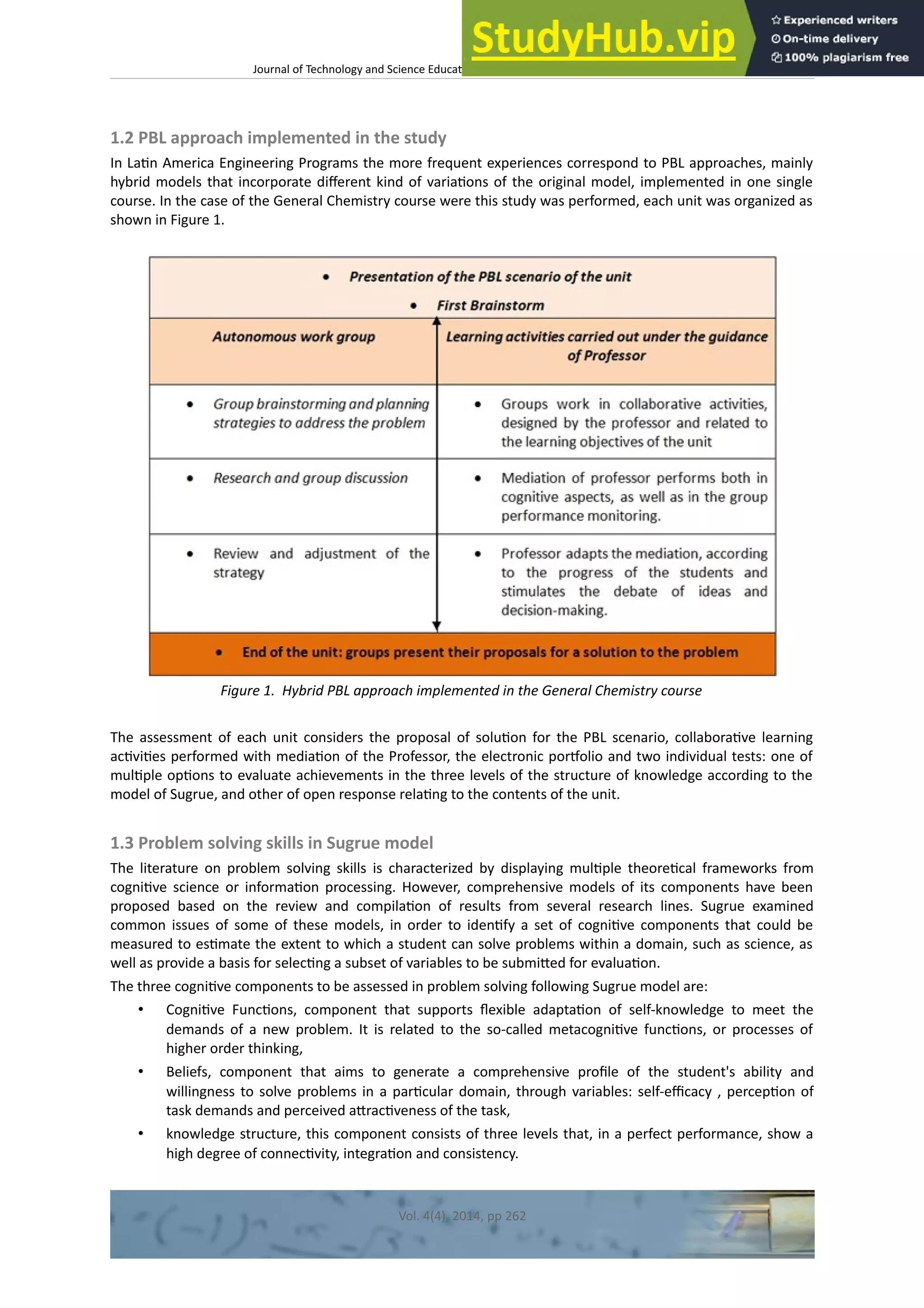
course. In the case of the General Chemistry course were this study was performed, each unit was organized as
shown in Figure 1.
Figure 1. Hybrid PBL approach implemented in the General Chemistry course
The assessment of each unit considers the proposal of soluton for the PBL scenario, collaboratve learning
actvites performed with mediaton of the Professor, the electronic portolio and two individual tests: one of
multple optons to evaluate achievements in the three levels of the structure of knowledge according to the
model of Sugrue, and other of open response relatng to the contents of the unit.
1.3 Problem solving skills in Sugrue model
The literature on problem solving skills is characterized by displaying multple theoretcal frameworks from
cognitve science or informaton processing. However, comprehensive models of its components have been
proposed based on the review and compilaton of results from several research lines. Sugrue examined
common issues of some of these models, in order to identfy a set of cognitve components that could be
measured to estmate the extent to which a student can solve problems within a domain, such as science, as
well as provide a basis for selectng a subset of variables to be submited for evaluaton.
The three cognitve components to be assessed in problem solving following Sugrue model are:
• Cognitve Functons, component that supports fexible adaptaton of self-knowledge to meet the
demands of a new problem. It is related to the so-called metacognitve functons, or processes of
higher order thinking,
• Beliefs, component that aims to generate a comprehensive profle of the student's ability and
willingness to solve problems in a partcular domain, through variables: self-efcacy , percepton of
task demands and perceived atractveness of the task,
• knowledge structure, this component consists of three levels that, in a perfect performance, show a
high degree of connectvity, integraton and consistency.
Vol. 4(4), 2014, pp 262
Journal of Technology and Science Educaton – htp://dx.doi.org/10.3926/jotse.100
Sugrue suggests that the ability to solve problems in a partcular domain results from the complex interacton of
the structure of knowledge, metacognitve functons and motvaton. The diferences observed during the
process, from the interpretaton of the problem to the persistence in trying to solve it, can be atributed to
variatons in these three aspects of cognitve constructs. For each of the three categories of cognitve
components, Sugrue describes a limited set of variables that should be targeted by assessment under two
criteria: they were shown to be critcal by research or open to instructonal interventon. In this study, interest
has focused on developing tools to assess achievements in the component knowledge structure, so this theme
is developed in more detail in the next secton.
1.4 Knowledge structure assessment
This component of Sugrue model considers three levels:
• First level: Concepts. A concept is a category of objects, events, people, symbols and ideas that share
common atributes and propertes, and are identfed by the same name. The evaluaton of the
understanding of a concept implies: selectng examples of the concept (in a multple choice format), or
generatng of examples of the concept (in an open-ended format), or explanaton of why examples
refect concept atributes (in a hands-on format).
• Second level: Principles. A principle is defned as a rule, law, formula or statement that characterizes
the relatonship (ofen causal) between two or more concepts. The evaluaton of the understanding of
principles involves: selectng best predictons or best explanaton (in a multple choice format), or
generatng predictons or solutons (in an open-ended format), or giving an explanaton of an event or
result (in a hands-on format).
• Third level: Linking the concepts and principles to conditons and procedures for applicaton. To
facilitate the resoluton of the problem, the concepts and principles should be linked to the conditons
and procedures that facilitate their use in new situatons. A procedure is a set of steps that can be
done to achieve a goal. The conditons are aspects of the context that indicate the existence of an
instance of a concept, or to indicate that a principle is operatng or can be applied, or that a partcular
procedure is appropriate. Subjects with good performance in problem solving should be able to
recognize situatons where procedures can be performed to identfy or generate instances of a concept
and should be able to carry out these procedures exactly. Overall, they should be able to assemble a
procedure based on a principle to construct a desired achievement in a new situaton. The evaluaton
of this level involves: selectng correct procedure for identfying instances of a concept, or selectng
most appropriate procedure to change the state of one concept by manipulatng other (in a multple-
choice format); or generatng a procedure for identfying instances of a concept, or generatng a
procedure to change the state of one concept by manipulatng other (in a multple-choice format); or
performing procedures to identfy instances of a concept, or performing a procedure to change the
state of one concept by manipulatng other (in a hands-on format).
The diagnostc evaluaton of problem solving skills should allow the identfcaton of students who understand
the concepts but not the principle that binds them, students who understand the principles and concepts but
have no knowledge of the procedures for applying them, and students who are able to perform procedures
correctly but do not know when it is appropriate their applicaton.
The fndings of Gijbels et al. (2005) showed no signifcant diferences in the frst level, corresponding to the
understanding of concepts, comparing the achievements reported in PBL implementatons with conventonal
teaching methodology. However, in the second level, corresponding to the understanding of principles linking
concepts, PBL showed signifcant superiority. There were not enough studies on the third level of the model, for
this reason, previous research aimed to develop tests to assess achievements in the third level that were
applied to freshmen engineering courses, in the context of General Chemistry and General Physics courses
(Morales 2011a, 2011b).
The aim of the present study is to develop and validate instruments that can be used for the assessment of
cognitve achievement in the three levels of knowledge structure, based on a model that is consistent with the
learning environment promoted by methodologies such as PBL.
Vol. 4(4), 2014, pp 263
Journal of Technology and Science Educaton – htp://dx.doi.org/10.3926/jotse.100
2 METHODOLOGY
2.1 Instruments constructon
The frst task in the constructon of the tests was to identfy the concepts, principles and the conditons and
procedures that were to be evaluated in the main thematc units of General Chemistry 2 course. To do this, it
was conducted a content analysis of topics and issues in the curriculum, to detail the domain and sub-domain
of interest and decide the level of assessment. Then the items were writen taken as reference Sugrue model
for evaluatng three levels of Knowledge Structure: concepts, principles and link the concepts and principles to
conditons and procedures for applicaton, resultng in the constructon of three tests, one for each topic:
Thermodynamics, Kinetcs and Chemical Equilibrium. The format used for all the tests was multple choices.
The items were formulated in such a way that for the frst level, the student should identfy examples of the
concept. At the second level, the student should select the best explanaton of a partcular event and in the
third level, the student must select the correct procedure to identfy concepts in a given situaton, or select the
most appropriate procedure to change a concept status manipulatng another concept.
Some examples:
• First level:
The soldiers ofen bring prepared food placed in a closed plastc bag or aluminium foil, which can be
heated by immersing it in boiling water or by placing it on the hot engine of a vehicle. Another
possibility is to use the "fameless heaters," which utlize a reacton between magnesium metal and
water, which is very exothermic.
From the text above:
Identfy a thermodynamic system and indicate its type (open, closed, isolated), justfying your answer.
• Second level:
It is suspected that the decompositon of a biological substance follows a frst order kinetcs. To
confrm this, the concentraton of the substance was measured at diferent tmes. What must we do
with this data?
• We must determine the concentraton which decomposed, as the diference between the
inital concentraton and the remaining concentraton at each tme. If the graph of the
obtained values versus tme is a straight line, then it is a frst order reacton.
• We must calculate the inverse of concentraton at each tme. If the graph of the obtained
values versus tme is a straight line, then it is a frst order reacton.
• We must determine the log of the inverse of concentraton at each tme. If the graph of the
obtained values versus tme is a straight line, then it is a frst order reacton.
• We must determine the log of the concentraton at each tme. If the graph of the obtained
values versus tme is a straight line, then it is a frst order reacton.
• Third level:
We want to increase the acidity of a soluton containing 0.1 M acetc acid (Ka = 1.8 x 10⁻⁵
). In the
laboratory we fnd the following aqueous solutons: hydrocyanic acid 0.1 M (Ka = 6.2 x 10⁻¹⁰
) and
nitrous acid 0.1 M (Ka = 4.0 x 10⁻⁴
). Which of the following alternatves will achieve the goal?
• Add a volume of the nitrous acid soluton, which is a stronger acid and provide greater
amount of H+ ions to the acetc acid soluton, increasing its acidity.
• Add a volume of the hydrocyanic acid soluton, which is a stronger acid and provide greater
amount of H+ ions to the acetc acid soluton, increasing its acidity.
• Increase the volume of the acetc acid soluton by adding water, so acid ionizaton will increase
and therefore the acidity.
Vol. 4(4), 2014, pp 264
Journal of Technology and Science Educaton – htp://dx.doi.org/10.3926/jotse.100
2.2 Content validaton
This is the most important stage in the validaton process, as it shows the logical relatonship between test
items and content and skills assessed. For this case, fve Chemistry professors from Pontfcal Catholic University
of Peru (PUCP) were invited to assume the role of judges in assessing the degree of coherence between the
concepts and principles to be assessed with each item and the item statement. Also, they were asked to assess
the degree of consistency between the learning objectves associated with each item and the item statement.
On the basis of the judges’ evaluaton and their comments and suggestons, adjustments were made to the
items in each test, to proceed with their pilot applicaton and a reassessment by three Chemistry professors
from PUCP who partcipated as judges.
2.3 Pilot applicaton
The tests were applied with students of General Chemistry 2 course (PUCP) following a hybrid PBL approach in
diferent semesters between 2010 and 2011. The ages of the students involved ranged between 17 and 20
years, with the highest percentage at the age of 17 years (43.2%). Table 1 reports further informaton about
partcipants in the pilot implementaton of each test.
Test N° partcipants (N)
Gender (%)
Male Female
Thermodynamics 328 73,1 26,9
Kinetcs 313 69,0 31,0
Chemical Equilibrium 283 70,5 29,5
Table 1. Informaton about partcipants in the pilot implementaton of each test
The test applicaton was always made at the end of the corresponding thematc unity. The maximum duraton
of applicaton was 50 min. With the tests responses, it was performed the analysis of items for each of the
three tests. For this purpose it was determined:
• the percentage of omissions, corresponding to reactve responses that have been lef in blank,
• the difculty degree, which is a measure of the number of subjects who responded correctly to the
reagent;
• biserial point coefcient (rpb), which is a special case of Pearson correlaton for determining the
correlaton between the reactant and the total score and consttutes an internal discriminaton index.
3 RESULTS
3.1 Instruments constructon
Table 2 summarizes the fnal structure of each test.
Test
N° First level
items
N° Second level items N° Third level items
Thermodynamics 2 1 3
Kinetcs 2 2 2
Chemical Equilibrium 1 1 3
Table 2. Final structure of each test
Vol. 4(4), 2014, pp 265
Journal of Technology and Science Educaton – htp://dx.doi.org/10.3926/jotse.100
3.2 Content validaton
Table 3 summarizes the results of the second judges’ evaluaton of the built tests. The evaluaton by the second
group of judges was satsfactory, qualifying the degree of consistency between the questons and the learning
objectves, concepts and principles associated, as good or very good.
Test
Degree of consistency (%) between test items and:
Learning objectves Concepts and principles
Very good Good Very good Good
Thermodynamics 78 22 83 17
Kinetcs 83 17 89 11
Chemical Equilibrium 80 20 87 13
Table 3. Summary of second judges’ evaluaton of the built tests
3.3 Pilot applicaton
Table 4 summarizes the results of analysis of items for each of the three tests. The percentage of omissions is
not included, because in all cases the partcipatng students answered the total of questons.
Test Level Item
Difculty
degree (%)
Proporton of
errors
rpb
Thermodynamics
1 1 56,4 0,436 0,433
1 2 65,5 0,345 0,475
2 3 54,6 0,454 0,585
3 4 41,5 0,585 0,478
3 5 80,8 0,192 0,418
3 6 43,6 0,564 0,466
Kinetcs
1 1 66,8 0,332 0,488
1 2 83,7 0,163 0,476
2 3 78,9 0,211 0,461
2 4 62,9 0,371 0,484
3 5 64,2 0,358 0,511
3 6 57,4 0,426 0,469
Chemical
Equilibrium
1 1 71 0,29 0,510
2 2 35,3 0,647 0,519
3 3 56,2 0,438 0,586
3 4 32,2 0,678 0,463
3 5 61,5 0,385 0,476
Table 4. Summary of the results of analysis of items for each test
The average of degree of difculty for the Thermodynamics test was 57.07%; for Kinetcs test the value
obtained was 68.98% and for Chemical Equilibrium test was 51.24%. According to this, the second test can be
classifed as moderately difcult, while the frst and the third tests would qualify as medium difculty. The
variability of the values obtained for the items in each test was adequate, showing that it contained questons
of diferent levels of difculty for students. Biserial point coefcient (rpb) is located in the range 0.418 to 0.586
for all items of the tests, so it is an indicaton that the reagents of each test discriminate between subjects
achieving high score on the test and those with low scores.
Vol. 4(4), 2014, pp 266
Journal of Technology and Science Educaton – htp://dx.doi.org/10.3926/jotse.100
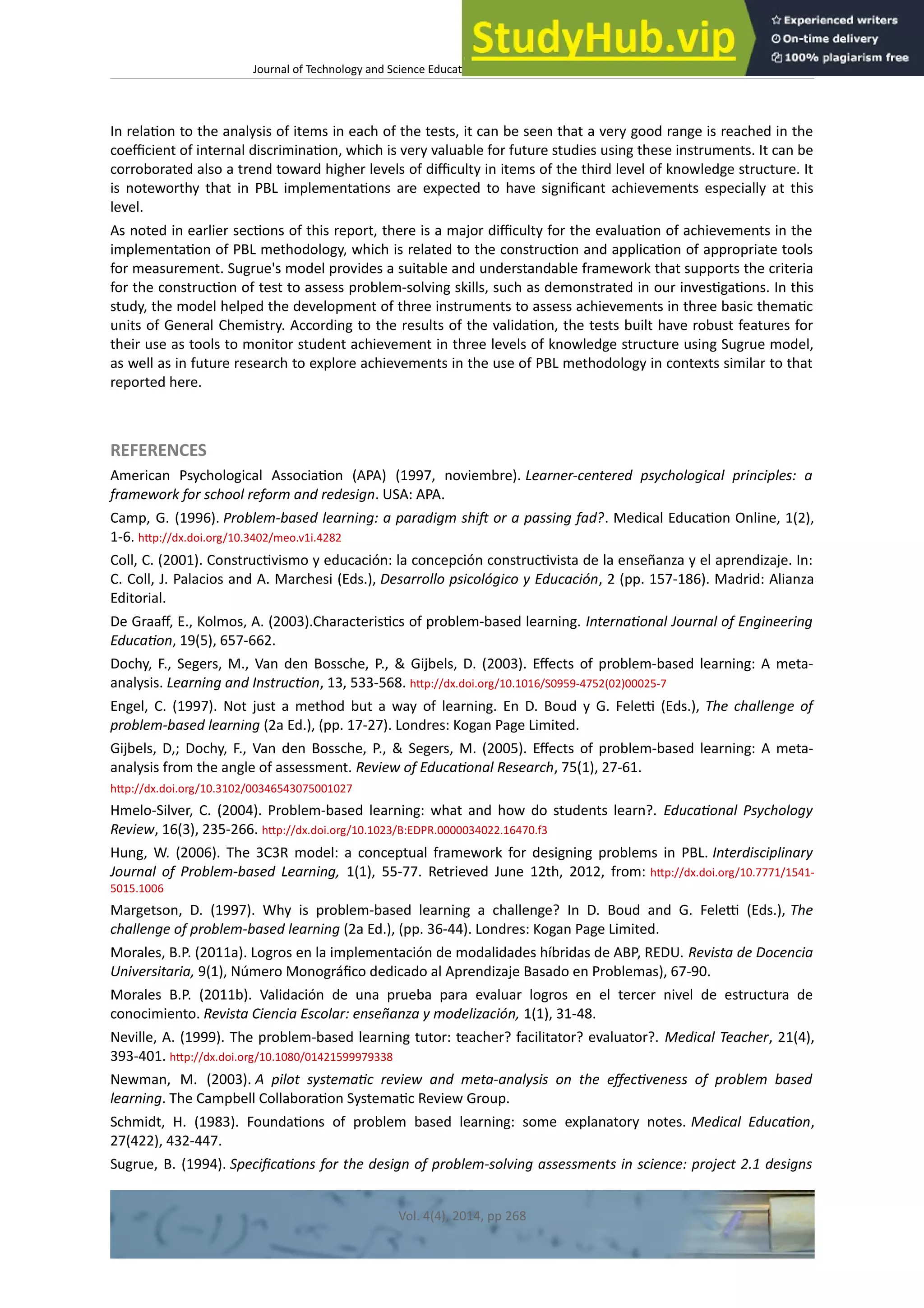
Figure 2 shows, as an example, a comparison of the results in the evaluaton of achievements in the three levels
of knowledge structure of three students, using Thermodynamics test.
Figure 2. Evaluaton results on the three levels of knowledge
structure of three students in a General Chemistry course
It can be seen that the student RBS had very satsfactory results according to the learning goals of PBL
methodology. The student BBG had very good levels of achievement in concepts and principles, but must
improve his skills in the third level. Something similar happens with the student DRI, although his results are
lower, especially in the third level, so he may require special atenton.
The overall results in the applicaton of these instruments with a group of students allow the professor to get
informaton about achievement in terms of expectatons in line with PBL approach. According to it, the
facilitator can have evidence to reformulate the problems, learning actvites or his facilitaton.
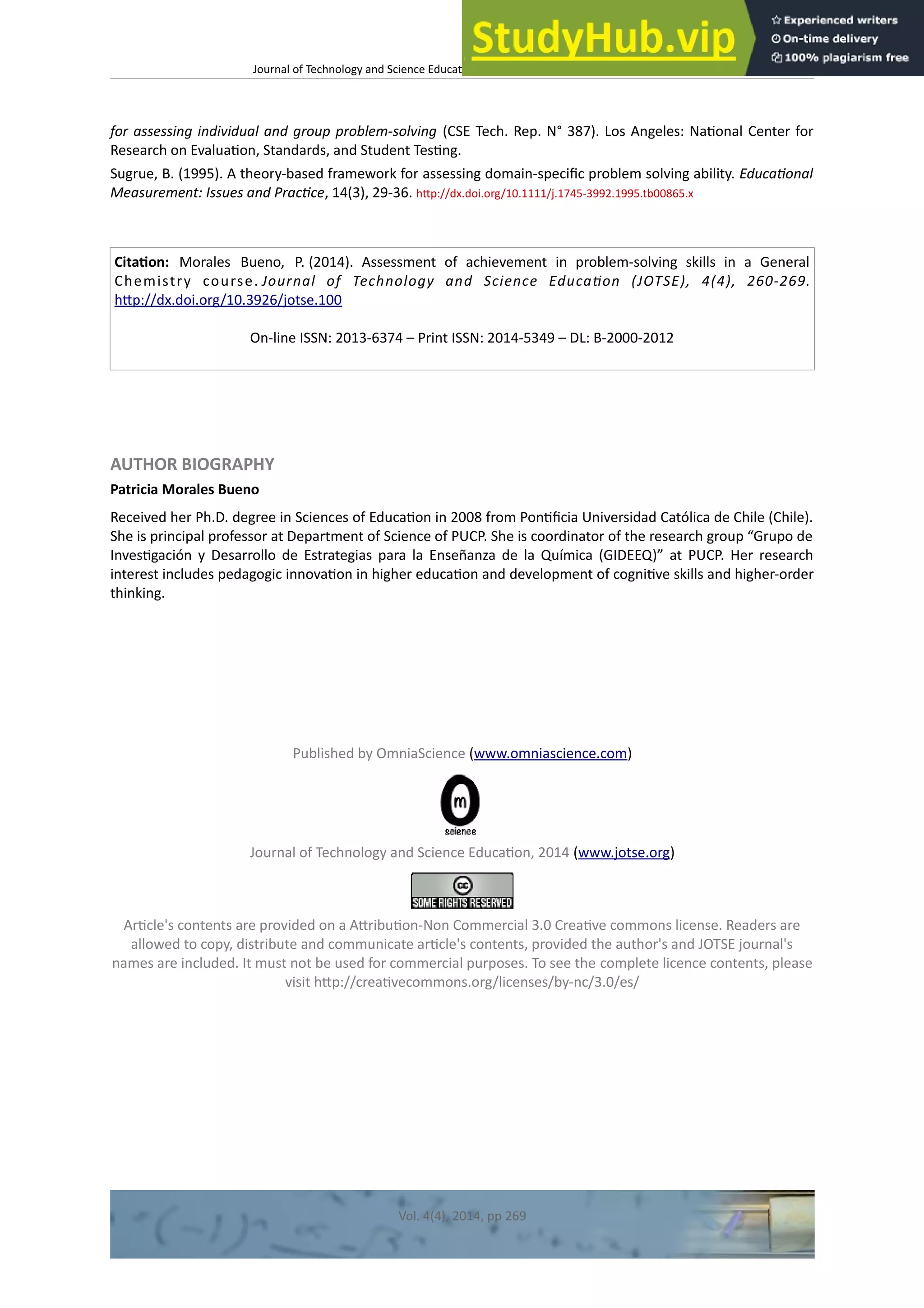
For example, Figure 3 shows that the results in Chemical Equilibrium test were lowest in the group of students
assessed, so it would be necessary to analyze the reasons of this situaton for planning correctve acton.
Figure 3. Global results on the three levels of knowledge
structure for each test
4 CONCLUSIONS
The results obtained in the validaton of the built instruments are highly satsfactory, since, frst, ensure a high
degree of consistency between the learning objectves, the content assessed and the items in each test. The
theoretcal foundatons of the model have been applied rigorously and are relevant to the learning contexts
promoted by PBL methodology.
Vol. 4(4), 2014, pp 267
Journal of Technology and Science Educaton – htp://dx.doi.org/10.3926/jotse.100
In relaton to the analysis of items in each of the tests, it can be seen that a very good range is reached in the
coefcient of internal discriminaton, which is very valuable for future studies using these instruments. It can be
corroborated also a trend toward higher levels of difculty in items of the third level of knowledge structure. It
is noteworthy that in PBL implementatons are expected to have signifcant achievements especially at this
level.
As noted in earlier sectons of this report, there is a major difculty for the evaluaton of achievements in the
implementaton of PBL methodology, which is related to the constructon and applicaton of appropriate tools
for measurement. Sugrue's model provides a suitable and understandable framework that supports the criteria
for the constructon of test to assess problem-solving skills, such as demonstrated in our investgatons. In this
study, the model helped the development of three instruments to assess achievements in three basic thematc
units of General Chemistry. According to the results of the validaton, the tests built have robust features for
their use as tools to monitor student achievement in three levels of knowledge structure using Sugrue model,
as well as in future research to explore achievements in the use of PBL methodology in contexts similar to that
reported here.
REFERENCES
American Psychological Associaton (APA) (1997, noviembre). Learner-centered psychological principles: a
framework for school reform and redesign. USA: APA.
Camp, G. (1996). Problem-based learning: a paradigm shif or a passing fad?. Medical Educaton Online, 1(2),
1-6. htp://dx.doi.org/10.3402/meo.v1i.4282
Coll, C. (2001). Constructvismo y educación: la concepción constructvista de la enseñanza y el aprendizaje. In:
C. Coll, J. Palacios and A. Marchesi (Eds.), Desarrollo psicológico y Educación, 2 (pp. 157-186). Madrid: Alianza
Editorial.
De Graaf, E., Kolmos, A. (2003).Characteristcs of problem-based learning. Internatonal Journal of Engineering
Educaton, 19(5), 657-662.
Dochy, F., Segers, M., Van den Bossche, P., & Gijbels, D. (2003). Efects of problem-based learning: A meta-
analysis. Learning and Instructon, 13, 533-568. htp://dx.doi.org/10.1016/S0959-4752(02)00025-7
Engel, C. (1997). Not just a method but a way of learning. En D. Boud y G. Felet (Eds.), The challenge of
problem-based learning (2a Ed.), (pp. 17-27). Londres: Kogan Page Limited.
Gijbels, D,; Dochy, F., Van den Bossche, P., & Segers, M. (2005). Efects of problem-based learning: A meta-
analysis from the angle of assessment. Review of Educatonal Research, 75(1), 27-61.
htp://dx.doi.org/10.3102/00346543075001027
Hmelo-Silver, C. (2004). Problem-based learning: what and how do students learn?. Educatonal Psychology
Review, 16(3), 235-266. htp://dx.doi.org/10.1023/B:EDPR.0000034022.16470.f3
Hung, W. (2006). The 3C3R model: a conceptual framework for designing problems in PBL. Interdisciplinary
Journal of Problem-based Learning, 1(1), 55-77. Retrieved June 12th, 2012, from: htp://dx.doi.org/10.7771/1541-
5015.1006
Margetson, D. (1997). Why is problem-based learning a challenge? In D. Boud and G. Felet (Eds.), The
challenge of problem-based learning (2a Ed.), (pp. 36-44). Londres: Kogan Page Limited.
Morales, B.P. (2011a). Logros en la implementación de modalidades híbridas de ABP, REDU. Revista de Docencia
Universitaria, 9(1), Número Monográfco dedicado al Aprendizaje Basado en Problemas), 67-90.
Morales B.P. (2011b). Validación de una prueba para evaluar logros en el tercer nivel de estructura de
conocimiento. Revista Ciencia Escolar: enseñanza y modelización, 1(1), 31-48.
Neville, A. (1999). The problem-based learning tutor: teacher? facilitator? evaluator?. Medical Teacher, 21(4),
393-401. htp://dx.doi.org/10.1080/01421599979338
Newman, M. (2003). A pilot systematc review and meta-analysis on the efectveness of problem based
learning. The Campbell Collaboraton Systematc Review Group.
Schmidt, H. (1983). Foundatons of problem based learning: some explanatory notes. Medical Educaton,
27(422), 432-447.
Sugrue, B. (1994). Specifcatons for the design of problem-solving assessments in science: project 2.1 designs
Vol. 4(4), 2014, pp 268
Journal of Technology and Science Educaton – htp://dx.doi.org/10.3926/jotse.100
for assessing individual and group problem-solving (CSE Tech. Rep. N° 387). Los Angeles: Natonal Center for
Research on Evaluaton, Standards, and Student Testng.
Sugrue, B. (1995). A theory-based framework for assessing domain-specifc problem solving ability. Educatonal
Measurement: Issues and Practce, 14(3), 29-36. htp://dx.doi.org/10.1111/j.1745-3992.1995.tb00865.x
Citaton: Morales Bueno, P. (2014). Assessment of achievement in problem-solving skills in a General
Chemistry course. Journal of Technology and Science Educaton (JOTSE), 4(4), 260-269.
htp://dx.doi.org/10.3926/jotse.100
On-line ISSN: 2013-6374 – Print ISSN: 2014-5349 – DL: B-2000-2012
AUTHOR BIOGRAPHY
Patricia Morales Bueno
Received her Ph.D. degree in Sciences of Educaton in 2008 from Pontfcia Universidad Católica de Chile (Chile).
She is principal professor at Department of Science of PUCP. She is coordinator of the research group “Grupo de
Investgación y Desarrollo de Estrategias para la Enseñanza de la Química (GIDEEQ)” at PUCP. Her research
interest includes pedagogic innovaton in higher educaton and development of cognitve skills and higher-order
thinking.
Published by OmniaScience (www.omniascience.com)
Journal of Technology and Science Educaton, 2014 (www.jotse.org)
Artcle's contents are provided on a Atributon-Non Commercial 3.0 Creatve commons license. Readers are
allowed to copy, distribute and communicate artcle's contents, provided the author's and JOTSE journal's
names are included. It must not be used for commercial purposes. To see the complete licence contents, please
visit htp://creatvecommons.org/licenses/by-nc/3.0/es/
Vol. 4(4), 2014, pp 269

Assessment Of Achievement In Problem-Solving Skills In A General Chemistry Course

  • 1.
    Journal of Technologyand Science Education ISSN: 2014-5349 info@jotse.org OmniaScience España Morales Bueno, Patricia ASSESSMENT OF ACHIEVEMENT IN PROBLEM-SOLVING SKILLS IN A GENERAL CHEMISTRY COURSE Journal of Technology and Science Education, vol. 4, núm. 4, 2014, pp. 260-269 OmniaScience Barcelona, España Available in: http://www.redalyc.org/articulo.oa?id=331132766007 How to cite Complete issue More information about this article Journal's homepage in redalyc.org Scientific Information System Network of Scientific Journals from Latin America, the Caribbean, Spain and Portugal Non-profit academic project, developed under the open access initiative
  • 2.
    Journal of Technologyand Science Education ASSESSMENT OF ACHIEVEMENT IN PROBLEM-SOLVING SKILLS IN A GENERAL CHEMISTRY COURSE Patricia Morales Bueno Department of Science, Pontfcia Universidad Católica del Perú PUCP Perú pmorale@pucp.edu.pe Abstract This artcle reports the development and validaton study of tests to assess achievements at three levels of knowledge structure, following the model proposed by Sugrue to measure problem-solving skills. The literature has reported this proposal as a model consistent with the theoretcal constructs underlying problem-based learning (PBL) methodology. The tests were constructed for a General Chemistry course in a curriculum of engineering, which implements PBL methodology at a Peruvian university. The content validaton of the tests was performed, as well as a pilot implementaton with Peruvian students of frst year engineering. The results obtained in omissions percentage, difculty degree, items response patern and the point biserial coefcient (rpb), let us to conclude that these are appropriate tools for assessing these skills, mainly for the purpose of contributng to process facilitaton as well as to future research in this line. Keywords – Problem-solving skills, Academic achievement, Problem-based learning, Higher educaton. ---------- 1 INTRODUCTION Despite the variety of approaches to problem-based learning, in terms of its defniton and diferent modalites of implementaton (Dochy, Segers, Van den Bossche & Gijbels, 2003; De Graaf & Kolmos, 2003), there is no doubt that there is a consensus to point out that from the cognitve dimension, one of the main objectves in this educatonal proposal is the development of problem solving skills both for the acquisiton of knowledge, as for its applicaton (Hmelo-Silver, 2004). Although there is a large volume of research on PBL, there is no consensus on what achievements or what measurement methods should be used to evaluate their efects, and this situaton leads to the need to identfy relevant theoretcal constructs underlying PBL features and main goals in the learning context (Newman, 2003). The meta-analysis performed by Gijbels , Dochy , Van den Bossche and Segers (2005), used Sugrue’s model (1994, 1995) as a frame of reference to study the PBL efects when the assessment of its main goals focuses on the understanding of concepts, principles that link concepts, and the linking of concepts and principles to conditons and procedures for applicaton. For the authors, the great advantage of Sugrue model is that it is translated into specifcatons for the assessment of the main cognitve components of problem solving: knowledge structure, metacognitve functons, and motvaton. This study follows the line of work of Gijbels et al. (2005), to develop instruments with the purpose to monitor student achievement in three levels of knowledge structure using Sugrue model, in a General Chemistry course where a hybrid PBL approach was implemented. Journal of Technology and Science Educaton. Vol 4(4), 2014, pp 260 On-line ISSN 2013-6374 – Print-ISSN 2014-5349 DL: B-2000-2012 – htp://dx.doi.org/10.3926/jotse.100
  • 3.
    Journal of Technologyand Science Educaton – htp://dx.doi.org/10.3926/jotse.100 1.1 PBL theoretcal framework PBL methodology is part of an educatonal vision that promotes an open, critcal, and refectve learning with a holistc approach to knowledge that recognizes their complex and changing nature, and involves a community of people who interact collaboratvely to make decisions regarding diferent problem situatons they must face. PBL, in this sense, is the medium to set the conditons to promote actve, contextualized, integrated and comprehension oriented learning, providing opportunites to refect on the educatonal experience and to practce the applicaton of learning (Margetson, 1997; Engel, 1997). Therefore, it is clear that the learning goals go far beyond the mere acquisiton of disciplinary content. The scenario or problem that initates the learning process fulflls several functons during the process: to organize the content and knowledge; provide the context of the learning environment, stmulate higher order thinking and refecton, as well as promotng and maintaining motvaton for learning. Hung (2006) proposes an interestng model that clearly illustrates the diferent components of the scenario or problem design, and can be a reference to identfy the main issues involved in PBL learning goals. The core components of the model: content, context and connecton are mainly related to the ownership and adequacy of content knowledge, and their contextualizaton and integraton. The content, as a central component, validates proper alignment between the problem scope and the curricular contents (expected learning) in breadth and depth. The context ensures that the situaton presented is authentc (real or realistc), relevant to the professional area in which the student is formed, their personal interests or his life as a member of society. The connecton component enables students to integrate knowledge and interconnect the concepts in such a way of establishing a conceptual network of the subject. Processing components: research, reasoning and refecton facilitate conscious and meaningful involvement of students in their learning process. They are the dynamic elements of the model, thus, research enables the core components, promotes the development of skills for the search and processing of informaton, facilitates conceptual connectons for student learning and supports the processes of reasoning and refecton. The reasoning component promotes the development of skills of higher order thinking, actves core components also facilitates student conceptual connectons and supports the processes of research and refecton. The later component acts as a guiding element for metacogniton, facilitates refecton process to synthesize and integrate the knowledge learned, promotes in students the habit to develop and use their skills to self-directed learning and lifelong learning. There is an additonal important element to consider: PBL process is developed on the basis of efcient teamwork dynamics. The infuence of interpersonal relatonships and communicaton with others about learning is recognized in both learner-centered psychological principles proposed by APA (1997), and the constructvist view of teaching and learning (Coll, 2001). Working collaboratvely with peers favors the actvaton of prior knowledge, provides opportunites for exchange of ideas contributng to the restructuring of paterns of knowledge, stmulates epistemic curiosity, attude and motvaton for learning (Schmidt, 1983). According to discussed so far, PBL methodology helps students to construct an extensive and fexible knowledge base; develop efectve problem-solving skills; develop self-directed, lifelong learning skills; become efectve collaborators; and become intrinsically motvated to learn (Hmelo-Silver, 2004). The adopton of PBL involves substantal changes in various aspects related to insttuton, teachers and students, which will ultmately determine the achievement of the fundamental goals of this educatonal proposal. This transiton is not a simple process and therefore, it has emerged a variety of approaches to the methodology ranging from adopton in isolated courses belonging to a traditonal curriculum, untl joining a radical curricular transformaton (Dochy et al., 2003). The diversity of approaches has hampered the interpretaton of results of research on their efectveness (Camp, 1996), which is why from the late ninetes, several studies have recognized the need to consider the characteristcs of the specifc context in where the PBL implementaton is performed, in order to have more and beter informaton for evaluatng the achievements of the methodology and the factors that may afect them (Dochy et al., 2003; Gijbels et al., 2005; Neville, 1999; Newman, 2003). Vol. 4(4), 2014, pp 261
  • 4.
    Journal of Technologyand Science Educaton – htp://dx.doi.org/10.3926/jotse.100 1.2 PBL approach implemented in the study In Latn America Engineering Programs the more frequent experiences correspond to PBL approaches, mainly hybrid models that incorporate diferent kind of variatons of the original model, implemented in one single course. In the case of the General Chemistry course were this study was performed, each unit was organized as shown in Figure 1. Figure 1. Hybrid PBL approach implemented in the General Chemistry course The assessment of each unit considers the proposal of soluton for the PBL scenario, collaboratve learning actvites performed with mediaton of the Professor, the electronic portolio and two individual tests: one of multple optons to evaluate achievements in the three levels of the structure of knowledge according to the model of Sugrue, and other of open response relatng to the contents of the unit. 1.3 Problem solving skills in Sugrue model The literature on problem solving skills is characterized by displaying multple theoretcal frameworks from cognitve science or informaton processing. However, comprehensive models of its components have been proposed based on the review and compilaton of results from several research lines. Sugrue examined common issues of some of these models, in order to identfy a set of cognitve components that could be measured to estmate the extent to which a student can solve problems within a domain, such as science, as well as provide a basis for selectng a subset of variables to be submited for evaluaton. The three cognitve components to be assessed in problem solving following Sugrue model are: • Cognitve Functons, component that supports fexible adaptaton of self-knowledge to meet the demands of a new problem. It is related to the so-called metacognitve functons, or processes of higher order thinking, • Beliefs, component that aims to generate a comprehensive profle of the student's ability and willingness to solve problems in a partcular domain, through variables: self-efcacy , percepton of task demands and perceived atractveness of the task, • knowledge structure, this component consists of three levels that, in a perfect performance, show a high degree of connectvity, integraton and consistency. Vol. 4(4), 2014, pp 262
  • 5.
    Journal of Technologyand Science Educaton – htp://dx.doi.org/10.3926/jotse.100 Sugrue suggests that the ability to solve problems in a partcular domain results from the complex interacton of the structure of knowledge, metacognitve functons and motvaton. The diferences observed during the process, from the interpretaton of the problem to the persistence in trying to solve it, can be atributed to variatons in these three aspects of cognitve constructs. For each of the three categories of cognitve components, Sugrue describes a limited set of variables that should be targeted by assessment under two criteria: they were shown to be critcal by research or open to instructonal interventon. In this study, interest has focused on developing tools to assess achievements in the component knowledge structure, so this theme is developed in more detail in the next secton. 1.4 Knowledge structure assessment This component of Sugrue model considers three levels: • First level: Concepts. A concept is a category of objects, events, people, symbols and ideas that share common atributes and propertes, and are identfed by the same name. The evaluaton of the understanding of a concept implies: selectng examples of the concept (in a multple choice format), or generatng of examples of the concept (in an open-ended format), or explanaton of why examples refect concept atributes (in a hands-on format). • Second level: Principles. A principle is defned as a rule, law, formula or statement that characterizes the relatonship (ofen causal) between two or more concepts. The evaluaton of the understanding of principles involves: selectng best predictons or best explanaton (in a multple choice format), or generatng predictons or solutons (in an open-ended format), or giving an explanaton of an event or result (in a hands-on format). • Third level: Linking the concepts and principles to conditons and procedures for applicaton. To facilitate the resoluton of the problem, the concepts and principles should be linked to the conditons and procedures that facilitate their use in new situatons. A procedure is a set of steps that can be done to achieve a goal. The conditons are aspects of the context that indicate the existence of an instance of a concept, or to indicate that a principle is operatng or can be applied, or that a partcular procedure is appropriate. Subjects with good performance in problem solving should be able to recognize situatons where procedures can be performed to identfy or generate instances of a concept and should be able to carry out these procedures exactly. Overall, they should be able to assemble a procedure based on a principle to construct a desired achievement in a new situaton. The evaluaton of this level involves: selectng correct procedure for identfying instances of a concept, or selectng most appropriate procedure to change the state of one concept by manipulatng other (in a multple- choice format); or generatng a procedure for identfying instances of a concept, or generatng a procedure to change the state of one concept by manipulatng other (in a multple-choice format); or performing procedures to identfy instances of a concept, or performing a procedure to change the state of one concept by manipulatng other (in a hands-on format). The diagnostc evaluaton of problem solving skills should allow the identfcaton of students who understand the concepts but not the principle that binds them, students who understand the principles and concepts but have no knowledge of the procedures for applying them, and students who are able to perform procedures correctly but do not know when it is appropriate their applicaton. The fndings of Gijbels et al. (2005) showed no signifcant diferences in the frst level, corresponding to the understanding of concepts, comparing the achievements reported in PBL implementatons with conventonal teaching methodology. However, in the second level, corresponding to the understanding of principles linking concepts, PBL showed signifcant superiority. There were not enough studies on the third level of the model, for this reason, previous research aimed to develop tests to assess achievements in the third level that were applied to freshmen engineering courses, in the context of General Chemistry and General Physics courses (Morales 2011a, 2011b). The aim of the present study is to develop and validate instruments that can be used for the assessment of cognitve achievement in the three levels of knowledge structure, based on a model that is consistent with the learning environment promoted by methodologies such as PBL. Vol. 4(4), 2014, pp 263
  • 6.
    Journal of Technologyand Science Educaton – htp://dx.doi.org/10.3926/jotse.100 2 METHODOLOGY 2.1 Instruments constructon The frst task in the constructon of the tests was to identfy the concepts, principles and the conditons and procedures that were to be evaluated in the main thematc units of General Chemistry 2 course. To do this, it was conducted a content analysis of topics and issues in the curriculum, to detail the domain and sub-domain of interest and decide the level of assessment. Then the items were writen taken as reference Sugrue model for evaluatng three levels of Knowledge Structure: concepts, principles and link the concepts and principles to conditons and procedures for applicaton, resultng in the constructon of three tests, one for each topic: Thermodynamics, Kinetcs and Chemical Equilibrium. The format used for all the tests was multple choices. The items were formulated in such a way that for the frst level, the student should identfy examples of the concept. At the second level, the student should select the best explanaton of a partcular event and in the third level, the student must select the correct procedure to identfy concepts in a given situaton, or select the most appropriate procedure to change a concept status manipulatng another concept. Some examples: • First level: The soldiers ofen bring prepared food placed in a closed plastc bag or aluminium foil, which can be heated by immersing it in boiling water or by placing it on the hot engine of a vehicle. Another possibility is to use the "fameless heaters," which utlize a reacton between magnesium metal and water, which is very exothermic. From the text above: Identfy a thermodynamic system and indicate its type (open, closed, isolated), justfying your answer. • Second level: It is suspected that the decompositon of a biological substance follows a frst order kinetcs. To confrm this, the concentraton of the substance was measured at diferent tmes. What must we do with this data? • We must determine the concentraton which decomposed, as the diference between the inital concentraton and the remaining concentraton at each tme. If the graph of the obtained values versus tme is a straight line, then it is a frst order reacton. • We must calculate the inverse of concentraton at each tme. If the graph of the obtained values versus tme is a straight line, then it is a frst order reacton. • We must determine the log of the inverse of concentraton at each tme. If the graph of the obtained values versus tme is a straight line, then it is a frst order reacton. • We must determine the log of the concentraton at each tme. If the graph of the obtained values versus tme is a straight line, then it is a frst order reacton. • Third level: We want to increase the acidity of a soluton containing 0.1 M acetc acid (Ka = 1.8 x 10⁻⁵ ). In the laboratory we fnd the following aqueous solutons: hydrocyanic acid 0.1 M (Ka = 6.2 x 10⁻¹⁰ ) and nitrous acid 0.1 M (Ka = 4.0 x 10⁻⁴ ). Which of the following alternatves will achieve the goal? • Add a volume of the nitrous acid soluton, which is a stronger acid and provide greater amount of H+ ions to the acetc acid soluton, increasing its acidity. • Add a volume of the hydrocyanic acid soluton, which is a stronger acid and provide greater amount of H+ ions to the acetc acid soluton, increasing its acidity. • Increase the volume of the acetc acid soluton by adding water, so acid ionizaton will increase and therefore the acidity. Vol. 4(4), 2014, pp 264
  • 7.
    Journal of Technologyand Science Educaton – htp://dx.doi.org/10.3926/jotse.100 2.2 Content validaton This is the most important stage in the validaton process, as it shows the logical relatonship between test items and content and skills assessed. For this case, fve Chemistry professors from Pontfcal Catholic University of Peru (PUCP) were invited to assume the role of judges in assessing the degree of coherence between the concepts and principles to be assessed with each item and the item statement. Also, they were asked to assess the degree of consistency between the learning objectves associated with each item and the item statement. On the basis of the judges’ evaluaton and their comments and suggestons, adjustments were made to the items in each test, to proceed with their pilot applicaton and a reassessment by three Chemistry professors from PUCP who partcipated as judges. 2.3 Pilot applicaton The tests were applied with students of General Chemistry 2 course (PUCP) following a hybrid PBL approach in diferent semesters between 2010 and 2011. The ages of the students involved ranged between 17 and 20 years, with the highest percentage at the age of 17 years (43.2%). Table 1 reports further informaton about partcipants in the pilot implementaton of each test. Test N° partcipants (N) Gender (%) Male Female Thermodynamics 328 73,1 26,9 Kinetcs 313 69,0 31,0 Chemical Equilibrium 283 70,5 29,5 Table 1. Informaton about partcipants in the pilot implementaton of each test The test applicaton was always made at the end of the corresponding thematc unity. The maximum duraton of applicaton was 50 min. With the tests responses, it was performed the analysis of items for each of the three tests. For this purpose it was determined: • the percentage of omissions, corresponding to reactve responses that have been lef in blank, • the difculty degree, which is a measure of the number of subjects who responded correctly to the reagent; • biserial point coefcient (rpb), which is a special case of Pearson correlaton for determining the correlaton between the reactant and the total score and consttutes an internal discriminaton index. 3 RESULTS 3.1 Instruments constructon Table 2 summarizes the fnal structure of each test. Test N° First level items N° Second level items N° Third level items Thermodynamics 2 1 3 Kinetcs 2 2 2 Chemical Equilibrium 1 1 3 Table 2. Final structure of each test Vol. 4(4), 2014, pp 265
  • 8.
    Journal of Technologyand Science Educaton – htp://dx.doi.org/10.3926/jotse.100 3.2 Content validaton Table 3 summarizes the results of the second judges’ evaluaton of the built tests. The evaluaton by the second group of judges was satsfactory, qualifying the degree of consistency between the questons and the learning objectves, concepts and principles associated, as good or very good. Test Degree of consistency (%) between test items and: Learning objectves Concepts and principles Very good Good Very good Good Thermodynamics 78 22 83 17 Kinetcs 83 17 89 11 Chemical Equilibrium 80 20 87 13 Table 3. Summary of second judges’ evaluaton of the built tests 3.3 Pilot applicaton Table 4 summarizes the results of analysis of items for each of the three tests. The percentage of omissions is not included, because in all cases the partcipatng students answered the total of questons. Test Level Item Difculty degree (%) Proporton of errors rpb Thermodynamics 1 1 56,4 0,436 0,433 1 2 65,5 0,345 0,475 2 3 54,6 0,454 0,585 3 4 41,5 0,585 0,478 3 5 80,8 0,192 0,418 3 6 43,6 0,564 0,466 Kinetcs 1 1 66,8 0,332 0,488 1 2 83,7 0,163 0,476 2 3 78,9 0,211 0,461 2 4 62,9 0,371 0,484 3 5 64,2 0,358 0,511 3 6 57,4 0,426 0,469 Chemical Equilibrium 1 1 71 0,29 0,510 2 2 35,3 0,647 0,519 3 3 56,2 0,438 0,586 3 4 32,2 0,678 0,463 3 5 61,5 0,385 0,476 Table 4. Summary of the results of analysis of items for each test The average of degree of difculty for the Thermodynamics test was 57.07%; for Kinetcs test the value obtained was 68.98% and for Chemical Equilibrium test was 51.24%. According to this, the second test can be classifed as moderately difcult, while the frst and the third tests would qualify as medium difculty. The variability of the values obtained for the items in each test was adequate, showing that it contained questons of diferent levels of difculty for students. Biserial point coefcient (rpb) is located in the range 0.418 to 0.586 for all items of the tests, so it is an indicaton that the reagents of each test discriminate between subjects achieving high score on the test and those with low scores. Vol. 4(4), 2014, pp 266
  • 9.
    Journal of Technologyand Science Educaton – htp://dx.doi.org/10.3926/jotse.100 Figure 2 shows, as an example, a comparison of the results in the evaluaton of achievements in the three levels of knowledge structure of three students, using Thermodynamics test. Figure 2. Evaluaton results on the three levels of knowledge structure of three students in a General Chemistry course It can be seen that the student RBS had very satsfactory results according to the learning goals of PBL methodology. The student BBG had very good levels of achievement in concepts and principles, but must improve his skills in the third level. Something similar happens with the student DRI, although his results are lower, especially in the third level, so he may require special atenton. The overall results in the applicaton of these instruments with a group of students allow the professor to get informaton about achievement in terms of expectatons in line with PBL approach. According to it, the facilitator can have evidence to reformulate the problems, learning actvites or his facilitaton. For example, Figure 3 shows that the results in Chemical Equilibrium test were lowest in the group of students assessed, so it would be necessary to analyze the reasons of this situaton for planning correctve acton. Figure 3. Global results on the three levels of knowledge structure for each test 4 CONCLUSIONS The results obtained in the validaton of the built instruments are highly satsfactory, since, frst, ensure a high degree of consistency between the learning objectves, the content assessed and the items in each test. The theoretcal foundatons of the model have been applied rigorously and are relevant to the learning contexts promoted by PBL methodology. Vol. 4(4), 2014, pp 267
  • 10.
    Journal of Technologyand Science Educaton – htp://dx.doi.org/10.3926/jotse.100 In relaton to the analysis of items in each of the tests, it can be seen that a very good range is reached in the coefcient of internal discriminaton, which is very valuable for future studies using these instruments. It can be corroborated also a trend toward higher levels of difculty in items of the third level of knowledge structure. It is noteworthy that in PBL implementatons are expected to have signifcant achievements especially at this level. As noted in earlier sectons of this report, there is a major difculty for the evaluaton of achievements in the implementaton of PBL methodology, which is related to the constructon and applicaton of appropriate tools for measurement. Sugrue's model provides a suitable and understandable framework that supports the criteria for the constructon of test to assess problem-solving skills, such as demonstrated in our investgatons. In this study, the model helped the development of three instruments to assess achievements in three basic thematc units of General Chemistry. According to the results of the validaton, the tests built have robust features for their use as tools to monitor student achievement in three levels of knowledge structure using Sugrue model, as well as in future research to explore achievements in the use of PBL methodology in contexts similar to that reported here. REFERENCES American Psychological Associaton (APA) (1997, noviembre). Learner-centered psychological principles: a framework for school reform and redesign. USA: APA. Camp, G. (1996). Problem-based learning: a paradigm shif or a passing fad?. Medical Educaton Online, 1(2), 1-6. htp://dx.doi.org/10.3402/meo.v1i.4282 Coll, C. (2001). Constructvismo y educación: la concepción constructvista de la enseñanza y el aprendizaje. In: C. Coll, J. Palacios and A. Marchesi (Eds.), Desarrollo psicológico y Educación, 2 (pp. 157-186). Madrid: Alianza Editorial. De Graaf, E., Kolmos, A. (2003).Characteristcs of problem-based learning. Internatonal Journal of Engineering Educaton, 19(5), 657-662. Dochy, F., Segers, M., Van den Bossche, P., & Gijbels, D. (2003). Efects of problem-based learning: A meta- analysis. Learning and Instructon, 13, 533-568. htp://dx.doi.org/10.1016/S0959-4752(02)00025-7 Engel, C. (1997). Not just a method but a way of learning. En D. Boud y G. Felet (Eds.), The challenge of problem-based learning (2a Ed.), (pp. 17-27). Londres: Kogan Page Limited. Gijbels, D,; Dochy, F., Van den Bossche, P., & Segers, M. (2005). Efects of problem-based learning: A meta- analysis from the angle of assessment. Review of Educatonal Research, 75(1), 27-61. htp://dx.doi.org/10.3102/00346543075001027 Hmelo-Silver, C. (2004). Problem-based learning: what and how do students learn?. Educatonal Psychology Review, 16(3), 235-266. htp://dx.doi.org/10.1023/B:EDPR.0000034022.16470.f3 Hung, W. (2006). The 3C3R model: a conceptual framework for designing problems in PBL. Interdisciplinary Journal of Problem-based Learning, 1(1), 55-77. Retrieved June 12th, 2012, from: htp://dx.doi.org/10.7771/1541- 5015.1006 Margetson, D. (1997). Why is problem-based learning a challenge? In D. Boud and G. Felet (Eds.), The challenge of problem-based learning (2a Ed.), (pp. 36-44). Londres: Kogan Page Limited. Morales, B.P. (2011a). Logros en la implementación de modalidades híbridas de ABP, REDU. Revista de Docencia Universitaria, 9(1), Número Monográfco dedicado al Aprendizaje Basado en Problemas), 67-90. Morales B.P. (2011b). Validación de una prueba para evaluar logros en el tercer nivel de estructura de conocimiento. Revista Ciencia Escolar: enseñanza y modelización, 1(1), 31-48. Neville, A. (1999). The problem-based learning tutor: teacher? facilitator? evaluator?. Medical Teacher, 21(4), 393-401. htp://dx.doi.org/10.1080/01421599979338 Newman, M. (2003). A pilot systematc review and meta-analysis on the efectveness of problem based learning. The Campbell Collaboraton Systematc Review Group. Schmidt, H. (1983). Foundatons of problem based learning: some explanatory notes. Medical Educaton, 27(422), 432-447. Sugrue, B. (1994). Specifcatons for the design of problem-solving assessments in science: project 2.1 designs Vol. 4(4), 2014, pp 268
  • 11.
    Journal of Technologyand Science Educaton – htp://dx.doi.org/10.3926/jotse.100 for assessing individual and group problem-solving (CSE Tech. Rep. N° 387). Los Angeles: Natonal Center for Research on Evaluaton, Standards, and Student Testng. Sugrue, B. (1995). A theory-based framework for assessing domain-specifc problem solving ability. Educatonal Measurement: Issues and Practce, 14(3), 29-36. htp://dx.doi.org/10.1111/j.1745-3992.1995.tb00865.x Citaton: Morales Bueno, P. (2014). Assessment of achievement in problem-solving skills in a General Chemistry course. Journal of Technology and Science Educaton (JOTSE), 4(4), 260-269. htp://dx.doi.org/10.3926/jotse.100 On-line ISSN: 2013-6374 – Print ISSN: 2014-5349 – DL: B-2000-2012 AUTHOR BIOGRAPHY Patricia Morales Bueno Received her Ph.D. degree in Sciences of Educaton in 2008 from Pontfcia Universidad Católica de Chile (Chile). She is principal professor at Department of Science of PUCP. She is coordinator of the research group “Grupo de Investgación y Desarrollo de Estrategias para la Enseñanza de la Química (GIDEEQ)” at PUCP. Her research interest includes pedagogic innovaton in higher educaton and development of cognitve skills and higher-order thinking. Published by OmniaScience (www.omniascience.com) Journal of Technology and Science Educaton, 2014 (www.jotse.org) Artcle's contents are provided on a Atributon-Non Commercial 3.0 Creatve commons license. Readers are allowed to copy, distribute and communicate artcle's contents, provided the author's and JOTSE journal's names are included. It must not be used for commercial purposes. To see the complete licence contents, please visit htp://creatvecommons.org/licenses/by-nc/3.0/es/ Vol. 4(4), 2014, pp 269