PROJECT BASED LEARNING – SOLAR SYSTEM
MANGAYARKKARASI SIVAPRAKASAM
NEED OF PBL TO LEARN SOLAR SYSTEM
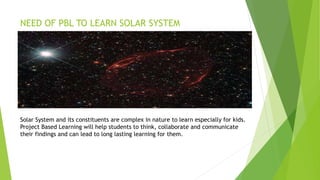
Solar System and its constituents are complex in nature to learn especially for kids.
Project Based Learning will help students to think, collaborate and communicate
their findings and can lead to long lasting learning for them.
LESSON OBJECTIVES
Identified Learning Target:
Students will:
Understand that planetary images contain valuable
information, but require interpretation, which is
somewhat uncertain.
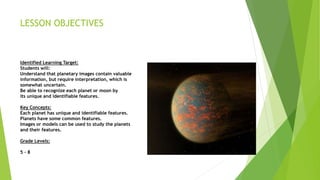
Be able to recognize each planet or moon by
its unique and identifiable features.
Key Concepts:
Each planet has unique and identifiable features.
Planets have some common features.
Images or models can be used to study the planets
and their features.
Grade Levels:
5 - 8
PROJECT OBJECTIVES
• Divide classroom into multiple groups.
• Encourage each group to study
characteristics of different planets.
• Enable students to define and describe
each planet, encourage them to ask
questions.
• Ensure each group and students
communicate, collaborate,
• Develop skills to arrive at model.
• Allow each group to demo their model.
PROJECT GROUPS
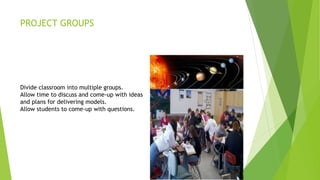
Divide classroom into multiple groups.
Allow time to discuss and come-up with ideas
and plans for delivering models.
Allow students to come-up with questions.
PROJECT STEPS
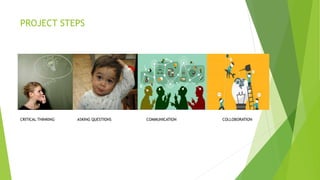
CRITICAL THINKING ASKING QUESTIONS COMMUNICATION COLLOBORATION
PROJECT OUTPUT
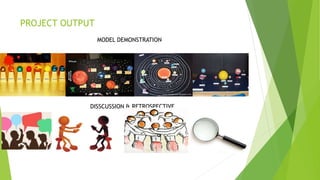
DISSCUSSION & RETROSPECTIVE
MODEL DEMONSTRATION
BENEFITS
Students getting opportunity to think
research the topic.
Getting motivation to discuss with peers
and parents.
Opportunity to ask questions and imagine
model.
Able to develop model and demonstrate
their understanding.
Develops innovation, collaboration,
communication and critical thinking.
Develops long lasting understanding of the
topic.
REFERENCES
i Perceptions. (2011). National Aeronautics and space administration. Retrieved
October 9, 2016, from http://www.nasa.gov
TeradaSenior, Y., & Curation, R. (2014, June 26). 5 keys to rigorous project-
based learning. Retrieved October 9, 2016, from Project-Based Learning,
http://www.edutopia.org/video/5-keys-rigorous-project-based-learning
Institute, B., & Education. (2016). Project based learning. Retrieved October 9,
2016, from http://www.bie.org/about/what_pbl
THANK YOU!

Project based learning

  • 1.
    PROJECT BASED LEARNING– SOLAR SYSTEM MANGAYARKKARASI SIVAPRAKASAM
  • 2.
    NEED OF PBLTO LEARN SOLAR SYSTEM Solar System and its constituents are complex in nature to learn especially for kids. Project Based Learning will help students to think, collaborate and communicate their findings and can lead to long lasting learning for them.
  • 3.
    LESSON OBJECTIVES Identified LearningTarget: Students will: Understand that planetary images contain valuable information, but require interpretation, which is somewhat uncertain. Be able to recognize each planet or moon by its unique and identifiable features. Key Concepts: Each planet has unique and identifiable features. Planets have some common features. Images or models can be used to study the planets and their features. Grade Levels: 5 - 8
  • 4.
    PROJECT OBJECTIVES • Divideclassroom into multiple groups. • Encourage each group to study characteristics of different planets. • Enable students to define and describe each planet, encourage them to ask questions. • Ensure each group and students communicate, collaborate, • Develop skills to arrive at model. • Allow each group to demo their model.
  • 5.
    PROJECT GROUPS Divide classroominto multiple groups. Allow time to discuss and come-up with ideas and plans for delivering models. Allow students to come-up with questions.
  • 6.
    PROJECT STEPS CRITICAL THINKINGASKING QUESTIONS COMMUNICATION COLLOBORATION
  • 7.
    PROJECT OUTPUT DISSCUSSION &RETROSPECTIVE MODEL DEMONSTRATION
  • 8.
    BENEFITS Students getting opportunityto think research the topic. Getting motivation to discuss with peers and parents. Opportunity to ask questions and imagine model. Able to develop model and demonstrate their understanding. Develops innovation, collaboration, communication and critical thinking. Develops long lasting understanding of the topic.
  • 9.
    REFERENCES i Perceptions. (2011).National Aeronautics and space administration. Retrieved October 9, 2016, from http://www.nasa.gov TeradaSenior, Y., & Curation, R. (2014, June 26). 5 keys to rigorous project- based learning. Retrieved October 9, 2016, from Project-Based Learning, http://www.edutopia.org/video/5-keys-rigorous-project-based-learning Institute, B., & Education. (2016). Project based learning. Retrieved October 9, 2016, from http://www.bie.org/about/what_pbl
  • 10.