   Sound is created by a disturbance travelling in
    an elastic medium like air and water. For
    instance, when an excess pressure is produced
    on some region of the air, that region tends to
    expand towards the neighbouring zones. This,
    in turn, compresses those zones, creating a
    new excess pressure which will tend to expand
    next, and, again, a new excess pressure is
    further created. The pressure disturbance will
    thus propagate through the air, and eventually
    it will reach some receiver (for instance a
    microphone or an ear). Excess pressure is
    called sound pressure(see Ladefoged,1996:3f).
 This  kind of movement in which it is not
 the medium itself but some disturbance
 what is travelling, is called a wave. There
 are many other types of waves, such as
 radio waves, light, heat radiation, the
 ripples on the surface of a lake,
 earthquakes, etc. When the wave takes
 place in a liquid or gaseous medium
 (except surface waves), the wave is called
 an acoustic wave. When a wave is audible,
 it is called a sound wave.
    most waves are the result of many
    successive disturbances of the medium,
    instead of only one. When those
    disturbances are generated at regular
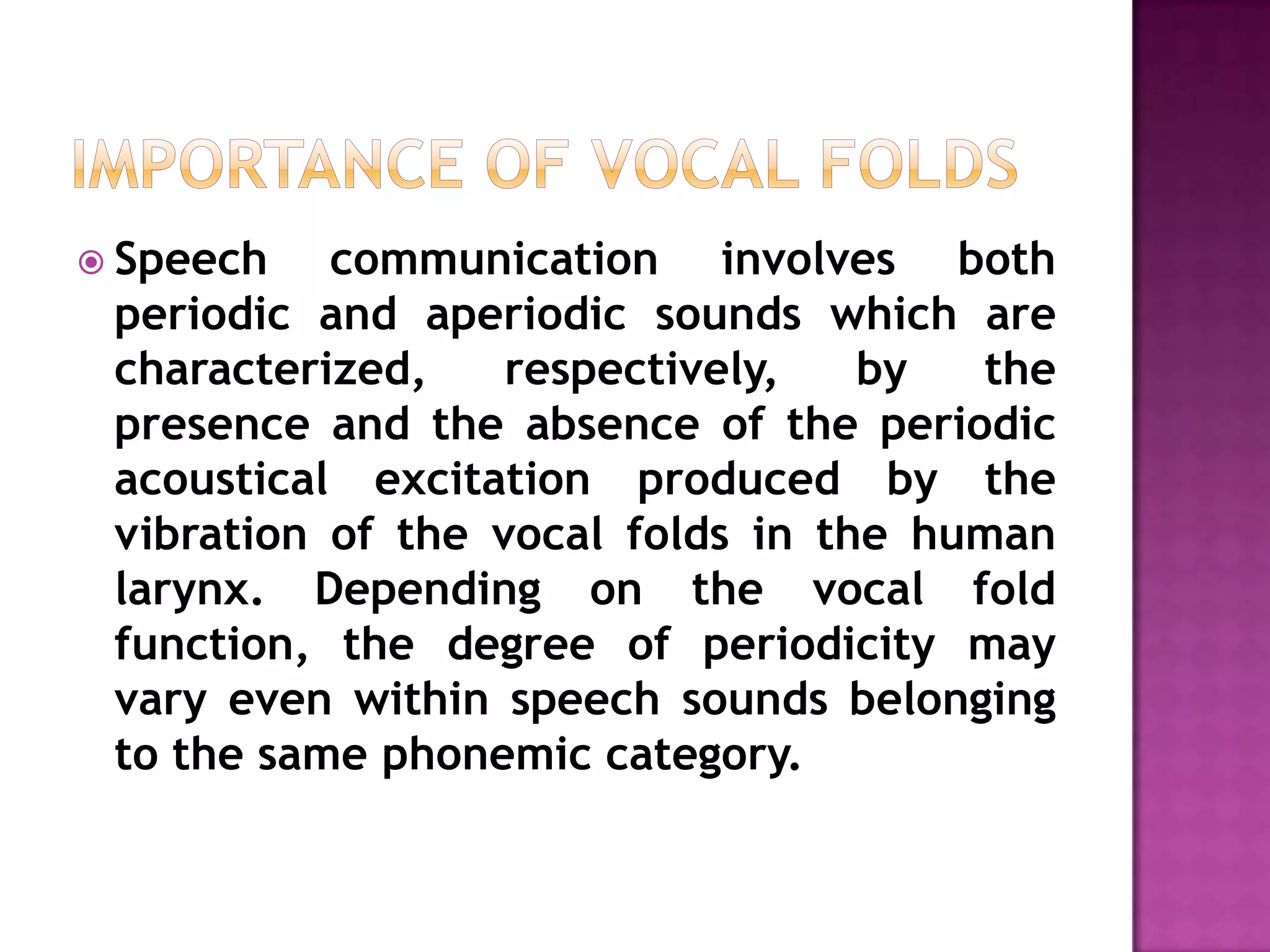
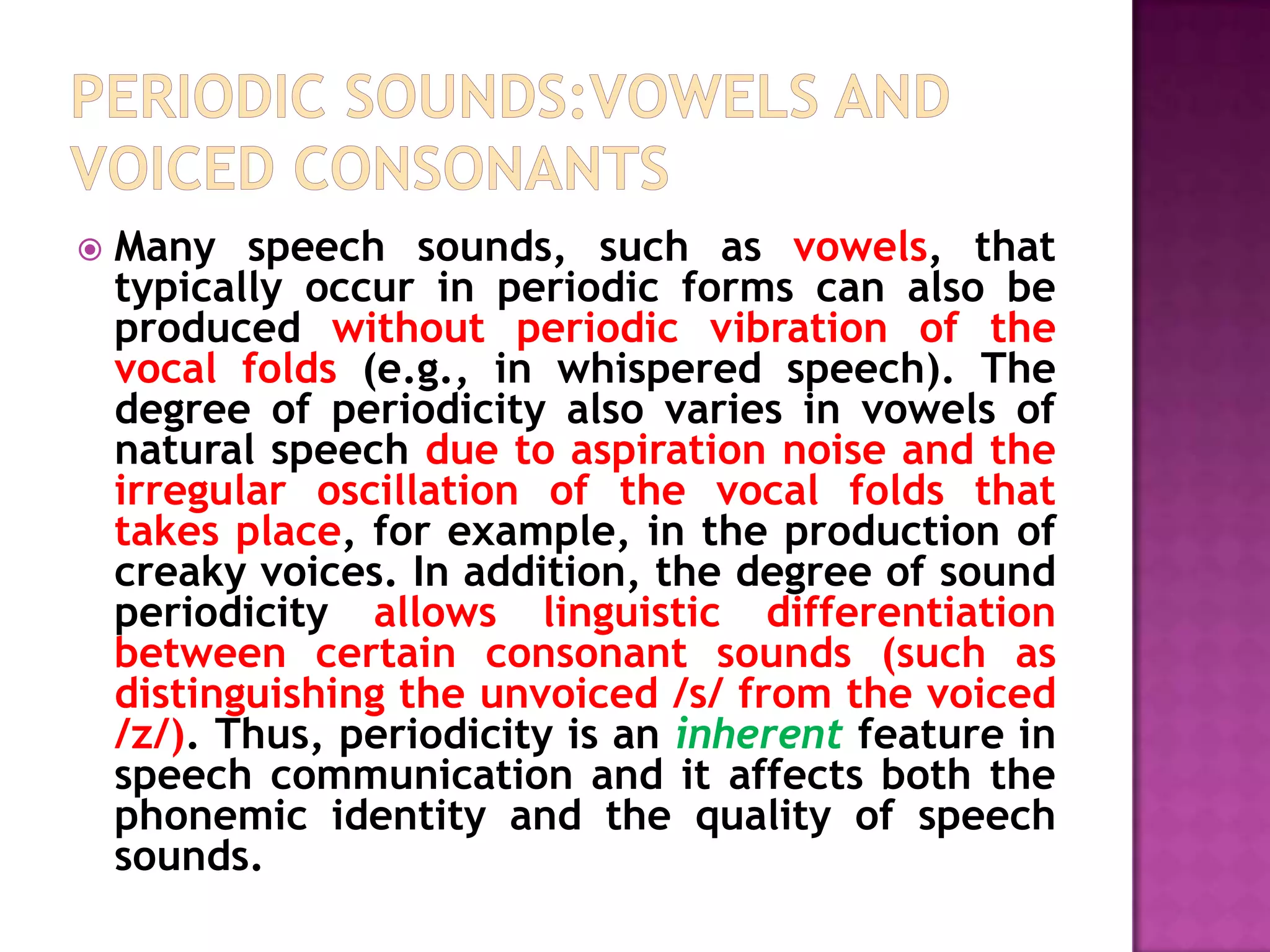
    intervals and are all the same shape we are
    in the presence of a periodic wave, and the
    number of disturbances per unit time is
    called the frequency of the wave. It is
    expressed in a unit called Hertz (Hz),
    meaning cycles per second (a cycle is all
    that happens in between a disturbance). In
    the case of sound waves, frequency is
    between 20 Hz and 20,000 Hz.
 Acoustic waves of frequency smaller than
 20 Hz are called infrasounds, and those of
 frequency greater than 20,000 Hz are
 called ultrasounds. Neither of them can
 ordinarily been heard by humans. Several
 animals (such as the dog, for instance) can
 hear very low frequency sounds, such as
 those created by ground waves during an
 earthquake.
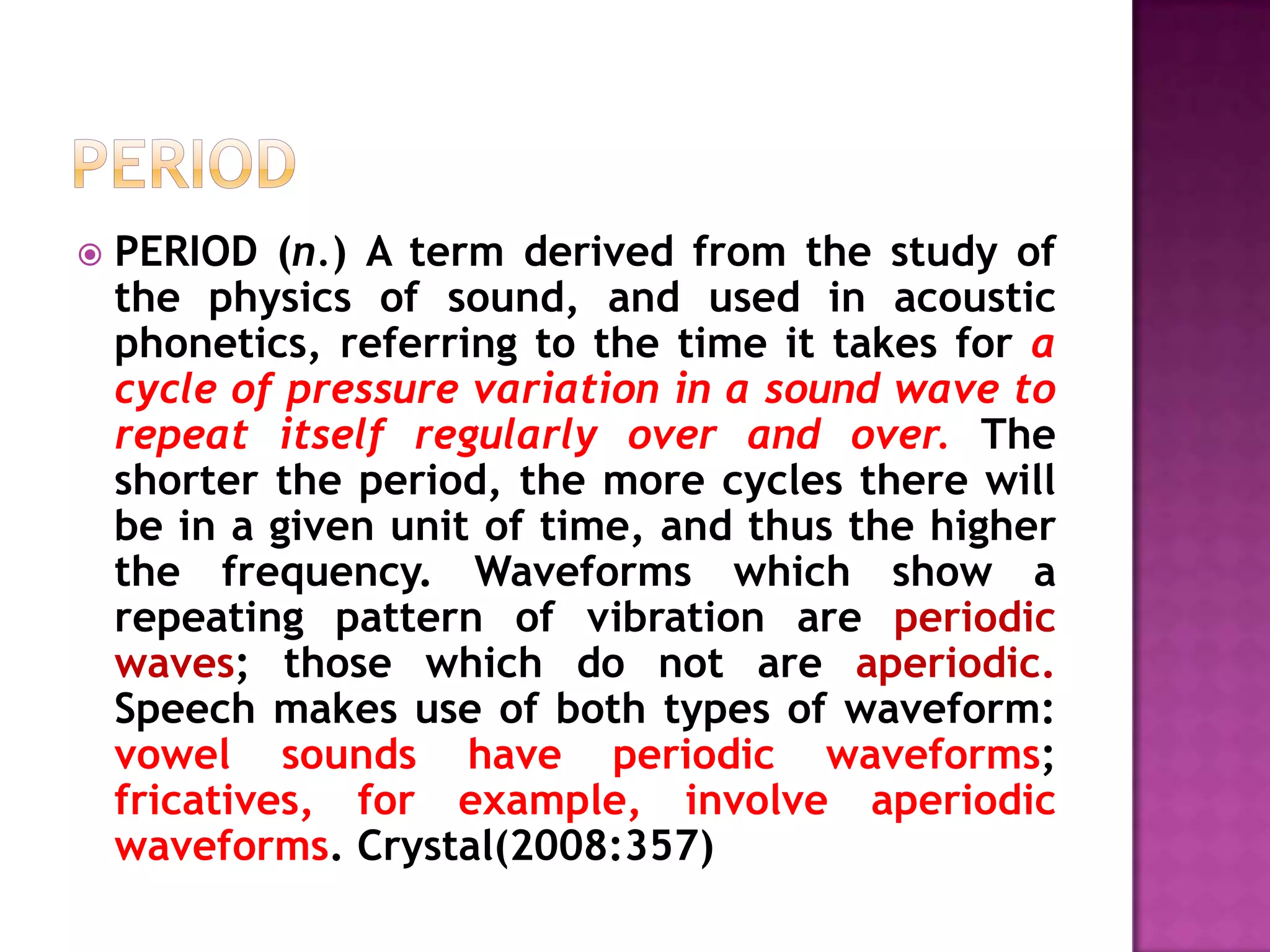
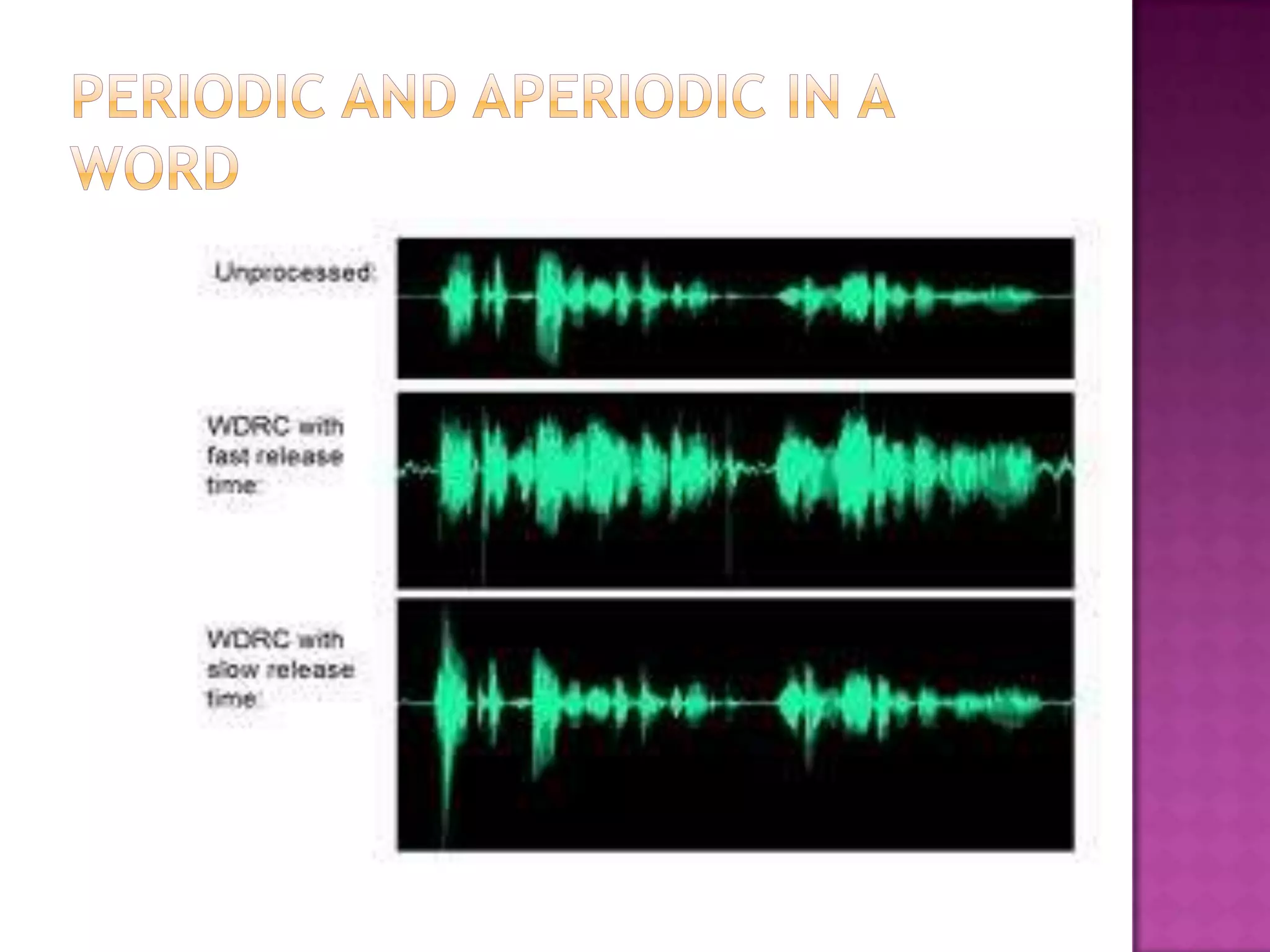
   Even if there are many sounds which are nearly
    periodic, such as those sounds produced by pitched
    musical instruments, the vast majority of sounds in
    Nature are aperiodic, that is, successive disturbances
    are not equally spaced in time, and are not of constant
    shape either. This is what in a technical sense is called
    noise. Aperiodic waves usually cannot convey the
    sensation of pitch. Some examples are the consonants of
    speech, urban noise, the noise of the wind and the sea,
    and the sound of many percussive instruments such as
    drums, charlestons, etc.

   PERIOD (n.) A term derived from the study of
    the physics of sound, and used in acoustic
    phonetics, referring to the time it takes for a
    cycle of pressure variation in a sound wave to
    repeat itself regularly over and over. The
    shorter the period, the more cycles there will
    be in a given unit of time, and thus the higher
    the frequency. Waveforms which show a
    repeating pattern of vibration are periodic
    waves; those which do not are aperiodic.
    Speech makes use of both types of waveform:
    vowel sounds have periodic waveforms;
    fricatives, for example, involve aperiodic
    waveforms. Crystal(2008:357)
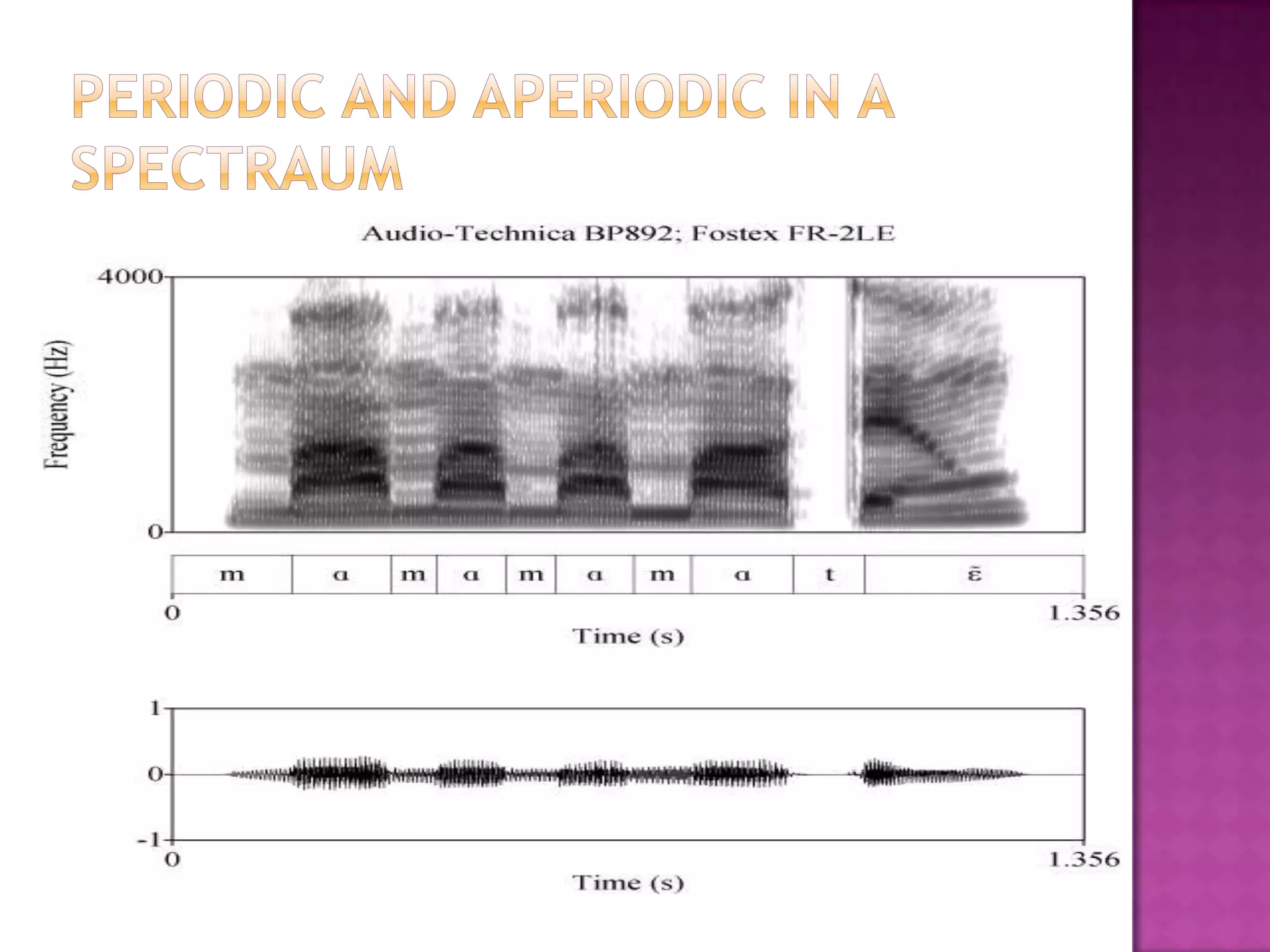
 Speech   communication involves both
 periodic and aperiodic sounds which are
 characterized,    respectively,   by  the
 presence and the absence of the periodic
 acoustical excitation produced by the
 vibration of the vocal folds in the human
 larynx. Depending on the vocal fold
 function, the degree of periodicity may
 vary even within speech sounds belonging
 to the same phonemic category.
   Many speech sounds, such as vowels, that
    typically occur in periodic forms can also be
    produced without periodic vibration of the
    vocal folds (e.g., in whispered speech). The
    degree of periodicity also varies in vowels of
    natural speech due to aspiration noise and the
    irregular oscillation of the vocal folds that
    takes place, for example, in the production of
    creaky voices. In addition, the degree of sound
    periodicity allows linguistic differentiation
    between certain consonant sounds (such as
    distinguishing the unvoiced /s/ from the voiced
    /z/). Thus, periodicity is an inherent feature in
    speech communication and it affects both the
    phonemic identity and the quality of speech
    sounds.
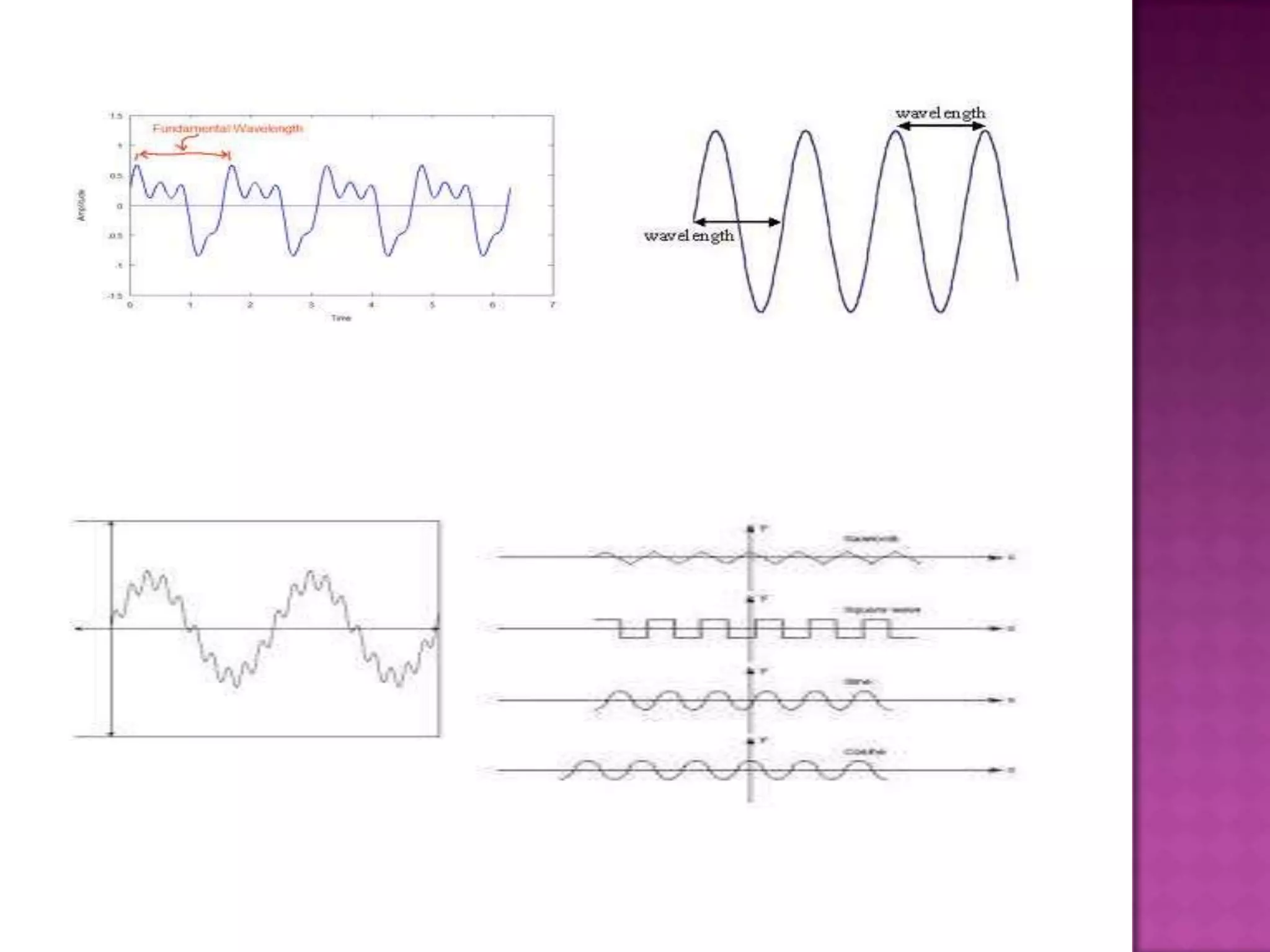
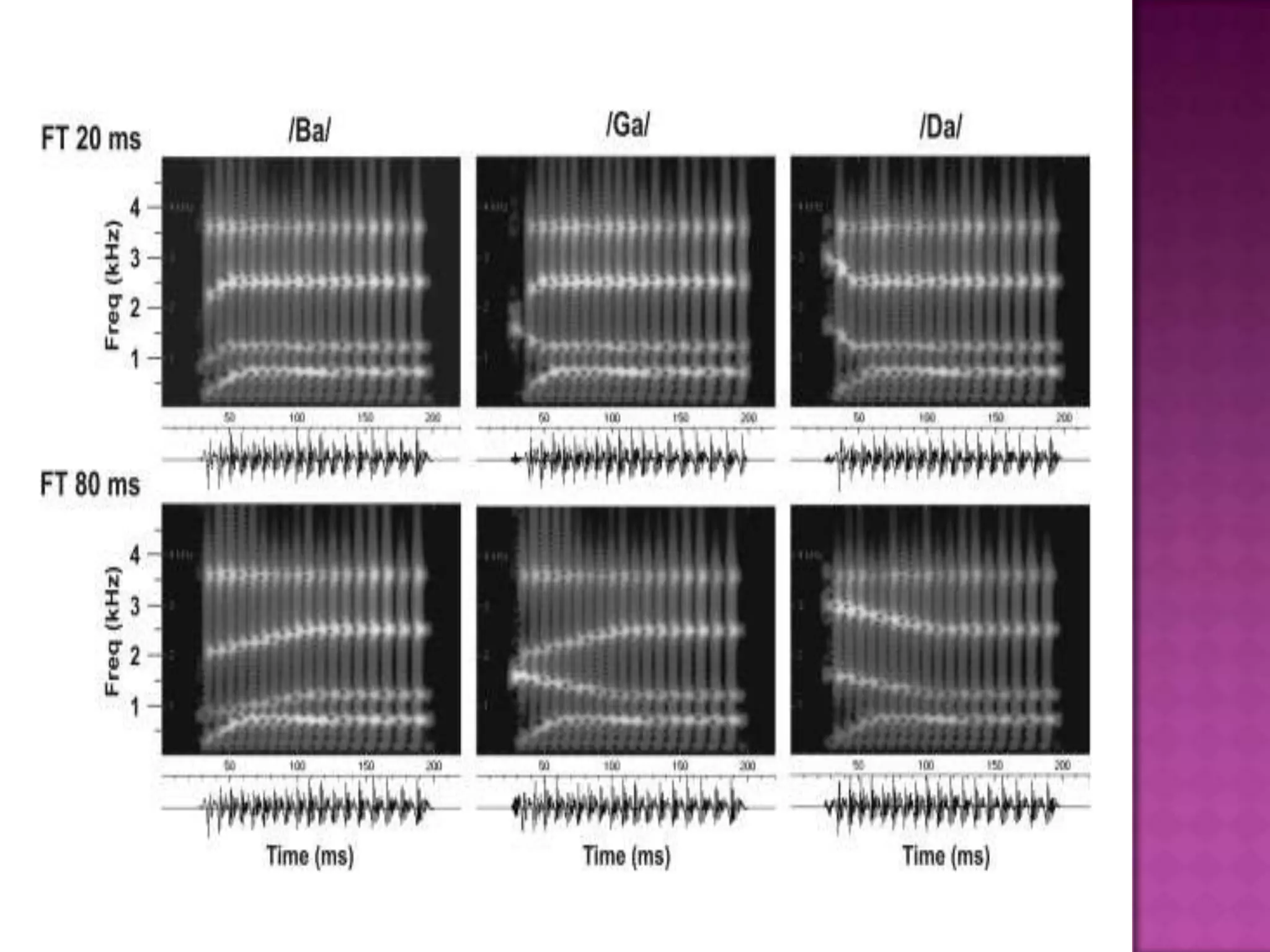
 The description of the sine waves which
  compose a given sound is called the spectrum
  of the sound (see Ashby,2011:58). The
  spectrum of sound is important since it allows
  a description of sound waves which is closely
  related to the effect of different devices and
  physical modifiers of sound.
 O’Connor    (1973:74) states that periodic
  sounds give rise to a clear sensation of pitch
  whose height is related to the frequency of
  vibration- the higher the frequency, the higher
  the pitch. But not all periodic sounds have the
  simple and elegant shape (sinusoidal shape) of
  the vibrations.
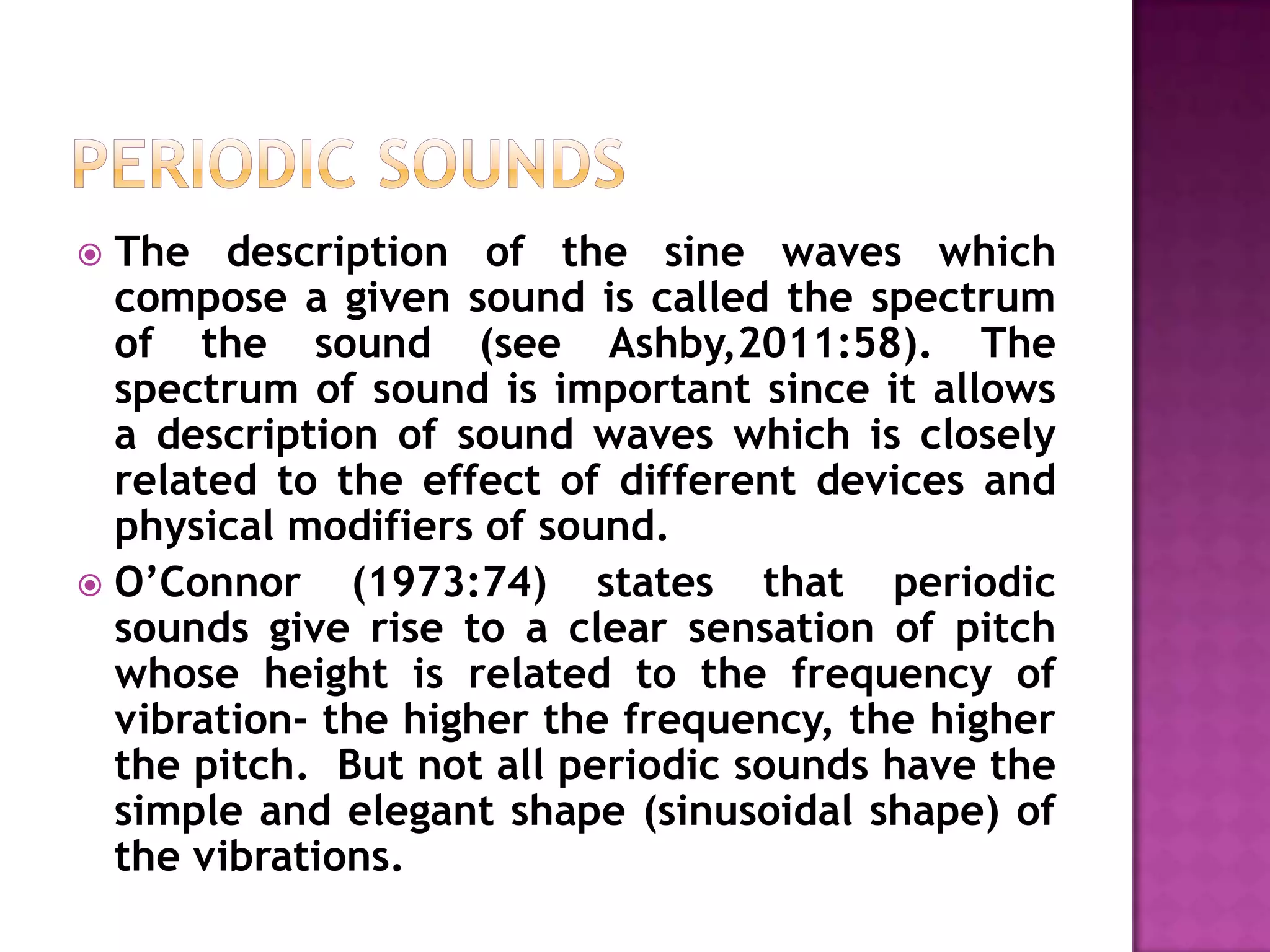
    These are not sinusoidal in shape and yet the
    remarkable thing about it is that it can be
    analyzed into a combination of two shapes
    which are sinusoidal. This is done by
    measuring the separate amplitudes at equal
    interval of time along the horizontal axis
    adding the amplitude values together
    whenever both are on the same side. The
    more complex the periodic shapes , the more
    sinusoidal components will be needed to built
    it up. These sinusoidal components are known
    as the harmonies of that sound. The higher
    harmonies are always simple multiples of the
    lowest harmonic which is known as the
    fundamental frequency or simply fundamental.
 Two   quite distinct sounds may obviously
  have the same fundamental frequency but
  differ in quality, which in turn related to
  the harmonic structure of the sounds. We
  can therefore specify periodic sounds by
  stating the frequencies and amplitudes of
  the fundamental and whatever higher
  harmonics are present.
 No speech sounds are absolutely periodic,
  that is, perfectly from one cycle to the
  next, but some are so nearly periodic (e.g.
  vowel sounds) . The wave forms of spoken
  vowels are very complex.
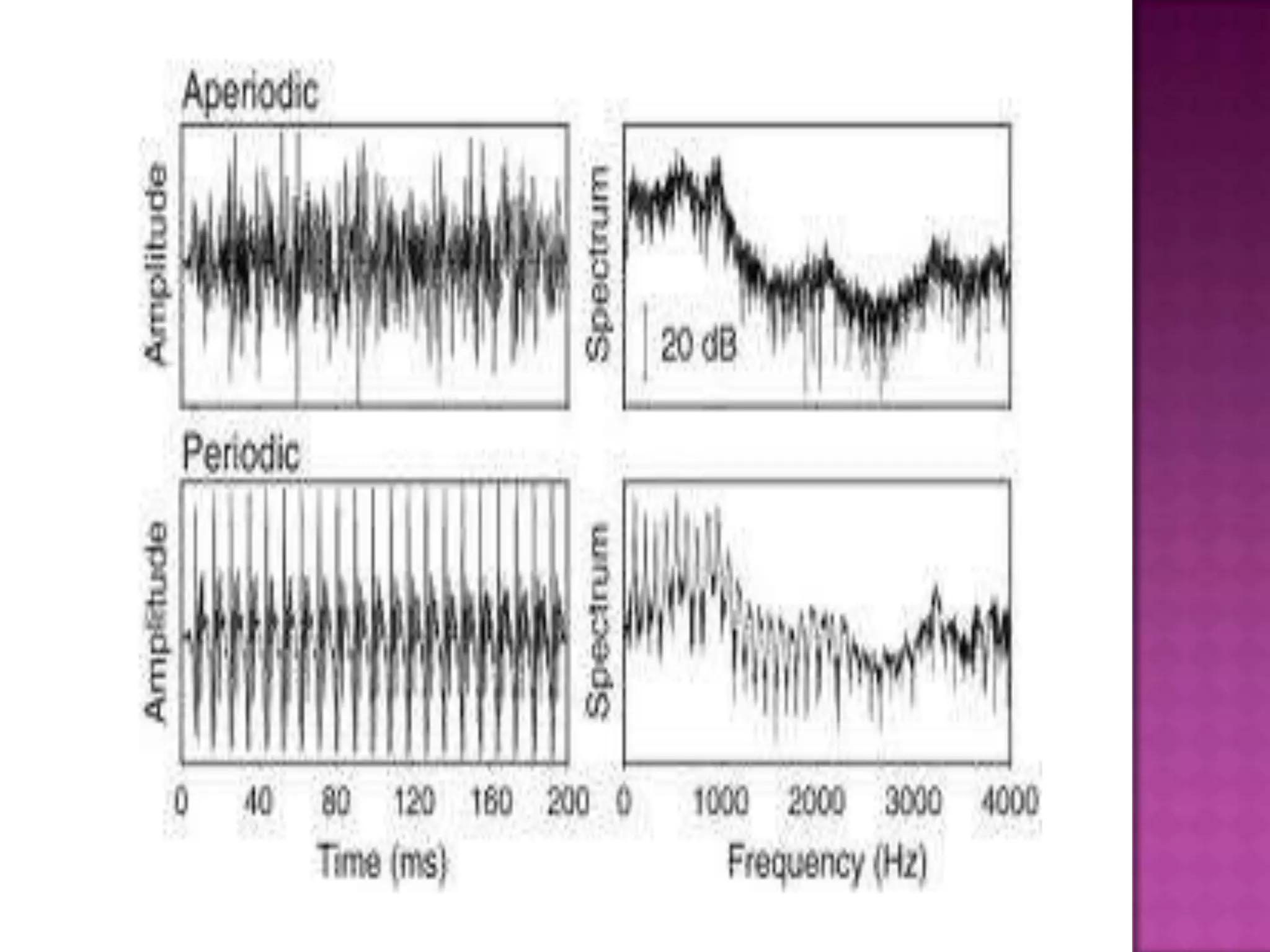
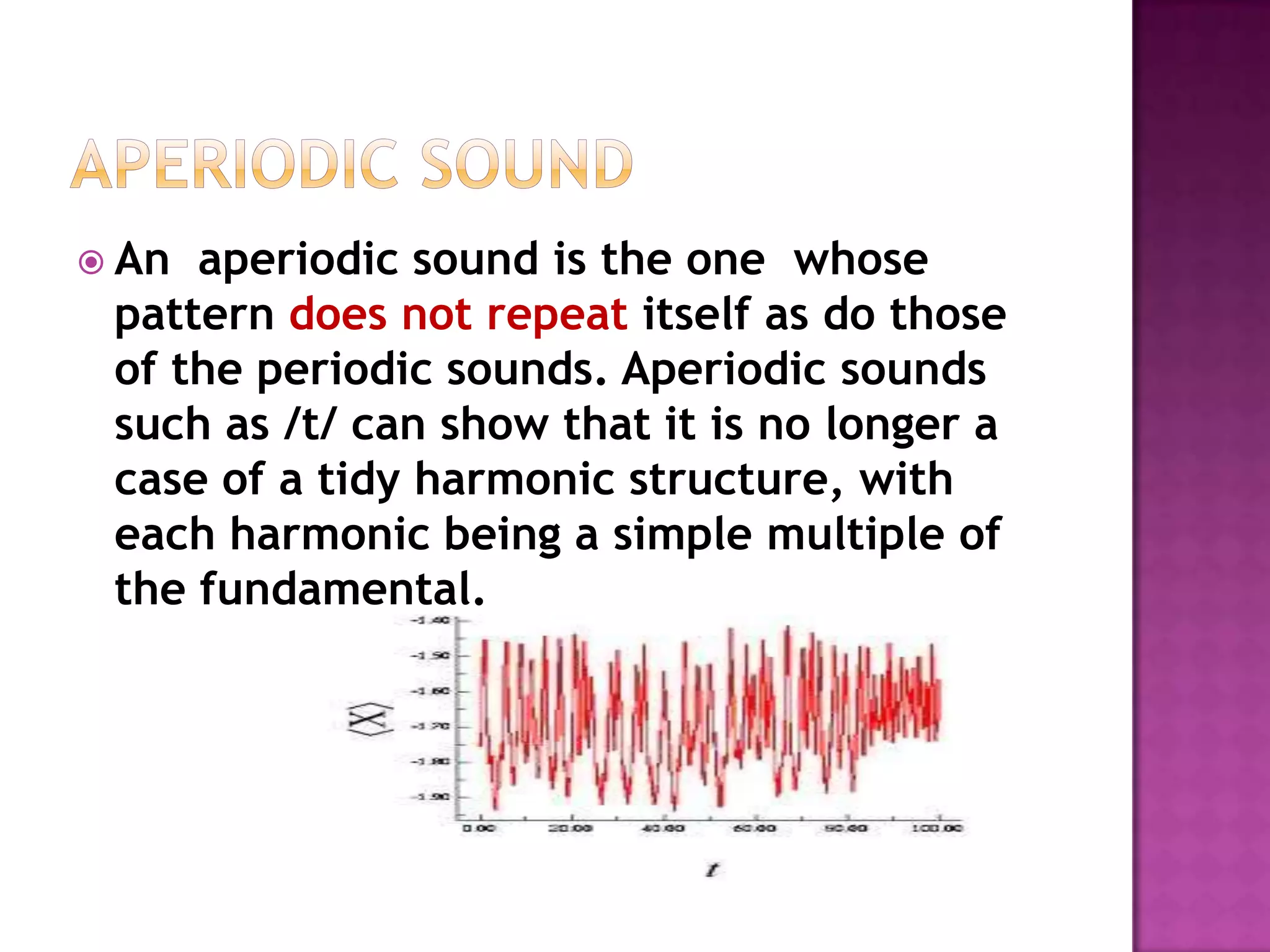
 An aperiodic sound is the one whose
 pattern does not repeat itself as do those
 of the periodic sounds. Aperiodic sounds
 such as /t/ can show that it is no longer a
 case of a tidy harmonic structure, with
 each harmonic being a simple multiple of
 the fundamental.
    for aperiodic sounds there is no fundamental ,
    no harmonics; on the contrary , noise is going
    on at every frequency , which is why we do
    not perceive any clear pitch for such sounds as
    for these periodic ones.       The spectra of
    aperiodic sounds cannot therefore be a series
    of vertical lines representing the frequencies
    and amplitudes of the separate harmonics; it
    must be a continuous line with these
    differences in the amplitude profile over the
    frequency range which enables us to
    distinguish one aperiodic sound from another.
    Also , the same aperiodic sound can be of
    different spectra (see O’Connor ,1973:78f).
Periodic and aperiodic sounds (2)

Periodic and aperiodic sounds (2)

  • 2.
    Sound is created by a disturbance travelling in an elastic medium like air and water. For instance, when an excess pressure is produced on some region of the air, that region tends to expand towards the neighbouring zones. This, in turn, compresses those zones, creating a new excess pressure which will tend to expand next, and, again, a new excess pressure is further created. The pressure disturbance will thus propagate through the air, and eventually it will reach some receiver (for instance a microphone or an ear). Excess pressure is called sound pressure(see Ladefoged,1996:3f).
  • 3.
     This kind of movement in which it is not the medium itself but some disturbance what is travelling, is called a wave. There are many other types of waves, such as radio waves, light, heat radiation, the ripples on the surface of a lake, earthquakes, etc. When the wave takes place in a liquid or gaseous medium (except surface waves), the wave is called an acoustic wave. When a wave is audible, it is called a sound wave.
  • 4.
    most waves are the result of many successive disturbances of the medium, instead of only one. When those disturbances are generated at regular intervals and are all the same shape we are in the presence of a periodic wave, and the number of disturbances per unit time is called the frequency of the wave. It is expressed in a unit called Hertz (Hz), meaning cycles per second (a cycle is all that happens in between a disturbance). In the case of sound waves, frequency is between 20 Hz and 20,000 Hz.
  • 5.
     Acoustic wavesof frequency smaller than 20 Hz are called infrasounds, and those of frequency greater than 20,000 Hz are called ultrasounds. Neither of them can ordinarily been heard by humans. Several animals (such as the dog, for instance) can hear very low frequency sounds, such as those created by ground waves during an earthquake.
  • 6.
    Even if there are many sounds which are nearly periodic, such as those sounds produced by pitched musical instruments, the vast majority of sounds in Nature are aperiodic, that is, successive disturbances are not equally spaced in time, and are not of constant shape either. This is what in a technical sense is called noise. Aperiodic waves usually cannot convey the sensation of pitch. Some examples are the consonants of speech, urban noise, the noise of the wind and the sea, and the sound of many percussive instruments such as drums, charlestons, etc. 
  • 7.
    PERIOD (n.) A term derived from the study of the physics of sound, and used in acoustic phonetics, referring to the time it takes for a cycle of pressure variation in a sound wave to repeat itself regularly over and over. The shorter the period, the more cycles there will be in a given unit of time, and thus the higher the frequency. Waveforms which show a repeating pattern of vibration are periodic waves; those which do not are aperiodic. Speech makes use of both types of waveform: vowel sounds have periodic waveforms; fricatives, for example, involve aperiodic waveforms. Crystal(2008:357)
  • 9.
     Speech communication involves both periodic and aperiodic sounds which are characterized, respectively, by the presence and the absence of the periodic acoustical excitation produced by the vibration of the vocal folds in the human larynx. Depending on the vocal fold function, the degree of periodicity may vary even within speech sounds belonging to the same phonemic category.
  • 10.
    Many speech sounds, such as vowels, that typically occur in periodic forms can also be produced without periodic vibration of the vocal folds (e.g., in whispered speech). The degree of periodicity also varies in vowels of natural speech due to aspiration noise and the irregular oscillation of the vocal folds that takes place, for example, in the production of creaky voices. In addition, the degree of sound periodicity allows linguistic differentiation between certain consonant sounds (such as distinguishing the unvoiced /s/ from the voiced /z/). Thus, periodicity is an inherent feature in speech communication and it affects both the phonemic identity and the quality of speech sounds.
  • 11.
     The descriptionof the sine waves which compose a given sound is called the spectrum of the sound (see Ashby,2011:58). The spectrum of sound is important since it allows a description of sound waves which is closely related to the effect of different devices and physical modifiers of sound.  O’Connor (1973:74) states that periodic sounds give rise to a clear sensation of pitch whose height is related to the frequency of vibration- the higher the frequency, the higher the pitch. But not all periodic sounds have the simple and elegant shape (sinusoidal shape) of the vibrations.
  • 13.
    These are not sinusoidal in shape and yet the remarkable thing about it is that it can be analyzed into a combination of two shapes which are sinusoidal. This is done by measuring the separate amplitudes at equal interval of time along the horizontal axis adding the amplitude values together whenever both are on the same side. The more complex the periodic shapes , the more sinusoidal components will be needed to built it up. These sinusoidal components are known as the harmonies of that sound. The higher harmonies are always simple multiples of the lowest harmonic which is known as the fundamental frequency or simply fundamental.
  • 14.
     Two quite distinct sounds may obviously have the same fundamental frequency but differ in quality, which in turn related to the harmonic structure of the sounds. We can therefore specify periodic sounds by stating the frequencies and amplitudes of the fundamental and whatever higher harmonics are present.  No speech sounds are absolutely periodic, that is, perfectly from one cycle to the next, but some are so nearly periodic (e.g. vowel sounds) . The wave forms of spoken vowels are very complex.
  • 16.
     An aperiodicsound is the one whose pattern does not repeat itself as do those of the periodic sounds. Aperiodic sounds such as /t/ can show that it is no longer a case of a tidy harmonic structure, with each harmonic being a simple multiple of the fundamental.
  • 17.
    for aperiodic sounds there is no fundamental , no harmonics; on the contrary , noise is going on at every frequency , which is why we do not perceive any clear pitch for such sounds as for these periodic ones. The spectra of aperiodic sounds cannot therefore be a series of vertical lines representing the frequencies and amplitudes of the separate harmonics; it must be a continuous line with these differences in the amplitude profile over the frequency range which enables us to distinguish one aperiodic sound from another. Also , the same aperiodic sound can be of different spectra (see O’Connor ,1973:78f).