5
Camera Framing
& Movement
Video Study 1: Zooming and Handheld Camera
•Barry Lyndon – Zoom
•Handheld 1 – Blair witch hunt
•Golden Rule – Camera should be on a tripod unless there is a reason
for it not to be
•Editing – Great Expectations
Video Study 2: Goodfellas in production
Slomo
Freezeframe
Handheld camera
Some improvisation around script
Epic steadicam tracking shot (Entrance to nightclub)
Slow motion tracking shot (Jimmy Conway decides to murder)
Jump-cutting at wedding
Panning at wedding
Creating drug-induced confusion
Video Study 3: The Trombone Shot (dolly zoom)
•Zooming in from a distance will ‘flatten’ the field of view
•Zooming while tracking will keep the foreground subject a uniform size
while the background subject will appear to grow
Video Study 4:
Camera Framing
Camera Movement
Tracking
Crane Shot
Camera framing in The Third Man
Camera Movement in The Untouchables (Panning|Crane)
Tracking Shot (Klute)
Crane Shot/God Shot (Citizen Kane|Halloween|Raising Arizona|
Highlander|Origins)
Video Study 5: The Steadicam
Summary: camera & movement
Techniques
•Handheld camera
•Steadicam
•Tracking & Dolly Shot
•Panning & tilting
•Trombone shot (dolly zoom)
•Crane shot (God Shot)
•Low angle/high angle
•Arc shot & bullet time
•Framing Terminology: POV, OTS, ECU, ELS, Establishing Shot, etc
•Depth of field
•180 degree rule
Framing
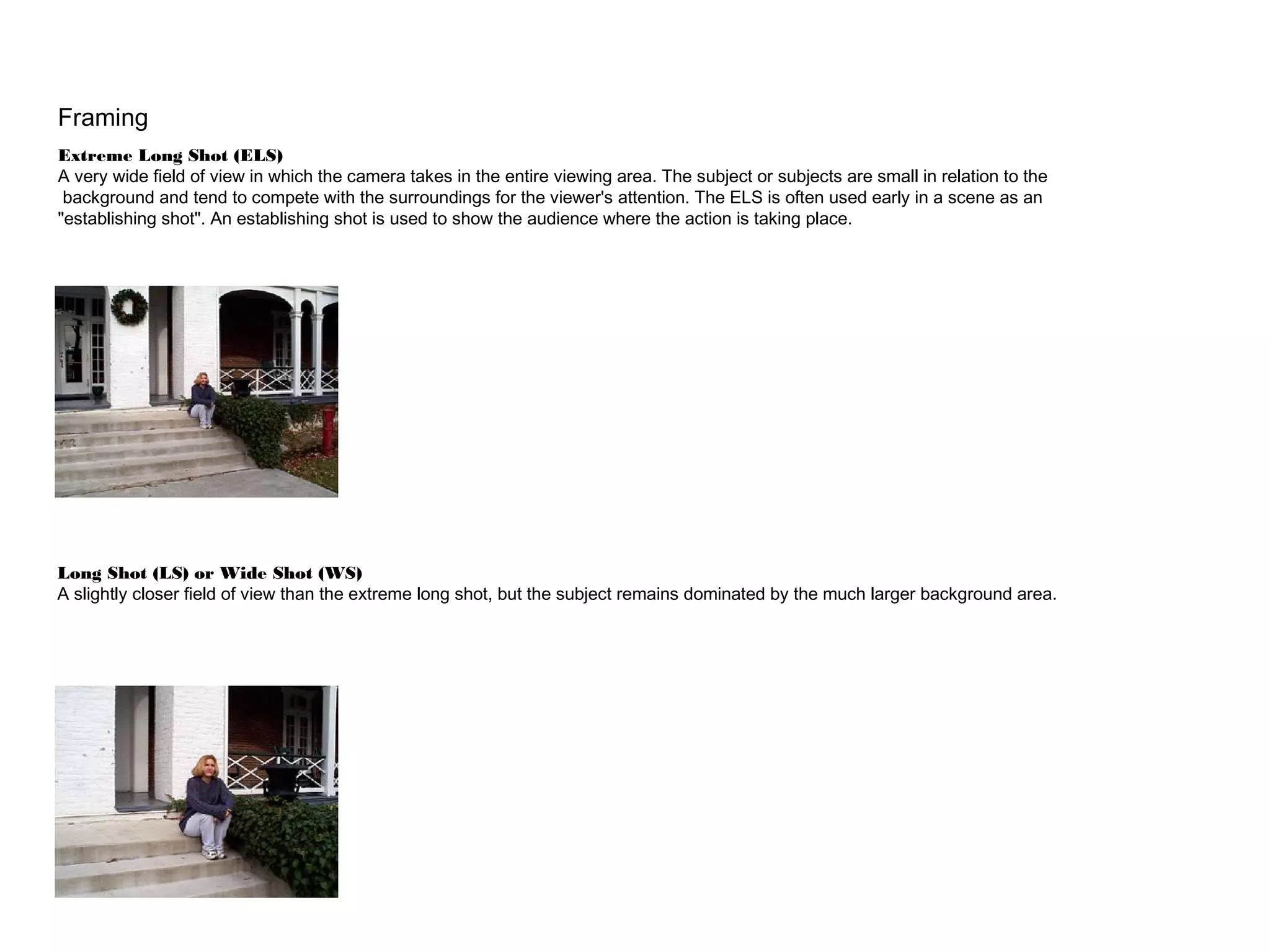
Extreme Long Shot (ELS)
A very wide field of view in which the camera takes in the entire viewing area. The subject or subjects are small in relation to the
background and tend to compete with the surroundings for the viewer's attention. The ELS is often used early in a scene as an
"establishing shot". An establishing shot is used to show the audience where the action is taking place.
Long Shot (LS) or Wide Shot (WS)
A slightly closer field of view than the extreme long shot, but the subject remains dominated by the much larger background area.
Medium Shot (MS)
The subject becomes larger and more dominant. The background is still important but now shares space with the subject.
Close-up (CU)
The subject becomes the primary focus within the shot. Only a small portion of the background is visible.
Extreme Close-up (ECU)
The subject fills the screen and is clearly the central focus of the shot.

5 camera framing and movement

  • 1.
  • 2.
    Video Study 1:Zooming and Handheld Camera
  • 3.
    •Barry Lyndon –Zoom •Handheld 1 – Blair witch hunt •Golden Rule – Camera should be on a tripod unless there is a reason for it not to be •Editing – Great Expectations
  • 4.
    Video Study 2:Goodfellas in production
  • 5.
    Slomo Freezeframe Handheld camera Some improvisationaround script Epic steadicam tracking shot (Entrance to nightclub) Slow motion tracking shot (Jimmy Conway decides to murder) Jump-cutting at wedding Panning at wedding Creating drug-induced confusion
  • 6.
    Video Study 3:The Trombone Shot (dolly zoom)
  • 7.
    •Zooming in froma distance will ‘flatten’ the field of view •Zooming while tracking will keep the foreground subject a uniform size while the background subject will appear to grow
  • 8.
    Video Study 4: CameraFraming Camera Movement Tracking Crane Shot
  • 9.
    Camera framing inThe Third Man Camera Movement in The Untouchables (Panning|Crane) Tracking Shot (Klute) Crane Shot/God Shot (Citizen Kane|Halloween|Raising Arizona| Highlander|Origins)
  • 10.
    Video Study 5:The Steadicam
  • 11.
    Summary: camera &movement Techniques •Handheld camera •Steadicam •Tracking & Dolly Shot •Panning & tilting •Trombone shot (dolly zoom) •Crane shot (God Shot) •Low angle/high angle •Arc shot & bullet time •Framing Terminology: POV, OTS, ECU, ELS, Establishing Shot, etc •Depth of field •180 degree rule
  • 12.
    Framing Extreme Long Shot(ELS) A very wide field of view in which the camera takes in the entire viewing area. The subject or subjects are small in relation to the background and tend to compete with the surroundings for the viewer's attention. The ELS is often used early in a scene as an "establishing shot". An establishing shot is used to show the audience where the action is taking place. Long Shot (LS) or Wide Shot (WS) A slightly closer field of view than the extreme long shot, but the subject remains dominated by the much larger background area.
  • 13.
    Medium Shot (MS) Thesubject becomes larger and more dominant. The background is still important but now shares space with the subject. Close-up (CU) The subject becomes the primary focus within the shot. Only a small portion of the background is visible.
  • 14.
    Extreme Close-up (ECU) Thesubject fills the screen and is clearly the central focus of the shot.