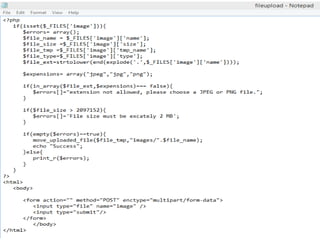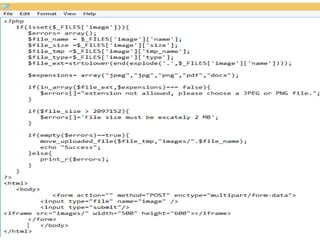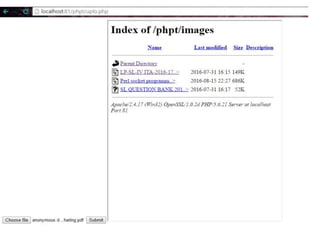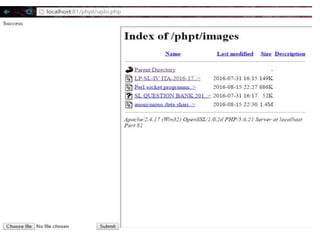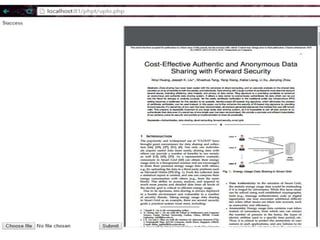

FILE UPLOADING
BY
SANA MATEEN
INTRODUCTION
• It’s actually possible to transfer of any kind of file via
HTTP, including Microsoft Office documents, PDFs,
executables, MPEGs, ZIP files, and a wide range of
other file types.
• Although FTP historically has been the standard
means for uploading files to a server, file transfers are
becoming increasingly prevalent via a web-based
interface
• PHP’s file upload configuration directives
• PHP’s $_FILES superglobal array, used to handle
file-upload data
• PHP’s built-in file-upload functions:
is_uploaded_file() and
move_uploaded_file()
• A review of possible error messages returned from
an upload script
• An overview of the HTTP_Upload PEAR package
Uploading Files via HTTP
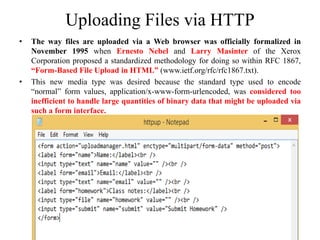
• The way files are uploaded via a Web browser was officially formalized in
November 1995 when Ernesto Nebel and Larry Masinter of the Xerox
Corporation proposed a standardized methodology for doing so within RFC 1867,
“Form-Based File Upload in HTML” (www.ietf.org/rfc/rfc1867.txt).
• This new media type was desired because the standard type used to encode
“normal” form values, application/x-www-form-urlencoded, was considered too
inefficient to handle large quantities of binary data that might be uploaded via
such a form interface.
Uploading Files with PHP
• Successfully managing file uploads via PHP is the result of cooperation between various
configuration directives, the $_FILES superglobal, and a properly coded web form.
• PHP’s File Upload/Resource Directives
• Several configuration directives are available for fine-tuning PHP’s file-upload capabilities.
These directives determine whether PHP’s file-upload support is enabled, as well as the
maximum allowable uploadable file size, the maximum allowable script memory allocation,
and various other important resource benchmarks.
• file_uploads = On | Off
• Scope: PHP_INI_SYSTEM; Default value: On
• The file_uploads directive determines whether PHP scripts on the server can accept file
uploads.
• max_input_time = integer
• Scope: PHP_INI_ALL; Default value: 60
• The max_input_time directive determines the maximum amount of time, in seconds, that a
PHP script will spend attempting to parse input before registering a fatal error. This is relevant
because particularly large files can take some time to upload.
• Note that if you create an upload feature which handles large documents or high resolution
photos, you may need to increase the limit set by this directive accordingly.
• max_file_uploads = integer
• Scope: PHP_INI_SYSTEM; Default value: 20
• Available since PHP 5.2.12, the max_file_uploads directive sets an upper limit on the number
of files which can be simultaneously uploaded.
• memory_limit = integerM
• Scope: PHP_INI_ALL; Default value: 16M
• The memory_limit directive sets a maximum allowable amount of memory in megabytes that
a script can allocate (note that the integer value must be followed by M for this setting to
work properly).
• It prevents runaway scripts from monopolizing server memory and even crashing the
server in certain situations.
• post_max_size = integerM
• Scope: PHP_INI_PERDIR; Default value: 8M
• The post_max_size places an upper limit on the size of data submitted via the POST method.
• Because files are uploaded using POST, you may need to adjust this setting upwards along
with upload_max_filesize when working with larger files.
• upload_max_filesize = integerM
• Scope: PHP_INI_PERDIR; Default value: 2M
• The upload_max_filesize directive determines the maximum size in megabytes of an
uploaded file.
• This directive should be smaller than post_max_size because it applies only to information
passed via the file input type and not to all information passed via the POST instance. Like
memory_limit, note that M must follow the integer value.
• upload_tmp_dir = string
• Scope: PHP_INI_SYSTEM; Default value: NULL
• Because an uploaded file must be successfully transferred to the server before subsequent
• processing on that file can begin, a staging area of sorts must be designated for such files
where they can be temporarily placed until they are moved to their final location. This staging
location is specified using the upload_tmp_dir directive. For example, suppose you want to
temporarily store uploaded files in the /tmp/phpuploads/ directory. You would use the
following:
• upload_tmp_dir = "/tmp/phpuploads/"
• Keep in mind that this directory must be writable by the user owning the server process.
The $_FILES Array
• The $_FILES superglobal stores a variety of information pertinent to a file uploaded to the
server via a PHP script. In total, five items are available in this array, each of which is
introduced here:
• Note Each of the array elements introduced in this section makes reference to userfile.
This term is simply a placeholder for the name assigned to the file-upload form element. You
will probably change this name in accordance with your chosen name assignment.
• $_FILES['userfile']['error']: This array value offers important information pertinent to
the outcome of the upload attempt. In total, five return values are possible: one signifying a
successful outcome and four others denoting specific errors that arise from the attempt.
• $_FILES['userfile']['name']: This variable specifies the original name of the file,
including the extension, as declared on the client machine. Therefore, if you browse to a
file named vacation.png and upload it via the form, this variable will be assigned the value
vacation.png.
• $_FILES['userfile']['size']: This variable specifies the size, in bytes, of the file uploaded
from the client machine. For example, in the case of the vacation.png file, this variable
could plausibly be assigned a value such as 5253, or roughly 5KB.
PHP’s File-Upload Functions
• In addition to the number of file-handling functions made available via PHP’s file
system library PHP offers two functions specifically intended to aid in the
fileupload
• process, is_uploaded_file() and move_uploaded_file().
$_FILES['userfile']['tmp_name']: This variable specifies the temporary name assigned
to the file once it has been uploaded to the server. This is the name of the file assigned to
it while stored in the temporary directory (specified by the PHP directive
upload_tmp_dir).
$_FILES['userfile']['type']: This variable specifies the MIME type of the file uploaded
from the client machine. Therefore, in the case of the vacation.png image file, this
variable would be assigned the value image/png. If a PDF was uploaded, the value
application/pdf would be assigned. Because this variable sometimes produces unexpected
results, you should explicitly verify it yourself from within the script.
Determining Whether a File Was Uploaded
• The is_uploaded_file() function determines whether a file specified by the input parameter
filename is uploaded using the POST method. Its prototype follows:
• boolean is_uploaded_file(string filename)
• This function is intended to prevent a potential attacker from manipulating files not intended
for interaction via the script in question. For example, consider a scenario in which uploaded
files are made immediately available for viewing via a public site repository. Say an attacker
wants to make a file somewhat juicier than the boring old class notes available for his perusal,
say /etc/passwd. Rather than navigate to a class notes file as would be expected, the attacker
instead types /etc/passwd directly into the form’s file-upload field.
• Now consider the following script:
• <?php
• copy($_FILES['classnotes']['tmp_name'],
• "/www/htdocs/classnotes/".basename($classnotes));
• ?>
• The result of this poorly written example would be that the /etc/passwd file is copied to a
publicly accessible directory. (Go ahead, try it. Scary, isn’t it?) To avoid such a problem, use
the is_uploaded_file() function to ensure that the file denoted by the form field (in this case,
classnotes) is indeed a file that has been uploaded via the form.
• Here’s an improved and revised version of the previous example:
• <?php
• if (is_uploaded_file($_FILES['classnotes']['tmp_name'])) {
• copy($_FILES['classnotes']['tmp_name'],
• "/www/htdocs/classnotes/".$_FILES['classnotes']['name']);
• } else {
• echo "<p>Potential script abuse attempt detected.</p>";
• }
• ?>
• In the revised script, is_uploaded_file() checks whether the file denoted by
• $_FILES['classnotes']['tmp_name'] has indeed been uploaded. If the answer is yes,
the file is copied to
• the desired destination. Otherwise, an error message is displayed.
Moving an Uploaded File
• The move_uploaded_file() function provides a convenient means for moving an
uploaded file from the temporary directory to a final location. Its prototype follows:
• boolean move_uploaded_file(string filename, string destination)
• Although copy() works equally well, move_uploaded_file() offers one additional
feature: it will check to ensure that the file denoted by the filename input parameter
was in fact uploaded via PHP’s HTTP POST upload mechanism. If the file has not
been uploaded, the move will fail and a FALSE value will be returned. Because of
this, you can forgo using is_uploaded_file() as a precursor condition to using
move_uploaded_file().
• Using move_uploaded_file() is simple. Consider a scenario in which you want to
move the uploaded class notes file to the directory /www/htdocs/classnotes/ while
also preserving the file name as specified on the client:
• move_uploaded_file($_FILES['classnotes']['tmp_name'],"/www/htdocs/classnotes/"
.$_FILES['classnotes']['name']);
• Of course, you can rename the file to anything you wish after it’s been moved. It’s
important, however, that you properly reference the file’s temporary name within
the first parameter.
Upload Error Messages
• How do you know with certainty that the file-upload procedure was successful? And if
something goes awry during the upload process, how do you know what caused the error?
Happily, sufficient information for determining the outcome (and in the case of an error, the
reason for the error) is provided in $_FILES['userfile']['error']:
• UPLOAD_ERR_OK: A value of 0 is returned if the upload is successful.
• UPLOAD_ERR_INI_SIZE: A value of 1 is returned if there is an attempt to upload a file
whose size exceeds the value specified by the upload_max_filesize directive.
• UPLOAD_ERR_FORM_SIZE: A value of 2 is returned if there is an attempt to upload a
file whose size exceeds the value of the max_file_size directive, which can be embedded into
the HTML form
• UPLOAD_ERR_PARTIAL: A value of 3 is returned if a file is not completely uploaded.
• This might happen if a network error causes a disruption of the upload process.
• UPLOAD_ERR_NO_FILE: A value of 4 is returned if the user submits the form without
specifying a file for upload.
• UPLOAD_ERR_NO_TMP_DIR: A value of 6 is returned if the temporary directory does
not exist.
• UPLOAD_ERR_CANT_WRITE: Introduced in PHP 5.1.0, a value of 7 is returned if the
file can’t be written to the disk.
• UPLOAD_ERR_EXTENSION: Introduced in PHP 5.2.0, a value of 8 is returned if an issue
with PHP’s configuration caused the upload to fail.
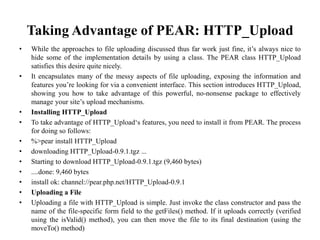
Taking Advantage of PEAR: HTTP_Upload
• While the approaches to file uploading discussed thus far work just fine, it’s always nice to
hide some of the implementation details by using a class. The PEAR class HTTP_Upload
satisfies this desire quite nicely.
• It encapsulates many of the messy aspects of file uploading, exposing the information and
features you’re looking for via a convenient interface. This section introduces HTTP_Upload,
showing you how to take advantage of this powerful, no-nonsense package to effectively
manage your site’s upload mechanisms.
• Installing HTTP_Upload
• To take advantage of HTTP_Upload‘s features, you need to install it from PEAR. The process
for doing so follows:
• %>pear install HTTP_Upload
• downloading HTTP_Upload-0.9.1.tgz ...
• Starting to download HTTP_Upload-0.9.1.tgz (9,460 bytes)
• ....done: 9,460 bytes
• install ok: channel://pear.php.net/HTTP_Upload-0.9.1
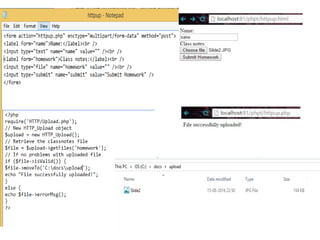
• Uploading a File
• Uploading a file with HTTP_Upload is simple. Just invoke the class constructor and pass the
name of the file-specific form field to the getFiles() method. If it uploads correctly (verified
using the isValid() method), you can then move the file to its final destination (using the
moveTo() method)
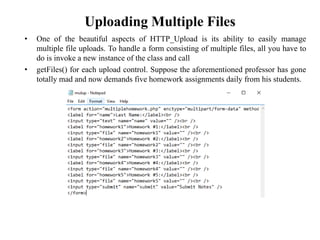
Uploading Multiple Files
• One of the beautiful aspects of HTTP_Upload is its ability to easily manage
multiple file uploads. To handle a form consisting of multiple files, all you have to
do is invoke a new instance of the class and call
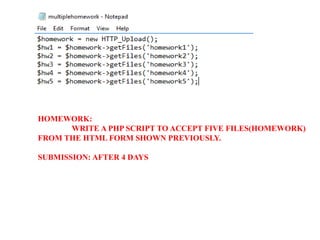
• getFiles() for each upload control. Suppose the aforementioned professor has gone
totally mad and now demands five homework assignments daily from his students.
HOMEWORK:
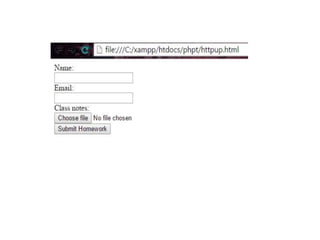
WRITE A PHP SCRIPT TO ACCEPT FIVE FILES(HOMEWORK)
FROM THE HTML FORM SHOWN PREVIOUSLY.
SUBMISSION: AFTER 4 DAYS

File upload php

  • 1.
  • 2.
    INTRODUCTION • It’s actuallypossible to transfer of any kind of file via HTTP, including Microsoft Office documents, PDFs, executables, MPEGs, ZIP files, and a wide range of other file types. • Although FTP historically has been the standard means for uploading files to a server, file transfers are becoming increasingly prevalent via a web-based interface • PHP’s file upload configuration directives • PHP’s $_FILES superglobal array, used to handle file-upload data • PHP’s built-in file-upload functions: is_uploaded_file() and move_uploaded_file() • A review of possible error messages returned from an upload script • An overview of the HTTP_Upload PEAR package
  • 3.
    Uploading Files viaHTTP • The way files are uploaded via a Web browser was officially formalized in November 1995 when Ernesto Nebel and Larry Masinter of the Xerox Corporation proposed a standardized methodology for doing so within RFC 1867, “Form-Based File Upload in HTML” (www.ietf.org/rfc/rfc1867.txt). • This new media type was desired because the standard type used to encode “normal” form values, application/x-www-form-urlencoded, was considered too inefficient to handle large quantities of binary data that might be uploaded via such a form interface.
  • 5.
    Uploading Files withPHP • Successfully managing file uploads via PHP is the result of cooperation between various configuration directives, the $_FILES superglobal, and a properly coded web form. • PHP’s File Upload/Resource Directives • Several configuration directives are available for fine-tuning PHP’s file-upload capabilities. These directives determine whether PHP’s file-upload support is enabled, as well as the maximum allowable uploadable file size, the maximum allowable script memory allocation, and various other important resource benchmarks. • file_uploads = On | Off • Scope: PHP_INI_SYSTEM; Default value: On • The file_uploads directive determines whether PHP scripts on the server can accept file uploads. • max_input_time = integer • Scope: PHP_INI_ALL; Default value: 60 • The max_input_time directive determines the maximum amount of time, in seconds, that a PHP script will spend attempting to parse input before registering a fatal error. This is relevant because particularly large files can take some time to upload.
  • 6.
    • Note thatif you create an upload feature which handles large documents or high resolution photos, you may need to increase the limit set by this directive accordingly. • max_file_uploads = integer • Scope: PHP_INI_SYSTEM; Default value: 20 • Available since PHP 5.2.12, the max_file_uploads directive sets an upper limit on the number of files which can be simultaneously uploaded. • memory_limit = integerM • Scope: PHP_INI_ALL; Default value: 16M • The memory_limit directive sets a maximum allowable amount of memory in megabytes that a script can allocate (note that the integer value must be followed by M for this setting to work properly). • It prevents runaway scripts from monopolizing server memory and even crashing the server in certain situations. • post_max_size = integerM • Scope: PHP_INI_PERDIR; Default value: 8M • The post_max_size places an upper limit on the size of data submitted via the POST method. • Because files are uploaded using POST, you may need to adjust this setting upwards along with upload_max_filesize when working with larger files.
  • 7.
    • upload_max_filesize =integerM • Scope: PHP_INI_PERDIR; Default value: 2M • The upload_max_filesize directive determines the maximum size in megabytes of an uploaded file. • This directive should be smaller than post_max_size because it applies only to information passed via the file input type and not to all information passed via the POST instance. Like memory_limit, note that M must follow the integer value. • upload_tmp_dir = string • Scope: PHP_INI_SYSTEM; Default value: NULL • Because an uploaded file must be successfully transferred to the server before subsequent • processing on that file can begin, a staging area of sorts must be designated for such files where they can be temporarily placed until they are moved to their final location. This staging location is specified using the upload_tmp_dir directive. For example, suppose you want to temporarily store uploaded files in the /tmp/phpuploads/ directory. You would use the following: • upload_tmp_dir = "/tmp/phpuploads/" • Keep in mind that this directory must be writable by the user owning the server process.
  • 8.
    The $_FILES Array •The $_FILES superglobal stores a variety of information pertinent to a file uploaded to the server via a PHP script. In total, five items are available in this array, each of which is introduced here: • Note Each of the array elements introduced in this section makes reference to userfile. This term is simply a placeholder for the name assigned to the file-upload form element. You will probably change this name in accordance with your chosen name assignment. • $_FILES['userfile']['error']: This array value offers important information pertinent to the outcome of the upload attempt. In total, five return values are possible: one signifying a successful outcome and four others denoting specific errors that arise from the attempt. • $_FILES['userfile']['name']: This variable specifies the original name of the file, including the extension, as declared on the client machine. Therefore, if you browse to a file named vacation.png and upload it via the form, this variable will be assigned the value vacation.png. • $_FILES['userfile']['size']: This variable specifies the size, in bytes, of the file uploaded from the client machine. For example, in the case of the vacation.png file, this variable could plausibly be assigned a value such as 5253, or roughly 5KB.
  • 9.
    PHP’s File-Upload Functions •In addition to the number of file-handling functions made available via PHP’s file system library PHP offers two functions specifically intended to aid in the fileupload • process, is_uploaded_file() and move_uploaded_file(). $_FILES['userfile']['tmp_name']: This variable specifies the temporary name assigned to the file once it has been uploaded to the server. This is the name of the file assigned to it while stored in the temporary directory (specified by the PHP directive upload_tmp_dir). $_FILES['userfile']['type']: This variable specifies the MIME type of the file uploaded from the client machine. Therefore, in the case of the vacation.png image file, this variable would be assigned the value image/png. If a PDF was uploaded, the value application/pdf would be assigned. Because this variable sometimes produces unexpected results, you should explicitly verify it yourself from within the script.
  • 10.
    Determining Whether aFile Was Uploaded • The is_uploaded_file() function determines whether a file specified by the input parameter filename is uploaded using the POST method. Its prototype follows: • boolean is_uploaded_file(string filename) • This function is intended to prevent a potential attacker from manipulating files not intended for interaction via the script in question. For example, consider a scenario in which uploaded files are made immediately available for viewing via a public site repository. Say an attacker wants to make a file somewhat juicier than the boring old class notes available for his perusal, say /etc/passwd. Rather than navigate to a class notes file as would be expected, the attacker instead types /etc/passwd directly into the form’s file-upload field. • Now consider the following script: • <?php • copy($_FILES['classnotes']['tmp_name'], • "/www/htdocs/classnotes/".basename($classnotes)); • ?> • The result of this poorly written example would be that the /etc/passwd file is copied to a publicly accessible directory. (Go ahead, try it. Scary, isn’t it?) To avoid such a problem, use the is_uploaded_file() function to ensure that the file denoted by the form field (in this case, classnotes) is indeed a file that has been uploaded via the form.
  • 11.
    • Here’s animproved and revised version of the previous example: • <?php • if (is_uploaded_file($_FILES['classnotes']['tmp_name'])) { • copy($_FILES['classnotes']['tmp_name'], • "/www/htdocs/classnotes/".$_FILES['classnotes']['name']); • } else { • echo "<p>Potential script abuse attempt detected.</p>"; • } • ?> • In the revised script, is_uploaded_file() checks whether the file denoted by • $_FILES['classnotes']['tmp_name'] has indeed been uploaded. If the answer is yes, the file is copied to • the desired destination. Otherwise, an error message is displayed.
  • 12.
    Moving an UploadedFile • The move_uploaded_file() function provides a convenient means for moving an uploaded file from the temporary directory to a final location. Its prototype follows: • boolean move_uploaded_file(string filename, string destination) • Although copy() works equally well, move_uploaded_file() offers one additional feature: it will check to ensure that the file denoted by the filename input parameter was in fact uploaded via PHP’s HTTP POST upload mechanism. If the file has not been uploaded, the move will fail and a FALSE value will be returned. Because of this, you can forgo using is_uploaded_file() as a precursor condition to using move_uploaded_file(). • Using move_uploaded_file() is simple. Consider a scenario in which you want to move the uploaded class notes file to the directory /www/htdocs/classnotes/ while also preserving the file name as specified on the client: • move_uploaded_file($_FILES['classnotes']['tmp_name'],"/www/htdocs/classnotes/" .$_FILES['classnotes']['name']); • Of course, you can rename the file to anything you wish after it’s been moved. It’s important, however, that you properly reference the file’s temporary name within the first parameter.
  • 13.
    Upload Error Messages •How do you know with certainty that the file-upload procedure was successful? And if something goes awry during the upload process, how do you know what caused the error? Happily, sufficient information for determining the outcome (and in the case of an error, the reason for the error) is provided in $_FILES['userfile']['error']: • UPLOAD_ERR_OK: A value of 0 is returned if the upload is successful. • UPLOAD_ERR_INI_SIZE: A value of 1 is returned if there is an attempt to upload a file whose size exceeds the value specified by the upload_max_filesize directive. • UPLOAD_ERR_FORM_SIZE: A value of 2 is returned if there is an attempt to upload a file whose size exceeds the value of the max_file_size directive, which can be embedded into the HTML form • UPLOAD_ERR_PARTIAL: A value of 3 is returned if a file is not completely uploaded. • This might happen if a network error causes a disruption of the upload process. • UPLOAD_ERR_NO_FILE: A value of 4 is returned if the user submits the form without specifying a file for upload. • UPLOAD_ERR_NO_TMP_DIR: A value of 6 is returned if the temporary directory does not exist. • UPLOAD_ERR_CANT_WRITE: Introduced in PHP 5.1.0, a value of 7 is returned if the file can’t be written to the disk. • UPLOAD_ERR_EXTENSION: Introduced in PHP 5.2.0, a value of 8 is returned if an issue with PHP’s configuration caused the upload to fail.
  • 20.
    Taking Advantage ofPEAR: HTTP_Upload • While the approaches to file uploading discussed thus far work just fine, it’s always nice to hide some of the implementation details by using a class. The PEAR class HTTP_Upload satisfies this desire quite nicely. • It encapsulates many of the messy aspects of file uploading, exposing the information and features you’re looking for via a convenient interface. This section introduces HTTP_Upload, showing you how to take advantage of this powerful, no-nonsense package to effectively manage your site’s upload mechanisms. • Installing HTTP_Upload • To take advantage of HTTP_Upload‘s features, you need to install it from PEAR. The process for doing so follows: • %>pear install HTTP_Upload • downloading HTTP_Upload-0.9.1.tgz ... • Starting to download HTTP_Upload-0.9.1.tgz (9,460 bytes) • ....done: 9,460 bytes • install ok: channel://pear.php.net/HTTP_Upload-0.9.1 • Uploading a File • Uploading a file with HTTP_Upload is simple. Just invoke the class constructor and pass the name of the file-specific form field to the getFiles() method. If it uploads correctly (verified using the isValid() method), you can then move the file to its final destination (using the moveTo() method)
  • 22.
    Uploading Multiple Files •One of the beautiful aspects of HTTP_Upload is its ability to easily manage multiple file uploads. To handle a form consisting of multiple files, all you have to do is invoke a new instance of the class and call • getFiles() for each upload control. Suppose the aforementioned professor has gone totally mad and now demands five homework assignments daily from his students.
  • 23.
    HOMEWORK: WRITE A PHPSCRIPT TO ACCEPT FIVE FILES(HOMEWORK) FROM THE HTML FORM SHOWN PREVIOUSLY. SUBMISSION: AFTER 4 DAYS