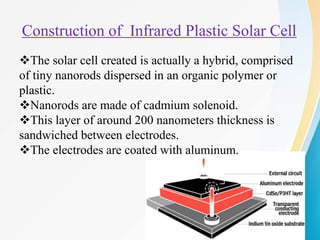
The document discusses infrared plastic solar cells. It describes the construction of these solar cells as a hybrid of tiny nanorods dispersed in an organic polymer or plastic layer only 200 nanometers thick sandwiched between electrodes. The nanorods are made of cadmium selenide and act as wires that absorb light and generate electrons and holes. Infrared plastic solar cells could harness invisible infrared light and be five times more efficient than traditional solar cells. They also work on cloudy days due to their ability to absorb infrared light. While costly now, infrared plastic solar cells show promise as a more compact and flexible alternative energy source.