Optical fiber communication
OPTICAL FIBER
COMMUNICATION
INTRODUCTION
BASIC COMMUNICATION SYSTEM
BLOCK DAIGRAM
ADVANTAGES
APPLICATIONS
OPTICAL WAVE GUIDES
MODES
SOURCE
DETECTOR
LOSSES IN FIBER
INTRODUCTION
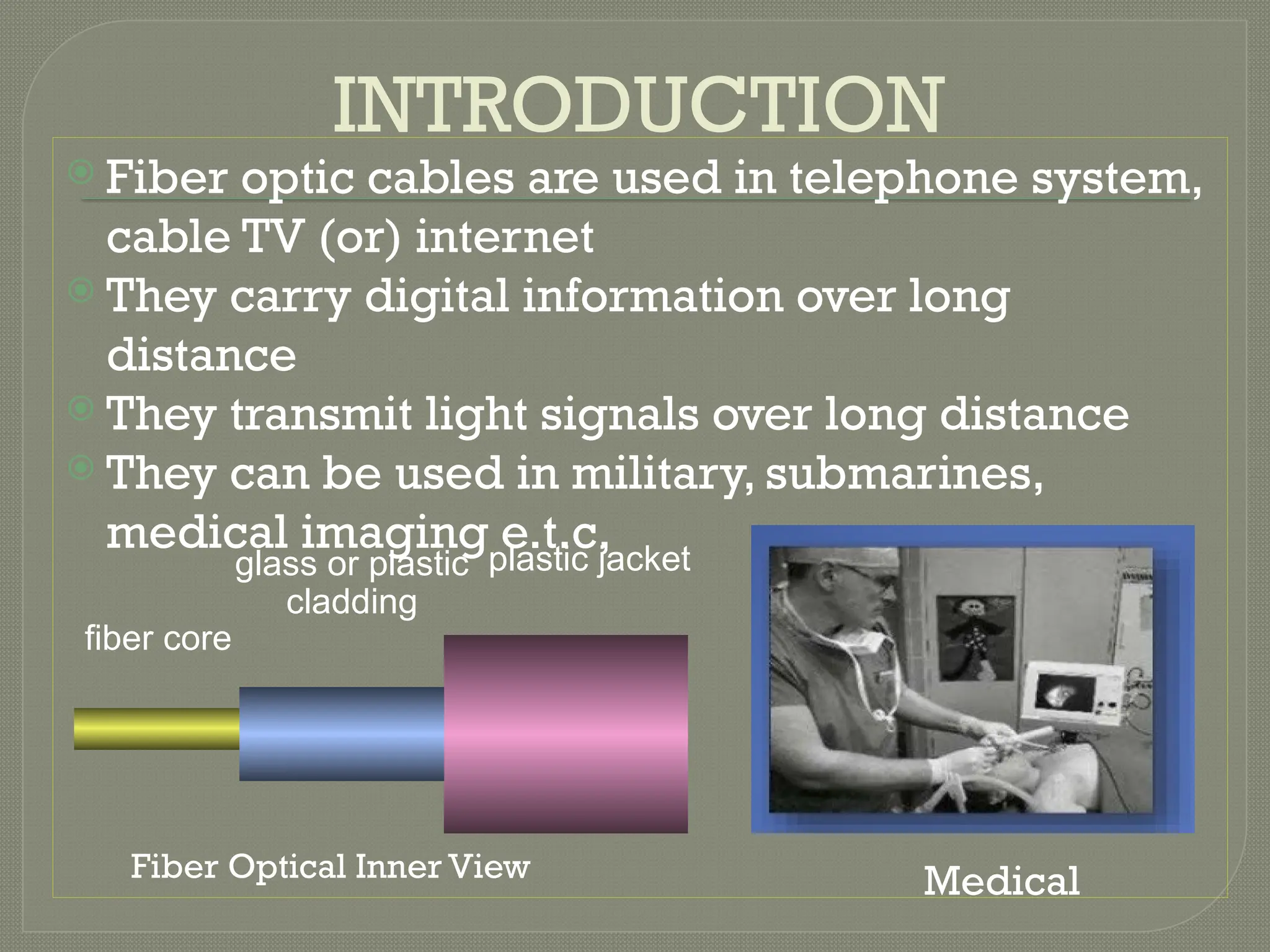
 Fiber optic cables are used in telephone system,
cable TV (or) internet
 They carry digital information over long
distance
 They transmit light signals over long distance
 They can be used in military, submarines,
medical imaging e.t.c,
plastic jacket
glass or plastic
cladding
fiber core
Medical
Fiber Optical Inner View
Working Principle of TIR
when a ray light travels from a denser to a rare medium such that the angle of incidence is greater than critical angle the ray reflects back in to the
same medium this phenomena is TIR
In optical fiber the ray undergo repeated total number of reflections until it emerges out of the other end of fiber ,even if fiber is bent.
military Electronics
Basic communication system
Transmitter: In this message is generated
an put in suitable form
Information channel: It is divided in two
categories (i)unguided(ii)guided
Receiver:The message is extracted from
the channel and put in final form.
Transmitter
Information
channel
receiver
Block diagram
 Message Origin: it is a transducer to convert
electrical message in to proper format.
 Modulator: it perform two functions(i) convert
electrical message to proper format(ii)it
impress the signal wave generated by source
 Carrier Oscillator: carrier wave produced by
electronic oscillator for fiber system i.e.
LD,LED.
Channel Coupler: In radio/TV it acts
like an antenna.
Information Channel: It is a path
between transmitter and receiver. It is
used to boost up the power level of
weak signal.
Detector: In this optic wave convert in
to electric current by photodiode.
Signal Processing: In this two types of
circuits are used (i)Amplifier (ii)Filter
Advantages
Less expensive
Thinner
High carrying capacity
Less signal degration
Light signal
Non-flammable
Flexible
Medical imaging
Light weight
Applications
 Telephone applications are wide spread ranging from
global n/w to desktop computer
 It involves transmission of voice ,data (or) video over
distances of less than a meter tom 100km.
 POTS(Plain old telephone service) across nation wide
network
 LECS(Local exchange carries) central office switches
at local levels
 In cable TV companies also used fiber for delivery of
digital video(or) data services.
 It used in Bio-medical industry, Modern tele- medicine
for transmission of digital diagnostic images.
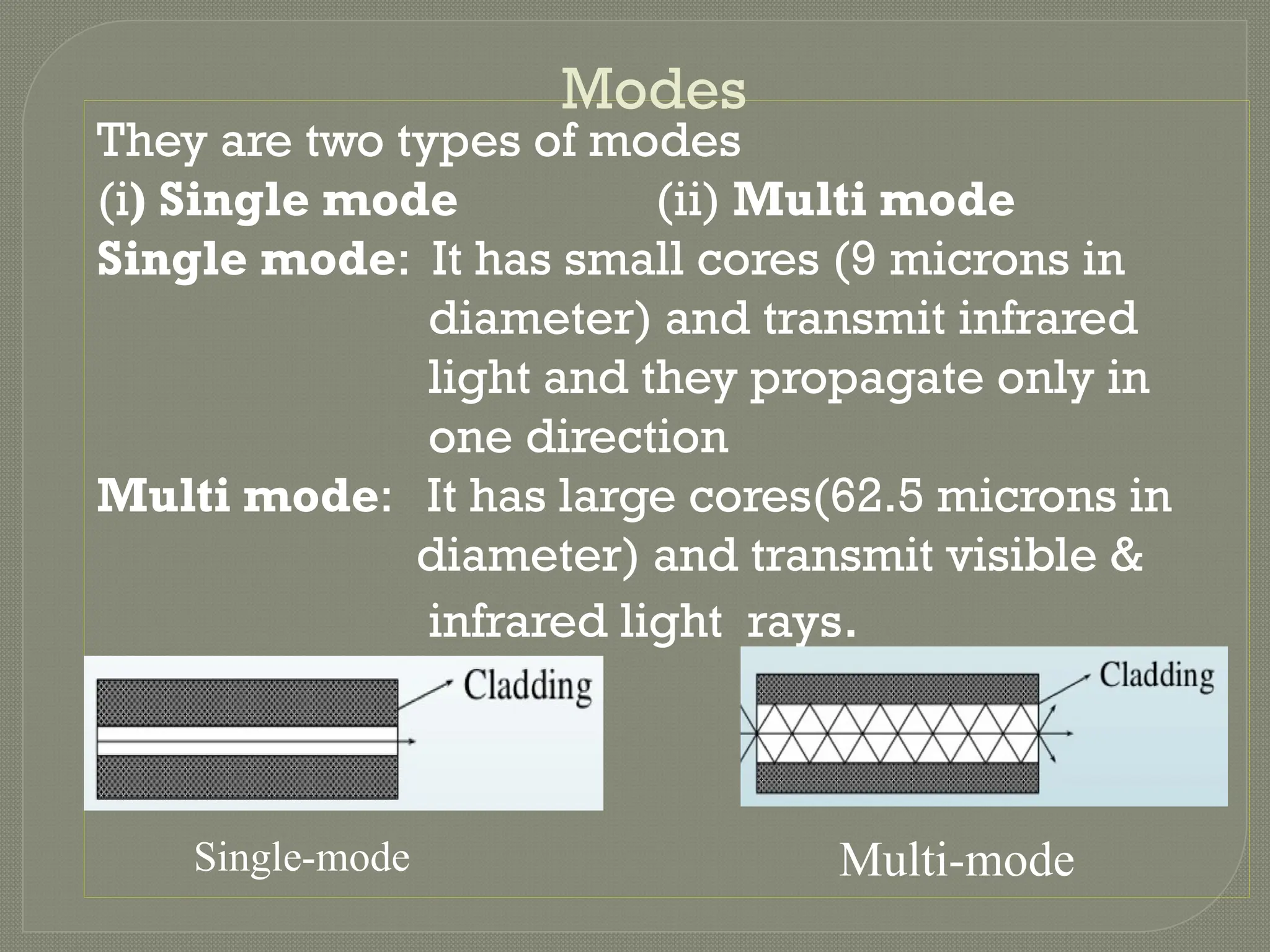
They are two types of modes
(i) Single mode (ii) Multi mode
Single mode: It has small cores (9 microns in
diameter) and transmit infrared
light and they propagate only in
one direction
Multi mode: It has large cores(62.5 microns in
diameter) and transmit visible &
infrared light rays.
Modes
Single-mode Multi-mode
Optical Fiber Wave Guides
 Step Index:The rays entering at different angles travel
different paths and emerge out at the end of fiber at
different times
 GRIN :The core has non uniform refractive index in any
medium
Materials :
 Glass core-Glass cladding
 Plastic core-Plastic cladding
 The size of fiber denoted by writing a core diameter that
cladding diameter both in microns with a slash between them
50/125.
 Glass-long distance, Plastic-Short distance
Sources
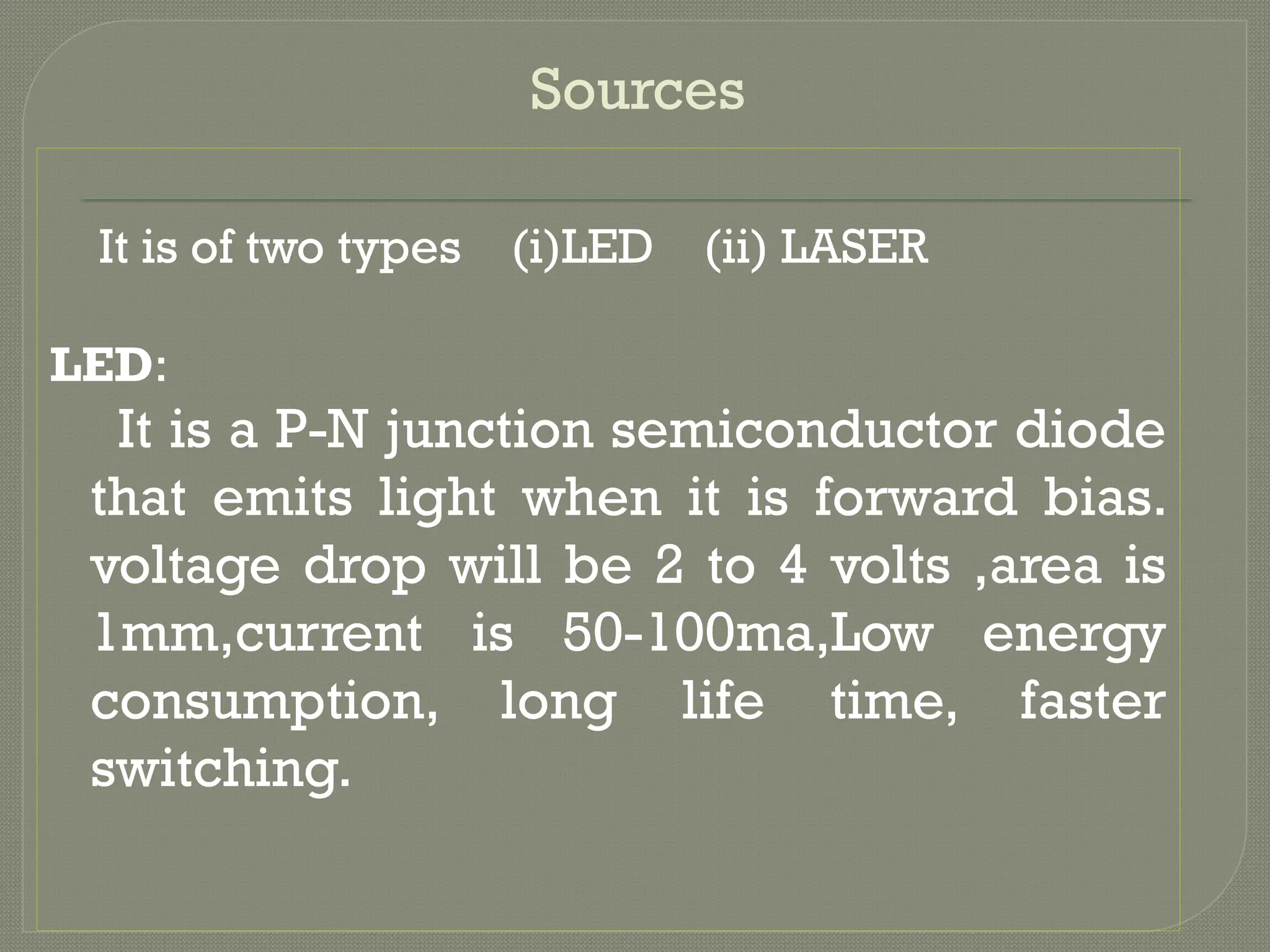
It is of two types (i)LED (ii) LASER
LED:
It is a P-N junction semiconductor diode
that emits light when it is forward bias.
voltage drop will be 2 to 4 volts ,area is
1mm,current is 50-100ma,Low energy
consumption, long life time, faster
switching.
LED
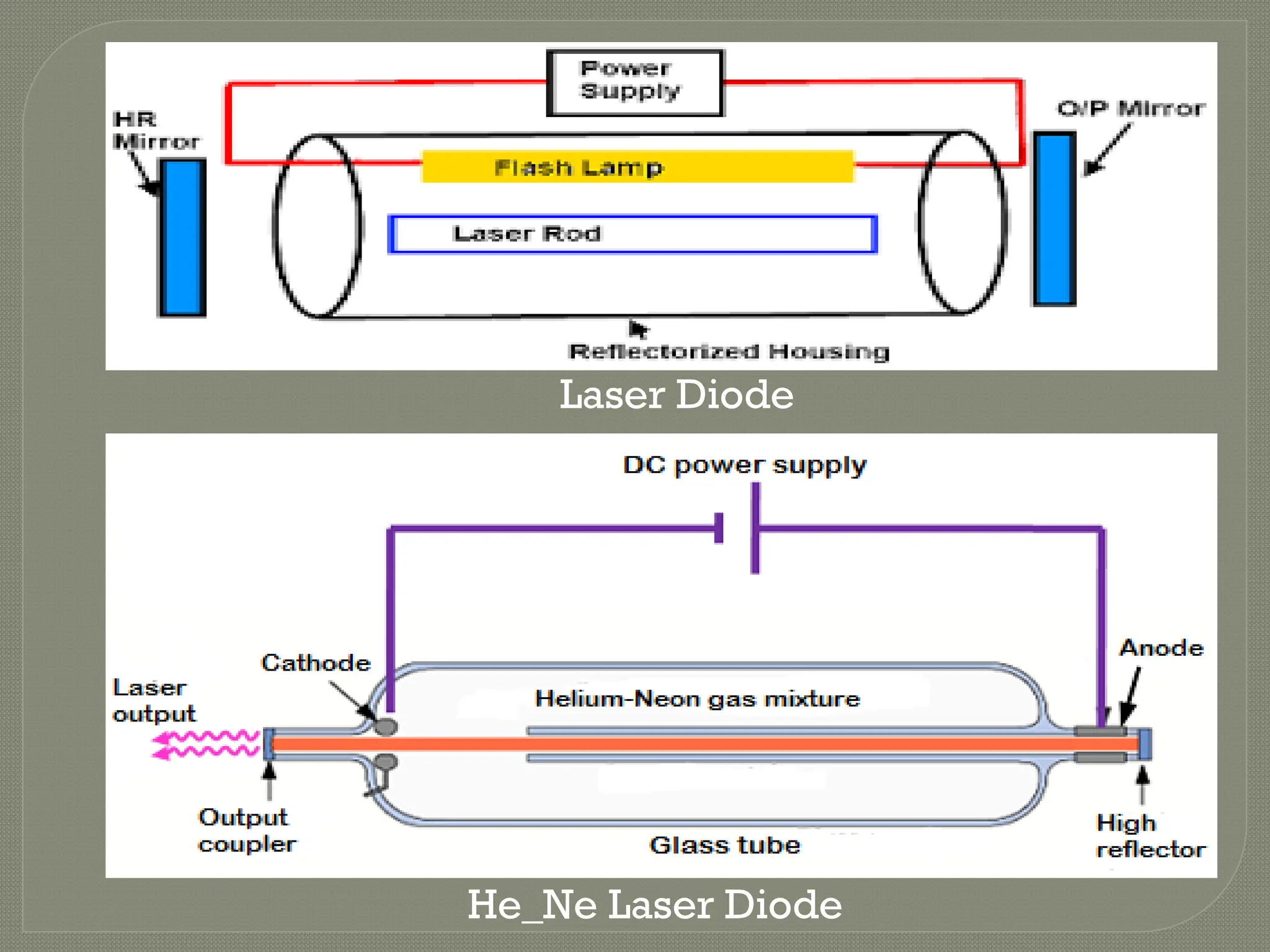
LASER
In this two types (i)He-Ne (ii)Nd:YAG
He-Ne: It is coupled to bare fiber to detect
break/cut and by using this NA can be measured.
In this two types of emissions
(i)Spontaneous:-Electrons drops from an excited
state to a lower state emitting a photon
(ii)Stimulated:-Photon of same frequency
interacts with electron in excited state which
drops two lower state.
Duration 10-8
seconds the atom stay in high state.
11 years in room temperature,&700
-10,000hours.
He_Ne Laser Diode
Laser Diode
PHOTO DETECTORS
In this photo detection mechanism are of
two types
External:- In which electrons are feed
from the surface of a metal by the energy
absorbed from an incident stream of
photons. EX:Vacuum tube, PMT
Internal:- The free charge carries
electrons and holes are generated by
absorption of incoming photons. Ex:
PN,PIN,APD
Semi conductor:-
They are small, light ,sensitive, fast and operate with a
few bias volts
For Emission the diode is forward bias the charges
injected in the junction recombination to produce
photons
For detection the diode reverse bias to generate
electron hole pair producing electric current.
PIN: High resistance ,improve efficiency
APD: It convert light to electricity, High reverse bias,
Reverse voltage 100-200v,gain 105
-106
Vacuum tube PIN photodiode
Losses in Fiber
Attenuation:
Loss of light energy as the light pulse
travels from one end of cable to the
other.-signal loss(or)fiber loss
It also decide no. of repeaters required
between transmitter and receiver.
It directly proportional to length of cable.
Losses in Fiber Communication
Bending
 Macroscopic: in which fiber undergo bends which
causes certain modes not be reflected.
 Microscopic: Either core (or) cladding undergo slight
bends at it’s surface.
 Inter modal: Difference between modes with in
multimode
 Intra modal: Pulse spreading that occurs in single mode
 Light energy due to heating of ion impurities results in
dimming of light at the end of fiber
(i)Intrinsic(ii)Extrinsic
Distortion
Absorption
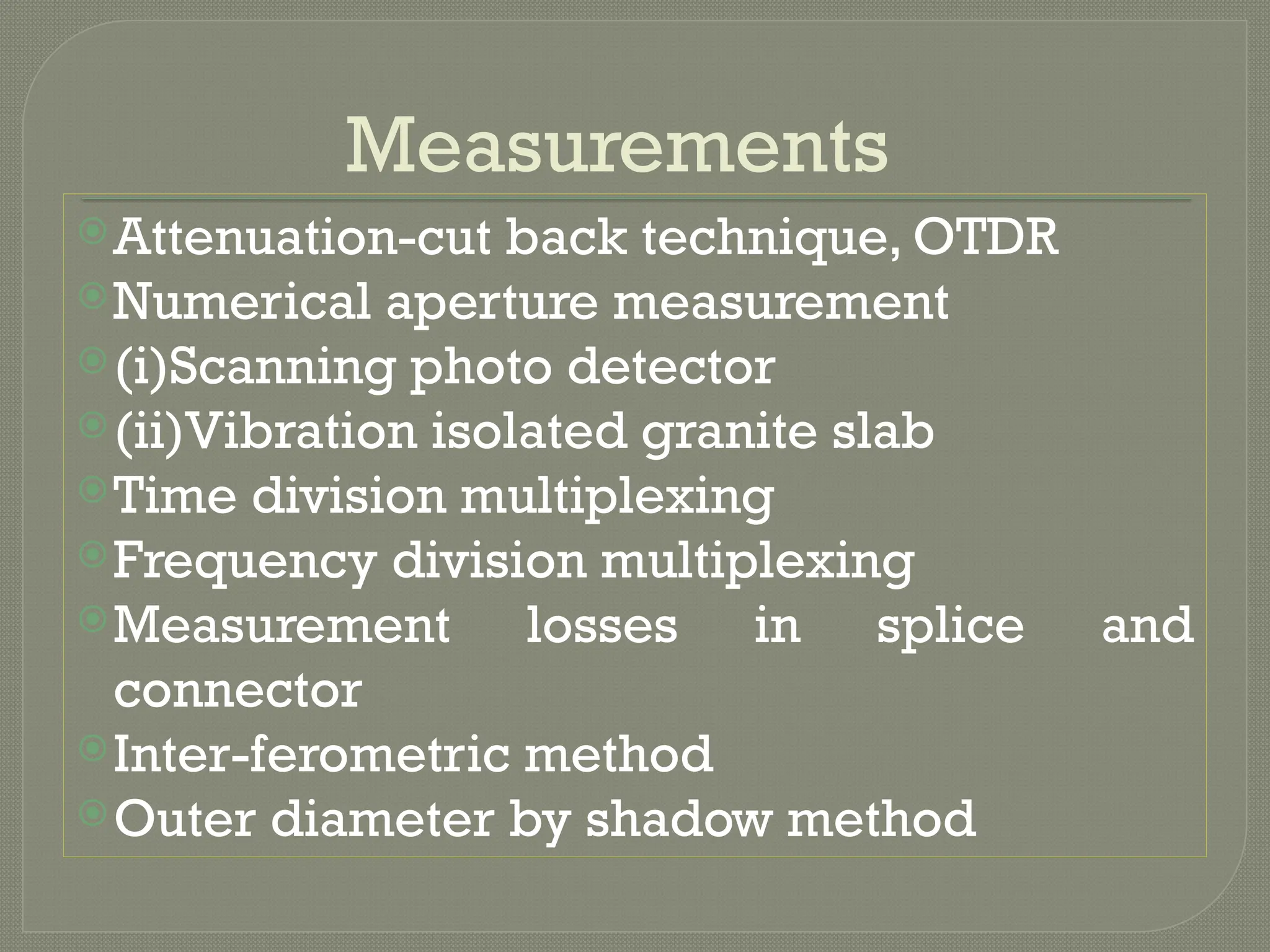
Measurements
Attenuation-cut back technique, OTDR
Numerical aperture measurement
(i)Scanning photo detector
(ii)Vibration isolated granite slab
Time division multiplexing
Frequency division multiplexing
Measurement losses in splice and
connector
Inter-ferometric method
Outer diameter by shadow method
ThankYou

Fiber optic communication Block diagram and Working Principle

  • 1.
  • 2.
    OPTICAL FIBER COMMUNICATION INTRODUCTION BASIC COMMUNICATIONSYSTEM BLOCK DAIGRAM ADVANTAGES APPLICATIONS OPTICAL WAVE GUIDES MODES SOURCE DETECTOR LOSSES IN FIBER
  • 3.
    INTRODUCTION  Fiber opticcables are used in telephone system, cable TV (or) internet  They carry digital information over long distance  They transmit light signals over long distance  They can be used in military, submarines, medical imaging e.t.c, plastic jacket glass or plastic cladding fiber core Medical Fiber Optical Inner View
  • 4.
    Working Principle ofTIR when a ray light travels from a denser to a rare medium such that the angle of incidence is greater than critical angle the ray reflects back in to the same medium this phenomena is TIR In optical fiber the ray undergo repeated total number of reflections until it emerges out of the other end of fiber ,even if fiber is bent. military Electronics
  • 5.
    Basic communication system Transmitter:In this message is generated an put in suitable form Information channel: It is divided in two categories (i)unguided(ii)guided Receiver:The message is extracted from the channel and put in final form. Transmitter Information channel receiver
  • 6.
    Block diagram  MessageOrigin: it is a transducer to convert electrical message in to proper format.  Modulator: it perform two functions(i) convert electrical message to proper format(ii)it impress the signal wave generated by source  Carrier Oscillator: carrier wave produced by electronic oscillator for fiber system i.e. LD,LED.
  • 7.
    Channel Coupler: Inradio/TV it acts like an antenna. Information Channel: It is a path between transmitter and receiver. It is used to boost up the power level of weak signal. Detector: In this optic wave convert in to electric current by photodiode. Signal Processing: In this two types of circuits are used (i)Amplifier (ii)Filter
  • 8.
    Advantages Less expensive Thinner High carryingcapacity Less signal degration Light signal Non-flammable Flexible Medical imaging Light weight
  • 9.
    Applications  Telephone applicationsare wide spread ranging from global n/w to desktop computer  It involves transmission of voice ,data (or) video over distances of less than a meter tom 100km.  POTS(Plain old telephone service) across nation wide network  LECS(Local exchange carries) central office switches at local levels  In cable TV companies also used fiber for delivery of digital video(or) data services.  It used in Bio-medical industry, Modern tele- medicine for transmission of digital diagnostic images.
  • 10.
    They are twotypes of modes (i) Single mode (ii) Multi mode Single mode: It has small cores (9 microns in diameter) and transmit infrared light and they propagate only in one direction Multi mode: It has large cores(62.5 microns in diameter) and transmit visible & infrared light rays. Modes Single-mode Multi-mode
  • 11.
    Optical Fiber WaveGuides  Step Index:The rays entering at different angles travel different paths and emerge out at the end of fiber at different times  GRIN :The core has non uniform refractive index in any medium Materials :  Glass core-Glass cladding  Plastic core-Plastic cladding  The size of fiber denoted by writing a core diameter that cladding diameter both in microns with a slash between them 50/125.  Glass-long distance, Plastic-Short distance
  • 12.
    Sources It is oftwo types (i)LED (ii) LASER LED: It is a P-N junction semiconductor diode that emits light when it is forward bias. voltage drop will be 2 to 4 volts ,area is 1mm,current is 50-100ma,Low energy consumption, long life time, faster switching.
  • 13.
  • 14.
    LASER In this twotypes (i)He-Ne (ii)Nd:YAG He-Ne: It is coupled to bare fiber to detect break/cut and by using this NA can be measured. In this two types of emissions (i)Spontaneous:-Electrons drops from an excited state to a lower state emitting a photon (ii)Stimulated:-Photon of same frequency interacts with electron in excited state which drops two lower state. Duration 10-8 seconds the atom stay in high state. 11 years in room temperature,&700 -10,000hours.
  • 15.
  • 16.
    PHOTO DETECTORS In thisphoto detection mechanism are of two types External:- In which electrons are feed from the surface of a metal by the energy absorbed from an incident stream of photons. EX:Vacuum tube, PMT Internal:- The free charge carries electrons and holes are generated by absorption of incoming photons. Ex: PN,PIN,APD
  • 17.
    Semi conductor:- They aresmall, light ,sensitive, fast and operate with a few bias volts For Emission the diode is forward bias the charges injected in the junction recombination to produce photons For detection the diode reverse bias to generate electron hole pair producing electric current. PIN: High resistance ,improve efficiency APD: It convert light to electricity, High reverse bias, Reverse voltage 100-200v,gain 105 -106
  • 18.
    Vacuum tube PINphotodiode
  • 19.
    Losses in Fiber Attenuation: Lossof light energy as the light pulse travels from one end of cable to the other.-signal loss(or)fiber loss It also decide no. of repeaters required between transmitter and receiver. It directly proportional to length of cable.
  • 20.
    Losses in FiberCommunication
  • 21.
    Bending  Macroscopic: inwhich fiber undergo bends which causes certain modes not be reflected.  Microscopic: Either core (or) cladding undergo slight bends at it’s surface.  Inter modal: Difference between modes with in multimode  Intra modal: Pulse spreading that occurs in single mode  Light energy due to heating of ion impurities results in dimming of light at the end of fiber (i)Intrinsic(ii)Extrinsic Distortion Absorption
  • 22.
    Measurements Attenuation-cut back technique,OTDR Numerical aperture measurement (i)Scanning photo detector (ii)Vibration isolated granite slab Time division multiplexing Frequency division multiplexing Measurement losses in splice and connector Inter-ferometric method Outer diameter by shadow method
  • 23.

Editor's Notes