1
I A S
Institut für
Afrika-Studien
In Cooperation with
“Reintegration into domestic
job markets –
easier said than done!
How to successfully manage still”
AGEP/ ALUMNIPORTAL
Monday, July 06th 2015
Dr. Julia Boger (julia.boger@yahoo.de)
Content
1. Introduction
2. Theories and Typologies of
Migration
3. Model of Preparedness
4. Reintegration Assistance Schemes
5. Theories of job search
6. The case studies: Ghana/Cameroon
2
Reality Check I
“Where do you see
yourselves in 3 years
from now?”
o Working in home country
o Working in Germany
o Working elsewhere in the
world
o Being self-employed
o Don’t know yet
• 5 SLIDES:
• - Map - with animated arrows
• Definitin Migration = XXXX
Theories and Typologies
of Migration
Migration
Definition:
“to move from one country, place, or locality to
another” (Merriam-Webster)
“The stock of international migrants is estimated
at 247 million in 2013, significantly larger than
the previous estimate of 232 million, and is
expected to surpass 250 million in 2015”
(The World Bank 2015, Migration and Development Brief, 24)
Flows
Source: The World Bank (2015) Migration and Development Brief 24: 3.
Types
 Internal migration
 International migration
 Labour migration
 Flight
 Family reunion
 Educational migration
 1960ies: Neo-classic (Return = failure)
 1980ies: NELM (Return = success)
 1990ies: Social networks (Return = open)
 2000: Transnationalism (Return = circular)
Cassarino (2004), King (2012)
Theories
9
Agents
of Change
(de Haas 2008)
Financial:
Remittances
Know-how:
Diaspora
-Collaboration
Know-how:
Returning/
circulating
experts
Migration & Development
Highly skilled migration
 Educational migration from South-North =
Braindrain, Braingain, Brainwaste,
Braincirculation?
 105,000 Students from Global South in
Germany (HIS-HF 2013)
 Tracer Studies:
 Few quantitative large scale studies on scholarship
holders
 Occupational Status Quo/ positions
 Lacking insights about job search process
Your opinion:
 Obstacles?
 Personal fears?
 Preparation?
Model of preparedness
Source: adapted from Cassarino (2004: 271).
Assisted Voluntary Reintegration
Humanitarian Schemes: for refugees
 Cheaper
 EU-Migration policies
 Transportation and pocket money
 REAG*/ GARP**
 financed by BAMF, Ministry for Refugees and Migration
*Reintegration and Emigration Program for Asylum-Seekers in Germany;
**Government Assisted Repatriation Program
Assisted Voluntary Reintegration
Development schemes: for highly skilled
 Know-how transfer = Braingain
 Transportation, salary top-up and
workplace equipment
 Migration for Development (CIM)/ RE24
(Bread for the world);
 financed by BMZ, Ministry for economic cooperation and
Development
Your opinion:
 How will you get
a job?
 Did you start
searching?
 Where will you
look for jobs?
16
Explaining labour market entry
Picture: © Gerd Müller, ZAV/CIM (2005)
Information
(hidden job market)
Social capital/ networks
(Granovetter 1974, Lin et al. 1981,
Portes 1990)
Human capital
(Schultz 1960, Becker 1962,
Mincer 1958)
Jobs/ demand
(advertised, job
placement)
Financial capital/ embodied capital
(Coleman 1966, Bourdieu 1983, Willot 2011)
Case studies
 Empirical research Ghana/Cameroon
 Returned graduates from STEM-fields
in the years 2000-2010
 Research 2008-2010
 Qualitative design
 50 interviewed returnees (22 Cameroon, 28
Ghana)
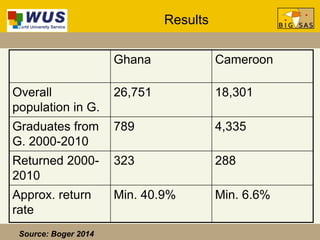
Results
Ghana Cameroon
Overall
population in G.
26,751 18,301
Graduates from
G. 2000-2010
789 4,335
Returned 2000-
2010
323 288
Approx. return
rate
Min. 40.9% Min. 6.6%
Source: Boger 2014
Getting a job:
which type are you?
20
„Tell my fellow brothers
and sisters that home
[Ghana] is better in terms
of good jobs. Greet all for
me (Mr. X, e-mail 2009)“
Type Ghana Cameroon
Achieving
(skills)
high low
Arranging
(re-instruments)
high low
Getting
sponsored
(referrals)
low high
Source: Boger 2014
Level of Development
Source: Boger 2014: 297
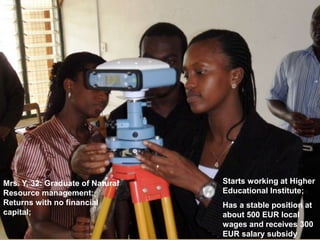
Starts working at Higher
Educational Institute;
Has a stable position at
about 500 EUR local
wages and receives 300
EUR salary subsidy
Mrs. Y, 32: Graduate of Natural
Resource management;
Returns with no financial
capital;
Ms. L, age 40: PhD graduate
linguistics in Germany;
Returns with no financial
capital;
Starts working in local NGO as
communication officer at the local wage
level of 70 EUR per month and receives
salary subsidy from CIM at 500  600
EUR
 Insecure position, has to find another
job after 2 years minimum!
NO EQUIPMENT!!!!
Mr. X, age 35: graduate of
Electrical Engineering in
Germany;
Returns with medium financial
capital;
Workplace equipment: Solar panel
Starts working in NGO of a friend at the
local wage level of 200 EUR per month
and receives salary subsidy from CIM at
500  700 EUR
 Insecure position, has to start
building own business
Reality Check II
“Where do you see
yourselves in 3 years
from now?”
o Working in home country
o Working in Germany
o Working elsewhere in the
world
o Being self-employed
o Don’t know yet
Checklist
Certificates, CV, application documents
List of friends/ mates/ fellows/ relatives
List of companies/ institutions
Information about reintegration subsidies
Getting in touch with local counsellors
Applying for reintegration schemes
Online registration at CIM, Bread for the
World, WUS
Contacts/ links
Centrum für internationale Migration und
Entwicklung (CIM)
Programm Migration für Entwicklung
Dag-Hammarskjöld-Weg 1-5
65760 Eschborn
Deutschland
Tel.: +49 6196 79 - 3366
Fax: +49 6196 79 – 3650
E-Mail: return@cimonline.de
Internet: www.returning-experts.de |
www.cimonline.de
Contacts/ links
Brot für die Welt – Evangelischer
Entwicklungsdienst
Evangelisches Werk für Diakonie und
Entwicklung e.V.
Internationale Personaldienste
Caroline-Michaelis-Str.1
10115 Berlin
bewerbung@brot-fuer-die-welt.de
Telefon +49 (0)30 65211 1335
Contacts/ links
World University Service (WUS),
Deutsches Komitee e.V.
Programm Migration für Entwicklung -
APA-Förderung
Goebenstr. 35 - 65195 Wiesbaden
Tel.: +49 (0) 611 9446051 - Fax: +49 (0)
611 446489
E-Mail: apa@wusgermany.de
www.wusgermany.de
References
• Becker, G. S. (1962). Investment in human capital: A theoretical analysis. The Journal of
Political Economy, 72(2/2), 9–49.
• Boger, Julia (2014): The Job hunt. Return migration and labour market entries of
Cameroonian and Ghanaian graduates from German universities.
• Cassarino, J.-P. (2004). Theorising return migration: The conceptual approach to return
migrants revisited. International Journal on Multicultural Societies (IJMS), 6(2), 253–279.
• Granovetter, M. (1995). Getting a job: a study of contacts and careers (2nd ed.). Chicago:
University of Chicago Press.
• Haas, de H. (2008). Migration and development: A theoretical perspective (IMI Working
Papers). University of Oxford: International Migration Institute.
• King, R. (2012). Theories and Typologies of Migration: An Overview and a Primer:
International Migration and Ethnic Relations (Willy Brandt Series of Working Papers No. 3).
Malmö: Diversity and Welfare.
• Lin, N., M. Ensel, W., & Vaughn, J. C. (1981). Social resources and strength of ties:
Structural factors in occupational status attainment. American Sociological Review, 46(4),
393–405.
• Mincer, J. (1970). The distribution of labor incomes: A survey. Journal of Economic
Literature, 8(1), 1–26.
• Portes, A., & Landolt, P. (2000). Social Capital: Promise and pitfalls of its role in
development. Journal of Latin American Studies, (32), 529–547.
• Schultz, T. W. (1961). Investment in human capital. The American Economic Review,
51(1), 1–17.
• World Bank (2015): Migration and Development Brief, 24.
Thank you for your kind
attention

Agep 07 2015-final3

  • 1.
    1 I A S Institutfür Afrika-Studien In Cooperation with “Reintegration into domestic job markets – easier said than done! How to successfully manage still” AGEP/ ALUMNIPORTAL Monday, July 06th 2015 Dr. Julia Boger (julia.boger@yahoo.de)
  • 2.
    Content 1. Introduction 2. Theoriesand Typologies of Migration 3. Model of Preparedness 4. Reintegration Assistance Schemes 5. Theories of job search 6. The case studies: Ghana/Cameroon 2
  • 3.
    Reality Check I “Wheredo you see yourselves in 3 years from now?” o Working in home country o Working in Germany o Working elsewhere in the world o Being self-employed o Don’t know yet
  • 4.
    • 5 SLIDES: •- Map - with animated arrows • Definitin Migration = XXXX Theories and Typologies of Migration
  • 5.
    Migration Definition: “to move fromone country, place, or locality to another” (Merriam-Webster) “The stock of international migrants is estimated at 247 million in 2013, significantly larger than the previous estimate of 232 million, and is expected to surpass 250 million in 2015” (The World Bank 2015, Migration and Development Brief, 24)
  • 6.
    Flows Source: The WorldBank (2015) Migration and Development Brief 24: 3.
  • 7.
    Types  Internal migration International migration  Labour migration  Flight  Family reunion  Educational migration
  • 8.
     1960ies: Neo-classic(Return = failure)  1980ies: NELM (Return = success)  1990ies: Social networks (Return = open)  2000: Transnationalism (Return = circular) Cassarino (2004), King (2012) Theories
  • 9.
    9 Agents of Change (de Haas2008) Financial: Remittances Know-how: Diaspora -Collaboration Know-how: Returning/ circulating experts Migration & Development
  • 10.
    Highly skilled migration Educational migration from South-North = Braindrain, Braingain, Brainwaste, Braincirculation?  105,000 Students from Global South in Germany (HIS-HF 2013)  Tracer Studies:  Few quantitative large scale studies on scholarship holders  Occupational Status Quo/ positions  Lacking insights about job search process
  • 11.
    Your opinion:  Obstacles? Personal fears?  Preparation?
  • 12.
    Model of preparedness Source:adapted from Cassarino (2004: 271).
  • 13.
    Assisted Voluntary Reintegration HumanitarianSchemes: for refugees  Cheaper  EU-Migration policies  Transportation and pocket money  REAG*/ GARP**  financed by BAMF, Ministry for Refugees and Migration *Reintegration and Emigration Program for Asylum-Seekers in Germany; **Government Assisted Repatriation Program
  • 14.
    Assisted Voluntary Reintegration Developmentschemes: for highly skilled  Know-how transfer = Braingain  Transportation, salary top-up and workplace equipment  Migration for Development (CIM)/ RE24 (Bread for the world);  financed by BMZ, Ministry for economic cooperation and Development
  • 15.
    Your opinion:  Howwill you get a job?  Did you start searching?  Where will you look for jobs?
  • 16.
    16 Explaining labour marketentry Picture: © Gerd Müller, ZAV/CIM (2005) Information (hidden job market) Social capital/ networks (Granovetter 1974, Lin et al. 1981, Portes 1990) Human capital (Schultz 1960, Becker 1962, Mincer 1958) Jobs/ demand (advertised, job placement) Financial capital/ embodied capital (Coleman 1966, Bourdieu 1983, Willot 2011)
  • 17.
    Case studies  Empiricalresearch Ghana/Cameroon  Returned graduates from STEM-fields in the years 2000-2010  Research 2008-2010  Qualitative design  50 interviewed returnees (22 Cameroon, 28 Ghana)
  • 19.
    Results Ghana Cameroon Overall population inG. 26,751 18,301 Graduates from G. 2000-2010 789 4,335 Returned 2000- 2010 323 288 Approx. return rate Min. 40.9% Min. 6.6% Source: Boger 2014
  • 20.
    Getting a job: whichtype are you? 20 „Tell my fellow brothers and sisters that home [Ghana] is better in terms of good jobs. Greet all for me (Mr. X, e-mail 2009)“ Type Ghana Cameroon Achieving (skills) high low Arranging (re-instruments) high low Getting sponsored (referrals) low high Source: Boger 2014
  • 21.
  • 22.
    Starts working atHigher Educational Institute; Has a stable position at about 500 EUR local wages and receives 300 EUR salary subsidy Mrs. Y, 32: Graduate of Natural Resource management; Returns with no financial capital;
  • 23.
    Ms. L, age40: PhD graduate linguistics in Germany; Returns with no financial capital; Starts working in local NGO as communication officer at the local wage level of 70 EUR per month and receives salary subsidy from CIM at 500  600 EUR  Insecure position, has to find another job after 2 years minimum! NO EQUIPMENT!!!!
  • 24.
    Mr. X, age35: graduate of Electrical Engineering in Germany; Returns with medium financial capital; Workplace equipment: Solar panel Starts working in NGO of a friend at the local wage level of 200 EUR per month and receives salary subsidy from CIM at 500  700 EUR  Insecure position, has to start building own business
  • 25.
    Reality Check II “Wheredo you see yourselves in 3 years from now?” o Working in home country o Working in Germany o Working elsewhere in the world o Being self-employed o Don’t know yet
  • 26.
    Checklist Certificates, CV, applicationdocuments List of friends/ mates/ fellows/ relatives List of companies/ institutions Information about reintegration subsidies Getting in touch with local counsellors Applying for reintegration schemes Online registration at CIM, Bread for the World, WUS
  • 27.
    Contacts/ links Centrum fürinternationale Migration und Entwicklung (CIM) Programm Migration für Entwicklung Dag-Hammarskjöld-Weg 1-5 65760 Eschborn Deutschland Tel.: +49 6196 79 - 3366 Fax: +49 6196 79 – 3650 E-Mail: return@cimonline.de Internet: www.returning-experts.de | www.cimonline.de
  • 28.
    Contacts/ links Brot fürdie Welt – Evangelischer Entwicklungsdienst Evangelisches Werk für Diakonie und Entwicklung e.V. Internationale Personaldienste Caroline-Michaelis-Str.1 10115 Berlin bewerbung@brot-fuer-die-welt.de Telefon +49 (0)30 65211 1335
  • 29.
    Contacts/ links World UniversityService (WUS), Deutsches Komitee e.V. Programm Migration für Entwicklung - APA-Förderung Goebenstr. 35 - 65195 Wiesbaden Tel.: +49 (0) 611 9446051 - Fax: +49 (0) 611 446489 E-Mail: apa@wusgermany.de www.wusgermany.de
  • 30.
    References • Becker, G.S. (1962). Investment in human capital: A theoretical analysis. The Journal of Political Economy, 72(2/2), 9–49. • Boger, Julia (2014): The Job hunt. Return migration and labour market entries of Cameroonian and Ghanaian graduates from German universities. • Cassarino, J.-P. (2004). Theorising return migration: The conceptual approach to return migrants revisited. International Journal on Multicultural Societies (IJMS), 6(2), 253–279. • Granovetter, M. (1995). Getting a job: a study of contacts and careers (2nd ed.). Chicago: University of Chicago Press. • Haas, de H. (2008). Migration and development: A theoretical perspective (IMI Working Papers). University of Oxford: International Migration Institute. • King, R. (2012). Theories and Typologies of Migration: An Overview and a Primer: International Migration and Ethnic Relations (Willy Brandt Series of Working Papers No. 3). Malmö: Diversity and Welfare. • Lin, N., M. Ensel, W., & Vaughn, J. C. (1981). Social resources and strength of ties: Structural factors in occupational status attainment. American Sociological Review, 46(4), 393–405. • Mincer, J. (1970). The distribution of labor incomes: A survey. Journal of Economic Literature, 8(1), 1–26. • Portes, A., & Landolt, P. (2000). Social Capital: Promise and pitfalls of its role in development. Journal of Latin American Studies, (32), 529–547. • Schultz, T. W. (1961). Investment in human capital. The American Economic Review, 51(1), 1–17. • World Bank (2015): Migration and Development Brief, 24.
  • 31.
    Thank you foryour kind attention