Dr. Hans-Peter Winkelmann
Climate Change Expert
Global Climate Change Alliance (GCCA+)
Climate Support Facility, Brussels
Director, CLIMATE CAMPUS
16 December 2015
Dr. Hans-Peter Winkelmann, Key Expert on Climate Change, GCCA+ CSF
Webinar
After Paris: How can Universities fight Climate Change?
Dr. Hans-Peter Winkelmann, Key Expert on
Climate Change, GCCA CSF
What is the GCCA/GCCA+?
The Global Climate Change Alliance GCCA was established by the European
Union (EU) in 2007 to strengthen dialogue and cooperation with developing
countries, in particular Least Developed Countries (LDCs) and Small Island
Developing States (SIDS).
It has a budget of more than €300 million and is one of the most significant
climate initiatives in the world. It supports 51 programmes around the world
and is active in 38 countries, 8 regions and subregions and on the global
level.
The GCCA+ focuses its technical support on three priority
areas:
•Climate change mainstreaming and poverty reduction
•Increasing resilience to climate-related stresses and shocks
•Sector-based climate change adaptation and mitigation strategies
Dr. Hans-Peter Winkelmann, Key Expert on
Climate Change, GCCA CSF
Mainstreaming climate change into higher education
www.climate-campus.org
Let‘s talk a bit about climate change…
Climate change is widely acknowledged as mankind’s
most pressing challenge and what we do in the next
few years will determine whether we can avoid
serious impacts.
Dr. Hans-Peter Winkelmann, Key Expert on
Climate Change, GCCA CSF
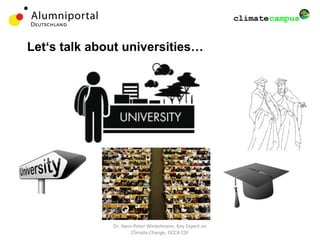
Let‘s talk about universities…
Dr. Hans-Peter Winkelmann, Key Expert on
Climate Change, GCCA CSF
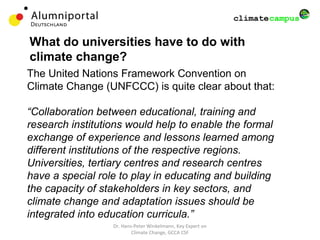
What do universities have to do with
climate change?
“Collaboration between educational, training and
research institutions would help to enable the formal
exchange of experience and lessons learned among
different institutions of the respective regions.
Universities, tertiary centres and research centres
have a special role to play in educating and building
the capacity of stakeholders in key sectors, and
climate change and adaptation issues should be
integrated into education curricula.”
The United Nations Framework Convention on
Climate Change (UNFCCC) is quite clear about that:
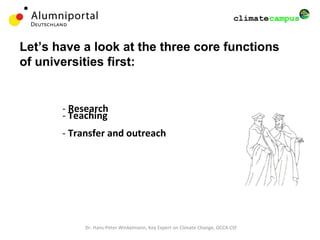
- Research
Dr. Hans-Peter Winkelmann, Key Expert on Climate Change, GCCA CSF
Let’s have a look at the three core functions
of universities first:
- Teaching
- Transfer and outreach
Dr. Hans-Peter Winkelmann, Key Expert on Climate Change, GCCA CSF
Civil Society
University
Education Research
Outreach/
Transfer
Management/Operations
Let‘s look at the role of universities in society in
view of the core functions of universities
Dr. Hans-Peter Winkelmann, Key Expert on Climate Change, GCCA CSF
Civil Society
University
Education Research
Outreach/
Transfer
Management/Operations
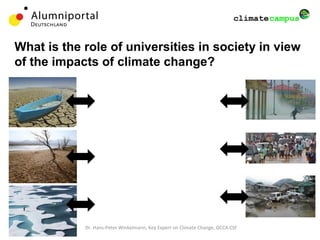
What is the role of universities in society in view
of the impacts of climate change?
Dr. Hans-Peter Winkelmann, Key Expert on Climate Change, GCCA CSF
Civil Society
University
Education Research
Outreach/
Transfer
Management/Operations
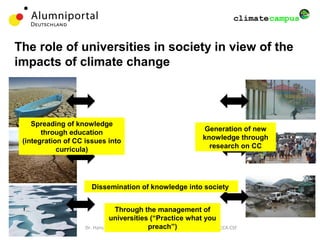
The role of universities in society in view of the
impacts of climate change
Generation of new
knowledge through
research on CC
Spreading of knowledge
through education
(integration of CC issues into
curricula)
Dissemination of knowledge into society
Through the management of
universities (“Practice what you
preach”)
Universities have a particularly important role
to play:
This is because of their traditional mission in research and
teaching, their increasing role in the complex process of
innovation, along with their other contributions to economic
competitiveness and social cohesion, e.g. their role in the
life of the community and in regional development.
Therefore universities have a special responsibility to
society on the local level and should play an important role
as local knowledge centers for climate change mitigation
and adaptation to help society to meet the challenge of
climate change.
Dr. Hans-Peter Winkelmann, Key Expert on Climate Change, GCCA CSF
Regarding climate change mitigation and adaptation,
universities are critical social multipliers in achieving
sustainable production and consumption patterns.
Universities are important actors in the community, as
employers, purchasers and service users.
Universities are also businesses where the prudent use
of natural resources saves money and safeguards
reputations. Besides the teaching and learning function
of universities their good housekeeping becomes more
and more crucial:
“Practice what you preach!”
Dr. Hans-Peter Winkelmann, Key Expert on Climate Change, GCCA CSF
8,000 universities worldwide can become models for
society in the pursuance of reducing greenhouse gas
emissions and tackling climate change.
140 million students are critical agents for a safer
future!
Conclusion:
Higher education occupies a central position in
shaping the way to cope with the challenge of
climate change.
Dr. Hans-Peter Winkelmann, Key Expert on Climate Change, GCCA CSF
Therefore, universities are called upon
•to teach not only the skills required to advance
successfully in the labour market,
•but also to nourish in their students, faculty and staff a
positive attitude towards climate change mitigation
and adaptation, and
•to help them to understand how people can contribute
to a better life in a sustainable world.
What does the COP21 in Paris say?
“7. Parties should strengthen their cooperation on enhancing
action on adaptation, taking into account the Cancun
Adaptation Framework, including with regard to:
(a)Sharing information, good practices, experiences and
lessons learned, including, as appropriate, as these relate to
science, planning, policies and implementation in relation to
adaptation actions; …(…)…
(c) Strengthening scientific knowledge on climate, including
research, systematic observation of the climate system and
early warning systems, in a manner that informs climate
services and supports decision-making;”
Dr. Hans-Peter Winkelmann, Key Expert on Climate Change, GCCA CSF
The challenge:
Mainstreaming the environment and climate
change into universities!
Dr. Hans-Peter Winkelmann, Key Expert on Climate Change, GCCA CSF
What do we mean by mainstreaming of
environment and climate issues?
Climate change is pervasive: it affects, and is
affected by, all spheres of public life and is closely
linked to poverty. This is why climate must be an
integral consideration in national development
plans, policies and budgets.
Dr. Hans-Peter Winkelmann, Key Expert on Climate Change, GCCA CSF
What do we mean by mainstreaming of
environment and climate issues?
Mainstreaming the environment and climate
change into all university programmes contributes
to successful and long-lasting results. It provides
tools and mechanisms to reduce vulnerabilities,
build resilience, identify opportunities for
sustainable livelihoods and contribute to the
transformation into an inclusive green economy.
Dr. Hans-Peter Winkelmann, Key Expert on Climate Change, GCCA CSF
How can universities realize mainstreaming
environment and climate change?
Dr. Hans-Peter Winkelmann, Key Expert on Climate Change, GCCA CSF
Universities can put mainstreaming environment
and climate change into practice in different ways:
- In the area of research through the generation of new
knowledge on climate change mitigation and adaptation,
- in the area of curriculum and teaching through the
incorporation of environment and climate change issues and
options into their teaching activities (“greening the curricula”),
- in the area of physical operations at university campuses
committed to sustainability work to reduce the institution's
carbon footprint and demonstrate practical examples of
sustainable living (“greening the campus”),
- in the transfer of know-how and technology to society.
Dr. Hans-Peter Winkelmann, Key Expert on Climate Change, GCCA CSF
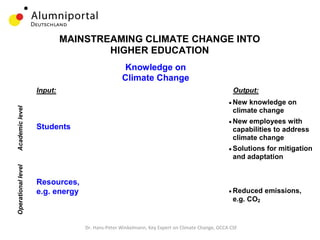
Resources,
e.g. energy
Input:
Knowledge on
Climate Change
Research
Education
Transfer
Operations and
Management
Students
OperationallevelAcademiclevel
MAINSTREAMING CLIMATE CHANGE INTO
HIGHER EDUCATION
• Reduced emissions,
e.g. CO2
• New knowledge on
climate change
• New employees with
capabilities to address
climate change
• Solutions for mitigation
and adaptation
Output:
Dr. Hans-Peter Winkelmann, Key Expert on Climate Change, GCCA CSF
Let us discuss!
Dr. Hans-Peter Winkelmann, Key Expert on Climate Change, GCCA CSF
Think about your own university:
- How could your own university generate new knowledge
on
climate change?
- How could your own university spread this new knowledge
through education?
- How could your own university disseminate the new
knowledge on climate change to society?
- How could your own university be better managed in a
climate friendly way?
- How could your own university better demonstrate
sustainable living and working?
Dr. Hans-Peter Winkelmann, Key Expert on Climate Change, GCCA CSF
Look at the following questions from the
student’s perspective:
- What new key competences are needed to contribute to a
climate friendly future and how can they be acquired?
- How could universities enable students to contribute to a
climate friendly future?
- How can students acquire new knowledge and skills on
climate change?
- What could students in general do to help universities to
become climate friendly?
Thank you for your collaboration!
Dr. Hans-Peter Winkelmann, Key Expert on Climate Change, GCCA CSF

Webinar presentation

  • 1.
    Dr. Hans-Peter Winkelmann ClimateChange Expert Global Climate Change Alliance (GCCA+) Climate Support Facility, Brussels Director, CLIMATE CAMPUS 16 December 2015 Dr. Hans-Peter Winkelmann, Key Expert on Climate Change, GCCA+ CSF Webinar After Paris: How can Universities fight Climate Change?
  • 2.
    Dr. Hans-Peter Winkelmann,Key Expert on Climate Change, GCCA CSF What is the GCCA/GCCA+? The Global Climate Change Alliance GCCA was established by the European Union (EU) in 2007 to strengthen dialogue and cooperation with developing countries, in particular Least Developed Countries (LDCs) and Small Island Developing States (SIDS). It has a budget of more than €300 million and is one of the most significant climate initiatives in the world. It supports 51 programmes around the world and is active in 38 countries, 8 regions and subregions and on the global level. The GCCA+ focuses its technical support on three priority areas: •Climate change mainstreaming and poverty reduction •Increasing resilience to climate-related stresses and shocks •Sector-based climate change adaptation and mitigation strategies
  • 3.
    Dr. Hans-Peter Winkelmann,Key Expert on Climate Change, GCCA CSF Mainstreaming climate change into higher education www.climate-campus.org
  • 4.
    Let‘s talk abit about climate change… Climate change is widely acknowledged as mankind’s most pressing challenge and what we do in the next few years will determine whether we can avoid serious impacts.
  • 11.
    Dr. Hans-Peter Winkelmann,Key Expert on Climate Change, GCCA CSF Let‘s talk about universities…
  • 12.
    Dr. Hans-Peter Winkelmann,Key Expert on Climate Change, GCCA CSF What do universities have to do with climate change? “Collaboration between educational, training and research institutions would help to enable the formal exchange of experience and lessons learned among different institutions of the respective regions. Universities, tertiary centres and research centres have a special role to play in educating and building the capacity of stakeholders in key sectors, and climate change and adaptation issues should be integrated into education curricula.” The United Nations Framework Convention on Climate Change (UNFCCC) is quite clear about that:
  • 13.
    - Research Dr. Hans-PeterWinkelmann, Key Expert on Climate Change, GCCA CSF Let’s have a look at the three core functions of universities first: - Teaching - Transfer and outreach
  • 14.
    Dr. Hans-Peter Winkelmann,Key Expert on Climate Change, GCCA CSF Civil Society University Education Research Outreach/ Transfer Management/Operations Let‘s look at the role of universities in society in view of the core functions of universities
  • 15.
    Dr. Hans-Peter Winkelmann,Key Expert on Climate Change, GCCA CSF Civil Society University Education Research Outreach/ Transfer Management/Operations What is the role of universities in society in view of the impacts of climate change?
  • 16.
    Dr. Hans-Peter Winkelmann,Key Expert on Climate Change, GCCA CSF Civil Society University Education Research Outreach/ Transfer Management/Operations The role of universities in society in view of the impacts of climate change Generation of new knowledge through research on CC Spreading of knowledge through education (integration of CC issues into curricula) Dissemination of knowledge into society Through the management of universities (“Practice what you preach”)
  • 17.
    Universities have aparticularly important role to play: This is because of their traditional mission in research and teaching, their increasing role in the complex process of innovation, along with their other contributions to economic competitiveness and social cohesion, e.g. their role in the life of the community and in regional development. Therefore universities have a special responsibility to society on the local level and should play an important role as local knowledge centers for climate change mitigation and adaptation to help society to meet the challenge of climate change. Dr. Hans-Peter Winkelmann, Key Expert on Climate Change, GCCA CSF
  • 18.
    Regarding climate changemitigation and adaptation, universities are critical social multipliers in achieving sustainable production and consumption patterns. Universities are important actors in the community, as employers, purchasers and service users. Universities are also businesses where the prudent use of natural resources saves money and safeguards reputations. Besides the teaching and learning function of universities their good housekeeping becomes more and more crucial: “Practice what you preach!” Dr. Hans-Peter Winkelmann, Key Expert on Climate Change, GCCA CSF
  • 19.
    Dr. Hans-Peter Winkelmann,Key Expert on Climate Change, GCCA CSF 8,000 universities worldwide can become models for society in the pursuance of reducing greenhouse gas emissions and tackling climate change. 140 million students are critical agents for a safer future!
  • 20.
    Conclusion: Higher education occupiesa central position in shaping the way to cope with the challenge of climate change. Dr. Hans-Peter Winkelmann, Key Expert on Climate Change, GCCA CSF
  • 21.
    Dr. Hans-Peter Winkelmann,Key Expert on Climate Change, GCCA CSF Therefore, universities are called upon •to teach not only the skills required to advance successfully in the labour market, •but also to nourish in their students, faculty and staff a positive attitude towards climate change mitigation and adaptation, and •to help them to understand how people can contribute to a better life in a sustainable world.
  • 22.
    What does theCOP21 in Paris say? “7. Parties should strengthen their cooperation on enhancing action on adaptation, taking into account the Cancun Adaptation Framework, including with regard to: (a)Sharing information, good practices, experiences and lessons learned, including, as appropriate, as these relate to science, planning, policies and implementation in relation to adaptation actions; …(…)… (c) Strengthening scientific knowledge on climate, including research, systematic observation of the climate system and early warning systems, in a manner that informs climate services and supports decision-making;” Dr. Hans-Peter Winkelmann, Key Expert on Climate Change, GCCA CSF
  • 23.
    The challenge: Mainstreaming theenvironment and climate change into universities! Dr. Hans-Peter Winkelmann, Key Expert on Climate Change, GCCA CSF
  • 24.
    What do wemean by mainstreaming of environment and climate issues? Climate change is pervasive: it affects, and is affected by, all spheres of public life and is closely linked to poverty. This is why climate must be an integral consideration in national development plans, policies and budgets. Dr. Hans-Peter Winkelmann, Key Expert on Climate Change, GCCA CSF
  • 25.
    What do wemean by mainstreaming of environment and climate issues? Mainstreaming the environment and climate change into all university programmes contributes to successful and long-lasting results. It provides tools and mechanisms to reduce vulnerabilities, build resilience, identify opportunities for sustainable livelihoods and contribute to the transformation into an inclusive green economy. Dr. Hans-Peter Winkelmann, Key Expert on Climate Change, GCCA CSF
  • 26.
    Dr. Hans-Peter Winkelmann,Key Expert on Climate Change, GCCA CSF How can universities realize mainstreaming environment and climate change?
  • 27.
    Dr. Hans-Peter Winkelmann,Key Expert on Climate Change, GCCA CSF Universities can put mainstreaming environment and climate change into practice in different ways: - In the area of research through the generation of new knowledge on climate change mitigation and adaptation, - in the area of curriculum and teaching through the incorporation of environment and climate change issues and options into their teaching activities (“greening the curricula”), - in the area of physical operations at university campuses committed to sustainability work to reduce the institution's carbon footprint and demonstrate practical examples of sustainable living (“greening the campus”), - in the transfer of know-how and technology to society.
  • 28.
    Dr. Hans-Peter Winkelmann,Key Expert on Climate Change, GCCA CSF Resources, e.g. energy Input: Knowledge on Climate Change Research Education Transfer Operations and Management Students OperationallevelAcademiclevel MAINSTREAMING CLIMATE CHANGE INTO HIGHER EDUCATION • Reduced emissions, e.g. CO2 • New knowledge on climate change • New employees with capabilities to address climate change • Solutions for mitigation and adaptation Output:
  • 29.
    Dr. Hans-Peter Winkelmann,Key Expert on Climate Change, GCCA CSF Let us discuss!
  • 30.
    Dr. Hans-Peter Winkelmann,Key Expert on Climate Change, GCCA CSF Think about your own university: - How could your own university generate new knowledge on climate change? - How could your own university spread this new knowledge through education? - How could your own university disseminate the new knowledge on climate change to society? - How could your own university be better managed in a climate friendly way? - How could your own university better demonstrate sustainable living and working?
  • 31.
    Dr. Hans-Peter Winkelmann,Key Expert on Climate Change, GCCA CSF Look at the following questions from the student’s perspective: - What new key competences are needed to contribute to a climate friendly future and how can they be acquired? - How could universities enable students to contribute to a climate friendly future? - How can students acquire new knowledge and skills on climate change? - What could students in general do to help universities to become climate friendly?
  • 32.
    Thank you foryour collaboration! Dr. Hans-Peter Winkelmann, Key Expert on Climate Change, GCCA CSF