Physiological changes
during pregnancy
introduction
 During pregnancy there is progressive anatomical ,physiological and
biochemical change not only confined to the genital organs but also all
systems of the body.

 It is principally a phenomenon of maternal adaptation of to the increasing
demand of the growing fetus
Genital organ changes
vulva
 Vulva becomes oedematous and more
muscular ,
 superficial varicosities may appear in
multipara
 Labia minora are pigmented and
hypertrophied
vagina
 Walls become hypertrophied
,edematous and vascular
 Jacquemier’s sign
 Secretions become copious ,thin and
curdy white
 pH becomes acidic
UTERUS
 NON PREGNANT STATE:: weight;60gm length;7.5cm
 PREGNANT:: at term weight;900-1000gm length;35cm
 Capacity increased by 500 to 1000 times
 Change occur in all parts of uterus
Uterus (con)
Body of uterus:
 Enlargement of the uterus is affected by following factors
Changes in muscle( hypertrophy and
hyperplasia)
stretching
 Arrangement of muscle fibre
outer longitudinal
inner circular
intermediate
Uterus (con)
Vascular system
 Blood supply to uterus - by uterine and ovarian artery
 there is marked spiralling of arteries reaching maximum at 20 weeks
thereafter they straighten up
 Vasodialation due to estradiol
 Numerous lymphatic channel opens up
 Vascular channel more pronounced at placental site
Uterus (con)
 Weight;increases due to the increased growth of uterine
muscles,connective tissue and vascular channels
 Shape;becomes globular at 12 weeks,pyriform by 28 weeks and changes to
sphetrical beyond 36 weeks
 Braxton hick’s contraction
ENDOMETRIUM
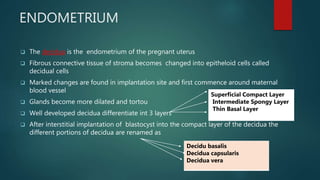
 The decidua is the endometrium of the pregnant uterus
 Fibrous connective tissue of stroma becomes changed into epitheloid cells called
decidual cells
 Marked changes are found in implantation site and first commence around maternal
blood vessel
 Glands become more dilated and tortou
 Well developed decidua differentiate int 3 layers
 After interstitial implantation of blastocyst into the compact layer of the decidua the
different portions of decidua are renamed as
`
Superficial Compact Layer
Intermediate Spongy Layer
Thin Basal Layer
Decidu basalis
Decidua capsularis
Decidua vera
ISTHMUS
 During first trimester:::ishthmus hypertrophies and elongates 3 times its original length
 With advancing pregnancy:::progressively unfolds and rom above until incorporated into the uterine
cavity
 Circularly arranged muscle fibers in this region function as a sphincter In early pregnancy and thus
helps to hold the fetus within uterus
 Incompetency may lead to mid trimester abortion
 Encirclage operation is done to correct this defect on the based on the principle of restoration of
function of isthmus
CERVIX
A. STROMA:: hypertrophy and hyperplasia of the elastic and connective tissue,flud accumulate and
inside and inbetween fibers,vascularity is increased,hypertrophy and hyper plasia of glands
occur>>>all these lead to marked softening>>>Goodell’s sign
B. EPIITHELIUM::Marked proliferation of the enddocervical mucosa with downward extension of
beyond squamo columnar junction
C. SECRETION::secretion is copious and tenacious,due to the effect of progesterone,mucus is rich in
cytokines and immunoglobulin,mucous foms a thick plug effectively sealing the cervical canal
FALLOPIAN TUBE
 Tube become congested ,
 muscle undergo hypertrophy
 Epithelium becomes flattened and patches of decidual reaction are observed
OVARY
 The growth and development of corpus luteum reaches its peek at 8th week when I is about 2.5cm
long and becomes cystic
 Colloid degeneration occurs at 12th weekwhich later becomes calcified at term
 hormones estrogen and progesterone produced by corpus luteum
maintain an environment for the growing ovum
control the formation and maintenance of decidua
inhibit the ripening of follicles
BREASTS
 SIZE::increases;due to marked hypertrophy and proliferation of ducts and alveoli,vascularity is
also increased
 NIPPE AND AREOLA::nipples becomes larger,erectile and deeply pigmented.variable number of
sebaceous glands which remain invisible become hypertrophied and are called Montogomery’s
tubercles(their secretio keeps nipple and areola moist and healthy)
 Secretion::colostrum can be squeezed out of breast at about12th week
CUTANEOUS
CHANGES
 PIGMENTATION
A. FACE::: chloasma gravidarum
B. ABDOMEN::: linea nigra ,striae
gravidarum,spider erythema ,mild
hirsuitsm
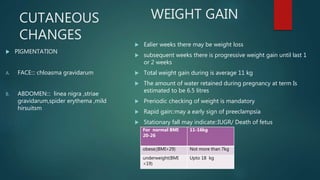
 Ealier weeks there may be weight loss
 subsequent weeks there is progressive weight gain until last 1
or 2 weeks
 Total weight gain during is average 11 kg
 The amount of water retained during pregnancy at term Is
estimated to be 6.5 litres
 Preriodic checking of weight is mandatory
 Rapid gain::may a early sign of preeclampsia
 Stationary fall may indicate::IUGR/ Death of fetus
WEIGHT GAIN
For normal BMI
20-26
11-16kg
obese;(BMI>29) Not more than 7kg
underweight(BMI
<19)
Upto 18 kg
BODY WATER METABOLISM
 Pregnancy is a state of hypervolemia
 The water content of fetus,placenta,and amniotic fluid is about 3.5ltr
 There is active retention of sodium and potassium
 The important causes of sodium retention and volume overload are
1. Changes in osmoregulation
2. Increased estrogen and progesterone
3. Increase in renin angiotensin activity
4. Increase in aldosterone,deoxy cortiserone
5. Control by Arginie vasopresine(AVP) from posterior pituitary
HEMATOLGICAL
CHANGES
BLOOD
VOLUME
 INCREASED VASCULARiTY of the
enlarging uterus with interpositioning
of the uteroplacental circulation
 Blood volume is markedly raised,all
the constituents of blood are affected
by increased blood volume
 blood volume start to raise from
about 6th week expands rapidly and
there after to maximum 40-5o%above
the pregnant level at 30-32 weeks
 Stars to raise by 6 weeks and plateaus
at 30weeks,rate of increase is almost
parallel to blood volume
 Total plasma volume increase upto
1.25 ltr
 The increase is greater and large baby,
multigravida,multiple pregnancy
PLASMA
VOLUME
RBC AND Hb
 RBC mass is increased to the extent of 20-30%
 The total increase in volume is about 350 ml
 The increase is regulated by increased demand of oxygen transport during pregnancy
 RBC mass begins to risea t about 10 weeks and continue till term
 disproportionate rise in plasma volume and Hb produces state of HEMODILUTION
Leukocyte and
immune system
 Neutrophilic leukocytosis occurs
too the extent of 10-15000/cumm
and even upto 2000/cumm
 The increase may bee due to rise
in levels of estrogen and cortisol
 Changes in the immune system is
the modulation away from cell
mediated immunity to humoral
and innate immunity
 Pregnancy is hypercoagulable state
 Fibrinogen level rises
 ESR Gives much higher value
 Gestational thrombocytopenia
 Fibrinolytic activity diminished
 Increase in activity of clotting factor
Blood coagulation
factors
Cardiovascular system
 Anatomical changes
 Abnormal clinical finding
 Blood pressure changes
 Cardiac output
Metabolic changes
 General metabolic changes
 Protein metabolism changes
 Carbohydrate metabolism changes
 Fat metabolism changes
 Lipid metabolism changes
 Iron metabolism changes
Respiratory system
 Elevation of diaphragm
 A state of hyperventilation
 Respirtory alkalosis
 Shortness of breath
Urinary system
 Kidney
 Ureter
 bladder  LFT rises except ALP
 Mild cholestatsis
 Atonocity of gall bladder
 Cahnce of stone formation
Liver and gall
bladder
Alimentary
system
 Gum bleeding
 Decreased motility of the gut
 Esophagitis and heart burn
Nervous system
 Some sort of temperamental changes
 Postpartum blues,depression or psychosis
 Carpel tunnel syndrome
 Parasthesia and sensory loss over lateral aspect of thigh
Endocrine system
Physiological changes in pregnancy

Physiological changes in pregnancy

  • 1.
  • 2.
    introduction  During pregnancythere is progressive anatomical ,physiological and biochemical change not only confined to the genital organs but also all systems of the body.  It is principally a phenomenon of maternal adaptation of to the increasing demand of the growing fetus
  • 3.
    Genital organ changes vulva Vulva becomes oedematous and more muscular ,  superficial varicosities may appear in multipara  Labia minora are pigmented and hypertrophied vagina  Walls become hypertrophied ,edematous and vascular  Jacquemier’s sign  Secretions become copious ,thin and curdy white  pH becomes acidic
  • 4.
    UTERUS  NON PREGNANTSTATE:: weight;60gm length;7.5cm  PREGNANT:: at term weight;900-1000gm length;35cm  Capacity increased by 500 to 1000 times  Change occur in all parts of uterus
  • 5.
    Uterus (con) Body ofuterus:  Enlargement of the uterus is affected by following factors Changes in muscle( hypertrophy and hyperplasia) stretching  Arrangement of muscle fibre outer longitudinal inner circular intermediate
  • 6.
    Uterus (con) Vascular system Blood supply to uterus - by uterine and ovarian artery  there is marked spiralling of arteries reaching maximum at 20 weeks thereafter they straighten up  Vasodialation due to estradiol  Numerous lymphatic channel opens up  Vascular channel more pronounced at placental site
  • 7.
    Uterus (con)  Weight;increasesdue to the increased growth of uterine muscles,connective tissue and vascular channels  Shape;becomes globular at 12 weeks,pyriform by 28 weeks and changes to sphetrical beyond 36 weeks  Braxton hick’s contraction
  • 8.
    ENDOMETRIUM  The deciduais the endometrium of the pregnant uterus  Fibrous connective tissue of stroma becomes changed into epitheloid cells called decidual cells  Marked changes are found in implantation site and first commence around maternal blood vessel  Glands become more dilated and tortou  Well developed decidua differentiate int 3 layers  After interstitial implantation of blastocyst into the compact layer of the decidua the different portions of decidua are renamed as ` Superficial Compact Layer Intermediate Spongy Layer Thin Basal Layer Decidu basalis Decidua capsularis Decidua vera
  • 9.
    ISTHMUS  During firsttrimester:::ishthmus hypertrophies and elongates 3 times its original length  With advancing pregnancy:::progressively unfolds and rom above until incorporated into the uterine cavity  Circularly arranged muscle fibers in this region function as a sphincter In early pregnancy and thus helps to hold the fetus within uterus  Incompetency may lead to mid trimester abortion  Encirclage operation is done to correct this defect on the based on the principle of restoration of function of isthmus
  • 10.
    CERVIX A. STROMA:: hypertrophyand hyperplasia of the elastic and connective tissue,flud accumulate and inside and inbetween fibers,vascularity is increased,hypertrophy and hyper plasia of glands occur>>>all these lead to marked softening>>>Goodell’s sign B. EPIITHELIUM::Marked proliferation of the enddocervical mucosa with downward extension of beyond squamo columnar junction C. SECRETION::secretion is copious and tenacious,due to the effect of progesterone,mucus is rich in cytokines and immunoglobulin,mucous foms a thick plug effectively sealing the cervical canal
  • 11.
    FALLOPIAN TUBE  Tubebecome congested ,  muscle undergo hypertrophy  Epithelium becomes flattened and patches of decidual reaction are observed
  • 12.
    OVARY  The growthand development of corpus luteum reaches its peek at 8th week when I is about 2.5cm long and becomes cystic  Colloid degeneration occurs at 12th weekwhich later becomes calcified at term  hormones estrogen and progesterone produced by corpus luteum maintain an environment for the growing ovum control the formation and maintenance of decidua inhibit the ripening of follicles
  • 13.
    BREASTS  SIZE::increases;due tomarked hypertrophy and proliferation of ducts and alveoli,vascularity is also increased  NIPPE AND AREOLA::nipples becomes larger,erectile and deeply pigmented.variable number of sebaceous glands which remain invisible become hypertrophied and are called Montogomery’s tubercles(their secretio keeps nipple and areola moist and healthy)  Secretion::colostrum can be squeezed out of breast at about12th week
  • 14.
    CUTANEOUS CHANGES  PIGMENTATION A. FACE:::chloasma gravidarum B. ABDOMEN::: linea nigra ,striae gravidarum,spider erythema ,mild hirsuitsm  Ealier weeks there may be weight loss  subsequent weeks there is progressive weight gain until last 1 or 2 weeks  Total weight gain during is average 11 kg  The amount of water retained during pregnancy at term Is estimated to be 6.5 litres  Preriodic checking of weight is mandatory  Rapid gain::may a early sign of preeclampsia  Stationary fall may indicate::IUGR/ Death of fetus WEIGHT GAIN For normal BMI 20-26 11-16kg obese;(BMI>29) Not more than 7kg underweight(BMI <19) Upto 18 kg
  • 15.
    BODY WATER METABOLISM Pregnancy is a state of hypervolemia  The water content of fetus,placenta,and amniotic fluid is about 3.5ltr  There is active retention of sodium and potassium  The important causes of sodium retention and volume overload are 1. Changes in osmoregulation 2. Increased estrogen and progesterone 3. Increase in renin angiotensin activity 4. Increase in aldosterone,deoxy cortiserone 5. Control by Arginie vasopresine(AVP) from posterior pituitary
  • 16.
  • 17.
    BLOOD VOLUME  INCREASED VASCULARiTYof the enlarging uterus with interpositioning of the uteroplacental circulation  Blood volume is markedly raised,all the constituents of blood are affected by increased blood volume  blood volume start to raise from about 6th week expands rapidly and there after to maximum 40-5o%above the pregnant level at 30-32 weeks  Stars to raise by 6 weeks and plateaus at 30weeks,rate of increase is almost parallel to blood volume  Total plasma volume increase upto 1.25 ltr  The increase is greater and large baby, multigravida,multiple pregnancy PLASMA VOLUME
  • 18.
    RBC AND Hb RBC mass is increased to the extent of 20-30%  The total increase in volume is about 350 ml  The increase is regulated by increased demand of oxygen transport during pregnancy  RBC mass begins to risea t about 10 weeks and continue till term  disproportionate rise in plasma volume and Hb produces state of HEMODILUTION
  • 19.
    Leukocyte and immune system Neutrophilic leukocytosis occurs too the extent of 10-15000/cumm and even upto 2000/cumm  The increase may bee due to rise in levels of estrogen and cortisol  Changes in the immune system is the modulation away from cell mediated immunity to humoral and innate immunity  Pregnancy is hypercoagulable state  Fibrinogen level rises  ESR Gives much higher value  Gestational thrombocytopenia  Fibrinolytic activity diminished  Increase in activity of clotting factor Blood coagulation factors
  • 20.
    Cardiovascular system  Anatomicalchanges  Abnormal clinical finding  Blood pressure changes  Cardiac output
  • 21.
    Metabolic changes  Generalmetabolic changes  Protein metabolism changes  Carbohydrate metabolism changes  Fat metabolism changes  Lipid metabolism changes  Iron metabolism changes
  • 22.
    Respiratory system  Elevationof diaphragm  A state of hyperventilation  Respirtory alkalosis  Shortness of breath
  • 23.
    Urinary system  Kidney Ureter  bladder  LFT rises except ALP  Mild cholestatsis  Atonocity of gall bladder  Cahnce of stone formation Liver and gall bladder Alimentary system  Gum bleeding  Decreased motility of the gut  Esophagitis and heart burn
  • 24.
    Nervous system  Somesort of temperamental changes  Postpartum blues,depression or psychosis  Carpel tunnel syndrome  Parasthesia and sensory loss over lateral aspect of thigh
  • 25.