THE PHYSIOLOGY OF
TRANSITION
BY
DR. AYODELE, NOSRULLAH S
FMC, BIRNIN KEBBI
OUTLINE
๏ฏ INTRODUCTION
๏ฏ FETAL PHYSIOLOGY
๏ฏ CHANGES AT BIRTH
๏ฏ SEQUELAE OF ABNORMAL
TRANSITION
๏ฏ REFERENCES
INTRODUCTION
๏ฏ The transition from a fetus to a newborn is the
most complex physiologic adaptation that
occurs in human experience
๏ฏ It is the summation of multiple rapid organ
adaptations that occurs as the baby moves
from intrauterine to extrauterine life to ensure
the survival of the newborn
๏ฏ These changes are results of some chemical
mediators mainly cortisol and catecholamines.
INTRODUCTION
๏ฏ All organ systems are involved at some level
๏ฏ The major immediate adaptations are the
establishment of air breathing concurrently
with changes in pressures and flows within the
cardiovascular system
๏ฏ Abnormalities in adaptation are frequent
following preterm birth or delivery by
Caesarean section at term
๏ฏ These abnormalities necessitate assistance in
the process of transition
FETAL RESPIRATION
๏ฏ The fetal lung is an outgrowth of the primitive
foregut.
๏ฏ Full differentiation of the capillary and
canalicular elements of the lungs is apparent
by the 20th week of intrauterine life.
๏ฏ Alveoli develop between 24-26 weeks of fetal
life.
๏ฏ Type II alveolar cells produce surfactant.
๏ฏ Surfactants prevent collapse of alveoli during
expiration by lowering surface tension
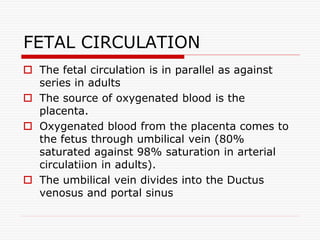
FETAL CIRCULATION
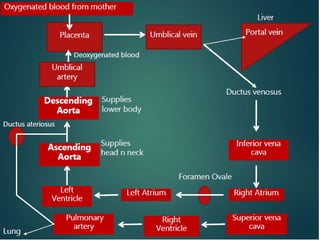
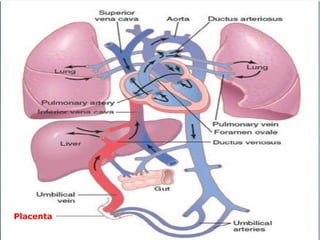
๏ฏ The fetal circulation is in parallel as against
series in adults
๏ฏ The source of oxygenated blood is the
placenta.
๏ฏ Oxygenated blood from the placenta comes to
the fetus through umbilical vein (80%
saturated against 98% saturation in arterial
circulatiion in adults).
๏ฏ The umbilical vein divides into the Ductus
venosus and portal sinus
FETAL RESPIRATION
๏ฏ The fetal lung is an outgrowth of the primitive
foregut.
๏ฏ Full differentiation of the capillary and
canalicular elements of the lungs is apparent
by the 20th week of intrauterine life.
๏ฏ Alveoli develop between 24-26 weeks of fetal
life.
๏ฏ Type II alveolar cells produce surfactant.
๏ฏ Surfactants prevent collapse of alveoli during
expiration by lowering surface tension
๏ฏ Fetus practices breathing by 10 weeks but the
lungs remains collapsedPlacenta
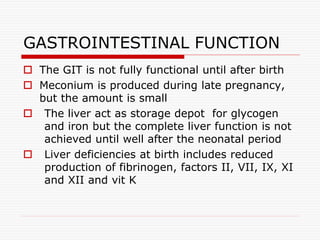
GASTROINTESTINAL FUNCTION
๏ฏ The GIT is not fully functional until after birth
๏ฏ Meconium is produced during late pregnancy,
but the amount is small
๏ฏ The liver act as storage depot for glycogen
and iron but the complete liver function is not
achieved until well after the neonatal period
๏ฏ Liver deficiencies at birth includes reduced
production of fibrinogen, factors II, VII, IX, XI
and XII and vit K
RENAL FUNCTION
๏ฏ The placenta serves as the major regulator of
fluid and electrolyte balance with maternal
lungs and kidneys .
๏ฏ The kidneys assume the homeostatic functional
demand of extrauterine life when the
connection between fetal circulation and the
placenta is interrupted during delivery
CHANGES AT BIRTH
๏ฏ The most obvious effect of birth on the baby is
the loss of placental connection with the
mother.
๏ฏ Hence loss of respiration and metabolic
support.
๏ฏ The baby therefore commences breathing.
๏ฏ Stimulants to respiration.
- a slightly asphyxiated state incident to the
birth process.
- sensory impulses that originate in the
suddenly cooled skin.
- thoracic compression in the vagina.
๏ฏ Breathing usually commences within 20-30
secs of birth.
๏ฏ Initially, there is gasping, followed by normal
respiration.
๏ฏ During the gasps, a markedly negative intra
pleural pressure (-30 to -50 mmHg) is created.
๏ฏ This expands the lungs.
๏ฏ Amniotic fluid in the respiratory tract is drained
or absorbed.
CHANGES AT BIRTH
๏ฏ Dispersion of air into the surfactant-rich liquid
of the mature lungs results in formation of
stable alveoli.
๏ฏ There is increased partial pressure of oxygen in
the alveoli and arterial circulation.
๏ฏ The pH falls as carbondioxide is excreted.
๏ฏ Pulmonary vascular resistance falls to less than
20% of in-utero value.
๏ฏ The right ventricular output is now directed
increasingly to the pulmonary artery.
CHANGES AT BIRTH
๏ฏ With stoppage of blood flow through the
placenta, the systemic vascular resistance is
approximately doubled.
๏ฏ There is significant fall in the pressure of the
right side of the heart but increase in the
pressure on the left side of the heart
CHANGES AT BIRTH
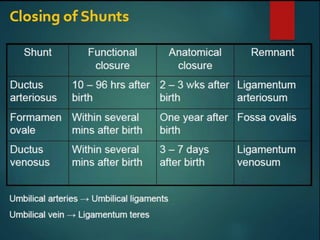
FUNCTIONAL CLOSURE OF
UMBILICAL ARTERIES
๏ฏ Follows contraction of the smooth musculature
in the walls caused by thermal and
mechanical stimuli as well as change in
oxygen tension.
๏ฏ The actual obliteration may take 2 to 3
months.
๏ฏ The distal part forms the medial umbilical
ligament while the proximal portions remain
open as the superior vesical arteries.
CLOSURE OF UMBILICAL VEIN
AND DUCTUS VENOSUS
๏ฏ Occurs shortly after that of umbilical arteries.
๏ฏ Blood from the placenta may pass to the new
born for some time after birth (placental
transfusion).
๏ฏ Obliterated umbilical vein forms the
ligamentum teres hepatis in the lower margin
of the falciform ligament.
๏ฏ The ductus venosus forms the ligamentum
venosum.
CLOSURE OF FORAMEN OVALE
๏ฏ With fall in right atrial pressure and rise in
left atrial pressure, blood attempts to flow
backward through the foramen ovale from
left to right.
๏ฏ The valve closes.
๏ฏ During the first day of life the closure is
reversible.
๏ฏ Crying by the baby may create a shunt.
๏ฏ This accounts for cyanotic periods in the
newborn.
CLOSURE OF FORAMEN OVALE
๏ฏ In 20% of individuals perfect anatomical
closure may not occur (patent foramen ovale).
๏ฏ Even in these individuals pressure differential
still keeps the valve closed.
CLOSURE OF DUCTUS
ARTERIOSUS.
๏ฏ Because of higher aortic pressure than
pulmonary arterial pressure at birth, blood
begins to flow backward from the aorta into
the pulmonary artery through the ductus
arteriosus.
๏ฏ Immediately after birth, there is contraction of
the muscular wall of ductus arteriosus leading
to closure.
๏ฏ Within 1 to 8 days the functional closure is
sufficient to stop this blood flow.
๏ฏ Causes of functional closure.
- Bradykinin released from the
lungs during inflation.
- Increased oxygenation of blood flowing
through the ductus.
๏ฏ Complete anatomical obliteration of ductus
arteriosus by proliferation of the intima may
take 1 to 3 months.
๏ฏ The obliterated ductus arteriosus forms the
ligamentum arteriosum in adult.
CLOSURE OF DUCTUS
ARTERIOSUS.
๏ฏ About 1 in every 5,500 babies the ductus
arteriosus does not close, causing patent
ductus arteriosus.
๏ฏ Failure of closure of ductus may result from
excessive vasodilating prostaglandin
(prostacyclin) in the ductus wall.
๏ฏ Rectal administration of indomethacin, a drug
that inhibits prostaglandin synthesis may close
the ductus in infants.
๏ฏ Closure of ductus before birth causes
pulmonary hypertension.
CLOSURE OF DUCTUS
ARTERIOSUS.
DIFFICULTIES TRANSITIONING
๏ฏ Risk factors
๏ฎ Maternal conditions (advanced age, diabetes,
hypertension, substance abuse)
๏ฎ Fetal conditions (prematurity, postmaturity,
๏ฎ multiple gestation, anomalies)
๏ฎ Antepartum problems (oligohydramnios,
polyhydramnios, placental anomalies)
๏ฎ Delivery (breech, transverse, meconium, maternal
narcotics, difficult delivery)
SEQUELAE OF ABNORMAL
TRANSITION
๏ฏ Patent foramen ovale
๏ฏ Patent ductus arteriosus
๏ฏ Pulmonary hypertension
๏ฏ Respiratory distress syndrome
๏ฏ Meconium aspiration
๏ฏ Diaphragmatic hernia
REFERENCES
1. Hillman NH, Kallapur SG, Jobe AH. Physiology of
transition from intrauterine to extrauterine life. Clinics in
perinatology. 2012 Dec 1;39(4):769-83.
2. Yigit MB, Kowalski WJ, Hutchon DJ, Pekkan K. Transition
from fetal to neonatal circulation: modeling the effect of
umbilical cord clamping. Journal of biomechanics. 2015
Jun 25;48(9):1662-70.
3. Adewale FB. Fetal physiology, respiration, circulation.
NPMCN Update course in Obstetrics and Gynaecology.
2016
4. Adewale FB. Cardio-pulmonary changes at birth and
clinical chemistry of the newborn. NPMCN Update course
in Obstetrics and Gynaecology. 2016
๏ฏ THANK YOU

Physiology of transition

  • 1.
    THE PHYSIOLOGY OF TRANSITION BY DR.AYODELE, NOSRULLAH S FMC, BIRNIN KEBBI
  • 2.
    OUTLINE ๏ฏ INTRODUCTION ๏ฏ FETALPHYSIOLOGY ๏ฏ CHANGES AT BIRTH ๏ฏ SEQUELAE OF ABNORMAL TRANSITION ๏ฏ REFERENCES
  • 3.
    INTRODUCTION ๏ฏ The transitionfrom a fetus to a newborn is the most complex physiologic adaptation that occurs in human experience ๏ฏ It is the summation of multiple rapid organ adaptations that occurs as the baby moves from intrauterine to extrauterine life to ensure the survival of the newborn ๏ฏ These changes are results of some chemical mediators mainly cortisol and catecholamines.
  • 4.
    INTRODUCTION ๏ฏ All organsystems are involved at some level ๏ฏ The major immediate adaptations are the establishment of air breathing concurrently with changes in pressures and flows within the cardiovascular system ๏ฏ Abnormalities in adaptation are frequent following preterm birth or delivery by Caesarean section at term ๏ฏ These abnormalities necessitate assistance in the process of transition
  • 5.
    FETAL RESPIRATION ๏ฏ Thefetal lung is an outgrowth of the primitive foregut. ๏ฏ Full differentiation of the capillary and canalicular elements of the lungs is apparent by the 20th week of intrauterine life. ๏ฏ Alveoli develop between 24-26 weeks of fetal life. ๏ฏ Type II alveolar cells produce surfactant. ๏ฏ Surfactants prevent collapse of alveoli during expiration by lowering surface tension
  • 6.
    FETAL CIRCULATION ๏ฏ Thefetal circulation is in parallel as against series in adults ๏ฏ The source of oxygenated blood is the placenta. ๏ฏ Oxygenated blood from the placenta comes to the fetus through umbilical vein (80% saturated against 98% saturation in arterial circulatiion in adults). ๏ฏ The umbilical vein divides into the Ductus venosus and portal sinus
  • 8.
    FETAL RESPIRATION ๏ฏ Thefetal lung is an outgrowth of the primitive foregut. ๏ฏ Full differentiation of the capillary and canalicular elements of the lungs is apparent by the 20th week of intrauterine life. ๏ฏ Alveoli develop between 24-26 weeks of fetal life. ๏ฏ Type II alveolar cells produce surfactant. ๏ฏ Surfactants prevent collapse of alveoli during expiration by lowering surface tension ๏ฏ Fetus practices breathing by 10 weeks but the lungs remains collapsedPlacenta
  • 9.
    GASTROINTESTINAL FUNCTION ๏ฏ TheGIT is not fully functional until after birth ๏ฏ Meconium is produced during late pregnancy, but the amount is small ๏ฏ The liver act as storage depot for glycogen and iron but the complete liver function is not achieved until well after the neonatal period ๏ฏ Liver deficiencies at birth includes reduced production of fibrinogen, factors II, VII, IX, XI and XII and vit K
  • 10.
    RENAL FUNCTION ๏ฏ Theplacenta serves as the major regulator of fluid and electrolyte balance with maternal lungs and kidneys . ๏ฏ The kidneys assume the homeostatic functional demand of extrauterine life when the connection between fetal circulation and the placenta is interrupted during delivery
  • 11.
    CHANGES AT BIRTH ๏ฏThe most obvious effect of birth on the baby is the loss of placental connection with the mother. ๏ฏ Hence loss of respiration and metabolic support. ๏ฏ The baby therefore commences breathing. ๏ฏ Stimulants to respiration. - a slightly asphyxiated state incident to the birth process. - sensory impulses that originate in the suddenly cooled skin. - thoracic compression in the vagina.
  • 12.
    ๏ฏ Breathing usuallycommences within 20-30 secs of birth. ๏ฏ Initially, there is gasping, followed by normal respiration. ๏ฏ During the gasps, a markedly negative intra pleural pressure (-30 to -50 mmHg) is created. ๏ฏ This expands the lungs. ๏ฏ Amniotic fluid in the respiratory tract is drained or absorbed. CHANGES AT BIRTH
  • 13.
    ๏ฏ Dispersion ofair into the surfactant-rich liquid of the mature lungs results in formation of stable alveoli. ๏ฏ There is increased partial pressure of oxygen in the alveoli and arterial circulation. ๏ฏ The pH falls as carbondioxide is excreted. ๏ฏ Pulmonary vascular resistance falls to less than 20% of in-utero value. ๏ฏ The right ventricular output is now directed increasingly to the pulmonary artery. CHANGES AT BIRTH
  • 14.
    ๏ฏ With stoppageof blood flow through the placenta, the systemic vascular resistance is approximately doubled. ๏ฏ There is significant fall in the pressure of the right side of the heart but increase in the pressure on the left side of the heart CHANGES AT BIRTH
  • 15.
    FUNCTIONAL CLOSURE OF UMBILICALARTERIES ๏ฏ Follows contraction of the smooth musculature in the walls caused by thermal and mechanical stimuli as well as change in oxygen tension. ๏ฏ The actual obliteration may take 2 to 3 months. ๏ฏ The distal part forms the medial umbilical ligament while the proximal portions remain open as the superior vesical arteries.
  • 16.
    CLOSURE OF UMBILICALVEIN AND DUCTUS VENOSUS ๏ฏ Occurs shortly after that of umbilical arteries. ๏ฏ Blood from the placenta may pass to the new born for some time after birth (placental transfusion). ๏ฏ Obliterated umbilical vein forms the ligamentum teres hepatis in the lower margin of the falciform ligament. ๏ฏ The ductus venosus forms the ligamentum venosum.
  • 17.
    CLOSURE OF FORAMENOVALE ๏ฏ With fall in right atrial pressure and rise in left atrial pressure, blood attempts to flow backward through the foramen ovale from left to right. ๏ฏ The valve closes. ๏ฏ During the first day of life the closure is reversible. ๏ฏ Crying by the baby may create a shunt. ๏ฏ This accounts for cyanotic periods in the newborn.
  • 18.
    CLOSURE OF FORAMENOVALE ๏ฏ In 20% of individuals perfect anatomical closure may not occur (patent foramen ovale). ๏ฏ Even in these individuals pressure differential still keeps the valve closed.
  • 19.
    CLOSURE OF DUCTUS ARTERIOSUS. ๏ฏBecause of higher aortic pressure than pulmonary arterial pressure at birth, blood begins to flow backward from the aorta into the pulmonary artery through the ductus arteriosus. ๏ฏ Immediately after birth, there is contraction of the muscular wall of ductus arteriosus leading to closure. ๏ฏ Within 1 to 8 days the functional closure is sufficient to stop this blood flow.
  • 20.
    ๏ฏ Causes offunctional closure. - Bradykinin released from the lungs during inflation. - Increased oxygenation of blood flowing through the ductus. ๏ฏ Complete anatomical obliteration of ductus arteriosus by proliferation of the intima may take 1 to 3 months. ๏ฏ The obliterated ductus arteriosus forms the ligamentum arteriosum in adult. CLOSURE OF DUCTUS ARTERIOSUS.
  • 21.
    ๏ฏ About 1in every 5,500 babies the ductus arteriosus does not close, causing patent ductus arteriosus. ๏ฏ Failure of closure of ductus may result from excessive vasodilating prostaglandin (prostacyclin) in the ductus wall. ๏ฏ Rectal administration of indomethacin, a drug that inhibits prostaglandin synthesis may close the ductus in infants. ๏ฏ Closure of ductus before birth causes pulmonary hypertension. CLOSURE OF DUCTUS ARTERIOSUS.
  • 22.
    DIFFICULTIES TRANSITIONING ๏ฏ Riskfactors ๏ฎ Maternal conditions (advanced age, diabetes, hypertension, substance abuse) ๏ฎ Fetal conditions (prematurity, postmaturity, ๏ฎ multiple gestation, anomalies) ๏ฎ Antepartum problems (oligohydramnios, polyhydramnios, placental anomalies) ๏ฎ Delivery (breech, transverse, meconium, maternal narcotics, difficult delivery)
  • 23.
    SEQUELAE OF ABNORMAL TRANSITION ๏ฏPatent foramen ovale ๏ฏ Patent ductus arteriosus ๏ฏ Pulmonary hypertension ๏ฏ Respiratory distress syndrome ๏ฏ Meconium aspiration ๏ฏ Diaphragmatic hernia
  • 25.
    REFERENCES 1. Hillman NH,Kallapur SG, Jobe AH. Physiology of transition from intrauterine to extrauterine life. Clinics in perinatology. 2012 Dec 1;39(4):769-83. 2. Yigit MB, Kowalski WJ, Hutchon DJ, Pekkan K. Transition from fetal to neonatal circulation: modeling the effect of umbilical cord clamping. Journal of biomechanics. 2015 Jun 25;48(9):1662-70. 3. Adewale FB. Fetal physiology, respiration, circulation. NPMCN Update course in Obstetrics and Gynaecology. 2016 4. Adewale FB. Cardio-pulmonary changes at birth and clinical chemistry of the newborn. NPMCN Update course in Obstetrics and Gynaecology. 2016
  • 26.