Dr S.KRITHIKA MDDr I.GURUBHARATH MD PhD
BPP
 The BPP was developed
by Manning in 1980 and
incorporates:
 Fetal tone,
 Movements,
 Breathing,
 Amniotic fluid,
 Non stress test
 Each of the five
 components is assigned
a score of either 2
(normal or present) or
 0 (abnormal, absent, or
insufficient)
 A compromised fetus typically exhibits
 Loss of HR accelerations,
 Decreased body movement and breathing,
 Hypotonia,
 Decreased amniotic fluid volume.
 Non invasive
 Accurate in predicting fetal hypoxemia,acidemia
 The modified BPP combines the
 NST,
as a short-term indicator of fetal acid-base status,
 AFI
is the sum of measurements of the deepest cord-free
amniotic fluid pocket in each of the abdominal
quadrants, as an indicator of long-term placental
function
 Women with high-risk factors for significant fetal acidemia.
 Testing may be initiated as early as 26 weeks’ gestation when clinical
conditions suggest earlyfetal compromise is likely.
 Initiating testing at 32 to 34 weeks is appropriate for most pregnancies
at increased risk for stillbirth.
 A reassuring test (e.g., BPP of 8-10/10) should be repeated periodically
(weekly or twice weekly) until delivery when the high-risk condition
persists.
 Any significant deterioration in the clinical status
 (e.g., worsening preeclampsia, decreased fetal activity) requires fetal
reevaluation, regardless of the time elapsed since the last test.
 Severe oligohydramnios (no vertical pocket >2 cm or AFI ≤5 cm)
requires either delivery or close maternal and fetal surveillance.
DOPPLER
 Doppler ultrasound plays a fundamental role in the
diagnosis of IUGR
 Doppler sonography of the UA and MCA, in combination
with biometry, provides the best tool to identify small
fetuses at risk for an adverse outcome.
 In addition, Doppler ultrasound studies of the fetal
cardiovascular system allow assessment of the blood flow
redistribution observed in IUGR.
 This process is mainly characterized by an increased UA
and a decreased MCA pulsatility index, which suggests
increased vascular resistance of the UA and cerebral
vasodilation.
 Various aspects of blood flow in circulation, including the
presence and direction of flow, velocity profile, volume of
flow, and impedance to flow
 The essential condition for the assessment of true velocity
depends on the angle between the ultrasound beam and
the direction of the blood flow, which needs to be as close
as possible to 0 degrees
 Systolic-to-diastolic (S/D) ratio = Peak systolic
velocity/End diastolic velocity (PSV/EDV)
 Resistive index (RI) = (PSV − EDV)/PSV
 Pulsatility index (PI) = (PSV − EDV)/Mean velocity
UMBILICAL ARTERY
 Umbilical arterial (UA) Doppler assessment is
used in surveillance of fetal well-being in the third
trimester of pregnancy.
 Abnormal umbilical artery Doppler is a marker
of uteroplacental insufficiency and
consequent intrauterine growth restriction (IUGR) or
suspected pre-eclampsia.
 Doppler ultrasound
 The Doppler indices measured at the fetal end the
free loop and the placental end of the umbilical cord
are different with the impedance highest at the fetal
end.
 The changes in the indices are likely to be seen at the
fetal end first. Ideally the measurements should be
made in the free cord.
Waveform
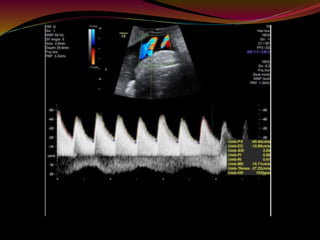
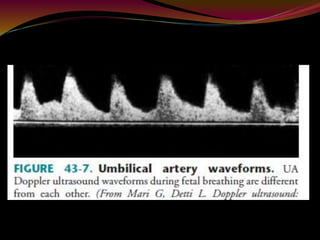
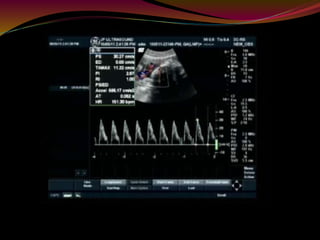
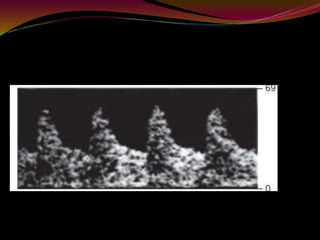
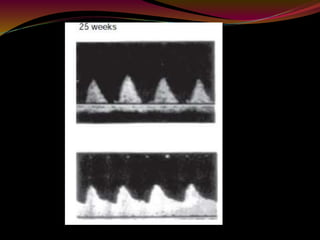
 “Saw tooth" pattern with flow always in the forward
direction.
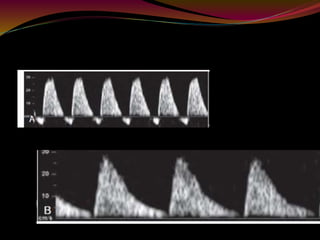
 An abnormal waveform shows absent or reversed
diastolic flow.
 Before the 15th week, absent diastolic flow may be a
normal finding
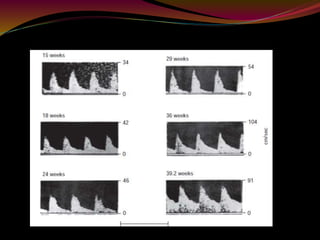
 The diastolic component increases with advancing
gestation because of a decreased placental vascular
resistance.
 The Doppler indices have been found to decline
gradually with gestational age:
 S/D ratio mean value decreases from 3.560 to 2.511
 RI mean value decreases from 0.756 to 0.609
 PI mean value decreases from 1.270 to 0.967
SEVERITY
 In growth-retarded fetuses and fetuses developing
intrauterine distress, the umbilical artery blood
velocity waveform usually changes in a progressive
manner as below
 reduction in end diastolic flow: increasing RI values,
PI values and S/D ratio
 absent end diastolic flow (AEDF): RI = 1
 reversal of end diastolic flow (REDF)
MCA
 The middle cerebral artery is the vessel of choice to
 easy to identify,
 is highly reproducible
 provides information on the brain-sparing effect.
 In addition, the MCA can be studied easily with an
angle of 0 degrees between the ultrasound beam and
the direction of blood flow providing information on
the true velocity
 The MCA should be sampled soon after its origin from
the ICA
 Reference values for the middle cerebral artery
pulsatility index (MCA PI) change throughout
gestation
 The lower PI values early and late in gestation may be
caused by the increased metabolic requirements of the
brain during these periods.
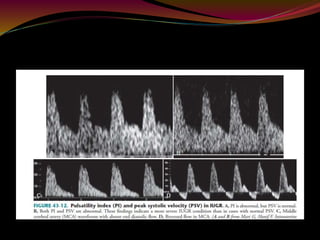
 IUGR is associated with increased blood flow to the fetal
Brain.
 This increase in blood flow during diastole can be
demonstrated by Doppler ultrasound of the MCA.
 This effect is termed the brain-sparing effect and is
demonstrated by a lower value of the MCA PI
Take home points
 BPP
 MCA (PI increases)-decreased diastolic flow when
compared to umbilical artery
 UA(PI decreases)-increased diastolic flow
 Fetal breathing
 No compression
 Same site for measurement
 Thank you

Fetal biophysical profile

  • 1.
    Dr S.KRITHIKA MDDrI.GURUBHARATH MD PhD
  • 2.
    BPP  The BPPwas developed by Manning in 1980 and incorporates:  Fetal tone,  Movements,  Breathing,  Amniotic fluid,  Non stress test  Each of the five  components is assigned a score of either 2 (normal or present) or  0 (abnormal, absent, or insufficient)
  • 3.
     A compromisedfetus typically exhibits  Loss of HR accelerations,  Decreased body movement and breathing,  Hypotonia,  Decreased amniotic fluid volume.  Non invasive  Accurate in predicting fetal hypoxemia,acidemia
  • 6.
     The modifiedBPP combines the  NST, as a short-term indicator of fetal acid-base status,  AFI is the sum of measurements of the deepest cord-free amniotic fluid pocket in each of the abdominal quadrants, as an indicator of long-term placental function
  • 7.
     Women withhigh-risk factors for significant fetal acidemia.  Testing may be initiated as early as 26 weeks’ gestation when clinical conditions suggest earlyfetal compromise is likely.  Initiating testing at 32 to 34 weeks is appropriate for most pregnancies at increased risk for stillbirth.  A reassuring test (e.g., BPP of 8-10/10) should be repeated periodically (weekly or twice weekly) until delivery when the high-risk condition persists.  Any significant deterioration in the clinical status  (e.g., worsening preeclampsia, decreased fetal activity) requires fetal reevaluation, regardless of the time elapsed since the last test.  Severe oligohydramnios (no vertical pocket >2 cm or AFI ≤5 cm) requires either delivery or close maternal and fetal surveillance.
  • 8.
    DOPPLER  Doppler ultrasoundplays a fundamental role in the diagnosis of IUGR  Doppler sonography of the UA and MCA, in combination with biometry, provides the best tool to identify small fetuses at risk for an adverse outcome.  In addition, Doppler ultrasound studies of the fetal cardiovascular system allow assessment of the blood flow redistribution observed in IUGR.  This process is mainly characterized by an increased UA and a decreased MCA pulsatility index, which suggests increased vascular resistance of the UA and cerebral vasodilation.
  • 9.
     Various aspectsof blood flow in circulation, including the presence and direction of flow, velocity profile, volume of flow, and impedance to flow  The essential condition for the assessment of true velocity depends on the angle between the ultrasound beam and the direction of the blood flow, which needs to be as close as possible to 0 degrees  Systolic-to-diastolic (S/D) ratio = Peak systolic velocity/End diastolic velocity (PSV/EDV)  Resistive index (RI) = (PSV − EDV)/PSV  Pulsatility index (PI) = (PSV − EDV)/Mean velocity
  • 10.
    UMBILICAL ARTERY  Umbilicalarterial (UA) Doppler assessment is used in surveillance of fetal well-being in the third trimester of pregnancy.  Abnormal umbilical artery Doppler is a marker of uteroplacental insufficiency and consequent intrauterine growth restriction (IUGR) or suspected pre-eclampsia.
  • 11.
     Doppler ultrasound The Doppler indices measured at the fetal end the free loop and the placental end of the umbilical cord are different with the impedance highest at the fetal end.  The changes in the indices are likely to be seen at the fetal end first. Ideally the measurements should be made in the free cord.
  • 12.
    Waveform  “Saw tooth"pattern with flow always in the forward direction.  An abnormal waveform shows absent or reversed diastolic flow.  Before the 15th week, absent diastolic flow may be a normal finding  The diastolic component increases with advancing gestation because of a decreased placental vascular resistance.
  • 13.
     The Dopplerindices have been found to decline gradually with gestational age:  S/D ratio mean value decreases from 3.560 to 2.511  RI mean value decreases from 0.756 to 0.609  PI mean value decreases from 1.270 to 0.967
  • 14.
    SEVERITY  In growth-retardedfetuses and fetuses developing intrauterine distress, the umbilical artery blood velocity waveform usually changes in a progressive manner as below  reduction in end diastolic flow: increasing RI values, PI values and S/D ratio  absent end diastolic flow (AEDF): RI = 1  reversal of end diastolic flow (REDF)
  • 19.
  • 20.
     The middlecerebral artery is the vessel of choice to  easy to identify,  is highly reproducible  provides information on the brain-sparing effect.  In addition, the MCA can be studied easily with an angle of 0 degrees between the ultrasound beam and the direction of blood flow providing information on the true velocity  The MCA should be sampled soon after its origin from the ICA
  • 21.
     Reference valuesfor the middle cerebral artery pulsatility index (MCA PI) change throughout gestation  The lower PI values early and late in gestation may be caused by the increased metabolic requirements of the brain during these periods.  IUGR is associated with increased blood flow to the fetal Brain.  This increase in blood flow during diastole can be demonstrated by Doppler ultrasound of the MCA.  This effect is termed the brain-sparing effect and is demonstrated by a lower value of the MCA PI
  • 27.
    Take home points BPP  MCA (PI increases)-decreased diastolic flow when compared to umbilical artery  UA(PI decreases)-increased diastolic flow  Fetal breathing  No compression  Same site for measurement
  • 28.