Ferrara Ring (ICRs)
A-Z
PAULO FERRARA, MD, PHD
Paulo Ferrara Eye Clinic
Ferrara Ophthalmics
Belo Horizonte – MG - Brasil
Declaration of Conflict of Interest
•Ferrara Ophthalmics
•Ferrara e Hijos
•AJL
•Intacs
1950 - Barraquer, J., Intracorneal implants
1966 - Blavatskaya - Corneal rings from corneal tissue
1986 - Simon, G. - Silicon Rings
1987 - Fleming - Adjustable rings
HISTORY
SHAPE ?
SIZE?
OPTICAL ZONE?
DEPTH?
TOLERANCE?
INFLAMATORY RESPONSE?
STABILITY?
RANGE OF CORRECTION?
SURGICAL TECHNIQUE ?
QUESTIONS TO BE ANSWERER 1985
FERRARA RING
1986
Pocket incision
Intra Corneal Ring Segments Research
ICRS: Well Tolerated in the Deep Stroma
1
2
3
3
2
1
Intra Corneal Ring Segments Research
ICRS: Well Tolerated in the Deep Stroma
Intra Corneal Ring Segments Research
Reversibility
Superficial stroma
Deep stroma
Localization: 80% corneal
thickness
Why deep?
MYOPIA CORRECTION
Remove tissue of the center of the cornea;
Add tissue to the periphery of the cornea.
HYPEROPIA CORRECTION
Add tissue to the center of the cornea
Remove tissue from the periphery of the
cornea
BARRAQUER’s THICKCESS LAW
The larger (diameter) the ring
the lesser the correction
The thicker the ring
the greater the correction
BLAVATSKAYA’S LAW
6
6,5
7
7,5
8
8,5
9
9,5
10
10,5
11
1,3
2
2,7
3,4
4,1
0
2
4
6
8
10
12
14
200 250 300 350 400 450
Diopters
Ferrara
(OZ 5)
Intacs
(OZ 7)
More ThicKCess
More Correction
250 
100 D
150 D
300 D
ICRS ThicKCess
Less ThiKCess
Less Correction
150 
Blavastkaya
FERRARA RING
1991
Lamellar keratectomy
One piece ring
FERRARA RING
1994
TUNELIZATION INCISION
1994
TUNNELIZATION TECHNIQUE
Ferrara Ring Nomogram
(Myopia)
 RING THICKCESS SPHERICAL EQ
AF5/15 µ -2 to -4
AF5/20 µ -4 to -6
AF5/25 µ -6 to -8
AF5/30 µ -8 to -10
AF5/35 µ -10 to -12
AF = Ferrara Ring 5 = Ring Diameter
µ = micra
1994 Ferrara ring 350°
For high myopia
(First Generation)
11 years post op
MYOPIC GROUP
Very high
myopic correction
Poor previsibility
FERRARA RING NOMOGRAM
First generation (1997 - 2003): spherical equivalent
Eye 1 Eye 2
Refraction: -10.00 D Refraction: -10.00 D
Are these the same?
NO !
cornea hypercorrection in axial myopia
THE RING AS A PRIMARY REFRACTIVE
PROCEDURE SHOWED LOW PREVISIBILITY
DESPITE LONG TERM STABILITY AND
GOOD VISUAL PERFORMANCE.
SAFETY AND LONG TERM STABILITY
IN DIFFICULT CASES SUGGESTED THEIR
APPLICATION IN CONTACT LENS
INTOLERANT KERATOCONUS PATIENTS
1995
MOVING TO OTHER APPLICATIONS...
1995
Ferrara ring as an orthopedic procedure
FERRARA RING
FOR KERATOCONUS
1996
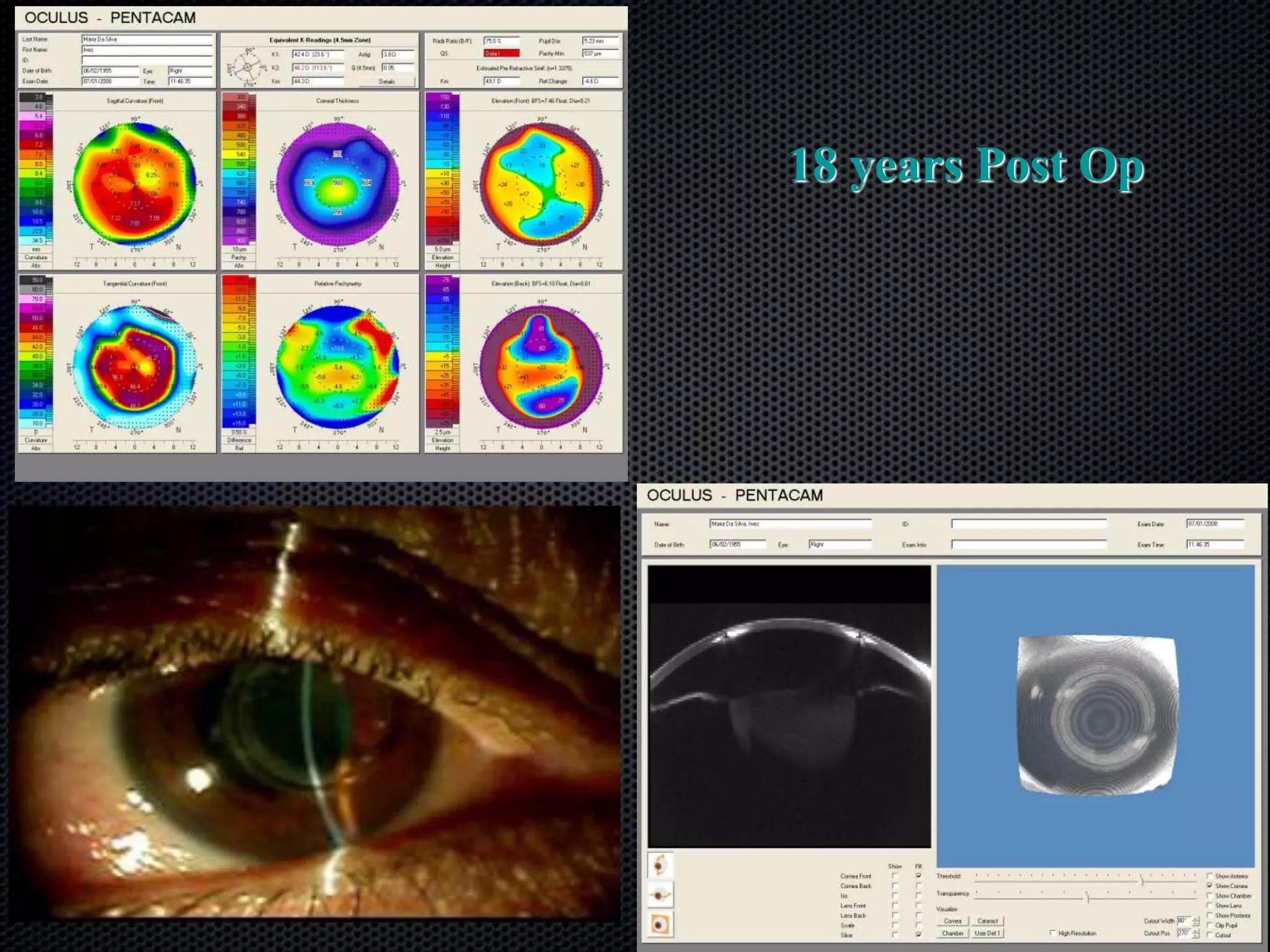
I.M.S. Pre Op.
SURGERY: 08/20/1996
AF5.60.160/25 RE.
UCVA: 20/400
BSCVA: 20/40
Refraction: –5,50 –1,00 x 10
keratometry: 46,00 / 46,50
18 years Post Op
Material PMMA
YELLOW FILTER
Apical Diameter 5mm
Triangular cross section =
PRISMATIC EFFECT
FLAT BASIS WIDTH 0,6 MM
Variable arch lengh segments
Hole in each extremity
FERRARA RING
CHARACTERISTICS
SECOND
GENERATION
TWO RING
SEGMENTS
1996
RING SEGMENTS
THIRD GENERATION
RING DESIGN
IMPROVED SURFACE QUALITY AND FINISHING
INCLUSION OF A HOLE IN EACH EXTREMITY
DEFINITION OF A NOMOGRAM ON A
STATISTICAL BASIS
ASYMMETRIC
SEGMENTS
AF
5/20
The flat basis is responsible for the induction of the astigmatism
Evaluation of ring segments
position in the corneal stroma
with respect to the visual axis
and its depth, and thus providing
a better underestanding of the
results
2004
Indications
 Primary or Orthopedic indication
 Corneal irregularities
 Keratoconus
 Pellucid Marginal Degeneration
 IATROGENIC
 PKP
 PRK; LASIK; RK
 TRAUMA
 SECUNDARY
 REFRACTIVE
Indications
GOALS:
• Stabilize the evolution and/or progression
• Reduce corneal asymmetry
• Preparing for optical treatment with stable cornea
Keratoconus
Prevalence: 1:2000*
*Siganos., 2002
Keratoconus
Inclusion Criteria
• Young patients
• Contact lens intolerant keratoconus
• Evidence of evolution of the corneal ectasia,
despite CL tolerance
• Reduce CL dependency
Inclusion Criteria
Patients with good CDVA, good pachymetry and low asymmetry
Refractive purpose (best cases)
Patients with bad CDVA, reasonable pachymetry and asymmetry
Regularize corena
Patients with bad CDVA, pachymetry and asymmetry, corneal
scars
Lamellar keratoplasty
Exclusion Criteria
• Hidropsia
• Severe corneal opacities
• Ocular or sistemic disease (vernal keratoconjuntivitis,
Severe dry eye(Steven Johnson, Sjogren syndrome, etc)
• Young patients presenting VA ≥ 20/40 CDVA.
• These patients need to be observed every three
months to detect the progression of the condition.
Patient Selection
• Assessment of visual function
• Assessment of CDVA, pH VA plus spheric refraction
• Ectasia classification
• Management
Clinical Case
ICLK
G.M., male, 16 y.o.
1st. Visit 04/01/2011
Ferrara ring RE
LE KC III ( CXL)
Bad visual acuity LE
Ferrara ring implantation LE 07/11/2011 (manual technique)
Clinical Case
CDVA 20/60 CDVA20/30 21/08/201431/03/2011
I.R.G., male, 15 yo
1st. Visit 01/07/2008
CDVA 20/25 both eyes
KC in evolution RE operated in 01/17/2008 (manual technique)
RE UDVA 06 y.o. POST OP 20/20
Last Visit in 08/08/2014
KC in evolution LE operated in 08/08/2014 ( FEMTOSECOND)
LE UDVA post op IMMEDIATE 20/30
Clinical Case
CDVA Pre op20/25 UDVA Post op20/20
ICRS implant in 01/17/2008 (manual technique)
Clinical Case
ICRS implant in 08/08/2014 (Femtosecond)
Comparative Topometric Map 2008 and 2014
Clinical Case
Preop CDVA20/30 Post op CDVA20/20
Clinical Case
Pellucid Marginal Degenration ( PMD)
E.B.,male, 62y.o.
PMD ICL
Visit 04/03/2010
RE +3,50-6,00 x 85 20/400
LE +3,00-4,50 x 95 20/40-
Clinical Case
Pellucid Marginal Degenration ( PMD)
Ferrara ring implant in RE (04/03/2010)
CDVA in 07/04/2010 (33º DPO)
RE -1,50-5,00 x 95º 20/80-
Phaco + LIO in RE
15/06/2010
CDVA in 07/04/2010 (22º DPO)
RE +0,50-3,50 x 85º 20/30
Clinical Case
Pellucid Marginal Degenration (PMD)
+1,50 -1,00 x 95º 20/30+3,50 -6,00 x 85 20/400
10/09/2010
Clinical Case
Pellucid Marginal Degenration ( DMP)
Last Visit
18/02/2013
RE +1,75-4,25 x 85º 20/20
LE +3,75-2,75 x 95º 20/20
Clinical Case
Post RK ring implantation
Y.A.P.,male, 53y.o.
Underwent RK 1992
Lasek 1998
KC 4 years later
AF surgery LE (14/06/2011)
Clinical Case
Post RK ring implantation
Pre op
CDVA 08/08/2011 (53º DPO)
LE -3,00 -2,50 x 85º 20/60
CDVA in 14/06/2011
LE -2,50 -5,00 x 90 20/80
Ferrara ring LE (14/06/2011)
Post RK ring implantation
Clinical Case
Clinical Case
Post RK ring implantation
-2,50 -5,00 x 90 20/80 -3,00 -2,50 x 85º 20/60
53º
DPO
Clinical Case
High astigmatism post PKP
Clinical Case
M.V.T.P.,female, 32y.o.
ICLK
PKP LE followed by
Ferrara ring implantation
1996
Ferrara ring for corneal
irregularities
Clinical Case
18 years AFTER
Phaco+ Lio LE
Post op
CDVA 20/25
Clinical Case
Ferrara ring and ICL
Combination of Techniques
N.O.R.,female, 23y.o.
ICL
Ferrara ring implantation 1 year post op RE
VA RE -8,50 -1,00 x135 20/30+2
15/05/2014
AV preop -8,50 -1,00 x 135 20/30+2
AV post op Plano 20/40
ICL Implantation after FR in RE 07/04/2014
Clinical Case
Ferrara ring and ICL
LASIK in 2002
Clinical Case
Unseccessful Contact LensTest
CXL
Ferrara ring Implatation
pH VA: RE 20/100 LE 20/80
UCVA: RE<20/400 LE<20/100
Imediate post op
UCVA RE 20/100 LE 20/80
Nomogram Based on Corneal
Astigmatism
0%
25%
33%
50%
Mapa
Distribution of
the ectasia
Description
Entire ectasia is located on
one side of the cornea
75%
75% of the ectasia is
located on one side of the
cornea
66% of the ectasia is
located on one side of the
cornea
50%
The ectasia is symmetrically
distributed over the cornea
100%
66%
G.M.H.S.,male, 19 y.o.
UCVA RE 20/20
LE< 20/400
20/80 (PH)
biomicroscopy
Grade II KC LE
WHAT TO DO?
LC RGP ???
CXL?
RINGS???
TYPE
NOMOGRAM
Segmentosasimétricos
25/75%
up para 2,00 D 01 segt of 15
2,25 TO 4,00D 01 segt of 20
4,25 TO 6,00D 01 segt of 25
6,25 TO 8,00D 01 segt of 30
8,25 TO 10,00D 02 segts 15/25
10,25 TO 12,00D 02 segts 20/30
.
FERRARA RING
01 SEGMENT 160/25
INCISION 90
DEPTH 450 µm
surgery: 06/26/2008
Last visit (09/26/08):
UCVA 20/80
BSCVA 20/40
MANIFEST Rx:
+0.50 -1.50 x 10⁵
L.F.A., female, 28 y.o
KC III LE
TYPE 3
Pre op Data 06/09/2008
MANIFEST Rx
LE: -14.00 -2.50 x 180
BSCVA
LE: 20/80
NOMOGRAM
Asymmetric Astigmatism
33/66%
Up TO 2,00 D 01 segt 15
2,25 TO 4,00D 02 segts 15/20
4,25 TO 6,00D 02 segts 20/25
6,25 TO 8,00D 02 segts 25/30
SURGICAL STRATEGY
2 AFR 160/20
160/25
Incision 75º
Depth 480 µm
L.F.A., female, 28 y.o.
KC III LE
TYPE 3
Post op Data 09/30/2008
MANIFEST Rx
LE: -9.00 sph
BSCVA
LE: 20/40
F.B.S., male, 19 y.o.
KC II
TYPE 4
Pre op data 07/31/2007
UCVA 20/200
BSCVA 20/200
MANIFEST Rx
IMPOSSIBLE
Central
Symmetric Bow-tie
Up to 1,00D 02 segts of 15
1,25 to 2,00D 02 segts of 20
2,25 to 3,00D 02 segts of 25
3,25 to 4,00D 02 segts of30
Surgical Strategy
2 AFR 160/20
Incision 60º
Depth 440 µm
F.B.S., male,
19 y.o.
KC II
TYPE 4
Post op data
09/30/2008
UCVA 20/20
NIPPLE KC
A.M.A, 30 y.o., male
Ectasia Post PRK
Pre op date 23/04/2008
BSCVA = <20/400
MANIFEST Rx+1.00 -6.50 X 140
Contact lens intolerant
NIPPLE TYPE
Central
nipple
210 Segments
Up to 2,50 D 01 segt of 15
2,75 to 4,00 D 01 segt of 20
4,25 to 5,75 D 01 segt of 25
6,00 to 8,00 D 01 segt of 30
3,79
5,79
8,01
2,52
-
1,00
2,00
3,00
4,00
5,00
6,00
7,00
8,00
9,00
Segm
ento
15
Segm
ento
20
Segm
ento
25
Segm
ento
30
Surgical Strategy
01 SEGMENT 210/25
A.M.A 30 yo male
Post op data (04/08/2008)
MANIFEST Rx-0.50 -2.50 x 90
BSCVA = 20/30
FERRARA RING NOMOGRAMA
Third generation (2006 - 2009):Topografic astigmatism
Eye1 Eye2
Keratometry: 42.00 x 47.00 D
Are the same?
NO !
Same topografic astigmatism- different changes after the ICRS implantation
Keratometry: 52.00 x 57.00 D
PAULO FERRARA, MD, PhD
LEONARDO TORQUETTI, MD, PhD
GUILHERME FERRARA, MD
JESUS MERAYO-LLOVES, MD,PhD
PAULO FERRARAEYE CLINIC
BELO HORIZONTE – MG
Comparison of clinical Results after implantation of
ring segments using two different NOMOGRAMS:
Corneal topographic astigmatism vs asphericity
Results
Preoperative and post operative BCVA, according to
keartoconus stage
TA = parapograficoastigmatismo - Q = Asfericidad
Results
TA Q
Preop Postop p Preop Postop p
Asphericty (Q) -0.88 -0.35 0.000 -0,77 -0,13 0.000
Keratometry (D) 49.18 45.72 0.000 48,91 45,54 0.000
Pachymetry (μm) 448 465 0.000 447 465 0.000
160 arc ring
Results
TA Q
Preop Post op p Preop Post op p
Asphericity(Q) -1.17 -0.56 0.000 -0,89 -0,40 0.000
Keratometry(D) 51.92 48.10 0.000 52,82 48,87 0.000
Pachymetry (μm) 418 435 0.000 423 445 0.000
210 arc ring
There’s a tendency to implant less tissue to achieve the
same (or better) correction than the past;
Value of Q = Quality of the vision
NOMOGRAM
SELECTION OF THE RING BASED ON
CORNEAL ASPHERICITY
Corneal Eccentricity (E-value)
Define the shape of the cornea (conic section)
Center of the cornea flattening to the periphery
(Q= - e2)
Behavior of the Asphericity
Healthy and ectasic cornea
What is prolate, and oblate?
Radius of curvature
Sphere: Same radius of curvature
Prolate surface (negative Q), periphery radius > center
radius
Oblate surface (positive Q), periphery radius < center
radius
Behavior of the Asphericity
Healthy and ectasic cornea
•Corneal Asphericity (Q) –shape of the
cornea;
•Oblate…………………….Prolate;
• “Normal”:lightly prolate
•Keratoconus: hiperprolate cornea;
• Normal Value of Q: - 0.231
Asphericity
1. Yebra-Pimentel E, González-Méijome JM, Cervino A, et al. Asfericidadcornealen una
poblácion de adultos jóvenes. Implicaciones clínicas. ArchSocEspOftalmol 2004: 79:385-392
Keratoconus (KC) Phenotypes
Central KC:
Hiperprolate (nipple)
High regular astigmatism (bow-tie)
Paracentral KC (oval)
Morphological Classification
KC Classification for ICRS
Other ectasias Phenotypes
Pellucid Marginal degeneration (DMP)
Pelucid “Like”
Morphological Classification
KC Classification for ICRS
Spherical Surface (Q = 0)
Several focal points (More light bean refracted at the
Periphery than in thecenter)
Behavior of the Asphericity
Healthy and ectasic cornea
e2 = 0
SA = +0.30 µm
Behavior of the Asphericity
Healthy and ectasic cornea
Prolate Surface(Q < 0)
Single focal point (reduction of spherical aberration)
e2> 0
SA ≈ 0.0 µm
e2≈+0.60
Behavior of the Asphericity
Healthy and ectasic cornea
Oblate surface (Q > 0)
Many focal points (Increase in spherical aberration)
e2< 0
SA > 0.30 µm
•High reproducibility between the same devices
But poor reproducibility between different devices
!
•Different topographers can provide different
values in the same patient. (each unit has its own
reference point)
Asphericity
Retrospective Study
165 eyes operated between january and luly of 2013. (Dr. Paulo Ferrara Eye Clinic)
Groups (keratoconus grade*)
Group I – Grade I keratoconus (Km < 48 D)
Group II –Grade II keratoconus(48 < Km < 52 D)
Group III –Grade III keratoconus(52 < Km < 58 D)
Group IV –Grade IV keratoconus (Km > 59 D
Group V –Control
Evaluation of SimK. Maximunkeratometry and conrealasphericity at 20º, 25º, 30, 35º e40º.
(Pentacam)
BehavioroftheAsphericity
Healthyandectasiccornea
*Ferrara-Amsler
Results
Behavior of the Asphericity
Healthy and ectasic cornea
Mean corneal asphericity
n = 38 EYES
-0.60
-0.50
-0.40
-0.30
-0.20
-0.10
0.00
20 25 30 35 40
Normal Corneas
Results
Behavior of the Asphericity
Healthy and ectasic cornea
Mean corneal asphericity
Km < 48 D
n = 54 EYES
-0.63
-0.61
-0.59
-0.57
-0.55
-0.53
-0.51
-0.49
-0.47
-0.45
20 25 30 35 40
KCN 1
KCN 1
Results
Behavior of the Asphericity
Healthy and ectasic cornea
Mean corneal asphericity
48 < Km < 52 D
n = 43 EYES
-1.20
-1.10
-1.00
-0.90
-0.80
-0.70
-0.60
20 25 30 35 40
KCN 2
KCN 2
Results
Behavior of the Asphericity
Healthy and ectasic cornea
Mean corneal asphericity
52 < Km < 58 D
n = 38 EYES
-1.55
-1.45
-1.35
-1.25
-1.15
-1.05
-0.95
-0.85
20 25 30 35 40
KCN 3
KCN 3
Results
Behavior of the Asphericity
Healthy and ectasic cornea
Mean corneal asphericity
Km > 58 D
n = 7 EYES
-1.80
-1.70
-1.60
-1.50
-1.40
-1.30
-1.20
-1.10
-1.00
20 25 30 35 40
KCN 4
KCN 4
Results
Behavior of the Asphericity
Healthy and ectasic cornea
Asphericity: Healthy vs ectasic cornea
-1.80
-1.60
-1.40
-1.20
-1.00
-0.80
-0.60
-0.40
20 25 30 35 40
Corneas Normais
KCN 1
KCN 2
KCN 3
KCN 4
CLINICAL CASE
R.S.C.female, 29 y.o.
CLINICAL CASE
-0.9
-0.8
-0.7
-0.6
-0.5
-0.4
-0.3
-0.2
-0.1
0
20º 25º 30º 35º 40º
CLINICAL CASE
R.M.B.,male, 26y.o..
Inferior keratoconus
CLINICAL CASE
-0.25
-0.2
-0.15
-0.1
-0.05
0
0.05
0.1
20º 25º 30º 35º 40º
Inferior keratoconus
CLINICAL CASE
R.S.O.C.,female, 17 y.o.
CLINICAL CASE
-2.15
-2.05
-1.95
-1.85
-1.75
-1.65
-1.55
20º 25º 30º 35º 40º
RSOC
RSOC
Selection of the segment based on corneal
asphericity
CLINICAL CASE
CDVA OD post op: + 0,50 - 1,00 x 95º 2
02/02/2012
17/01/2014
CDVA OD pre op: plano - 4,50 x 90º 20/40
CLINICAL CASE
Pre Post op
Behavior of corneal asphericity
Pre and post Ferrara ring implantation
-2.1
-1.9
-1.7
-1.5
-1.3
-1.1
-0.9
-0.7
-0.5
-0.3
-0.1
20º 25º 30º 35º 40º
Pre op
Pos op
CLINICAL CASE
CDVA LE post op: + 0,50 // -1,25 x
125º 20/30
02/02/2012
17/01/2014
CDVA LE preop: +3,00 // -5,00 x
90º 20/70 +
CLINICAL CASE
Preop Post op
-2.1
-1.9
-1.7
-1.5
-1.3
-1.1
-0.9
-0.7
-0.5
-0.3
-0.1
20º 25º 30º 35º 40º
Pre op
Pos op
Behavior of corneal asphericity
Pre and post Ferrara ring implantation
160 arc = (“standard” ring)
- negative Q (prolate to hiperprolatecornea)
-HighvaluesofK
-Highastigmaitisms
140 arc = PMD
- Q 0 or positive
- Low values of K
- High astigmatism
210 arc = Nipple
- Q negative (hiperprolatecornea)
- High values of K
- Low astigmatism
Variationof K (Keratometry) according to the
thickness of the ring
0.1 1 10
250-250
200-200
150-200
250
150
5.300000191
6.269999981
5.650000095
3.859999895
4.349999905
3.400000095
2.74000001
1.820000052
0.779999971
Diopters
Variationof Q (asphericity) according
To the thickess of the ring
-1.20
-1.00
-0.80
-0.60
-0.40
-0.20
0.00
150 200 250 150-150 150-200 150-250 200-200 200-250 250-250
-0.07
-0.310000002
-0.340000004
-0.569999993
-0.730000019
-0.800000012
-0.860000014
-1.019999981
-0.99000001
Q
Clinical Case
20/200 -6.00-2.50x10
SURGICAL PLANNING ?
PREOP
POSTOP
20/40 pl-5.000x50
AF 150/160
AF 250/160
Clinical Case
20/200
SURGICAL PLANNING ?
PREOP
POSTOP
20/40 -2.50-1.50x45
AF 200/160
Clinical Case
20/400 +3.00-6.00x85
Cataract + PMD
SURGICAL PLANNING ?
PREOP
POSTOP
20/30 +0.50-3.00x85
AF 150/140
3 months after: Phaco+ IOL: 20/30 +2.00-3.00x85
Clinical Case
Nipple
20/60 -8.50-1.50x140
SURGICAL PLANNING ?
PREOP
POSTOP
20/40 --0.50-1.50x40
AF 250/210
Clinical Case
Nipple
20/60 -8.50-1.50x140
SURGICAL PLANNING ?
PREOP
POSTOP
20/40 -5.50
AF 200/210
CLINICAL CASE
Q = 0,13
Cil = -5.2 D
K1 = 39.8 D
K2 = 44.9 D
PREOP
SURGERY
STRATEGY?
CLINICAL CASE
AF 150/140
Q = 0,08
Cil = -2.2 D
K1 = 40.7 D
K2 = 42.9 D
POSTOP
IF THE astigmatism WAS USED IN THE SELECTION OF
SEGMENT (160/250):
Oblate CORNEA
overcorrection
CLINICAL CASE
Ambliopia
BCVA: 20/80
-2.50-4.50x20
Q = -0.31
Cil = -3.5 D
K1 = 41.2 D
K2 = 44.7 D
PREOP
Surgical
Strategy??
CLINICAL CASE
AF 150/140
BCVA: 20/30
-3.50
Q = -0.26
Cil = -1.5 D
K1 = 41.4 D
K2 = 43.0 D
FOLLOWED BY
CORRECTION
OF
AMETROPIA BY
PRK
POSTOP
• Normal Value of Q: - 0.23 1
•Corneal asphericity in KC:
The target of the correction is - 0.23
OR
The Q value of the unaffected fellow eye
Asphericity
1. Yebra-Pimentel E, González-Méijome JM, Cervino A, et al. Asfericidadcornealen una
poblácion de adultos jóvenes. Implicaciones clínicas. ArchSocEspOftalmol 2004: 79:385-392
SURGICAL TECHNIQUE
Manual
Femtosecond
1-Pachymetryat thesteepestaxisofthecornea (manual technique) (ZO 5 mm)
OR thethinnestpointonthepathofthering (Femtosecond)
2- Incision 80% depth of the thickness of the cornea at site of the incision
(if manual technique)
The incision is always performed at the steepestaxis
AND
Incision 80% depth of the thickness of the cornea at thinnest point
onthepathofthering (Femtosecond)
SURGICAL TECHNIQUE
RING SELECTION BASED ON THE
NOMOGRAM
SURGICAL TECHNIQUE
-1.20
-1.00
-0.80
-0.60
-0.40
-0.20
0.00
150 200 250 150-150 150-200 150-250 200-200 200-250 250-250
-0.07
-0.310000002
-0.340000004
-0.569999993
-0.730000019
-0.800000012
-0.860000014
-1.019999981
-0.99000001
MANUAL TECHNIQUE
FERRARA RING
FEMTOSECOND
FERRARA RING
SURGICAL TECHNIQUE
ADVANTAGES FEMTO ADVANTAGES MANUAL
TECHNIQUE
Easytoperform Cheap
Reproducible Portability
Less trauma
Fast visual recovery
Long termresults are thesame
ICRS IN COMBINED SURGERIES
PAULO FERRARAEYECLINIC
BELO HORIZONTE – MG
PAULO FERRARA
KERATOCONUS
Highand irregular keratometricvalues
Associateornottohighametropia
Needforsurgicalassociationoftechniquesto
obtainresults more satisfactory
Phakic IOL’s
ICL
CACHET
ARTISAN …
FERRARA RINGS + CXL…
PSEUDO PHAKIC LENS
FERRARA RING +PHAKIC IOL
FERRARA RING +TORIC ICL
FR + ARTISAN
FR + ARTISAN
C.G.B.
FR + PSEUDOPHAKIA
SAFETY AND EFFICACY ANALYSIS OF A LARGE
SAMPLE OF EYES IMPLANTED WITH INTRASTROMAL
CORNEAL RING SEGMENTS
GUILHERME FERRARA, MD
LEONARDO TORQUETTI, MD, PhD
JESUS MERAYO-LLOVES, MD,PhD
PAULO FERRARA, MD, PhD
PAULO FERRARA EYE CLINIC
BELO HORIZONTE – MG
•Sample: 1073 eyesof 810 patientsoperatedconsecutivelybetweenJanuary2006
and July 2008
•Twogroups (TYPE OF RING IMPLANTED):
Group I - patientsimplantedwith 160-degreearch (n = 972)
Group II - patientsimplantedwitharcsof 210 degreesofarch (n = 101)
•Parametersstudied:
Uncorrected visual acuity (UCVA)
Best corrected visual acuity (BCVA)
Keratometry (K)
Asphericity (Q)
Cornealthickcess at thethinnestpointofthe cornea
METHOD
•Average of age: 29.2 ± 9.4 (grupo I) and 30.2 ± 8.7 (grupo II);
• Follow-up: 23.8 ± 12.2 (groupI) y 22.9 ± 15.1 months (groupII).
Allpatientscomplited at least 6 monthsoffollow-up
• Statistical analysis: tStudent´s Test for paired data- SPSS software
(SPSS, Chicago, IL).
METHOD
grupo I grupo II
Preop Postop p Preop Postop p
UCVA 20/220 20/80 0.000 20/350 20/130 0.001
BCVA 20/100 20/40 0.000 20/110 20/60 0.000
Sph. Eq. (D) -3.99 -2.26 0.000 -8.52 -4.14 0.000
Asphericity -0.88 -0.35 0.000 -1.17 -0.56 0.000
Keratometry(D) 49.18 45.72 0.000 51.92 48.10 0.000
Pachymetry (m) 448 465 0.000 418 435 0.000
RESULTS
UCVA pre y post op
210
60
220
80
250
100
400
200
0
50
100
150
200
250
300
350
400
I II III IV
Preop
Postop
I II III IV
RESULTS
I II III IV
60
35
94
40
400
55
800
90
0
100
200
300
400
500
600
700
800
I II III IV
Preop
Postop
BCVA pre y post op
RESULTS
Complicatios (treatment) ojos (%)
Undercorrection (implantationofadditional segment) 16 (1.49)
Overcorrection (segmentremovalfollowed by reimplantation) 11 (1.02)
Extrusion (removal of the segment) 6 (0.56)
Malposition (repositioning of the segmento) 4 (0.37)
KC progression (keraparaplasty) 2 (0.18)
Neovascularization (bevacizumab) 2 (0.18)
TOTAL 41 (3.82%)
RESULTS
• RELATED TO SURGICAL TECHNIQUE
• RELATED TO THE NOMOGRAM
• RELATED THE RING
COMPLICATIONS
- Extrusion 0.1%
- Infection 0.08%
- Descentration of the segment
- Migration
- Rotation
-Deviation or asymmetry of the segments
RELATED TO SURGICAL
TECHNIQUE
Shallow tunnelExtrusion
EXTRUSION
INFECTION
MIGRATION
RING ASYMMETRY
RING MALPOSITION
(Corneal biomecanics)
1 - Hipocorrection
2 - Overcorrection
RELATED TO THE
NOMOGRAM
Halos and Glare
Peri ring deposits
Neovascularization
RELATED TO THE RING
Preoperative 1 month 1 year 2y.o. 3y.o. 4y.o. 5y.o.
KMAX
52.95 ± 6.78 49.36 ± 6.66 47.69 ± 5.43 47.77 ± 5.26 47.81 ± 5.87 48.07 ± 6.26 48.09 ± 5.92
KMIN
47.86 ± 5.19 45.27 ± 5.39 44.03 ± 4.52 44.29 ± 4.46 44.04 ± 4.85 44.82 ± 5.57 44.45 ± 5.97
KMEAN
50.36 ± 5.68 47.29 ± 5.91 45.79 ± 4.85 45.96 ± 4.65 45.83 ± 5.08 46.44 ± 5.90 46.24 ± 5.89
UCVA 0.12 ± 0.14 0.25 ± 0.19 0.33 ± 0.23 0.29 ± 0.18 0.34 ± 0.23 0.42 ± 0.31 0.31 ± 0.23
BCVA 0.41 ± 0.24 0.56 ± 0.24 0.67 ± 0.25 0.68 ± 0.24 0.63 ± 0.21 0.65 ± 0.19 0.59 ± 0.19
Calculated exponential cell loss rate over the mean
interval of follow-up (4y.o.):
1.4% per year
Endothelial Cell Loss (per year) in:
Young normal ojos: 1.1%
Old normal ojos: 0.6%
después cataract surgery: 2.5%
después PKP: 4.2-9.4%
The mean BCVA increased from 20/125para20/55 (p=0.0001)
Preoperative Posparaperative
UCVA 20/185 20/66 p = 0.005
BCVA 20/125 20/40 p = 0.008
Apex Pachymetry 457.7 466.2 p =0.025
Asfericidad (Q) -0.95 -0.23 p = 0.006
Queraparametría (K) 45.41 42.88 p = 0.000
Take home message
• Identify the KC
• Central
• Eccentric -inferior
• Corneal Asphericity: Nomogram for ring size and
thicKCess
• One or two
• ThicKCess
• Incision on steep meridian at 80% depth
Conclusions
• Improve UCVA and BCVA
• Reduce Rx measurements
• Reduce Avg Ks and increase asphericity
• Mechanically stabilize cornea
• Improve CL tolerance and/or spectacle use
Conclusions
•Restore of Functional Vision
Functional Refraction with Soft, Soft-Toric, or Rigid Contact
Lenses
•Post-Surgical Recovery
Immediate Visual Improvement
•High Potential to Avoid Corneal Transplant
Thank You

Ferrara Ring - 1st Red Sea Ophthalmology Symposium

  • 1.
    Ferrara Ring (ICRs) A-Z PAULOFERRARA, MD, PHD Paulo Ferrara Eye Clinic Ferrara Ophthalmics Belo Horizonte – MG - Brasil
  • 2.
    Declaration of Conflictof Interest •Ferrara Ophthalmics •Ferrara e Hijos •AJL •Intacs
  • 3.
    1950 - Barraquer,J., Intracorneal implants 1966 - Blavatskaya - Corneal rings from corneal tissue 1986 - Simon, G. - Silicon Rings 1987 - Fleming - Adjustable rings HISTORY
  • 4.
    SHAPE ? SIZE? OPTICAL ZONE? DEPTH? TOLERANCE? INFLAMATORYRESPONSE? STABILITY? RANGE OF CORRECTION? SURGICAL TECHNIQUE ? QUESTIONS TO BE ANSWERER 1985
  • 5.
  • 6.
    Intra Corneal RingSegments Research ICRS: Well Tolerated in the Deep Stroma
  • 7.
    1 2 3 3 2 1 Intra Corneal RingSegments Research ICRS: Well Tolerated in the Deep Stroma
  • 8.
    Intra Corneal RingSegments Research Reversibility
  • 9.
    Superficial stroma Deep stroma Localization:80% corneal thickness Why deep?
  • 10.
    MYOPIA CORRECTION Remove tissueof the center of the cornea; Add tissue to the periphery of the cornea. HYPEROPIA CORRECTION Add tissue to the center of the cornea Remove tissue from the periphery of the cornea BARRAQUER’s THICKCESS LAW
  • 11.
    The larger (diameter)the ring the lesser the correction The thicker the ring the greater the correction BLAVATSKAYA’S LAW
  • 12.
    6 6,5 7 7,5 8 8,5 9 9,5 10 10,5 11 1,3 2 2,7 3,4 4,1 0 2 4 6 8 10 12 14 200 250 300350 400 450 Diopters Ferrara (OZ 5) Intacs (OZ 7) More ThicKCess More Correction 250  100 D 150 D 300 D ICRS ThicKCess Less ThiKCess Less Correction 150  Blavastkaya
  • 14.
  • 16.
  • 20.
  • 21.
    Ferrara Ring Nomogram (Myopia) RING THICKCESS SPHERICAL EQ AF5/15 µ -2 to -4 AF5/20 µ -4 to -6 AF5/25 µ -6 to -8 AF5/30 µ -8 to -10 AF5/35 µ -10 to -12 AF = Ferrara Ring 5 = Ring Diameter µ = micra
  • 22.
    1994 Ferrara ring350° For high myopia (First Generation)
  • 23.
  • 24.
    MYOPIC GROUP Very high myopiccorrection Poor previsibility
  • 25.
    FERRARA RING NOMOGRAM Firstgeneration (1997 - 2003): spherical equivalent Eye 1 Eye 2 Refraction: -10.00 D Refraction: -10.00 D Are these the same? NO ! cornea hypercorrection in axial myopia
  • 26.
    THE RING ASA PRIMARY REFRACTIVE PROCEDURE SHOWED LOW PREVISIBILITY DESPITE LONG TERM STABILITY AND GOOD VISUAL PERFORMANCE. SAFETY AND LONG TERM STABILITY IN DIFFICULT CASES SUGGESTED THEIR APPLICATION IN CONTACT LENS INTOLERANT KERATOCONUS PATIENTS 1995 MOVING TO OTHER APPLICATIONS...
  • 27.
    1995 Ferrara ring asan orthopedic procedure
  • 28.
  • 29.
    I.M.S. Pre Op. SURGERY:08/20/1996 AF5.60.160/25 RE. UCVA: 20/400 BSCVA: 20/40 Refraction: –5,50 –1,00 x 10 keratometry: 46,00 / 46,50
  • 30.
  • 32.
    Material PMMA YELLOW FILTER ApicalDiameter 5mm Triangular cross section = PRISMATIC EFFECT FLAT BASIS WIDTH 0,6 MM Variable arch lengh segments Hole in each extremity FERRARA RING CHARACTERISTICS
  • 33.
  • 34.
  • 38.
  • 39.
    IMPROVED SURFACE QUALITYAND FINISHING INCLUSION OF A HOLE IN EACH EXTREMITY DEFINITION OF A NOMOGRAM ON A STATISTICAL BASIS
  • 41.
  • 42.
  • 44.
    The flat basisis responsible for the induction of the astigmatism
  • 45.
    Evaluation of ringsegments position in the corneal stroma with respect to the visual axis and its depth, and thus providing a better underestanding of the results 2004
  • 50.
    Indications  Primary orOrthopedic indication  Corneal irregularities  Keratoconus  Pellucid Marginal Degeneration  IATROGENIC  PKP  PRK; LASIK; RK  TRAUMA  SECUNDARY  REFRACTIVE
  • 51.
    Indications GOALS: • Stabilize theevolution and/or progression • Reduce corneal asymmetry • Preparing for optical treatment with stable cornea
  • 52.
  • 53.
  • 54.
    Inclusion Criteria • Youngpatients • Contact lens intolerant keratoconus • Evidence of evolution of the corneal ectasia, despite CL tolerance • Reduce CL dependency
  • 55.
    Inclusion Criteria Patients withgood CDVA, good pachymetry and low asymmetry Refractive purpose (best cases) Patients with bad CDVA, reasonable pachymetry and asymmetry Regularize corena Patients with bad CDVA, pachymetry and asymmetry, corneal scars Lamellar keratoplasty
  • 56.
    Exclusion Criteria • Hidropsia •Severe corneal opacities • Ocular or sistemic disease (vernal keratoconjuntivitis, Severe dry eye(Steven Johnson, Sjogren syndrome, etc) • Young patients presenting VA ≥ 20/40 CDVA. • These patients need to be observed every three months to detect the progression of the condition.
  • 57.
    Patient Selection • Assessmentof visual function • Assessment of CDVA, pH VA plus spheric refraction • Ectasia classification • Management
  • 58.
  • 59.
    G.M., male, 16y.o. 1st. Visit 04/01/2011 Ferrara ring RE LE KC III ( CXL) Bad visual acuity LE Ferrara ring implantation LE 07/11/2011 (manual technique) Clinical Case
  • 60.
    CDVA 20/60 CDVA20/3021/08/201431/03/2011
  • 61.
    I.R.G., male, 15yo 1st. Visit 01/07/2008 CDVA 20/25 both eyes KC in evolution RE operated in 01/17/2008 (manual technique) RE UDVA 06 y.o. POST OP 20/20 Last Visit in 08/08/2014 KC in evolution LE operated in 08/08/2014 ( FEMTOSECOND) LE UDVA post op IMMEDIATE 20/30 Clinical Case
  • 62.
    CDVA Pre op20/25UDVA Post op20/20 ICRS implant in 01/17/2008 (manual technique) Clinical Case
  • 63.
    ICRS implant in08/08/2014 (Femtosecond) Comparative Topometric Map 2008 and 2014 Clinical Case
  • 64.
  • 65.
    Clinical Case Pellucid MarginalDegenration ( PMD) E.B.,male, 62y.o. PMD ICL Visit 04/03/2010 RE +3,50-6,00 x 85 20/400 LE +3,00-4,50 x 95 20/40-
  • 66.
    Clinical Case Pellucid MarginalDegenration ( PMD) Ferrara ring implant in RE (04/03/2010) CDVA in 07/04/2010 (33º DPO) RE -1,50-5,00 x 95º 20/80- Phaco + LIO in RE 15/06/2010 CDVA in 07/04/2010 (22º DPO) RE +0,50-3,50 x 85º 20/30
  • 67.
    Clinical Case Pellucid MarginalDegenration (PMD) +1,50 -1,00 x 95º 20/30+3,50 -6,00 x 85 20/400 10/09/2010
  • 68.
    Clinical Case Pellucid MarginalDegenration ( DMP) Last Visit 18/02/2013 RE +1,75-4,25 x 85º 20/20 LE +3,75-2,75 x 95º 20/20
  • 69.
    Clinical Case Post RKring implantation Y.A.P.,male, 53y.o. Underwent RK 1992 Lasek 1998 KC 4 years later AF surgery LE (14/06/2011)
  • 70.
    Clinical Case Post RKring implantation Pre op
  • 71.
    CDVA 08/08/2011 (53ºDPO) LE -3,00 -2,50 x 85º 20/60 CDVA in 14/06/2011 LE -2,50 -5,00 x 90 20/80 Ferrara ring LE (14/06/2011) Post RK ring implantation Clinical Case
  • 72.
    Clinical Case Post RKring implantation -2,50 -5,00 x 90 20/80 -3,00 -2,50 x 85º 20/60 53º DPO
  • 73.
  • 74.
    Clinical Case M.V.T.P.,female, 32y.o. ICLK PKPLE followed by Ferrara ring implantation 1996 Ferrara ring for corneal irregularities
  • 75.
    Clinical Case 18 yearsAFTER Phaco+ Lio LE Post op CDVA 20/25
  • 76.
    Clinical Case Ferrara ringand ICL Combination of Techniques N.O.R.,female, 23y.o. ICL Ferrara ring implantation 1 year post op RE VA RE -8,50 -1,00 x135 20/30+2
  • 77.
    15/05/2014 AV preop -8,50-1,00 x 135 20/30+2 AV post op Plano 20/40 ICL Implantation after FR in RE 07/04/2014 Clinical Case Ferrara ring and ICL
  • 78.
  • 79.
  • 80.
  • 81.
    Ferrara ring Implatation pHVA: RE 20/100 LE 20/80 UCVA: RE<20/400 LE<20/100
  • 82.
    Imediate post op UCVARE 20/100 LE 20/80
  • 84.
    Nomogram Based onCorneal Astigmatism
  • 85.
    0% 25% 33% 50% Mapa Distribution of the ectasia Description Entireectasia is located on one side of the cornea 75% 75% of the ectasia is located on one side of the cornea 66% of the ectasia is located on one side of the cornea 50% The ectasia is symmetrically distributed over the cornea 100% 66%
  • 86.
    G.M.H.S.,male, 19 y.o. UCVARE 20/20 LE< 20/400 20/80 (PH) biomicroscopy Grade II KC LE WHAT TO DO? LC RGP ??? CXL? RINGS??? TYPE
  • 87.
    NOMOGRAM Segmentosasimétricos 25/75% up para 2,00D 01 segt of 15 2,25 TO 4,00D 01 segt of 20 4,25 TO 6,00D 01 segt of 25 6,25 TO 8,00D 01 segt of 30 8,25 TO 10,00D 02 segts 15/25 10,25 TO 12,00D 02 segts 20/30 .
  • 88.
    FERRARA RING 01 SEGMENT160/25 INCISION 90 DEPTH 450 µm surgery: 06/26/2008 Last visit (09/26/08): UCVA 20/80 BSCVA 20/40 MANIFEST Rx: +0.50 -1.50 x 10⁵
  • 89.
    L.F.A., female, 28y.o KC III LE TYPE 3 Pre op Data 06/09/2008 MANIFEST Rx LE: -14.00 -2.50 x 180 BSCVA LE: 20/80
  • 90.
    NOMOGRAM Asymmetric Astigmatism 33/66% Up TO2,00 D 01 segt 15 2,25 TO 4,00D 02 segts 15/20 4,25 TO 6,00D 02 segts 20/25 6,25 TO 8,00D 02 segts 25/30
  • 91.
    SURGICAL STRATEGY 2 AFR160/20 160/25 Incision 75º Depth 480 µm
  • 92.
    L.F.A., female, 28y.o. KC III LE TYPE 3 Post op Data 09/30/2008 MANIFEST Rx LE: -9.00 sph BSCVA LE: 20/40
  • 93.
    F.B.S., male, 19y.o. KC II TYPE 4 Pre op data 07/31/2007 UCVA 20/200 BSCVA 20/200 MANIFEST Rx IMPOSSIBLE
  • 94.
    Central Symmetric Bow-tie Up to1,00D 02 segts of 15 1,25 to 2,00D 02 segts of 20 2,25 to 3,00D 02 segts of 25 3,25 to 4,00D 02 segts of30
  • 95.
    Surgical Strategy 2 AFR160/20 Incision 60º Depth 440 µm
  • 96.
    F.B.S., male, 19 y.o. KCII TYPE 4 Post op data 09/30/2008 UCVA 20/20
  • 98.
  • 99.
    A.M.A, 30 y.o.,male Ectasia Post PRK Pre op date 23/04/2008 BSCVA = <20/400 MANIFEST Rx+1.00 -6.50 X 140 Contact lens intolerant NIPPLE TYPE
  • 100.
    Central nipple 210 Segments Up to2,50 D 01 segt of 15 2,75 to 4,00 D 01 segt of 20 4,25 to 5,75 D 01 segt of 25 6,00 to 8,00 D 01 segt of 30 3,79 5,79 8,01 2,52 - 1,00 2,00 3,00 4,00 5,00 6,00 7,00 8,00 9,00 Segm ento 15 Segm ento 20 Segm ento 25 Segm ento 30
  • 101.
  • 102.
    A.M.A 30 yomale Post op data (04/08/2008) MANIFEST Rx-0.50 -2.50 x 90 BSCVA = 20/30
  • 103.
    FERRARA RING NOMOGRAMA Thirdgeneration (2006 - 2009):Topografic astigmatism Eye1 Eye2 Keratometry: 42.00 x 47.00 D Are the same? NO ! Same topografic astigmatism- different changes after the ICRS implantation Keratometry: 52.00 x 57.00 D
  • 104.
    PAULO FERRARA, MD,PhD LEONARDO TORQUETTI, MD, PhD GUILHERME FERRARA, MD JESUS MERAYO-LLOVES, MD,PhD PAULO FERRARAEYE CLINIC BELO HORIZONTE – MG Comparison of clinical Results after implantation of ring segments using two different NOMOGRAMS: Corneal topographic astigmatism vs asphericity
  • 105.
    Results Preoperative and postoperative BCVA, according to keartoconus stage TA = parapograficoastigmatismo - Q = Asfericidad
  • 106.
    Results TA Q Preop Postopp Preop Postop p Asphericty (Q) -0.88 -0.35 0.000 -0,77 -0,13 0.000 Keratometry (D) 49.18 45.72 0.000 48,91 45,54 0.000 Pachymetry (μm) 448 465 0.000 447 465 0.000 160 arc ring
  • 107.
    Results TA Q Preop Postop p Preop Post op p Asphericity(Q) -1.17 -0.56 0.000 -0,89 -0,40 0.000 Keratometry(D) 51.92 48.10 0.000 52,82 48,87 0.000 Pachymetry (μm) 418 435 0.000 423 445 0.000 210 arc ring
  • 108.
    There’s a tendencyto implant less tissue to achieve the same (or better) correction than the past; Value of Q = Quality of the vision NOMOGRAM
  • 109.
    SELECTION OF THERING BASED ON CORNEAL ASPHERICITY
  • 110.
    Corneal Eccentricity (E-value) Definethe shape of the cornea (conic section) Center of the cornea flattening to the periphery (Q= - e2) Behavior of the Asphericity Healthy and ectasic cornea
  • 111.
    What is prolate,and oblate? Radius of curvature Sphere: Same radius of curvature Prolate surface (negative Q), periphery radius > center radius Oblate surface (positive Q), periphery radius < center radius Behavior of the Asphericity Healthy and ectasic cornea
  • 112.
    •Corneal Asphericity (Q)–shape of the cornea; •Oblate…………………….Prolate; • “Normal”:lightly prolate •Keratoconus: hiperprolate cornea; • Normal Value of Q: - 0.231 Asphericity 1. Yebra-Pimentel E, González-Méijome JM, Cervino A, et al. Asfericidadcornealen una poblácion de adultos jóvenes. Implicaciones clínicas. ArchSocEspOftalmol 2004: 79:385-392
  • 113.
    Keratoconus (KC) Phenotypes CentralKC: Hiperprolate (nipple) High regular astigmatism (bow-tie) Paracentral KC (oval) Morphological Classification KC Classification for ICRS
  • 114.
    Other ectasias Phenotypes PellucidMarginal degeneration (DMP) Pelucid “Like” Morphological Classification KC Classification for ICRS
  • 115.
    Spherical Surface (Q= 0) Several focal points (More light bean refracted at the Periphery than in thecenter) Behavior of the Asphericity Healthy and ectasic cornea e2 = 0 SA = +0.30 µm
  • 116.
    Behavior of theAsphericity Healthy and ectasic cornea Prolate Surface(Q < 0) Single focal point (reduction of spherical aberration) e2> 0 SA ≈ 0.0 µm e2≈+0.60
  • 117.
    Behavior of theAsphericity Healthy and ectasic cornea Oblate surface (Q > 0) Many focal points (Increase in spherical aberration) e2< 0 SA > 0.30 µm
  • 118.
    •High reproducibility betweenthe same devices But poor reproducibility between different devices ! •Different topographers can provide different values in the same patient. (each unit has its own reference point) Asphericity
  • 119.
    Retrospective Study 165 eyesoperated between january and luly of 2013. (Dr. Paulo Ferrara Eye Clinic) Groups (keratoconus grade*) Group I – Grade I keratoconus (Km < 48 D) Group II –Grade II keratoconus(48 < Km < 52 D) Group III –Grade III keratoconus(52 < Km < 58 D) Group IV –Grade IV keratoconus (Km > 59 D Group V –Control Evaluation of SimK. Maximunkeratometry and conrealasphericity at 20º, 25º, 30, 35º e40º. (Pentacam) BehavioroftheAsphericity Healthyandectasiccornea *Ferrara-Amsler
  • 120.
    Results Behavior of theAsphericity Healthy and ectasic cornea Mean corneal asphericity n = 38 EYES -0.60 -0.50 -0.40 -0.30 -0.20 -0.10 0.00 20 25 30 35 40 Normal Corneas
  • 121.
    Results Behavior of theAsphericity Healthy and ectasic cornea Mean corneal asphericity Km < 48 D n = 54 EYES -0.63 -0.61 -0.59 -0.57 -0.55 -0.53 -0.51 -0.49 -0.47 -0.45 20 25 30 35 40 KCN 1 KCN 1
  • 122.
    Results Behavior of theAsphericity Healthy and ectasic cornea Mean corneal asphericity 48 < Km < 52 D n = 43 EYES -1.20 -1.10 -1.00 -0.90 -0.80 -0.70 -0.60 20 25 30 35 40 KCN 2 KCN 2
  • 123.
    Results Behavior of theAsphericity Healthy and ectasic cornea Mean corneal asphericity 52 < Km < 58 D n = 38 EYES -1.55 -1.45 -1.35 -1.25 -1.15 -1.05 -0.95 -0.85 20 25 30 35 40 KCN 3 KCN 3
  • 124.
    Results Behavior of theAsphericity Healthy and ectasic cornea Mean corneal asphericity Km > 58 D n = 7 EYES -1.80 -1.70 -1.60 -1.50 -1.40 -1.30 -1.20 -1.10 -1.00 20 25 30 35 40 KCN 4 KCN 4
  • 125.
    Results Behavior of theAsphericity Healthy and ectasic cornea Asphericity: Healthy vs ectasic cornea -1.80 -1.60 -1.40 -1.20 -1.00 -0.80 -0.60 -0.40 20 25 30 35 40 Corneas Normais KCN 1 KCN 2 KCN 3 KCN 4
  • 126.
  • 127.
  • 128.
  • 129.
  • 130.
  • 131.
  • 132.
    Selection of thesegment based on corneal asphericity
  • 133.
    CLINICAL CASE CDVA ODpost op: + 0,50 - 1,00 x 95º 2 02/02/2012 17/01/2014 CDVA OD pre op: plano - 4,50 x 90º 20/40
  • 134.
    CLINICAL CASE Pre Postop Behavior of corneal asphericity Pre and post Ferrara ring implantation -2.1 -1.9 -1.7 -1.5 -1.3 -1.1 -0.9 -0.7 -0.5 -0.3 -0.1 20º 25º 30º 35º 40º Pre op Pos op
  • 135.
    CLINICAL CASE CDVA LEpost op: + 0,50 // -1,25 x 125º 20/30 02/02/2012 17/01/2014 CDVA LE preop: +3,00 // -5,00 x 90º 20/70 +
  • 136.
    CLINICAL CASE Preop Postop -2.1 -1.9 -1.7 -1.5 -1.3 -1.1 -0.9 -0.7 -0.5 -0.3 -0.1 20º 25º 30º 35º 40º Pre op Pos op Behavior of corneal asphericity Pre and post Ferrara ring implantation
  • 137.
    160 arc =(“standard” ring) - negative Q (prolate to hiperprolatecornea) -HighvaluesofK -Highastigmaitisms
  • 138.
    140 arc =PMD - Q 0 or positive - Low values of K - High astigmatism
  • 139.
    210 arc =Nipple - Q negative (hiperprolatecornea) - High values of K - Low astigmatism
  • 140.
    Variationof K (Keratometry)according to the thickness of the ring 0.1 1 10 250-250 200-200 150-200 250 150 5.300000191 6.269999981 5.650000095 3.859999895 4.349999905 3.400000095 2.74000001 1.820000052 0.779999971 Diopters
  • 141.
    Variationof Q (asphericity)according To the thickess of the ring -1.20 -1.00 -0.80 -0.60 -0.40 -0.20 0.00 150 200 250 150-150 150-200 150-250 200-200 200-250 250-250 -0.07 -0.310000002 -0.340000004 -0.569999993 -0.730000019 -0.800000012 -0.860000014 -1.019999981 -0.99000001 Q
  • 142.
    Clinical Case 20/200 -6.00-2.50x10 SURGICALPLANNING ? PREOP POSTOP 20/40 pl-5.000x50 AF 150/160 AF 250/160
  • 143.
    Clinical Case 20/200 SURGICAL PLANNING? PREOP POSTOP 20/40 -2.50-1.50x45 AF 200/160
  • 144.
    Clinical Case 20/400 +3.00-6.00x85 Cataract+ PMD SURGICAL PLANNING ? PREOP POSTOP 20/30 +0.50-3.00x85 AF 150/140 3 months after: Phaco+ IOL: 20/30 +2.00-3.00x85
  • 145.
    Clinical Case Nipple 20/60 -8.50-1.50x140 SURGICALPLANNING ? PREOP POSTOP 20/40 --0.50-1.50x40 AF 250/210
  • 146.
    Clinical Case Nipple 20/60 -8.50-1.50x140 SURGICALPLANNING ? PREOP POSTOP 20/40 -5.50 AF 200/210
  • 147.
    CLINICAL CASE Q =0,13 Cil = -5.2 D K1 = 39.8 D K2 = 44.9 D PREOP SURGERY STRATEGY?
  • 148.
    CLINICAL CASE AF 150/140 Q= 0,08 Cil = -2.2 D K1 = 40.7 D K2 = 42.9 D POSTOP IF THE astigmatism WAS USED IN THE SELECTION OF SEGMENT (160/250): Oblate CORNEA overcorrection
  • 149.
    CLINICAL CASE Ambliopia BCVA: 20/80 -2.50-4.50x20 Q= -0.31 Cil = -3.5 D K1 = 41.2 D K2 = 44.7 D PREOP Surgical Strategy??
  • 150.
    CLINICAL CASE AF 150/140 BCVA:20/30 -3.50 Q = -0.26 Cil = -1.5 D K1 = 41.4 D K2 = 43.0 D FOLLOWED BY CORRECTION OF AMETROPIA BY PRK POSTOP
  • 151.
    • Normal Valueof Q: - 0.23 1 •Corneal asphericity in KC: The target of the correction is - 0.23 OR The Q value of the unaffected fellow eye Asphericity 1. Yebra-Pimentel E, González-Méijome JM, Cervino A, et al. Asfericidadcornealen una poblácion de adultos jóvenes. Implicaciones clínicas. ArchSocEspOftalmol 2004: 79:385-392
  • 152.
  • 153.
    1-Pachymetryat thesteepestaxisofthecornea (manualtechnique) (ZO 5 mm) OR thethinnestpointonthepathofthering (Femtosecond) 2- Incision 80% depth of the thickness of the cornea at site of the incision (if manual technique) The incision is always performed at the steepestaxis AND Incision 80% depth of the thickness of the cornea at thinnest point onthepathofthering (Femtosecond) SURGICAL TECHNIQUE
  • 154.
    RING SELECTION BASEDON THE NOMOGRAM SURGICAL TECHNIQUE -1.20 -1.00 -0.80 -0.60 -0.40 -0.20 0.00 150 200 250 150-150 150-200 150-250 200-200 200-250 250-250 -0.07 -0.310000002 -0.340000004 -0.569999993 -0.730000019 -0.800000012 -0.860000014 -1.019999981 -0.99000001
  • 155.
  • 157.
  • 158.
    SURGICAL TECHNIQUE ADVANTAGES FEMTOADVANTAGES MANUAL TECHNIQUE Easytoperform Cheap Reproducible Portability Less trauma Fast visual recovery Long termresults are thesame
  • 159.
    ICRS IN COMBINEDSURGERIES PAULO FERRARAEYECLINIC BELO HORIZONTE – MG PAULO FERRARA
  • 160.
  • 161.
    Phakic IOL’s ICL CACHET ARTISAN … FERRARARINGS + CXL… PSEUDO PHAKIC LENS
  • 162.
  • 163.
  • 164.
  • 165.
  • 166.
  • 167.
    SAFETY AND EFFICACYANALYSIS OF A LARGE SAMPLE OF EYES IMPLANTED WITH INTRASTROMAL CORNEAL RING SEGMENTS GUILHERME FERRARA, MD LEONARDO TORQUETTI, MD, PhD JESUS MERAYO-LLOVES, MD,PhD PAULO FERRARA, MD, PhD PAULO FERRARA EYE CLINIC BELO HORIZONTE – MG
  • 168.
    •Sample: 1073 eyesof810 patientsoperatedconsecutivelybetweenJanuary2006 and July 2008 •Twogroups (TYPE OF RING IMPLANTED): Group I - patientsimplantedwith 160-degreearch (n = 972) Group II - patientsimplantedwitharcsof 210 degreesofarch (n = 101) •Parametersstudied: Uncorrected visual acuity (UCVA) Best corrected visual acuity (BCVA) Keratometry (K) Asphericity (Q) Cornealthickcess at thethinnestpointofthe cornea METHOD
  • 169.
    •Average of age:29.2 ± 9.4 (grupo I) and 30.2 ± 8.7 (grupo II); • Follow-up: 23.8 ± 12.2 (groupI) y 22.9 ± 15.1 months (groupII). Allpatientscomplited at least 6 monthsoffollow-up • Statistical analysis: tStudent´s Test for paired data- SPSS software (SPSS, Chicago, IL). METHOD
  • 170.
    grupo I grupoII Preop Postop p Preop Postop p UCVA 20/220 20/80 0.000 20/350 20/130 0.001 BCVA 20/100 20/40 0.000 20/110 20/60 0.000 Sph. Eq. (D) -3.99 -2.26 0.000 -8.52 -4.14 0.000 Asphericity -0.88 -0.35 0.000 -1.17 -0.56 0.000 Keratometry(D) 49.18 45.72 0.000 51.92 48.10 0.000 Pachymetry (m) 448 465 0.000 418 435 0.000 RESULTS
  • 171.
    UCVA pre ypost op 210 60 220 80 250 100 400 200 0 50 100 150 200 250 300 350 400 I II III IV Preop Postop I II III IV RESULTS
  • 172.
    I II IIIIV 60 35 94 40 400 55 800 90 0 100 200 300 400 500 600 700 800 I II III IV Preop Postop BCVA pre y post op RESULTS
  • 173.
    Complicatios (treatment) ojos(%) Undercorrection (implantationofadditional segment) 16 (1.49) Overcorrection (segmentremovalfollowed by reimplantation) 11 (1.02) Extrusion (removal of the segment) 6 (0.56) Malposition (repositioning of the segmento) 4 (0.37) KC progression (keraparaplasty) 2 (0.18) Neovascularization (bevacizumab) 2 (0.18) TOTAL 41 (3.82%) RESULTS
  • 174.
    • RELATED TOSURGICAL TECHNIQUE • RELATED TO THE NOMOGRAM • RELATED THE RING COMPLICATIONS
  • 175.
    - Extrusion 0.1% -Infection 0.08% - Descentration of the segment - Migration - Rotation -Deviation or asymmetry of the segments RELATED TO SURGICAL TECHNIQUE
  • 176.
  • 177.
  • 178.
  • 179.
  • 180.
  • 181.
    (Corneal biomecanics) 1 -Hipocorrection 2 - Overcorrection RELATED TO THE NOMOGRAM
  • 182.
    Halos and Glare Periring deposits Neovascularization RELATED TO THE RING
  • 183.
    Preoperative 1 month1 year 2y.o. 3y.o. 4y.o. 5y.o. KMAX 52.95 ± 6.78 49.36 ± 6.66 47.69 ± 5.43 47.77 ± 5.26 47.81 ± 5.87 48.07 ± 6.26 48.09 ± 5.92 KMIN 47.86 ± 5.19 45.27 ± 5.39 44.03 ± 4.52 44.29 ± 4.46 44.04 ± 4.85 44.82 ± 5.57 44.45 ± 5.97 KMEAN 50.36 ± 5.68 47.29 ± 5.91 45.79 ± 4.85 45.96 ± 4.65 45.83 ± 5.08 46.44 ± 5.90 46.24 ± 5.89 UCVA 0.12 ± 0.14 0.25 ± 0.19 0.33 ± 0.23 0.29 ± 0.18 0.34 ± 0.23 0.42 ± 0.31 0.31 ± 0.23 BCVA 0.41 ± 0.24 0.56 ± 0.24 0.67 ± 0.25 0.68 ± 0.24 0.63 ± 0.21 0.65 ± 0.19 0.59 ± 0.19
  • 184.
    Calculated exponential cellloss rate over the mean interval of follow-up (4y.o.): 1.4% per year Endothelial Cell Loss (per year) in: Young normal ojos: 1.1% Old normal ojos: 0.6% después cataract surgery: 2.5% después PKP: 4.2-9.4%
  • 185.
    The mean BCVAincreased from 20/125para20/55 (p=0.0001)
  • 186.
    Preoperative Posparaperative UCVA 20/18520/66 p = 0.005 BCVA 20/125 20/40 p = 0.008 Apex Pachymetry 457.7 466.2 p =0.025 Asfericidad (Q) -0.95 -0.23 p = 0.006 Queraparametría (K) 45.41 42.88 p = 0.000
  • 187.
    Take home message •Identify the KC • Central • Eccentric -inferior • Corneal Asphericity: Nomogram for ring size and thicKCess • One or two • ThicKCess • Incision on steep meridian at 80% depth
  • 188.
    Conclusions • Improve UCVAand BCVA • Reduce Rx measurements • Reduce Avg Ks and increase asphericity • Mechanically stabilize cornea • Improve CL tolerance and/or spectacle use
  • 189.
    Conclusions •Restore of FunctionalVision Functional Refraction with Soft, Soft-Toric, or Rigid Contact Lenses •Post-Surgical Recovery Immediate Visual Improvement •High Potential to Avoid Corneal Transplant
  • 190.