
Transmission,
Introgression,
and Evolution
Fernando Baquero
Department of Microbiology, Ramón y Cajal University Hospital,
Division of Biology and Evolution of Microorganisms, IRYCIS, Madrid,
Spain
International Symposium Series: Microbiology
TRANSMISSION
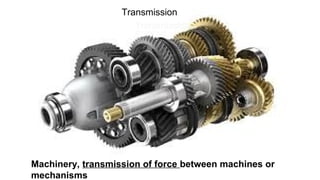
Machinery, transmission of force between machines or
mechanisms
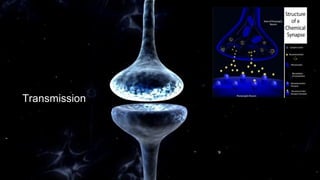
Transmission
Transmission
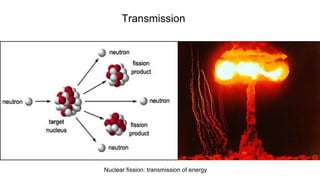
Nuclear fission: transmission of energy
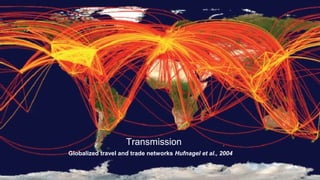
Globalized travel and trade networks Hufnagel et al., 2004
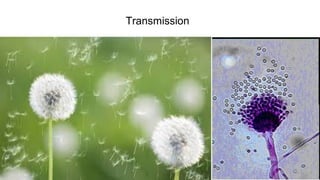
Transmission
Transmission
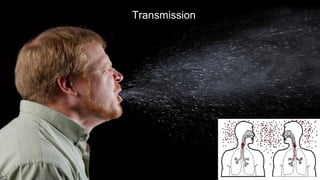
Transmission
(memes)
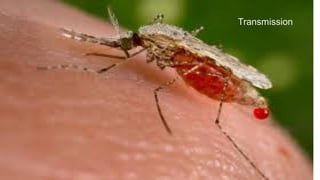
Transmission
Transmission
Transmission
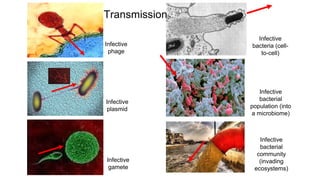
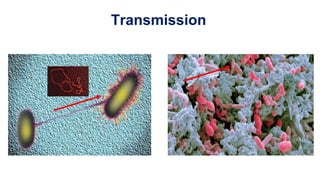
Infective
phage
Infective
plasmid
Infective
gamete
Infective
bacteria (cell-
to-cell)
Infective
bacterial
community
(invading
ecosystems)
Infective
bacterial
population (into
a microbiome)
Transmission
Transmission
In Latin, transmission = transmittere, more in the
sense of sending across, cause to go across, transfer,
pass on, from trans- "across" + mittere "to send”.
In Greek, transmission = μετάδοση (metádosi), with
the sense of “sharing” or “exchange” by “interaction”,
something flowing from one entity to another one.
Introgression
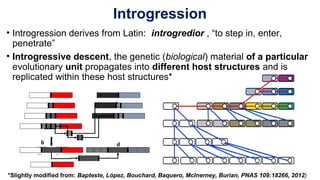
• Introgression derives from Latin: introgredior , “to step in, enter,
penetrate”
• Introgressive descent, the genetic (biological) material of a particular
evolutionary unit propagates into different host structures and is
replicated within these host structures*
*Slightly modified from: Bapteste, López, Bouchard, Baquero, McInerney, Burian, PNAS 109:18266, 2012)
......
...
........
..
b d
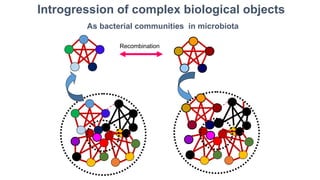
Recombination
Introgression of complex biological objects
As bacterial communities in microbiota
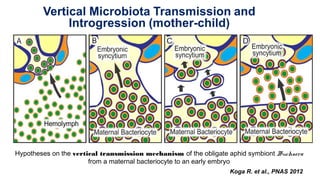
Hypotheses on the vertical transmission mechanism of the obligate aphid symbiont Buchnera
from a maternal bacteriocyte to an early embryo
Koga R. et al., PNAS 2012
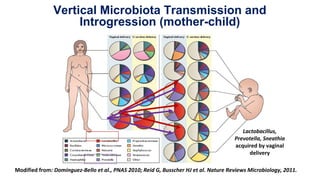
Modified from: Dominguez-Bello et al., PNAS 2010; Reid G, Busscher HJ et al. Nature Reviews Microbiology, 2011.
Lactobacillus,
Prevotella, Sneathia
acquired by vaginal
delivery
Vertical Microbiota Transmission and
Introgression (mother-child)
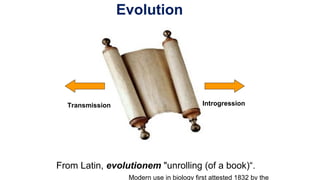
Evolution
From Latin, evolutionem "unrolling (of a book)“.
Modern use in biology first attested 1832 by the
IntrogressionTransmission
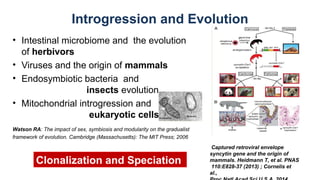
Captured retroviral envelope
syncytin gene and the origin of
mammals. Heidmann T, et al. PNAS
110:E828-37 (2013) ; Cornelis et
al.,
Introgression and Evolution
• Intestinal microbiome and the evolution
of herbivors
• Viruses and the origin of mammals
• Endosymbiotic bacteria and
insects evolution
• Mitochondrial introgression and
eukaryotic cells
Watson RA: The impact of sex, symbiosis and modularity on the gradualist
framework of evolution. Cambridge (Massachusetts): The MIT Press; 2006
Clonalization and Speciation
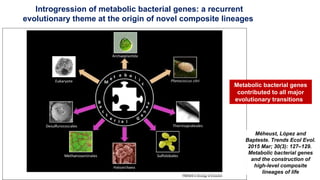
Introgression of metabolic bacterial genes: a recurrent
evolutionary theme at the origin of novel composite lineages
Méheust, López and
Bapteste. Trends Ecol Evol.
2015 Mar; 30(3): 127–129.
Metabolic bacterial genes
and the construction of
high-level composite
lineages of life
Metabolic bacterial genes
contributed to all major
evolutionary transitions.
Transmission
Transmission
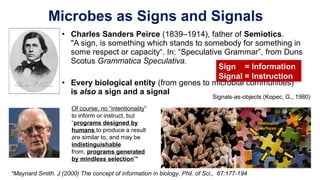
• Charles Sanders Peirce (1839–1914), father of Semiotics.
"A sign, is something which stands to somebody for something in
some respect or capacity“. In: “Speculative Grammar”, from Duns
Scotus Grammatica Speculativa.
• Every biological entity (from genes to microbial communities)
is also a sign and a signal
Microbes as Signs and Signals
Sign = Information
Signal = Instruction
Informative
surfaces
Signals-as-objects (Kopec, G., 1980)
Of course, no “intentionality”
to inform or instruct, but
“programs designed by
humans to produce a result
are similar to, and may be
indistinguishable
from, programs generated
by mindless selection”*
*Maynard Smith. J (2000) The concept of information in biology. Phil. of Sci., 67:177-194
Microbes as Signs and Signals
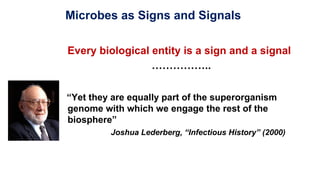
Every biological entity is a sign and a signal
……………..
“Yet they are equally part of the superorganism
genome with which we engage the rest of the
biosphere”
Joshua Lederberg, “Infectious History” (2000)
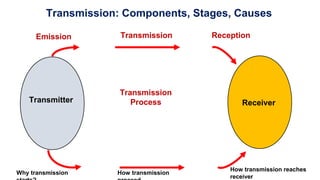
Reception
Transmitter
Emission
Receiver
Transmission
Process
Transmission
Transmission: Components, Stages, Causes
Why transmission How transmission
How transmission reaches
receiver
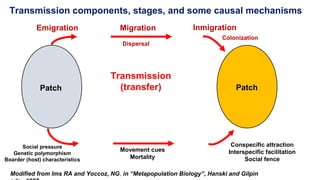
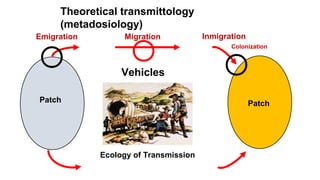
Patch
Emigration
Patch
Migration Inmigration
Colonization
Transmission
(transfer)
Social pressure
Genetic polymorphism
Boarder (host) characteristics
Movement cues
Mortality
Conspecific attraction
Interspecific facilitation
Social fence
Modified from Ims RA and Yoccoz, NG, in “Metapopulation Biology”, Hanski and Gilpin
Transmission components, stages, and some causal mechanisms
Dispersal
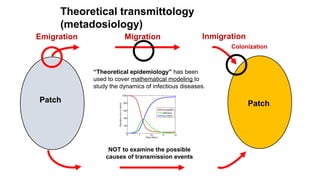
Inmigration
Colonization
Patch
Emigration
Patch
Migration
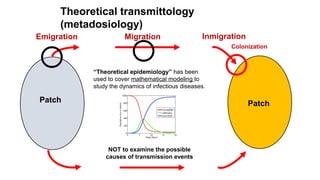
Theoretical transmittology
(metadosiology)
“Theoretical epidemiology” has been
used to cover mathematical modeling to
study the dynamics of infectious diseases.
NOT to examine the possible
causes of transmission events
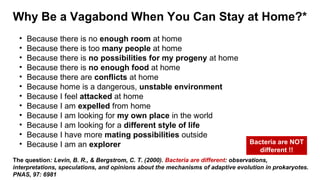
Why Be a Vagabond When You Can Stay at Home?*
The question: Levin, B. R., & Bergstrom, C. T. (2000). Bacteria are different: observations,
interpretations, speculations, and opinions about the mechanisms of adaptive evolution in prokaryotes.
PNAS, 97: 6981
• Because there is no enough room at home
• Because there is too many people at home
• Because there is no possibilities for my progeny at home
• Because there is no enough food at home
• Because there are conflicts at home
• Because home is a dangerous, unstable environment
• Because I feel attacked at home
• Because I am expelled from home
• Because I am looking for my own place in the world
• Because I am looking for a different style of life
• Because I have more mating possibilities outside
• Because I am an explorer Bacteria are NOT
different !!
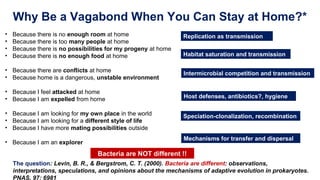
Why Be a Vagabond When You Can Stay at Home?*
The question: Levin, B. R., & Bergstrom, C. T. (2000). Bacteria are different: observations,
interpretations, speculations, and opinions about the mechanisms of adaptive evolution in prokaryotes.
PNAS, 97: 6981
• Because there is no enough room at home
• Because there is too many people at home
• Because there is no possibilities for my progeny at home
• Because there is no enough food at home
• Because there are conflicts at home
• Because home is a dangerous, unstable environment
• Because I feel attacked at home
• Because I am expelled from home
• Because I am looking for my own place in the world
• Because I am looking for a different style of life
• Because I have more mating possibilities outside
• Because I am an explorer
Bacteria are NOT different !!
Habitat saturation and transmission
Intermicrobial competition and transmission
Host defenses, antibiotics?, hygiene
Speciation-clonalization, recombination
Replication as transmission
Mechanisms for transfer and dispersal
Inmigration
Colonization
Patch
Emigration
Patch
Migration
Theoretical transmittology
(metadosiology)
“Theoretical epidemiology” has been
used to cover mathematical modeling to
study the dynamics of infectious diseases.
NOT to examine the possible
causes of transmission events
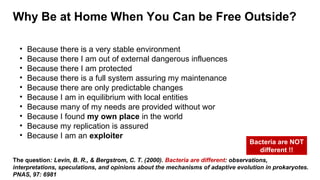
Why Be at Home When You Can be Free Outside?
The question: Levin, B. R., & Bergstrom, C. T. (2000). Bacteria are different: observations,
interpretations, speculations, and opinions about the mechanisms of adaptive evolution in prokaryotes.
PNAS, 97: 6981
• Because there is a very stable environment
• Because there I am out of external dangerous influences
• Because there I am protected
• Because there is a full system assuring my maintenance
• Because there are only predictable changes
• Because I am in equilibrium with local entities
• Because many of my needs are provided without wor
• Because I found my own place in the world
• Because my replication is assured
• Because I am an exploiter
Bacteria are NOT
different !!
Inmigration
Colonization
Patch
Emigration
Patch
Migration
Theoretical transmittology
(metadosiology)
Vehicles
Ecology of Transmission
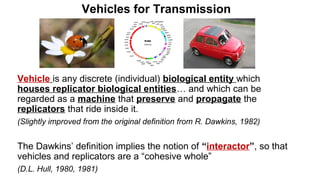
Vehicles for Transmission
Vehicle is any discrete (individual) biological entity which
houses replicator biological entities… and which can be
regarded as a machine that preserve and propagate the
replicators that ride inside it.
(Slightly improved from the original definition from R. Dawkins, 1982)
The Dawkins’ definition implies the notion of “interactor”, so that
vehicles and replicators are a “cohesive whole”
(D.L. Hull, 1980, 1981)
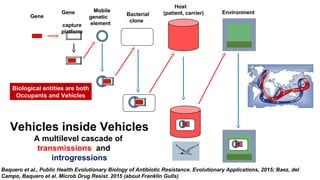
Gene
Gene
capture
platform
Mobile
genetic
element
Bacterial
clone
Host
(patient, carrier) Environment
Baquero et al., Public Health Evolutionary Biology of Antibiotic Resistance. Evolutionary Applications, 2015; Baez, del
Campo, Baquero et al. Microb Drug Resist. 2015 (about Franklin Gulls)
Vehicles inside Vehicles
A multilevel cascade of
transmissions and
introgressions
Biological entities are both
Occupants and Vehicles
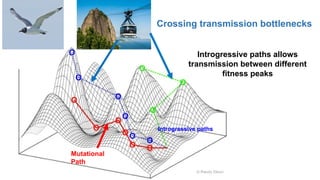
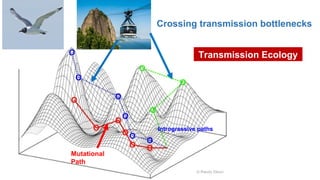
Mutational
Path
Introgressive paths
Introgressive paths allows
transmission between different
fitness peaks
Crossing transmission bottlenecks
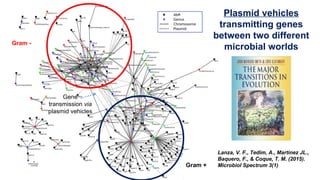
Gram -
Gram +
Gene
transmission via
plasmid vehicles
Plasmid vehicles
transmitting genes
between two different
microbial worlds
Lanza, V. F., Tedim, A., Martínez JL.,
Baquero, F., & Coque, T. M. (2015).
Microbiol Spectrum 3(1)
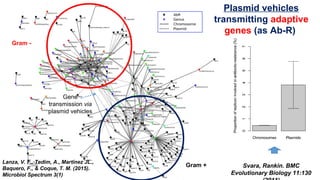
Gram -
Gram +
Gene
transmission via
plasmid vehicles
Plasmid vehicles
transmitting adaptive
genes (as Ab-R)
Lanza, V. F., Tedim, A., Martínez JL.,
Baquero, F., & Coque, T. M. (2015).
Microbiol Spectrum 3(1)
Svara, Rankin. BMC
Evolutionary Biology 11:130
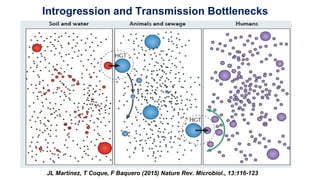
JL Martínez, T Coque, F Baquero (2015) Nature Rev. Microbiol., 13:116-123
Introgression and Transmission Bottlenecks
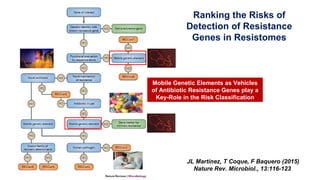
JL Martínez, T Coque, F Baquero (2015)
Nature Rev. Microbiol., 13:116-123
Ranking the Risks of
Detection of Resistance
Genes in Resistomes
Mobile Genetic Elements as Vehicles
of Antibiotic Resistance Genes play a
Key-Role in the Risk Classification
Mutational
Path
Introgressive paths
Transmission Ecology
Crossing transmission bottlenecks
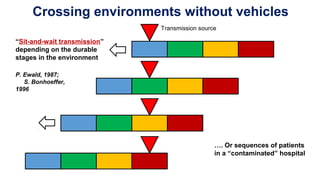
Crossing environments without vehicles
“Sit-and-wait transmission”
depending on the durable
stages in the environment
P. Ewald, 1987;
S. Bonhoeffer,
1996
…. Or sequences of patients
in a “contaminated” hospital
Transmission source
Transmission Waves and Türing Instability
Türing AM. (1952) The chemical bases of morphogenesis. Phil. Transact. Roy. Soc. London B
237:37 and Kauffmann SA (1993) The Origins of Order, Oxford University Press
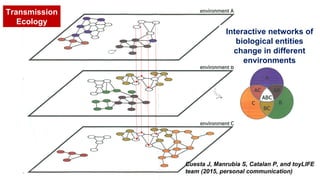
Cuesta J, Manrubia S, Catalan P, and toyLIFE
team (2015, personal communication)
Interactive networks of
biological entities
change in different
environments
Transmission
Ecology
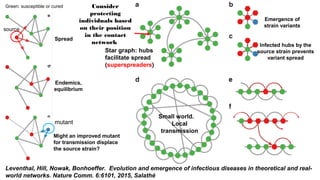
Leventhal, Hill, Nowak, Bonhoeffer. Evolution and emergence of infectious diseases in theoretical and real-
world networks. Nature Comm. 6:6101, 2015, Salathé
Green: susceptible or cured
Spread
Endemics,
equilibrium
source
Might an improved mutant
for transmission displace
the source strain?
mutant
Star graph: hubs
facilitate spread
(superspreaders)
Emergence of
strain variants
Infected hubs by the
source strain prevents
variant spread
Small world.
Local
transmission
Consider
protecting
individuals based
on their position
in the contact
network
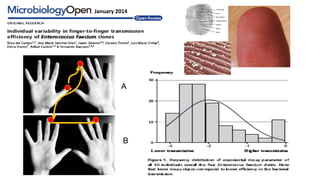
January 2014
A
B
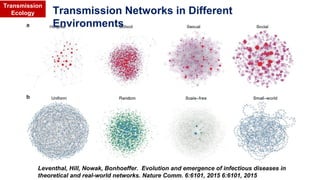
Leventhal, Hill, Nowak, Bonhoeffer. Evolution and emergence of infectious diseases in
theoretical and real-world networks. Nature Comm. 6:6101, 2015 6:6101, 2015
Transmission Networks in Different
Environments
Transmission
Ecology
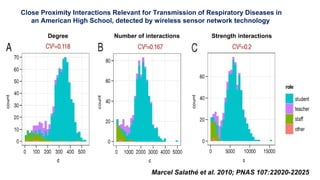
Marcel Salathé et al. 2010; PNAS 107:22020-22025
Strength interactionsNumber of interactionsDegree
Close Proximity Interactions Relevant for Transmission of Respiratory Diseases in
an American High School, detected by wireless sensor network technology
Transmissible diseases?
• Diseases are never transmissible, as they result from an
interaction: the microbial agent doing something (in-fection,
from Latin “inficere” (in+facere) inside the host.
• What is transmissible is only the microbial agent
• The type of disease might contribute to the transmission of
the agent (cough, diarrhea…), and the transmission of hosts,
eventually carrying secondary hosts, influences the
transmission of the microbial agent.
• The host is a vehicle for the microbe’s transmission
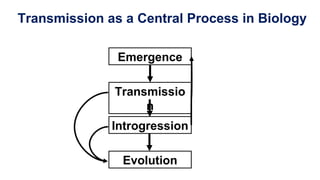
Emergence
Transmissio
n
Introgression
Evolution
Transmission as a Central Process in Biology
Particular “intellectual” thanks to:
• Teresa M. Coque
• Val Fernández Lanza
• José-Luis Martínez (CNB-CSIC)
• Rosa del Campo
• Ana Sofía P. Tedim
• Victor de Lorenzo (CNB-CSIC)
• Juan-Carlos Galán
• Carlos Llorens (Biotechvana)
• Bruce Levin (Emory University)
• Eric Bapteste (Pierre and Marie Curie University, Paris)
• Rob Willems (Utrech University)
• Andrés Moya and Amparo Latorre (Valencia University)
• Rafael Cantón and the Dpt. of Microbiology, Ramón y Cajal Hospital, Madrid
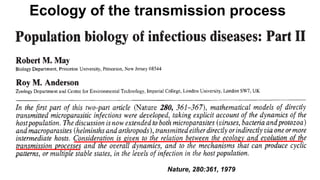
Ecology of the transmission process
Nature, 280:361, 1979
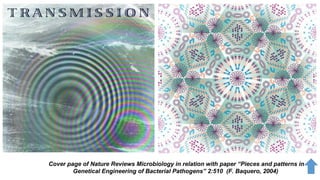
Cover page of Nature Reviews Microbiology in relation with paper “Pieces and patterns in
Genetical Engineering of Bacterial Pathogens” 2:510 (F. Baquero, 2004)
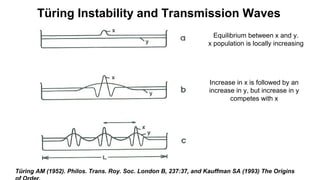
Türing Instability and Transmission Waves
Türing AM (1952). Philos. Trans. Roy. Soc. London B, 237:37, and Kauffman SA (1993) The Origins
Equilibrium between x and y.
x population is locally increasing
Increase in x is followed by an
increase in y, but increase in y
competes with x

Fernando Baquero - Simposio Microbiología: Transmisión

  • 1.
    Transmission, Introgression, and Evolution Fernando Baquero Departmentof Microbiology, Ramón y Cajal University Hospital, Division of Biology and Evolution of Microorganisms, IRYCIS, Madrid, Spain International Symposium Series: Microbiology TRANSMISSION
  • 2.
    Machinery, transmission offorce between machines or mechanisms Transmission
  • 4.
  • 5.
    Globalized travel andtrade networks Hufnagel et al., 2004 Transmission
  • 6.
  • 7.
  • 8.
  • 10.
  • 11.
  • 13.
  • 14.
    Transmission In Latin, transmission= transmittere, more in the sense of sending across, cause to go across, transfer, pass on, from trans- "across" + mittere "to send”. In Greek, transmission = μετάδοση (metádosi), with the sense of “sharing” or “exchange” by “interaction”, something flowing from one entity to another one.
  • 15.
    Introgression • Introgression derivesfrom Latin: introgredior , “to step in, enter, penetrate” • Introgressive descent, the genetic (biological) material of a particular evolutionary unit propagates into different host structures and is replicated within these host structures* *Slightly modified from: Bapteste, López, Bouchard, Baquero, McInerney, Burian, PNAS 109:18266, 2012) ...... ... ........ .. b d
  • 16.
    Recombination Introgression of complexbiological objects As bacterial communities in microbiota
  • 17.
    Hypotheses on thevertical transmission mechanism of the obligate aphid symbiont Buchnera from a maternal bacteriocyte to an early embryo Koga R. et al., PNAS 2012
  • 18.
    Modified from: Dominguez-Belloet al., PNAS 2010; Reid G, Busscher HJ et al. Nature Reviews Microbiology, 2011. Lactobacillus, Prevotella, Sneathia acquired by vaginal delivery Vertical Microbiota Transmission and Introgression (mother-child)
  • 19.
    Evolution From Latin, evolutionem"unrolling (of a book)“. Modern use in biology first attested 1832 by the IntrogressionTransmission
  • 20.
    Captured retroviral envelope syncytingene and the origin of mammals. Heidmann T, et al. PNAS 110:E828-37 (2013) ; Cornelis et al., Introgression and Evolution • Intestinal microbiome and the evolution of herbivors • Viruses and the origin of mammals • Endosymbiotic bacteria and insects evolution • Mitochondrial introgression and eukaryotic cells Watson RA: The impact of sex, symbiosis and modularity on the gradualist framework of evolution. Cambridge (Massachusetts): The MIT Press; 2006 Clonalization and Speciation
  • 21.
    Introgression of metabolicbacterial genes: a recurrent evolutionary theme at the origin of novel composite lineages Méheust, López and Bapteste. Trends Ecol Evol. 2015 Mar; 30(3): 127–129. Metabolic bacterial genes and the construction of high-level composite lineages of life Metabolic bacterial genes contributed to all major evolutionary transitions.
  • 22.
  • 23.
  • 24.
    • Charles SandersPeirce (1839–1914), father of Semiotics. "A sign, is something which stands to somebody for something in some respect or capacity“. In: “Speculative Grammar”, from Duns Scotus Grammatica Speculativa. • Every biological entity (from genes to microbial communities) is also a sign and a signal Microbes as Signs and Signals Sign = Information Signal = Instruction Informative surfaces Signals-as-objects (Kopec, G., 1980) Of course, no “intentionality” to inform or instruct, but “programs designed by humans to produce a result are similar to, and may be indistinguishable from, programs generated by mindless selection”* *Maynard Smith. J (2000) The concept of information in biology. Phil. of Sci., 67:177-194
  • 25.
    Microbes as Signsand Signals Every biological entity is a sign and a signal …………….. “Yet they are equally part of the superorganism genome with which we engage the rest of the biosphere” Joshua Lederberg, “Infectious History” (2000)
  • 26.
    Reception Transmitter Emission Receiver Transmission Process Transmission Transmission: Components, Stages,Causes Why transmission How transmission How transmission reaches receiver
  • 27.
    Patch Emigration Patch Migration Inmigration Colonization Transmission (transfer) Social pressure Geneticpolymorphism Boarder (host) characteristics Movement cues Mortality Conspecific attraction Interspecific facilitation Social fence Modified from Ims RA and Yoccoz, NG, in “Metapopulation Biology”, Hanski and Gilpin Transmission components, stages, and some causal mechanisms Dispersal
  • 28.
    Inmigration Colonization Patch Emigration Patch Migration Theoretical transmittology (metadosiology) “Theoretical epidemiology”has been used to cover mathematical modeling to study the dynamics of infectious diseases. NOT to examine the possible causes of transmission events
  • 29.
    Why Be aVagabond When You Can Stay at Home?* The question: Levin, B. R., & Bergstrom, C. T. (2000). Bacteria are different: observations, interpretations, speculations, and opinions about the mechanisms of adaptive evolution in prokaryotes. PNAS, 97: 6981 • Because there is no enough room at home • Because there is too many people at home • Because there is no possibilities for my progeny at home • Because there is no enough food at home • Because there are conflicts at home • Because home is a dangerous, unstable environment • Because I feel attacked at home • Because I am expelled from home • Because I am looking for my own place in the world • Because I am looking for a different style of life • Because I have more mating possibilities outside • Because I am an explorer Bacteria are NOT different !!
  • 30.
    Why Be aVagabond When You Can Stay at Home?* The question: Levin, B. R., & Bergstrom, C. T. (2000). Bacteria are different: observations, interpretations, speculations, and opinions about the mechanisms of adaptive evolution in prokaryotes. PNAS, 97: 6981 • Because there is no enough room at home • Because there is too many people at home • Because there is no possibilities for my progeny at home • Because there is no enough food at home • Because there are conflicts at home • Because home is a dangerous, unstable environment • Because I feel attacked at home • Because I am expelled from home • Because I am looking for my own place in the world • Because I am looking for a different style of life • Because I have more mating possibilities outside • Because I am an explorer Bacteria are NOT different !! Habitat saturation and transmission Intermicrobial competition and transmission Host defenses, antibiotics?, hygiene Speciation-clonalization, recombination Replication as transmission Mechanisms for transfer and dispersal
  • 31.
    Inmigration Colonization Patch Emigration Patch Migration Theoretical transmittology (metadosiology) “Theoretical epidemiology”has been used to cover mathematical modeling to study the dynamics of infectious diseases. NOT to examine the possible causes of transmission events
  • 32.
    Why Be atHome When You Can be Free Outside? The question: Levin, B. R., & Bergstrom, C. T. (2000). Bacteria are different: observations, interpretations, speculations, and opinions about the mechanisms of adaptive evolution in prokaryotes. PNAS, 97: 6981 • Because there is a very stable environment • Because there I am out of external dangerous influences • Because there I am protected • Because there is a full system assuring my maintenance • Because there are only predictable changes • Because I am in equilibrium with local entities • Because many of my needs are provided without wor • Because I found my own place in the world • Because my replication is assured • Because I am an exploiter Bacteria are NOT different !!
  • 33.
  • 34.
    Vehicles for Transmission Vehicleis any discrete (individual) biological entity which houses replicator biological entities… and which can be regarded as a machine that preserve and propagate the replicators that ride inside it. (Slightly improved from the original definition from R. Dawkins, 1982) The Dawkins’ definition implies the notion of “interactor”, so that vehicles and replicators are a “cohesive whole” (D.L. Hull, 1980, 1981)
  • 35.
    Gene Gene capture platform Mobile genetic element Bacterial clone Host (patient, carrier) Environment Baqueroet al., Public Health Evolutionary Biology of Antibiotic Resistance. Evolutionary Applications, 2015; Baez, del Campo, Baquero et al. Microb Drug Resist. 2015 (about Franklin Gulls) Vehicles inside Vehicles A multilevel cascade of transmissions and introgressions Biological entities are both Occupants and Vehicles
  • 36.
    Mutational Path Introgressive paths Introgressive pathsallows transmission between different fitness peaks Crossing transmission bottlenecks
  • 37.
    Gram - Gram + Gene transmissionvia plasmid vehicles Plasmid vehicles transmitting genes between two different microbial worlds Lanza, V. F., Tedim, A., Martínez JL., Baquero, F., & Coque, T. M. (2015). Microbiol Spectrum 3(1)
  • 38.
    Gram - Gram + Gene transmissionvia plasmid vehicles Plasmid vehicles transmitting adaptive genes (as Ab-R) Lanza, V. F., Tedim, A., Martínez JL., Baquero, F., & Coque, T. M. (2015). Microbiol Spectrum 3(1) Svara, Rankin. BMC Evolutionary Biology 11:130
  • 39.
    JL Martínez, TCoque, F Baquero (2015) Nature Rev. Microbiol., 13:116-123 Introgression and Transmission Bottlenecks
  • 40.
    JL Martínez, TCoque, F Baquero (2015) Nature Rev. Microbiol., 13:116-123 Ranking the Risks of Detection of Resistance Genes in Resistomes Mobile Genetic Elements as Vehicles of Antibiotic Resistance Genes play a Key-Role in the Risk Classification
  • 41.
  • 42.
    Crossing environments withoutvehicles “Sit-and-wait transmission” depending on the durable stages in the environment P. Ewald, 1987; S. Bonhoeffer, 1996 …. Or sequences of patients in a “contaminated” hospital Transmission source
  • 43.
    Transmission Waves andTüring Instability Türing AM. (1952) The chemical bases of morphogenesis. Phil. Transact. Roy. Soc. London B 237:37 and Kauffmann SA (1993) The Origins of Order, Oxford University Press Cuesta J, Manrubia S, Catalan P, and toyLIFE team (2015, personal communication) Interactive networks of biological entities change in different environments Transmission Ecology
  • 44.
    Leventhal, Hill, Nowak,Bonhoeffer. Evolution and emergence of infectious diseases in theoretical and real- world networks. Nature Comm. 6:6101, 2015, Salathé Green: susceptible or cured Spread Endemics, equilibrium source Might an improved mutant for transmission displace the source strain? mutant Star graph: hubs facilitate spread (superspreaders) Emergence of strain variants Infected hubs by the source strain prevents variant spread Small world. Local transmission Consider protecting individuals based on their position in the contact network
  • 45.
  • 46.
    Leventhal, Hill, Nowak,Bonhoeffer. Evolution and emergence of infectious diseases in theoretical and real-world networks. Nature Comm. 6:6101, 2015 6:6101, 2015 Transmission Networks in Different Environments Transmission Ecology
  • 47.
    Marcel Salathé etal. 2010; PNAS 107:22020-22025 Strength interactionsNumber of interactionsDegree Close Proximity Interactions Relevant for Transmission of Respiratory Diseases in an American High School, detected by wireless sensor network technology
  • 48.
    Transmissible diseases? • Diseasesare never transmissible, as they result from an interaction: the microbial agent doing something (in-fection, from Latin “inficere” (in+facere) inside the host. • What is transmissible is only the microbial agent • The type of disease might contribute to the transmission of the agent (cough, diarrhea…), and the transmission of hosts, eventually carrying secondary hosts, influences the transmission of the microbial agent. • The host is a vehicle for the microbe’s transmission
  • 49.
  • 50.
    Particular “intellectual” thanksto: • Teresa M. Coque • Val Fernández Lanza • José-Luis Martínez (CNB-CSIC) • Rosa del Campo • Ana Sofía P. Tedim • Victor de Lorenzo (CNB-CSIC) • Juan-Carlos Galán • Carlos Llorens (Biotechvana) • Bruce Levin (Emory University) • Eric Bapteste (Pierre and Marie Curie University, Paris) • Rob Willems (Utrech University) • Andrés Moya and Amparo Latorre (Valencia University) • Rafael Cantón and the Dpt. of Microbiology, Ramón y Cajal Hospital, Madrid
  • 51.
    Ecology of thetransmission process Nature, 280:361, 1979
  • 52.
    Cover page ofNature Reviews Microbiology in relation with paper “Pieces and patterns in Genetical Engineering of Bacterial Pathogens” 2:510 (F. Baquero, 2004)
  • 53.
    Türing Instability andTransmission Waves Türing AM (1952). Philos. Trans. Roy. Soc. London B, 237:37, and Kauffman SA (1993) The Origins Equilibrium between x and y. x population is locally increasing Increase in x is followed by an increase in y, but increase in y competes with x

Editor's Notes

  • #48 Distribution and CV2 of degree, d (A); number of interactions, c (B); and strength, s (C), based on the full contact network and colored by the role of individuals.