


Come to the Back and Check out a Text Turn in Your Safety Contract
The Science of Microbiology Classification of Organisms Chapter 1 Microbiology Liberty Senior High Mr. Knowles
Two Main Forms of Cells All cells share certain characteristics They are all enclosed by a membrane They all use DNA as genetic information There are  two main forms  of cells: Eukaryotic Prokaryotic
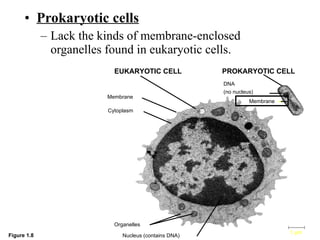
Prokaryotic cells Lack the kinds of membrane-enclosed organelles found in eukaryotic cells. EUKARYOTIC CELL Membrane Cytoplasm Organelles Nucleus (contains DNA) 1 µm PROKARYOTIC CELL DNA  (no nucleus) Membrane Figure 1.8
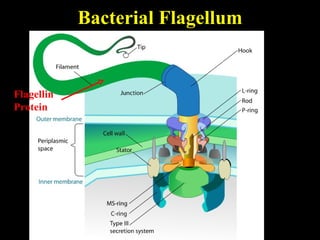
Unicellular organisms that lack a nucleus and membrane-bound organelles Unique flagella (flagellin), no cilia Bacteria and Archaea Domain Have DNA and cell membranes Prokaryotic Cells
Bacterial Flagellum Flagellin Protein
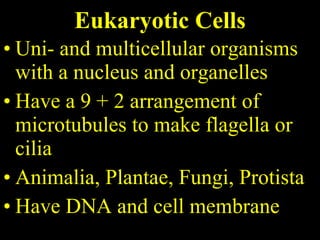
Eukaryotic Cells Uni- and multicellular organisms with a nucleus and organelles Have a 9 + 2 arrangement of microtubules to make flagella or cilia Animalia, Plantae, Fungi, Protista Have DNA and cell membrane
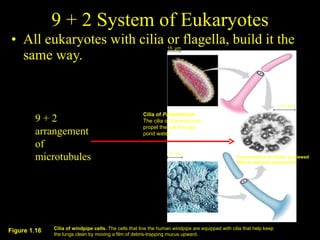
9 + 2 System of Eukaryotes All eukaryotes with cilia or flagella, build it the same way. 9 + 2 arrangement of microtubules Cilia of  Paramecium. The cilia of  Paramecium propel the cell through pond water. Cross section of cilium, as viewed with an electron microscope 15  µm 1.0  µm 5  µm Cilia of windpipe cells.  The cells that line the human windpipe are equipped with cilia that help keep the lungs clean by moving a film of debris-trapping mucus upward. Figure 1.16
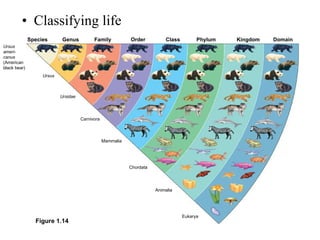
Classifying life Species    Genus    Family    Order    Class  Phylum  Kingdom  Domain  Mammalia Ursus ameri- canus (American black bear) Ursus Ursidae Carnivora Chordata Animalia Eukarya Figure 1.14
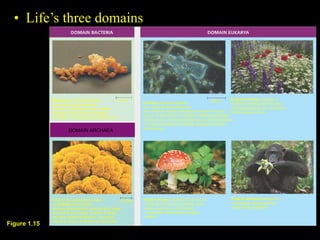
Life’s three domains Figure 1.15 100 µm 0.5 µm 4 µm Bacteria  are the most diverse  and widespread prokaryotes  and are now divided among multiple  kingdoms. Each of the rod-shaped structures in  this photo is a bacterial cell. Protists  (multiple kingdoms) are unicellular eukaryotes and  their relatively simple multicellular relatives.Pictured here is an assortment of protists inhabiting pond water. Scientists are currently debating how to split the protists into several kingdoms that better represent evolution and diversity.  Kingdom Plantae  consists of  multicellula eukaryotes that carry  out photosynthesis, the conversion  of light energy to food. Many of the prokaryotes known  as  archaea  live in Earth‘s  extreme environments, such as salty lakes  and boiling hot springs. Domain Archaea  includes multiple kingdoms. The photo shows a colony composed of many cells. Kindom Fungi  is defined in part by the nutritional mode of its members, such as this mushroom, which absorb  nutrientsafter decomposing organic  material. Kindom Animalia  consists of  multicellular eukaryotes that ingest other organisms. DOMAIN ARCHAEA
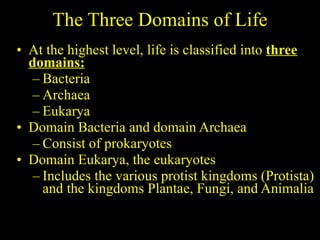
The Three Domains of Life At the highest level, life is classified into  three domains: Bacteria Archaea Eukarya Domain Bacteria and domain Archaea Consist of prokaryotes Domain Eukarya, the eukaryotes Includes the various protist kingdoms (Protista) and the kingdoms Plantae, Fungi, and Animalia
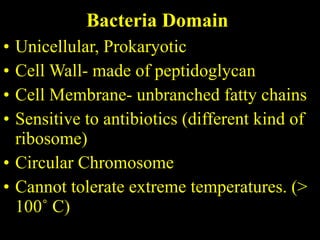
Bacteria Domain Unicellular, Prokaryotic Cell Wall- made of peptidoglycan Cell Membrane- unbranched fatty chains Sensitive to antibiotics (different kind of ribosome) Circular Chromosome Cannot tolerate extreme temperatures. (> 100˚ C)
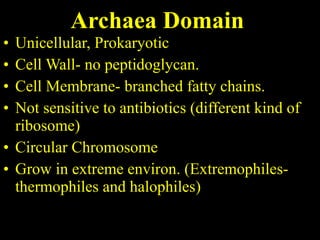
Archaea Domain Unicellular, Prokaryotic Cell Wall- no peptidoglycan. Cell Membrane- branched fatty chains. Not sensitive to antibiotics (different kind of ribosome) Circular Chromosome Grow in extreme environ. (Extremophiles- thermophiles and halophiles)
Show me the “ancient bacteria”-  Kingdom Archaebacteria. Video:  Intimate Strangers- The Tree of Life .
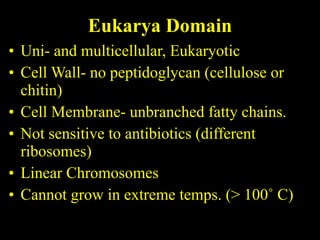
Eukarya Domain Uni- and multicellular, Eukaryotic Cell Wall- no peptidoglycan (cellulose or chitin) Cell Membrane- unbranched fatty chains. Not sensitive to antibiotics (different ribosomes) Linear Chromosomes Cannot grow in extreme temps. (> 100˚ C)
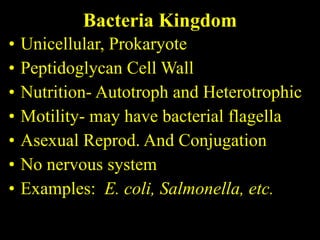
Bacteria Kingdom Unicellular, Prokaryote Peptidoglycan Cell Wall Nutrition- Autotroph and Heterotrophic Motility- may have bacterial flagella Asexual Reprod. And Conjugation No nervous system Examples:  E. coli, Salmonella, etc.
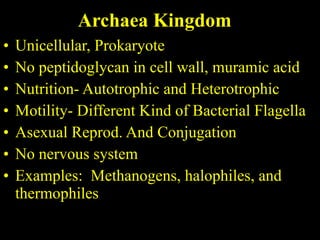
Archaea Kingdom Unicellular, Prokaryote No peptidoglycan in cell wall, muramic acid Nutrition- Autotrophic and Heterotrophic Motility- Different Kind of Bacterial Flagella Asexual Reprod. And Conjugation No nervous system Examples:  Methanogens, halophiles, and thermophiles
Protista Kingdom Mostly Uni- but some multicellular Eukaryotes Various Types of Cell Wall, no peptidoglycan Nutrition- Autotrophic and Heterotrophic Motility- (9 + 2) Cilia or flagella Meiosis and Fertilization Nervous system- primitive conduction of some stimuli (light, heat, etc.) Ex. :  Paramecia, Amoeba, Euglena
Fungi Kingdom Mostly multi, some unicellular Eukaryotes Chitin Cell Wall Nutrition- Heterotrophic Nonmotile Meiosis and Fertilization No nervous system Ex.: molds, mushrooms, mildew
Animalia Kingdom Multicellular, Eukaryote No cell wall Nutrition- Heterotrophic Motility- (9 + 2) Cilia or flagella Meiosis and Fertilization Primitive and complex nervous systems Ex. :  worms, fish, birds, YOU!
Plantae Kingdom Multicellular Eukaryote Cell Wall – Cellulose Nutrition – Autotroph Most cells are nonmotile, but some make reproductive cells that have (9 + 2) flagella Meiosis and Fertilization No nervous system Meiosis and Fertilization Ex. :  Trees, shrubs, Venus Fly Trap!
How Do We Group Microorganisms? Into Four Kingdoms: Protista-  protists and algae (many Kingdoms) Fungi-  yeast and other fungi Eubacteria-  “true” bacteria (many Kingdoms)  Archaebacteria-  “ancient” bacteria (many Kingdoms) In its own Group: Viruses
Question of the Day! Who was the  first  microbiologist?
Holy Moses! Instructed people to bury feces and other wastes. Bible also refers to isolating lepers. (Deuteronomy, Ch. 13)
Hippocrates Greek physician in 400 B.C. who established medical ethics. Linked symptoms to certain diseases. Realized diseases could be transmitted by clothing.
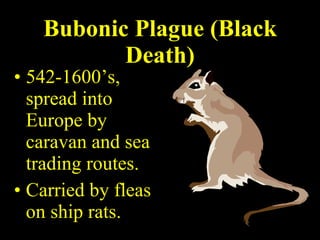
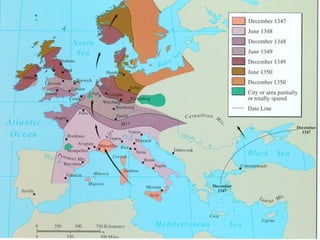
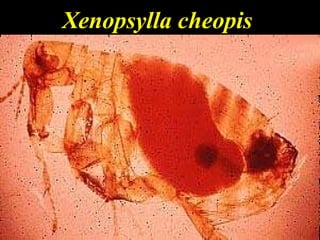
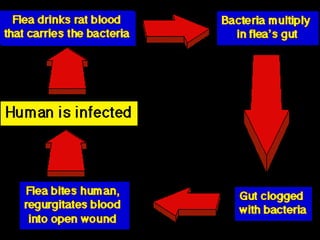
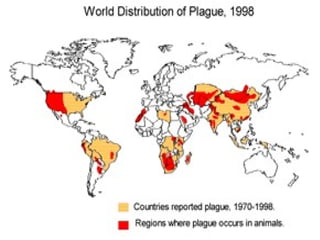
Bubonic Plague (Black Death) 542-1600’s, spread into Europe by caravan and sea trading routes. Carried by fleas on ship rats.
 
Xenopsylla cheopis
 
Show me more of the Black Death! Video:  Secrets of the Dead- The Mystery of the Black Death
 
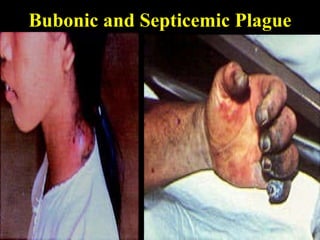
Bubonic and Septicemic Plague
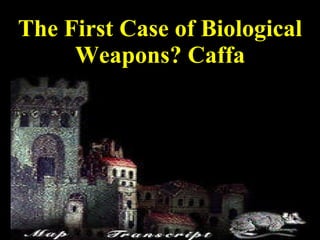
The First Case of Biological Weapons? Caffa
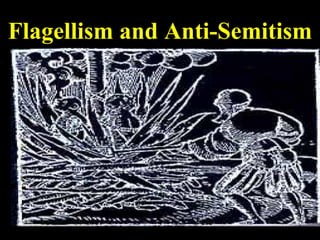
Flagellism and Anti-Semitism
Robert Hooke In 17 th  Century, built the first microscope. Used the term “cell” to describe what he saw--after the small rooms of monks.
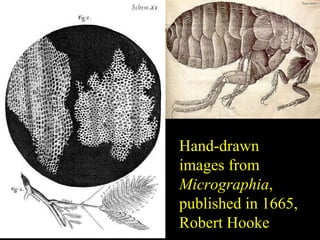
Hand-drawn images from  Micrographia , published in 1665, Robert Hooke
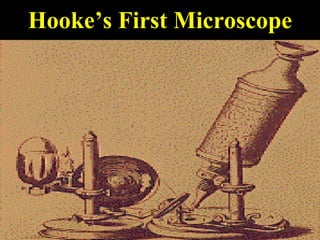
Hooke’s First Microscope
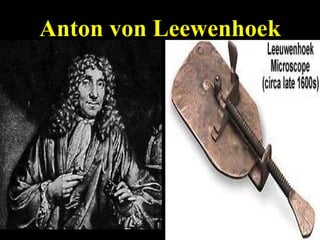
Anton von Leewenhoek
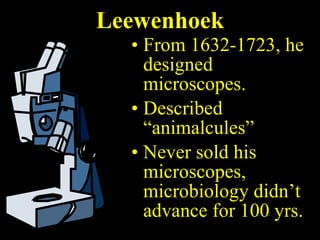
Leewenhoek From 1632-1723, he designed microscopes. Described “animalcules” Never sold his microscopes, microbiology didn’t advance for 100 yrs.
Schleiden and Schwann Formulated the  Cell Theory-  that cells are the fundamental units of all life.
Germ Theory Mid-19 th  Century: Microorganisms can invade other organisms and cause disease.
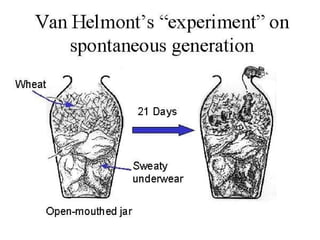
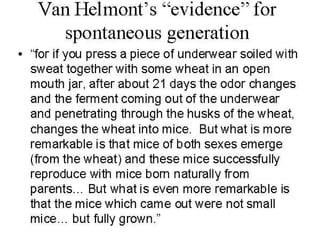
Spontaneous Generation Belief that life arose from nonliving things, a “vital force” found in the air. Ex: Broth turning cloudy happened spontaneously from nonliving material. Ex: Rags   rats  Meat    maggots.
 
 
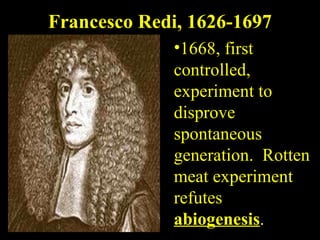
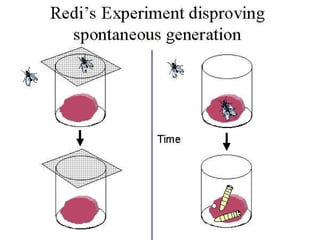
Francesco Redi, 1626-1697 1668, first controlled, experiment to disprove spontaneous generation.  Rotten meat experiment refutes  abiogenesis .
 
Francesco Redi Disproved spontaneous generation with the fly and rotting meat experiment.
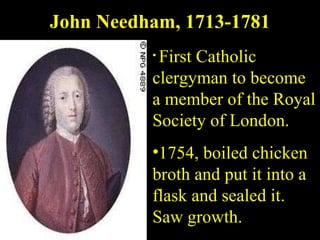
John Needham, 1713-1781 First Catholic clergyman to become a member of the Royal Society of London. 1754, boiled chicken broth and put it into a flask and sealed it.  Saw growth.
Needham and “Vital Atoms” Needham and Georges Comte de Buffon proposed  “vital atoms”  cause life. They could be seen in pond water and infusions. “ Vital atoms” escape dying organic material and move into the soil or water to be taken up the the plants.
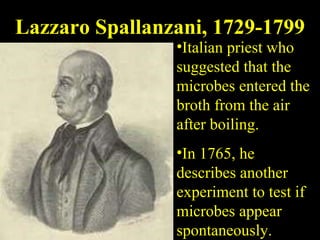
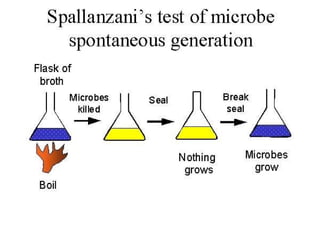
Lazzaro Spallanzani, 1729-1799 Italian priest who suggested that the microbes entered the broth from the air after boiling.  In 1765, he describes another experiment to test if microbes appear spontaneously.
 
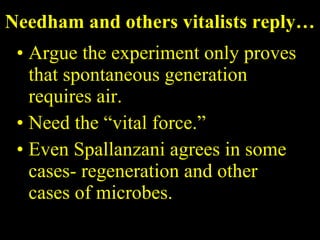
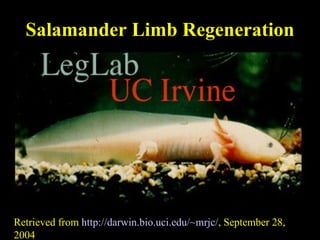
Needham and others vitalists reply… Argue the experiment only proves that spontaneous generation requires air. Need the “vital force.” Even Spallanzani agrees in some cases- regeneration and other cases of microbes.
Salamander Limb Regeneration Retrieved from  http://darwin.bio.uci.edu/~mrjc/ , September 28, 2004
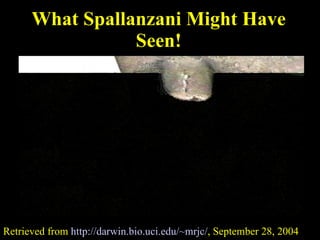
What Spallanzani Might Have Seen! Retrieved from  http://darwin.bio.uci.edu/~mrjc/ , September 28, 2004
Louis Pasteur
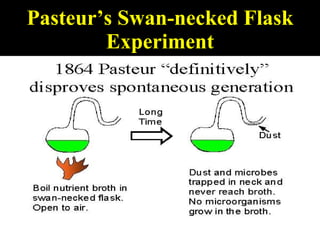
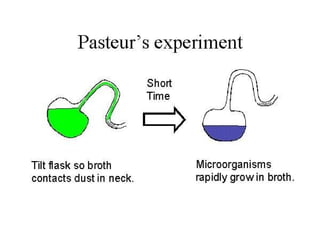
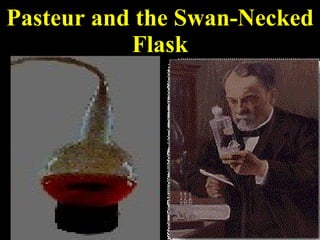
Pasteur and Tyndall In the mid-1800’s, disproved spontaneous generation using experiments with “swan-necked” flasks--allowed the air with the “vital force” to enter.
Pasteur’s Swan-necked Flask Experiment
 
Pasteur and the Swan-Necked Flask
Louis Pasteur From 1822-1895 Developed  pasteurization  technique of heating wine to kill other microorganisms without killing yeast. Developed first rabies vaccine- from rabbit spinal cord
 
Robert Koch
Robert Koch Developed techniques for isolating bacteria and growing  in vitro  (out of the body) Developed different medias for growing cultures.
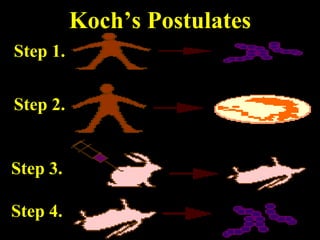
Koch’s Postulates Step 1. Step 2. Step 3. Step 4.
Koch’s Postulates 1.) The specific pathogen (disease-causing) organism must be found in all cases of the disease. 2.) The pathogen must be isolated.
Koch’s Postulates 3.) Must inoculate a healthy animal with the pathogen and cause the disease. 4.) Must recover the same pathogen from the inoculated animal.
Still use Koch’s Postulates Today! The Story of Lyme Disease- Borrelia burgdorferi Video:  Parasites-The Body Snatchers , #96
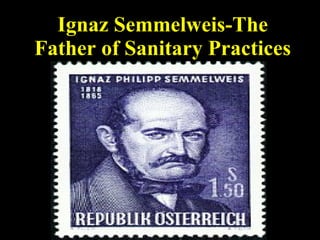
Ignaz Semmelweis-The Father of Sanitary Practices
Ignaz Semmelweis 1800’s, Autopsy to child birth; puerperal (childbed) fever. Encouraged sanitary practices by physicians. Ridiculed, had a nervous breakdown, asylum and died of an infection.
Joseph Lister Developed aseptic technique for surgeons Used carbolic acid to sterilize instruments.
The First Vaccines Came Out of an Epidemic! The Story of Smallpox Video:  Plagues:  The Smallpox Curse ,  #36
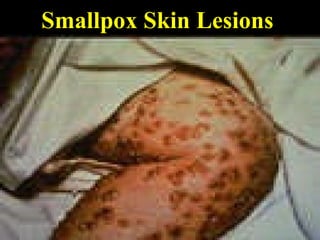
Smallpox Skin Lesions
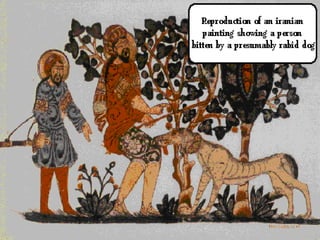
How Do We Protect Ourselves?  Immunology Ancient Chinese-  inhaled ground smallpox scabs--develop a mild case of smallpox but survive later exposure.
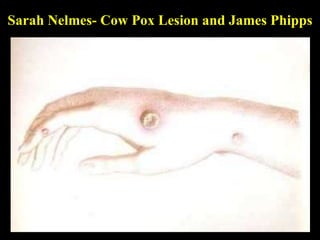
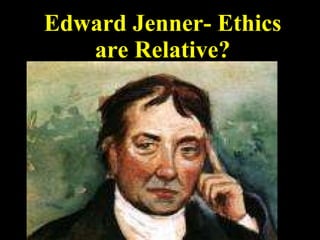
Smallpox and Edward Jenner In late 1100’s, smallpox had been carried back to Europe with the Crusaders from the Near East. Late 1700’s, Jenner realized milkmaids with cowpox did not get smallpox. First “tested” vaccine ( vacca  means cow) against smallpox.
Sarah Nelmes- Cow Pox Lesion and James Phipps
Edward Jenner- Ethics are Relative?
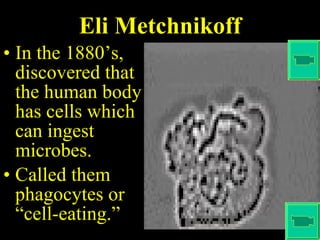
Eli Metchnikoff In the 1880’s, discovered that the human body has cells which can ingest microbes. Called them phagocytes or “cell-eating.”
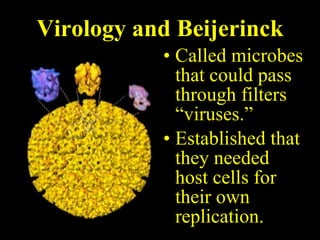
Virology and Beijerinck Called microbes that could pass through filters “viruses.” Established that they needed host cells for their own replication.
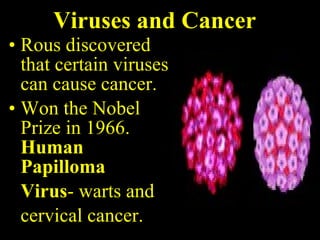
Viruses and Cancer Rous discovered that certain viruses can cause cancer. Won the Nobel Prize in 1966.  Human Papilloma Virus - warts and  cervical cancer.
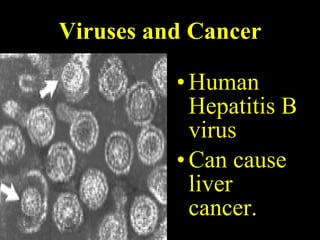
Viruses and Cancer Human Hepatitis B virus Can cause liver cancer.

Microbiology chapter 1 lect(2)

  • 1.
    Come to theBack and Check out a Text Turn in Your Safety Contract
  • 2.
    The Science ofMicrobiology Classification of Organisms Chapter 1 Microbiology Liberty Senior High Mr. Knowles
  • 3.
    Two Main Formsof Cells All cells share certain characteristics They are all enclosed by a membrane They all use DNA as genetic information There are two main forms of cells: Eukaryotic Prokaryotic
  • 4.
    Prokaryotic cells Lackthe kinds of membrane-enclosed organelles found in eukaryotic cells. EUKARYOTIC CELL Membrane Cytoplasm Organelles Nucleus (contains DNA) 1 µm PROKARYOTIC CELL DNA (no nucleus) Membrane Figure 1.8
  • 5.
    Unicellular organisms thatlack a nucleus and membrane-bound organelles Unique flagella (flagellin), no cilia Bacteria and Archaea Domain Have DNA and cell membranes Prokaryotic Cells
  • 6.
  • 7.
    Eukaryotic Cells Uni-and multicellular organisms with a nucleus and organelles Have a 9 + 2 arrangement of microtubules to make flagella or cilia Animalia, Plantae, Fungi, Protista Have DNA and cell membrane
  • 8.
    9 + 2System of Eukaryotes All eukaryotes with cilia or flagella, build it the same way. 9 + 2 arrangement of microtubules Cilia of Paramecium. The cilia of Paramecium propel the cell through pond water. Cross section of cilium, as viewed with an electron microscope 15 µm 1.0 µm 5 µm Cilia of windpipe cells. The cells that line the human windpipe are equipped with cilia that help keep the lungs clean by moving a film of debris-trapping mucus upward. Figure 1.16
  • 9.
    Classifying life Species Genus Family Order Class Phylum Kingdom Domain Mammalia Ursus ameri- canus (American black bear) Ursus Ursidae Carnivora Chordata Animalia Eukarya Figure 1.14
  • 10.
    Life’s three domainsFigure 1.15 100 µm 0.5 µm 4 µm Bacteria are the most diverse and widespread prokaryotes and are now divided among multiple kingdoms. Each of the rod-shaped structures in this photo is a bacterial cell. Protists (multiple kingdoms) are unicellular eukaryotes and their relatively simple multicellular relatives.Pictured here is an assortment of protists inhabiting pond water. Scientists are currently debating how to split the protists into several kingdoms that better represent evolution and diversity. Kingdom Plantae consists of multicellula eukaryotes that carry out photosynthesis, the conversion of light energy to food. Many of the prokaryotes known as archaea live in Earth‘s extreme environments, such as salty lakes and boiling hot springs. Domain Archaea includes multiple kingdoms. The photo shows a colony composed of many cells. Kindom Fungi is defined in part by the nutritional mode of its members, such as this mushroom, which absorb nutrientsafter decomposing organic material. Kindom Animalia consists of multicellular eukaryotes that ingest other organisms. DOMAIN ARCHAEA
  • 11.
    The Three Domainsof Life At the highest level, life is classified into three domains: Bacteria Archaea Eukarya Domain Bacteria and domain Archaea Consist of prokaryotes Domain Eukarya, the eukaryotes Includes the various protist kingdoms (Protista) and the kingdoms Plantae, Fungi, and Animalia
  • 12.
    Bacteria Domain Unicellular,Prokaryotic Cell Wall- made of peptidoglycan Cell Membrane- unbranched fatty chains Sensitive to antibiotics (different kind of ribosome) Circular Chromosome Cannot tolerate extreme temperatures. (> 100˚ C)
  • 13.
    Archaea Domain Unicellular,Prokaryotic Cell Wall- no peptidoglycan. Cell Membrane- branched fatty chains. Not sensitive to antibiotics (different kind of ribosome) Circular Chromosome Grow in extreme environ. (Extremophiles- thermophiles and halophiles)
  • 14.
    Show me the“ancient bacteria”- Kingdom Archaebacteria. Video: Intimate Strangers- The Tree of Life .
  • 15.
    Eukarya Domain Uni-and multicellular, Eukaryotic Cell Wall- no peptidoglycan (cellulose or chitin) Cell Membrane- unbranched fatty chains. Not sensitive to antibiotics (different ribosomes) Linear Chromosomes Cannot grow in extreme temps. (> 100˚ C)
  • 16.
    Bacteria Kingdom Unicellular,Prokaryote Peptidoglycan Cell Wall Nutrition- Autotroph and Heterotrophic Motility- may have bacterial flagella Asexual Reprod. And Conjugation No nervous system Examples: E. coli, Salmonella, etc.
  • 17.
    Archaea Kingdom Unicellular,Prokaryote No peptidoglycan in cell wall, muramic acid Nutrition- Autotrophic and Heterotrophic Motility- Different Kind of Bacterial Flagella Asexual Reprod. And Conjugation No nervous system Examples: Methanogens, halophiles, and thermophiles
  • 18.
    Protista Kingdom MostlyUni- but some multicellular Eukaryotes Various Types of Cell Wall, no peptidoglycan Nutrition- Autotrophic and Heterotrophic Motility- (9 + 2) Cilia or flagella Meiosis and Fertilization Nervous system- primitive conduction of some stimuli (light, heat, etc.) Ex. : Paramecia, Amoeba, Euglena
  • 19.
    Fungi Kingdom Mostlymulti, some unicellular Eukaryotes Chitin Cell Wall Nutrition- Heterotrophic Nonmotile Meiosis and Fertilization No nervous system Ex.: molds, mushrooms, mildew
  • 20.
    Animalia Kingdom Multicellular,Eukaryote No cell wall Nutrition- Heterotrophic Motility- (9 + 2) Cilia or flagella Meiosis and Fertilization Primitive and complex nervous systems Ex. : worms, fish, birds, YOU!
  • 21.
    Plantae Kingdom MulticellularEukaryote Cell Wall – Cellulose Nutrition – Autotroph Most cells are nonmotile, but some make reproductive cells that have (9 + 2) flagella Meiosis and Fertilization No nervous system Meiosis and Fertilization Ex. : Trees, shrubs, Venus Fly Trap!
  • 22.
    How Do WeGroup Microorganisms? Into Four Kingdoms: Protista- protists and algae (many Kingdoms) Fungi- yeast and other fungi Eubacteria- “true” bacteria (many Kingdoms) Archaebacteria- “ancient” bacteria (many Kingdoms) In its own Group: Viruses
  • 23.
    Question of theDay! Who was the first microbiologist?
  • 24.
    Holy Moses! Instructedpeople to bury feces and other wastes. Bible also refers to isolating lepers. (Deuteronomy, Ch. 13)
  • 25.
    Hippocrates Greek physicianin 400 B.C. who established medical ethics. Linked symptoms to certain diseases. Realized diseases could be transmitted by clothing.
  • 26.
    Bubonic Plague (BlackDeath) 542-1600’s, spread into Europe by caravan and sea trading routes. Carried by fleas on ship rats.
  • 27.
  • 28.
  • 29.
  • 30.
    Show me moreof the Black Death! Video: Secrets of the Dead- The Mystery of the Black Death
  • 31.
  • 32.
  • 33.
    The First Caseof Biological Weapons? Caffa
  • 34.
  • 35.
    Robert Hooke In17 th Century, built the first microscope. Used the term “cell” to describe what he saw--after the small rooms of monks.
  • 36.
    Hand-drawn images from Micrographia , published in 1665, Robert Hooke
  • 37.
  • 38.
  • 39.
    Leewenhoek From 1632-1723,he designed microscopes. Described “animalcules” Never sold his microscopes, microbiology didn’t advance for 100 yrs.
  • 40.
    Schleiden and SchwannFormulated the Cell Theory- that cells are the fundamental units of all life.
  • 41.
    Germ Theory Mid-19th Century: Microorganisms can invade other organisms and cause disease.
  • 42.
    Spontaneous Generation Beliefthat life arose from nonliving things, a “vital force” found in the air. Ex: Broth turning cloudy happened spontaneously from nonliving material. Ex: Rags  rats Meat  maggots.
  • 43.
  • 44.
  • 45.
    Francesco Redi, 1626-16971668, first controlled, experiment to disprove spontaneous generation. Rotten meat experiment refutes abiogenesis .
  • 46.
  • 47.
    Francesco Redi Disprovedspontaneous generation with the fly and rotting meat experiment.
  • 48.
    John Needham, 1713-1781First Catholic clergyman to become a member of the Royal Society of London. 1754, boiled chicken broth and put it into a flask and sealed it. Saw growth.
  • 49.
    Needham and “VitalAtoms” Needham and Georges Comte de Buffon proposed “vital atoms” cause life. They could be seen in pond water and infusions. “ Vital atoms” escape dying organic material and move into the soil or water to be taken up the the plants.
  • 50.
    Lazzaro Spallanzani, 1729-1799Italian priest who suggested that the microbes entered the broth from the air after boiling. In 1765, he describes another experiment to test if microbes appear spontaneously.
  • 51.
  • 52.
    Needham and othersvitalists reply… Argue the experiment only proves that spontaneous generation requires air. Need the “vital force.” Even Spallanzani agrees in some cases- regeneration and other cases of microbes.
  • 53.
    Salamander Limb RegenerationRetrieved from http://darwin.bio.uci.edu/~mrjc/ , September 28, 2004
  • 54.
    What Spallanzani MightHave Seen! Retrieved from http://darwin.bio.uci.edu/~mrjc/ , September 28, 2004
  • 55.
  • 56.
    Pasteur and TyndallIn the mid-1800’s, disproved spontaneous generation using experiments with “swan-necked” flasks--allowed the air with the “vital force” to enter.
  • 57.
  • 58.
  • 59.
    Pasteur and theSwan-Necked Flask
  • 60.
    Louis Pasteur From1822-1895 Developed pasteurization technique of heating wine to kill other microorganisms without killing yeast. Developed first rabies vaccine- from rabbit spinal cord
  • 61.
  • 62.
  • 63.
    Robert Koch Developedtechniques for isolating bacteria and growing in vitro (out of the body) Developed different medias for growing cultures.
  • 64.
    Koch’s Postulates Step1. Step 2. Step 3. Step 4.
  • 65.
    Koch’s Postulates 1.)The specific pathogen (disease-causing) organism must be found in all cases of the disease. 2.) The pathogen must be isolated.
  • 66.
    Koch’s Postulates 3.)Must inoculate a healthy animal with the pathogen and cause the disease. 4.) Must recover the same pathogen from the inoculated animal.
  • 67.
    Still use Koch’sPostulates Today! The Story of Lyme Disease- Borrelia burgdorferi Video: Parasites-The Body Snatchers , #96
  • 68.
    Ignaz Semmelweis-The Fatherof Sanitary Practices
  • 69.
    Ignaz Semmelweis 1800’s,Autopsy to child birth; puerperal (childbed) fever. Encouraged sanitary practices by physicians. Ridiculed, had a nervous breakdown, asylum and died of an infection.
  • 70.
    Joseph Lister Developedaseptic technique for surgeons Used carbolic acid to sterilize instruments.
  • 71.
    The First VaccinesCame Out of an Epidemic! The Story of Smallpox Video: Plagues: The Smallpox Curse , #36
  • 72.
  • 73.
    How Do WeProtect Ourselves? Immunology Ancient Chinese- inhaled ground smallpox scabs--develop a mild case of smallpox but survive later exposure.
  • 74.
    Smallpox and EdwardJenner In late 1100’s, smallpox had been carried back to Europe with the Crusaders from the Near East. Late 1700’s, Jenner realized milkmaids with cowpox did not get smallpox. First “tested” vaccine ( vacca means cow) against smallpox.
  • 75.
    Sarah Nelmes- CowPox Lesion and James Phipps
  • 76.
    Edward Jenner- Ethicsare Relative?
  • 77.
    Eli Metchnikoff Inthe 1880’s, discovered that the human body has cells which can ingest microbes. Called them phagocytes or “cell-eating.”
  • 78.
    Virology and BeijerinckCalled microbes that could pass through filters “viruses.” Established that they needed host cells for their own replication.
  • 79.
    Viruses and CancerRous discovered that certain viruses can cause cancer. Won the Nobel Prize in 1966. Human Papilloma Virus - warts and cervical cancer.
  • 80.
    Viruses and CancerHuman Hepatitis B virus Can cause liver cancer.