Gst and technology
umamaheswari
GST
GST is an destination based tax, inter state of goods and services.
Settlement happens between states and the centre- because of strong IT
infrastructure and service back bone.
GSTN network is a non profit organisation was incorporated on March
28,2018. to provide IT services to the central and state government.
The authorized capital is Rs.10 crore in which the government of India holds
24.5% equity in GSTN and all states of the Indian union, including NCT.(
National capital territory) of delhi, puducherry, empowered committeee of
state finance ministers, together hold another 24.5%, balance 51% equity with
non government financial institutions.
.
GSTN
Gst portal –mother databasefor everything.
Backbone of the common portal, which is the interfacebetween the taxpayers and
the government
The entire processfrom filing to returns is online starting from registration to the
filing of returns.
It has to support about 3 billion invoices per month and the subsequent return filing
from Rs.65 to Rs.70 lakhs taxpayers.
Handles- invoices, various returns, registrations,payments and refunds.
Genesis and structure of GSTN
 Currently, the centre and state indirect tax administrations work under differentlaws,
regulations, proceduresand formats and consequently theIT systems work as independent
sites.
 It has same level of IT maturity with uniform formats and interfaces for taxpayers and other
external stakeholders.
 Empowered committeeof State Finance Ministers held on 21/7/2010 discussedthis aspect.
 EC approved the creationof an empowered group on IT infrastructure for GST under the
chairmanship ofDr. Nandan Nilekani along with five state commissionersof Trade taxes.
Infrastructure of GST
Member
Additional secretary
Directorate General
CBEC (member secretary)
Ministry of finance
Member secretary, empowered group of state finance ministers
Member technology advisory group for unique projects
Commercial tax commissioners of Maharastra, Assam, Karnataka, West
Bengal and Gujarat
NIU/ SPV
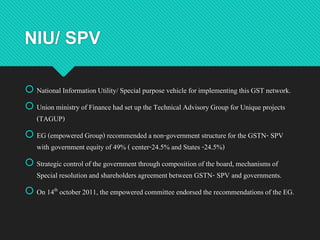
 National InformationUtility/ Special purpose vehicle forimplementing this GST network.
 Union ministry of Finance had set up the Technical AdvisoryGroup for Unique projects
(TAGUP)
 EG (empowered Group) recommended a non-government structurefor the GSTN- SPV
with government equity of 49% ( center-24.5% and States -24.5%)
 Strategic control of the government through compositionof the board, mechanisms of
Special resolutionand shareholdersagreement between GSTN- SPV and governments.
 On 14th october 2011, the empowered committee endorsedthe recommendationsof the EG.
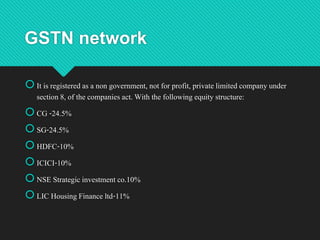
GSTN network
It is registeredas a non government, not for profit, private limited company under
section 8, of the companies act. With the following equity structure:
CG -24.5%
SG-24.5%
HDFC-10%
ICICI-10%
NSE Strategicinvestment co.10%
LIC Housing Finance ltd-11%
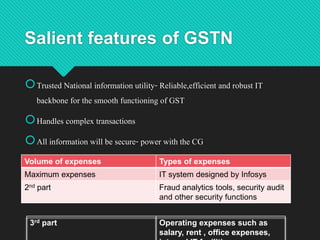
Salient features of GSTN
Trusted National information utility- Reliable,efficient and robust IT
backbone for the smooth functioning of GST
Handles complex transactions
All information will be secure- power with the CG
Expenses will be shared- user charges paid by CG and SG. 50:50, states-
according to tax payers
Volume of expenses Types of expenses
Maximum expenses IT system designed by Infosys
2nd part Fraud analytics tools, security audit
and other security functions
3rd part Operating expenses such as
salary, rent , office expenses,
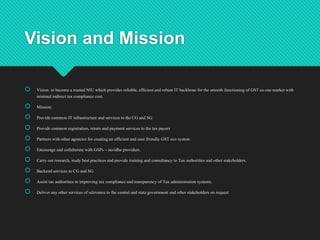
Vision and Mission
 Vision: to become a trusted NIU which provides reliable, efficient and robust IT backbone for the smooth functioning of GST as one market with
minimal indirect tax compliance cost.
 Mission:
 Provide common IT infrastructure and services to the CG and SG
 Provide common registration, return and payment services to the tax payers
 Partners with other agencies for creating an efficient and user friendly GST eco system
 Encourage and collaborate with GSPs – suvidha providers.
 Carry out research, study best practices and provide training and consultancy to Tax authorities and other stakeholders.
 Backend services to CG and SG
 Assist tax authorities in improving tax compliance and transparency of Tax administration systems.
 Deliver any other services of relevance to the central and state government and other stakeholders on request
Powers and functions of GST
network
 Facilitatesregistration
 Forwarding the returns to central and state authorities.
 Computation and settlement ofIGST
 Matching of tax payment detailswith banking network
 Providing various MIS reports to the CG and SG based on the tax payer return information
 MIS management informationsystem is a computerized databaseof financialinformation
organizedand programmedin such a way that it producesregular reports on operationsfor
every level of management.
 Providing analysisof tax payer’s profile
 Running the matching engine for matching, reversal and reclaim of ITC
GSP
GSP stands for GST suvidha Provider.
Enabler for the taxpayer to comply with the provisions of the GST law through it’s
web platform
Purchased made and entered can be downloaded via GSTR-2 from the GST portal.
G2B portal for taxpayers to accessthe GST system there will be a wide variety of
tax payers.
The specific needs of an industry or trade could be met by GSP.
Through innovative solutions.
Guidelines and architecture of
GSP
To integratemultiple tax department website, bringing all the tax administrators to
the same level of IT maturity with uniform formats and interfacesfor taxpayersand
other external stakeholders.
For taxpayers,GSTN provide common and shared IT infrastructure and cater to
functions such as filing registrationapplications,filing returns,creating challan for
tax payment, settlingIGST payment and generating businessintelligence and
analytics.
GSP should comply with government of India IT securitypolicies and standards.
GSP eco system
 GST system is developedby Infosys.
 The work consists of developmentof core system, provisioningof required IT
infrastructure to host the GST system and running and operatingthe system for five years.
 Upload informationon invoice, ITC claims, creation ofparty wise ledgers, uploading of
returns, payment of taxes, signing of such documentswith digital signatures.
 The GST system will have a G2B portal for taxpayersto accessthe GST systems, however
that would not be the only way for interactingwith the GST systems.
 All the applications relatedto the system is developedby third partieswith a genericname,
GST suvidha provider.

Gst and technology

  • 1.
  • 2.
    GST GST is andestination based tax, inter state of goods and services. Settlement happens between states and the centre- because of strong IT infrastructure and service back bone. GSTN network is a non profit organisation was incorporated on March 28,2018. to provide IT services to the central and state government. The authorized capital is Rs.10 crore in which the government of India holds 24.5% equity in GSTN and all states of the Indian union, including NCT.( National capital territory) of delhi, puducherry, empowered committeee of state finance ministers, together hold another 24.5%, balance 51% equity with non government financial institutions. .
  • 3.
    GSTN Gst portal –motherdatabasefor everything. Backbone of the common portal, which is the interfacebetween the taxpayers and the government The entire processfrom filing to returns is online starting from registration to the filing of returns. It has to support about 3 billion invoices per month and the subsequent return filing from Rs.65 to Rs.70 lakhs taxpayers. Handles- invoices, various returns, registrations,payments and refunds.
  • 4.
    Genesis and structureof GSTN  Currently, the centre and state indirect tax administrations work under differentlaws, regulations, proceduresand formats and consequently theIT systems work as independent sites.  It has same level of IT maturity with uniform formats and interfaces for taxpayers and other external stakeholders.  Empowered committeeof State Finance Ministers held on 21/7/2010 discussedthis aspect.  EC approved the creationof an empowered group on IT infrastructure for GST under the chairmanship ofDr. Nandan Nilekani along with five state commissionersof Trade taxes.
  • 5.
    Infrastructure of GST Member Additionalsecretary Directorate General CBEC (member secretary) Ministry of finance Member secretary, empowered group of state finance ministers Member technology advisory group for unique projects Commercial tax commissioners of Maharastra, Assam, Karnataka, West Bengal and Gujarat
  • 6.
    NIU/ SPV  NationalInformationUtility/ Special purpose vehicle forimplementing this GST network.  Union ministry of Finance had set up the Technical AdvisoryGroup for Unique projects (TAGUP)  EG (empowered Group) recommended a non-government structurefor the GSTN- SPV with government equity of 49% ( center-24.5% and States -24.5%)  Strategic control of the government through compositionof the board, mechanisms of Special resolutionand shareholdersagreement between GSTN- SPV and governments.  On 14th october 2011, the empowered committee endorsedthe recommendationsof the EG.
  • 7.
    GSTN network It isregisteredas a non government, not for profit, private limited company under section 8, of the companies act. With the following equity structure: CG -24.5% SG-24.5% HDFC-10% ICICI-10% NSE Strategicinvestment co.10% LIC Housing Finance ltd-11%
  • 8.
    Salient features ofGSTN Trusted National information utility- Reliable,efficient and robust IT backbone for the smooth functioning of GST Handles complex transactions All information will be secure- power with the CG Expenses will be shared- user charges paid by CG and SG. 50:50, states- according to tax payers Volume of expenses Types of expenses Maximum expenses IT system designed by Infosys 2nd part Fraud analytics tools, security audit and other security functions 3rd part Operating expenses such as salary, rent , office expenses,
  • 9.
    Vision and Mission Vision: to become a trusted NIU which provides reliable, efficient and robust IT backbone for the smooth functioning of GST as one market with minimal indirect tax compliance cost.  Mission:  Provide common IT infrastructure and services to the CG and SG  Provide common registration, return and payment services to the tax payers  Partners with other agencies for creating an efficient and user friendly GST eco system  Encourage and collaborate with GSPs – suvidha providers.  Carry out research, study best practices and provide training and consultancy to Tax authorities and other stakeholders.  Backend services to CG and SG  Assist tax authorities in improving tax compliance and transparency of Tax administration systems.  Deliver any other services of relevance to the central and state government and other stakeholders on request
  • 10.
    Powers and functionsof GST network  Facilitatesregistration  Forwarding the returns to central and state authorities.  Computation and settlement ofIGST  Matching of tax payment detailswith banking network  Providing various MIS reports to the CG and SG based on the tax payer return information  MIS management informationsystem is a computerized databaseof financialinformation organizedand programmedin such a way that it producesregular reports on operationsfor every level of management.  Providing analysisof tax payer’s profile  Running the matching engine for matching, reversal and reclaim of ITC
  • 11.
    GSP GSP stands forGST suvidha Provider. Enabler for the taxpayer to comply with the provisions of the GST law through it’s web platform Purchased made and entered can be downloaded via GSTR-2 from the GST portal. G2B portal for taxpayers to accessthe GST system there will be a wide variety of tax payers. The specific needs of an industry or trade could be met by GSP. Through innovative solutions.
  • 12.
    Guidelines and architectureof GSP To integratemultiple tax department website, bringing all the tax administrators to the same level of IT maturity with uniform formats and interfacesfor taxpayersand other external stakeholders. For taxpayers,GSTN provide common and shared IT infrastructure and cater to functions such as filing registrationapplications,filing returns,creating challan for tax payment, settlingIGST payment and generating businessintelligence and analytics. GSP should comply with government of India IT securitypolicies and standards.
  • 13.
    GSP eco system GST system is developedby Infosys.  The work consists of developmentof core system, provisioningof required IT infrastructure to host the GST system and running and operatingthe system for five years.  Upload informationon invoice, ITC claims, creation ofparty wise ledgers, uploading of returns, payment of taxes, signing of such documentswith digital signatures.  The GST system will have a G2B portal for taxpayersto accessthe GST systems, however that would not be the only way for interactingwith the GST systems.  All the applications relatedto the system is developedby third partieswith a genericname, GST suvidha provider.