R A M A N D E E P S I N G H
A S S I S T A N T P R O F E S S O R
S R I V E N K A T E S W A R A C O L L E G E
U N I V E R S I T Y O F D E L H I
Foreign Exchange Management
Act, 1999
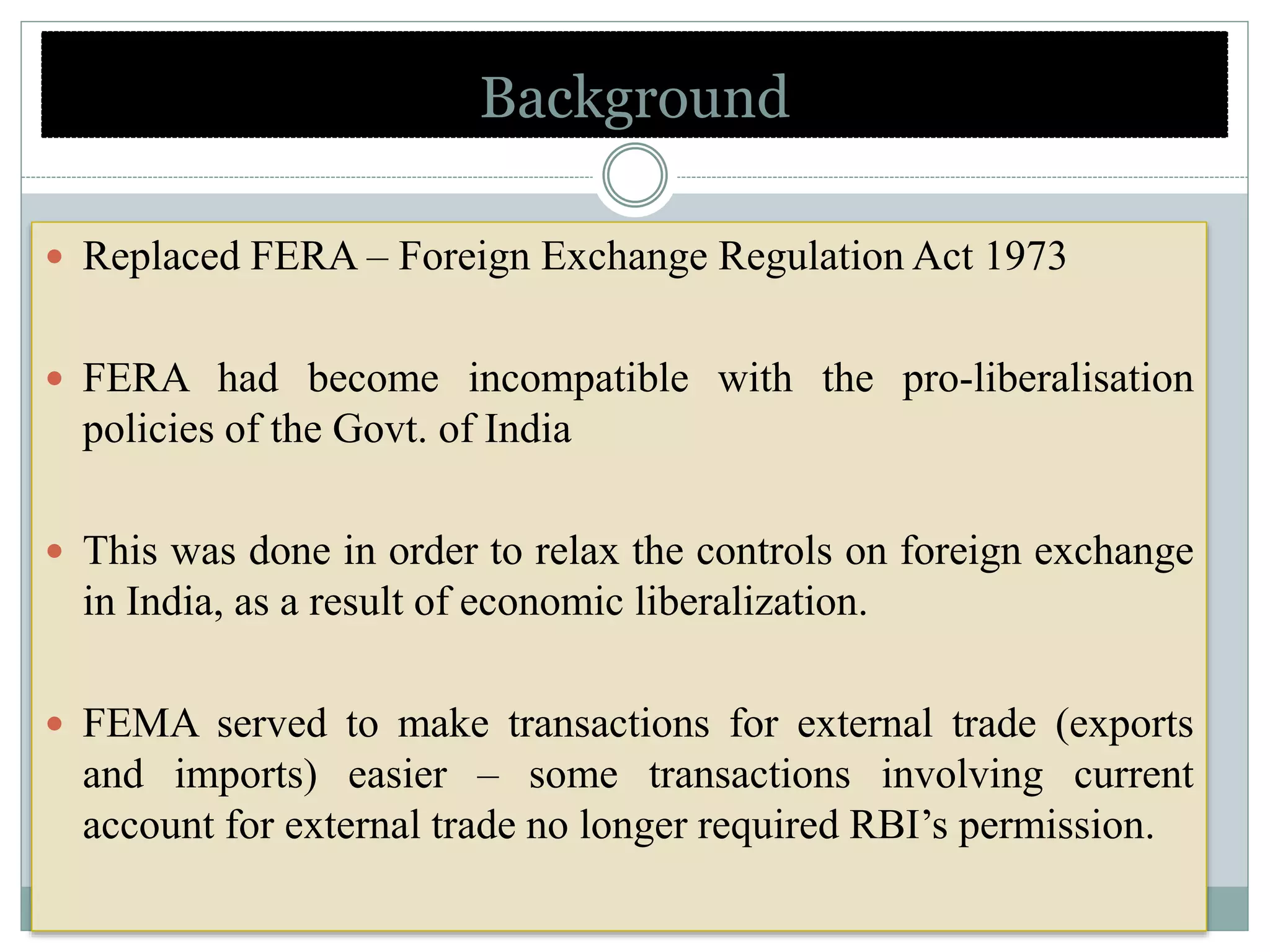
Background
 Replaced FERA – Foreign Exchange Regulation Act 1973
 FERA had become incompatible with the pro-liberalisation
policies of the Govt. of India
 This was done in order to relax the controls on foreign exchange
in India, as a result of economic liberalization.
 FEMA served to make transactions for external trade (exports
and imports) easier – some transactions involving current
account for external trade no longer required RBI’s permission.
FERA vs FEMA
 The objective of FERA was to conserve forex and prevent its
misuse. The objective of FEMA is to facilitate external trade
and payments and maintenance of foreign exchange in India.
 Violation of FERA was considered a criminal offence.
Whereas violation of FEMA is considered a civil offence.
 Under FERA citizenship was a criteria while determining a
person as resident of India whereas under FEMA stay of more
than 182 days is a criteria to determine residential status of a
person.
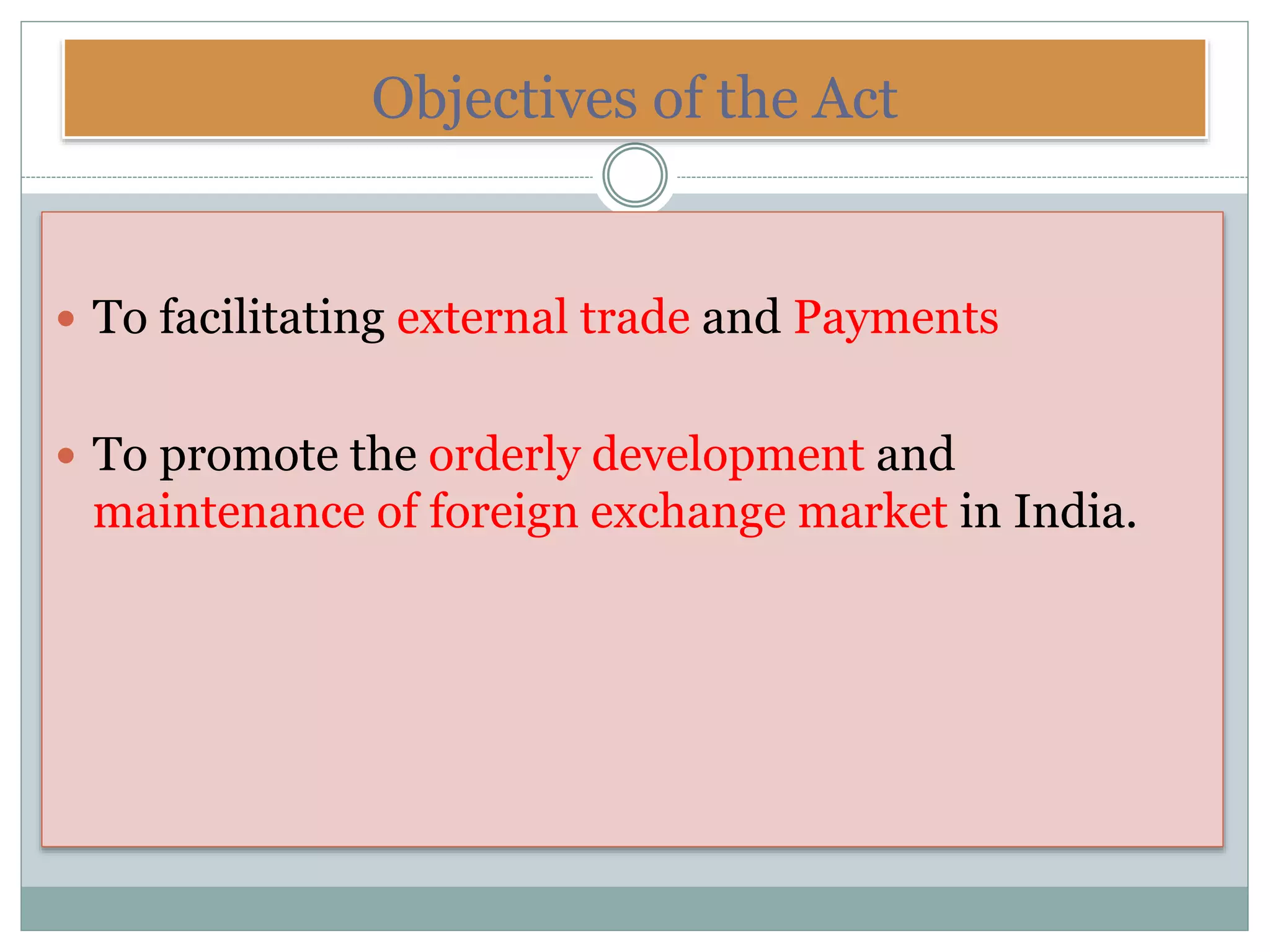
Objectives of the Act
 To facilitating external trade and Payments
 To promote the orderly development and
maintenance of foreign exchange market in India.
Few Highlights of FEMA, 1999
 FEMA is more transparent in its application.
 Application of FEMA may be seen broadly from two angles, viz.,
Capital A/c transactions
Current A/c transactions
There are 7 types of current transaction which are totally prohibited
and no transaction can be undertaken. (Lotteries, football pools,
banned magazines and a few others )
Few Definitions
"authorized person"
means an authorized dealer, money changer, off-shore
banking unit or any other person for the time being
authorized under sub-section (1) of section 10 to deal in
foreign exchange or foreign securities;
“Capital Account Transaction”
means a transaction which alters the assets or liabilities,
including contingent liabilities, outside India of persons
resident in India or assets or liabilities in India of persons
resident outside India, and includes transactions referred
to in sub-section (3) of section 6;
"currency“
includes all currency notes, postal notes, postal
orders, money orders, cheques, drafts, travelers
cheques, letters of credit, bills of exchange and
promissory notes, Debit card, credit card or such
other similar instruments, as may be notified by the
Reserve Bank;
"currency notes"
means and includes cash in the form
of coins and bank notes;
“current account transaction"
means a transaction other than a capital account transaction and includes –
(i) payments due in connection with foreign trade, other current business,
services, and short-term banking and credit facilities in the ordinary course
of business,
(ii) payments due as interest on loans and as net income from investments,
(iii) remittances for living expenses of parents, spouse and children residing
abroad, and
(iv) expenses in connection with foreign travel, education and medical care
of parents, spouse and children;
"foreign exchange"
means foreign currency and includes,-
(i) deposits, credits and balances payable in any foreign
currency,
(ii) drafts, travellers cheques, letters of credit or bills of
exchange, expressed or drawn in Indian currency but payable in
any foreign currency,
(iii) drafts, travellers cheques, letters of credit or bills of
exchange drawn by banks, institutions or persons outside India,
but payable in Indian currency;
"person" includes –
(i) an individual,
(ii) a Hindu undivided family,
(iii) a company,
(iv) a firm,
(v) an association of persons or a body of individuals, whether
incorporated or not,
(vi) every artificial juridical person, not falling within any of the
preceding sub-clauses
"person resident in India"
(i) a person residing in India for more than one hundred and eighty-
two days during the course of the preceding financial year. The
expression does not include
(a) A person who has gone out of India or who stays outside
India, in either case-
 (i) for or on taking up employment outside India or,
 (ii) for carrying on outside India a business or vocation outside in
 For any other purpose, indicating his intention to stay outside India for a
uncertain period.
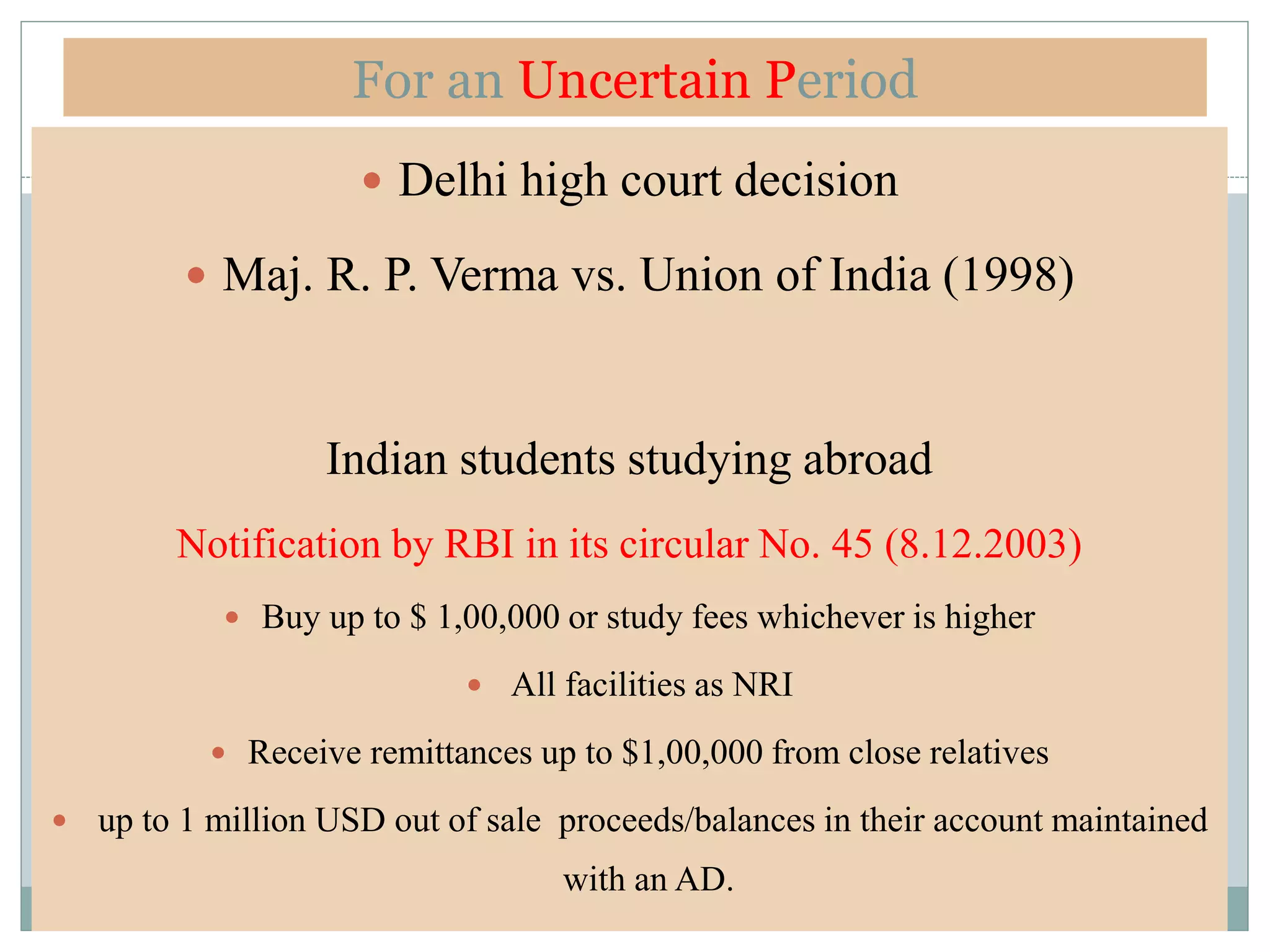
For an Uncertain Period
 Delhi high court decision
 Maj. R. P. Verma vs. Union of India (1998)
Indian students studying abroad
Notification by RBI in its circular No. 45 (8.12.2003)
 Buy up to $ 1,00,000 or study fees whichever is higher
 All facilities as NRI
 Receive remittances up to $1,00,000 from close relatives
 up to 1 million USD out of sale proceeds/balances in their account maintained
with an AD.
(B) A person who has come to or stays in
India, in either case, otherwise than –
 (i) for or on taking up employment in India or,
 (ii) for carrying on outside India a business or vocation in
India.
 (iii)For any other purpose, indicating his intention to stay in
India for a uncertain period.
(ii) Any person or body of corporate registered or
incorporated in India.
(iii) An office, branch or agency in India owned by or
controlled by a person resident outside India.
(iv) An office, branch or agency outside India owned by or
controlled by a person resident in India.
"person resident outside India"
means a person who is not resident in India;
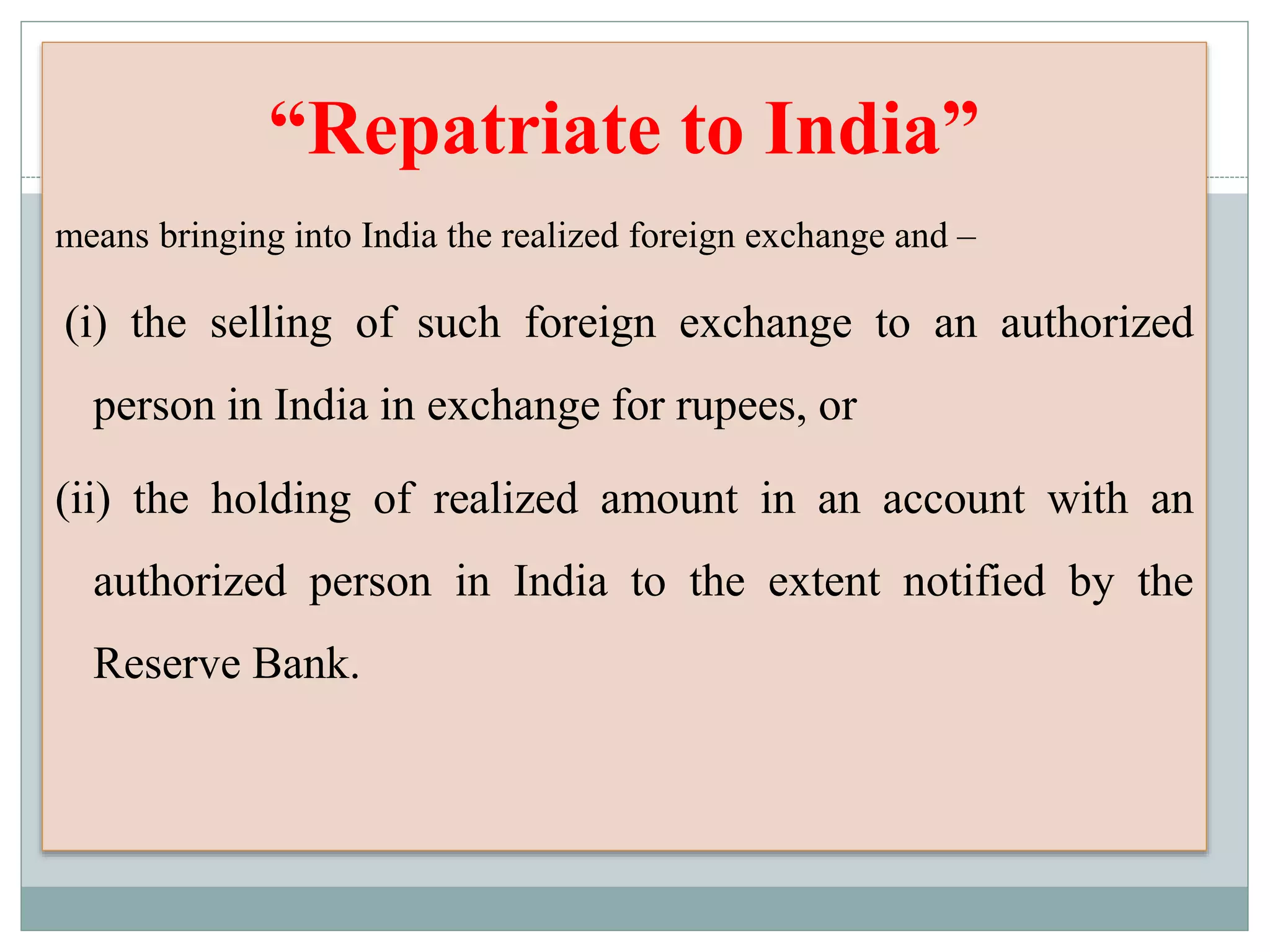
“Repatriate to India”
means bringing into India the realized foreign exchange and –
(i) the selling of such foreign exchange to an authorized
person in India in exchange for rupees, or
(ii) the holding of realized amount in an account with an
authorized person in India to the extent notified by the
Reserve Bank.
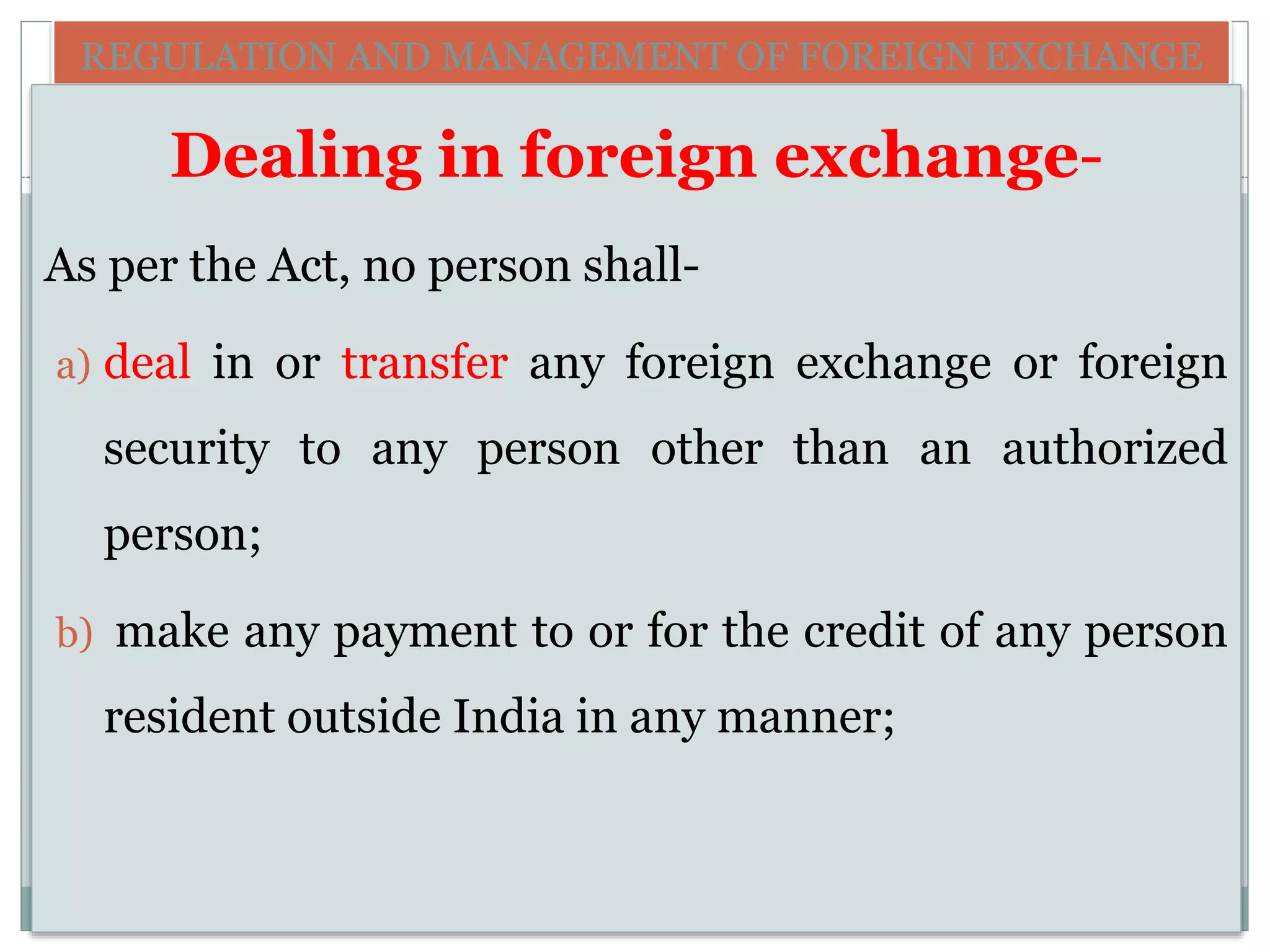
REGULATION AND MANAGEMENT OF FOREIGN EXCHANGE
Dealing in foreign exchange-
As per the Act, no person shall-
a) deal in or transfer any foreign exchange or foreign
security to any person other than an authorized
person;
b) make any payment to or for the credit of any person
resident outside India in any manner;
(c) receive, except through an authorized person, any
payment by order or on behalf of any person resident
outside India in any manner. (Explanation)
(d) enter into any financial transaction in India as
consideration for or in association with acquisition or
creation or transfer of a right to acquire, any asset
outside India by any person. (Explanation)
Holding of foreign exchange, etc.
Except as otherwise provided in this Act, no
person resident in India shall acquire, hold,
own, possess or transfer any foreign
exchange, foreign security or any
immovable property situated outside India.
Liberalizations
 1. Possession and Retention of Foreign Currency
(a) Authorized person can retain and possess foreign
currency and coins within the scope of his authority
without any limit.
(b) Any person can possess foreign coins without any
limit
(c) A person resident in india can retain foreign currency
notes, bank notes, and travelers' cheques not
exceeding US $ 2000 or its equivalent in aggregate.
Such currency should be acquired by him-
(a) While on a visit to any place outside India by way of
payment for services only.
(b) From any person not resident in India and who is on a visit
to India, as honorarium or gift or services rendered.
(c) by way of honorarium or gift while on a visit to any place
outside India.
(d) represents unspent amount of foreign exchange acquired
by him from an authorized person.
Receipt from, and payment to, a person resident outside India
A person resident in India can receive any payment in any of following mode:-
(a) Payment made in rupees by order or behalf of a person resident
outside India during his stay in India out of rupee funds provided
by him by sale of foreign exchange to an authorized dealer or a
money changer in India.
(b) Payment made by means of a cheque drawn on a bank situated
outside India or a bank draft or travelers' cheque issued outside
India. If it is in FE, it should be sold to authorized dealer.
(iii) Payment made in foreign currency notes directly from
out of India. It should be sold to authorized dealer within 7
days from receipt of payment.
(iv) Payment by means of postal order issued by a post office
outside India or by a postal money order issued by such
post office. (7 days)
Prohibition on drawal of Foreign Exchange for
certain current account transaction
 Travel to Nepal and Bhutan.
 Remittance out of lottery winnings.
 Remittance out of income from racing, riding etc.
 Payment of commission on exports made towards equity
investment in joint ventures/ wholly owned subsidiaries
aboard of Indian companies.
 Payment of Dividend by any company to
which the requirement of dividend balancing
is applicable.
 Payment related to ‘call back services’ of
telephones.
 Remittance of interest income on funds held
in Non-resident rupee account scheme.
Current Account Transactions which require approval of the
central Government
 Cultural Tours
 Advertisement in foreign print media for the purpose
other than promotion of tourism, foreign investments
and international bidding (exceeding US$ 10,000) by a
state govt. and its PSUs.
 Remittance of freight of vessel charted by a PSU.
 Payment of import through ocean transport by a Govt.
Department or a PSU.
 Multi-model transport operators making remittances to
their agents abroad.
 Remittance of hiring charges of transponders by (a) TV
Channels (b) Internet Service Providers.
 Remittance of container detention charges exceeding the
rate prescribed by DG of shipping..
Continue……..
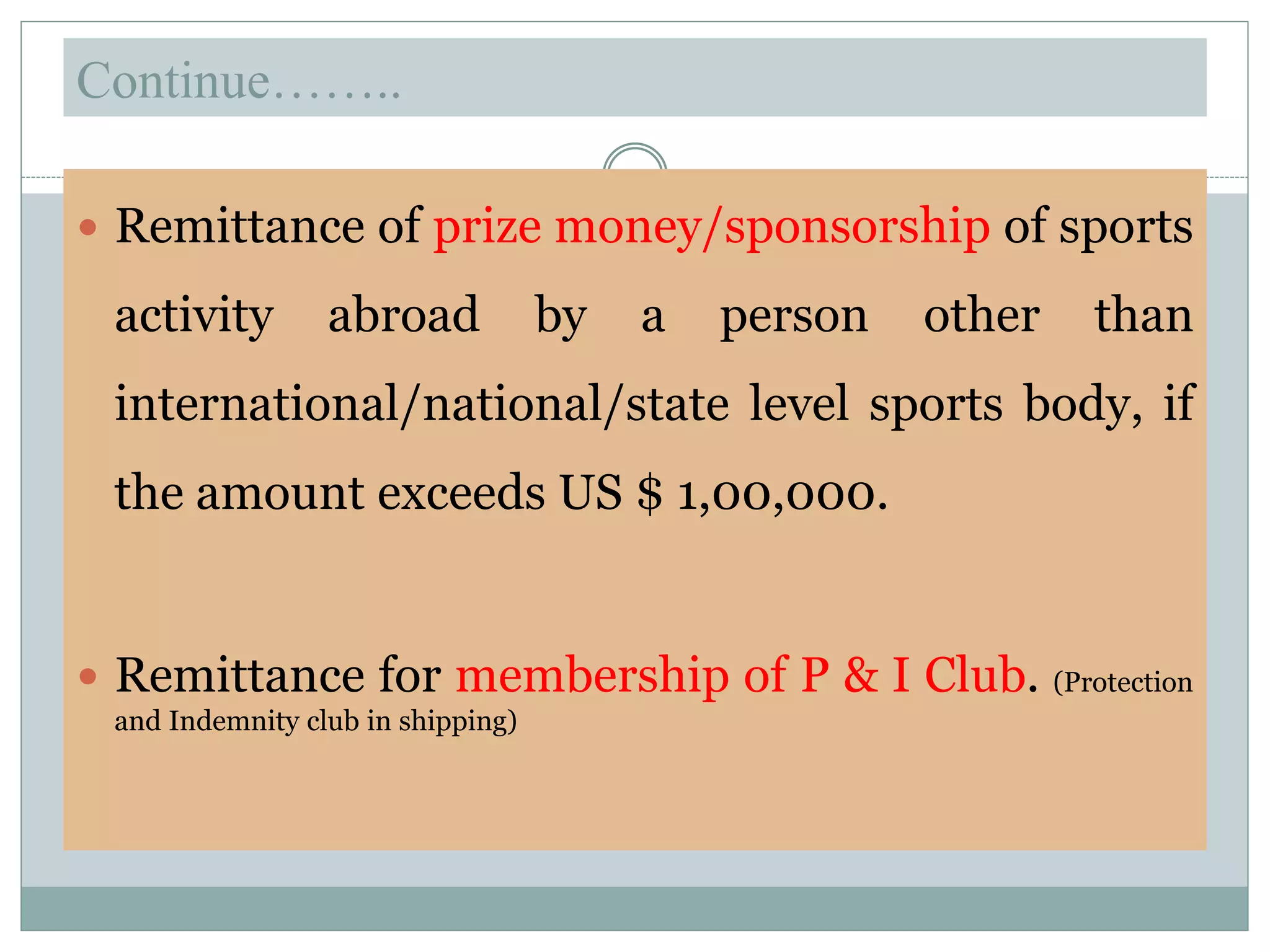
 Remittance of prize money/sponsorship of sports
activity abroad by a person other than
international/national/state level sports body, if
the amount exceeds US $ 1,00,000.
 Remittance for membership of P & I Club. (Protection
and Indemnity club in shipping)
Current Account Transactions which require approval of the
RBI
Any additional remittance in excess of 2,50,000 USD for the following purpose require
permission of RBI.
a) Private visit to any country. (Except Nepal and Bhutan)
b) Gift or Donation
c) Going abroad for employment.
d) Emigration
e) Maintenance of close relative abroad
f) Travel for business, or attending a conference or specialized training or meeting
medical expenses, or check up abroad, or for accompanying as attendant to a
patient going abroad.
g) Studies abroad
h) Any other current account transaction.
Facilities for persons other than individual
a) Donations exceeding 1% of their foreign exchange
earnings during the previous 3 financial years or US$
50,00,000, whichever is less, for-
(i) Creation of Chairs in reputed educational institutes,
(ii) Contribution to funds promoted by educational institutes;
(iii) Contribution to a technical institution or body or association in
the field of activity.
b) Commission, to agent abroad for sale of residential flats or
commercial plots in India exceeding US$ 25,000.
Continue……….
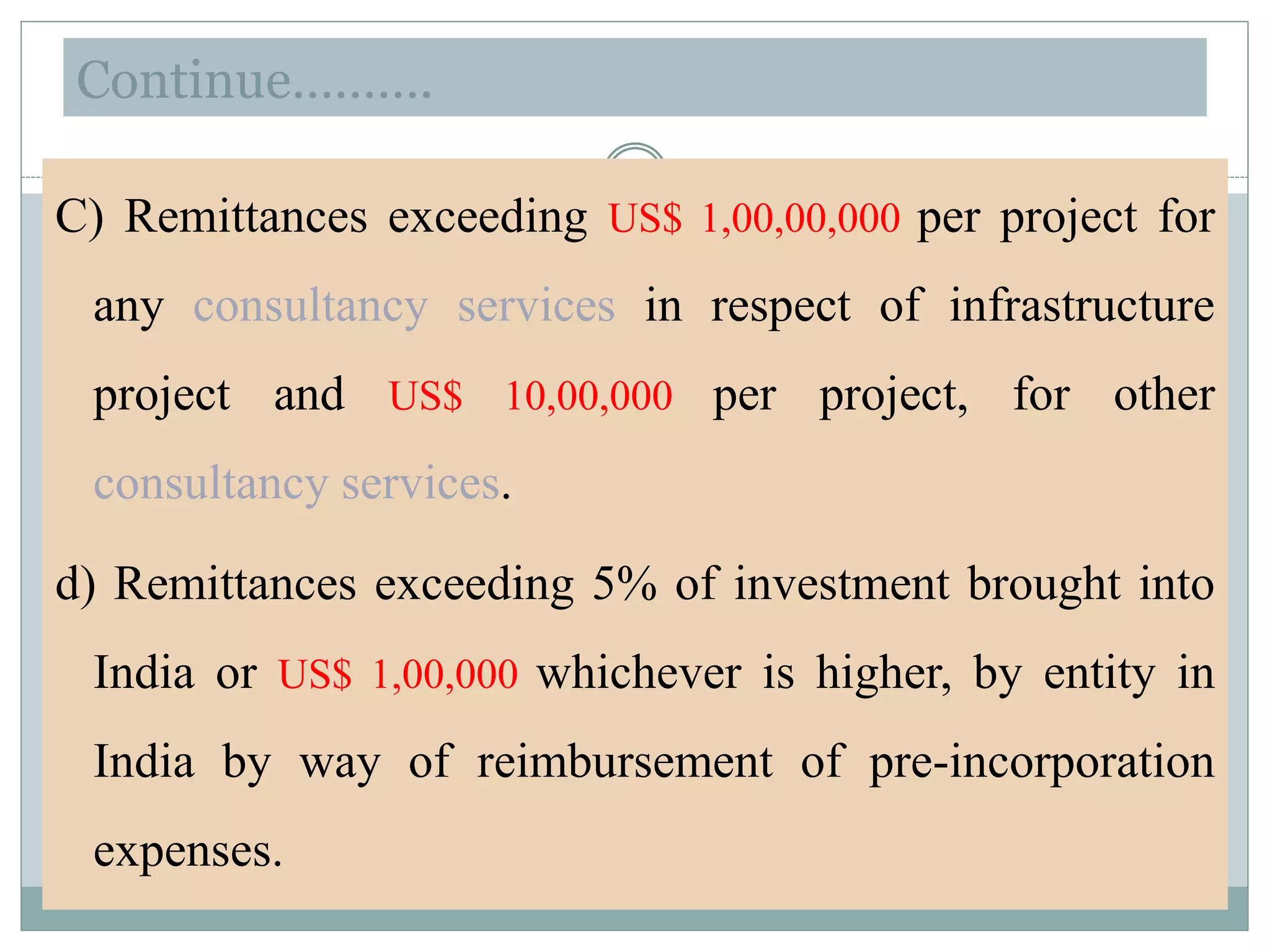
C) Remittances exceeding US$ 1,00,00,000 per project for
any consultancy services in respect of infrastructure
project and US$ 10,00,000 per project, for other
consultancy services.
d) Remittances exceeding 5% of investment brought into
India or US$ 1,00,000 whichever is higher, by entity in
India by way of reimbursement of pre-incorporation
expenses.
Capital Account Transaction
“capital account transaction” means a transaction
which alters the assets or liabilities, including
contingent liabilities, outside India of persons
resident in India or assets or liabilities in India of
persons resident outside India.
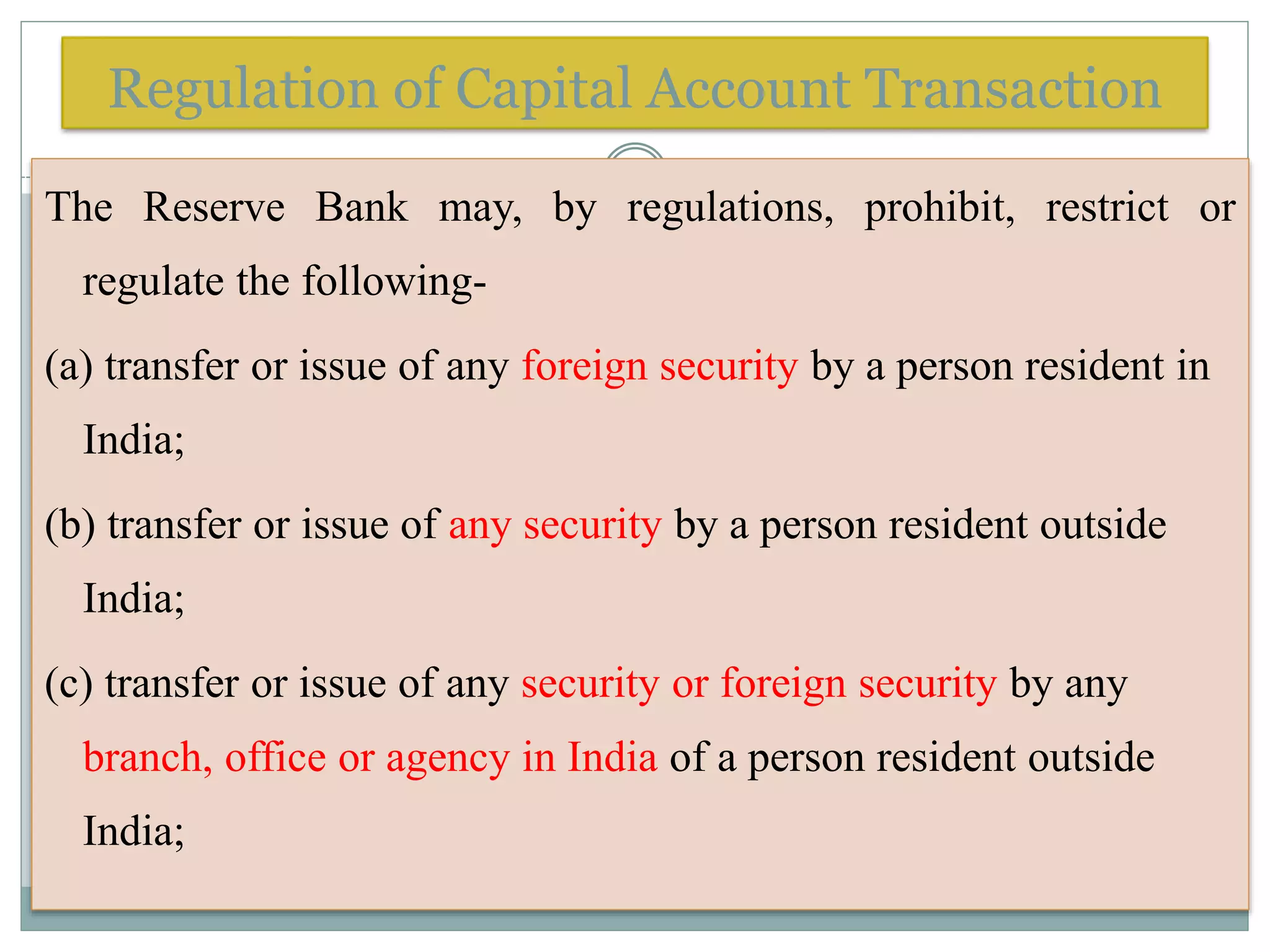
Regulation of Capital Account Transaction
The Reserve Bank may, by regulations, prohibit, restrict or
regulate the following-
(a) transfer or issue of any foreign security by a person resident in
India;
(b) transfer or issue of any security by a person resident outside
India;
(c) transfer or issue of any security or foreign security by any
branch, office or agency in India of a person resident outside
India;
(d) any borrowing or lending in rupees in whatever form or
by whatever name called between a person resident in
India and a person resident outside India;
(f) deposits between persons resident in India and persons
resident outside India;
(g) export, import or holding of currency or currency notes;
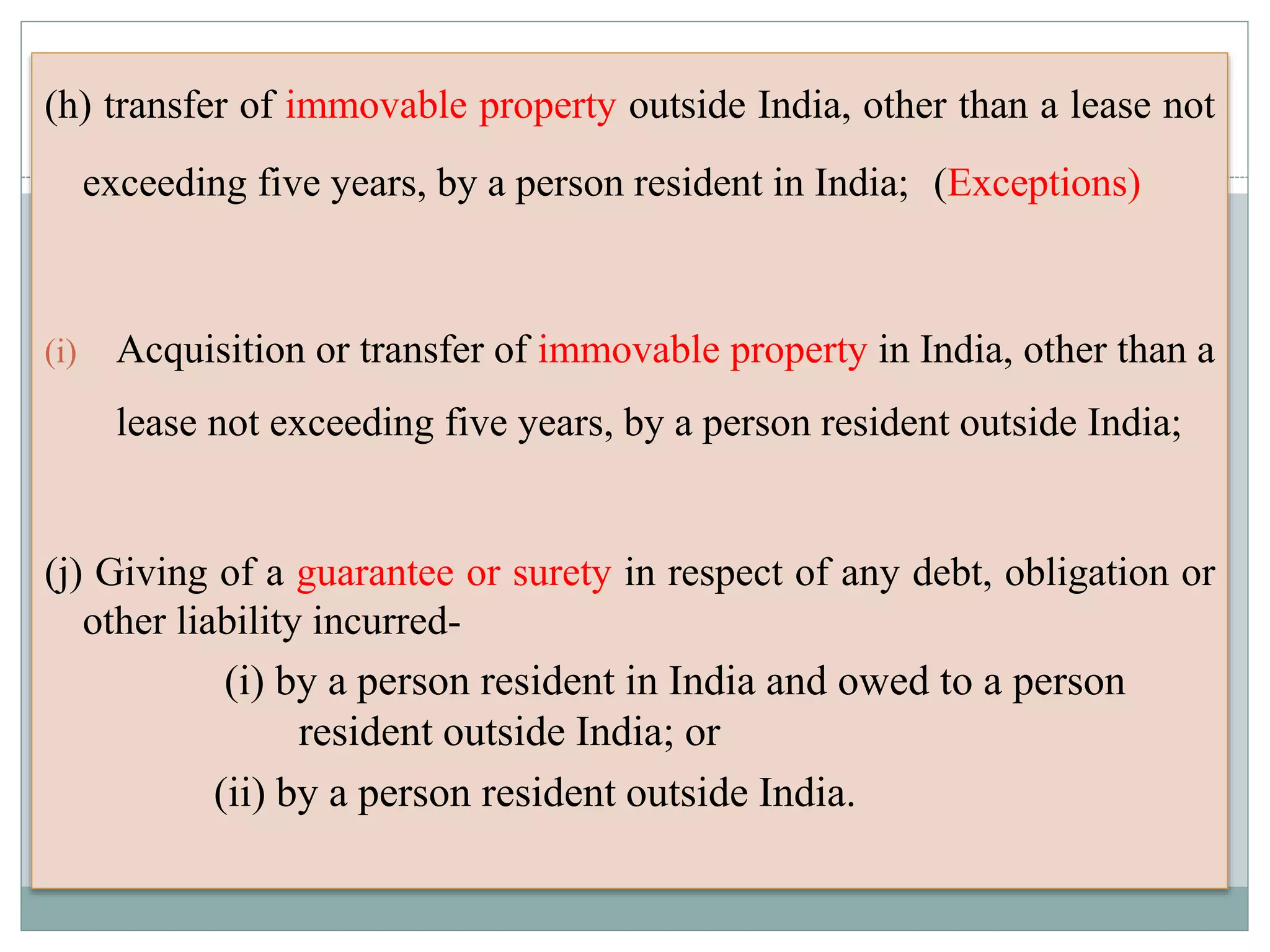
(h) transfer of immovable property outside India, other than a lease not
exceeding five years, by a person resident in India; (Exceptions)
(i) Acquisition or transfer of immovable property in India, other than a
lease not exceeding five years, by a person resident outside India;
(j) Giving of a guarantee or surety in respect of any debt, obligation or
other liability incurred-
(i) by a person resident in India and owed to a person
resident outside India; or
(ii) by a person resident outside India.
Acquisition and transfer of immovable property outside
India
A PRI can or may acquire immovable property outside India-
1. By way of gift or inheritance from a person as on or before 8
July, 1947 and continue to be held by him.
2. Any purchase from Resident Foreign Currency A/C (RFC).
3. Purchasing assets jointly with relative outside India.
4. Assets got from Gift or will from parents.
5. Any branch, office and immovable property for employees by
a company with the permission of RBI.
Capital Account Transaction that Cannot be
Prohibited
A person resident in India may hold, own, transfer or
invest in foreign currency, foreign security or any
immovable property situated outside India if such
currency, security or property was acquired, held or
owned by such person when he was resident outside
India or inherited from a person who was resident
outside India.
A person resident outside India may hold, own, transfer
or invest in Indian currency, security or any immovable
property situated in India if such currency, security or
property was acquired, held or owned by such person
when he was resident in India or inherited from a
person who was resident in India.
Permissible CAT by RBI for Person Resident In India
 Foreign currency loan raised in India and abroad by a PRI.
 Investment by a PRI in foreign securities.
 Transfer of immovable properties outside India by PRI.
 Export/Import and holding of currency/ currency notes.
 Loans and overdrafts by a PRI from a person resident outside India.
 Maintenance of foreign currency accounts in India and outside India by PRI.
 Taking out of insurance policy by a PRI from person resident outside India
from an insurance company outside India.
 Remittance outside India of capital assets by a PRI.
 Sale and purchase of foreign exchange derivatives in India or abroad by PRI.
Permissible CAT by RBI for Person Resident Outside
India
 Investment by a PROI in foreign securities of an Indian company.
 Acquisition and transfer of immovable properties in India by
PROI.
 Export/Import and holding of currency/ currency notes into/from
India by PROI.
 Guarantee by a PROI in favor of a person resident in India.
 Maintenance of foreign currency accounts in India by PROI.
 Remittance outside India of capital assets by a PROI.
 Deposits between a PRI and a PROI.
Prohibited Capital Account Transactions
a) A person shall not undertake or sell or draw foreign exchange to
or from an authorized person for any capital account transaction.
b) A non resident person shall not make investment in India in any
form, in any company or firm or any entity, whether
incorporated or not, which is engaged or proposes to engage:-
(i) in the business of chit fund, or
(ii) as Nidhi Company, or
(iii) in agricultural or plantation activities or
(iv) in real estate business, or construction of farm houses
or
Continue…..
(v) in trading in Transferable Development Rights
(TDRs)
means certificates issued in respect of category of land
acquired for public purposes either by the Central or
State Government in consideration of surrender of land
by the owner without monetary compensation, which
are transferable in part or whole.
Realization and Repatriation of Foreign Exchange.
Save as otherwise provided in this Act, where any amount
of foreign exchange is due or has accrued to any person
resident in India, such person shall take all reasonable
steps to realize and repatriate to India such foreign
exchange within such period and in such manner as may
be specified by the Reserve Bank. (However there are some
exemptions…….)
Exemption from realization and repatriation in
certain cases.
(a) possession of foreign currency or foreign coins by any
person up to such limit as the Reserve Bank may
specify;
(b) foreign currency account held or operated by such
person or class of persons and the limit up to which the
Reserve Bank may specify;
(c) foreign exchange acquired or received before the 8th
day of July, 1947 or any income arising or accruing
thereon which is held outside India by any person in
pursuance of a general or special permission granted by
the RBI;
(d) foreign exchange held by a PRI up to such limit as the
RBI may specify, if such foreign exchange was acquired
by way of gift or inheritance from a person referred to in
clause (c), including any income arising there from.
(e) foreign exchange acquired from employment, business,
trade, vocation, services, honorarium, gifts, inheritance
or any other legitimate means up to such limit as the RBI
may specify; and
(f) such other receipts in foreign exchange as the Reserve
Bank may specify.
Duties of the Exporter
To disclose the material information
To ensure the receipts of export proceeds
To inform delayed receipts
To make declaration in respect of services
Duties of Authorized person
 To comply with direction by RBI
 To make declaration
 To produce books of accounts and documents
 Contravention to public interest- An authorized person may be revoked by
RBI if it is in the public interest.
- Penalty -
If any authorized person fails to furnish any direction as directed by RBI, he is liable to pay
up to 10,000 rupees and in the case of continuing contravention, additional penalty up to
2,000 rupees for every day till the default continues.
Contravention and Penalties
Penalties [Section 13(1)]
If any person contravenes any provision of this Act,
or contravenes any rule, regulation, notification,
direction or order issued in exercise of the powers
under this Act, be liable to a penalty up to thrice the
sum involved in such contravention where such
amount is quantifiable, or up to 2 lakh rupees
where the amount is not quantifiable.
 where such contravention is a continuing one, further
penalty which may extend to 5 thousand rupees for every
day after the first day during which the contravention
continues.
 Any Adjudicating Authority adjudging any contravention, if he
thinks fit in addition to any penalty may direct that any currency,
security or property in respect of which the contravention has
taken place shall be confiscated to the Central Government
and further direct to defaulting person that such property shall be
brought back into India or shall be retained outside India in
accordance with the directions made in this behalf.
Confiscation of Money and Property [Section 13(2)]
If any person fails to make full payment of the penalty
imposed on him under section 13 within a period of 90
days from the date on which the notice for payment of
such penalty is served on him, he shall be liable to civil
imprisonment under this section.
(However , the defaulting person shall not be arrested or detained in civil prison unless
Adjudicating Authority issue or serve a notice upon him to appear.)
Enforcement of the Orders of Adjudicating
Authorities [Section 14]
The defaulter must be given an opportunity of being
heard.
Every person detained in the civil prison in execution of
the certificate may be so detained -
(a) where the certificate is for a demand of an amount
exceeding rupees one crore, up to three years, and
(b) in any other case, up to six months:
Important provisions of - Enforcement of the orders of Adjudicating
Authority
1. Obstruction in recovery of Penalty:
a) If the defaulter has obstructed the recovery of penalty, or
dishonestly transferred, concealed, or removed any pert of his
property.
b) If defaulter has means to pay the amount of penalty but refuses or
neglects to pay the same.
(2) Intend to Abscond
A warrant for the arrest of the defaulter may be issued by the
Adjudicating Authority if satisfied, that the defaulter is
likely to abscond or leave the local limits of the
jurisdiction of the Adjudicating Authority.
(A warrant of arrest issued by the Adjudicating Authority may also be executed by any
other Adjudicating Authority within whose jurisdiction the defaulter may for the time
being be found.)
(3) Non- Compliance of Served Notice:
the Adjudicating Authority may issue a warrant for the arrest
of the defaulter if such person does not comply with notice
issued and served to present himself before the authority.
(4) Presenting Arrested person before the authority
Every person arrested in pursuance of a warrant of arrest
under this section shall be brought before the Adjudicating
Authority issuing the warrant as soon as practicable and in
any event within 24 hours of his arrest (exclusive of the
time required for the journey).
Important note:-
But, if the defaulter pays the amount entered in the warrant and the costs of arrest to the officer
arresting him, he should be released at once.
(5) Opportunity of Being Heard
When a defaulter appears before the Adjudicating Authority
pursuant to a notice to show cause or is brought before the
Adjudicating Authority under this section, the
Adjudicating Authority shall give the defaulter an
opportunity showing cause why he should not be
committed to the civil prison
(6) Detention in the Custody
Pending the conclusion of the inquiry, the Adjudicating
Authority may, in his discretion, order the defaulter to
be detained in the custody of such officer as the
Adjudicating Authority may think fit or release him on
his furnishing the security amount to the satisfaction of
the Adjudicating Authority for his appearance as and
when required.
Upon the conclusion of the inquiry, the defaulter will be
released by giving an opportunity to satisfy the arrears of
penalty with a period of 15 days.
If arrears are not satisfied, the Adjudicating Authority may
make an order for the detention of the defaulter in the
civil prison and cause him to be arrested if he is not
already under arrest. Sec 14(9) .
Continue from 6 point
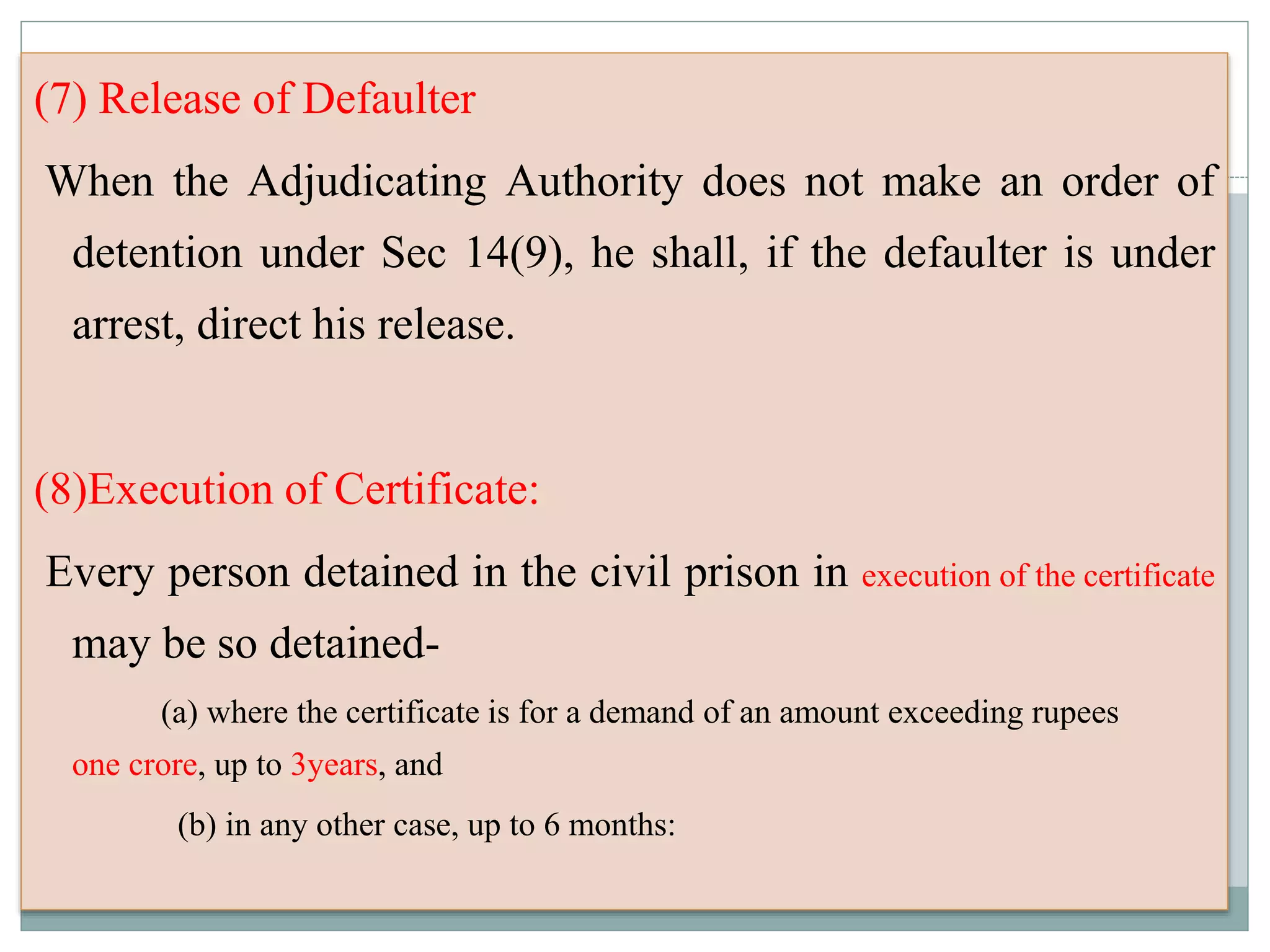
(7) Release of Defaulter
When the Adjudicating Authority does not make an order of
detention under Sec 14(9), he shall, if the defaulter is under
arrest, direct his release.
(8)Execution of Certificate:
Every person detained in the civil prison in execution of the certificate
may be so detained-
(a) where the certificate is for a demand of an amount exceeding rupees
one crore, up to 3years, and
(b) in any other case, up to 6 months:
(9) Release does not amount to Discharge
A defaulter released from detention under this section
shall not, merely by reason of his release, be discharged
from his liability for the arrears, but he shall not be
liable to be arrested under the certificate in execution of
which he was detained in the civil prison.
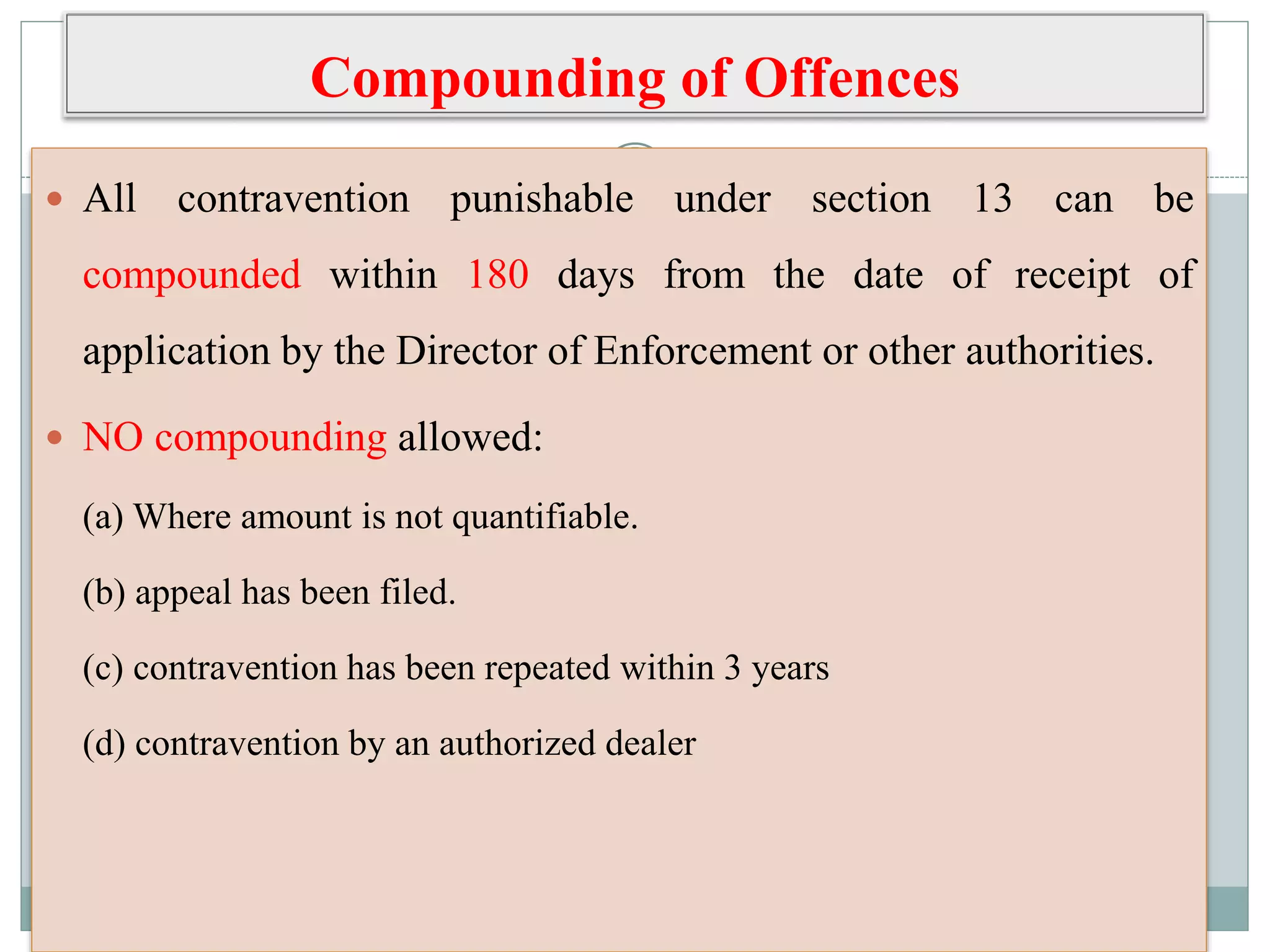
Compounding of Offences
 All contravention punishable under section 13 can be
compounded within 180 days from the date of receipt of
application by the Director of Enforcement or other authorities.
 NO compounding allowed:
(a) Where amount is not quantifiable.
(b) appeal has been filed.
(c) contravention has been repeated within 3 years
(d) contravention by an authorized dealer
Procedure and Process for Compounding of Offences
 An application for compounding may be submitted to the
compounding authority with prescribed fees with relevant
facts and supporting documents.
 The authority may call for any info and record relevant to
the compounding proceedings.
 Such additional info shall be submitted within 30 days. If
the contravener fails to submit such info, the application
for compounding will be liable to be rejected.
 The proceeding would be concluded within 180 days from
the date of the receipt of the application.
 The sum for which contravention has been compounded
shall be paid within 15 days from the date of order of
compounding.
 The payment shall be made by demand draft (DD) in favor
of compounding authority.
Appointment of Adjudicating Authority
(1) Appointment of Adjudicating Authority
The Central Government may, by an order published in the Official
Gazette, appoint as many officers of the Central Government as it
may thinks fit, as the Adjudicating Authorities for holding an
inquiry in the manner prescribed, against the person who has
committed contravention and a complaint has been made.
Note:- A reasonable opportunity of being heard will be provided before imposing any
penalty.
(2) Filling of Complaint and Holding of Enquiry
No Adjudicating Authority shall hold an enquiry under sub-
section (1) except upon a complaint in writing made by
any officer authorized by a general or special order by the
Central Government.
(3) Right to Take Legal Assistance
The said person (Defaulter) may appear either in
person or take the assistance of a legal practitioner
or a chartered accountant (CA) of his choice for
presenting his case before the Adjudicating
Authority.
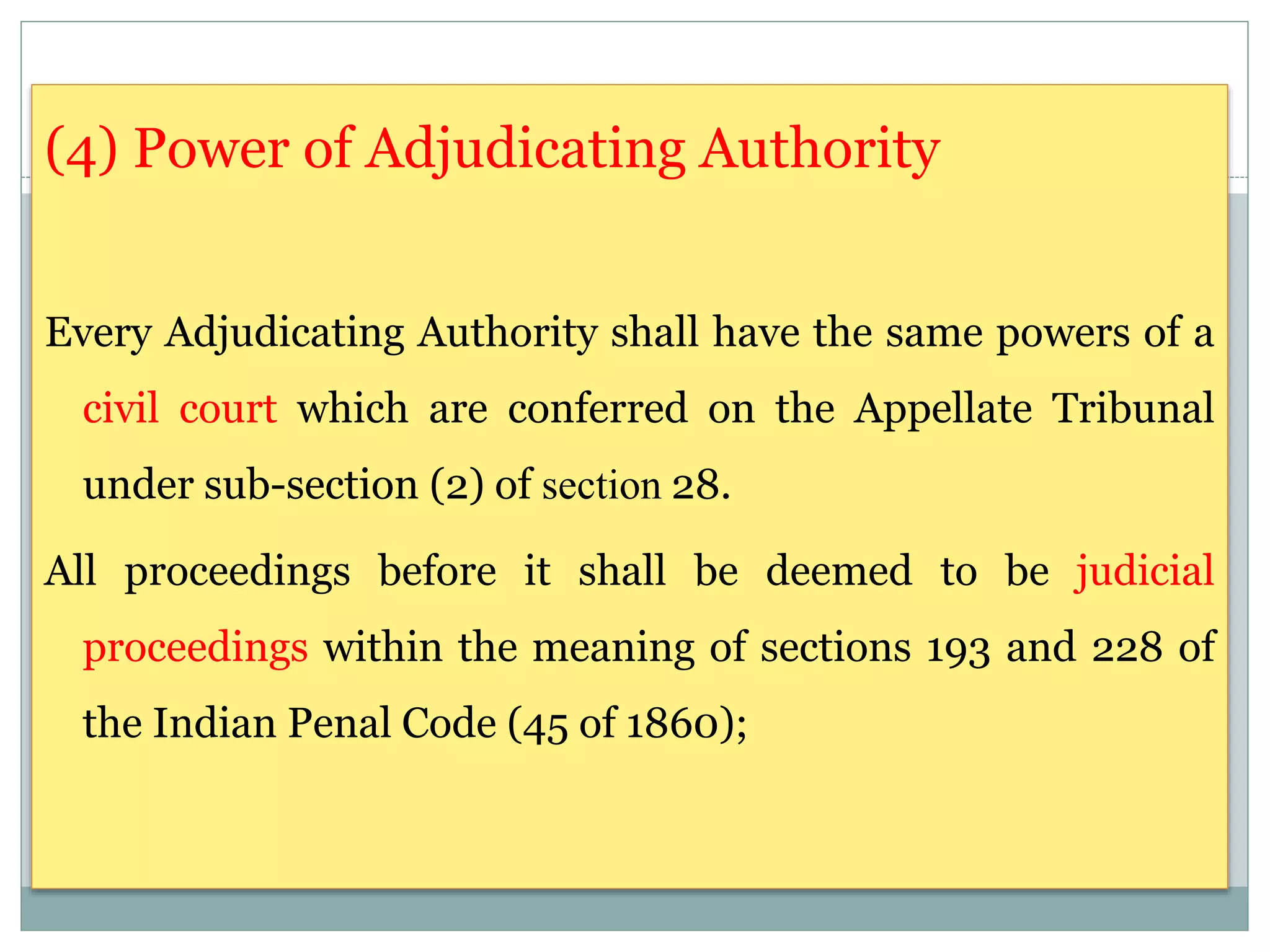
(4) Power of Adjudicating Authority
Every Adjudicating Authority shall have the same powers of a
civil court which are conferred on the Appellate Tribunal
under sub-section (2) of section 28.
All proceedings before it shall be deemed to be judicial
proceedings within the meaning of sections 193 and 228 of
the Indian Penal Code (45 of 1860);
(5) Maximum Time-limit to Dispose off a complaint
Every Adjudicating Authority shall deal with the complaints as
expeditiously as possible and endeavor shall be made to dispose
of the complaint finally within 1 year from the date of receipt of
the complaint.
(Note:- If the complaint cannot be disposed off with in 1 year, the AA shall record
the reasons in writings.)
(6) Appeal to Special Director
The Central Government shall, by notification, appoint one
or more Special Directors (Appeals) to hear appeals
against the orders of the Adjudicating Authorities along
with their jurisdictions.
Note:- The Special Directors (Appeals) shall have the same powers of a civil court
and all proceedings will be deemed to be juridicial proceedings .
(7)Time Limit to File an Appeal
Every appeal shall be filed within 45 days from the date on
which the copy of the order made by the Adjudicating
Authority is received by the aggrieved person and it shall
be in such form, verified in such manner and be
accompanied by such fee as may be prescribed. Section 17(3)
Note:- The special director may entertain an appeal after the expiry of 45 days if
he desires so on reasonable grounds.
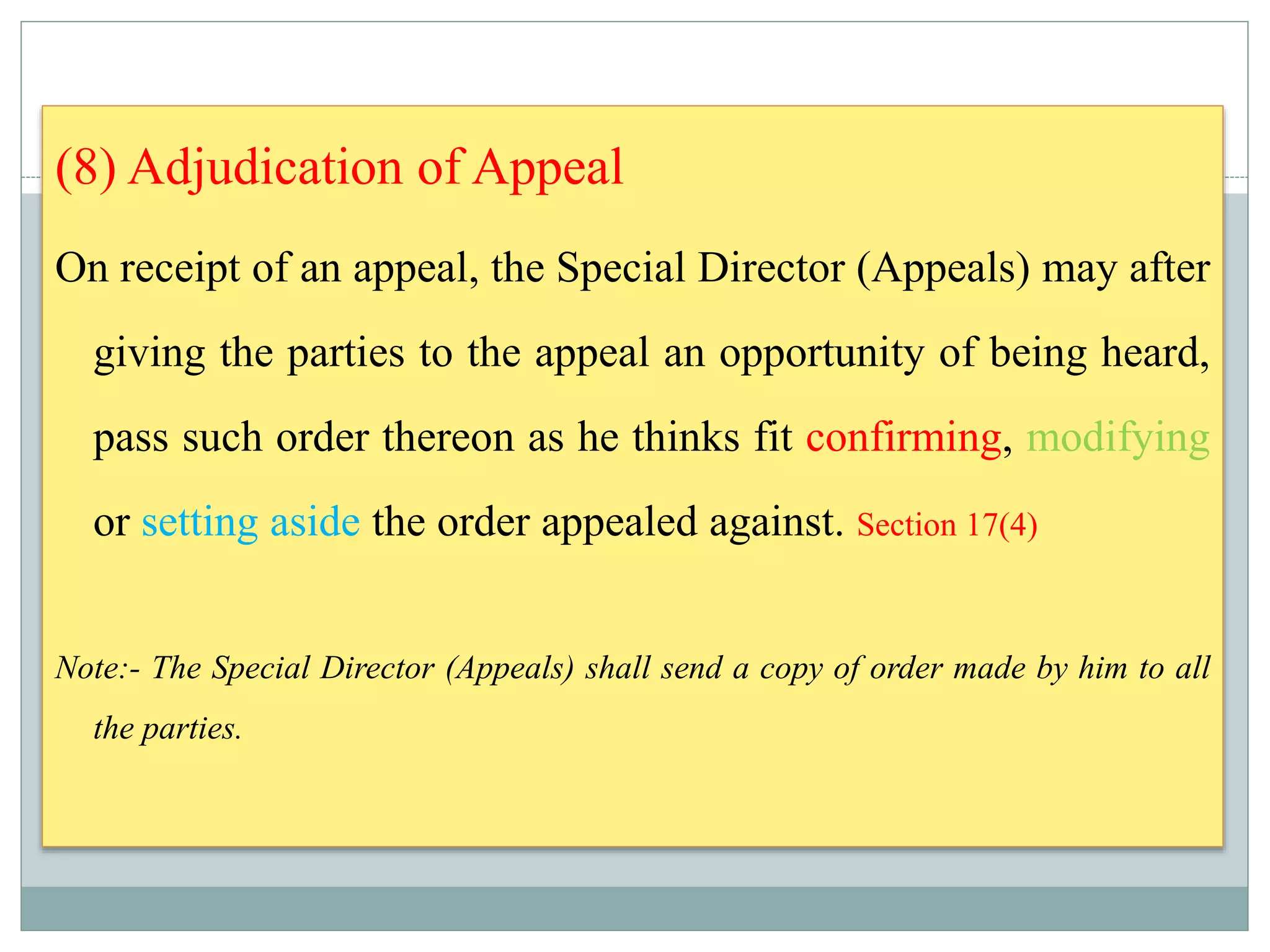
(8) Adjudication of Appeal
On receipt of an appeal, the Special Director (Appeals) may after
giving the parties to the appeal an opportunity of being heard,
pass such order thereon as he thinks fit confirming, modifying
or setting aside the order appealed against. Section 17(4)
Note:- The Special Director (Appeals) shall send a copy of order made by him to all
the parties.
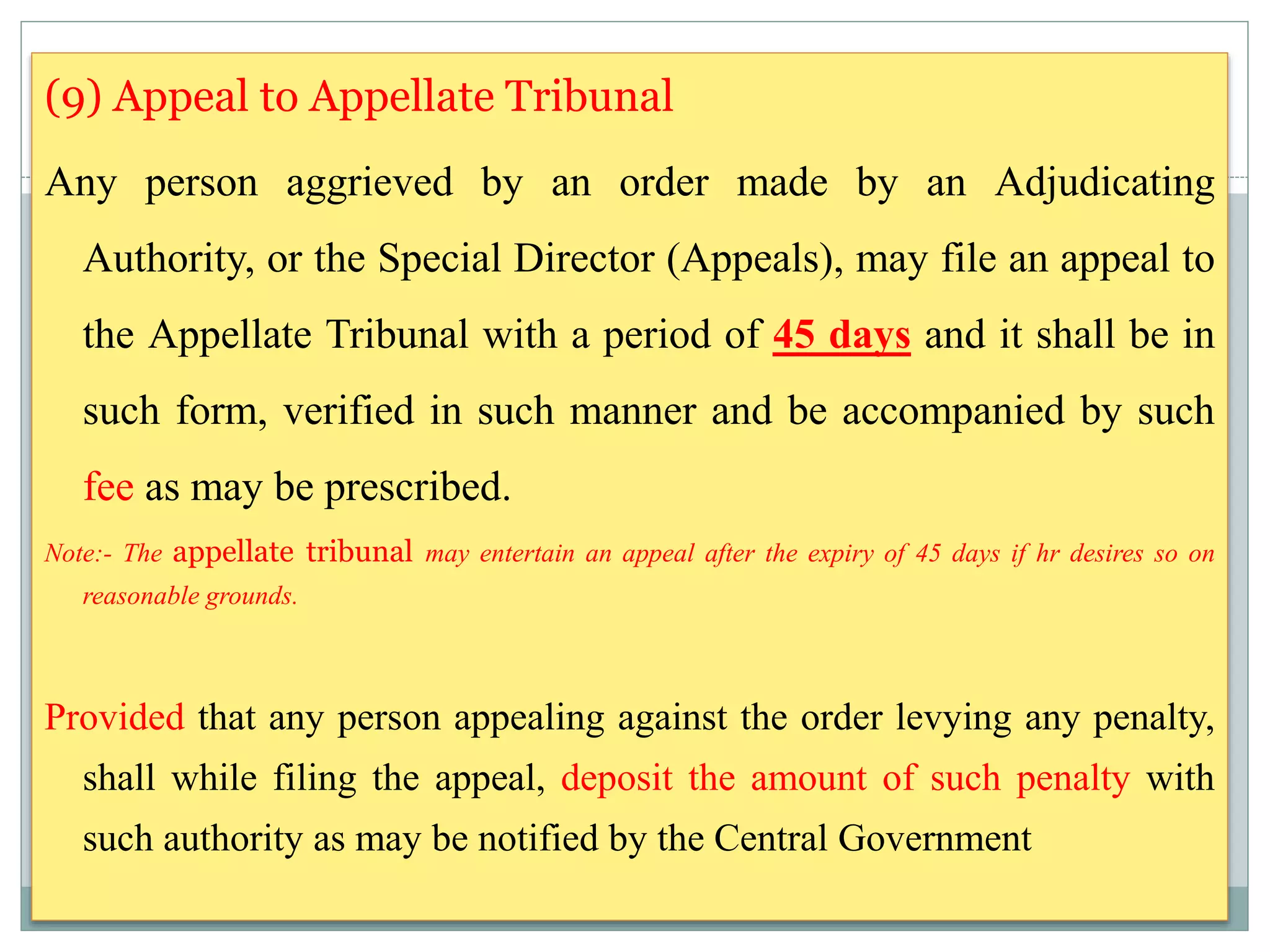
(9) Appeal to Appellate Tribunal
Any person aggrieved by an order made by an Adjudicating
Authority, or the Special Director (Appeals), may file an appeal to
the Appellate Tribunal with a period of 45 days and it shall be in
such form, verified in such manner and be accompanied by such
fee as may be prescribed.
Note:- The appellate tribunal may entertain an appeal after the expiry of 45 days if hr desires so on
reasonable grounds.
Provided that any person appealing against the order levying any penalty,
shall while filing the appeal, deposit the amount of such penalty with
such authority as may be notified by the Central Government
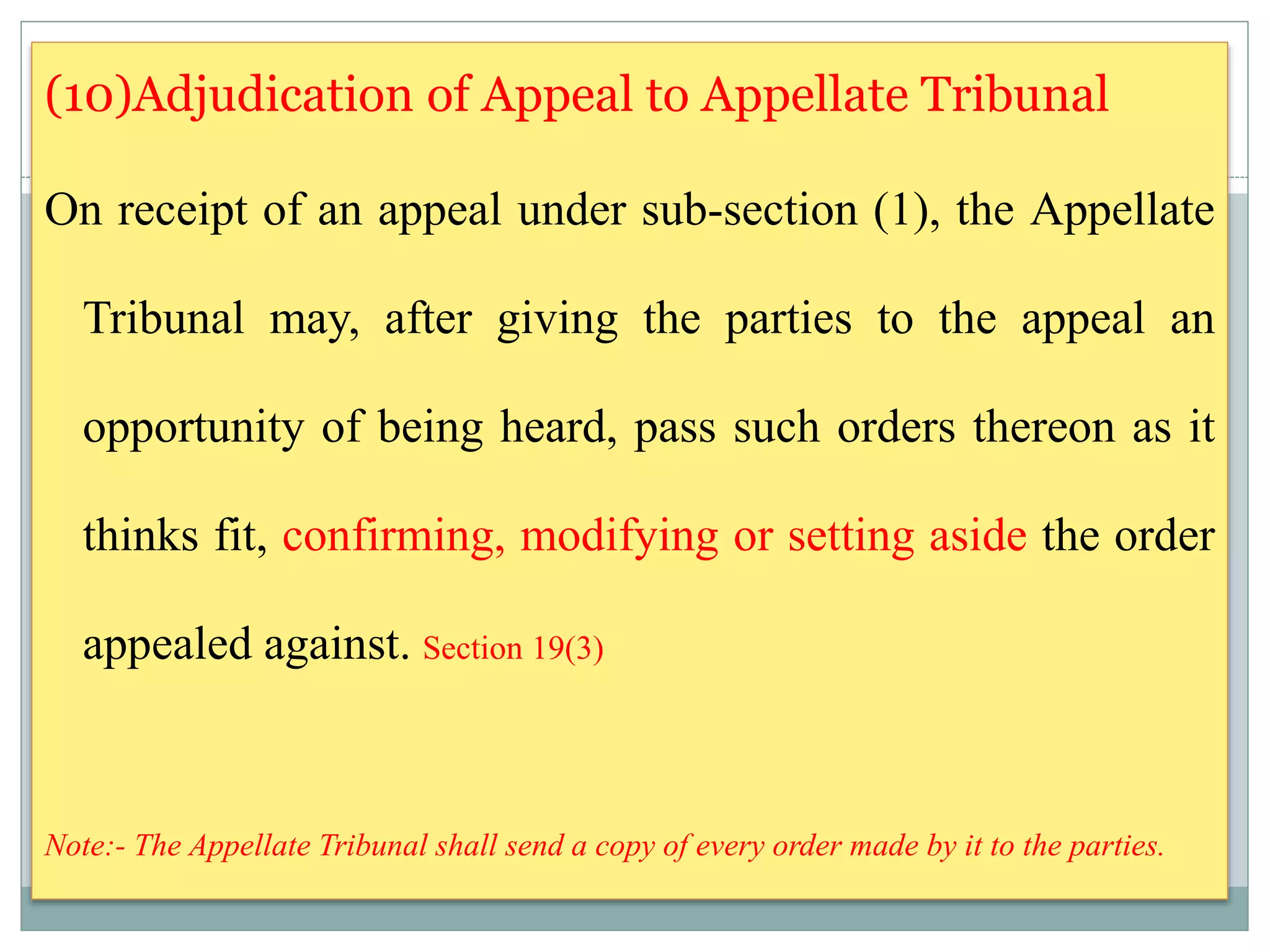
(10)Adjudication of Appeal to Appellate Tribunal
On receipt of an appeal under sub-section (1), the Appellate
Tribunal may, after giving the parties to the appeal an
opportunity of being heard, pass such orders thereon as it
thinks fit, confirming, modifying or setting aside the order
appealed against. Section 19(3)
Note:- The Appellate Tribunal shall send a copy of every order made by it to the parties.
(11) Time Limit of adjudication
The appeal filed before the Appellate Tribunal shall be
dealt with by it as expeditiously as possible and endeavor
shall be made by it to dispose of the appeal finally
within 180 days from the date of receipt of the
appeal.
Note:- The person aggrieved with the decision of the AT may have an appeal to
the High Court with in 60 days from the date of decision of the Tribunal.
Thank you

FEMA 1999

  • 1.
    R A MA N D E E P S I N G H A S S I S T A N T P R O F E S S O R S R I V E N K A T E S W A R A C O L L E G E U N I V E R S I T Y O F D E L H I Foreign Exchange Management Act, 1999
  • 2.
    Background  Replaced FERA– Foreign Exchange Regulation Act 1973  FERA had become incompatible with the pro-liberalisation policies of the Govt. of India  This was done in order to relax the controls on foreign exchange in India, as a result of economic liberalization.  FEMA served to make transactions for external trade (exports and imports) easier – some transactions involving current account for external trade no longer required RBI’s permission.
  • 3.
    FERA vs FEMA The objective of FERA was to conserve forex and prevent its misuse. The objective of FEMA is to facilitate external trade and payments and maintenance of foreign exchange in India.  Violation of FERA was considered a criminal offence. Whereas violation of FEMA is considered a civil offence.  Under FERA citizenship was a criteria while determining a person as resident of India whereas under FEMA stay of more than 182 days is a criteria to determine residential status of a person.
  • 4.
    Objectives of theAct  To facilitating external trade and Payments  To promote the orderly development and maintenance of foreign exchange market in India.
  • 5.
    Few Highlights ofFEMA, 1999  FEMA is more transparent in its application.  Application of FEMA may be seen broadly from two angles, viz., Capital A/c transactions Current A/c transactions There are 7 types of current transaction which are totally prohibited and no transaction can be undertaken. (Lotteries, football pools, banned magazines and a few others )
  • 6.
    Few Definitions "authorized person" meansan authorized dealer, money changer, off-shore banking unit or any other person for the time being authorized under sub-section (1) of section 10 to deal in foreign exchange or foreign securities;
  • 7.
    “Capital Account Transaction” meansa transaction which alters the assets or liabilities, including contingent liabilities, outside India of persons resident in India or assets or liabilities in India of persons resident outside India, and includes transactions referred to in sub-section (3) of section 6;
  • 8.
    "currency“ includes all currencynotes, postal notes, postal orders, money orders, cheques, drafts, travelers cheques, letters of credit, bills of exchange and promissory notes, Debit card, credit card or such other similar instruments, as may be notified by the Reserve Bank;
  • 9.
    "currency notes" means andincludes cash in the form of coins and bank notes;
  • 10.
    “current account transaction" meansa transaction other than a capital account transaction and includes – (i) payments due in connection with foreign trade, other current business, services, and short-term banking and credit facilities in the ordinary course of business, (ii) payments due as interest on loans and as net income from investments, (iii) remittances for living expenses of parents, spouse and children residing abroad, and (iv) expenses in connection with foreign travel, education and medical care of parents, spouse and children;
  • 11.
    "foreign exchange" means foreigncurrency and includes,- (i) deposits, credits and balances payable in any foreign currency, (ii) drafts, travellers cheques, letters of credit or bills of exchange, expressed or drawn in Indian currency but payable in any foreign currency, (iii) drafts, travellers cheques, letters of credit or bills of exchange drawn by banks, institutions or persons outside India, but payable in Indian currency;
  • 12.
    "person" includes – (i)an individual, (ii) a Hindu undivided family, (iii) a company, (iv) a firm, (v) an association of persons or a body of individuals, whether incorporated or not, (vi) every artificial juridical person, not falling within any of the preceding sub-clauses
  • 13.
    "person resident inIndia" (i) a person residing in India for more than one hundred and eighty- two days during the course of the preceding financial year. The expression does not include (a) A person who has gone out of India or who stays outside India, in either case-  (i) for or on taking up employment outside India or,  (ii) for carrying on outside India a business or vocation outside in  For any other purpose, indicating his intention to stay outside India for a uncertain period.
  • 14.
    For an UncertainPeriod  Delhi high court decision  Maj. R. P. Verma vs. Union of India (1998) Indian students studying abroad Notification by RBI in its circular No. 45 (8.12.2003)  Buy up to $ 1,00,000 or study fees whichever is higher  All facilities as NRI  Receive remittances up to $1,00,000 from close relatives  up to 1 million USD out of sale proceeds/balances in their account maintained with an AD.
  • 15.
    (B) A personwho has come to or stays in India, in either case, otherwise than –  (i) for or on taking up employment in India or,  (ii) for carrying on outside India a business or vocation in India.  (iii)For any other purpose, indicating his intention to stay in India for a uncertain period.
  • 16.
    (ii) Any personor body of corporate registered or incorporated in India. (iii) An office, branch or agency in India owned by or controlled by a person resident outside India. (iv) An office, branch or agency outside India owned by or controlled by a person resident in India.
  • 17.
    "person resident outsideIndia" means a person who is not resident in India;
  • 18.
    “Repatriate to India” meansbringing into India the realized foreign exchange and – (i) the selling of such foreign exchange to an authorized person in India in exchange for rupees, or (ii) the holding of realized amount in an account with an authorized person in India to the extent notified by the Reserve Bank.
  • 19.
    REGULATION AND MANAGEMENTOF FOREIGN EXCHANGE Dealing in foreign exchange- As per the Act, no person shall- a) deal in or transfer any foreign exchange or foreign security to any person other than an authorized person; b) make any payment to or for the credit of any person resident outside India in any manner;
  • 20.
    (c) receive, exceptthrough an authorized person, any payment by order or on behalf of any person resident outside India in any manner. (Explanation) (d) enter into any financial transaction in India as consideration for or in association with acquisition or creation or transfer of a right to acquire, any asset outside India by any person. (Explanation)
  • 21.
    Holding of foreignexchange, etc. Except as otherwise provided in this Act, no person resident in India shall acquire, hold, own, possess or transfer any foreign exchange, foreign security or any immovable property situated outside India.
  • 22.
    Liberalizations  1. Possessionand Retention of Foreign Currency (a) Authorized person can retain and possess foreign currency and coins within the scope of his authority without any limit. (b) Any person can possess foreign coins without any limit (c) A person resident in india can retain foreign currency notes, bank notes, and travelers' cheques not exceeding US $ 2000 or its equivalent in aggregate.
  • 23.
    Such currency shouldbe acquired by him- (a) While on a visit to any place outside India by way of payment for services only. (b) From any person not resident in India and who is on a visit to India, as honorarium or gift or services rendered. (c) by way of honorarium or gift while on a visit to any place outside India. (d) represents unspent amount of foreign exchange acquired by him from an authorized person.
  • 24.
    Receipt from, andpayment to, a person resident outside India A person resident in India can receive any payment in any of following mode:- (a) Payment made in rupees by order or behalf of a person resident outside India during his stay in India out of rupee funds provided by him by sale of foreign exchange to an authorized dealer or a money changer in India. (b) Payment made by means of a cheque drawn on a bank situated outside India or a bank draft or travelers' cheque issued outside India. If it is in FE, it should be sold to authorized dealer.
  • 25.
    (iii) Payment madein foreign currency notes directly from out of India. It should be sold to authorized dealer within 7 days from receipt of payment. (iv) Payment by means of postal order issued by a post office outside India or by a postal money order issued by such post office. (7 days)
  • 26.
    Prohibition on drawalof Foreign Exchange for certain current account transaction  Travel to Nepal and Bhutan.  Remittance out of lottery winnings.  Remittance out of income from racing, riding etc.  Payment of commission on exports made towards equity investment in joint ventures/ wholly owned subsidiaries aboard of Indian companies.
  • 27.
     Payment ofDividend by any company to which the requirement of dividend balancing is applicable.  Payment related to ‘call back services’ of telephones.  Remittance of interest income on funds held in Non-resident rupee account scheme.
  • 28.
    Current Account Transactionswhich require approval of the central Government  Cultural Tours  Advertisement in foreign print media for the purpose other than promotion of tourism, foreign investments and international bidding (exceeding US$ 10,000) by a state govt. and its PSUs.  Remittance of freight of vessel charted by a PSU.  Payment of import through ocean transport by a Govt. Department or a PSU.  Multi-model transport operators making remittances to their agents abroad.  Remittance of hiring charges of transponders by (a) TV Channels (b) Internet Service Providers.  Remittance of container detention charges exceeding the rate prescribed by DG of shipping..
  • 29.
    Continue……..  Remittance ofprize money/sponsorship of sports activity abroad by a person other than international/national/state level sports body, if the amount exceeds US $ 1,00,000.  Remittance for membership of P & I Club. (Protection and Indemnity club in shipping)
  • 30.
    Current Account Transactionswhich require approval of the RBI Any additional remittance in excess of 2,50,000 USD for the following purpose require permission of RBI. a) Private visit to any country. (Except Nepal and Bhutan) b) Gift or Donation c) Going abroad for employment. d) Emigration e) Maintenance of close relative abroad f) Travel for business, or attending a conference or specialized training or meeting medical expenses, or check up abroad, or for accompanying as attendant to a patient going abroad. g) Studies abroad h) Any other current account transaction.
  • 31.
    Facilities for personsother than individual a) Donations exceeding 1% of their foreign exchange earnings during the previous 3 financial years or US$ 50,00,000, whichever is less, for- (i) Creation of Chairs in reputed educational institutes, (ii) Contribution to funds promoted by educational institutes; (iii) Contribution to a technical institution or body or association in the field of activity. b) Commission, to agent abroad for sale of residential flats or commercial plots in India exceeding US$ 25,000.
  • 32.
    Continue………. C) Remittances exceedingUS$ 1,00,00,000 per project for any consultancy services in respect of infrastructure project and US$ 10,00,000 per project, for other consultancy services. d) Remittances exceeding 5% of investment brought into India or US$ 1,00,000 whichever is higher, by entity in India by way of reimbursement of pre-incorporation expenses.
  • 33.
    Capital Account Transaction “capitalaccount transaction” means a transaction which alters the assets or liabilities, including contingent liabilities, outside India of persons resident in India or assets or liabilities in India of persons resident outside India.
  • 34.
    Regulation of CapitalAccount Transaction The Reserve Bank may, by regulations, prohibit, restrict or regulate the following- (a) transfer or issue of any foreign security by a person resident in India; (b) transfer or issue of any security by a person resident outside India; (c) transfer or issue of any security or foreign security by any branch, office or agency in India of a person resident outside India;
  • 35.
    (d) any borrowingor lending in rupees in whatever form or by whatever name called between a person resident in India and a person resident outside India; (f) deposits between persons resident in India and persons resident outside India; (g) export, import or holding of currency or currency notes;
  • 36.
    (h) transfer ofimmovable property outside India, other than a lease not exceeding five years, by a person resident in India; (Exceptions) (i) Acquisition or transfer of immovable property in India, other than a lease not exceeding five years, by a person resident outside India; (j) Giving of a guarantee or surety in respect of any debt, obligation or other liability incurred- (i) by a person resident in India and owed to a person resident outside India; or (ii) by a person resident outside India.
  • 37.
    Acquisition and transferof immovable property outside India A PRI can or may acquire immovable property outside India- 1. By way of gift or inheritance from a person as on or before 8 July, 1947 and continue to be held by him. 2. Any purchase from Resident Foreign Currency A/C (RFC). 3. Purchasing assets jointly with relative outside India. 4. Assets got from Gift or will from parents. 5. Any branch, office and immovable property for employees by a company with the permission of RBI.
  • 38.
    Capital Account Transactionthat Cannot be Prohibited A person resident in India may hold, own, transfer or invest in foreign currency, foreign security or any immovable property situated outside India if such currency, security or property was acquired, held or owned by such person when he was resident outside India or inherited from a person who was resident outside India.
  • 39.
    A person residentoutside India may hold, own, transfer or invest in Indian currency, security or any immovable property situated in India if such currency, security or property was acquired, held or owned by such person when he was resident in India or inherited from a person who was resident in India.
  • 40.
    Permissible CAT byRBI for Person Resident In India  Foreign currency loan raised in India and abroad by a PRI.  Investment by a PRI in foreign securities.  Transfer of immovable properties outside India by PRI.  Export/Import and holding of currency/ currency notes.  Loans and overdrafts by a PRI from a person resident outside India.  Maintenance of foreign currency accounts in India and outside India by PRI.  Taking out of insurance policy by a PRI from person resident outside India from an insurance company outside India.  Remittance outside India of capital assets by a PRI.  Sale and purchase of foreign exchange derivatives in India or abroad by PRI.
  • 41.
    Permissible CAT byRBI for Person Resident Outside India  Investment by a PROI in foreign securities of an Indian company.  Acquisition and transfer of immovable properties in India by PROI.  Export/Import and holding of currency/ currency notes into/from India by PROI.  Guarantee by a PROI in favor of a person resident in India.  Maintenance of foreign currency accounts in India by PROI.  Remittance outside India of capital assets by a PROI.  Deposits between a PRI and a PROI.
  • 42.
    Prohibited Capital AccountTransactions a) A person shall not undertake or sell or draw foreign exchange to or from an authorized person for any capital account transaction. b) A non resident person shall not make investment in India in any form, in any company or firm or any entity, whether incorporated or not, which is engaged or proposes to engage:- (i) in the business of chit fund, or (ii) as Nidhi Company, or (iii) in agricultural or plantation activities or (iv) in real estate business, or construction of farm houses or
  • 43.
    Continue….. (v) in tradingin Transferable Development Rights (TDRs) means certificates issued in respect of category of land acquired for public purposes either by the Central or State Government in consideration of surrender of land by the owner without monetary compensation, which are transferable in part or whole.
  • 44.
    Realization and Repatriationof Foreign Exchange. Save as otherwise provided in this Act, where any amount of foreign exchange is due or has accrued to any person resident in India, such person shall take all reasonable steps to realize and repatriate to India such foreign exchange within such period and in such manner as may be specified by the Reserve Bank. (However there are some exemptions…….)
  • 45.
    Exemption from realizationand repatriation in certain cases. (a) possession of foreign currency or foreign coins by any person up to such limit as the Reserve Bank may specify; (b) foreign currency account held or operated by such person or class of persons and the limit up to which the Reserve Bank may specify;
  • 46.
    (c) foreign exchangeacquired or received before the 8th day of July, 1947 or any income arising or accruing thereon which is held outside India by any person in pursuance of a general or special permission granted by the RBI;
  • 47.
    (d) foreign exchangeheld by a PRI up to such limit as the RBI may specify, if such foreign exchange was acquired by way of gift or inheritance from a person referred to in clause (c), including any income arising there from.
  • 48.
    (e) foreign exchangeacquired from employment, business, trade, vocation, services, honorarium, gifts, inheritance or any other legitimate means up to such limit as the RBI may specify; and (f) such other receipts in foreign exchange as the Reserve Bank may specify.
  • 49.
    Duties of theExporter To disclose the material information To ensure the receipts of export proceeds To inform delayed receipts To make declaration in respect of services
  • 50.
    Duties of Authorizedperson  To comply with direction by RBI  To make declaration  To produce books of accounts and documents  Contravention to public interest- An authorized person may be revoked by RBI if it is in the public interest. - Penalty - If any authorized person fails to furnish any direction as directed by RBI, he is liable to pay up to 10,000 rupees and in the case of continuing contravention, additional penalty up to 2,000 rupees for every day till the default continues.
  • 51.
    Contravention and Penalties Penalties[Section 13(1)] If any person contravenes any provision of this Act, or contravenes any rule, regulation, notification, direction or order issued in exercise of the powers under this Act, be liable to a penalty up to thrice the sum involved in such contravention where such amount is quantifiable, or up to 2 lakh rupees where the amount is not quantifiable.
  • 52.
     where suchcontravention is a continuing one, further penalty which may extend to 5 thousand rupees for every day after the first day during which the contravention continues.
  • 53.
     Any AdjudicatingAuthority adjudging any contravention, if he thinks fit in addition to any penalty may direct that any currency, security or property in respect of which the contravention has taken place shall be confiscated to the Central Government and further direct to defaulting person that such property shall be brought back into India or shall be retained outside India in accordance with the directions made in this behalf. Confiscation of Money and Property [Section 13(2)]
  • 54.
    If any personfails to make full payment of the penalty imposed on him under section 13 within a period of 90 days from the date on which the notice for payment of such penalty is served on him, he shall be liable to civil imprisonment under this section. (However , the defaulting person shall not be arrested or detained in civil prison unless Adjudicating Authority issue or serve a notice upon him to appear.) Enforcement of the Orders of Adjudicating Authorities [Section 14]
  • 55.
    The defaulter mustbe given an opportunity of being heard. Every person detained in the civil prison in execution of the certificate may be so detained - (a) where the certificate is for a demand of an amount exceeding rupees one crore, up to three years, and (b) in any other case, up to six months:
  • 56.
    Important provisions of- Enforcement of the orders of Adjudicating Authority 1. Obstruction in recovery of Penalty: a) If the defaulter has obstructed the recovery of penalty, or dishonestly transferred, concealed, or removed any pert of his property. b) If defaulter has means to pay the amount of penalty but refuses or neglects to pay the same.
  • 57.
    (2) Intend toAbscond A warrant for the arrest of the defaulter may be issued by the Adjudicating Authority if satisfied, that the defaulter is likely to abscond or leave the local limits of the jurisdiction of the Adjudicating Authority. (A warrant of arrest issued by the Adjudicating Authority may also be executed by any other Adjudicating Authority within whose jurisdiction the defaulter may for the time being be found.)
  • 58.
    (3) Non- Complianceof Served Notice: the Adjudicating Authority may issue a warrant for the arrest of the defaulter if such person does not comply with notice issued and served to present himself before the authority.
  • 59.
    (4) Presenting Arrestedperson before the authority Every person arrested in pursuance of a warrant of arrest under this section shall be brought before the Adjudicating Authority issuing the warrant as soon as practicable and in any event within 24 hours of his arrest (exclusive of the time required for the journey). Important note:- But, if the defaulter pays the amount entered in the warrant and the costs of arrest to the officer arresting him, he should be released at once.
  • 60.
    (5) Opportunity ofBeing Heard When a defaulter appears before the Adjudicating Authority pursuant to a notice to show cause or is brought before the Adjudicating Authority under this section, the Adjudicating Authority shall give the defaulter an opportunity showing cause why he should not be committed to the civil prison
  • 61.
    (6) Detention inthe Custody Pending the conclusion of the inquiry, the Adjudicating Authority may, in his discretion, order the defaulter to be detained in the custody of such officer as the Adjudicating Authority may think fit or release him on his furnishing the security amount to the satisfaction of the Adjudicating Authority for his appearance as and when required.
  • 62.
    Upon the conclusionof the inquiry, the defaulter will be released by giving an opportunity to satisfy the arrears of penalty with a period of 15 days. If arrears are not satisfied, the Adjudicating Authority may make an order for the detention of the defaulter in the civil prison and cause him to be arrested if he is not already under arrest. Sec 14(9) . Continue from 6 point
  • 63.
    (7) Release ofDefaulter When the Adjudicating Authority does not make an order of detention under Sec 14(9), he shall, if the defaulter is under arrest, direct his release. (8)Execution of Certificate: Every person detained in the civil prison in execution of the certificate may be so detained- (a) where the certificate is for a demand of an amount exceeding rupees one crore, up to 3years, and (b) in any other case, up to 6 months:
  • 64.
    (9) Release doesnot amount to Discharge A defaulter released from detention under this section shall not, merely by reason of his release, be discharged from his liability for the arrears, but he shall not be liable to be arrested under the certificate in execution of which he was detained in the civil prison.
  • 65.
    Compounding of Offences All contravention punishable under section 13 can be compounded within 180 days from the date of receipt of application by the Director of Enforcement or other authorities.  NO compounding allowed: (a) Where amount is not quantifiable. (b) appeal has been filed. (c) contravention has been repeated within 3 years (d) contravention by an authorized dealer
  • 66.
    Procedure and Processfor Compounding of Offences  An application for compounding may be submitted to the compounding authority with prescribed fees with relevant facts and supporting documents.  The authority may call for any info and record relevant to the compounding proceedings.  Such additional info shall be submitted within 30 days. If the contravener fails to submit such info, the application for compounding will be liable to be rejected.
  • 67.
     The proceedingwould be concluded within 180 days from the date of the receipt of the application.  The sum for which contravention has been compounded shall be paid within 15 days from the date of order of compounding.  The payment shall be made by demand draft (DD) in favor of compounding authority.
  • 68.
    Appointment of AdjudicatingAuthority (1) Appointment of Adjudicating Authority The Central Government may, by an order published in the Official Gazette, appoint as many officers of the Central Government as it may thinks fit, as the Adjudicating Authorities for holding an inquiry in the manner prescribed, against the person who has committed contravention and a complaint has been made. Note:- A reasonable opportunity of being heard will be provided before imposing any penalty.
  • 69.
    (2) Filling ofComplaint and Holding of Enquiry No Adjudicating Authority shall hold an enquiry under sub- section (1) except upon a complaint in writing made by any officer authorized by a general or special order by the Central Government.
  • 70.
    (3) Right toTake Legal Assistance The said person (Defaulter) may appear either in person or take the assistance of a legal practitioner or a chartered accountant (CA) of his choice for presenting his case before the Adjudicating Authority.
  • 71.
    (4) Power ofAdjudicating Authority Every Adjudicating Authority shall have the same powers of a civil court which are conferred on the Appellate Tribunal under sub-section (2) of section 28. All proceedings before it shall be deemed to be judicial proceedings within the meaning of sections 193 and 228 of the Indian Penal Code (45 of 1860);
  • 72.
    (5) Maximum Time-limitto Dispose off a complaint Every Adjudicating Authority shall deal with the complaints as expeditiously as possible and endeavor shall be made to dispose of the complaint finally within 1 year from the date of receipt of the complaint. (Note:- If the complaint cannot be disposed off with in 1 year, the AA shall record the reasons in writings.)
  • 73.
    (6) Appeal toSpecial Director The Central Government shall, by notification, appoint one or more Special Directors (Appeals) to hear appeals against the orders of the Adjudicating Authorities along with their jurisdictions. Note:- The Special Directors (Appeals) shall have the same powers of a civil court and all proceedings will be deemed to be juridicial proceedings .
  • 74.
    (7)Time Limit toFile an Appeal Every appeal shall be filed within 45 days from the date on which the copy of the order made by the Adjudicating Authority is received by the aggrieved person and it shall be in such form, verified in such manner and be accompanied by such fee as may be prescribed. Section 17(3) Note:- The special director may entertain an appeal after the expiry of 45 days if he desires so on reasonable grounds.
  • 75.
    (8) Adjudication ofAppeal On receipt of an appeal, the Special Director (Appeals) may after giving the parties to the appeal an opportunity of being heard, pass such order thereon as he thinks fit confirming, modifying or setting aside the order appealed against. Section 17(4) Note:- The Special Director (Appeals) shall send a copy of order made by him to all the parties.
  • 76.
    (9) Appeal toAppellate Tribunal Any person aggrieved by an order made by an Adjudicating Authority, or the Special Director (Appeals), may file an appeal to the Appellate Tribunal with a period of 45 days and it shall be in such form, verified in such manner and be accompanied by such fee as may be prescribed. Note:- The appellate tribunal may entertain an appeal after the expiry of 45 days if hr desires so on reasonable grounds. Provided that any person appealing against the order levying any penalty, shall while filing the appeal, deposit the amount of such penalty with such authority as may be notified by the Central Government
  • 77.
    (10)Adjudication of Appealto Appellate Tribunal On receipt of an appeal under sub-section (1), the Appellate Tribunal may, after giving the parties to the appeal an opportunity of being heard, pass such orders thereon as it thinks fit, confirming, modifying or setting aside the order appealed against. Section 19(3) Note:- The Appellate Tribunal shall send a copy of every order made by it to the parties.
  • 78.
    (11) Time Limitof adjudication The appeal filed before the Appellate Tribunal shall be dealt with by it as expeditiously as possible and endeavor shall be made by it to dispose of the appeal finally within 180 days from the date of receipt of the appeal. Note:- The person aggrieved with the decision of the AT may have an appeal to the High Court with in 60 days from the date of decision of the Tribunal.
  • 79.