
SERVICE TAX
B.Yogita
Accounts Executive
About Service Tax
 Service Tax is a tax imposed by Government of India on services
provided in India. It is applicable all over India, except in the State
of Jammu and Kashmir. However, services provided from Jammu and
Kashmir outside Jammu and Kashmir are still liable to service tax.
The service provider collects the tax and pays the same to the
government. It is categorized under Indirect Tax and came into
existence under the Finance Act, 1994.
 From 2012, service tax is imposed on all services, except those
which are specifically exempted under law, known as negative list
(Section 66d of Finance Act 1994) of services.
 In budget presented for 2008-2009, it was announced that all small
service providers whose turnover does not exceed Rs.10 Lakhs
during the financial year need not pay service tax.
 Service tax at a rate of 14 percent will be imposed on all applicable
services from 1 June 2015 includes education cess 2% and higher
education cess is 1%.
History of Service Tax
The imposition of service tax in India started after the report of
“Chelliah committee on tax reforms”.
Based on this report, the then Finance Minister of India (Dr Manmohan
Singh, 1994-95) introduced the concept of tax on services.
For the past two decades, service tax in India was levied under
“selective approach” which means only selective services were taxed.
The government used to issue a list of services on which service tax
was to be paid by the person providing the services.
However, budget 2012 introduced a new concept of “negative list”,
under which all services are to be taxed, except for those mentioned
in the “negative list”. This approach is known as comprehensive
approach.
Matters related to service tax in India are handled by CBEC (Central
board of Excise and Customs).
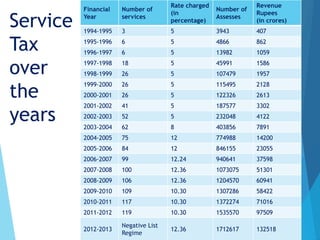
Financial
Year
Number of
services
Rate charged
(in
percentage)
Number of
Assesses
Revenue
Rupees
(in crores)
1994-1995 3 5 3943 407
1995-1996 6 5 4866 862
1996-1997 6 5 13982 1059
1997-1998 18 5 45991 1586
1998-1999 26 5 107479 1957
1999-2000 26 5 115495 2128
2000-2001 26 5 122326 2613
2001-2002 41 5 187577 3302
2002-2003 52 5 232048 4122
2003-2004 62 8 403856 7891
2004-2005 75 12 774988 14200
2005-2006 84 12 846155 23055
2006-2007 99 12.24 940641 37598
2007-2008 100 12.36 1073075 51301
2008-2009 106 12.36 1204570 60941
2009-2010 109 10.30 1307286 58422
2010-2011 117 10.30 1372274 71016
2011-2012 119 10.30 1535570 97509
2012-2013
Negative List
Regime
12.36 1712617 132518
Service
Tax
over
the
years
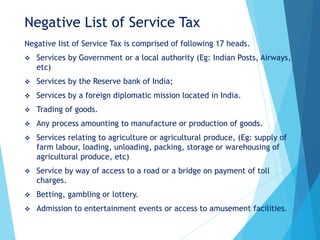
Negative List of Service Tax
Negative list of Service Tax is comprised of following 17 heads.
 Services by Government or a local authority (Eg: Indian Posts, Airways,
etc)
 Services by the Reserve bank of India;
 Services by a foreign diplomatic mission located in India.
 Trading of goods.
 Any process amounting to manufacture or production of goods.
 Services relating to agriculture or agricultural produce, (Eg: supply of
farm labour, loading, unloading, packing, storage or warehousing of
agricultural produce, etc)
 Service by way of access to a road or a bridge on payment of toll
charges.
 Betting, gambling or lottery.
 Admission to entertainment events or access to amusement facilities.
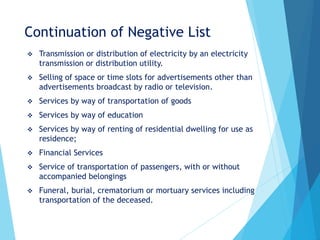
Continuation of Negative List
 Transmission or distribution of electricity by an electricity
transmission or distribution utility.
 Selling of space or time slots for advertisements other than
advertisements broadcast by radio or television.
 Services by way of transportation of goods
 Services by way of education
 Services by way of renting of residential dwelling for use as
residence;
 Financial Services
 Service of transportation of passengers, with or without
accompanied belongings
 Funeral, burial, crematorium or mortuary services including
transportation of the deceased.
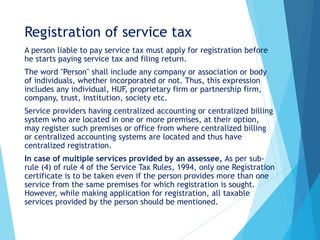
Registration of service tax
A person liable to pay service tax must apply for registration before
he starts paying service tax and filing return.
The word "Person" shall include any company or association or body
of individuals, whether incorporated or not. Thus, this expression
includes any individual, HUF, proprietary firm or partnership firm,
company, trust, institution, society etc.
Service providers having centralized accounting or centralized billing
system who are located in one or more premises, at their option,
may register such premises or office from where centralized billing
or centralized accounting systems are located and thus have
centralized registration.
In case of multiple services provided by an assessee, As per sub-
rule (4) of rule 4 of the Service Tax Rules, 1994, only one Registration
certificate is to be taken even if the person provides more than one
service from the same premises for which registration is sought.
However, while making application for registration, all taxable
services provided by the person should be mentioned.
Continuation Registration of service tax
If there is centralized registration, only one registration certificate is
required for services provided from different premises, declared in
the application for centralized registration.
In case, assessee starts providing a taxable service not mentioned
in the registration certificate He should intimate to the jurisdictional
Assistant Commissioner or Deputy Commissioner of Central Excise in
writing if there is a change in any information or details furnished by
him in the original ST-1 form submitted at the time of obtaining
registration or if he intends to furnish any additional information or
details within a period of thirty days of such change.
Any change in premises/office, as mentioned in Form ST-1, should be
intimated to jurisdictional Assistant/Deputy Commissioner Central
Excise.
Payment of service tax
Form G.A.R.7 (previously known as TR6 Challan) should be
used to make service tax payments. Payment of service tax
may be made at the specified branches of the designated
banks.
Service Tax can also be paid electronically, using e-payment
facility.
In case of Individuals or Proprietary Concerns and Partnership
Firm, service tax is to be paid on a quarterly basis.
In case of any other category of service provider, service tax is
to be paid on a monthly basis, by the 5th of the following
month (in case of e-payment, by 6th of the month
immediately following the respective month). However,
payment for the month of March is required to be made by
31st of March itself.
Continuation: Payment of service tax
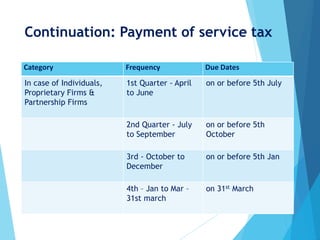
Category Frequency Due Dates
In case of Individuals,
Proprietary Firms &
Partnership Firms
1st Quarter - April
to June
on or before 5th July
2nd Quarter - July
to September
on or before 5th
October
3rd - October to
December
on or before 5th Jan
4th – Jan to Mar –
31st march
on 31st March
Penalty on delayed payment
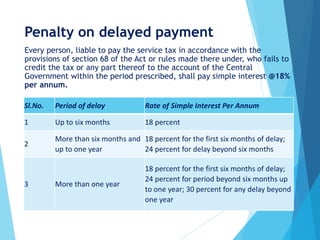
Every person, liable to pay the service tax in accordance with the
provisions of section 68 of the Act or rules made there under, who fails to
credit the tax or any part thereof to the account of the Central
Government within the period prescribed, shall pay simple interest @18%
per annum.
Sl.No. Period of delay Rate of Simple Interest Per Annum
1 Up to six months 18 percent
2
More than six months and
up to one year
18 percent for the first six months of delay;
24 percent for delay beyond six months
3 More than one year
18 percent for the first six months of delay;
24 percent for period beyond six months up
to one year; 30 percent for any delay beyond
one year
Refund of Service Tax
Where an assessee has issued an invoice, or received any
payment, against a service to be provided which is not so
provided by him either wholly or partially for any reason,
or where the amount of invoice is renegotiated due to
deficient provision of service, or any terms contained in a
contract the assessee may take credit of such excess
service tax paid by him, if the assessee:-
a) has refunded the payment or part thereof, so received
for the service provided to the person from whom it was
received or
b) has issued a credit note for the value of the service not
so provided to the person to whom such an invoice has
been issued.
Filing of returns
ST-3 Return is required to be filed twice in a financial year – half yearly.
Return for half year ending 30th September and 31st March are required
to be filed by 25th October and 25th April, respectively.
Filing of return within the prescribed time limit is compulsory, even if it
may be a nil return, failing which penal action is attracted.
The details in respect of each month/ Quarter, as the case may be, of
the period for which the return is filed, should be furnished in the Form
ST-3, separately. The instructions for filing return are mentioned in the
Form itself.
It should be accompanied by copies of all the GAR-7 Challans for
payment of Service Tax during the relevant period.
Revised return: Under rule 7B of Service Tax Rules, 1994 an assessee
may submit a revised return, in Form ST-3, in triplicate, to correct a
mistake or omission, within a period of ninety days from the date of
submission of the return under Rule 7. However, where an assessee
submits a revised return, the relevant date for the purpose of recovery
of service tax, if any, under section 73 of the Finance Act, 1994, shall be
the date of submission of such revised return
Records
There are no specific statutory records which have to be
maintained by a Service Tax assessee. The records including
computerized data, if any, which are being maintained by an
assessee on his own or as required under any other law in force,
such as Income Tax, Sales Tax etc. are acceptable for the purpose
of Service Tax
However, under the revised rule 5(2) of the STR, 1994 (with effect
from 28th December, 2007), the assessee is required to provide to
the jurisdictional Superintendent of Central Excise/Service Tax a
list, in duplicate, of all the records prepared or maintained by
the assessee for accounting of transactions.
If it is felt necessary, the Department can call for additional
information/ documents for scrutiny.
In the event of failure to make available the records/documents, a
penalty of Rs. 10000 or Rs.200 for every day during which such
failure continues, whichever is higher, starting with the first day
after the due date, till the date of actual compliance, is imposable
on the assessee under amended section 77 of the Finance Act, 1994
Invoice/Bill:
Issue of Invoice/Bill/Challan by a Service Tax assessee is
mandatory as per Rule 4A of the STR, 1994. The same
should be issued within 14 days from the date of
completion of taxable service or receipt of payment
towards the service, whichever is earlier.
The invoice/bill/challan should contain the following
information
i. Serial number.
ii. Name, address and registration no. of the service
provider.
iii. Name and address of the service receiver.
iv. Description, classification and value of taxable service
being provided or to be provided.
v. The amount of Service Tax payable (Service Tax and
Education cess should be shown separately)
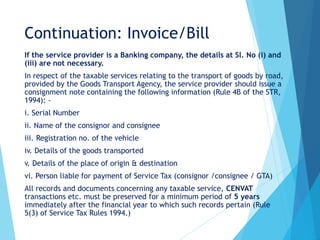
Continuation: Invoice/Bill
If the service provider is a Banking company, the details at Sl. No (i) and
(iii) are not necessary.
In respect of the taxable services relating to the transport of goods by road,
provided by the Goods Transport Agency, the service provider should issue a
consignment note containing the following information (Rule 4B of the STR,
1994): -
i. Serial Number
ii. Name of the consignor and consignee
iii. Registration no. of the vehicle
iv. Details of the goods transported
v. Details of the place of origin & destination
vi. Person liable for payment of Service Tax (consignor /consignee / GTA)
All records and documents concerning any taxable service, CENVAT
transactions etc. must be preserved for a minimum period of 5 years
immediately after the financial year to which such records pertain (Rule
5(3) of Service Tax Rules 1994.)
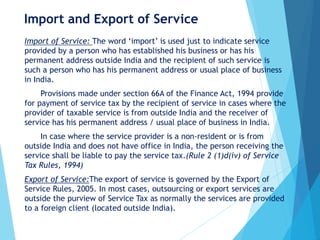
Import and Export of Service
Import of Service: The word ‘import’ is used just to indicate service
provided by a person who has established his business or has his
permanent address outside India and the recipient of such service is
such a person who has his permanent address or usual place of business
in India.
Provisions made under section 66A of the Finance Act, 1994 provide
for payment of service tax by the recipient of service in cases where the
provider of taxable service is from outside India and the receiver of
service has his permanent address / usual place of business in India.
In case where the service provider is a non-resident or is from
outside India and does not have office in India, the person receiving the
service shall be liable to pay the service tax.(Rule 2 (1)d(iv) of Service
Tax Rules, 1994)
Export of Service:The export of service is governed by the Export of
Service Rules, 2005. In most cases, outsourcing or export services are
outside the purview of Service Tax as normally the services are provided
to a foreign client (located outside India).
Thank You

Service tax

  • 1.
  • 2.
    About Service Tax Service Tax is a tax imposed by Government of India on services provided in India. It is applicable all over India, except in the State of Jammu and Kashmir. However, services provided from Jammu and Kashmir outside Jammu and Kashmir are still liable to service tax. The service provider collects the tax and pays the same to the government. It is categorized under Indirect Tax and came into existence under the Finance Act, 1994.  From 2012, service tax is imposed on all services, except those which are specifically exempted under law, known as negative list (Section 66d of Finance Act 1994) of services.  In budget presented for 2008-2009, it was announced that all small service providers whose turnover does not exceed Rs.10 Lakhs during the financial year need not pay service tax.  Service tax at a rate of 14 percent will be imposed on all applicable services from 1 June 2015 includes education cess 2% and higher education cess is 1%.
  • 3.
    History of ServiceTax The imposition of service tax in India started after the report of “Chelliah committee on tax reforms”. Based on this report, the then Finance Minister of India (Dr Manmohan Singh, 1994-95) introduced the concept of tax on services. For the past two decades, service tax in India was levied under “selective approach” which means only selective services were taxed. The government used to issue a list of services on which service tax was to be paid by the person providing the services. However, budget 2012 introduced a new concept of “negative list”, under which all services are to be taxed, except for those mentioned in the “negative list”. This approach is known as comprehensive approach. Matters related to service tax in India are handled by CBEC (Central board of Excise and Customs).
  • 4.
    Financial Year Number of services Rate charged (in percentage) Numberof Assesses Revenue Rupees (in crores) 1994-1995 3 5 3943 407 1995-1996 6 5 4866 862 1996-1997 6 5 13982 1059 1997-1998 18 5 45991 1586 1998-1999 26 5 107479 1957 1999-2000 26 5 115495 2128 2000-2001 26 5 122326 2613 2001-2002 41 5 187577 3302 2002-2003 52 5 232048 4122 2003-2004 62 8 403856 7891 2004-2005 75 12 774988 14200 2005-2006 84 12 846155 23055 2006-2007 99 12.24 940641 37598 2007-2008 100 12.36 1073075 51301 2008-2009 106 12.36 1204570 60941 2009-2010 109 10.30 1307286 58422 2010-2011 117 10.30 1372274 71016 2011-2012 119 10.30 1535570 97509 2012-2013 Negative List Regime 12.36 1712617 132518 Service Tax over the years
  • 5.
    Negative List ofService Tax Negative list of Service Tax is comprised of following 17 heads.  Services by Government or a local authority (Eg: Indian Posts, Airways, etc)  Services by the Reserve bank of India;  Services by a foreign diplomatic mission located in India.  Trading of goods.  Any process amounting to manufacture or production of goods.  Services relating to agriculture or agricultural produce, (Eg: supply of farm labour, loading, unloading, packing, storage or warehousing of agricultural produce, etc)  Service by way of access to a road or a bridge on payment of toll charges.  Betting, gambling or lottery.  Admission to entertainment events or access to amusement facilities.
  • 6.
    Continuation of NegativeList  Transmission or distribution of electricity by an electricity transmission or distribution utility.  Selling of space or time slots for advertisements other than advertisements broadcast by radio or television.  Services by way of transportation of goods  Services by way of education  Services by way of renting of residential dwelling for use as residence;  Financial Services  Service of transportation of passengers, with or without accompanied belongings  Funeral, burial, crematorium or mortuary services including transportation of the deceased.
  • 7.
    Registration of servicetax A person liable to pay service tax must apply for registration before he starts paying service tax and filing return. The word "Person" shall include any company or association or body of individuals, whether incorporated or not. Thus, this expression includes any individual, HUF, proprietary firm or partnership firm, company, trust, institution, society etc. Service providers having centralized accounting or centralized billing system who are located in one or more premises, at their option, may register such premises or office from where centralized billing or centralized accounting systems are located and thus have centralized registration. In case of multiple services provided by an assessee, As per sub- rule (4) of rule 4 of the Service Tax Rules, 1994, only one Registration certificate is to be taken even if the person provides more than one service from the same premises for which registration is sought. However, while making application for registration, all taxable services provided by the person should be mentioned.
  • 8.
    Continuation Registration ofservice tax If there is centralized registration, only one registration certificate is required for services provided from different premises, declared in the application for centralized registration. In case, assessee starts providing a taxable service not mentioned in the registration certificate He should intimate to the jurisdictional Assistant Commissioner or Deputy Commissioner of Central Excise in writing if there is a change in any information or details furnished by him in the original ST-1 form submitted at the time of obtaining registration or if he intends to furnish any additional information or details within a period of thirty days of such change. Any change in premises/office, as mentioned in Form ST-1, should be intimated to jurisdictional Assistant/Deputy Commissioner Central Excise.
  • 9.
    Payment of servicetax Form G.A.R.7 (previously known as TR6 Challan) should be used to make service tax payments. Payment of service tax may be made at the specified branches of the designated banks. Service Tax can also be paid electronically, using e-payment facility. In case of Individuals or Proprietary Concerns and Partnership Firm, service tax is to be paid on a quarterly basis. In case of any other category of service provider, service tax is to be paid on a monthly basis, by the 5th of the following month (in case of e-payment, by 6th of the month immediately following the respective month). However, payment for the month of March is required to be made by 31st of March itself.
  • 10.
    Continuation: Payment ofservice tax Category Frequency Due Dates In case of Individuals, Proprietary Firms & Partnership Firms 1st Quarter - April to June on or before 5th July 2nd Quarter - July to September on or before 5th October 3rd - October to December on or before 5th Jan 4th – Jan to Mar – 31st march on 31st March
  • 11.
    Penalty on delayedpayment Every person, liable to pay the service tax in accordance with the provisions of section 68 of the Act or rules made there under, who fails to credit the tax or any part thereof to the account of the Central Government within the period prescribed, shall pay simple interest @18% per annum. Sl.No. Period of delay Rate of Simple Interest Per Annum 1 Up to six months 18 percent 2 More than six months and up to one year 18 percent for the first six months of delay; 24 percent for delay beyond six months 3 More than one year 18 percent for the first six months of delay; 24 percent for period beyond six months up to one year; 30 percent for any delay beyond one year
  • 12.
    Refund of ServiceTax Where an assessee has issued an invoice, or received any payment, against a service to be provided which is not so provided by him either wholly or partially for any reason, or where the amount of invoice is renegotiated due to deficient provision of service, or any terms contained in a contract the assessee may take credit of such excess service tax paid by him, if the assessee:- a) has refunded the payment or part thereof, so received for the service provided to the person from whom it was received or b) has issued a credit note for the value of the service not so provided to the person to whom such an invoice has been issued.
  • 13.
    Filing of returns ST-3Return is required to be filed twice in a financial year – half yearly. Return for half year ending 30th September and 31st March are required to be filed by 25th October and 25th April, respectively. Filing of return within the prescribed time limit is compulsory, even if it may be a nil return, failing which penal action is attracted. The details in respect of each month/ Quarter, as the case may be, of the period for which the return is filed, should be furnished in the Form ST-3, separately. The instructions for filing return are mentioned in the Form itself. It should be accompanied by copies of all the GAR-7 Challans for payment of Service Tax during the relevant period. Revised return: Under rule 7B of Service Tax Rules, 1994 an assessee may submit a revised return, in Form ST-3, in triplicate, to correct a mistake or omission, within a period of ninety days from the date of submission of the return under Rule 7. However, where an assessee submits a revised return, the relevant date for the purpose of recovery of service tax, if any, under section 73 of the Finance Act, 1994, shall be the date of submission of such revised return
  • 14.
    Records There are nospecific statutory records which have to be maintained by a Service Tax assessee. The records including computerized data, if any, which are being maintained by an assessee on his own or as required under any other law in force, such as Income Tax, Sales Tax etc. are acceptable for the purpose of Service Tax However, under the revised rule 5(2) of the STR, 1994 (with effect from 28th December, 2007), the assessee is required to provide to the jurisdictional Superintendent of Central Excise/Service Tax a list, in duplicate, of all the records prepared or maintained by the assessee for accounting of transactions. If it is felt necessary, the Department can call for additional information/ documents for scrutiny. In the event of failure to make available the records/documents, a penalty of Rs. 10000 or Rs.200 for every day during which such failure continues, whichever is higher, starting with the first day after the due date, till the date of actual compliance, is imposable on the assessee under amended section 77 of the Finance Act, 1994
  • 15.
    Invoice/Bill: Issue of Invoice/Bill/Challanby a Service Tax assessee is mandatory as per Rule 4A of the STR, 1994. The same should be issued within 14 days from the date of completion of taxable service or receipt of payment towards the service, whichever is earlier. The invoice/bill/challan should contain the following information i. Serial number. ii. Name, address and registration no. of the service provider. iii. Name and address of the service receiver. iv. Description, classification and value of taxable service being provided or to be provided. v. The amount of Service Tax payable (Service Tax and Education cess should be shown separately)
  • 16.
    Continuation: Invoice/Bill If theservice provider is a Banking company, the details at Sl. No (i) and (iii) are not necessary. In respect of the taxable services relating to the transport of goods by road, provided by the Goods Transport Agency, the service provider should issue a consignment note containing the following information (Rule 4B of the STR, 1994): - i. Serial Number ii. Name of the consignor and consignee iii. Registration no. of the vehicle iv. Details of the goods transported v. Details of the place of origin & destination vi. Person liable for payment of Service Tax (consignor /consignee / GTA) All records and documents concerning any taxable service, CENVAT transactions etc. must be preserved for a minimum period of 5 years immediately after the financial year to which such records pertain (Rule 5(3) of Service Tax Rules 1994.)
  • 17.
    Import and Exportof Service Import of Service: The word ‘import’ is used just to indicate service provided by a person who has established his business or has his permanent address outside India and the recipient of such service is such a person who has his permanent address or usual place of business in India. Provisions made under section 66A of the Finance Act, 1994 provide for payment of service tax by the recipient of service in cases where the provider of taxable service is from outside India and the receiver of service has his permanent address / usual place of business in India. In case where the service provider is a non-resident or is from outside India and does not have office in India, the person receiving the service shall be liable to pay the service tax.(Rule 2 (1)d(iv) of Service Tax Rules, 1994) Export of Service:The export of service is governed by the Export of Service Rules, 2005. In most cases, outsourcing or export services are outside the purview of Service Tax as normally the services are provided to a foreign client (located outside India).
  • 18.