Foreign Exchange Management
Act, 1999 - An Overview


Presentation by: Sudha g. Bhushan
Objective of the FEMA, 1999

• To consolidate   and   amend    the   law   relating   to   foreign
  exchange;
    • Facilitating external trade and payments and
    • Promoting orderly development and maintenance of forex
      market in India


• Introduced after repulsion of FERA, an Act to control, regulate,
  restrict or prohibit foreign exchange keeping in view the
  interest of economic development of the country
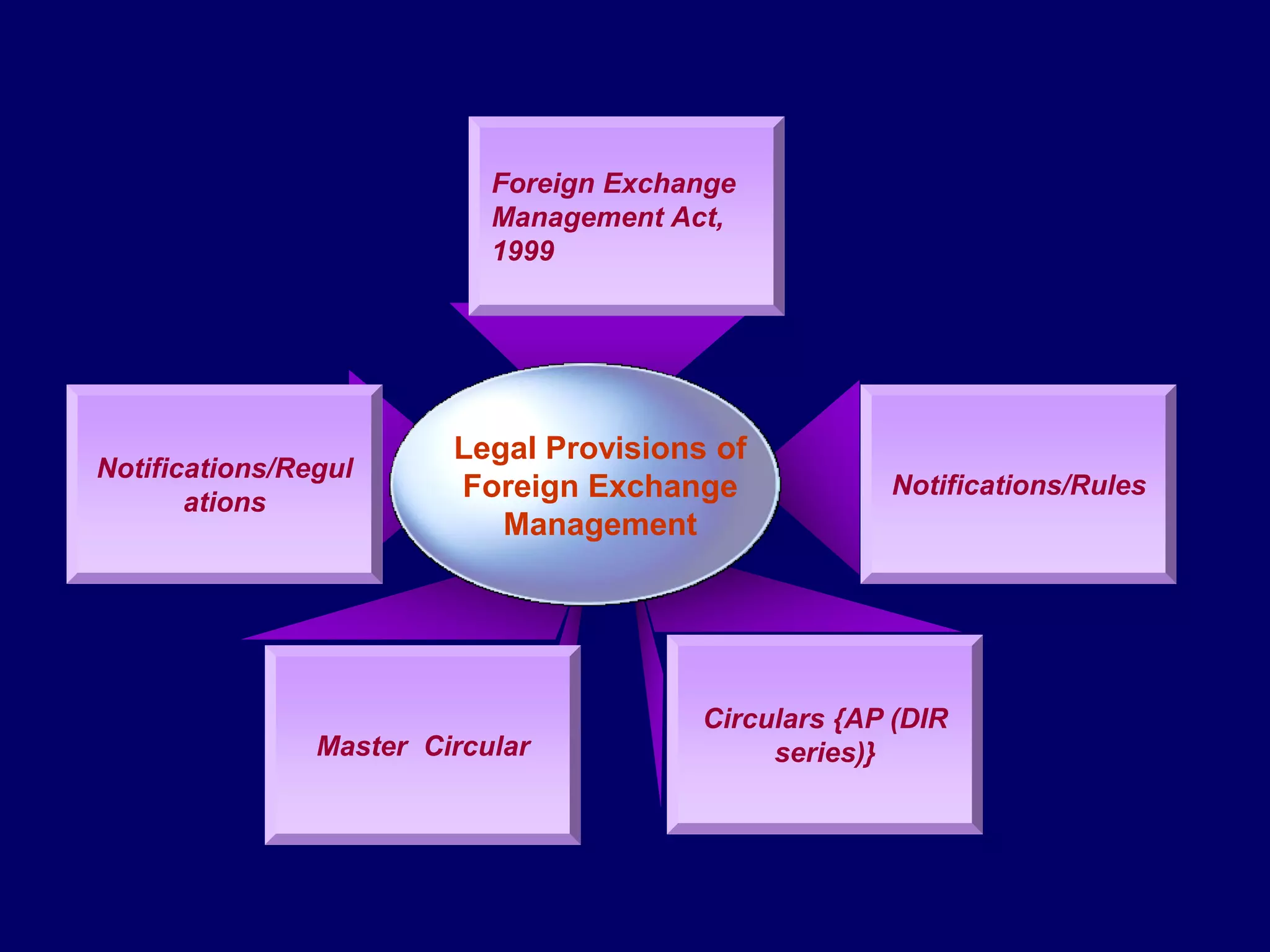
Foreign Exchange
                            Management Act,
                            1999


                         Legal Provisions of
Notifications/Regul
       ations
                         Foreign Exchange             Notifications/Rules
                            Management


                                         Circulars {AP (DIR
                Master Circular               series)}
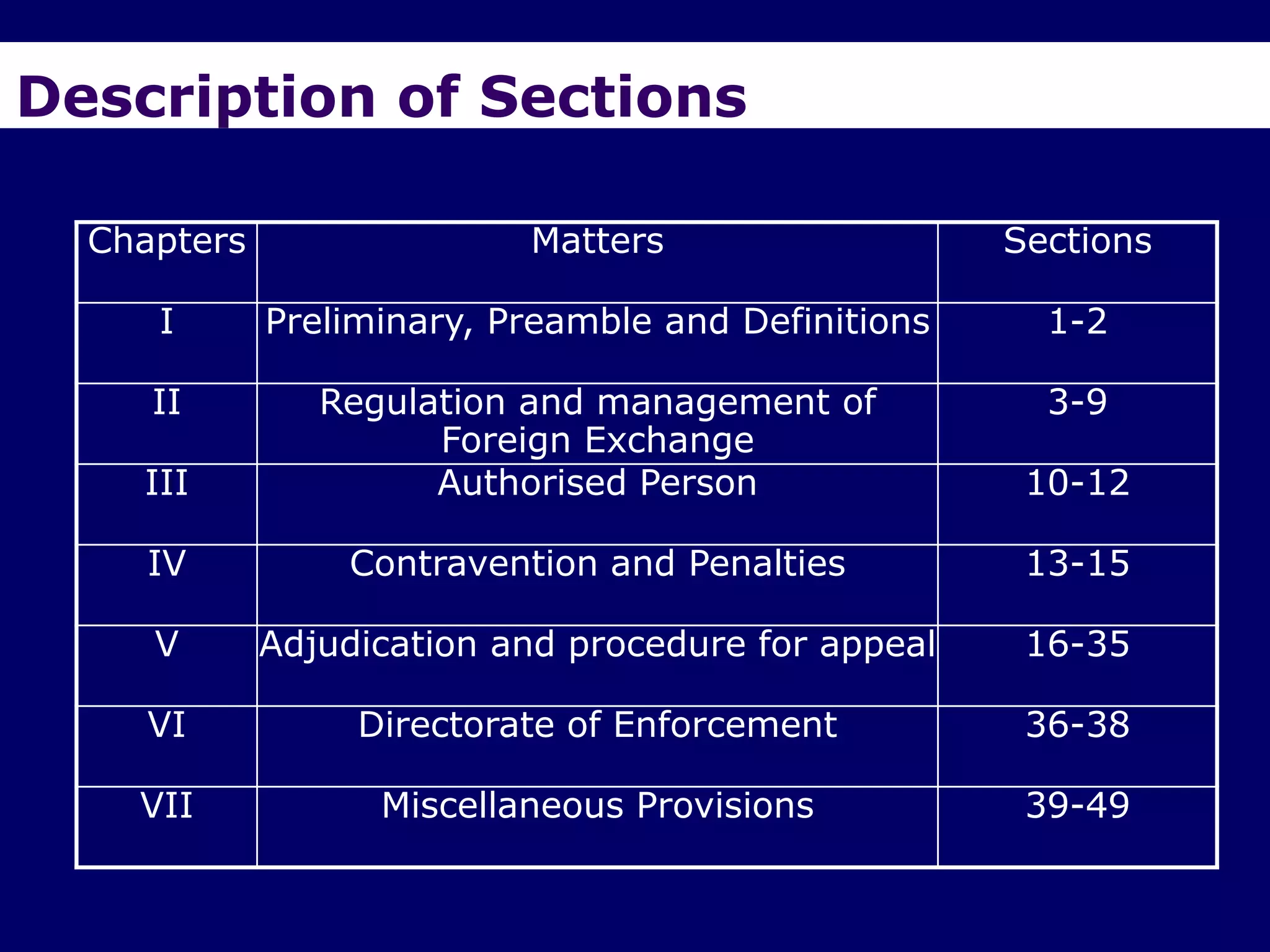
Description of Sections

  Chapters                 Matters                   Sections

     I       Preliminary, Preamble and Definitions     1-2

     II         Regulation and management of           3-9
                      Foreign Exchange
    III               Authorised Person               10-12

     IV          Contravention and Penalties          13-15

     V       Adjudication and procedure for appeal    16-35

     VI           Directorate of Enforcement          36-38

    VII            Miscellaneous Provisions           39-49
Important basic concepts

• Residential Status
• Capital Account transactions
• Current account transaction
• Liberalized Remittance Scheme
• Bank Accounts
Residential Status
Residential Status
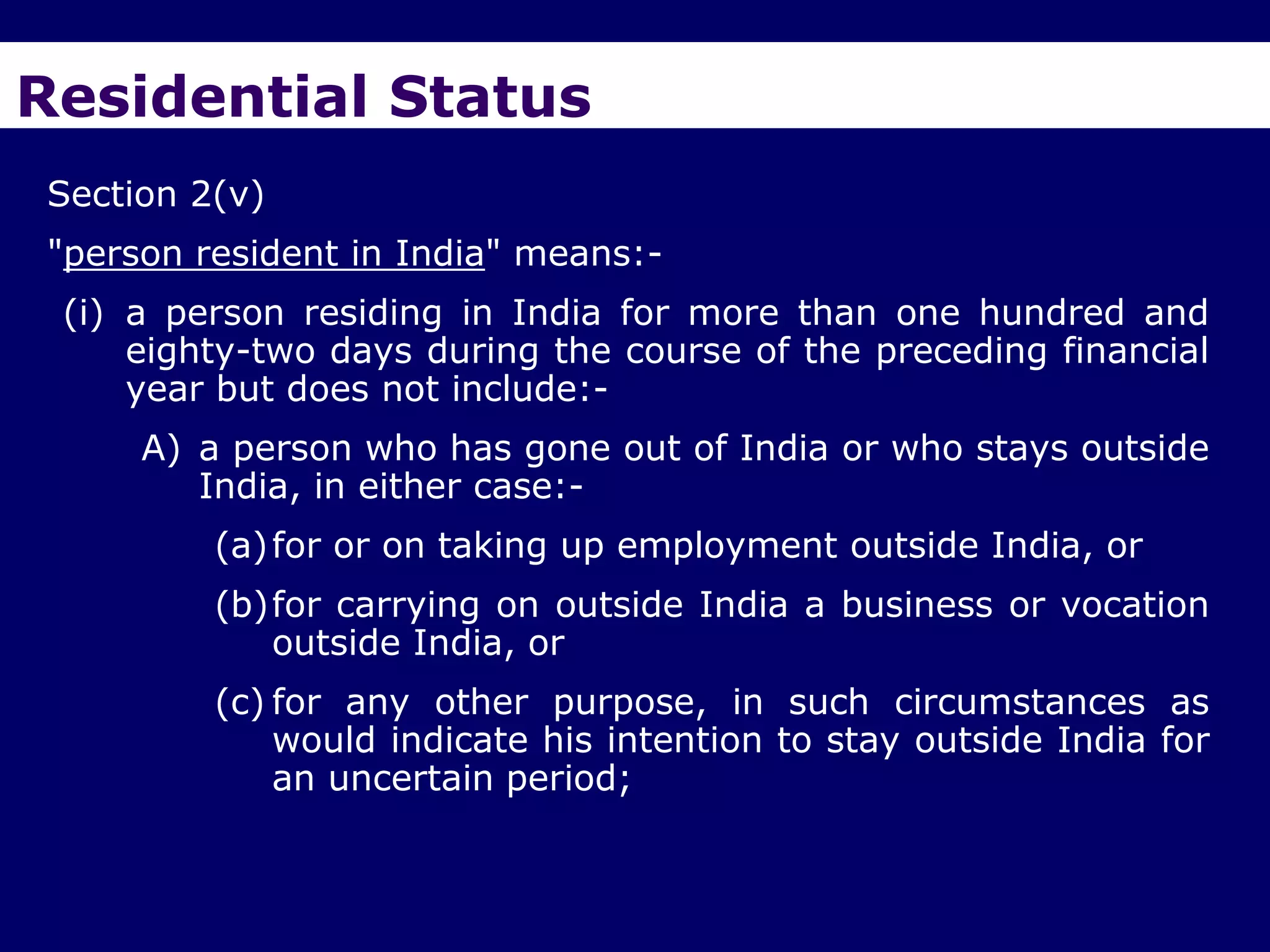
Section 2(v)
"person resident in India" means:-
 (i) a person residing in India for more than one hundred and
     eighty-two days during the course of the preceding financial
     year but does not include:-
     A) a person who has gone out of India or who stays outside
        India, in either case:-
         (a) for or on taking up employment outside India, or
         (b)for carrying on outside India a business or vocation
            outside India, or
         (c) for any other purpose, in such circumstances as
             would indicate his intention to stay outside India for
             an uncertain period;
Residential Status
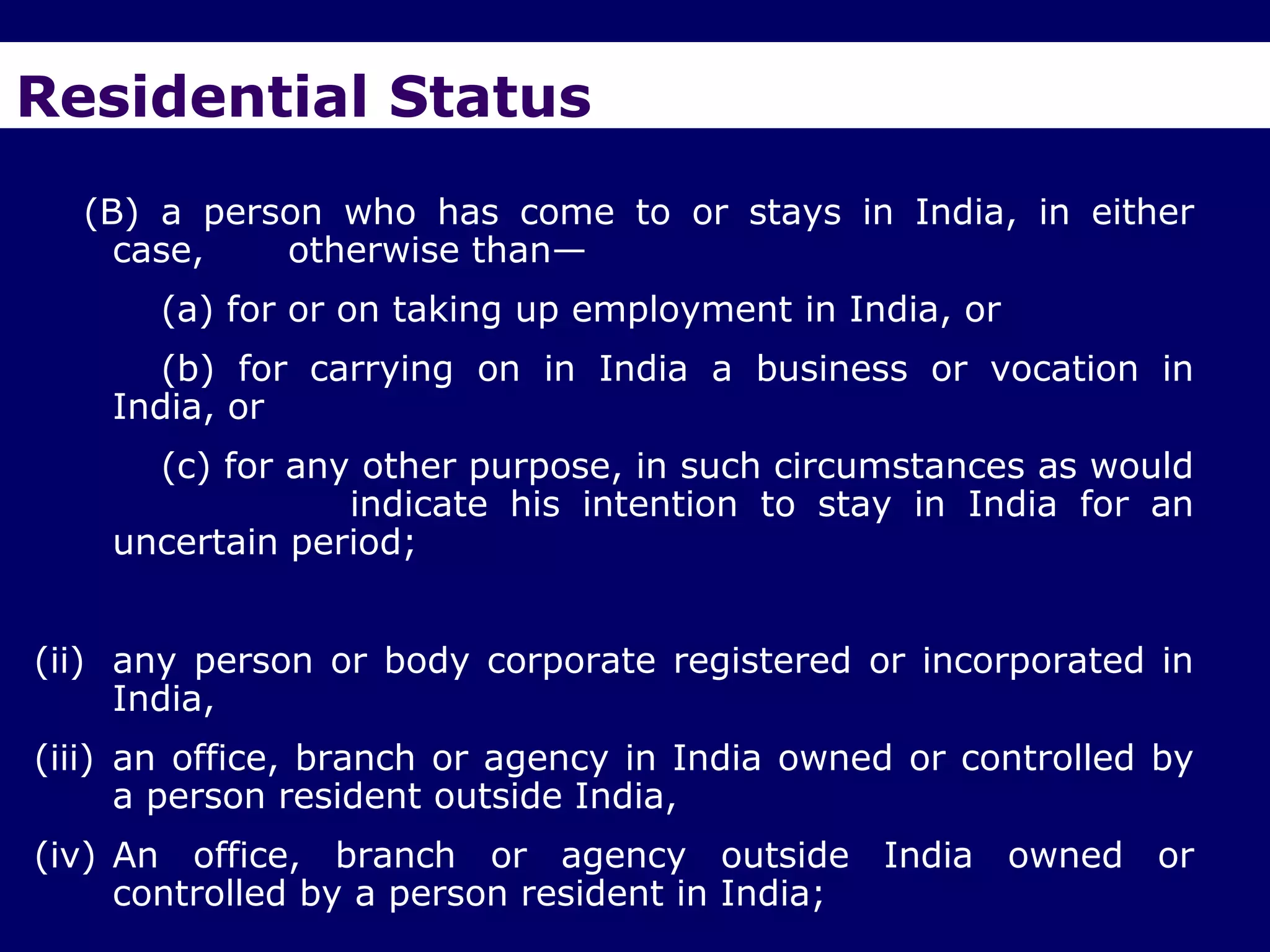
  (B) a person who has come to or stays in India, in either
    case,   otherwise than—
       (a) for or on taking up employment in India, or
       (b) for carrying on in India a business or vocation in
    India, or
      (c) for any other purpose, in such circumstances as would
                 indicate his intention to stay in India for an
    uncertain period;


(ii) any person or body corporate registered or incorporated in
     India,
(iii) an office, branch or agency in India owned or controlled by
      a person resident outside India,
(iv) An office, branch or agency outside India owned or
     controlled by a person resident in India;
Example

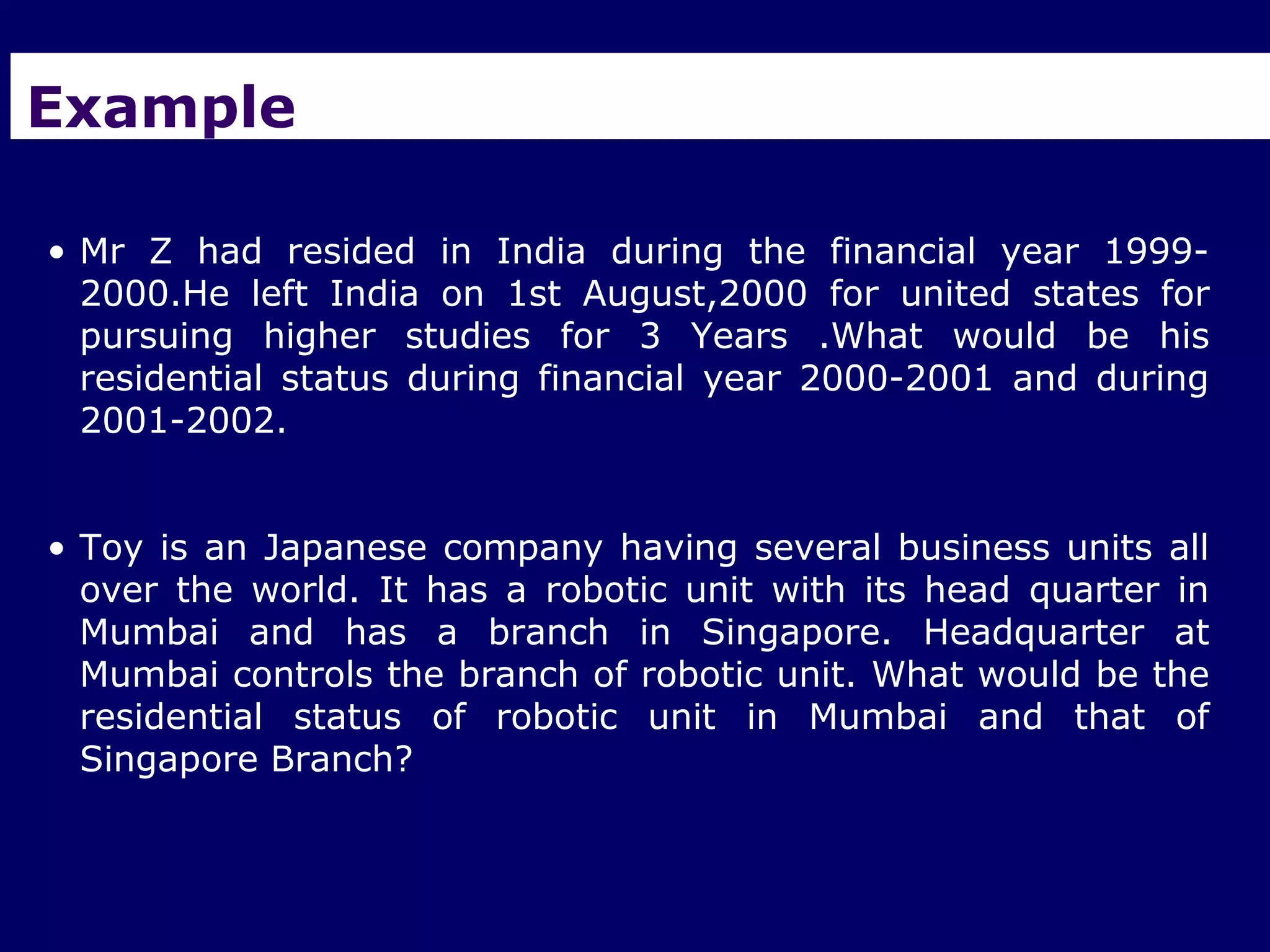
• Mr Z had resided in India during the financial year 1999-
  2000.He left India on 1st August,2000 for united states for
  pursuing higher studies for 3 Years .What would be his
  residential status during financial year 2000-2001 and during
  2001-2002.


• Toy is an Japanese company having several business units all
  over the world. It has a robotic unit with its head quarter in
  Mumbai and has a branch in Singapore. Headquarter at
  Mumbai controls the branch of robotic unit. What would be the
  residential status of robotic unit in Mumbai and that of
  Singapore Branch?
Example

• Miss is an air-hostess with the British Airways. She flies for 12
  days in a month and thereafter a break for 18 days. During the
  break, she is accommodated of ―base‖ which is normally the
  city where the airways is headquartered. However ,for security
  consideration ,she was based on Mumbai. During the financial
  year ,she was accommodated at Mumbai for more than 182
  days. What would be her residential status under FEMA?
Capital Account Transactions
Capital account transaction
A transaction which alters:-
• The assets;
• Liabilities; including contingent liabilities,
  outside India of persons resident in India
  or assets and liabilities in India of persons resident outside
  India and includes transactions referred to in sub section (3) of
  Section 6.
• As per notification no.FEMA1/2000-RB dated 3rd May 2000 no
  person shall undertake or sell or draw FOREX to or from an
  authorised person for any capital account transaction except
  for the purposes specified in Schedule I and Schedule II
Schedule I- for Persons resident in India
• Investment by a person resident in India in foreign securities;
• Foreign currency loans raised in India and abroad by a person resident
  in India;
• Transfer of immovable property outside India by a person resident in
  India;
• Guarantees issued by a person resident in India in favor of a person
  resident outside India;
• Export, import and holding of currency/currency notes;
• Loans and overdrafts (borrowings) by a person resident in India from a
  person resident outside India;
• Maintenance of foreign currency accounts in India and outside India by
  a person resident in India;
• Taking out of insurance policy by a person resident in India from an
  insurance company outside India;
• Loans and overdrafts by a person resident in India to a person resident
  outside India;
• Remittance outside India of capital assets of a person resident in India;
Schedule II- for Persons resident outside
India
• Investment in security of body corporate in India.
• Acquisition and transfer of immovable property in India by a
  person resident outside India.
• Guarantee by a person resident outside India in favour of, or on
  behalf of a person resident in India.
• Import and export of currency. currency notes into /from India
  by a person resident outside India.
• Deposits between a person resident in India and a person
  resident outside India.
• Foreign currency accounts in India of a person resident outside
  India.
• Remittance outside India of capital assets in India of a person
  resident outside India.
Capital account transaction - that cannot be
prohibited
• Amortisation of loan
• Depreciation of direct investment in the ordinary course of
  business
• Acquisition of transfer of immovable property in India on lease
  upto five years by a person resident in India.
• Acquisition or transfer of immovable property in India on lease
  up to five years by a person resident outside India.
• Holding, owning, transferring or investing in foreign currency,
  foreign security or any immovable property outside India by a
  person resident in India if the same was acquired, held or owned
  by such person when he was resident outside India or inherited
  from a person who was resident outside India.
• Holding, owning, transferring or investing in Indian currency,
  security or any immovable property in India by a person resident
  outside India if the same was acquired, held or owned by such
  person when he was resident in India or inherited from a person
  who was resident in India.
Current Account Transactions
Current account transaction
Section 2(J)
  "current account transaction" means a transaction other than a
  capital account transaction, and;
includes:-
(i)     payments due in connection with foreign trade, other
        current business, services, and short-term banking and
        credit facilities in the ordinary course of business,
(ii)    payments due as interest on loans and as net income
        from investments,
(iii)   remittances for living expenses of parents, spouse and
        children residing abroad, and
(iv)    expenses in connection with foreign travel, education and
        medical care of parents, spouse and Children.
Current account transaction

• Section 5 of the Act:-
 any person may sell or draw foreign exchange to or from an
 authorised person if such sale or drawal is a current account
 transaction.
 Provided that the central government may, in public
 interest and in consultation with the Reserve Bank, impose
 such reasonable restrictions for current account transactions as
 may be prescribed.


 Via Notification no. G.S.R.38(E) dated 3May 2000,Central
 Government has notified the rules to be called ―Foreign
 Exchange Management (Current Account Transaction) Rules,
 2000.
Prohibited transactions
As per the notification
Drawal of Foreign Exchange is prohibited in following Cases
•    Transactions specified in Schedule I
     Examples:-
         Remittance out of lottery winnings
         Remittance of Income from racing/Riding etc
         Payment related to call Back Services.


•    a travel to Nepal and /or Bhutan
•    a transaction with a person resident in Nepal or Bhutan.
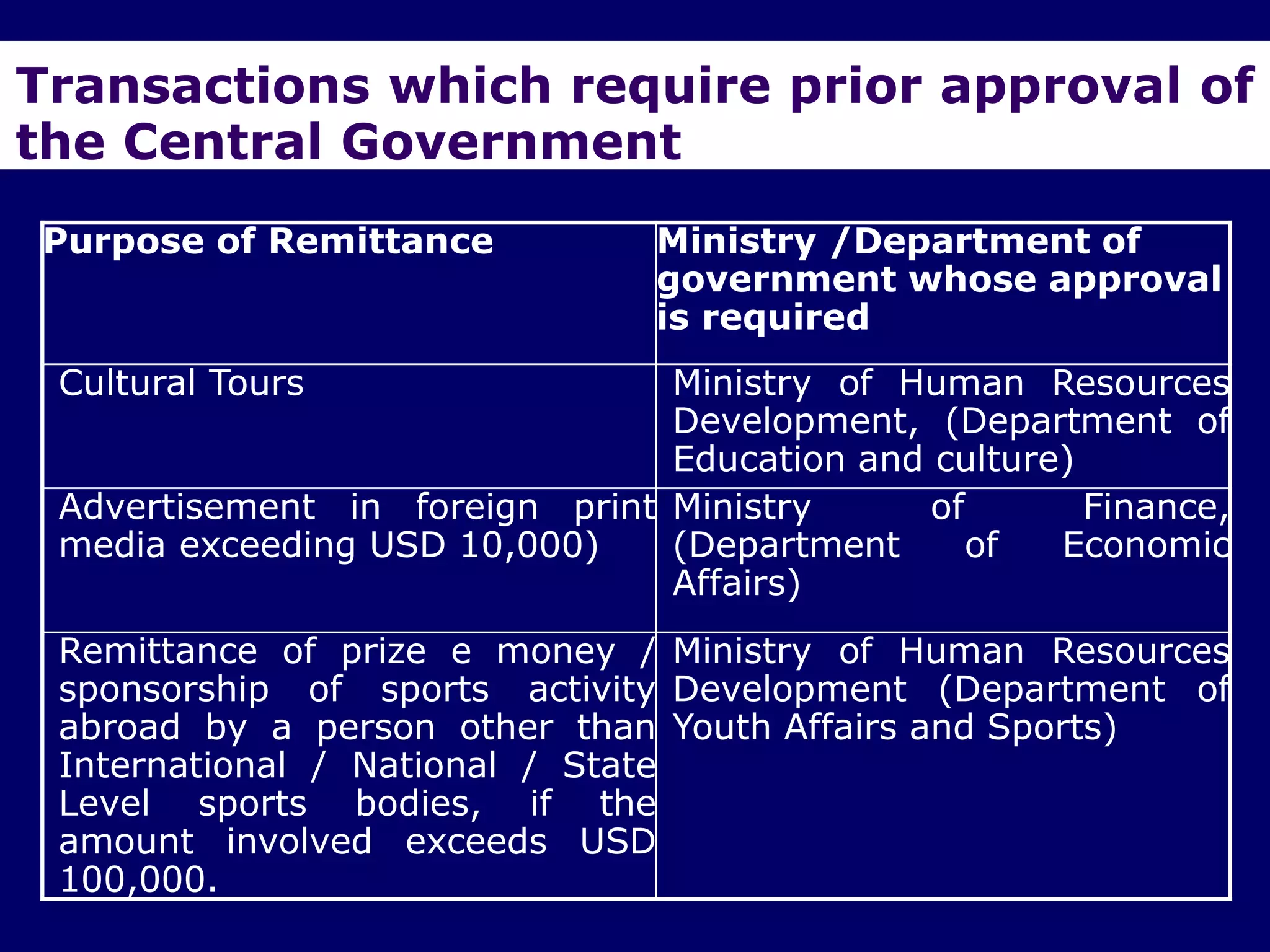
Transactions which require prior approval of
the Central Government
Purpose of Remittance           Ministry /Department of
                                government whose approval
                                is required
 Cultural Tours                 Ministry of Human Resources
                                Development, (Department of
                                Education and culture)
 Advertisement in foreign print Ministry      of       Finance,
 media exceeding USD 10,000)    (Department      of  Economic
                                Affairs)
 Remittance of prize e money / Ministry of Human Resources
 sponsorship of sports activity Development (Department of
 abroad by a person other than Youth Affairs and Sports)
 International / National / State
 Level sports bodies, if the
 amount involved exceeds USD
 100,000.
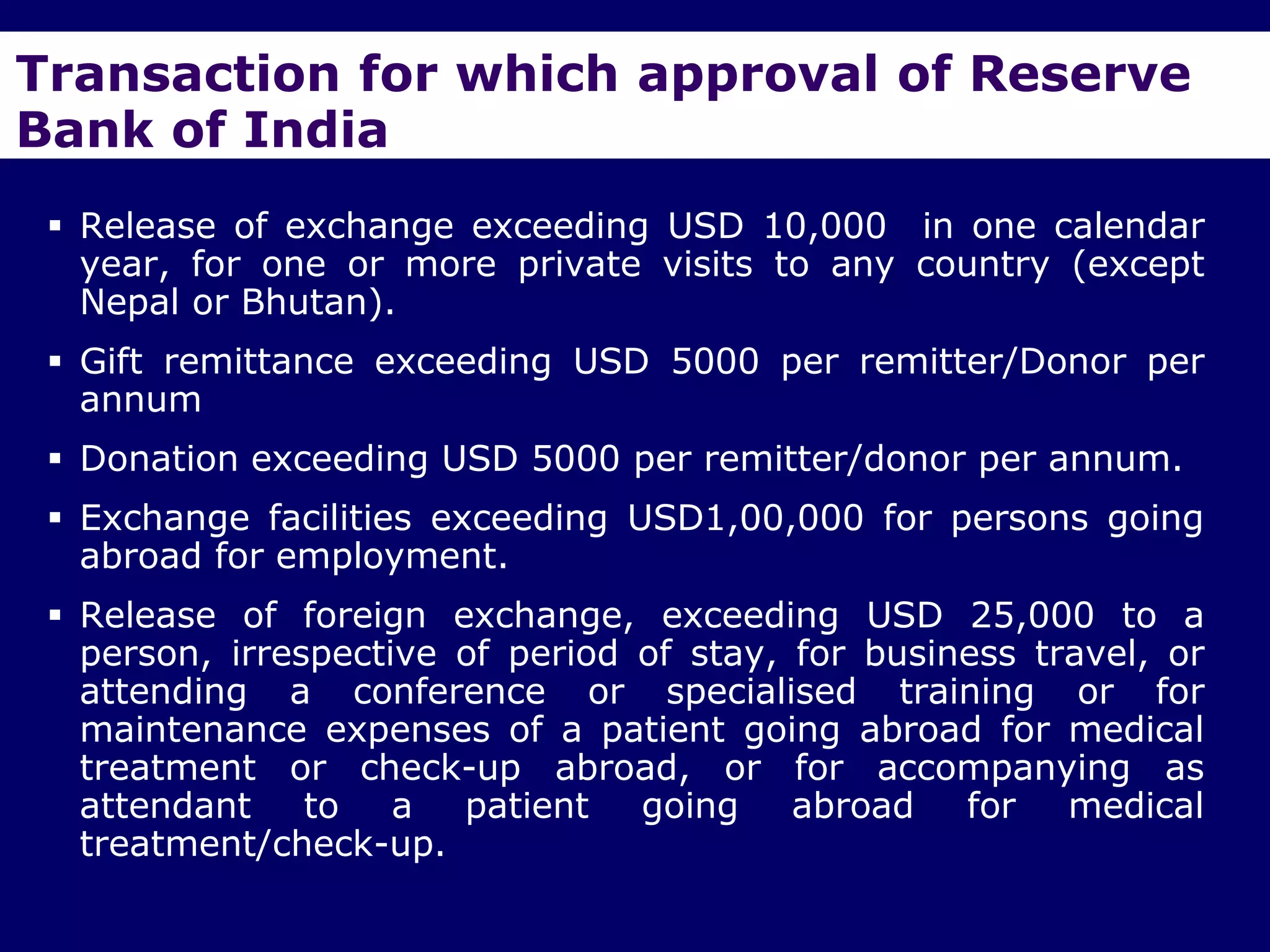
Transaction for which approval of Reserve
Bank of India
 ď‚§ Release of exchange exceeding USD 10,000 in one calendar
   year, for one or more private visits to any country (except
   Nepal or Bhutan).
 ď‚§ Gift remittance exceeding USD 5000 per remitter/Donor per
   annum
 ď‚§ Donation exceeding USD 5000 per remitter/donor per annum.
 ď‚§ Exchange facilities exceeding USD1,00,000 for persons going
   abroad for employment.
 ď‚§ Release of foreign exchange, exceeding USD 25,000 to a
   person, irrespective of period of stay, for business travel, or
   attending a conference or specialised training or for
   maintenance expenses of a patient going abroad for medical
   treatment or check-up abroad, or for accompanying as
   attendant to a patient going abroad for medical
   treatment/check-up.
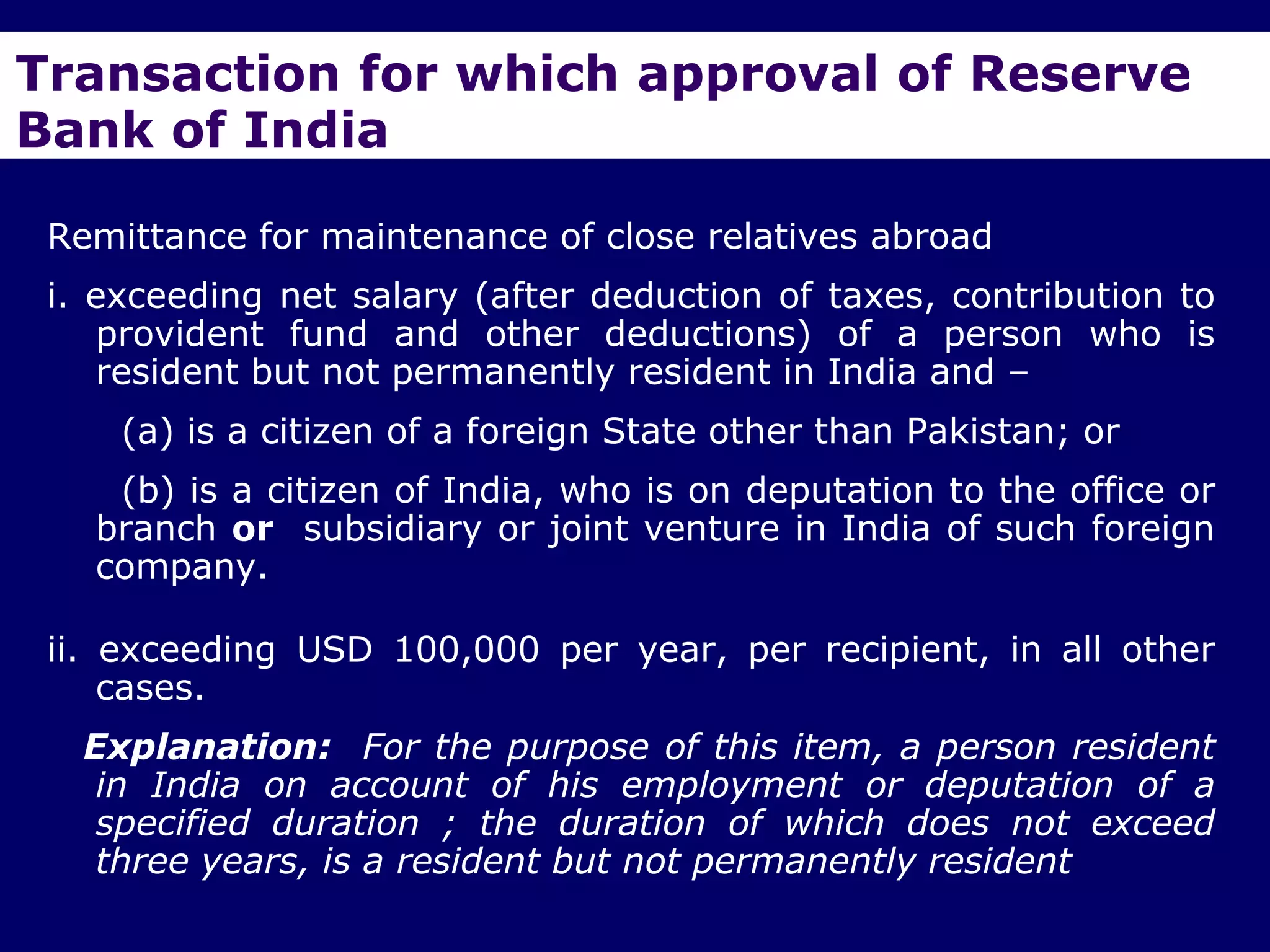
Transaction for which approval of Reserve
Bank of India

 Remittance for maintenance of close relatives abroad
 i. exceeding net salary (after deduction of taxes, contribution to
    provident fund and other deductions) of a person who is
    resident but not permanently resident in India and –
     (a) is a citizen of a foreign State other than Pakistan; or
    (b) is a citizen of India, who is on deputation to the office or
   branch or subsidiary or joint venture in India of such foreign
   company.

 ii. exceeding USD 100,000 per year, per recipient, in all other
     cases.
   Explanation: For the purpose of this item, a person resident
    in India on account of his employment or deputation of a
    specified duration ; the duration of which does not exceed
    three years, is a resident but not permanently resident
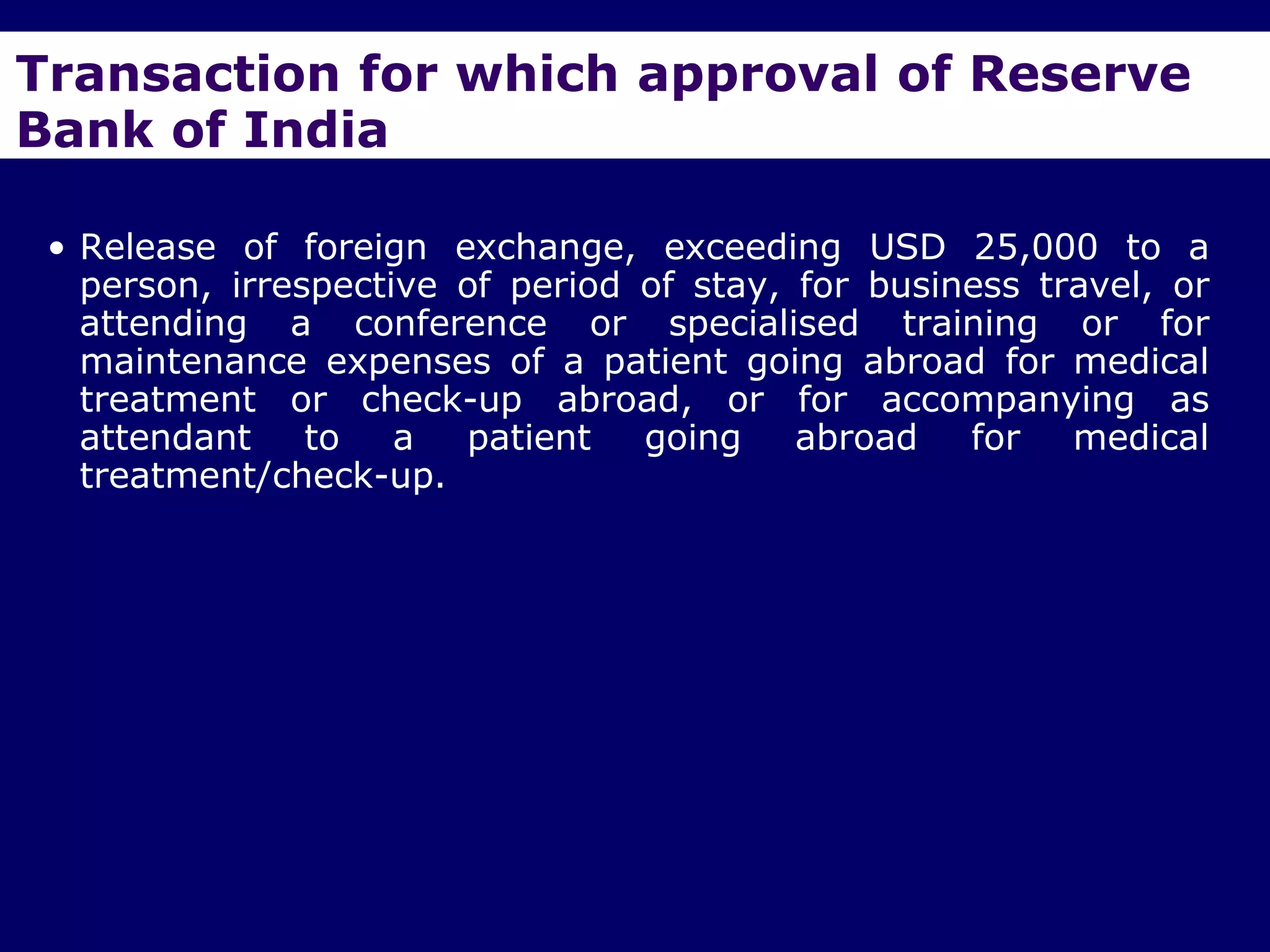
Transaction for which approval of Reserve
Bank of India

 • Release of foreign exchange, exceeding USD 25,000 to a
   person, irrespective of period of stay, for business travel, or
   attending a conference or specialised training or for
   maintenance expenses of a patient going abroad for medical
   treatment or check-up abroad, or for accompanying as
   attendant    to   a  patient   going    abroad   for medical
   treatment/check-up.
Transaction for which approval of Reserve
Bank of India

 • Release of exchange for meeting expenses for medical
   treatment abroad exceeding the estimate from the doctor in
   India or hospital/doctor abroad.
 • Release of exchange for studies abroad exceeding the
   estimate from the institution abroad or USD 100,000, per
   academic year, whichever is higher.
 • Commission, per transaction, to agents abroad for sale of
   residential flats or commercial plots in India exceeding USD
   25,000 or 5% of the inward remittance whichever is more
 • Remittance exceeding USD 1,000,000 per project, for any
   consultancy service procured from outside India.
 • Remittance exceeding USD 100,000 by an entity in India
   by way of reimbursement of pre incorporation expenses.
Liberalised Remittance Scheme
Liberalised Remittance

• Authorised Dealers may freely allow remittances by resident
  individuals up to USD 200,000 per financial year for any
  permitted current or capital account transactions or a
  combination of both.
• This limit includes remittance towards gift and donation by a
  resident individual.
• Remittances under the scheme are allowed only in respect of
  permissible current or capital account transaction.
BANK ACCOUNTS
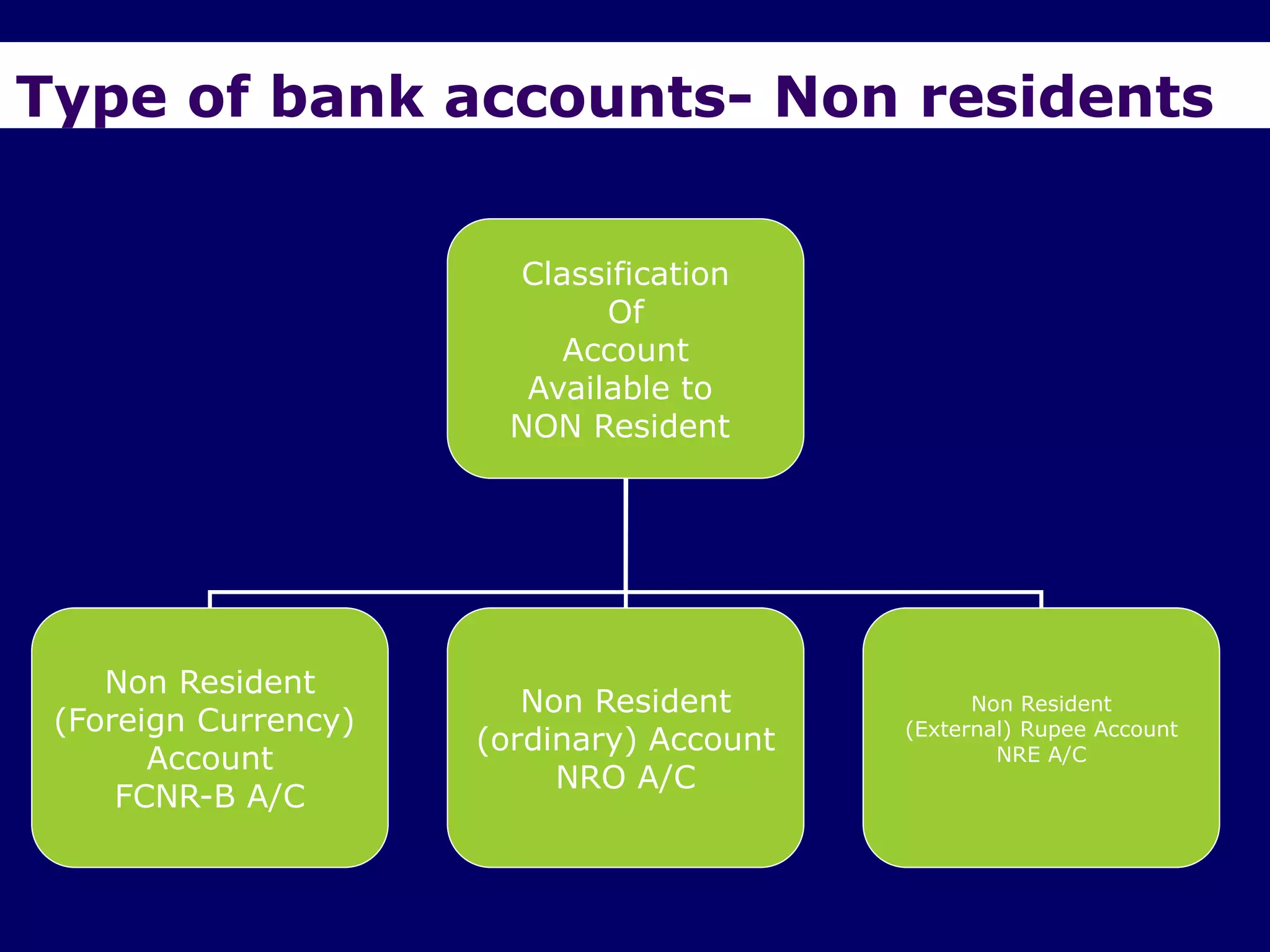
Type of bank accounts- Non residents

                        Classification
                              Of
                           Account
                         Available to
                        NON Resident


    Non Resident
                         Non Resident            Non Resident
 (Foreign Currency)                        (External) Rupee Account
                      (ordinary) Account
       Account                                     NRE A/C
                           NRO A/C
     FCNR-B A/C
Non-resident Ordinary (NRO) Rupee Account


   Any person resident outside India may open NRO account
    with an authorised dealer or an authorised bank for the
    purpose of putting through bonafide transactions
    denominated in Rupees, not involving any violation of the
    provisions of FEMA, rules, Regulations made thereunder.


    The accounts may be maintained in the form of savings or
    current or term deposit accounts.
Non-resident Ordinary (NRO) Rupee Account

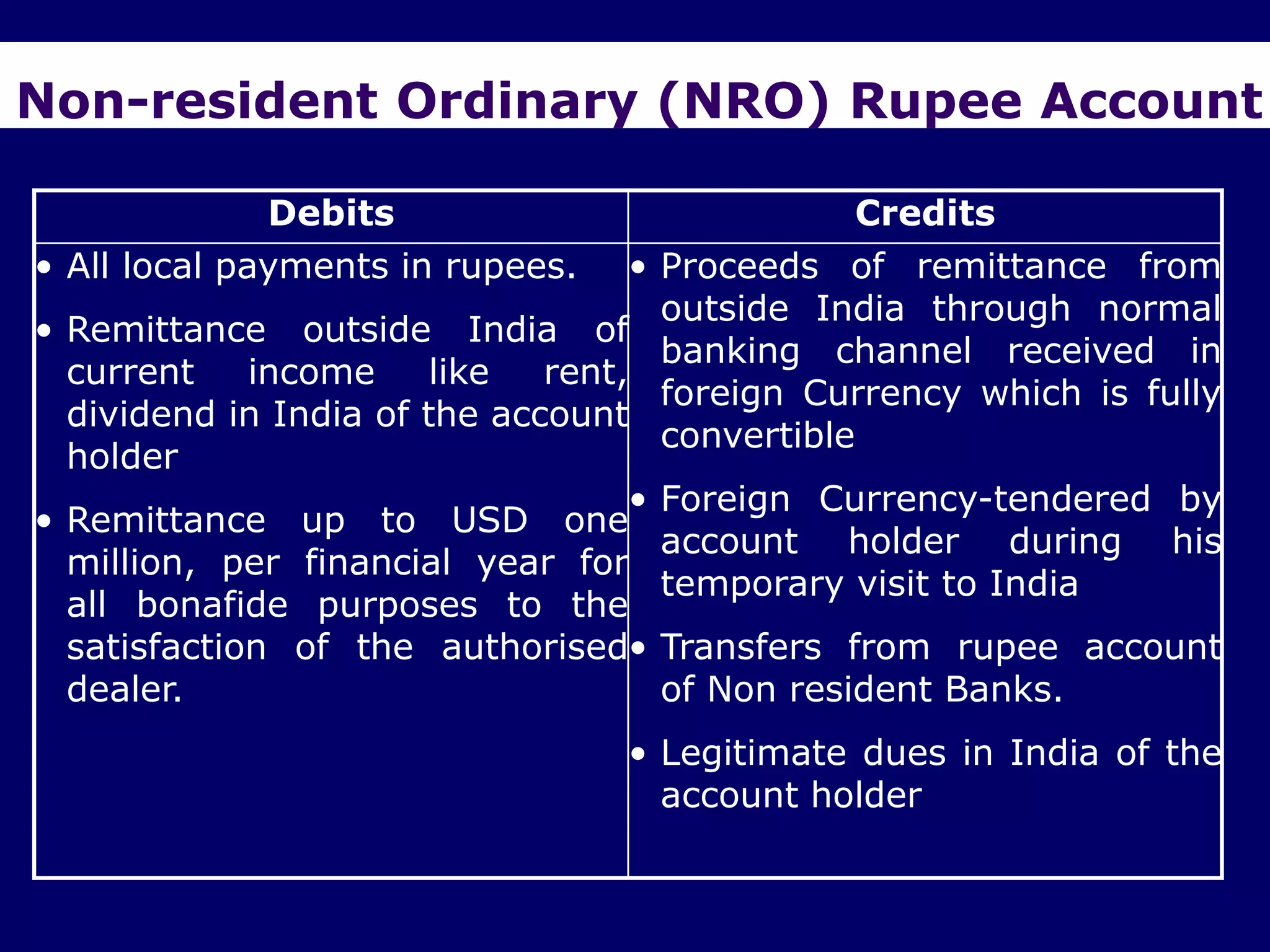
              Debits                              Credits
• All local payments in rupees.   •    Proceeds of remittance from
                                       outside India through normal
• Remittance outside India of
                                       banking channel received in
  current    income     like  rent,
                                       foreign Currency which is fully
  dividend in India of the account
                                       convertible
  holder
                                   •   Foreign Currency-tendered by
• Remittance up to USD one
                                       account holder during his
  million, per financial year for
                                       temporary visit to India
  all bonafide purposes to the
  satisfaction of the authorised•      Transfers from rupee account
  dealer.                              of Non resident Banks.
                                  • Legitimate dues in India of the
                                    account holder
Non-resident external (NRE) Rupee Account
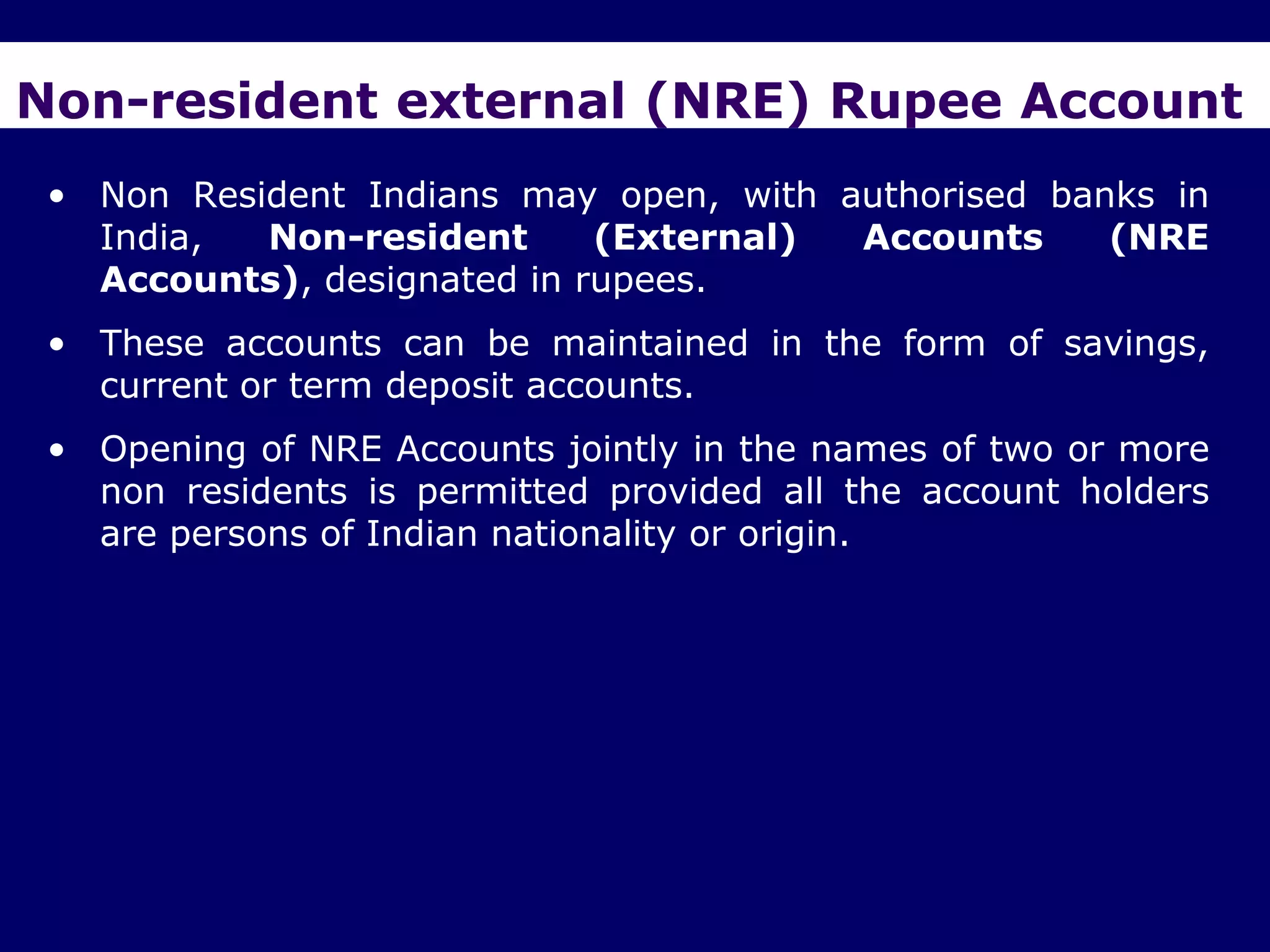
 • Non Resident Indians may open, with authorised banks in
   India,  Non-resident      (External) Accounts     (NRE
   Accounts), designated in rupees.
 • These accounts can be maintained in the form of savings,
   current or term deposit accounts.
 • Opening of NRE Accounts jointly in the names of two or more
   non residents is permitted provided all the account holders
   are persons of Indian nationality or origin.
Non-resident external (NRE) Rupee Account
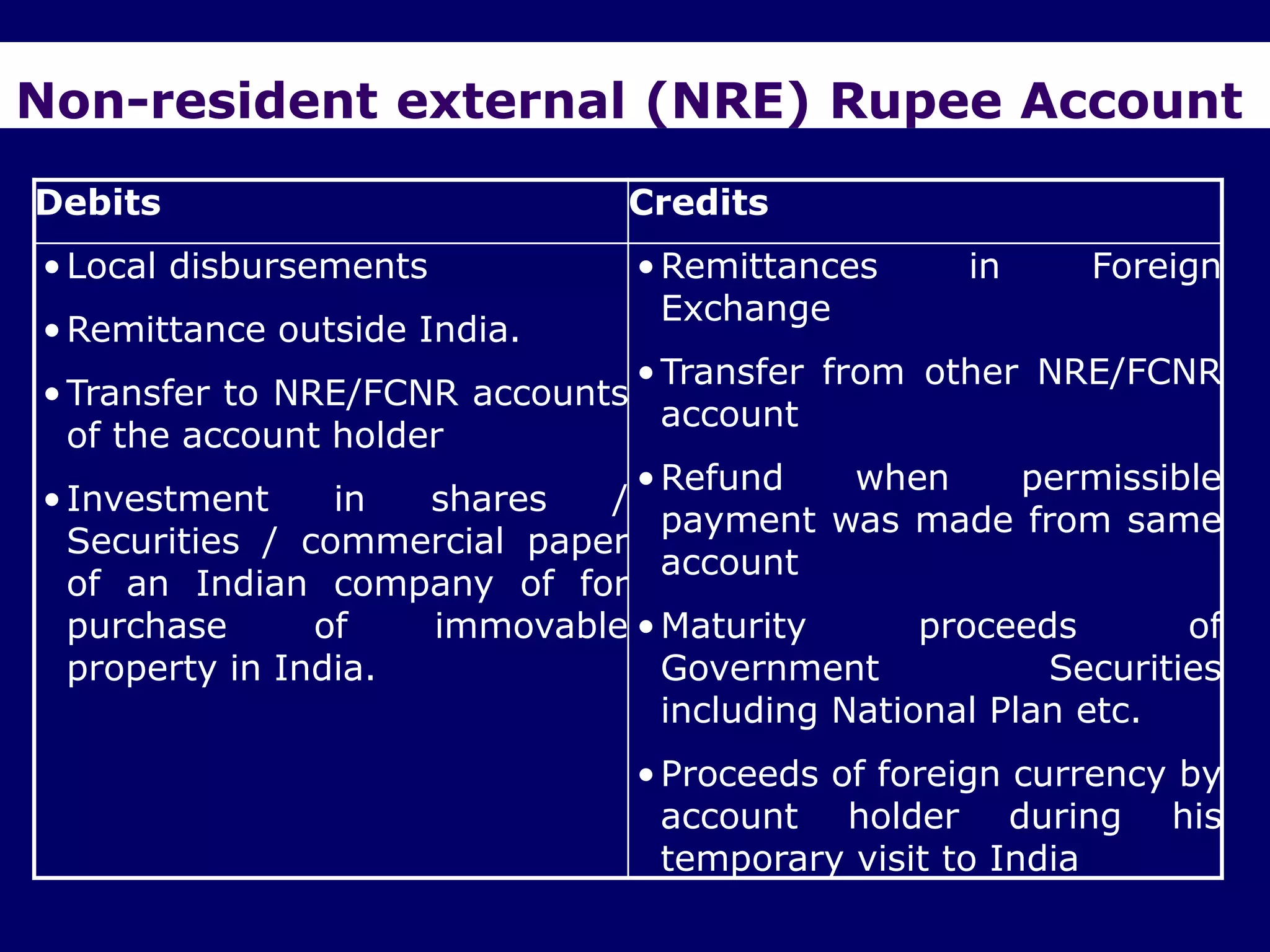
Debits                          Credits
• Local disbursements            • Remittances     in     Foreign
                                   Exchange
• Remittance outside India.
                                • Transfer from other NRE/FCNR
• Transfer to NRE/FCNR accounts
                                  account
  of the account holder
                                • Refund     when      permissible
• Investment     in   shares  /
                                  payment was made from same
  Securities / commercial paper
                                  account
  of an Indian company of for
  purchase      of    immovable • Maturity       proceeds       of
  property in India.              Government            Securities
                                  including National Plan etc.
                                 • Proceeds of foreign currency by
                                   account holder during his
                                   temporary visit to India
FCNR Account
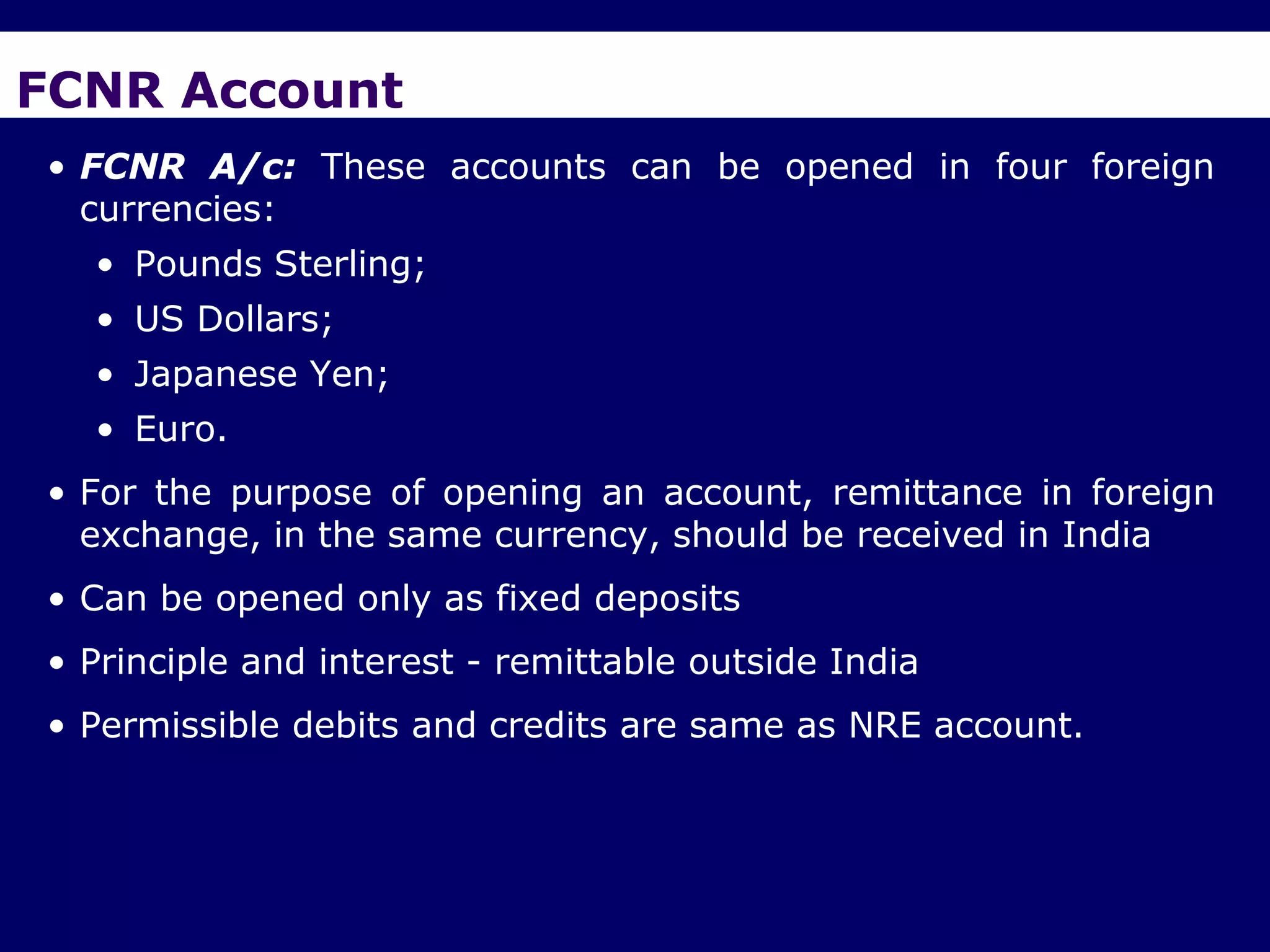
• FCNR A/c: These accounts can be opened in four foreign
  currencies:
  • Pounds Sterling;
  • US Dollars;
  • Japanese Yen;
  • Euro.
• For the purpose of opening an account, remittance in foreign
  exchange, in the same currency, should be received in India
• Can be opened only as fixed deposits
• Principle and interest - remittable outside India
• Permissible debits and credits are same as NRE account.
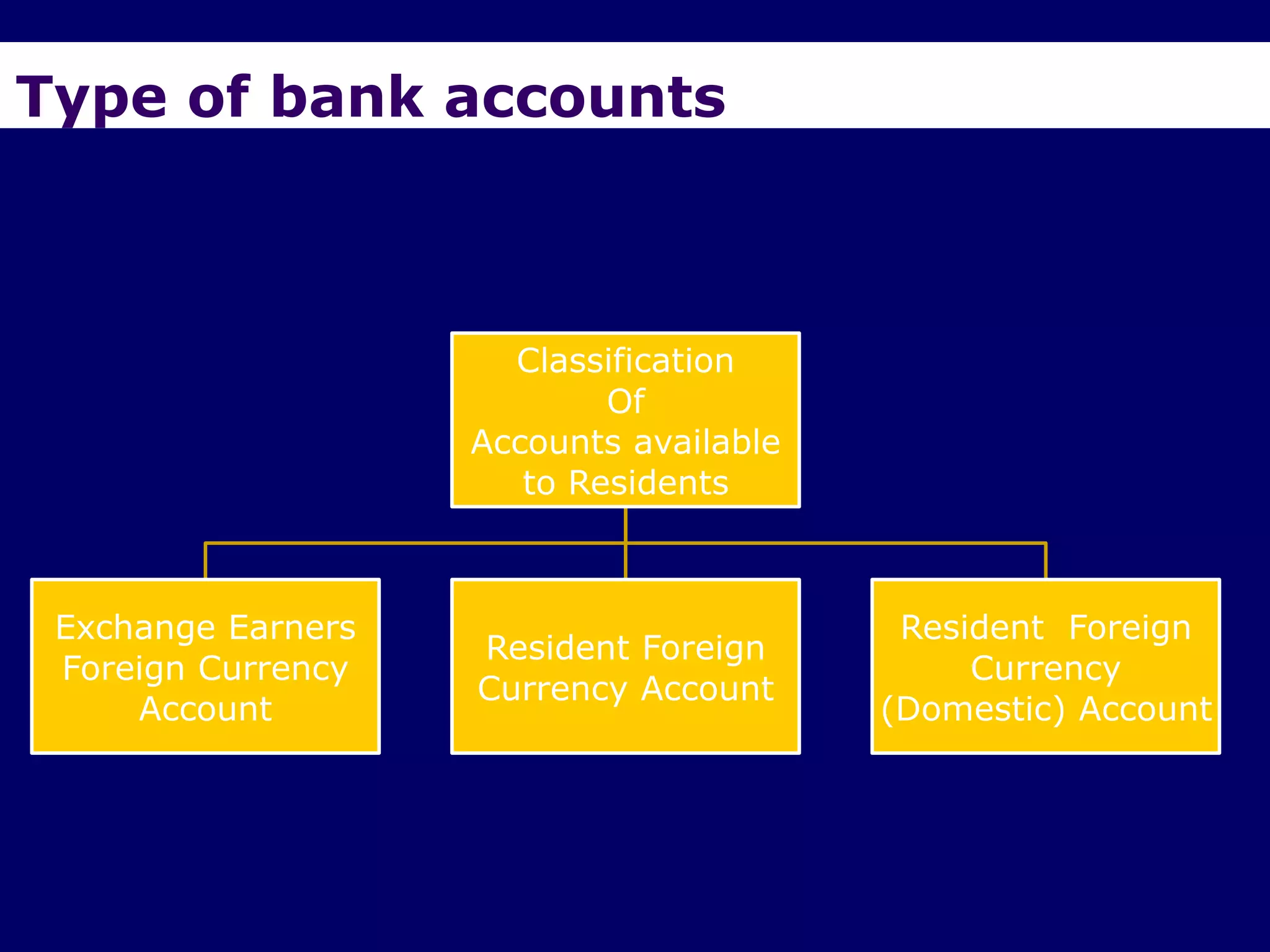
Type of bank accounts


                      Classification
                            Of
                    Accounts available
                       to Residents


 Exchange Earners                         Resident Foreign
                    Resident Foreign
 Foreign Currency                             Currency
                    Currency Account
     Account                             (Domestic) Account
Exchange Earners Foreign Currency Account


• A person in India can open, hold and maintain with an
  authorised Dealer in India, a Exchange Earners Foreign Currency
  Account
• Credited with the 100% FOREIGN EXCHANGE EARNINGS
• No restriction on withdrawal in Indian Rupees
Resident Foreign Currency A/C

• A person in India can open, hold and maintain with an
  authorised Dealer in India, a RESIDENT FOREIGN CURRENCY
  ACCOUNT, out of Foreign exchange
  • Received as pension or any other superannuation or any
    other monetary benefit from employer outside India
  • Realised on conversion of asset
  • Received or acquired as gift or inheritance
  • Received as the proceeds from life insurance policy settled in
    Foreign currency
Resident Foreign Currency (Domestic) A/C

• A resident individual may open, hold and maintain with an
  authorised Dealer in India, a RESIDENT FOREIGN CURRENCY
  (DOMESTIC) ACCOUNT, out of Foreign exchange
  • acquired by him from an authorised person for travel abroad
    and represents the unspent amount thereof.
  • acquired by him, while on visit to any place outside India, by
    way of payment for services.
  • acquired by him, from any person not resident in India and
    who is on visit to India, as honorarium, gift, for services
    rendered abroad
  • Acquired by him in settlement of any lawful obligation from
    any person not resident in India.
Contravention of FEMA
• Any person, contravening FEMA,        shall   be   liable,   upon
  adjudication, to a penalty up to
  • three times the sum involved in such contravention, where
    such amount is quantifiable,
  • up to Rupees Two hundred thousand, where the amount is
    not quantifiable.
• In addition, where such contravention is a continuing one, the
  person will be liable to further penalty, which may extend to
  Rupees Five thousand for every day after the first day, during
  which the contravention continues.
Income tax clearance

• Remittances to non-resident will be allowed to be made by the
  authorised dealers on production of an undertaking by the
  remitter and a certificate from a Chartered Accountant in the
  formats prescribed by the Central Board of Direct Taxes,
  Ministry of Finance, Government of India
sudhag999@gmail.com
   09769033172

Fema an overview- a presentation by CA. Sudha G. Bhushan

  • 1.
    Foreign Exchange Management Act,1999 - An Overview Presentation by: Sudha g. Bhushan
  • 2.
    Objective of theFEMA, 1999 • To consolidate and amend the law relating to foreign exchange; • Facilitating external trade and payments and • Promoting orderly development and maintenance of forex market in India • Introduced after repulsion of FERA, an Act to control, regulate, restrict or prohibit foreign exchange keeping in view the interest of economic development of the country
  • 3.
    Foreign Exchange Management Act, 1999 Legal Provisions of Notifications/Regul ations Foreign Exchange Notifications/Rules Management Circulars {AP (DIR Master Circular series)}
  • 4.
    Description of Sections Chapters Matters Sections I Preliminary, Preamble and Definitions 1-2 II Regulation and management of 3-9 Foreign Exchange III Authorised Person 10-12 IV Contravention and Penalties 13-15 V Adjudication and procedure for appeal 16-35 VI Directorate of Enforcement 36-38 VII Miscellaneous Provisions 39-49
  • 5.
    Important basic concepts •Residential Status • Capital Account transactions • Current account transaction • Liberalized Remittance Scheme • Bank Accounts
  • 6.
  • 7.
    Residential Status Section 2(v) "personresident in India" means:- (i) a person residing in India for more than one hundred and eighty-two days during the course of the preceding financial year but does not include:- A) a person who has gone out of India or who stays outside India, in either case:- (a) for or on taking up employment outside India, or (b)for carrying on outside India a business or vocation outside India, or (c) for any other purpose, in such circumstances as would indicate his intention to stay outside India for an uncertain period;
  • 8.
    Residential Status (B) a person who has come to or stays in India, in either case, otherwise than— (a) for or on taking up employment in India, or (b) for carrying on in India a business or vocation in India, or (c) for any other purpose, in such circumstances as would indicate his intention to stay in India for an uncertain period; (ii) any person or body corporate registered or incorporated in India, (iii) an office, branch or agency in India owned or controlled by a person resident outside India, (iv) An office, branch or agency outside India owned or controlled by a person resident in India;
  • 9.
    Example • Mr Zhad resided in India during the financial year 1999- 2000.He left India on 1st August,2000 for united states for pursuing higher studies for 3 Years .What would be his residential status during financial year 2000-2001 and during 2001-2002. • Toy is an Japanese company having several business units all over the world. It has a robotic unit with its head quarter in Mumbai and has a branch in Singapore. Headquarter at Mumbai controls the branch of robotic unit. What would be the residential status of robotic unit in Mumbai and that of Singapore Branch?
  • 10.
    Example • Miss isan air-hostess with the British Airways. She flies for 12 days in a month and thereafter a break for 18 days. During the break, she is accommodated of ―base‖ which is normally the city where the airways is headquartered. However ,for security consideration ,she was based on Mumbai. During the financial year ,she was accommodated at Mumbai for more than 182 days. What would be her residential status under FEMA?
  • 11.
  • 12.
    Capital account transaction Atransaction which alters:- • The assets; • Liabilities; including contingent liabilities, outside India of persons resident in India or assets and liabilities in India of persons resident outside India and includes transactions referred to in sub section (3) of Section 6. • As per notification no.FEMA1/2000-RB dated 3rd May 2000 no person shall undertake or sell or draw FOREX to or from an authorised person for any capital account transaction except for the purposes specified in Schedule I and Schedule II
  • 13.
    Schedule I- forPersons resident in India • Investment by a person resident in India in foreign securities; • Foreign currency loans raised in India and abroad by a person resident in India; • Transfer of immovable property outside India by a person resident in India; • Guarantees issued by a person resident in India in favor of a person resident outside India; • Export, import and holding of currency/currency notes; • Loans and overdrafts (borrowings) by a person resident in India from a person resident outside India; • Maintenance of foreign currency accounts in India and outside India by a person resident in India; • Taking out of insurance policy by a person resident in India from an insurance company outside India; • Loans and overdrafts by a person resident in India to a person resident outside India; • Remittance outside India of capital assets of a person resident in India;
  • 14.
    Schedule II- forPersons resident outside India • Investment in security of body corporate in India. • Acquisition and transfer of immovable property in India by a person resident outside India. • Guarantee by a person resident outside India in favour of, or on behalf of a person resident in India. • Import and export of currency. currency notes into /from India by a person resident outside India. • Deposits between a person resident in India and a person resident outside India. • Foreign currency accounts in India of a person resident outside India. • Remittance outside India of capital assets in India of a person resident outside India.
  • 15.
    Capital account transaction- that cannot be prohibited • Amortisation of loan • Depreciation of direct investment in the ordinary course of business • Acquisition of transfer of immovable property in India on lease upto five years by a person resident in India. • Acquisition or transfer of immovable property in India on lease up to five years by a person resident outside India. • Holding, owning, transferring or investing in foreign currency, foreign security or any immovable property outside India by a person resident in India if the same was acquired, held or owned by such person when he was resident outside India or inherited from a person who was resident outside India. • Holding, owning, transferring or investing in Indian currency, security or any immovable property in India by a person resident outside India if the same was acquired, held or owned by such person when he was resident in India or inherited from a person who was resident in India.
  • 16.
  • 17.
    Current account transaction Section2(J) "current account transaction" means a transaction other than a capital account transaction, and; includes:- (i) payments due in connection with foreign trade, other current business, services, and short-term banking and credit facilities in the ordinary course of business, (ii) payments due as interest on loans and as net income from investments, (iii) remittances for living expenses of parents, spouse and children residing abroad, and (iv) expenses in connection with foreign travel, education and medical care of parents, spouse and Children.
  • 18.
    Current account transaction •Section 5 of the Act:- any person may sell or draw foreign exchange to or from an authorised person if such sale or drawal is a current account transaction. Provided that the central government may, in public interest and in consultation with the Reserve Bank, impose such reasonable restrictions for current account transactions as may be prescribed. Via Notification no. G.S.R.38(E) dated 3May 2000,Central Government has notified the rules to be called ―Foreign Exchange Management (Current Account Transaction) Rules, 2000.
  • 19.
    Prohibited transactions As perthe notification Drawal of Foreign Exchange is prohibited in following Cases • Transactions specified in Schedule I Examples:- Remittance out of lottery winnings Remittance of Income from racing/Riding etc Payment related to call Back Services. • a travel to Nepal and /or Bhutan • a transaction with a person resident in Nepal or Bhutan.
  • 20.
    Transactions which requireprior approval of the Central Government Purpose of Remittance Ministry /Department of government whose approval is required Cultural Tours Ministry of Human Resources Development, (Department of Education and culture) Advertisement in foreign print Ministry of Finance, media exceeding USD 10,000) (Department of Economic Affairs) Remittance of prize e money / Ministry of Human Resources sponsorship of sports activity Development (Department of abroad by a person other than Youth Affairs and Sports) International / National / State Level sports bodies, if the amount involved exceeds USD 100,000.
  • 21.
    Transaction for whichapproval of Reserve Bank of India ď‚§ Release of exchange exceeding USD 10,000 in one calendar year, for one or more private visits to any country (except Nepal or Bhutan). ď‚§ Gift remittance exceeding USD 5000 per remitter/Donor per annum ď‚§ Donation exceeding USD 5000 per remitter/donor per annum. ď‚§ Exchange facilities exceeding USD1,00,000 for persons going abroad for employment. ď‚§ Release of foreign exchange, exceeding USD 25,000 to a person, irrespective of period of stay, for business travel, or attending a conference or specialised training or for maintenance expenses of a patient going abroad for medical treatment or check-up abroad, or for accompanying as attendant to a patient going abroad for medical treatment/check-up.
  • 22.
    Transaction for whichapproval of Reserve Bank of India Remittance for maintenance of close relatives abroad i. exceeding net salary (after deduction of taxes, contribution to provident fund and other deductions) of a person who is resident but not permanently resident in India and – (a) is a citizen of a foreign State other than Pakistan; or (b) is a citizen of India, who is on deputation to the office or branch or subsidiary or joint venture in India of such foreign company. ii. exceeding USD 100,000 per year, per recipient, in all other cases. Explanation: For the purpose of this item, a person resident in India on account of his employment or deputation of a specified duration ; the duration of which does not exceed three years, is a resident but not permanently resident
  • 23.
    Transaction for whichapproval of Reserve Bank of India • Release of foreign exchange, exceeding USD 25,000 to a person, irrespective of period of stay, for business travel, or attending a conference or specialised training or for maintenance expenses of a patient going abroad for medical treatment or check-up abroad, or for accompanying as attendant to a patient going abroad for medical treatment/check-up.
  • 24.
    Transaction for whichapproval of Reserve Bank of India • Release of exchange for meeting expenses for medical treatment abroad exceeding the estimate from the doctor in India or hospital/doctor abroad. • Release of exchange for studies abroad exceeding the estimate from the institution abroad or USD 100,000, per academic year, whichever is higher. • Commission, per transaction, to agents abroad for sale of residential flats or commercial plots in India exceeding USD 25,000 or 5% of the inward remittance whichever is more • Remittance exceeding USD 1,000,000 per project, for any consultancy service procured from outside India. • Remittance exceeding USD 100,000 by an entity in India by way of reimbursement of pre incorporation expenses.
  • 25.
  • 26.
    Liberalised Remittance • AuthorisedDealers may freely allow remittances by resident individuals up to USD 200,000 per financial year for any permitted current or capital account transactions or a combination of both. • This limit includes remittance towards gift and donation by a resident individual. • Remittances under the scheme are allowed only in respect of permissible current or capital account transaction.
  • 27.
  • 28.
    Type of bankaccounts- Non residents Classification Of Account Available to NON Resident Non Resident Non Resident Non Resident (Foreign Currency) (External) Rupee Account (ordinary) Account Account NRE A/C NRO A/C FCNR-B A/C
  • 29.
    Non-resident Ordinary (NRO)Rupee Account Any person resident outside India may open NRO account with an authorised dealer or an authorised bank for the purpose of putting through bonafide transactions denominated in Rupees, not involving any violation of the provisions of FEMA, rules, Regulations made thereunder. The accounts may be maintained in the form of savings or current or term deposit accounts.
  • 30.
    Non-resident Ordinary (NRO)Rupee Account Debits Credits • All local payments in rupees. • Proceeds of remittance from outside India through normal • Remittance outside India of banking channel received in current income like rent, foreign Currency which is fully dividend in India of the account convertible holder • Foreign Currency-tendered by • Remittance up to USD one account holder during his million, per financial year for temporary visit to India all bonafide purposes to the satisfaction of the authorised• Transfers from rupee account dealer. of Non resident Banks. • Legitimate dues in India of the account holder
  • 31.
    Non-resident external (NRE)Rupee Account • Non Resident Indians may open, with authorised banks in India, Non-resident (External) Accounts (NRE Accounts), designated in rupees. • These accounts can be maintained in the form of savings, current or term deposit accounts. • Opening of NRE Accounts jointly in the names of two or more non residents is permitted provided all the account holders are persons of Indian nationality or origin.
  • 32.
    Non-resident external (NRE)Rupee Account Debits Credits • Local disbursements • Remittances in Foreign Exchange • Remittance outside India. • Transfer from other NRE/FCNR • Transfer to NRE/FCNR accounts account of the account holder • Refund when permissible • Investment in shares / payment was made from same Securities / commercial paper account of an Indian company of for purchase of immovable • Maturity proceeds of property in India. Government Securities including National Plan etc. • Proceeds of foreign currency by account holder during his temporary visit to India
  • 33.
    FCNR Account • FCNRA/c: These accounts can be opened in four foreign currencies: • Pounds Sterling; • US Dollars; • Japanese Yen; • Euro. • For the purpose of opening an account, remittance in foreign exchange, in the same currency, should be received in India • Can be opened only as fixed deposits • Principle and interest - remittable outside India • Permissible debits and credits are same as NRE account.
  • 34.
    Type of bankaccounts Classification Of Accounts available to Residents Exchange Earners Resident Foreign Resident Foreign Foreign Currency Currency Currency Account Account (Domestic) Account
  • 35.
    Exchange Earners ForeignCurrency Account • A person in India can open, hold and maintain with an authorised Dealer in India, a Exchange Earners Foreign Currency Account • Credited with the 100% FOREIGN EXCHANGE EARNINGS • No restriction on withdrawal in Indian Rupees
  • 36.
    Resident Foreign CurrencyA/C • A person in India can open, hold and maintain with an authorised Dealer in India, a RESIDENT FOREIGN CURRENCY ACCOUNT, out of Foreign exchange • Received as pension or any other superannuation or any other monetary benefit from employer outside India • Realised on conversion of asset • Received or acquired as gift or inheritance • Received as the proceeds from life insurance policy settled in Foreign currency
  • 37.
    Resident Foreign Currency(Domestic) A/C • A resident individual may open, hold and maintain with an authorised Dealer in India, a RESIDENT FOREIGN CURRENCY (DOMESTIC) ACCOUNT, out of Foreign exchange • acquired by him from an authorised person for travel abroad and represents the unspent amount thereof. • acquired by him, while on visit to any place outside India, by way of payment for services. • acquired by him, from any person not resident in India and who is on visit to India, as honorarium, gift, for services rendered abroad • Acquired by him in settlement of any lawful obligation from any person not resident in India.
  • 38.
    Contravention of FEMA •Any person, contravening FEMA, shall be liable, upon adjudication, to a penalty up to • three times the sum involved in such contravention, where such amount is quantifiable, • up to Rupees Two hundred thousand, where the amount is not quantifiable. • In addition, where such contravention is a continuing one, the person will be liable to further penalty, which may extend to Rupees Five thousand for every day after the first day, during which the contravention continues.
  • 39.
    Income tax clearance •Remittances to non-resident will be allowed to be made by the authorised dealers on production of an undertaking by the remitter and a certificate from a Chartered Accountant in the formats prescribed by the Central Board of Direct Taxes, Ministry of Finance, Government of India
  • 40.