Federalists and 
Republicans 
p. 170-175
Alexander Hamilton 
• Hamilton: GW’s Secretary of Treasury 
• His goal: to enhance the authority of the national 
government and favor wealthy financiers and 
seaport merchants 
• He exerted more influence on domestic and 
foreign policy than anyone else during his time in 
office and after (during this time period)
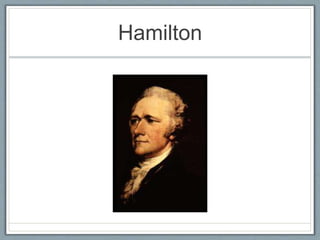
Hamilton
Hamilton’s Financial Plan 
1. Public Credit-January 1790 
• New gov’t would take responsibility of existing 
debt 
• Had been in the hands of wealthy speculators 
• These private certificates of debt would be traded 
for interest-bearing bonds 
• “funding the debt”
Hamilton’s Financial Plan 
• Hamilton also proposed a permanent national 
debt 
• This would allow for the gov’t to pay the 
speculators 
• The debt would be paid off by gold and silver 
coins at a 6% interest rate 
• Chance for wealthy to make $$$ & have a stake in 
the gov’t
Hamilton’s Financial Plan 
• Hamilton wanted the federal gov’t to assume the war debts 
of the states 
• Those on the inside found out and started buying the war 
bonds of southern states, thus gaining a huge profit 
• Some states wanted to control the power of the federal gov’t 
• To get the states (MD and VA) to agree, Hamilton agreed to 
move the capital to Washington, D.C. 
• “Dinner Table Bargain” 
• This gave Hamilton the support he needed to move the plan 
forward
Hamilton’s Financial Plan 
2. National Bank-December 1790 
 Safe place for gov’t to deposit funds 
 Provide loans & currency to businesses 
 Chartered by federal gov’t 
 Provide stable currency
Hamilton’s Financial Plan 
• Jefferson and Madison stated that a national bank 
was unconstitutional— “strict construction” 
• Incorporating a bank was not a delegated power 
• Hamilton used Article 1, Section 8, saying that 
Congress make “all laws which shall be necessary 
and proper” to carry out the Constitution’s 
provisions—implied powers 
• Washington agreed and signed it into law
Hamilton’s Financial Plan 
3. Revenue and Tariffs-December 1791 
 Hamilton wanted a national revenue that would 
be used to pay the annual interest on the 
permanent debt 
• 1792: Congress imposed several domestic taxes, 
such as on whiskey 
• The tax was too small to help much: $1 million 
annually
Hamilton’s Financial Plan 
• To raise more $, Hamilton called for tariffs on 
foreign imports 
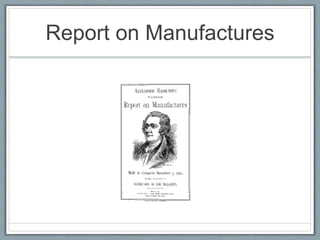
• “Report on Manufactures” (1791): a report calling 
for self-sufficiency in manufactured goods
Report on Manufactures
Did Hamilton’s Plan 
Work?
Did Hamilton’s Plan 
Work? 
• Yes! Customs revenue provided about 90% of the 
U.S. gov’t income between 1790-1820 
• Bonds sold well in America & abrorad 
• Manufacturing increased 
• **Outcome: provided the federal government with 
financial stability.
Jefferson’s Agrarian 
Vision 
• Hamilton was not totally supported 
• Federalists were broken up into two factions 
• Northern Federalists agreed with Hamilton 
• Southerners agreed with Madison and Jefferson 
• Hamilton’s supporters were named 
FEDERALISTS 
• Jefferson’s supporters were named 
DEMOCRATIC-REPUBLICANS
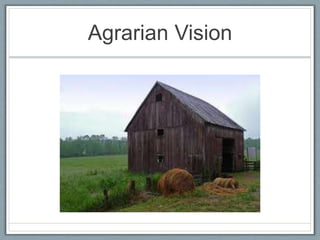
Agrarian Vision
Jefferson’s Agrarian 
Vision 
• Southern planters and western farmers moved 
towards Jefferson’s ideas 
• He thought that workers who depended on wages 
lacked the economic independence required to 
sustain a republic 
• his plan: a West settled by productive yeomen 
farm families
Jefferson Quotes 
• "Cultivators of the earth are the most valuable 
citizens. They are the most vigorous, the most 
independent, the most virtuous and they are tied 
to their country and wedded to its liberty and 
interests by the most lasting bands.”—Letter to 
John Jay (1785) 
• "Agriculture is our wisest pursuit, because it will in 
the end contribute most to real wealth, good 
morals, and happiness." –Letter to George 
Washington (1787)
Jefferson’s Agrarian 
Vision 
• He believed that having a massive agricultural 
society, Americans would be able to feed the US 
and Europe, and they would give us goods in 
return 
• French Revolution gave it a chance, and wheat 
and cotton prices soared, raising profits in 
southern region 
• Americans were divided over sides in the French 
Revolution, especially after the execution of Louis 
XVI (1793)
Jay’s Treaty (1794) 
• Britain’s navy was bullying American ships going to France 
 To avoid war, GW sent John Jay (Chief Justice) to Britain 
• Deal required the US gov’t to make “full and complete compensation” 
to British merchants for all pre-Revolutionary War debt owed by 
American citizens 
• Gave British right to remove French property from neutral ships 
• Americans submitted claims of illegal seizure to arbitration and 
required British to remove military garrisons from NW Territory and to 
end their aid to Indians there, but demands were not met 
• Many thought it asked America to give up too much, and it barely 
passed Senate; opposed by Republicans 
• But prevented war w/ Britain
Jay’s Treaty (1794)
Pinckney’s Treaty (1795) 
• Spain feared a British/American alliance would 
interfere w/ their N. American possessions 
• Spain recognized the right of Americans to 
navigate MS River to deposit goods at New 
Orleans 
• Agreed to fix northern boundary of FL at 31st 
parallel 
• Required Spanish authorities to prevent Indians in 
FL from launching raids across border
Whiskey Rebellion 
• Whiskey Rebellion in 1794: a protest on the 
whiskey tax of Hamilton: challenging federal 
authority, much like Shay’s Rebellion 
• Farmers in western PA refused to pay the tax & 
began terrorizing tax collectors 
• GW raised an army of almost 15,000 to stop 
rebellion, which collapsed
Whiskey Rebellion
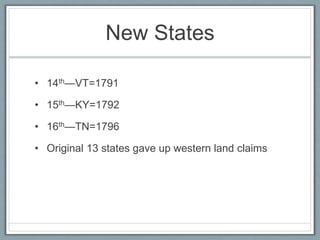
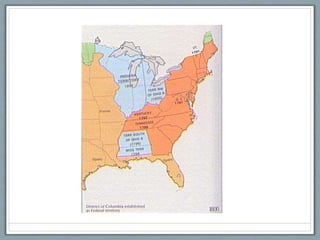
New States 
• 14th—VT=1791 
• 15th—KY=1792 
• 16th—TN=1796 
• Original 13 states gave up western land claims
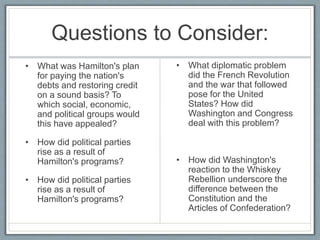
Questions to Consider: 
• What was Hamilton's plan 
for paying the nation's 
debts and restoring credit 
on a sound basis? To 
which social, economic, 
and political groups would 
this have appealed? 
• How did political parties 
rise as a result of 
Hamilton's programs? 
• How did political parties 
rise as a result of 
Hamilton's programs? 
• What diplomatic problem 
did the French Revolution 
and the war that followed 
pose for the United 
States? How did 
Washington and Congress 
deal with this problem? 
• How did Washington's 
reaction to the Whiskey 
Rebellion underscore the 
difference between the 
Constitution and the 
Articles of Confederation?

Federalists & Republicans

  • 1.
  • 2.
    Alexander Hamilton •Hamilton: GW’s Secretary of Treasury • His goal: to enhance the authority of the national government and favor wealthy financiers and seaport merchants • He exerted more influence on domestic and foreign policy than anyone else during his time in office and after (during this time period)
  • 3.
  • 4.
    Hamilton’s Financial Plan 1. Public Credit-January 1790 • New gov’t would take responsibility of existing debt • Had been in the hands of wealthy speculators • These private certificates of debt would be traded for interest-bearing bonds • “funding the debt”
  • 5.
    Hamilton’s Financial Plan • Hamilton also proposed a permanent national debt • This would allow for the gov’t to pay the speculators • The debt would be paid off by gold and silver coins at a 6% interest rate • Chance for wealthy to make $$$ & have a stake in the gov’t
  • 6.
    Hamilton’s Financial Plan • Hamilton wanted the federal gov’t to assume the war debts of the states • Those on the inside found out and started buying the war bonds of southern states, thus gaining a huge profit • Some states wanted to control the power of the federal gov’t • To get the states (MD and VA) to agree, Hamilton agreed to move the capital to Washington, D.C. • “Dinner Table Bargain” • This gave Hamilton the support he needed to move the plan forward
  • 7.
    Hamilton’s Financial Plan 2. National Bank-December 1790  Safe place for gov’t to deposit funds  Provide loans & currency to businesses  Chartered by federal gov’t  Provide stable currency
  • 8.
    Hamilton’s Financial Plan • Jefferson and Madison stated that a national bank was unconstitutional— “strict construction” • Incorporating a bank was not a delegated power • Hamilton used Article 1, Section 8, saying that Congress make “all laws which shall be necessary and proper” to carry out the Constitution’s provisions—implied powers • Washington agreed and signed it into law
  • 9.
    Hamilton’s Financial Plan 3. Revenue and Tariffs-December 1791  Hamilton wanted a national revenue that would be used to pay the annual interest on the permanent debt • 1792: Congress imposed several domestic taxes, such as on whiskey • The tax was too small to help much: $1 million annually
  • 10.
    Hamilton’s Financial Plan • To raise more $, Hamilton called for tariffs on foreign imports • “Report on Manufactures” (1791): a report calling for self-sufficiency in manufactured goods
  • 11.
  • 12.
  • 13.
    Did Hamilton’s Plan Work? • Yes! Customs revenue provided about 90% of the U.S. gov’t income between 1790-1820 • Bonds sold well in America & abrorad • Manufacturing increased • **Outcome: provided the federal government with financial stability.
  • 14.
    Jefferson’s Agrarian Vision • Hamilton was not totally supported • Federalists were broken up into two factions • Northern Federalists agreed with Hamilton • Southerners agreed with Madison and Jefferson • Hamilton’s supporters were named FEDERALISTS • Jefferson’s supporters were named DEMOCRATIC-REPUBLICANS
  • 15.
  • 16.
    Jefferson’s Agrarian Vision • Southern planters and western farmers moved towards Jefferson’s ideas • He thought that workers who depended on wages lacked the economic independence required to sustain a republic • his plan: a West settled by productive yeomen farm families
  • 17.
    Jefferson Quotes •"Cultivators of the earth are the most valuable citizens. They are the most vigorous, the most independent, the most virtuous and they are tied to their country and wedded to its liberty and interests by the most lasting bands.”—Letter to John Jay (1785) • "Agriculture is our wisest pursuit, because it will in the end contribute most to real wealth, good morals, and happiness." –Letter to George Washington (1787)
  • 18.
    Jefferson’s Agrarian Vision • He believed that having a massive agricultural society, Americans would be able to feed the US and Europe, and they would give us goods in return • French Revolution gave it a chance, and wheat and cotton prices soared, raising profits in southern region • Americans were divided over sides in the French Revolution, especially after the execution of Louis XVI (1793)
  • 19.
    Jay’s Treaty (1794) • Britain’s navy was bullying American ships going to France  To avoid war, GW sent John Jay (Chief Justice) to Britain • Deal required the US gov’t to make “full and complete compensation” to British merchants for all pre-Revolutionary War debt owed by American citizens • Gave British right to remove French property from neutral ships • Americans submitted claims of illegal seizure to arbitration and required British to remove military garrisons from NW Territory and to end their aid to Indians there, but demands were not met • Many thought it asked America to give up too much, and it barely passed Senate; opposed by Republicans • But prevented war w/ Britain
  • 20.
  • 21.
    Pinckney’s Treaty (1795) • Spain feared a British/American alliance would interfere w/ their N. American possessions • Spain recognized the right of Americans to navigate MS River to deposit goods at New Orleans • Agreed to fix northern boundary of FL at 31st parallel • Required Spanish authorities to prevent Indians in FL from launching raids across border
  • 22.
    Whiskey Rebellion •Whiskey Rebellion in 1794: a protest on the whiskey tax of Hamilton: challenging federal authority, much like Shay’s Rebellion • Farmers in western PA refused to pay the tax & began terrorizing tax collectors • GW raised an army of almost 15,000 to stop rebellion, which collapsed
  • 23.
  • 24.
    New States •14th—VT=1791 • 15th—KY=1792 • 16th—TN=1796 • Original 13 states gave up western land claims
  • 26.
    Questions to Consider: • What was Hamilton's plan for paying the nation's debts and restoring credit on a sound basis? To which social, economic, and political groups would this have appealed? • How did political parties rise as a result of Hamilton's programs? • How did political parties rise as a result of Hamilton's programs? • What diplomatic problem did the French Revolution and the war that followed pose for the United States? How did Washington and Congress deal with this problem? • How did Washington's reaction to the Whiskey Rebellion underscore the difference between the Constitution and the Articles of Confederation?