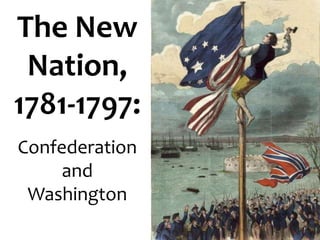
The New
 Nation,
1781-1797:
Confederation
     and
 Washington
Treaty of Paris, 1783
State Constitutions
Republicanism
Strong governors w/ veto power
Most:    property     requirement  for
voting, Some:     universal white male
suffrage
Most had bills of rights
Many: state-established religions
Occupations of State Assemblymen, 1780s
State Claims to Western Lands
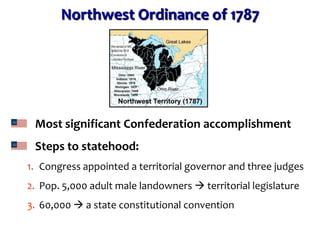
Northwest Ordinance of 1787


 Most significant Confederation accomplishment
 Steps to statehood:
1. Congress appointed a territorial governor and three judges
2. Pop. 5,000 adult male landowners  territorial legislature
3. 60,000  a state constitutional convention
Land Ordinance of 1785
The United States in 1787
1. Authority from
               citizens
            2. Selfless, educated
               citizens
   The      3. Frequent elections
“Virtuous
Republic”   4. Written Constitution
            5. “E Pluribus Unum”
            6. women 
               “Republican
               womanhood”
George Washington
     1st POTUS
    1789 – 1797

   President of
   precedents
100% of electoral
 vote = unanimous!

          Why?

 Led Continental Army
 during the Revolution,
had faith and trust of the
      entire nation.
Step 1: Pick a Good Title
         His Elective Majesty?
         His Excellency the
    Supreme Commander in Chief?
          His High Mightiness,
   the President of the United States
    and Protector of their Liberties?
       His Highness the President
    of the United States of America
and Protector of the Rights of the Same?
             Mr. President
Step 2: Choose a Cabinet


 Thomas Jefferson,        Alexander Hamilton,         Henry
Secretary of State aka          Secretary       Knox, Secretary of
“the Smooth Talker”          of the Treasury        War aka
                         aka “the Money Man”      “the Muscle”
Step 3: Choose a plan.
Federalists                      Democratic Republicans
• Led by Hamilton                • Led by Jefferson
• Feared anarchy more than       • Believed limited government
  tyranny                          preserves liberty
• Elitist, distrusted common     • Patrician, trusted the common
  man                              man
• Loose interpretation           • Strict interpretation
• Wanted:                        • Wanted:
   o Strong federal government     o Weak federal government to
     to preserve independence        preserve liberty
   o National debt as              o Against national debt
     investment in success
   o Strong ties with Britain     o Strong ties with France
   o US as an industrial,         o US as an agrarian nation
     mercantile power
Hamilton’s Economic Plan
Component                    Pro                        Con

A) Federal government        US will build credit and   Economic elites control
assumes states’ foreign      gain legitimacy with       nation’s finances
and domestic debt            foreign nations
                                                        Southern states had
B) sells debt to investors   Protects US from foreign   already paid their debts;
as government bonds          attack                     felt it unfair to help North
                                                        pay theirs
                             Investors become
                             stakeholders in federal
                             government’s success
Hamilton’s Economic Plan
Component                   Arguments For It           Arguments Against It

Establish a national bank   Issue money; handle        Fear of plutocracy – rule
                            taxes, receipts, and other by the rich
                            gov. funds.
                                                       Is it constitutional?
                            Investors become
                            stakeholders in federal
                            government’s success
Hamilton’s Economic Plan
Component                 Arguments For It            Arguments Against It

Tariff (tax on imports)   Raise badly-needed          Southern states import
                          money for new               more, will pay unfair
                          government                  share of taxes

                          Spur industrial growth by
                          making US
                          manufacturing more
                          competitive against
                          foreign goods
Hamilton’s Economic Plan
Component               Arguments For It         Arguments Against It

Excise tax on whiskey   Sin tax on immoral       Targets poor frontier
                        product                  farmers who distill corn
                                                 into whiskey for
                        Will raise significant   transport
                        funds
Washington vs. the Whiskey Rebellion
Judiciary Act of 1789

•   Six Supreme Court justices
    and 13 districts in 11 states
•   Chief Justice = John Jay
•   SCOTUS jurisdiction over
    cases in which a state was
    party
•   Appellate jurisdiction over
    fed. circuit court and state
    courts challenging federal
    law
French Revolution

•   Q: Help    France    fight
    Britain?
•   A:   Proclamation      of
    Neutrality, 1793
•   “Why … entangle our
    peace and prosperity in
    the toils of European
    ambition …? It is our true
    policy to steer clear of
    permanent alliances with
    any portion of the
    foreign world.”
     – Farewell Address, 1796
Washington’s Foreign Affairs
Treaty                 With           Why                              Result
Jay’s Treaty           Britain        Unpaid private debts to          Secured NW border,
(1794)                                Britain  British forts around   normalized trade
                                      Great Lakes, impressment of      relations with Britain
                                      American sailors


Pinckney's Treaty      Spain          Spain feared close American-     Defined SW border
(1795)                                British relations                with Spanish
                                                                       territory, opened
                                                                       Mississippi to trade


Treaty of Greenville   coalition of   Little Turtle defeated by Gen. Native Americans
(1795)                 Native         “Mad Anthony” Wayne at the ceded Ohio to US
                       American       Battle of Fallen Timbers
                       tribes
Disputed Territorial Claims Between Spain & US, 1783-1796
Indian Land Cessions: 1768-1799
Washington’s Legacy

1. First cabinet and other
   precedents
2. Judiciary Act of 1789
3. Suppressed Whiskey Rebellion
4. Secured borders and foreign
   policy of Isolationism
5. Warned against political
   parties
6. Established two-term tradition

The New Nation, 1781-1797: Confederation and Washington

  • 1.
  • 2.
  • 3.
    State Constitutions Republicanism Strong governorsw/ veto power Most: property requirement for voting, Some: universal white male suffrage Most had bills of rights Many: state-established religions
  • 4.
    Occupations of StateAssemblymen, 1780s
  • 5.
    State Claims toWestern Lands
  • 6.
    Northwest Ordinance of1787 Most significant Confederation accomplishment Steps to statehood: 1. Congress appointed a territorial governor and three judges 2. Pop. 5,000 adult male landowners  territorial legislature 3. 60,000  a state constitutional convention
  • 7.
  • 8.
  • 9.
    1. Authority from citizens 2. Selfless, educated citizens The 3. Frequent elections “Virtuous Republic” 4. Written Constitution 5. “E Pluribus Unum” 6. women  “Republican womanhood”
  • 10.
    George Washington 1st POTUS 1789 – 1797 President of precedents
  • 11.
    100% of electoral vote = unanimous! Why? Led Continental Army during the Revolution, had faith and trust of the entire nation.
  • 12.
    Step 1: Picka Good Title His Elective Majesty? His Excellency the Supreme Commander in Chief? His High Mightiness, the President of the United States and Protector of their Liberties? His Highness the President of the United States of America and Protector of the Rights of the Same? Mr. President
  • 13.
    Step 2: Choosea Cabinet Thomas Jefferson, Alexander Hamilton, Henry Secretary of State aka Secretary Knox, Secretary of “the Smooth Talker” of the Treasury War aka aka “the Money Man” “the Muscle”
  • 14.
    Step 3: Choosea plan. Federalists Democratic Republicans • Led by Hamilton • Led by Jefferson • Feared anarchy more than • Believed limited government tyranny preserves liberty • Elitist, distrusted common • Patrician, trusted the common man man • Loose interpretation • Strict interpretation • Wanted: • Wanted: o Strong federal government o Weak federal government to to preserve independence preserve liberty o National debt as o Against national debt investment in success o Strong ties with Britain o Strong ties with France o US as an industrial, o US as an agrarian nation mercantile power
  • 15.
    Hamilton’s Economic Plan Component Pro Con A) Federal government US will build credit and Economic elites control assumes states’ foreign gain legitimacy with nation’s finances and domestic debt foreign nations Southern states had B) sells debt to investors Protects US from foreign already paid their debts; as government bonds attack felt it unfair to help North pay theirs Investors become stakeholders in federal government’s success
  • 16.
    Hamilton’s Economic Plan Component Arguments For It Arguments Against It Establish a national bank Issue money; handle Fear of plutocracy – rule taxes, receipts, and other by the rich gov. funds. Is it constitutional? Investors become stakeholders in federal government’s success
  • 17.
    Hamilton’s Economic Plan Component Arguments For It Arguments Against It Tariff (tax on imports) Raise badly-needed Southern states import money for new more, will pay unfair government share of taxes Spur industrial growth by making US manufacturing more competitive against foreign goods
  • 18.
    Hamilton’s Economic Plan Component Arguments For It Arguments Against It Excise tax on whiskey Sin tax on immoral Targets poor frontier product farmers who distill corn into whiskey for Will raise significant transport funds
  • 19.
    Washington vs. theWhiskey Rebellion
  • 20.
    Judiciary Act of1789 • Six Supreme Court justices and 13 districts in 11 states • Chief Justice = John Jay • SCOTUS jurisdiction over cases in which a state was party • Appellate jurisdiction over fed. circuit court and state courts challenging federal law
  • 21.
    French Revolution • Q: Help France fight Britain? • A: Proclamation of Neutrality, 1793 • “Why … entangle our peace and prosperity in the toils of European ambition …? It is our true policy to steer clear of permanent alliances with any portion of the foreign world.” – Farewell Address, 1796
  • 22.
    Washington’s Foreign Affairs Treaty With Why Result Jay’s Treaty Britain Unpaid private debts to Secured NW border, (1794) Britain  British forts around normalized trade Great Lakes, impressment of relations with Britain American sailors Pinckney's Treaty Spain Spain feared close American- Defined SW border (1795) British relations with Spanish territory, opened Mississippi to trade Treaty of Greenville coalition of Little Turtle defeated by Gen. Native Americans (1795) Native “Mad Anthony” Wayne at the ceded Ohio to US American Battle of Fallen Timbers tribes
  • 24.
    Disputed Territorial ClaimsBetween Spain & US, 1783-1796
  • 25.
  • 26.
    Washington’s Legacy 1. Firstcabinet and other precedents 2. Judiciary Act of 1789 3. Suppressed Whiskey Rebellion 4. Secured borders and foreign policy of Isolationism 5. Warned against political parties 6. Established two-term tradition