The Challenges of ModernThe Challenges of Modern
FederalismFederalism
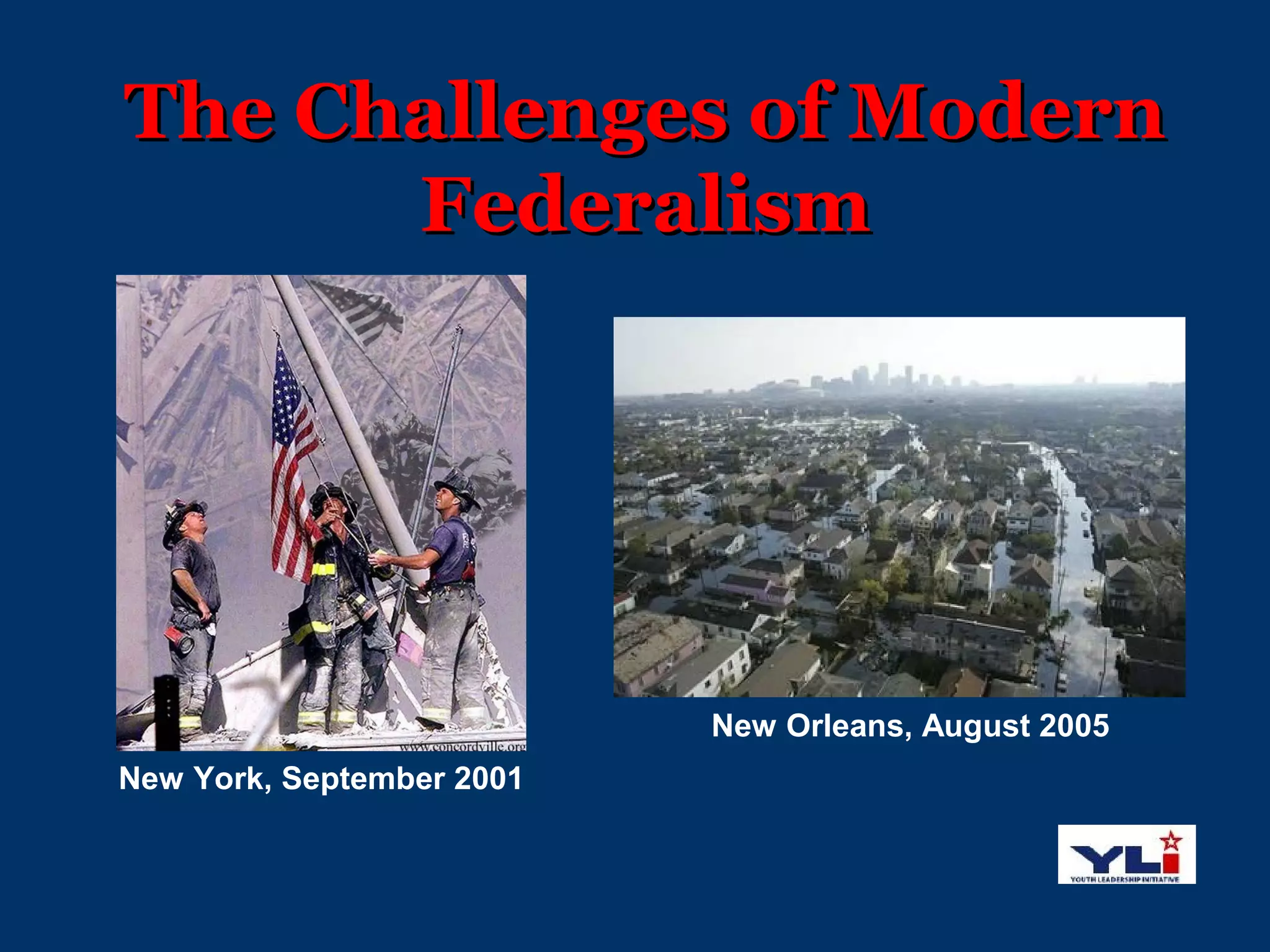
New York, September 2001
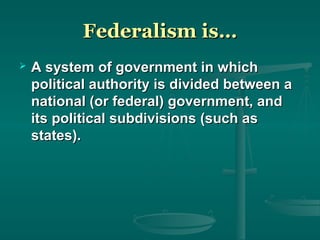
New Orleans, August 2005
Federalism is…Federalism is…
 A system of government in whichA system of government in which
political authority is divided between apolitical authority is divided between a
national (or federal) government, andnational (or federal) government, and
its political subdivisions (such asits political subdivisions (such as
states).states).
Federalism is…Federalism is…
 A system where national and stateA system where national and state
governments each have definedgovernments each have defined
powers, with some being shared bypowers, with some being shared by
both and some being denied to both.both and some being denied to both.
Federalism & theFederalism & the
ConstitutionConstitution
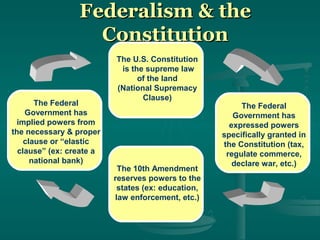
The Federal
Government has
expressed powers
specifically granted in
the Constitution (tax,
regulate commerce,
declare war, etc.)
The Federal
Government has
implied powers from
the necessary & proper
clause or “elastic
clause” (ex: create a
national bank)
The 10th Amendment
reserves powers to the
states (ex: education,
law enforcement, etc.)
The U.S. Constitution
is the supreme law
of the land
(National Supremacy
Clause)
Dual Federalism (1789-1932)Dual Federalism (1789-1932)
 Federal and state governments are co-Federal and state governments are co-
equals, each sovereignequals, each sovereign
 Narrow interpretation of the ConstitutionNarrow interpretation of the Constitution
 Federal government only has jurisdiction ifFederal government only has jurisdiction if
clear expressed in the Constitution (ex: coinclear expressed in the Constitution (ex: coin
money, foreign affairs)money, foreign affairs)
 State have greater role and powers (ex:State have greater role and powers (ex:
public education, race relations)public education, race relations)
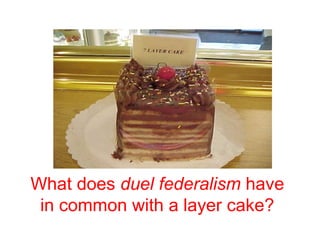
What does duel federalism have
in common with a layer cake?
Cooperative FederalismCooperative Federalism
(1933-present)(1933-present)
 National government clearly supreme over theNational government clearly supreme over the
states with wide interpretation of the “necessarystates with wide interpretation of the “necessary
and proper clause” (Article I, Sect. 8 of theand proper clause” (Article I, Sect. 8 of the
Constitution, also known as the “elastic clause.”)Constitution, also known as the “elastic clause.”)
 Federal government intervenes or assists inFederal government intervenes or assists in
some areas traditionally left to the states (ex:some areas traditionally left to the states (ex:
education, health care, civil rights)education, health care, civil rights)
 Began with the New Deal in the 1930sBegan with the New Deal in the 1930s
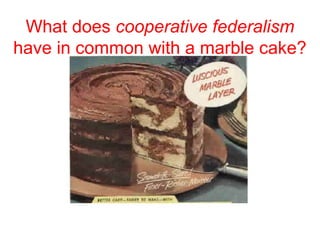
What does cooperative federalism
have in common with a marble cake?
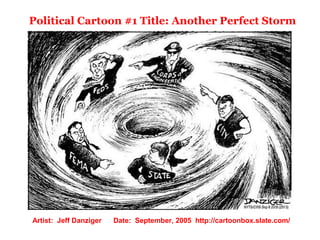
Political Cartoon #1 Title: Another Perfect Storm
Artist: Jeff Danziger Date: September, 2005 http://cartoonbox.slate.com/
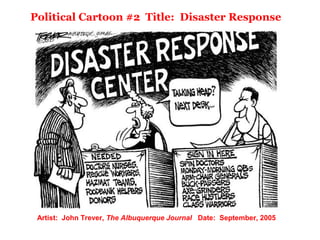
Political Cartoon #2 Title: Disaster Response
Artist: John Trever, The Albuquerque Journal Date: September, 2005
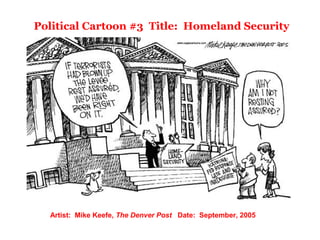
Political Cartoon #3 Title: Homeland Security
Artist: Mike Keefe, The Denver Post Date: September, 2005
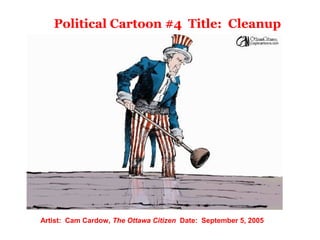
Political Cartoon #4 Title: Cleanup
Artist: Cam Cardow, The Ottawa Citizen Date: September 5, 2005
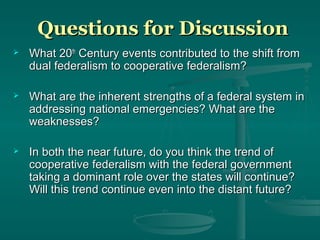
Questions for DiscussionQuestions for Discussion
 What 20What 20thth
Century events contributed to the shift fromCentury events contributed to the shift from
dual federalism to cooperative federalism?dual federalism to cooperative federalism?
 What are the inherent strengths of a federal system inWhat are the inherent strengths of a federal system in
addressing national emergencies? What are theaddressing national emergencies? What are the
weaknesses?weaknesses?
 In both the near future, do you think the trend ofIn both the near future, do you think the trend of
cooperative federalism with the federal governmentcooperative federalism with the federal government
taking a dominant role over the states will continue?taking a dominant role over the states will continue?
Will this trend continue even into the distant future?Will this trend continue even into the distant future?

Modern Federalism

  • 1.
    The Challenges ofModernThe Challenges of Modern FederalismFederalism New York, September 2001 New Orleans, August 2005
  • 2.
    Federalism is…Federalism is… A system of government in whichA system of government in which political authority is divided between apolitical authority is divided between a national (or federal) government, andnational (or federal) government, and its political subdivisions (such asits political subdivisions (such as states).states).
  • 3.
    Federalism is…Federalism is… A system where national and stateA system where national and state governments each have definedgovernments each have defined powers, with some being shared bypowers, with some being shared by both and some being denied to both.both and some being denied to both.
  • 4.
    Federalism & theFederalism& the ConstitutionConstitution The Federal Government has expressed powers specifically granted in the Constitution (tax, regulate commerce, declare war, etc.) The Federal Government has implied powers from the necessary & proper clause or “elastic clause” (ex: create a national bank) The 10th Amendment reserves powers to the states (ex: education, law enforcement, etc.) The U.S. Constitution is the supreme law of the land (National Supremacy Clause)
  • 5.
    Dual Federalism (1789-1932)DualFederalism (1789-1932)  Federal and state governments are co-Federal and state governments are co- equals, each sovereignequals, each sovereign  Narrow interpretation of the ConstitutionNarrow interpretation of the Constitution  Federal government only has jurisdiction ifFederal government only has jurisdiction if clear expressed in the Constitution (ex: coinclear expressed in the Constitution (ex: coin money, foreign affairs)money, foreign affairs)  State have greater role and powers (ex:State have greater role and powers (ex: public education, race relations)public education, race relations)
  • 6.
    What does duelfederalism have in common with a layer cake?
  • 7.
    Cooperative FederalismCooperative Federalism (1933-present)(1933-present) National government clearly supreme over theNational government clearly supreme over the states with wide interpretation of the “necessarystates with wide interpretation of the “necessary and proper clause” (Article I, Sect. 8 of theand proper clause” (Article I, Sect. 8 of the Constitution, also known as the “elastic clause.”)Constitution, also known as the “elastic clause.”)  Federal government intervenes or assists inFederal government intervenes or assists in some areas traditionally left to the states (ex:some areas traditionally left to the states (ex: education, health care, civil rights)education, health care, civil rights)  Began with the New Deal in the 1930sBegan with the New Deal in the 1930s
  • 8.
    What does cooperativefederalism have in common with a marble cake?
  • 9.
    Political Cartoon #1Title: Another Perfect Storm Artist: Jeff Danziger Date: September, 2005 http://cartoonbox.slate.com/
  • 10.
    Political Cartoon #2Title: Disaster Response Artist: John Trever, The Albuquerque Journal Date: September, 2005
  • 11.
    Political Cartoon #3Title: Homeland Security Artist: Mike Keefe, The Denver Post Date: September, 2005
  • 12.
    Political Cartoon #4Title: Cleanup Artist: Cam Cardow, The Ottawa Citizen Date: September 5, 2005
  • 13.
    Questions for DiscussionQuestionsfor Discussion  What 20What 20thth Century events contributed to the shift fromCentury events contributed to the shift from dual federalism to cooperative federalism?dual federalism to cooperative federalism?  What are the inherent strengths of a federal system inWhat are the inherent strengths of a federal system in addressing national emergencies? What are theaddressing national emergencies? What are the weaknesses?weaknesses?  In both the near future, do you think the trend ofIn both the near future, do you think the trend of cooperative federalism with the federal governmentcooperative federalism with the federal government taking a dominant role over the states will continue?taking a dominant role over the states will continue? Will this trend continue even into the distant future?Will this trend continue even into the distant future?