OSCE QUESTION & ANSWERS –
MAY 2022 – PART 5
Dr Gururaja, MD,DNB(Paed)
Dr Sangeeta B, DCH, DNB (Paed)
Station 1
• A 5 day old neonate born to VDRL positive
mother brought to OPD
• VDRL titre unknown
• Her TPHA is positive
• Her treatment status is unknown
• The neonate is asymptomatic
• Neonates clinical exmn - normal
• VDRL done in neonate is reactive
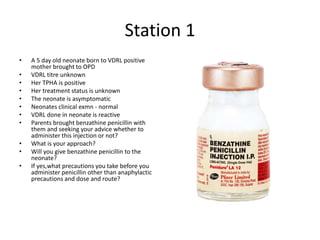
• Parents brought benzathine penicillin with
them and seeking your advice whether to
administer this injection or not?
• What is your approach?
• Will you give benzathine penicillin to the
neonate?
• If yes,what precautions you take before you
administer penicillin other than anaphylactic
precautions and dose and route?
Station-1
• This situation is probable congenital syphilis
• Maternal titers of VDRL unknown
• Maternal treatment status unknown
• Neonate asymptomatic and physical exmn is normal
• Advise CSF EXMN, CSF-VDRL,CBC,long bone X-rays
• You check for normal CSF, normal CBC, Normal long bone x rays
• If above things are normal then only give benzathine penicillin
• Dose 50000 units/kg as a single IM injection
• Call the neonate monthly to look for clinical and serological features
of congenital syphilis
• Follow up till serological test is negative in neonate
•
Station 2
• 1 yr old infant brought by mother with h/o vomiting, loose stools
for 2 days and poor feeding and activity since one day.
• Didn’t pass urine in last 12 hrs
• HR 140, Pulses – palpable but feeble, BP 50/30, SpO2 94% in room
air, Temp 98 deg F, CRT 4 sec.
• How much isotonic fluid bolus will you give and how fast?
• What are your actions after fluid bolus?
• Write the formula for calculation of MAP bedside.(for 5 th centile)
• What is your next action if the does not respond to the bolus?
•
Station -2
• 20 ml /kg over 15 minutes
• Assess HR, RR, Pulse, sensorium, urine output,
BP
• MAP (45 + 1.5 X age )– 5 th centile
• Repeat bolus of 10 ml/kg ----if no response ---
consider inotropes
Station 3
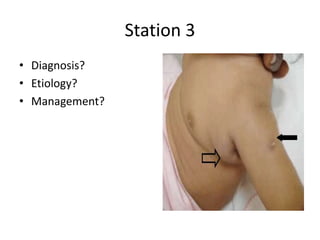
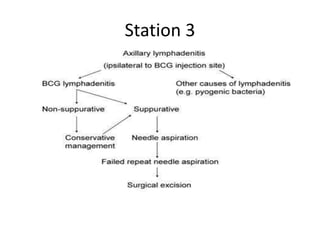
• Diagnosis?
• Etiology?
• Management?
Station 3
Station - 4
What are the important changes in
immunization schedule as per ACVIP 2020?
Station - 4
• IPV Booster at 4-5 yrs of age
• At least one dose of IPV in first 5 years
• Uniform dose of 0.5 ml above 6 months of age
– influenza vaccine
• Varicella vaccine – earlier second dose
• 3 -6 months after first dose
Station - 5
• 2 yr old girl child brought by mother with bluish discoloration of hands for
last 2 hours
• Airway clear
• Breathing – RR 30/min, WOB normal, no added sounds, cyanosis present
with SpO2 78% with O2
• Circulation – HR 129/min, NIBP – 92/66 perfusion good
• Disability – E4V4M6, PERL, Limb movements normal
• Exposure - afebrile, no abnomal smell, central cyanosis +, no clubbing
• On detailed history taking child took benzocaine for oral ulcers recently
• What is the diagnosis/DD?
• How will you confirm diagnosis?
• What is masimo pulse oxymeter?
• What is the treatment and dose?
Station - 5
• Methhaemoglobinemia
• Co-oximetry
• Blood gas
• Masimo pulse oximetry – non invasive mode
of co-oximetry
• Methylene blue – 1-2 mg/kg over 10 minutes
Station -6
• 12 yr old with medically non responsive ITP with
h/o intracranial bleed last month.
• What other treatment options do we have?
• Are any other vaccines contraindicated post
procedure?
• How will you plan immunization in this child?
• Which killed vaccines are not recommended to
be administered on the same day and why?
Station - 6
• Splenectomy
• No, exception – live attenuated influenza vaccine
• Hib, pneumococcal, meningococcal, and yearly
influenza vaccine
• All live and killed routine vaccines may be given
• May be offered TCV also.
• Complete vaccination 2 weeks before splenectomy
• Penicillin prophylaxis
• Do not give PCV 13 with MCV –DT (menactra)
• As it decreases seroconversion
• MCV – CRM (Menveo) may be given along with PCV
Station 6
• PCV – 1 dose ---- PPV 23 – 8 weeks after PCV
• MCV – 2 doses 8 weeks apart
• Influenza – yearly
• Hib – single dose (if unvaccinated)
• TCV – Single dose
Station - 7
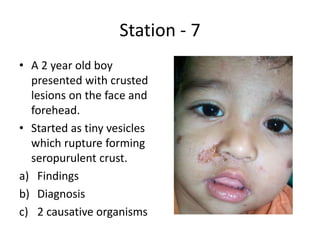
• A 2 year old boy
presented with crusted
lesions on the face and
forehead.
• Started as tiny vesicles
which rupture forming
seropurulent crust.
a) Findings
b) Diagnosis
c) 2 causative organisms
Station - 7
a) Typical honey coloured stuck-on crust lesion on face
and around nares
b) Impetigo Contagiosa
c) Caused by both staphylococci and streptococci
Station - 8
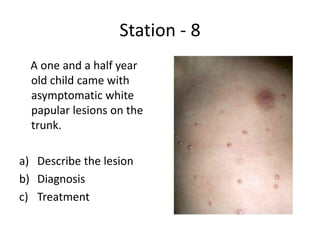
A one and a half year
old child came with
asymptomatic white
papular lesions on the
trunk.
a) Describe the lesion
b) Diagnosis
c) Treatment
Station - 8
a) Dome shaped, pearly or flesh colored umbilicated
papules
b) Molluscum Contagiosum
c) Most cases resolve in 6 to 9 months. Cryotherapy,
extraction with curette or application of topical
tretinoin cream
Station - 9
A 14 year old girl presents with
1. Ht < 3rd cent
2. No breast development
3. Slight amount of pubic hair
H/o corrective surgery for coarctation of aorta at 2
years of age.
Station - 9
a) What do you think
b) How will you work up
c) How will you treat
Station - 9
a) Delayed puberty with coarctation of aorta - ?Turner
syndrome
b) Bone age - will be delayed, FSH, LH, Karyotype- 45
XO
c) Hormone replacement therapy. Growth hormone
can be given if presents early
Station - 10
A 10 year old male presents with polyuria, polydipsia
and nocturia.There is h/o recurrent headaches, poor
height gain and excessive weight gain over the past 2
years. Urine output =5 litres/day. Na=149, Serum
osmolality=297,Urine osmolality=300 and RBS=100
gm%
Station - 10
a)What is the cause of polyuria?
b)What definitive test can you do to confirm it?
c)What other investigations will you need to do?
d) What are the other complications will you look out
for?
Station - 10
a) Diabetes insipidus
b) Water deprivation test
c) MRI or CT brain to look for tumour (Craniopharygioma)
d) GH deficiency and other anterior pituitary hormonal
deficiencies.
Station - 11
A newborn male is referred for evaluation of
refractory hypoglycemia causing recurrent seizures.
RBS= 20,birth weight =4.5 kg, there is macroglossia ,
omphalocele. No significant antenatal history.
Station - 11
a) What is the cause of the refractory hypoglycemia?
b) What is the underlying cause in this child?
c) How will you confirm the diagnosis of cause of
hypoglycemia?
d) What emergency treatment options can you offer?
Station - 11
a) Hyperinsulinemia (Islet cell dysmaturation)
b) Beckwith Widemann Syndrome
c) Simultaneous blood sugar and sr. insulin
d) Dextrose, Diazoxide, Hydrocortisone, Glucagon,
Octreotide, Subtotal pancreatectomy
Station - 12
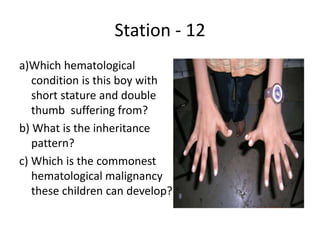
a)Which hematological
condition is this boy with
short stature and double
thumb suffering from?
b) What is the inheritance
pattern?
c) Which is the commonest
hematological malignancy
these children can develop?
Station - 12
a) Fanconis Anemia
b) Autosomal recessive
c) MDS &/or AML
Station - 13
A 3 month old infant exclusively breast fed presents
with loose motions since early neonatal period. On
examination she is pale and is failing to thrive. Her
CBC shows a pancytopenia. Her blood sugar is
200mg/dl.
a) What is the most likely diagnosis?
b) Which 2 investigations will clinch the diagnosis?
c) What is the treatment of this condition?
Station - 13
a) Pearson marrow pancreas Syndrome
b) Macrocytic anemia with increased HbF and ringed
sideroblasts with vacuolization of marrow precursors
c) Packed cell with G-CSF transfusion.
Station - 14
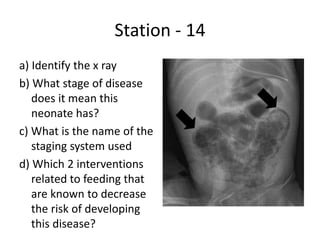
a) Identify the x ray
b) What stage of disease
does it mean this
neonate has?
c) What is the name of the
staging system used
d) Which 2 interventions
related to feeding that
are known to decrease
the risk of developing
this disease?
Station - 14
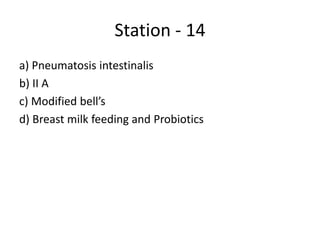
a) Pneumatosis intestinalis
b) II A
c) Modified bell’s
d) Breast milk feeding and Probiotics
Station - 15
Station - 15
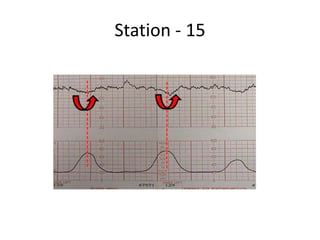
a) Spot the investigation
b) What is the interpretation of the tracing shown here
c) What is the likely cause
d) What are the other common abnormal tracings
observed?
e) Name 1 condition each that causes the above
patterns?
Station - 15
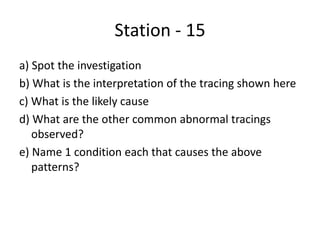
a) Electronic fetal monitoring / CTG
b) Early deceleration
c) Fetal Head compression
d) Late and variable deceleration
e) Placental insufficiency and cord compression
Station - 16
Station - 16
a) Scorbutic rosary
b) Calcified subperiosteal hematoma, pathological
fracture with periosteal reaction, Pencil thin cortex,
white line of frenkel, wimburger’s sign, Trumerfel
zone of rarefaction, pelkan spur, subperiosteal
hemorrhage
c) Petechial hemorrhages in skin
d) Vitamin C supplements 100 – 200 mg orally or
parenterally
•THANK YOU

OSCE MAY 2022-PART-5 -PAED.pptx

  • 1.
    OSCE QUESTION &ANSWERS – MAY 2022 – PART 5 Dr Gururaja, MD,DNB(Paed) Dr Sangeeta B, DCH, DNB (Paed)
  • 2.
    Station 1 • A5 day old neonate born to VDRL positive mother brought to OPD • VDRL titre unknown • Her TPHA is positive • Her treatment status is unknown • The neonate is asymptomatic • Neonates clinical exmn - normal • VDRL done in neonate is reactive • Parents brought benzathine penicillin with them and seeking your advice whether to administer this injection or not? • What is your approach? • Will you give benzathine penicillin to the neonate? • If yes,what precautions you take before you administer penicillin other than anaphylactic precautions and dose and route?
  • 3.
    Station-1 • This situationis probable congenital syphilis • Maternal titers of VDRL unknown • Maternal treatment status unknown • Neonate asymptomatic and physical exmn is normal • Advise CSF EXMN, CSF-VDRL,CBC,long bone X-rays • You check for normal CSF, normal CBC, Normal long bone x rays • If above things are normal then only give benzathine penicillin • Dose 50000 units/kg as a single IM injection • Call the neonate monthly to look for clinical and serological features of congenital syphilis • Follow up till serological test is negative in neonate •
  • 4.
    Station 2 • 1yr old infant brought by mother with h/o vomiting, loose stools for 2 days and poor feeding and activity since one day. • Didn’t pass urine in last 12 hrs • HR 140, Pulses – palpable but feeble, BP 50/30, SpO2 94% in room air, Temp 98 deg F, CRT 4 sec. • How much isotonic fluid bolus will you give and how fast? • What are your actions after fluid bolus? • Write the formula for calculation of MAP bedside.(for 5 th centile) • What is your next action if the does not respond to the bolus? •
  • 5.
    Station -2 • 20ml /kg over 15 minutes • Assess HR, RR, Pulse, sensorium, urine output, BP • MAP (45 + 1.5 X age )– 5 th centile • Repeat bolus of 10 ml/kg ----if no response --- consider inotropes
  • 6.
    Station 3 • Diagnosis? •Etiology? • Management?
  • 7.
  • 8.
    Station - 4 Whatare the important changes in immunization schedule as per ACVIP 2020?
  • 9.
    Station - 4 •IPV Booster at 4-5 yrs of age • At least one dose of IPV in first 5 years • Uniform dose of 0.5 ml above 6 months of age – influenza vaccine • Varicella vaccine – earlier second dose • 3 -6 months after first dose
  • 10.
    Station - 5 •2 yr old girl child brought by mother with bluish discoloration of hands for last 2 hours • Airway clear • Breathing – RR 30/min, WOB normal, no added sounds, cyanosis present with SpO2 78% with O2 • Circulation – HR 129/min, NIBP – 92/66 perfusion good • Disability – E4V4M6, PERL, Limb movements normal • Exposure - afebrile, no abnomal smell, central cyanosis +, no clubbing • On detailed history taking child took benzocaine for oral ulcers recently • What is the diagnosis/DD? • How will you confirm diagnosis? • What is masimo pulse oxymeter? • What is the treatment and dose?
  • 11.
    Station - 5 •Methhaemoglobinemia • Co-oximetry • Blood gas • Masimo pulse oximetry – non invasive mode of co-oximetry • Methylene blue – 1-2 mg/kg over 10 minutes
  • 12.
    Station -6 • 12yr old with medically non responsive ITP with h/o intracranial bleed last month. • What other treatment options do we have? • Are any other vaccines contraindicated post procedure? • How will you plan immunization in this child? • Which killed vaccines are not recommended to be administered on the same day and why?
  • 13.
    Station - 6 •Splenectomy • No, exception – live attenuated influenza vaccine • Hib, pneumococcal, meningococcal, and yearly influenza vaccine • All live and killed routine vaccines may be given • May be offered TCV also. • Complete vaccination 2 weeks before splenectomy • Penicillin prophylaxis • Do not give PCV 13 with MCV –DT (menactra) • As it decreases seroconversion • MCV – CRM (Menveo) may be given along with PCV
  • 14.
    Station 6 • PCV– 1 dose ---- PPV 23 – 8 weeks after PCV • MCV – 2 doses 8 weeks apart • Influenza – yearly • Hib – single dose (if unvaccinated) • TCV – Single dose
  • 15.
    Station - 7 •A 2 year old boy presented with crusted lesions on the face and forehead. • Started as tiny vesicles which rupture forming seropurulent crust. a) Findings b) Diagnosis c) 2 causative organisms
  • 16.
    Station - 7 a)Typical honey coloured stuck-on crust lesion on face and around nares b) Impetigo Contagiosa c) Caused by both staphylococci and streptococci
  • 17.
    Station - 8 Aone and a half year old child came with asymptomatic white papular lesions on the trunk. a) Describe the lesion b) Diagnosis c) Treatment
  • 18.
    Station - 8 a)Dome shaped, pearly or flesh colored umbilicated papules b) Molluscum Contagiosum c) Most cases resolve in 6 to 9 months. Cryotherapy, extraction with curette or application of topical tretinoin cream
  • 19.
    Station - 9 A14 year old girl presents with 1. Ht < 3rd cent 2. No breast development 3. Slight amount of pubic hair H/o corrective surgery for coarctation of aorta at 2 years of age.
  • 20.
    Station - 9 a)What do you think b) How will you work up c) How will you treat
  • 21.
    Station - 9 a)Delayed puberty with coarctation of aorta - ?Turner syndrome b) Bone age - will be delayed, FSH, LH, Karyotype- 45 XO c) Hormone replacement therapy. Growth hormone can be given if presents early
  • 22.
    Station - 10 A10 year old male presents with polyuria, polydipsia and nocturia.There is h/o recurrent headaches, poor height gain and excessive weight gain over the past 2 years. Urine output =5 litres/day. Na=149, Serum osmolality=297,Urine osmolality=300 and RBS=100 gm%
  • 23.
    Station - 10 a)Whatis the cause of polyuria? b)What definitive test can you do to confirm it? c)What other investigations will you need to do? d) What are the other complications will you look out for?
  • 24.
    Station - 10 a)Diabetes insipidus b) Water deprivation test c) MRI or CT brain to look for tumour (Craniopharygioma) d) GH deficiency and other anterior pituitary hormonal deficiencies.
  • 25.
    Station - 11 Anewborn male is referred for evaluation of refractory hypoglycemia causing recurrent seizures. RBS= 20,birth weight =4.5 kg, there is macroglossia , omphalocele. No significant antenatal history.
  • 26.
    Station - 11 a)What is the cause of the refractory hypoglycemia? b) What is the underlying cause in this child? c) How will you confirm the diagnosis of cause of hypoglycemia? d) What emergency treatment options can you offer?
  • 27.
    Station - 11 a)Hyperinsulinemia (Islet cell dysmaturation) b) Beckwith Widemann Syndrome c) Simultaneous blood sugar and sr. insulin d) Dextrose, Diazoxide, Hydrocortisone, Glucagon, Octreotide, Subtotal pancreatectomy
  • 28.
    Station - 12 a)Whichhematological condition is this boy with short stature and double thumb suffering from? b) What is the inheritance pattern? c) Which is the commonest hematological malignancy these children can develop?
  • 29.
    Station - 12 a)Fanconis Anemia b) Autosomal recessive c) MDS &/or AML
  • 30.
    Station - 13 A3 month old infant exclusively breast fed presents with loose motions since early neonatal period. On examination she is pale and is failing to thrive. Her CBC shows a pancytopenia. Her blood sugar is 200mg/dl. a) What is the most likely diagnosis? b) Which 2 investigations will clinch the diagnosis? c) What is the treatment of this condition?
  • 31.
    Station - 13 a)Pearson marrow pancreas Syndrome b) Macrocytic anemia with increased HbF and ringed sideroblasts with vacuolization of marrow precursors c) Packed cell with G-CSF transfusion.
  • 32.
    Station - 14 a)Identify the x ray b) What stage of disease does it mean this neonate has? c) What is the name of the staging system used d) Which 2 interventions related to feeding that are known to decrease the risk of developing this disease?
  • 33.
    Station - 14 a)Pneumatosis intestinalis b) II A c) Modified bell’s d) Breast milk feeding and Probiotics
  • 34.
  • 35.
    Station - 15 a)Spot the investigation b) What is the interpretation of the tracing shown here c) What is the likely cause d) What are the other common abnormal tracings observed? e) Name 1 condition each that causes the above patterns?
  • 36.
    Station - 15 a)Electronic fetal monitoring / CTG b) Early deceleration c) Fetal Head compression d) Late and variable deceleration e) Placental insufficiency and cord compression
  • 37.
  • 38.
    Station - 16 a)Scorbutic rosary b) Calcified subperiosteal hematoma, pathological fracture with periosteal reaction, Pencil thin cortex, white line of frenkel, wimburger’s sign, Trumerfel zone of rarefaction, pelkan spur, subperiosteal hemorrhage c) Petechial hemorrhages in skin d) Vitamin C supplements 100 – 200 mg orally or parenterally
  • 39.