Feature Detectors
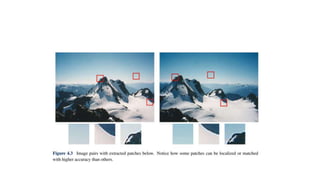
• Feature
• keypoint feature
Main Component Of Feature Detection
And Matching
• Detection: Identify the Interest Point
• Description: The local appearance around each feature point
is described in some way that is (ideally) invariant under
changes in illumination, translation, scale, and in-plane rotation.
We typically end up with a descriptor vector for each feature
point.
• Matching: Descriptors are compared across the images, to
identify similar features. For two images we may get a set of
pairs (Xi, Yi) ↔ (Xi`, Yi`), where (Xi, Yi) is a feature in one
image and (Xi`, Yi`) its matching feature in the other image.
Interest Point
• nterest point is the point at which the direction of the boundary
of the object changes abruptly or intersection point between two
or more edge segments.
Properties Of Interest Point
•It has a well-defined position in image space or well
localized.
•It is stable under local and global perturbations in the
image domain as illumination/brightness variations, such
that the interest points can be reliably computed with a
high degree of repeatability.
•Should provide efficient detection.
Possible Approaches
•Based on the brightness of an image(Usually by image
derivative).
•Based on Boundary extraction(Usually by Edge detection
and Curvature analysis).
Algorithms for Identification
• Harris Corner
• SIFT(Scale Invariant Feature Transform)
• SURF(Speeded Up Robust Feature)
• FAST(Features from Accelerated Segment Test)
• ORB(Oriented FAST and Rotated BRIEF)
Application Of Feature Detection And
Matching
• Automate object tracking
• Point matching for computing disparity
• Stereo calibration(Estimation of the fundamental matrix)
• Motion-based segmentation
• Recognition
• 3D object reconstruction
• Robot navigation
• Image retrieval and indexing
Harris Corner Detector
• corner can be interpreted as the junction of two edges, where
an edge is a sudden change in image brightness.
• Corners are the important features in the image, and they are
generally termed as interest points which are invar
We have to maximize this function E(u,v) for corner
detection. That means, we have to maximize the second
term. Applying Taylor Expansion to the above equation
and using some mathematical steps, we get the final
equation as:
Features

Features

  • 1.
  • 2.
  • 4.
    Main Component OfFeature Detection And Matching • Detection: Identify the Interest Point • Description: The local appearance around each feature point is described in some way that is (ideally) invariant under changes in illumination, translation, scale, and in-plane rotation. We typically end up with a descriptor vector for each feature point. • Matching: Descriptors are compared across the images, to identify similar features. For two images we may get a set of pairs (Xi, Yi) ↔ (Xi`, Yi`), where (Xi, Yi) is a feature in one image and (Xi`, Yi`) its matching feature in the other image.
  • 5.
    Interest Point • nterestpoint is the point at which the direction of the boundary of the object changes abruptly or intersection point between two or more edge segments.
  • 7.
    Properties Of InterestPoint •It has a well-defined position in image space or well localized. •It is stable under local and global perturbations in the image domain as illumination/brightness variations, such that the interest points can be reliably computed with a high degree of repeatability. •Should provide efficient detection.
  • 8.
    Possible Approaches •Based onthe brightness of an image(Usually by image derivative). •Based on Boundary extraction(Usually by Edge detection and Curvature analysis).
  • 9.
    Algorithms for Identification •Harris Corner • SIFT(Scale Invariant Feature Transform) • SURF(Speeded Up Robust Feature) • FAST(Features from Accelerated Segment Test) • ORB(Oriented FAST and Rotated BRIEF)
  • 10.
    Application Of FeatureDetection And Matching • Automate object tracking • Point matching for computing disparity • Stereo calibration(Estimation of the fundamental matrix) • Motion-based segmentation • Recognition • 3D object reconstruction • Robot navigation • Image retrieval and indexing
  • 11.
    Harris Corner Detector •corner can be interpreted as the junction of two edges, where an edge is a sudden change in image brightness. • Corners are the important features in the image, and they are generally termed as interest points which are invar
  • 13.
    We have tomaximize this function E(u,v) for corner detection. That means, we have to maximize the second term. Applying Taylor Expansion to the above equation and using some mathematical steps, we get the final equation as: