- Feasibility report -
Energy conservation in BFP by
reducing gearbox ratio
M.G.Morshad
Energy Manager / TS II
Introduction
• M/s VOITH has up with a suggestion that
about 160 KW of power can be saved in
BFP if input speed of HC is optimized by
changing gear box ratio.
• The purpose of this presentation is to
study the feasibility of such power saving
opportunity in BFP of TS II
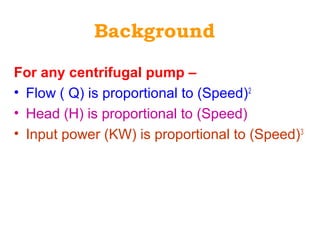
Background
For any centrifugal pump –
• Flow ( Q) is proportional to (Speed)2
• Head (H) is proportional to (Speed)
• Input power (KW) is proportional to (Speed)3
Background
• Rated flow of any pump is designed based on
the minimum speed which occurs during
operation at lowest grid frequency
• And rated motor capacity is designed based on
the maximum speed which occurs during
operation at highest grid frequency
Background
• Considering the grid condition in India, pump
and motor capacity are designed based on the
frequency band (47.5 Hz - 51.5Hz)
• But after implementation of ABT, grid frequency
band has narrowed down to (48.6 Hz to 50.5Hz)
Background
As a result of that
• Pumping system has become oversized
with respect to the present grid condition
• And therefore there is a definite possibility
of power saving by optimizing the size &
capacity of PUMP- MOTOR
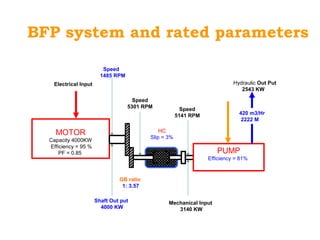
BFP system and rated parameters
MOTOR
Capacity 4000KW
Efficiency = 95 %
PF = 0.85 PUMP
Efficiency = 81%
GB ratio
1: 3.57
HC
Slip = 3%
Hydraulic Out Put
2543 KW
Electrical Input
Shaft Out put
4000 KW
Mechanical Input
3140 KW
Speed
1485 RPM
Speed
5301 RPM Speed
5141 RPM 420 m3/Hr
2222 M
Parameters that influence the
performance of BFP
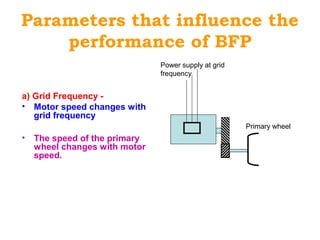
a) Grid Frequency -
• Motor speed changes with
grid frequency
• The speed of the primary
wheel changes with motor
speed.
Power supply at grid
frequency
Primary wheel
Parameters that influence the
performance of BFP
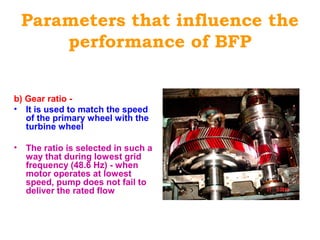
b) Gear ratio -
• It is used to match the speed
of the primary wheel with the
turbine wheel
• The ratio is selected in such a
way that during lowest grid
frequency (48.6 Hz) - when
motor operates at lowest
speed, pump does not fail to
deliver the rated flow
Parameters that influence the
performance of BFP
c) HC slip -
• The percentage speed
difference between
primary and turbine
wheels is known as slip.
• The slip can be controlled
linearly by draining out oil
between two wheels with
the help of scoop tube.
Primary wheel –
speed depends
on grid frequency
Turbine wheel –
speed depends
on the position of
the scoop tube
% SLIP = [(PW speed – TW speed) / PW speed] X100
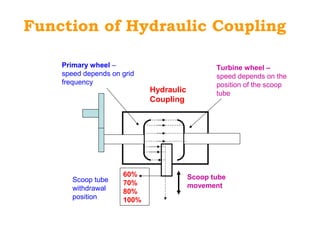
Function of Hydraulic Coupling
Scoop tube
withdrawal
position
60%
70%
80%
100%
Scoop tube
movement
Primary wheel –
speed depends on grid
frequency
Turbine wheel –
speed depends on the
position of the scoop
tubeHydraulic
Coupling
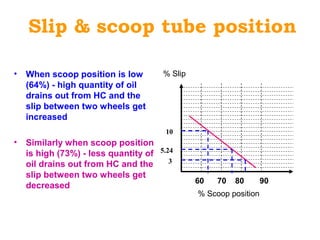
Slip & scoop tube position
• When scoop position is low
(64%) - high quantity of oil
drains out from HC and the
slip between two wheels get
increased
• Similarly when scoop position
is high (73%) - less quantity of
oil drains out from HC and the
slip between two wheels get
decreased
10
5.24
60 70 80 90
3
% Slip
% Scoop position
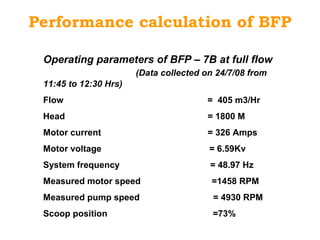
Performance calculation of BFP
Operating parameters of BFP – 7B at full flow
(Data collected on 24/7/08 from
11:45 to 12:30 Hrs)
Flow = 405 m3/Hr
Head = 1800 M
Motor current = 326 Amps
Motor voltage = 6.59Kv
System frequency = 48.97 Hz
Measured motor speed =1458 RPM
Measured pump speed = 4930 RPM
Scoop position =73%
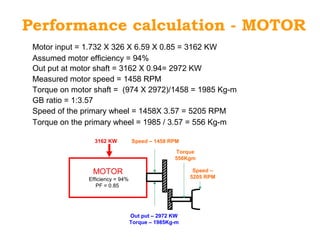
Performance calculation - MOTOR
Motor input = 1.732 X 326 X 6.59 X 0.85 = 3162 KW
Assumed motor efficiency = 94%
Out put at motor shaft = 3162 X 0.94= 2972 KW
Measured motor speed = 1458 RPM
GB ratio = 1:3.57
Torque on motor shaft = (974 X 2972)/1458 = 1985 Kg-m
Speed of the primary wheel = 1458X 3.57 = 5205 RPM
Torque on the primary wheel = 1985 / 3.57 = 556 Kg-m
MOTOR
Efficiency = 94%
PF = 0.85
Torque
556Kgm
3162 KW
Out put – 2972 KW
Torque – 1985Kg-m
Speed – 1458 RPM
Speed –
5205 RPM
Performance calculation – PUMP
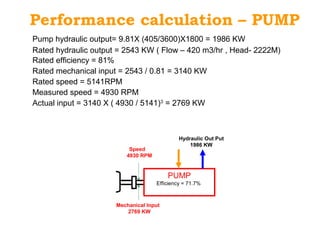
Pump hydraulic output= 9.81X (405/3600)X1800 = 1986 KW
Rated hydraulic output = 2543 KW ( Flow – 420 m3/hr , Head- 2222M)
Rated efficiency = 81%
Rated mechanical input = 2543 / 0.81 = 3140 KW
Measured speed = 4930 RPM
Rated speed = 5141RPM
Actual input = 3140 X ( 4930 / 5141)3
= 2769 KW
PUMP
Efficiency = 71.7%
Hydraulic Out Put
1986 KW
Mechanical Input
2769 KW
Speed
4930 RPM
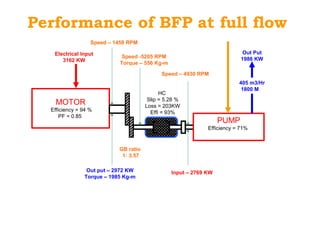
Performance of BFP at full flow
MOTOR
Efficiency = 94 %
PF = 0.85
PUMP
Efficiency = 71%
GB ratio
1: 3.57
HC
Slip = 5.28 %
Loss = 203KW
Effi = 93%
Out Put
1986 KW
Electrical Input
3162 KW
Out put – 2972 KW
Torque – 1985 Kg-m
Input – 2769 KW
Speed – 1458 RPM
Speed -5205 RPM
Torque – 556 Kg-m
Speed – 4930 RPM
405 m3/Hr
1800 M
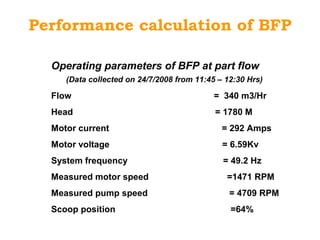
Performance calculation of BFP
Operating parameters of BFP at part flow
(Data collected on 24/7/2008 from 11:45 – 12:30 Hrs)
Flow = 340 m3/Hr
Head = 1780 M
Motor current = 292 Amps
Motor voltage = 6.59Kv
System frequency = 49.2 Hz
Measured motor speed =1471 RPM
Measured pump speed = 4709 RPM
Scoop position =64%
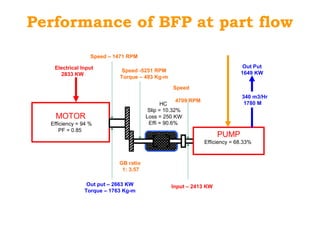
Performance of BFP at part flow
MOTOR
Efficiency = 94 %
PF = 0.85
PUMP
Efficiency = 68.33%
GB ratio
1: 3.57
HC
Slip = 10.32%
Loss = 250 KW
Effi = 90.6%
Out Put
1649 KW
Electrical Input
2833 KW
Out put – 2663 KW
Torque – 1763 Kg-m
Input – 2413 KW
Speed – 1471 RPM
Speed -5251 RPM
Torque – 493 Kg-m
Speed
4709 RPM
340 m3/Hr
1780 M
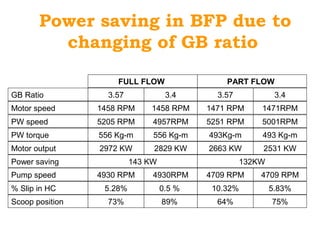
Power saving in BFP due to
changing of GB ratio
FULL FLOW PART FLOW
GB Ratio 3.57 3.4 3.57 3.4
Motor speed 1458 RPM 1458 RPM 1471 RPM 1471RPM
PW speed 5205 RPM 4957RPM 5251 RPM 5001RPM
PW torque 556 Kg-m 556 Kg-m 493Kg-m 493 Kg-m
Motor output 2972 KW 2829 KW 2663 KW 2531 KW
Power saving 143 KW 132KW
Pump speed 4930 RPM 4930RPM 4709 RPM 4709 RPM
% Slip in HC 5.28% 0.5 % 10.32% 5.83%
Scoop position 73% 89% 64% 75%
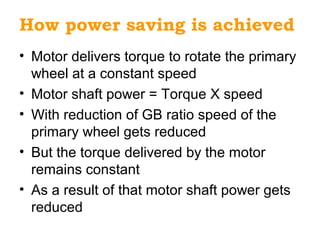
How power saving is achieved
• Motor delivers torque to rotate the primary
wheel at a constant speed
• Motor shaft power = Torque X speed
• With reduction of GB ratio speed of the
primary wheel gets reduced
• But the torque delivered by the motor
remains constant
• As a result of that motor shaft power gets
reduced
Performance of BFP at lowest grid
frequency with reduced GB ratio
PART FLOW
Grid frequency [ f ] 48.6 Hz
Motor syn speed [ Ns = (120 X f ) / P] 1458 RPM
Assumed motor slip [ %S] 0.3%
Motor speed [Nm = Ns(1-%S)] 1453 RPM
FULL FLOW
48.6 Hz
1458 RPM
0.7%
1448 RPM
Gear Box ratio [ R] 3.43.4
Primary Wheel speed [Np = Nm XR] 4940 RPM4923 RPM
Measured pump speed [Nt] 4709 RPM4930 RPM
HC slip [(Np – Nt) / Np] X 100 4.67%Neg. Slip
Scoop position 80%Not Possible
Minimum & Maximum power saving
due to modification
PART FLOW
Grid frequency [ f ] 49.2 Hz (Ave)
Motor syn speed [ Ns = (120 X f ) / P]
1471 RPM
Assumed motor slip [ %S]
1476 RPM
Motor speed [Nm = Ns(1-%S)]
0.3%
48.6 Hz (Min)
1453 RPM
1458 RPM
0.3%
Gear Box ratio [ R] 3.43.4
Primary Wheel speed [Np = Nm XR] 5001 RPM4940 RPM
Measured pump speed [Nt] 4709 RPM4709 RPM
HC slip [(Np – Nt) / Np] X 100 5.83%4.67%
Scoop position (From graph) 75%78%
Torque on the Primary Wheel [T] 493 Kg-m493 Kg-m
Motor output [Np X T / 974] 2531 KW2500 KW
Power saving 132 KW163 KW
Motor output before modification 2663 KW2663 KW
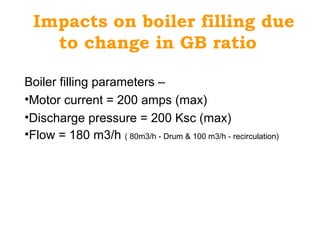
Impacts on boiler filling due
to change in GB ratio
Boiler filling parameters –
•Motor current = 200 amps (max)
•Discharge pressure = 200 Ksc (max)
•Flow = 180 m3/h ( 80m3/h - Drum & 100 m3/h - recirculation)
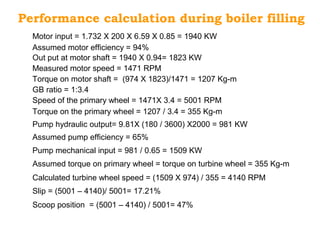
Performance calculation during boiler filling
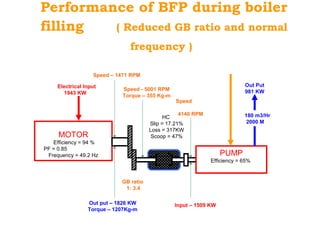
Motor input = 1.732 X 200 X 6.59 X 0.85 = 1940 KW
Assumed motor efficiency = 94%
Out put at motor shaft = 1940 X 0.94= 1823 KW
Measured motor speed = 1471 RPM
GB ratio = 1:3.4
Torque on motor shaft = (974 X 1823)/1471 = 1207 Kg-m
Speed of the primary wheel = 1471X 3.4 = 5001 RPM
Torque on the primary wheel = 1207 / 3.4 = 355 Kg-m
Pump hydraulic output= 9.81X (180 / 3600) X2000 = 981 KW
Assumed pump efficiency = 65%
Pump mechanical input = 981 / 0.65 = 1509 KW
Calculated turbine wheel speed = (1509 X 974) / 355 = 4140 RPM
Assumed torque on primary wheel = torque on turbine wheel = 355 Kg-m
Slip = (5001 – 4140)/ 5001= 17.21%
Scoop position = (5001 – 4140) / 5001= 47%
Performance of BFP during boiler
filling ( Reduced GB ratio and normal
frequency )
MOTOR
Efficiency = 94 %
PF = 0.85
Frequency = 49.2 Hz PUMP
Efficiency = 65%
GB ratio
1: 3.4
HC
Slip = 17.21%
Loss = 317KW
Scoop = 47%
Out Put
981 KW
Electrical Input
1943 KW
Out put – 1826 KW
Torque – 1207Kg-m
Input – 1509 KW
Speed – 1471 RPM
Speed - 5001 RPM
Torque – 355 Kg-m
Speed
4140 RPM 180 m3/Hr
2000 M
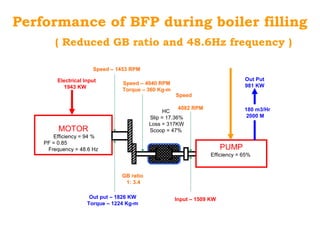
MOTOR
Efficiency = 94 %
PF = 0.85
Frequency = 48.6 Hz PUMP
Efficiency = 65%
GB ratio
1: 3.4
HC
Slip = 17.36%
Loss = 317KW
Scoop = 47%
Out Put
981 KW
Electrical Input
1943 KW
Out put – 1826 KW
Torque – 1224 Kg-m
Input – 1509 KW
Speed – 1453 RPM
Speed – 4940 RPM
Torque – 360 Kg-m
Speed
4082 RPM 180 m3/Hr
2000 M
Performance of BFP during boiler filling
( Reduced GB ratio and 48.6Hz frequency )
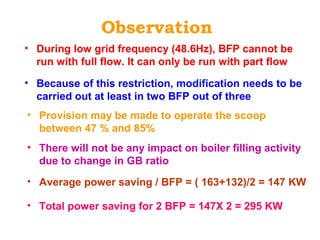
Observation
• During low grid frequency (48.6Hz), BFP cannot be
run with full flow. It can only be run with part flow
• Provision may be made to operate the scoop
between 47 % and 85%
• Because of this restriction, modification needs to be
carried out at least in two BFP out of three
• Average power saving / BFP = ( 163+132)/2 = 147 KW
• Total power saving for 2 BFP = 147X 2 = 295 KW
• There will not be any impact on boiler filling activity
due to change in GB ratio
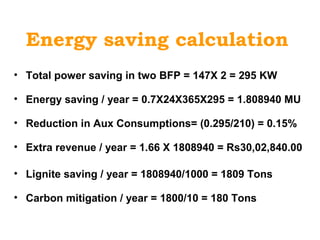
Energy saving calculation
• Total power saving in two BFP = 147X 2 = 295 KW
• Energy saving / year = 0.7X24X365X295 = 1.808940 MU
• Extra revenue / year = 1.66 X 1808940 = Rs30,02,840.00
• Lignite saving / year = 1808940/1000 = 1809 Tons
• Carbon mitigation / year = 1800/10 = 180 Tons
• Reduction in Aux Consumptions= (0.295/210) = 0.15%
Simple Payback calculation
• Cost for modification of one GB = Rs 62,40,000.00
• Total modification cost for two BFP = Rs1,24,80,000.00
• Extra revenue / year = Rs 30,02,840.00
• Simple payback periods = (12480000/3002840) = 4.15 Yrs
Facts need to be further investigation
Q 1 – Will there be any possibility of developing
vibration in pump due to change in mass at primary
wheel side as a result of changing GB ratio ?
Q 2 – Will it be possible to bring back the original set
up within a shortest time if problem is notice in the
modified GB ?
Thank You

Feasibility study bfp

  • 1.
    - Feasibility report- Energy conservation in BFP by reducing gearbox ratio M.G.Morshad Energy Manager / TS II
  • 2.
    Introduction • M/s VOITHhas up with a suggestion that about 160 KW of power can be saved in BFP if input speed of HC is optimized by changing gear box ratio. • The purpose of this presentation is to study the feasibility of such power saving opportunity in BFP of TS II
  • 3.
    Background For any centrifugalpump – • Flow ( Q) is proportional to (Speed)2 • Head (H) is proportional to (Speed) • Input power (KW) is proportional to (Speed)3
  • 4.
    Background • Rated flowof any pump is designed based on the minimum speed which occurs during operation at lowest grid frequency • And rated motor capacity is designed based on the maximum speed which occurs during operation at highest grid frequency
  • 5.
    Background • Considering thegrid condition in India, pump and motor capacity are designed based on the frequency band (47.5 Hz - 51.5Hz) • But after implementation of ABT, grid frequency band has narrowed down to (48.6 Hz to 50.5Hz)
  • 6.
    Background As a resultof that • Pumping system has become oversized with respect to the present grid condition • And therefore there is a definite possibility of power saving by optimizing the size & capacity of PUMP- MOTOR
  • 7.
    BFP system andrated parameters MOTOR Capacity 4000KW Efficiency = 95 % PF = 0.85 PUMP Efficiency = 81% GB ratio 1: 3.57 HC Slip = 3% Hydraulic Out Put 2543 KW Electrical Input Shaft Out put 4000 KW Mechanical Input 3140 KW Speed 1485 RPM Speed 5301 RPM Speed 5141 RPM 420 m3/Hr 2222 M
  • 8.
    Parameters that influencethe performance of BFP a) Grid Frequency - • Motor speed changes with grid frequency • The speed of the primary wheel changes with motor speed. Power supply at grid frequency Primary wheel
  • 9.
    Parameters that influencethe performance of BFP b) Gear ratio - • It is used to match the speed of the primary wheel with the turbine wheel • The ratio is selected in such a way that during lowest grid frequency (48.6 Hz) - when motor operates at lowest speed, pump does not fail to deliver the rated flow
  • 10.
    Parameters that influencethe performance of BFP c) HC slip - • The percentage speed difference between primary and turbine wheels is known as slip. • The slip can be controlled linearly by draining out oil between two wheels with the help of scoop tube. Primary wheel – speed depends on grid frequency Turbine wheel – speed depends on the position of the scoop tube % SLIP = [(PW speed – TW speed) / PW speed] X100
  • 11.
    Function of HydraulicCoupling Scoop tube withdrawal position 60% 70% 80% 100% Scoop tube movement Primary wheel – speed depends on grid frequency Turbine wheel – speed depends on the position of the scoop tubeHydraulic Coupling
  • 12.
    Slip & scooptube position • When scoop position is low (64%) - high quantity of oil drains out from HC and the slip between two wheels get increased • Similarly when scoop position is high (73%) - less quantity of oil drains out from HC and the slip between two wheels get decreased 10 5.24 60 70 80 90 3 % Slip % Scoop position
  • 13.
    Performance calculation ofBFP Operating parameters of BFP – 7B at full flow (Data collected on 24/7/08 from 11:45 to 12:30 Hrs) Flow = 405 m3/Hr Head = 1800 M Motor current = 326 Amps Motor voltage = 6.59Kv System frequency = 48.97 Hz Measured motor speed =1458 RPM Measured pump speed = 4930 RPM Scoop position =73%
  • 14.
    Performance calculation -MOTOR Motor input = 1.732 X 326 X 6.59 X 0.85 = 3162 KW Assumed motor efficiency = 94% Out put at motor shaft = 3162 X 0.94= 2972 KW Measured motor speed = 1458 RPM GB ratio = 1:3.57 Torque on motor shaft = (974 X 2972)/1458 = 1985 Kg-m Speed of the primary wheel = 1458X 3.57 = 5205 RPM Torque on the primary wheel = 1985 / 3.57 = 556 Kg-m MOTOR Efficiency = 94% PF = 0.85 Torque 556Kgm 3162 KW Out put – 2972 KW Torque – 1985Kg-m Speed – 1458 RPM Speed – 5205 RPM
  • 15.
    Performance calculation –PUMP Pump hydraulic output= 9.81X (405/3600)X1800 = 1986 KW Rated hydraulic output = 2543 KW ( Flow – 420 m3/hr , Head- 2222M) Rated efficiency = 81% Rated mechanical input = 2543 / 0.81 = 3140 KW Measured speed = 4930 RPM Rated speed = 5141RPM Actual input = 3140 X ( 4930 / 5141)3 = 2769 KW PUMP Efficiency = 71.7% Hydraulic Out Put 1986 KW Mechanical Input 2769 KW Speed 4930 RPM
  • 16.
    Performance of BFPat full flow MOTOR Efficiency = 94 % PF = 0.85 PUMP Efficiency = 71% GB ratio 1: 3.57 HC Slip = 5.28 % Loss = 203KW Effi = 93% Out Put 1986 KW Electrical Input 3162 KW Out put – 2972 KW Torque – 1985 Kg-m Input – 2769 KW Speed – 1458 RPM Speed -5205 RPM Torque – 556 Kg-m Speed – 4930 RPM 405 m3/Hr 1800 M
  • 17.
    Performance calculation ofBFP Operating parameters of BFP at part flow (Data collected on 24/7/2008 from 11:45 – 12:30 Hrs) Flow = 340 m3/Hr Head = 1780 M Motor current = 292 Amps Motor voltage = 6.59Kv System frequency = 49.2 Hz Measured motor speed =1471 RPM Measured pump speed = 4709 RPM Scoop position =64%
  • 18.
    Performance of BFPat part flow MOTOR Efficiency = 94 % PF = 0.85 PUMP Efficiency = 68.33% GB ratio 1: 3.57 HC Slip = 10.32% Loss = 250 KW Effi = 90.6% Out Put 1649 KW Electrical Input 2833 KW Out put – 2663 KW Torque – 1763 Kg-m Input – 2413 KW Speed – 1471 RPM Speed -5251 RPM Torque – 493 Kg-m Speed 4709 RPM 340 m3/Hr 1780 M
  • 19.
    Power saving inBFP due to changing of GB ratio FULL FLOW PART FLOW GB Ratio 3.57 3.4 3.57 3.4 Motor speed 1458 RPM 1458 RPM 1471 RPM 1471RPM PW speed 5205 RPM 4957RPM 5251 RPM 5001RPM PW torque 556 Kg-m 556 Kg-m 493Kg-m 493 Kg-m Motor output 2972 KW 2829 KW 2663 KW 2531 KW Power saving 143 KW 132KW Pump speed 4930 RPM 4930RPM 4709 RPM 4709 RPM % Slip in HC 5.28% 0.5 % 10.32% 5.83% Scoop position 73% 89% 64% 75%
  • 20.
    How power savingis achieved • Motor delivers torque to rotate the primary wheel at a constant speed • Motor shaft power = Torque X speed • With reduction of GB ratio speed of the primary wheel gets reduced • But the torque delivered by the motor remains constant • As a result of that motor shaft power gets reduced
  • 21.
    Performance of BFPat lowest grid frequency with reduced GB ratio PART FLOW Grid frequency [ f ] 48.6 Hz Motor syn speed [ Ns = (120 X f ) / P] 1458 RPM Assumed motor slip [ %S] 0.3% Motor speed [Nm = Ns(1-%S)] 1453 RPM FULL FLOW 48.6 Hz 1458 RPM 0.7% 1448 RPM Gear Box ratio [ R] 3.43.4 Primary Wheel speed [Np = Nm XR] 4940 RPM4923 RPM Measured pump speed [Nt] 4709 RPM4930 RPM HC slip [(Np – Nt) / Np] X 100 4.67%Neg. Slip Scoop position 80%Not Possible
  • 22.
    Minimum & Maximumpower saving due to modification PART FLOW Grid frequency [ f ] 49.2 Hz (Ave) Motor syn speed [ Ns = (120 X f ) / P] 1471 RPM Assumed motor slip [ %S] 1476 RPM Motor speed [Nm = Ns(1-%S)] 0.3% 48.6 Hz (Min) 1453 RPM 1458 RPM 0.3% Gear Box ratio [ R] 3.43.4 Primary Wheel speed [Np = Nm XR] 5001 RPM4940 RPM Measured pump speed [Nt] 4709 RPM4709 RPM HC slip [(Np – Nt) / Np] X 100 5.83%4.67% Scoop position (From graph) 75%78% Torque on the Primary Wheel [T] 493 Kg-m493 Kg-m Motor output [Np X T / 974] 2531 KW2500 KW Power saving 132 KW163 KW Motor output before modification 2663 KW2663 KW
  • 23.
    Impacts on boilerfilling due to change in GB ratio Boiler filling parameters – •Motor current = 200 amps (max) •Discharge pressure = 200 Ksc (max) •Flow = 180 m3/h ( 80m3/h - Drum & 100 m3/h - recirculation)
  • 24.
    Performance calculation duringboiler filling Motor input = 1.732 X 200 X 6.59 X 0.85 = 1940 KW Assumed motor efficiency = 94% Out put at motor shaft = 1940 X 0.94= 1823 KW Measured motor speed = 1471 RPM GB ratio = 1:3.4 Torque on motor shaft = (974 X 1823)/1471 = 1207 Kg-m Speed of the primary wheel = 1471X 3.4 = 5001 RPM Torque on the primary wheel = 1207 / 3.4 = 355 Kg-m Pump hydraulic output= 9.81X (180 / 3600) X2000 = 981 KW Assumed pump efficiency = 65% Pump mechanical input = 981 / 0.65 = 1509 KW Calculated turbine wheel speed = (1509 X 974) / 355 = 4140 RPM Assumed torque on primary wheel = torque on turbine wheel = 355 Kg-m Slip = (5001 – 4140)/ 5001= 17.21% Scoop position = (5001 – 4140) / 5001= 47%
  • 25.
    Performance of BFPduring boiler filling ( Reduced GB ratio and normal frequency ) MOTOR Efficiency = 94 % PF = 0.85 Frequency = 49.2 Hz PUMP Efficiency = 65% GB ratio 1: 3.4 HC Slip = 17.21% Loss = 317KW Scoop = 47% Out Put 981 KW Electrical Input 1943 KW Out put – 1826 KW Torque – 1207Kg-m Input – 1509 KW Speed – 1471 RPM Speed - 5001 RPM Torque – 355 Kg-m Speed 4140 RPM 180 m3/Hr 2000 M
  • 26.
    MOTOR Efficiency = 94% PF = 0.85 Frequency = 48.6 Hz PUMP Efficiency = 65% GB ratio 1: 3.4 HC Slip = 17.36% Loss = 317KW Scoop = 47% Out Put 981 KW Electrical Input 1943 KW Out put – 1826 KW Torque – 1224 Kg-m Input – 1509 KW Speed – 1453 RPM Speed – 4940 RPM Torque – 360 Kg-m Speed 4082 RPM 180 m3/Hr 2000 M Performance of BFP during boiler filling ( Reduced GB ratio and 48.6Hz frequency )
  • 27.
    Observation • During lowgrid frequency (48.6Hz), BFP cannot be run with full flow. It can only be run with part flow • Provision may be made to operate the scoop between 47 % and 85% • Because of this restriction, modification needs to be carried out at least in two BFP out of three • Average power saving / BFP = ( 163+132)/2 = 147 KW • Total power saving for 2 BFP = 147X 2 = 295 KW • There will not be any impact on boiler filling activity due to change in GB ratio
  • 28.
    Energy saving calculation •Total power saving in two BFP = 147X 2 = 295 KW • Energy saving / year = 0.7X24X365X295 = 1.808940 MU • Extra revenue / year = 1.66 X 1808940 = Rs30,02,840.00 • Lignite saving / year = 1808940/1000 = 1809 Tons • Carbon mitigation / year = 1800/10 = 180 Tons • Reduction in Aux Consumptions= (0.295/210) = 0.15%
  • 29.
    Simple Payback calculation •Cost for modification of one GB = Rs 62,40,000.00 • Total modification cost for two BFP = Rs1,24,80,000.00 • Extra revenue / year = Rs 30,02,840.00 • Simple payback periods = (12480000/3002840) = 4.15 Yrs
  • 30.
    Facts need tobe further investigation Q 1 – Will there be any possibility of developing vibration in pump due to change in mass at primary wheel side as a result of changing GB ratio ? Q 2 – Will it be possible to bring back the original set up within a shortest time if problem is notice in the modified GB ? Thank You