#FDOL131
Hello and 
welcome to the  
#FDOL131 
webinar.  
Please go to 
Meeting (top left)
> Audio setup wizard 
to check your audio
Flexible, Distance and Online Learning an open course using COOL FISh
http://fdol.wordpress.com/ Twitter: @openfdol #fdol131 
unit 5: open practices 
Carol Yeager, 22 April 13, 7‐8pm(GMT)
Maria and Lars
Rationale: The move towards ‘openness’ in education has accelerated in recent years with a 
number of high profile institutional initiatives such as the MIT OpenCourseware project and 
there is now a growing body of Open Educational Resources (OERs) and Open Educational 
Practices (OEP) offered by a number of institutions around the globe which not only give 
access to free educational courseware, such as images, video, audio and other assets to 
educators and learners worldwide, without an accompanying need to pay royalties or 
licence fees but also provide opportunities for open access participation and learning in 
course settings via for example Massive Open Online Courses (MOOC) which often attract 
large numbers of participants. The OER and OEP have emerged as a concept with great 
potential to support educational transformation as well as provide extended opportunities 
for learning in non‐formal settings. This unit explores the benefits and challenges of 
openness in education and learning more generally and looks at ways in which educators 
and learners can harness and benefit from a plethora of open opportunities to engage and 
re‐engage in learning but also to explore how OER and OEP can be re‐purposed, adapted 
and contextualised for specific learning and teaching situations.
unit 5: open educational
practices
Maria
Open practice for you
“Openness is a fundamental value underlying significant changes in
society and is a prerequisite to changes institutions of higher education
need to make in order to remain relevant to the society in which they
exist. There are a number of ways institutions can be more open,
including programs of open sharing of educational materials. Individual
faculty can also choose to be more open without waiting for institutional
programs. Increasing degrees of openness in society coupled with
innovations in business strategy like dynamic specialization are enabling
radical experiments in higher education and exerting increasing
competitive pressure on conventional higher education institutions. No
single response to the changes in the supersystem of higher education
can successfully address every institution’s situation. However, every
institution must begin addressing openness as a core organizational
value if it desires to both remain relevant to its learners and to contribute
to the positive advancement of the field of higher “ (Wiley and Hilton,
2009, 1)
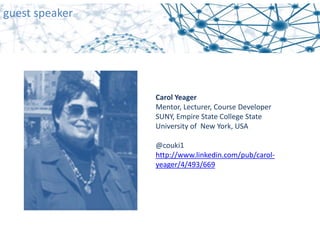
Carol Yeager
Mentor, Lecturer, Course Developer
SUNY, Empire State College State 
University of  New York, USA
@couki1
http://www.linkedin.com/pub/carol‐
yeager/4/493/669
guest speaker
OERs, cMOOCs and the Opening of 
Education
Carol Yeager
22 April 2013
What does                       mean
to you?
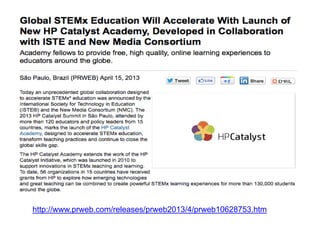
http://www.prweb.com/releases/prweb2013/4/prweb10628753.htm
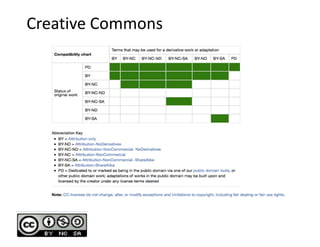
Creative Commons
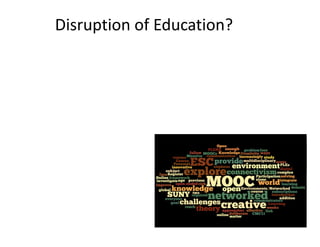
Disruption of Education?
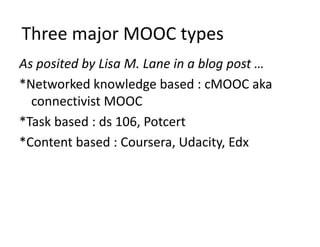
Three major MOOC types
As posited by Lisa M. Lane in a blog post …
*Networked knowledge based : cMOOC aka 
connectivist MOOC
*Task based : ds 106, Potcert
*Content based : Coursera, Udacity, Edx
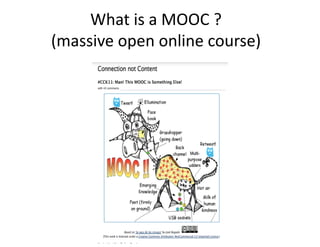
What is a MOOC ?
(massive open online course)
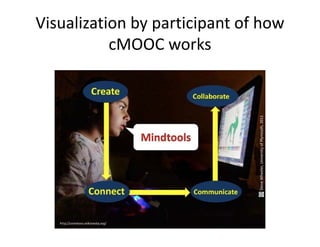
Visualization by participant of how 
cMOOC works
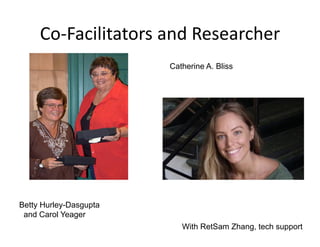
Co‐Facilitators and Researcher
Betty Hurley-Dasgupta
and Carol Yeager
Catherine A. Bliss
With RetSam Zhang, tech support
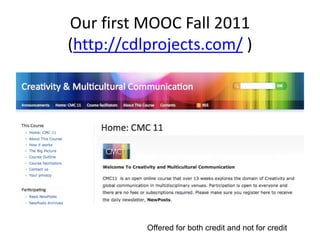
Our first MOOC Fall 2011
(http://cdlprojects.com/ )
Offered for both credit and not for credit
gRSShopper
open source by Stephen Downes
(grsshopper.downes.ca/about.htm )
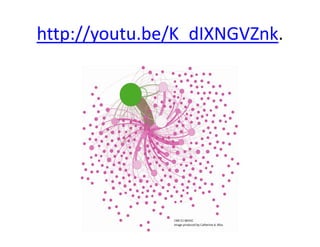
http://youtu.be/K_dIXNGVZnk. 
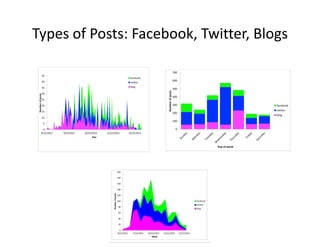
Types of Posts: Facebook, Twitter, Blogs
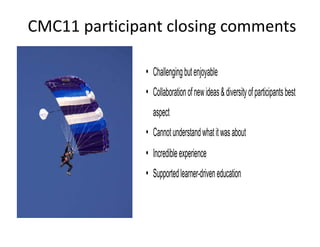
CMC11 participant closing comments
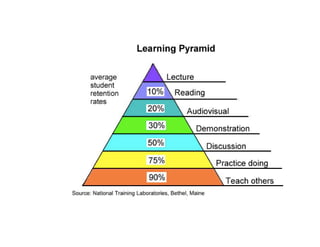
What is your learning style? Others?
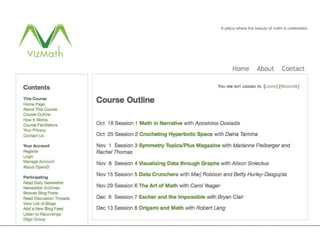
(http://math.cdlprojects.com/ )
our second MOOC Fall 2012
Not offered for credit
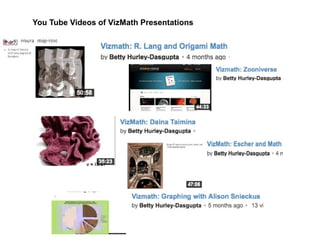
You Tube Videos of VizMath Presentations
Questions
• What challenges do cMOOCs present for 
assessing learning gained through engaging with 
the MOOC, including other MOOC participants?
• Is the cMOOC an accessible learning environment 
for all learners?
• What are essential elements of a MOOC? Is size 
(over 100) sufficient for it to be a MOOC? 
• Is a cMOOC really a course?
Your thoughts?
Reflections and my thoughts
Some References
• Research article on MOOCs:
• http://www.irrodl.org/index.php/irrodl/article/view/104
1/2025
• Dave Cormier on MOOCs:
• http://davecormier.com/edblog/2012/07/31/20‐
questions‐and‐answers‐about‐moocs/
• George Siemens on MOOCs (video):
• http://blog.p2pfoundation.net/george‐siemens‐on‐
massive‐open‐online‐courses/2011/05/14
• Stephen Downes on MOOCs (video):
• http://www.slideshare.net/Downes/xmooc‐the‐massive‐
open‐online‐course‐in‐theory‐and‐in‐practice
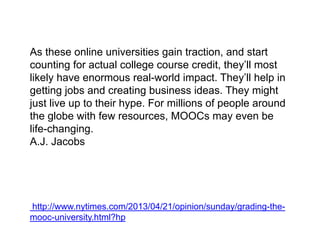
As these online universities gain traction, and start
counting for actual college course credit, they’ll most
likely have enormous real-world impact. They’ll help in
getting jobs and creating business ideas. They might
just live up to their hype. For millions of people around
the globe with few resources, MOOCs may even be
life-changing.
A.J. Jacobs
http://www.nytimes.com/2013/04/21/opinion/sunday/grading-the-
mooc-university.html?hp
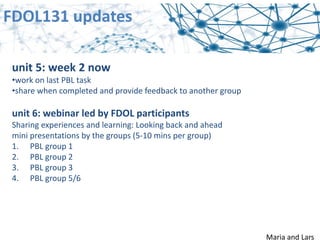
FDOL131 updates
Maria and Lars
unit 5: week 2 now
•work on last PBL task
•share when completed and provide feedback to another group
unit 6: webinar led by FDOL participants
Sharing experiences and learning: Looking back and ahead
mini presentations by the groups (5‐10 mins per group)
1. PBL group 1
2. PBL group 2
3. PBL group 3
4. PBL group 5/6
#FDOL131
Flexible, Distance and Online Learning an open course using COOL FISh
http://fdol.wordpress.com/  Twitter: @openfdol #fdol131
Thank you for 
joining us today 
and see you online
last webinar
unit 6: celebrating learning
2 May 13, 7‐8pm (UK time)
references
Wiley, D. and Hilton, J. (2009) Openness, Dynamic Specialization, and the
Disaggregated Future of Higher Education, in: International Review of Research in
Open and Distance Learning, Volume 10, Number 5, 2009, pp. 1-16., available at
http://www.irrodl.org/index.php/irrodl/article/view/768 [accessed 25 February 2013]

Fdol131 unit5: Open practicies with Carol Yeager