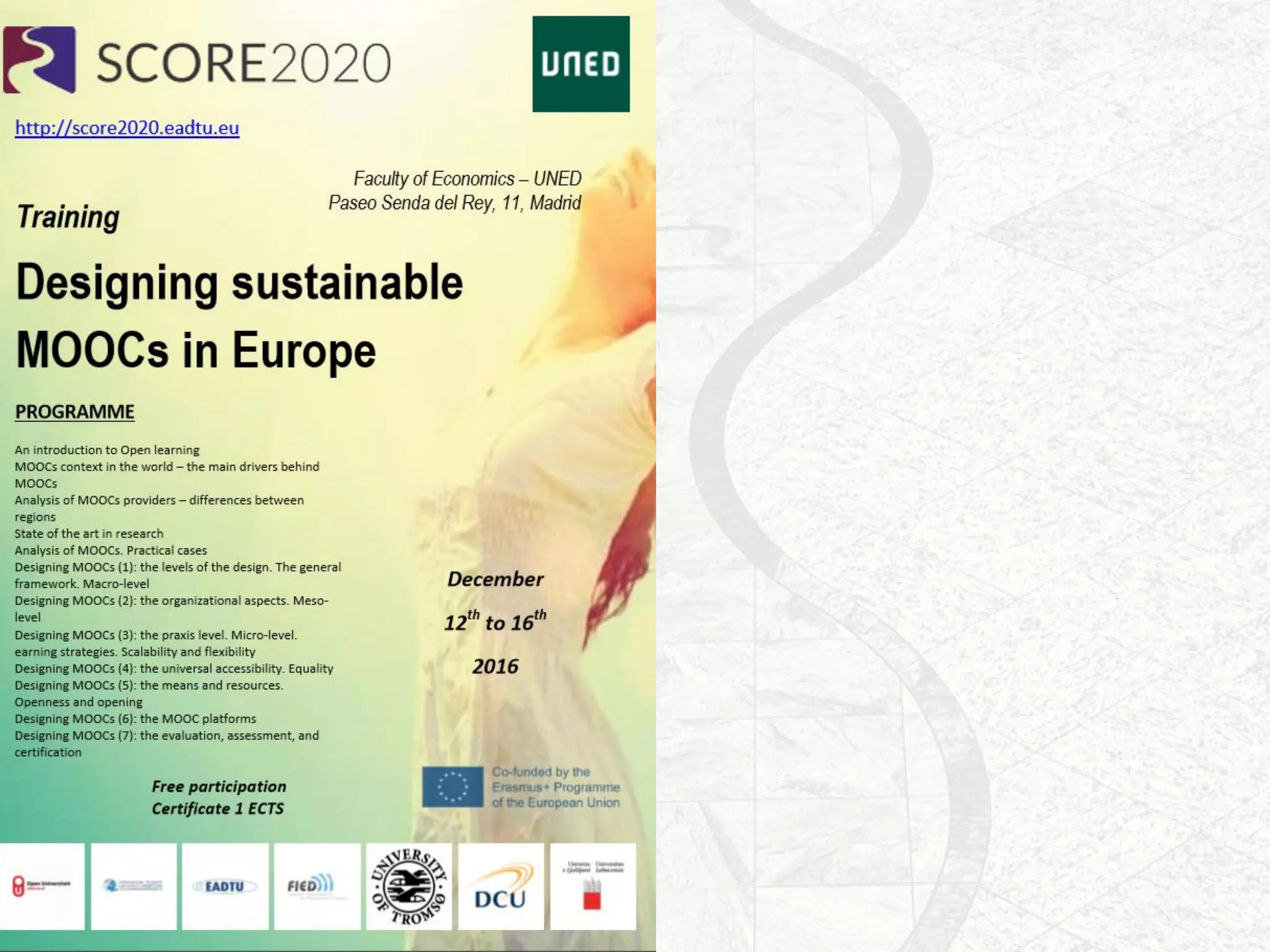
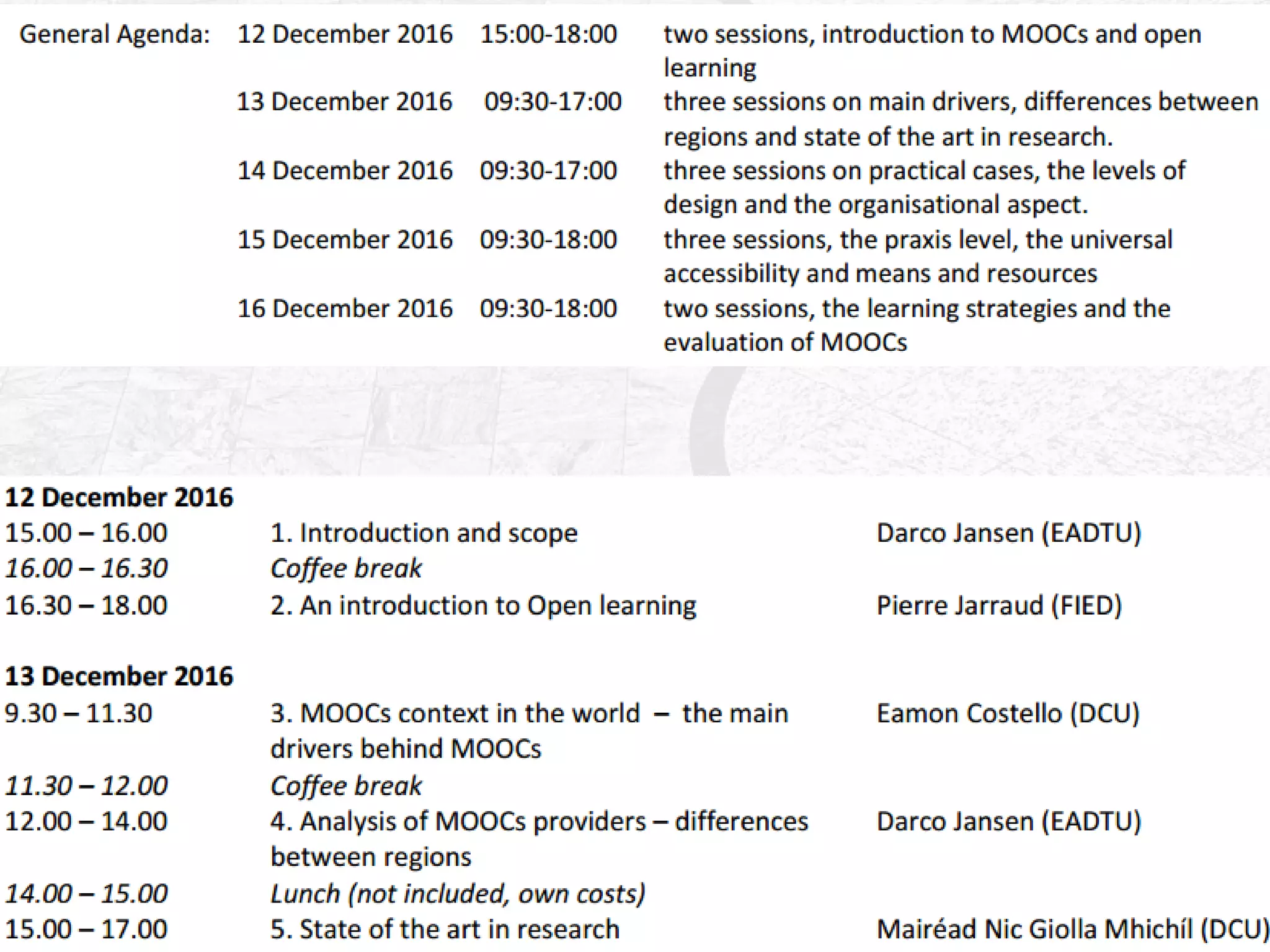
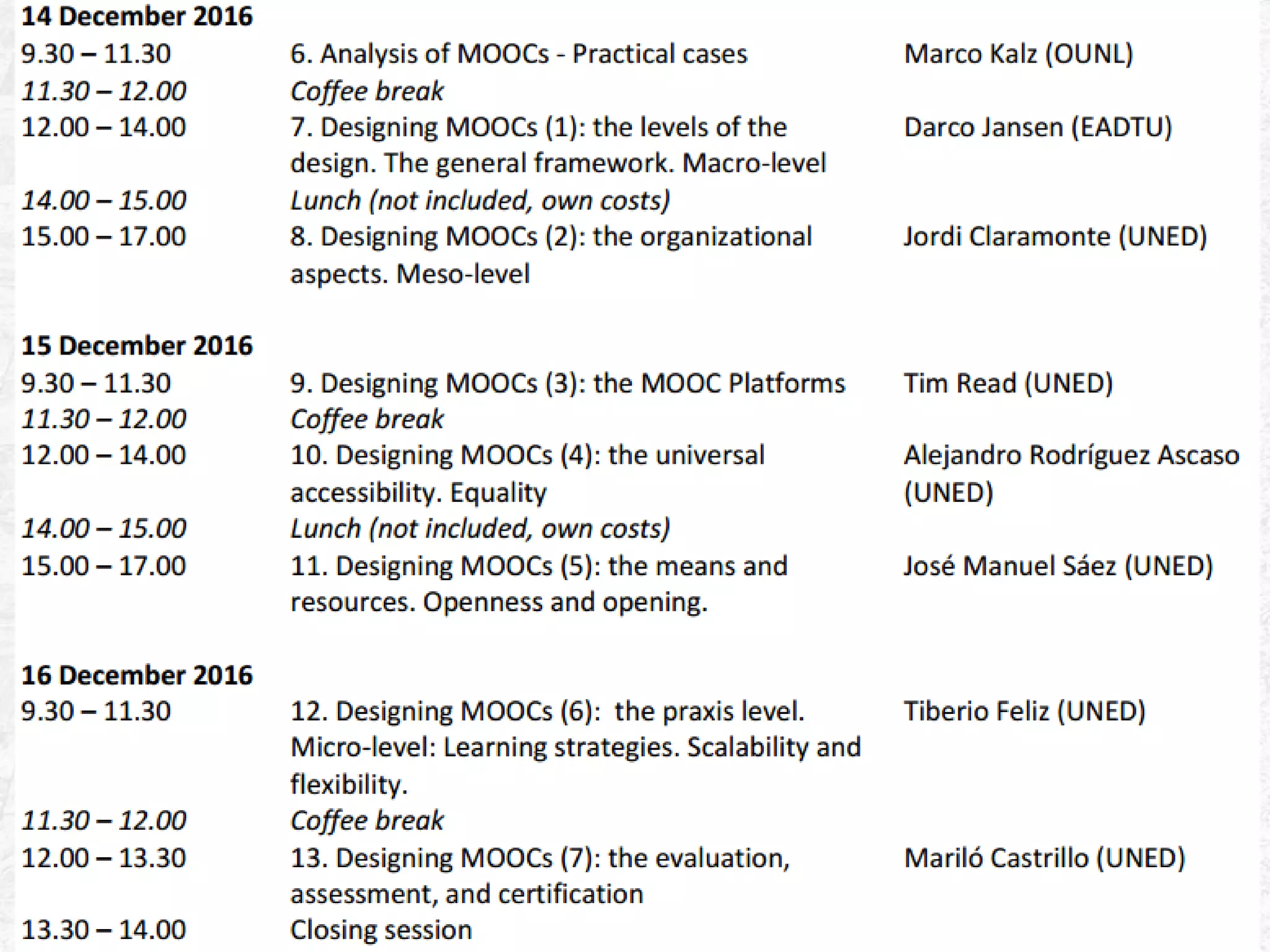
Training Madrid, 12-16 December 2016
Designing sustainable MOOCs in Europe
Introduction and Scope
training 12-16 December 2016
Designing sustainable MOOCs in Europe
Darco Jansen
EADTU
Darco.Jansen@eadtu.eu
Organised as part of SCORE2020 project
Aim SCORE2020 project
• Support the setup of regional support centres for the
development and use of MOOCs and Open
Education.
• Most countries of the partnership already started
with some way of cross-institutional support of open
education and/or MOOCs (e.g., Norway, France, the
Netherlands, Ireland).
• The partners will exchange and jointly develop
expertise and will develop a common approach.
• Transfer of possible models of regional support
centres on MOOCs and Open Education to other
countries and regions Darco Jansen
• Finally SCORE2020 will benchmark regional support
centres providing scenarios for support of different
target groups and evidence based practices for teachers
and institutions in their use of Open Education and
MOOCs.
Darco Jansen
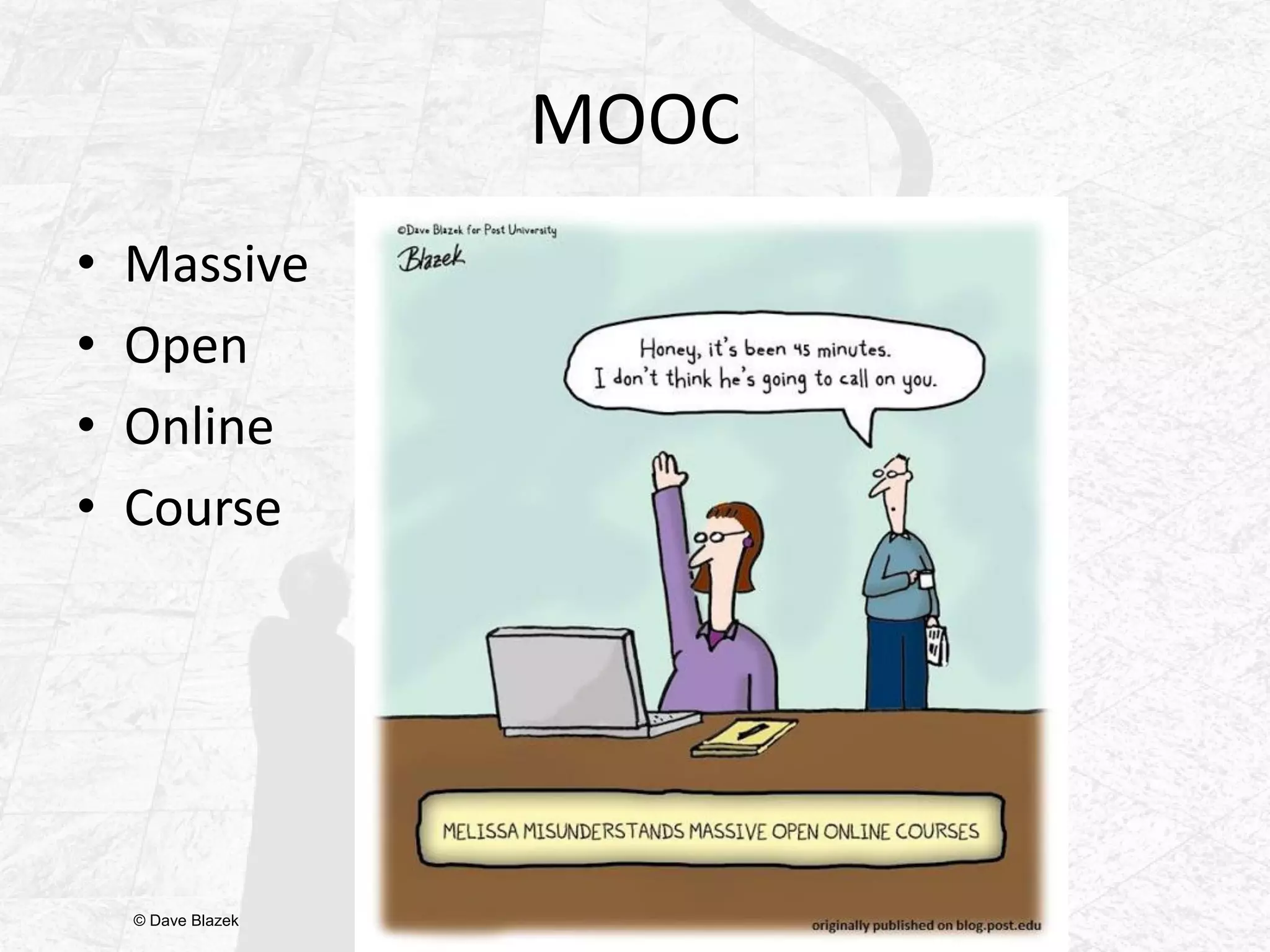
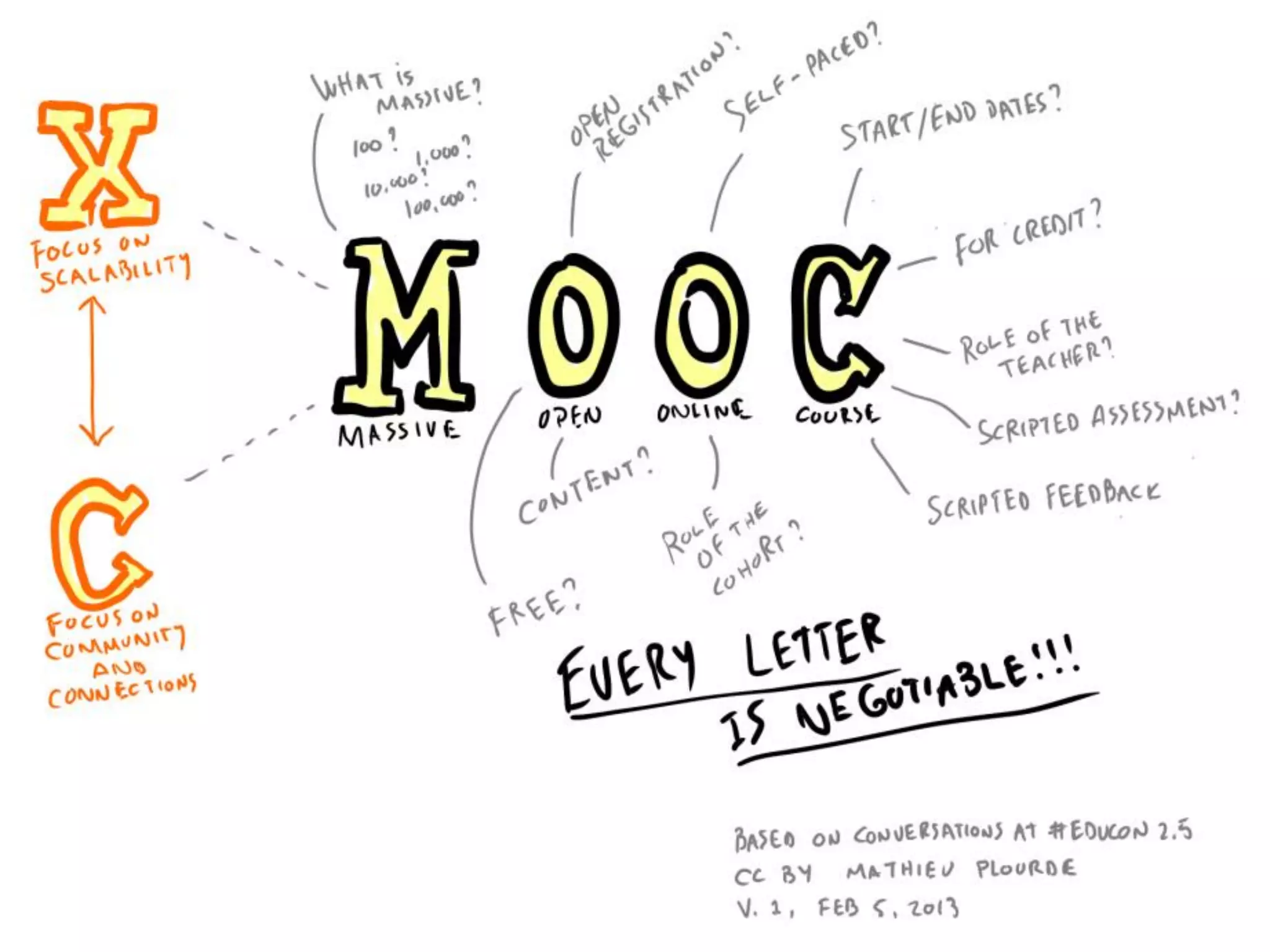
MOOC
• Massive
• Open
• Online
• Course
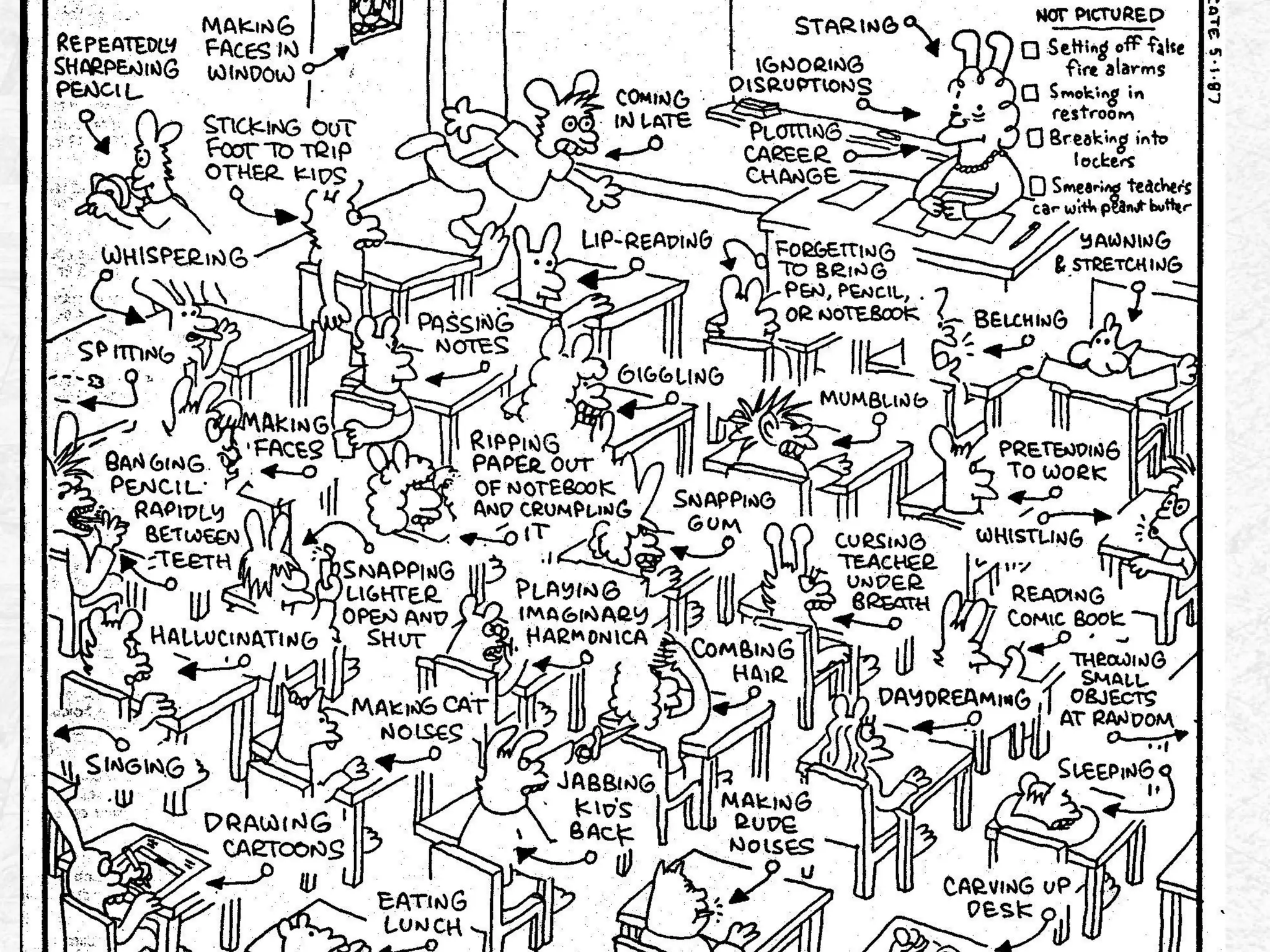
© Dave Blazek
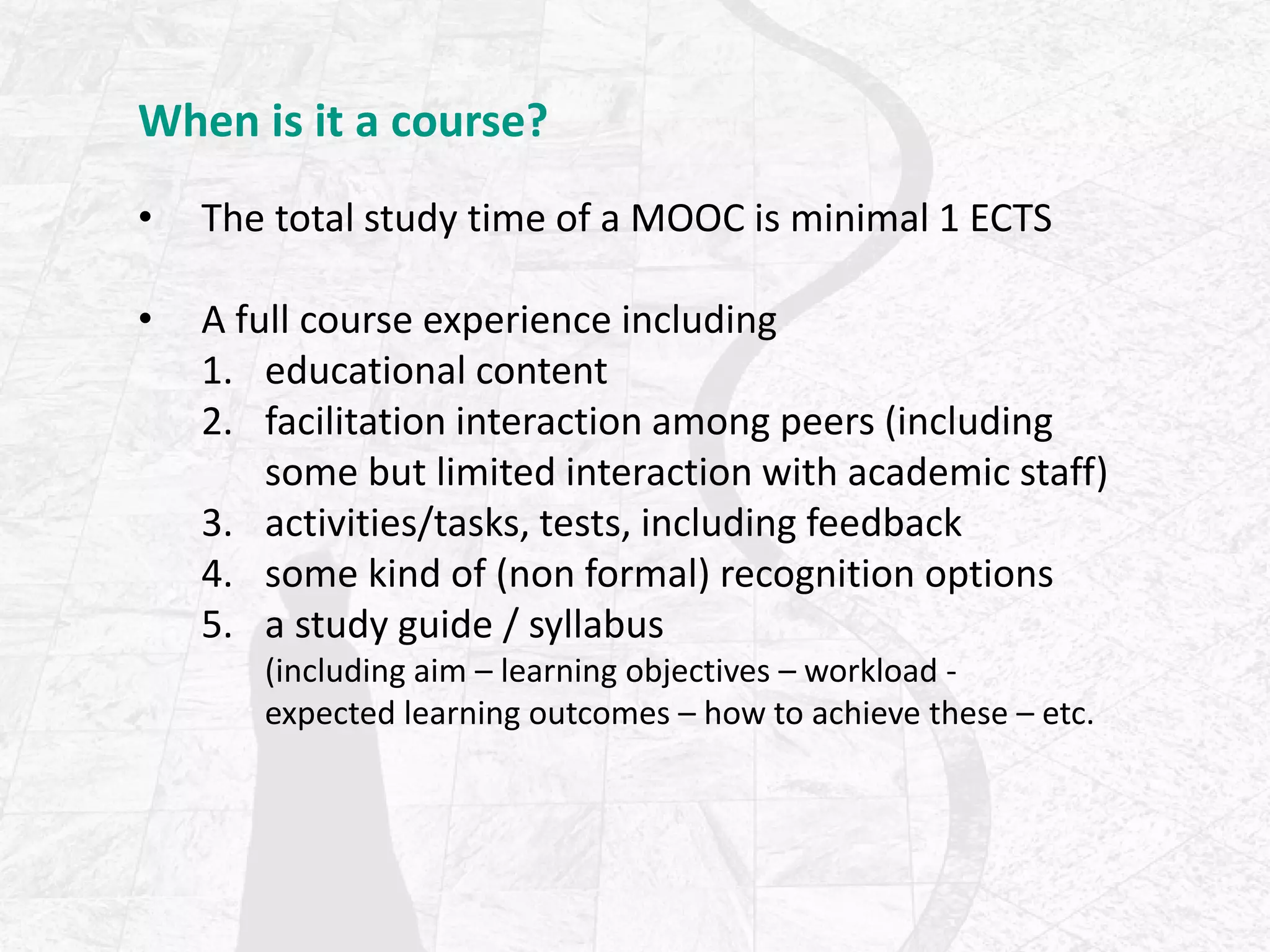
When is it a course?
• The total study time of a MOOC is minimal 1 ECTS
• A full course experience including
1. educational content
2. facilitation interaction among peers (including
some but limited interaction with academic staff)
3. activities/tasks, tests, including feedback
4. some kind of (non formal) recognition options
5. a study guide / syllabus
(including aim – learning objectives – workload -
expected learning outcomes – how to achieve these – etc.
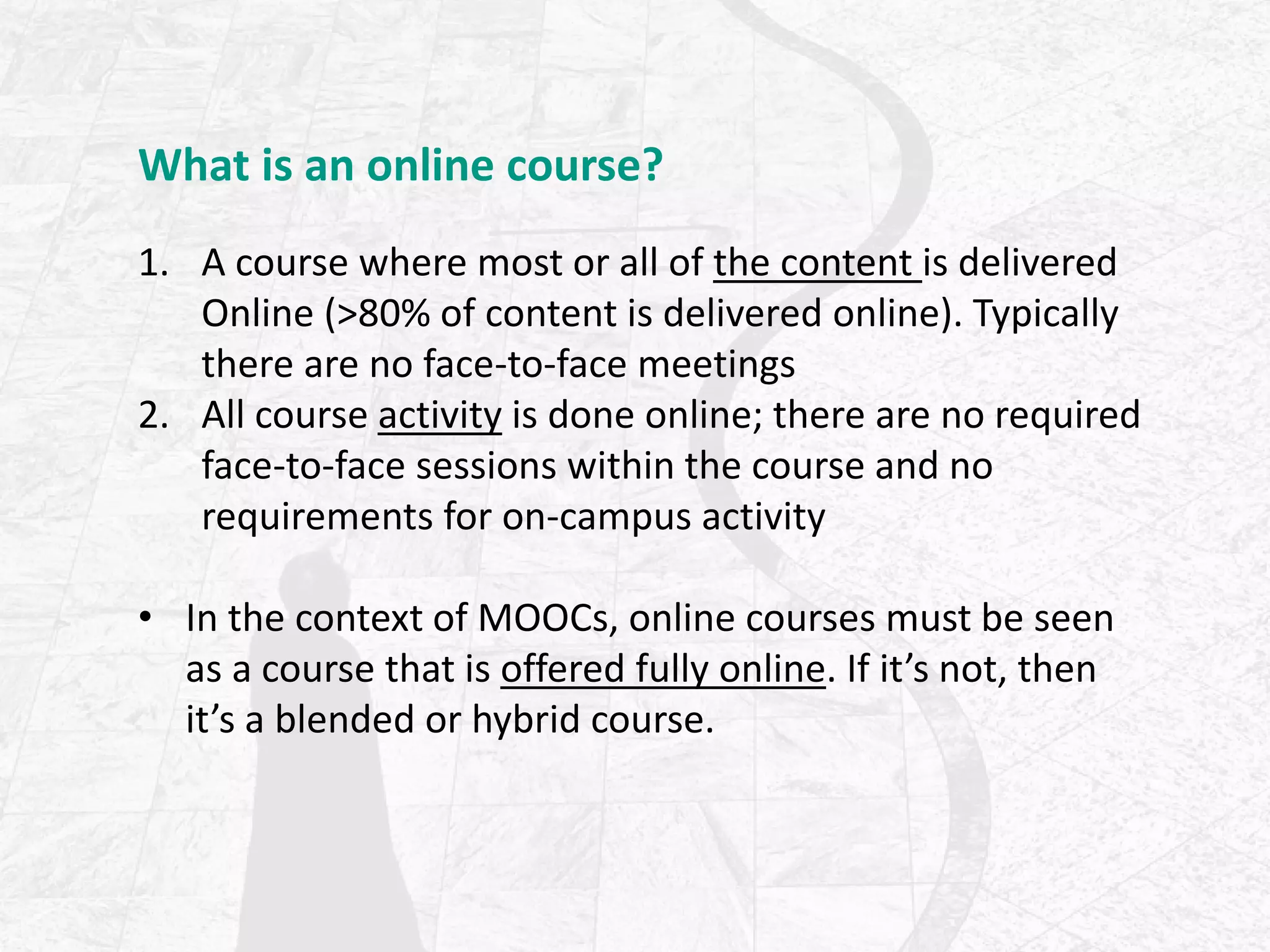
What is an online course?
1. A course where most or all of the content is delivered
Online (>80% of content is delivered online). Typically
there are no face-to-face meetings
2. All course activity is done online; there are no required
face-to-face sessions within the course and no
requirements for on-campus activity
• In the context of MOOCs, online courses must be seen
as a course that is offered fully online. If it’s not, then
it’s a blended or hybrid course.
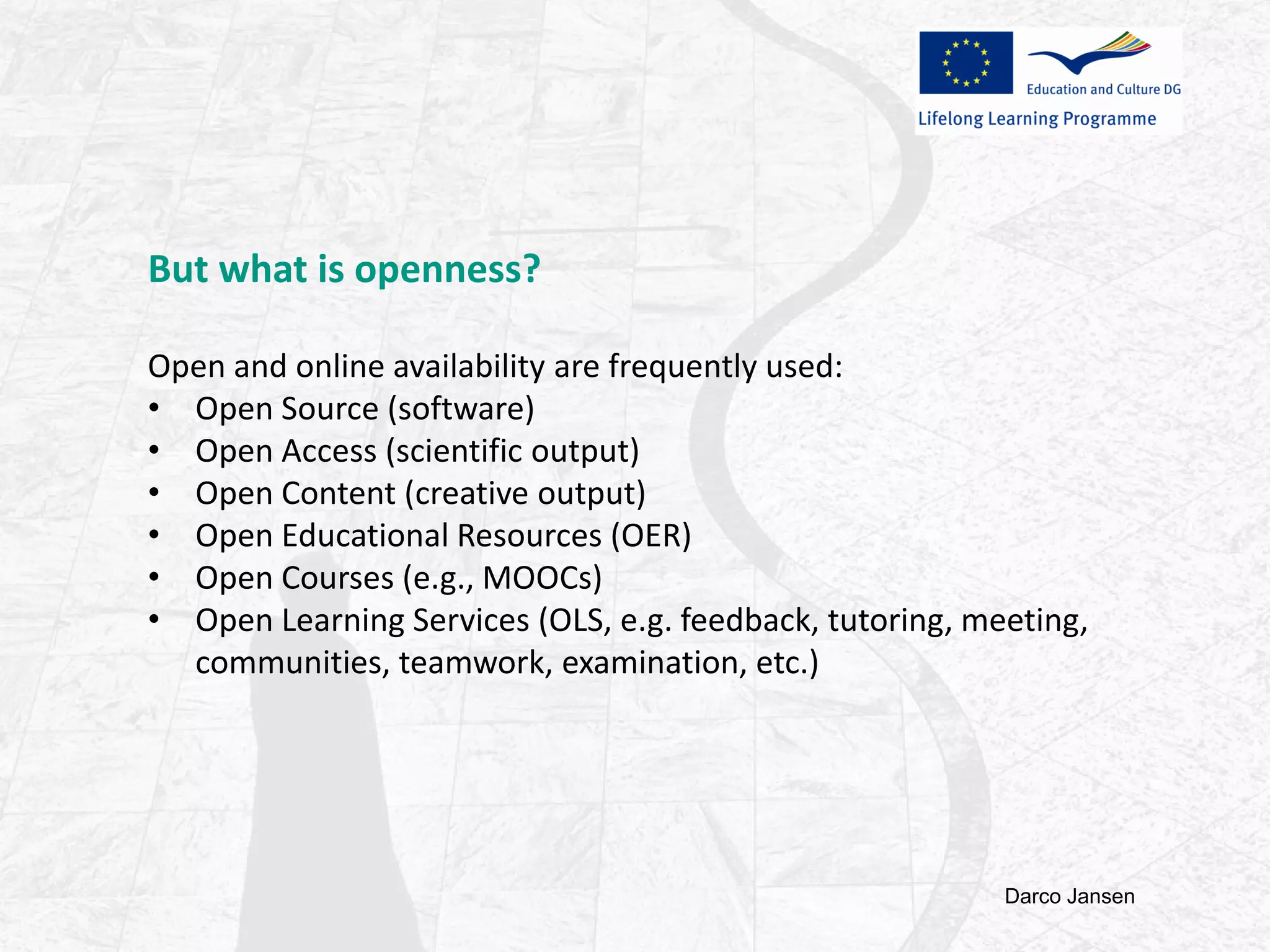
But what is openness?
Open and online availability are frequently used:
• Open Source (software)
• Open Access (scientific output)
• Open Content (creative output)
• Open Educational Resources (OER)
• Open Courses (e.g., MOOCs)
• Open Learning Services (OLS, e.g. feedback, tutoring, meeting,
communities, teamwork, examination, etc.)
Darco Jansen
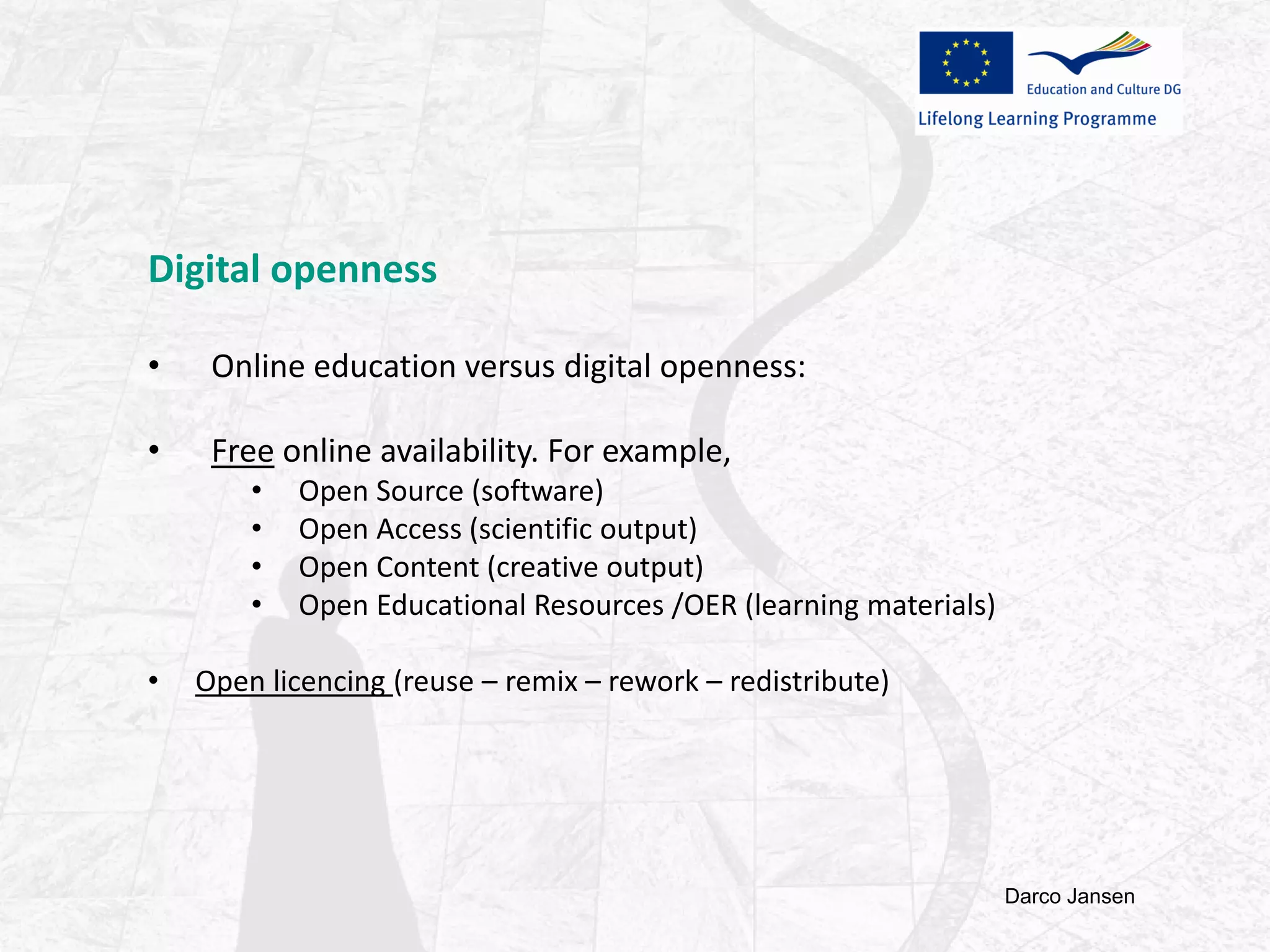
Digital openness
• Online education versus digital openness:
• Free online availability. For example,
• Open Source (software)
• Open Access (scientific output)
• Open Content (creative output)
• Open Educational Resources /OER (learning materials)
• Open licencing (reuse – remix – rework – redistribute)
Darco Jansen
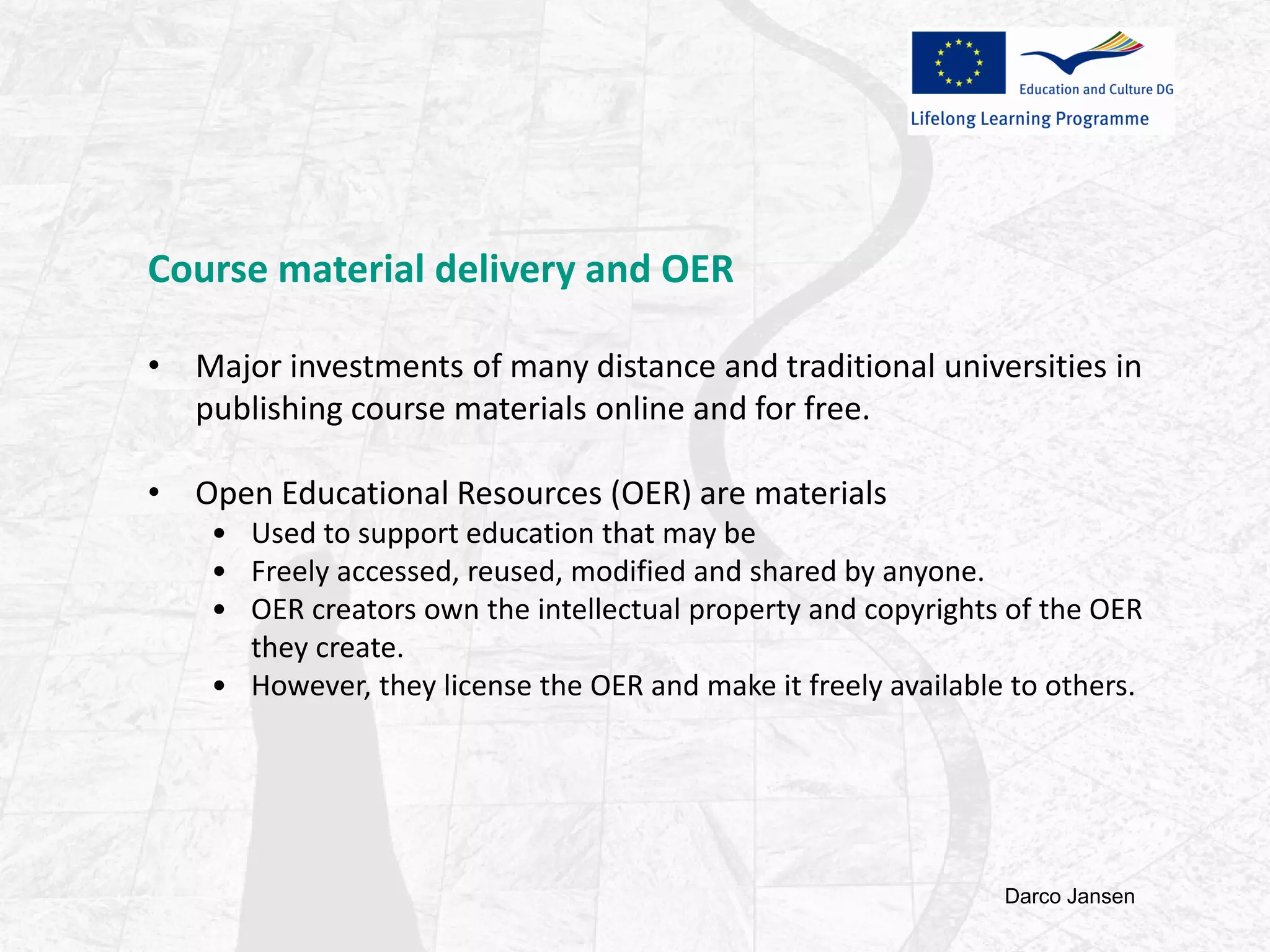
Course material delivery and OER
• Major investments of many distance and traditional universities in
publishing course materials online and for free.
• Open Educational Resources (OER) are materials
• Used to support education that may be
• Freely accessed, reused, modified and shared by anyone.
• OER creators own the intellectual property and copyrights of the OER
they create.
• However, they license the OER and make it freely available to others.
Darco Jansen
Open Educational Resources (OER)
UNESCO:
Teaching, learning and research materials in any
medium, digital or otherwise, that reside in the public
domain or have been released under an open license
that permits no-cost access, use, adaptation and
redistribution by others with no or limited restrictions.
http://ru.iite.unesco.org/files/news/639202/Paris%20OER%20Declaration_01.pdf
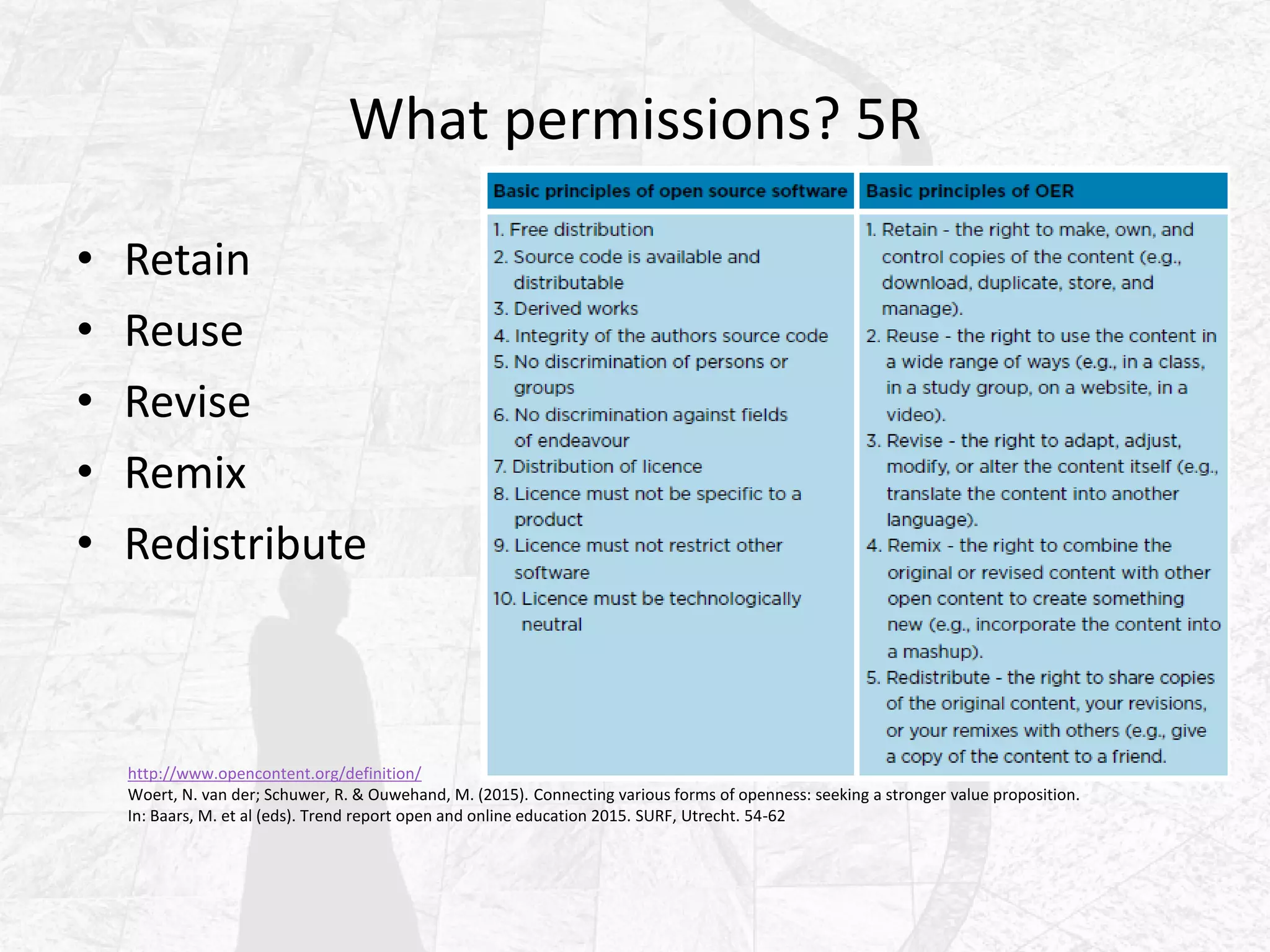
What permissions? 5R
• Retain
• Reuse
• Revise
• Remix
• Redistribute
http://www.opencontent.org/definition/
Woert, N. van der; Schuwer, R. & Ouwehand, M. (2015). Connecting various forms of openness: seeking a stronger value proposition.
In: Baars, M. et al (eds). Trend report open and online education 2015. SURF, Utrecht. 54-62
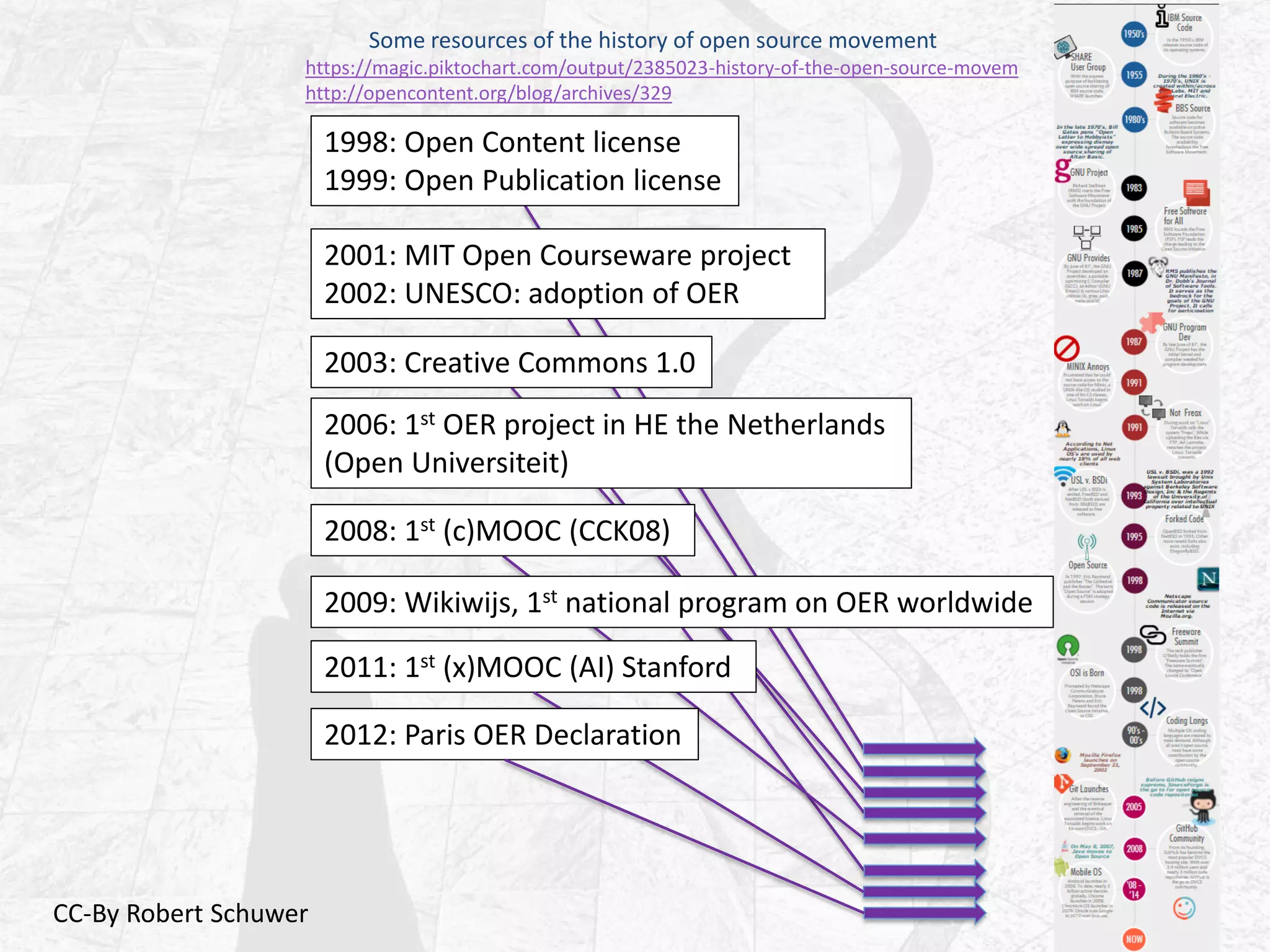
Some resources of the history of open source movement
https://magic.piktochart.com/output/2385023-history-of-the-open-source-movem
http://opencontent.org/blog/archives/329
1998: Open Content license
1999: Open Publication license
2001: MIT Open Courseware project
2002: UNESCO: adoption of OER
2003: Creative Commons 1.0
2006: 1st OER project in HE the Netherlands
(Open Universiteit)
2009: Wikiwijs, 1st national program on OER worldwide
2008: 1st (c)MOOC (CCK08)
2011: 1st (x)MOOC (AI) Stanford
2012: Paris OER Declaration
CC-By Robert Schuwer
Other opinions on open
• No registration needed (not even for free)
• Only OSS necessary to access the resource
• Always in a format accessible for people with
physical disabilities / handicapped
• Technical format of the resource makes adaptation
possible
Hylèn, J. (2007). Giving knowledge for free: The emergence of open educational resources. Paris: OECD
When is an open online course?
1. For free
2. Without entry requirements
3. Open accessible to all people
4. Always accessible anywhere anytime
5. Open without schedule (self-paced)
6. Open licensed (CC-By…)
7. Without cultural or language barriers
When is a course massive?
• Number of participants is larger than can be taught in a ‘normal’
campus class room / college situation
• >Dunbar’s ratio
• Relative to number of native speakers of language of MOOC
offering (>0,005%)
• Aimed at unlimited number of participants
• Scalable: the (pedagogical model of the) course is such that the
efforts of all services (including of academic staff on tutoring,
tests, etc.) does not increase significantly as the number of
participants increases.
How does a MOOC differ from regular courses?
• MOOCs are designed for in theory unlimited number of
participants and as such are related to the scalability of education
services
• MOOCs are for some part open, at least are accessible for free
without entry qualifications.
• All elements of course provision are provided fully online
Proposed definition
• MOOCs are online courses designed for large numbers of
participants, that can be accessed by anyone anywhere as long as
they have an internet connection, are open to everyone without
entry qualifications and offer a full/complete course experience
online for free.
• http://www.openuped.eu/images/docs/Definition_Massive_Open
_Online_Courses.pdf (adopted by many EU MOOC projects)
MOOCs or….?
• SPOC (Small Private Online Courses)
• ROOC (Regional Open Online Course)
• TORQUE (Tiny, Open-with-Restrictions courses focused on QUality
and Effectiveness)
• DOCCs (Distributed Open Collaborative Course)
• SMOC (Synchronous Massive Online Course)
• OOC (Open Online Course)
Any questions?

1. Introduction and scope - Darco Jansen (EADTU) - Presentation

  • 1.
    Training Madrid, 12-16December 2016 Designing sustainable MOOCs in Europe Introduction and Scope training 12-16 December 2016 Designing sustainable MOOCs in Europe Darco Jansen EADTU Darco.Jansen@eadtu.eu
  • 2.
    Organised as partof SCORE2020 project
  • 3.
    Aim SCORE2020 project •Support the setup of regional support centres for the development and use of MOOCs and Open Education. • Most countries of the partnership already started with some way of cross-institutional support of open education and/or MOOCs (e.g., Norway, France, the Netherlands, Ireland). • The partners will exchange and jointly develop expertise and will develop a common approach. • Transfer of possible models of regional support centres on MOOCs and Open Education to other countries and regions Darco Jansen
  • 4.
    • Finally SCORE2020will benchmark regional support centres providing scenarios for support of different target groups and evidence based practices for teachers and institutions in their use of Open Education and MOOCs. Darco Jansen
  • 8.
    MOOC • Massive • Open •Online • Course © Dave Blazek
  • 11.
    When is ita course? • The total study time of a MOOC is minimal 1 ECTS • A full course experience including 1. educational content 2. facilitation interaction among peers (including some but limited interaction with academic staff) 3. activities/tasks, tests, including feedback 4. some kind of (non formal) recognition options 5. a study guide / syllabus (including aim – learning objectives – workload - expected learning outcomes – how to achieve these – etc.
  • 12.
    What is anonline course? 1. A course where most or all of the content is delivered Online (>80% of content is delivered online). Typically there are no face-to-face meetings 2. All course activity is done online; there are no required face-to-face sessions within the course and no requirements for on-campus activity • In the context of MOOCs, online courses must be seen as a course that is offered fully online. If it’s not, then it’s a blended or hybrid course.
  • 14.
    But what isopenness? Open and online availability are frequently used: • Open Source (software) • Open Access (scientific output) • Open Content (creative output) • Open Educational Resources (OER) • Open Courses (e.g., MOOCs) • Open Learning Services (OLS, e.g. feedback, tutoring, meeting, communities, teamwork, examination, etc.) Darco Jansen
  • 15.
    Digital openness • Onlineeducation versus digital openness: • Free online availability. For example, • Open Source (software) • Open Access (scientific output) • Open Content (creative output) • Open Educational Resources /OER (learning materials) • Open licencing (reuse – remix – rework – redistribute) Darco Jansen
  • 16.
    Course material deliveryand OER • Major investments of many distance and traditional universities in publishing course materials online and for free. • Open Educational Resources (OER) are materials • Used to support education that may be • Freely accessed, reused, modified and shared by anyone. • OER creators own the intellectual property and copyrights of the OER they create. • However, they license the OER and make it freely available to others. Darco Jansen
  • 17.
    Open Educational Resources(OER) UNESCO: Teaching, learning and research materials in any medium, digital or otherwise, that reside in the public domain or have been released under an open license that permits no-cost access, use, adaptation and redistribution by others with no or limited restrictions. http://ru.iite.unesco.org/files/news/639202/Paris%20OER%20Declaration_01.pdf
  • 18.
    What permissions? 5R •Retain • Reuse • Revise • Remix • Redistribute http://www.opencontent.org/definition/ Woert, N. van der; Schuwer, R. & Ouwehand, M. (2015). Connecting various forms of openness: seeking a stronger value proposition. In: Baars, M. et al (eds). Trend report open and online education 2015. SURF, Utrecht. 54-62
  • 19.
    Some resources ofthe history of open source movement https://magic.piktochart.com/output/2385023-history-of-the-open-source-movem http://opencontent.org/blog/archives/329 1998: Open Content license 1999: Open Publication license 2001: MIT Open Courseware project 2002: UNESCO: adoption of OER 2003: Creative Commons 1.0 2006: 1st OER project in HE the Netherlands (Open Universiteit) 2009: Wikiwijs, 1st national program on OER worldwide 2008: 1st (c)MOOC (CCK08) 2011: 1st (x)MOOC (AI) Stanford 2012: Paris OER Declaration CC-By Robert Schuwer
  • 20.
    Other opinions onopen • No registration needed (not even for free) • Only OSS necessary to access the resource • Always in a format accessible for people with physical disabilities / handicapped • Technical format of the resource makes adaptation possible Hylèn, J. (2007). Giving knowledge for free: The emergence of open educational resources. Paris: OECD
  • 21.
    When is anopen online course? 1. For free 2. Without entry requirements 3. Open accessible to all people 4. Always accessible anywhere anytime 5. Open without schedule (self-paced) 6. Open licensed (CC-By…) 7. Without cultural or language barriers
  • 22.
    When is acourse massive? • Number of participants is larger than can be taught in a ‘normal’ campus class room / college situation • >Dunbar’s ratio • Relative to number of native speakers of language of MOOC offering (>0,005%) • Aimed at unlimited number of participants • Scalable: the (pedagogical model of the) course is such that the efforts of all services (including of academic staff on tutoring, tests, etc.) does not increase significantly as the number of participants increases.
  • 23.
    How does aMOOC differ from regular courses? • MOOCs are designed for in theory unlimited number of participants and as such are related to the scalability of education services • MOOCs are for some part open, at least are accessible for free without entry qualifications. • All elements of course provision are provided fully online
  • 24.
    Proposed definition • MOOCsare online courses designed for large numbers of participants, that can be accessed by anyone anywhere as long as they have an internet connection, are open to everyone without entry qualifications and offer a full/complete course experience online for free. • http://www.openuped.eu/images/docs/Definition_Massive_Open _Online_Courses.pdf (adopted by many EU MOOC projects)
  • 25.
    MOOCs or….? • SPOC(Small Private Online Courses) • ROOC (Regional Open Online Course) • TORQUE (Tiny, Open-with-Restrictions courses focused on QUality and Effectiveness) • DOCCs (Distributed Open Collaborative Course) • SMOC (Synchronous Massive Online Course) • OOC (Open Online Course)
  • 26.