MOOC’s Presentation
slides
Mthobisi Neliswa Thabethe
201310337
WHAT IS A MOOC?
Massive
 Student numbers can be 100,000 +
Open
 Study any course, anywhere at any time
Online
 As opposed to face-to-face or blended
Course
 Learning units in an academic subject
BACKGROUND HISTORY OF MOOC
• MOOC is within networks that learning can generate quite interesting
experiences. This leads us to the raise of MOOCs. The first MOOC was
launched in 2008. It was called ‘Connectivism and Connective
Knowledge/2008’ (CCK8), created by educators Stephen Downes and
George Siemens. Building off a for-credit course at the University of
Manitoba, Canada, this was the first class designed behind the acronym of
‘MOOC’ and used many different platforms to engage students with the
topic, including Facebook groups, Wiki pages, blogs, forums and other
resources.
HISTORY OF MOOC continue….
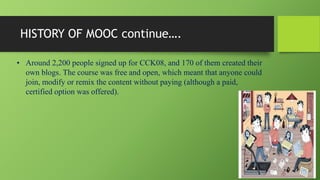
• Around 2,200 people signed up for CCK08, and 170 of them created their
own blogs. The course was free and open, which meant that anyone could
join, modify or remix the content without paying (although a paid,
certified option was offered).
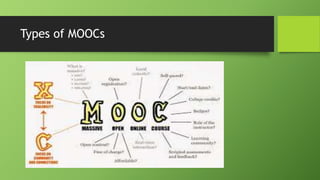
Types of MOOCs
Types of MOOCs
• xMOOC. Is the type of the learning where by the learners
share the ideas and there is only one instructor on the
discussion
• cMOOC. Hear the learners control their own learning, and they
create their own goal. The learners are not assessed or tested
weather they have met the outcomes that they where aiming at
FIELD OF INTEREST
• Life Orientation is one of the major subject I choose to teach.
• Life Orientation is a subject that enhance the holistic
development of the individual.
• It addresses skills, knowledge and values for the personal, social,
intellectual, emotional and physical growth of learners, and is
concerned with the way in which these facets are interrelated.
Life Orientation guides and prepares learners for life and its
possibilities and equips them for meaningful and successful living
in a rapidly changing and transforming society.
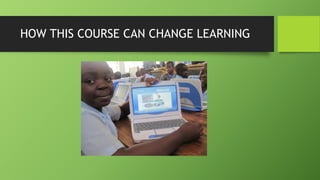
HOW THIS COURSE CAN CHANGE LEARNING
IMPORTANT TO REMEMBER:
• We need to be open and embrace Learning, Unlearning and
Relearning.
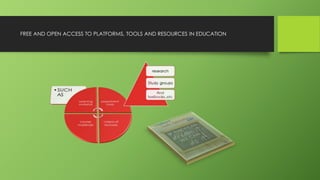
FREE AND OPEN ACCESS TO PLATFORMS, TOOLS AND RESOURCES IN EDUCATION
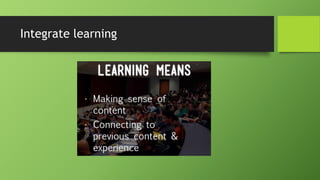
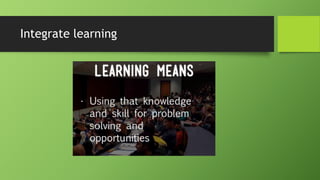
Integrate learning
Integrate learning
Presented by Mthobisi Thabethe

Mooc’s presentation slides

  • 1.
  • 2.
    WHAT IS AMOOC? Massive  Student numbers can be 100,000 + Open  Study any course, anywhere at any time Online  As opposed to face-to-face or blended Course  Learning units in an academic subject
  • 3.
    BACKGROUND HISTORY OFMOOC • MOOC is within networks that learning can generate quite interesting experiences. This leads us to the raise of MOOCs. The first MOOC was launched in 2008. It was called ‘Connectivism and Connective Knowledge/2008’ (CCK8), created by educators Stephen Downes and George Siemens. Building off a for-credit course at the University of Manitoba, Canada, this was the first class designed behind the acronym of ‘MOOC’ and used many different platforms to engage students with the topic, including Facebook groups, Wiki pages, blogs, forums and other resources.
  • 4.
    HISTORY OF MOOCcontinue…. • Around 2,200 people signed up for CCK08, and 170 of them created their own blogs. The course was free and open, which meant that anyone could join, modify or remix the content without paying (although a paid, certified option was offered).
  • 5.
  • 6.
    Types of MOOCs •xMOOC. Is the type of the learning where by the learners share the ideas and there is only one instructor on the discussion • cMOOC. Hear the learners control their own learning, and they create their own goal. The learners are not assessed or tested weather they have met the outcomes that they where aiming at
  • 7.
    FIELD OF INTEREST •Life Orientation is one of the major subject I choose to teach. • Life Orientation is a subject that enhance the holistic development of the individual. • It addresses skills, knowledge and values for the personal, social, intellectual, emotional and physical growth of learners, and is concerned with the way in which these facets are interrelated. Life Orientation guides and prepares learners for life and its possibilities and equips them for meaningful and successful living in a rapidly changing and transforming society.
  • 8.
    HOW THIS COURSECAN CHANGE LEARNING
  • 9.
    IMPORTANT TO REMEMBER: •We need to be open and embrace Learning, Unlearning and Relearning.
  • 10.
    FREE AND OPENACCESS TO PLATFORMS, TOOLS AND RESOURCES IN EDUCATION
  • 11.
  • 12.
  • 13.