FDA POST-MARKETING STUDY
 COMMITMENTS FOR SAFETY
       EVALUATION


      Professor Peivand Pirouzi
                2010
Food and Drug Administration Guidance
             Publications
Outline
• Public health burden of serious adverse
  drug events
• Reactions to drug safety systems
• Pre-approval drug evaluation
• Post-marketing safety evaluation
• Potential solutions
Serious Adverse Drug Events
             The Magnitude
• Approximately 100,000 drug-induced deaths/yr
  or the fifth leading cause of death
• Serious adverse drug events account for an
  estimated 3-6% of all hospital admissions
• Approximately 700,000 patients go to an
  Emergency Department for drug-induced,
  related adverse events
• Enormous human and societal costs
Serious Adverse Drug Events
           Time Trends
• From 1998 through 2005, 2.6-fold
  increase (from 35,000 to 90,000)
• Reported events increased faster than
  number of prescriptions
• Biotechnology products the worst
• 300 drugs accounted for 87% of all
  reported events

        Moore et al., Arch Intern Med 2007;167:1752-9
Sources of Drug Safety Information
Pre-approval
  Phase 2 and 3 trials
Post-approval
  Phase 4 trials
  MedWatch (N = 422,889 in 2004)
  Canada Vigilance
  International data
Asymmetry in the Evaluation
• Approval is contingent on evidence of
  efficacy from well-designed and adequately
  powered clinical trials
• Such trials are generally not designed to
  test specific hypotheses about safety
• The pre-market safety evaluation is often
  exploratory
Pre-Approval Phases
Phase 1 Studies: Drug cautiously given to small
group of healthy volunteers (absorption,
metabolism, excretion, early indications)
Phase 2 Studies: Beneficial and adverse effects,
and dosing in a few hundred patients with the
targeted condition
Phase 3 Trials: Comparative trials to determine
benefit vs. harm involving thousands of patients.
Intended for regulatory approval and marketing
Pre-Approval Requirements
• New drugs intended for long-term use in
  non-life threatening conditions:
• A minimum of 1,500 patients exposed
  - 300 to 600 for 6 months
  - 100 for a year
• Limits good evidence to: symptomatic
  improvement, efficacy and common side
  effects
Problems
•   Insufficient patient safety information for
    decision-making (approval
•   Limited safety data for populations most
    likely to be future users (elderly, those with
    co-morbidities)
•   Inadequate FDA review of design of studies
    for NDAs to achieve optimal detection of
    safety problems
•   Safety signals, even when recognized, often
    not actively pursued
Consequences
• Unsafe drug approved for marketing

• More than half have serious adverse drug events detected after
  approval

• 10% have Black Box Warning added

• Average number of patients exposed prior to
withdrawal approximately 4 million

• Example: Vioxx exposed to 20 million patients before wirthdrawal
Vioxx
•   A nonsteroidal anti-inflammatory drug (NSAID) that has now been
    withdrawn over safety concerns. It was marketed by Merck & Co. to treat
    osteoarthritis
•
•   Approved as safe and effective by the Food and Drug Administration
    (FDA) on May 20, 1999

•   On September 30, 2004, Merck voluntarily withdrew rofecoxib from the
    market because of concerns about increased risk of heart attack and
    stroke associated with long-term, high-dosage use.

•   In the year before withdrawal, Merck had sales revenue of US$2.5 billion from
    Vioxx.

•   FDA analysts estimated that Vioxx caused between 88,000 and 139,000 heart
    attacks, 30 to 40 percent of which were probably fatal, in the five years the drug
    was on the market.
Solutions – Pre-Approval
• More drug safety information -
  - Larger and longer trials
  - More relevant study populations
• More thorough FDA review of protocol
  design
• Proactive FDA pursuit of safety signals
• Conditional approval, if safety problems
  suspected
Post-market Commitments
• Today, 73% of new drugs have
  commitments agreed to by sponsors
• Often multiple commitments by product
• First commitment was for levodopa (1970)
    Therapeutic breakthrough for
    symptomatic relief; no cure, so concerns
    for long-term safety
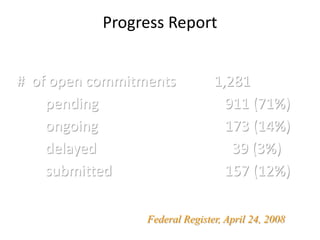
Progress Report


# of open commitments           1,281
    pending                       911 (71%)
    ongoing                       173 (14%)
    delayed                        39 (3%)
    submitted                     157 (12%)

                 Federal Register, April 24, 2008
Problems
•   Approval decisions rushed
•   Unmet commitments for safety trials
•   No penalties for failure to comply with post-approval
    study commitments
•   FDA lacks enforcement tools to leverage compliance
•   FDA’s historic post-marketing safety surveillance
    system is passive, insensitive and incomplete
•   High threshold of safety threat needed before FDA
    considers action (black box or withdrawal)
Solutions
• Unmet safety commitments by
  manufacturers should be grounds for drug
  withdrawal
• Authority to impose meaningful penalties
  for failing to conduct safety trials
• Proactive post-marketing safety surveillance
• Lower threshold for FDA actions
New Authority and Enforcement
              Tools
• FDA gets the authority to require post marketing studies
  to identify or assess potential serious risks
• FDA can also initiate timely label changes or new post
  marketing studies
• FDA may also use Risk Evaluation and Mitigation
  Strategies to ensure benefits outweigh risks
• Failure to comply may result in a determination of
  misbranding or escalating civil penalties

                   Psaty & Korn, JAMA 2007;298:2185-7
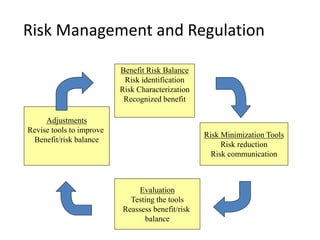
Risk Management and Regulation

                          Benefit Risk Balance
                           Risk identification
                          Risk Characterization
                           Recognized benefit

     Adjustments
Revise tools to improve
                                                  Risk Minimization Tools
 Benefit/risk balance
                                                       Risk reduction
                                                    Risk communication


                              Evaluation
                            Testing the tools
                          Reassess benefit/risk
                                balance
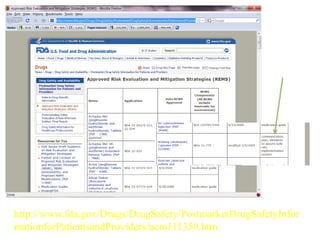
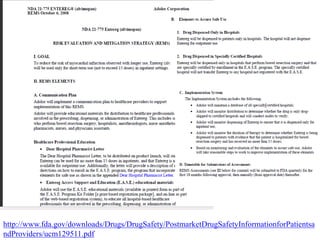
http://www.fda.gov/Drugs/DrugSafety/PostmarketDrugSafetyInfor
mationforPatientsandProviders/ucm111350.htm
http://www.fda.gov/downloads/Drugs/DrugSafety/PostmarketDrugSafetyInformationforPatientsa
ndProviders/ucm129511.pdf
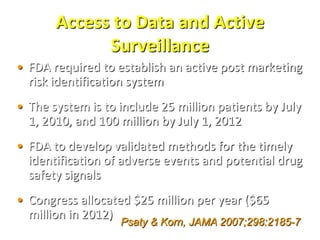
Access to Data and Active
             Surveillance
• FDA required to establish an active post marketing
  risk identification system
• The system is to include 25 million patients by July
  1, 2010, and 100 million by July 1, 2012
• FDA to develop validated methods for the timely
  identification of adverse events and potential drug
  safety signals
• Congress allocated $25 million per year ($65
  million in 2012)
                   Psaty & Korn, JAMA 2007;298:2185-7
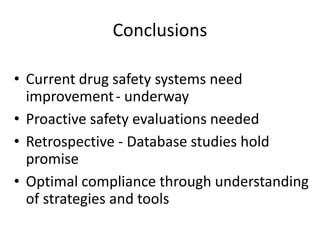
Conclusions

• Current drug safety systems need
  improvement - underway
• Proactive safety evaluations needed
• Retrospective - Database studies hold
  promise
• Optimal compliance through understanding
  of strategies and tools

Fda guidance for post marketing study commitments professor pirouzi

  • 1.
    FDA POST-MARKETING STUDY COMMITMENTS FOR SAFETY EVALUATION Professor Peivand Pirouzi 2010 Food and Drug Administration Guidance Publications
  • 2.
    Outline • Public healthburden of serious adverse drug events • Reactions to drug safety systems • Pre-approval drug evaluation • Post-marketing safety evaluation • Potential solutions
  • 3.
    Serious Adverse DrugEvents The Magnitude • Approximately 100,000 drug-induced deaths/yr or the fifth leading cause of death • Serious adverse drug events account for an estimated 3-6% of all hospital admissions • Approximately 700,000 patients go to an Emergency Department for drug-induced, related adverse events • Enormous human and societal costs
  • 4.
    Serious Adverse DrugEvents Time Trends • From 1998 through 2005, 2.6-fold increase (from 35,000 to 90,000) • Reported events increased faster than number of prescriptions • Biotechnology products the worst • 300 drugs accounted for 87% of all reported events Moore et al., Arch Intern Med 2007;167:1752-9
  • 5.
    Sources of DrugSafety Information Pre-approval Phase 2 and 3 trials Post-approval Phase 4 trials MedWatch (N = 422,889 in 2004) Canada Vigilance International data
  • 6.
    Asymmetry in theEvaluation • Approval is contingent on evidence of efficacy from well-designed and adequately powered clinical trials • Such trials are generally not designed to test specific hypotheses about safety • The pre-market safety evaluation is often exploratory
  • 7.
    Pre-Approval Phases Phase 1Studies: Drug cautiously given to small group of healthy volunteers (absorption, metabolism, excretion, early indications) Phase 2 Studies: Beneficial and adverse effects, and dosing in a few hundred patients with the targeted condition Phase 3 Trials: Comparative trials to determine benefit vs. harm involving thousands of patients. Intended for regulatory approval and marketing
  • 8.
    Pre-Approval Requirements • Newdrugs intended for long-term use in non-life threatening conditions: • A minimum of 1,500 patients exposed - 300 to 600 for 6 months - 100 for a year • Limits good evidence to: symptomatic improvement, efficacy and common side effects
  • 9.
    Problems • Insufficient patient safety information for decision-making (approval • Limited safety data for populations most likely to be future users (elderly, those with co-morbidities) • Inadequate FDA review of design of studies for NDAs to achieve optimal detection of safety problems • Safety signals, even when recognized, often not actively pursued
  • 10.
    Consequences • Unsafe drugapproved for marketing • More than half have serious adverse drug events detected after approval • 10% have Black Box Warning added • Average number of patients exposed prior to withdrawal approximately 4 million • Example: Vioxx exposed to 20 million patients before wirthdrawal
  • 11.
    Vioxx • A nonsteroidal anti-inflammatory drug (NSAID) that has now been withdrawn over safety concerns. It was marketed by Merck & Co. to treat osteoarthritis • • Approved as safe and effective by the Food and Drug Administration (FDA) on May 20, 1999 • On September 30, 2004, Merck voluntarily withdrew rofecoxib from the market because of concerns about increased risk of heart attack and stroke associated with long-term, high-dosage use. • In the year before withdrawal, Merck had sales revenue of US$2.5 billion from Vioxx. • FDA analysts estimated that Vioxx caused between 88,000 and 139,000 heart attacks, 30 to 40 percent of which were probably fatal, in the five years the drug was on the market.
  • 12.
    Solutions – Pre-Approval •More drug safety information - - Larger and longer trials - More relevant study populations • More thorough FDA review of protocol design • Proactive FDA pursuit of safety signals • Conditional approval, if safety problems suspected
  • 13.
    Post-market Commitments • Today,73% of new drugs have commitments agreed to by sponsors • Often multiple commitments by product • First commitment was for levodopa (1970) Therapeutic breakthrough for symptomatic relief; no cure, so concerns for long-term safety
  • 14.
    Progress Report # ofopen commitments 1,281 pending 911 (71%) ongoing 173 (14%) delayed 39 (3%) submitted 157 (12%) Federal Register, April 24, 2008
  • 15.
    Problems • Approval decisions rushed • Unmet commitments for safety trials • No penalties for failure to comply with post-approval study commitments • FDA lacks enforcement tools to leverage compliance • FDA’s historic post-marketing safety surveillance system is passive, insensitive and incomplete • High threshold of safety threat needed before FDA considers action (black box or withdrawal)
  • 16.
    Solutions • Unmet safetycommitments by manufacturers should be grounds for drug withdrawal • Authority to impose meaningful penalties for failing to conduct safety trials • Proactive post-marketing safety surveillance • Lower threshold for FDA actions
  • 17.
    New Authority andEnforcement Tools • FDA gets the authority to require post marketing studies to identify or assess potential serious risks • FDA can also initiate timely label changes or new post marketing studies • FDA may also use Risk Evaluation and Mitigation Strategies to ensure benefits outweigh risks • Failure to comply may result in a determination of misbranding or escalating civil penalties Psaty & Korn, JAMA 2007;298:2185-7
  • 18.
    Risk Management andRegulation Benefit Risk Balance Risk identification Risk Characterization Recognized benefit Adjustments Revise tools to improve Risk Minimization Tools Benefit/risk balance Risk reduction Risk communication Evaluation Testing the tools Reassess benefit/risk balance
  • 19.
  • 20.
  • 21.
    Access to Dataand Active Surveillance • FDA required to establish an active post marketing risk identification system • The system is to include 25 million patients by July 1, 2010, and 100 million by July 1, 2012 • FDA to develop validated methods for the timely identification of adverse events and potential drug safety signals • Congress allocated $25 million per year ($65 million in 2012) Psaty & Korn, JAMA 2007;298:2185-7
  • 22.
    Conclusions • Current drugsafety systems need improvement - underway • Proactive safety evaluations needed • Retrospective - Database studies hold promise • Optimal compliance through understanding of strategies and tools