ICH GUIDELINESHARMONISING FOR BETTER HEALTH    BY    T.SATHISH KUMAR    PHARMACOVIGILANCE
 CLINICAL SAFETY DATA MANAGEMENT: DEFINITIONS AND STANDARDS FOR EXPEDITED REPORTING (E2A)
CONTENTS INTRODUCTION
DEFINITIONS AND TERMINOLOGY
 STANDARDS FOR EXPEDITED REPORTING
 DATA ELEMENTS FOR EXPEDITEDREPORTSINTRODUCTIONEnsure uniform Good Clinical Practice standards in   drug developmental stage
The development of standard definitions and terminology for key aspects of clinical safety reporting
For appropriate mechanism for handling expedited (rapid) reporting, in the investigational phaseDEFINITIONS AND TERMINOLOGY ASSOCIATED WITH CLINICAL SAFETY EXPERIENCEAdverse Event (or Adverse Experience)Any untoward medical occurrence in a patient or clinical investigation subject administered a pharmaceutical product and which does not necessarily have a causal relationship with this treatment
DEFINITIONS AND TERMINOLOGY ASSOCIATED WITH CLINICAL SAFETY EXPERIENCE          Adverse Drug Reaction (ADR)In the pre-approval clinical experience :All noxious and unintended responses to a medicinal product related to any dose should be considered adverse drug reactions
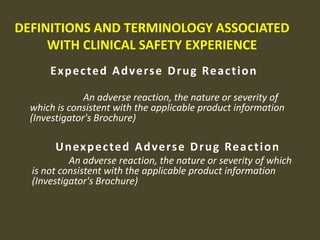
DEFINITIONS AND TERMINOLOGY ASSOCIATED WITH CLINICAL SAFETY EXPERIENCEExpected Adverse Drug ReactionAn adverse reaction, the nature or severity of which is consistent with the applicable product information (Investigator's Brochure)          Unexpected Adverse Drug ReactionAn adverse reaction, the nature or severity of which is not consistent with the applicable product information (Investigator's Brochure)
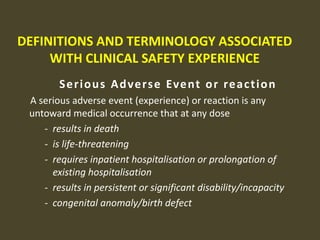
DEFINITIONS AND TERMINOLOGY ASSOCIATED WITH CLINICAL SAFETY EXPERIENCESerious Adverse Event or reaction        A serious adverse event (experience) or reaction is any untoward medical occurrence that at any dose              -  results in death              -  is life-threatening              -  requires inpatient hospitalisation or prolongation of                       	    existing hospitalisation              -  results in persistent or significant disability/incapacity              -  congenital anomaly/birth defect
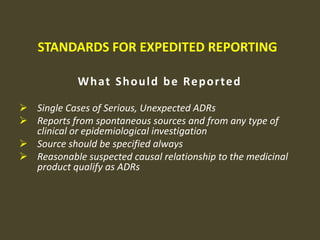
STANDARDS FOR EXPEDITED REPORTINGWhat Should be ReportedSingle Cases of Serious, Unexpected ADRs
Reports from spontaneous sources and from any type of clinical or epidemiological investigation
Source should be specified always
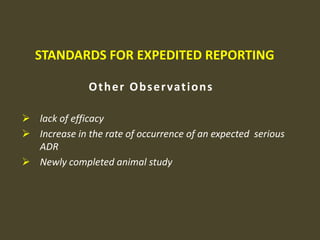
Reasonable suspected causal relationship to the medicinal product qualify as ADRsSTANDARDS FOR EXPEDITED REPORTINGOther Observationslack of efficacy
Increase in the rate of occurrence of an expected  serious  ADR
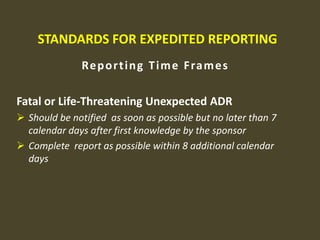
Newly completed animal study STANDARDS FOR EXPEDITED REPORTINGReporting Time FramesFatal or Life-Threatening Unexpected ADRShould be notified  as soon as possible but no later than 7 calendar days after first knowledge by the sponsor
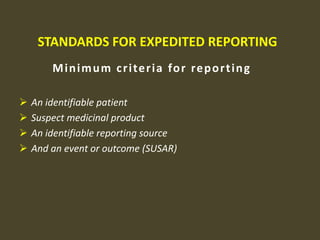
Complete  report as possible within 8 additional calendar   daysSTANDARDS FOR EXPEDITED REPORTING               Reporting Time FramesAll Other Serious, Unexpected ADRs	No later than 15 calendar days after first knowledge by the sponsorSTANDARDS FOR EXPEDITED REPORTING        Minimum criteria for reportingAn identifiable patient
Suspect medicinal product
An identifiable reporting source

ICH E2A GUIDELINE

  • 1.
    ICH GUIDELINESHARMONISING FORBETTER HEALTH BY T.SATHISH KUMAR PHARMACOVIGILANCE
  • 2.
    CLINICAL SAFETYDATA MANAGEMENT: DEFINITIONS AND STANDARDS FOR EXPEDITED REPORTING (E2A)
  • 3.
  • 4.
  • 5.
    STANDARDS FOREXPEDITED REPORTING
  • 6.
    DATA ELEMENTSFOR EXPEDITEDREPORTSINTRODUCTIONEnsure uniform Good Clinical Practice standards in drug developmental stage
  • 7.
    The development ofstandard definitions and terminology for key aspects of clinical safety reporting
  • 8.
    For appropriate mechanismfor handling expedited (rapid) reporting, in the investigational phaseDEFINITIONS AND TERMINOLOGY ASSOCIATED WITH CLINICAL SAFETY EXPERIENCEAdverse Event (or Adverse Experience)Any untoward medical occurrence in a patient or clinical investigation subject administered a pharmaceutical product and which does not necessarily have a causal relationship with this treatment
  • 9.
    DEFINITIONS AND TERMINOLOGYASSOCIATED WITH CLINICAL SAFETY EXPERIENCE Adverse Drug Reaction (ADR)In the pre-approval clinical experience :All noxious and unintended responses to a medicinal product related to any dose should be considered adverse drug reactions
  • 10.
    DEFINITIONS AND TERMINOLOGYASSOCIATED WITH CLINICAL SAFETY EXPERIENCEExpected Adverse Drug ReactionAn adverse reaction, the nature or severity of which is consistent with the applicable product information (Investigator's Brochure) Unexpected Adverse Drug ReactionAn adverse reaction, the nature or severity of which is not consistent with the applicable product information (Investigator's Brochure)
  • 11.
    DEFINITIONS AND TERMINOLOGYASSOCIATED WITH CLINICAL SAFETY EXPERIENCESerious Adverse Event or reaction A serious adverse event (experience) or reaction is any untoward medical occurrence that at any dose - results in death - is life-threatening - requires inpatient hospitalisation or prolongation of existing hospitalisation - results in persistent or significant disability/incapacity - congenital anomaly/birth defect
  • 12.
    STANDARDS FOR EXPEDITEDREPORTINGWhat Should be ReportedSingle Cases of Serious, Unexpected ADRs
  • 13.
    Reports from spontaneoussources and from any type of clinical or epidemiological investigation
  • 14.
    Source should bespecified always
  • 15.
    Reasonable suspected causalrelationship to the medicinal product qualify as ADRsSTANDARDS FOR EXPEDITED REPORTINGOther Observationslack of efficacy
  • 16.
    Increase in therate of occurrence of an expected serious ADR
  • 17.
    Newly completed animalstudy STANDARDS FOR EXPEDITED REPORTINGReporting Time FramesFatal or Life-Threatening Unexpected ADRShould be notified as soon as possible but no later than 7 calendar days after first knowledge by the sponsor
  • 18.
    Complete reportas possible within 8 additional calendar daysSTANDARDS FOR EXPEDITED REPORTING Reporting Time FramesAll Other Serious, Unexpected ADRs No later than 15 calendar days after first knowledge by the sponsorSTANDARDS FOR EXPEDITED REPORTING Minimum criteria for reportingAn identifiable patient
  • 19.
  • 20.
  • 21.
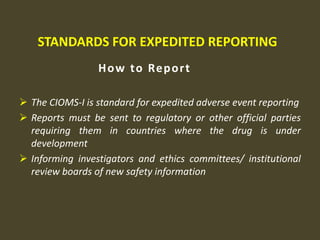
    And an eventor outcome (SUSAR)STANDARDS FOR EXPEDITED REPORTINGHow to ReportThe CIOMS-I is standard for expedited adverse event reporting
  • 22.
    Reports must besent to regulatory or other official parties requiring them in countries where the drug is under development
  • 23.
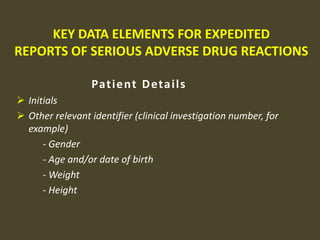
    Informing investigators andethics committees/ institutional review boards of new safety informationKEY DATA ELEMENTS FOR EXPEDITEDREPORTS OF SERIOUS ADVERSE DRUG REACTIONSPatient DetailsInitials
  • 24.
    Other relevant identifier(clinical investigation number, for example) - Gender - Age and/or date of birth - Weight - Height
  • 25.
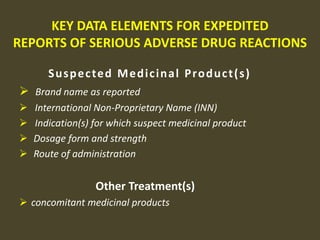
    KEY DATA ELEMENTSFOR EXPEDITEDREPORTS OF SERIOUS ADVERSE DRUG REACTIONSSuspected Medicinal Product(s)Brand name as reported
  • 26.
  • 27.
    Indication(s) for whichsuspect medicinal product
  • 28.
  • 29.
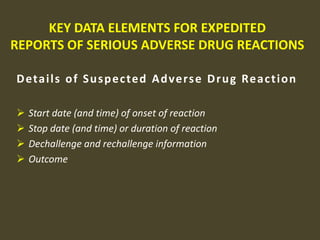
    Route ofadministrationOther Treatment(s)concomitant medicinal productsKEY DATA ELEMENTS FOR EXPEDITEDREPORTS OF SERIOUS ADVERSE DRUG REACTIONSDetails of Suspected Adverse Drug ReactionStart date (and time) of onset of reaction
  • 30.
    Stop date (andtime) or duration of reaction
  • 31.
  • 32.
    OutcomeKEY DATA ELEMENTSFOR EXPEDITEDREPORTS OF SERIOUS ADVERSE DRUG REACTIONS Other details Details on Reporter of Event
  • 33.
  • 34.