A Seminar on
DRUG DEVELOPMENT & DRUG APPROVAL
PROCESS
Submited to
Savitribai Phule , University of Pune
In Partial fulifillment of Requirements for the Award of
Degree of
MASTER OF PHARMACY
IN
QUALITY ASSURANCE TECHNIQUES
Presented by- Guided by-
Miss.Veena.S.Katoriya Dr.Gitanjali S.Deokar
M.Pharm(QAT)Sem III (M.Pharm,Ph.D)
Bhujbal Knowledge City,
MET’S Institute of Pharmacy,
Adgaon,Nashik.
2015-2016
1
CONTENTS
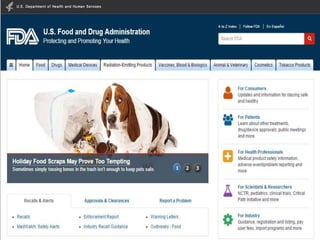
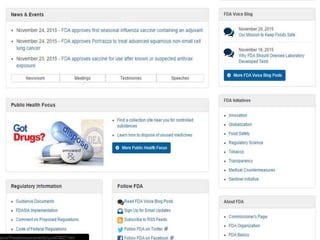
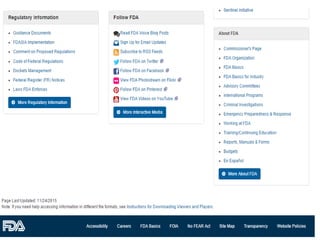
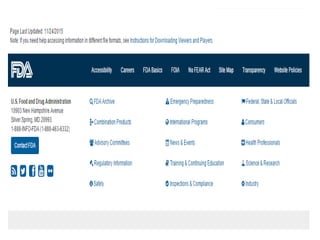
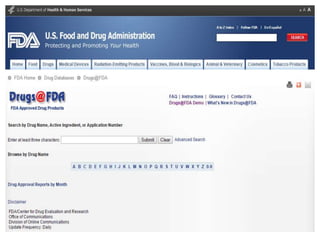
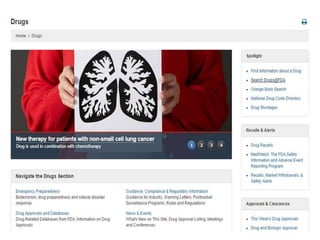
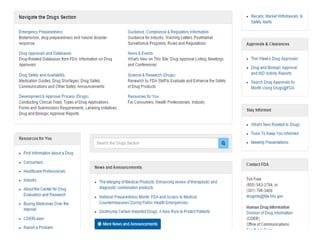
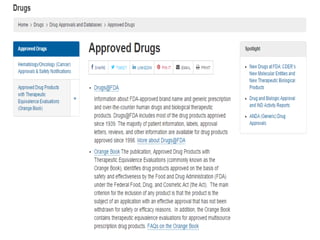
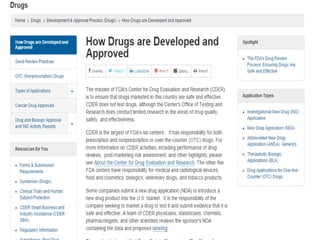
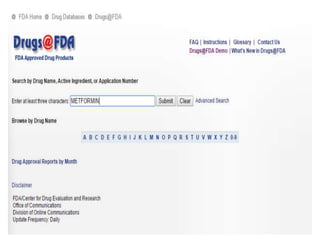
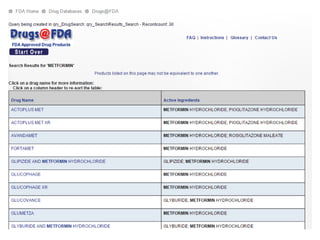
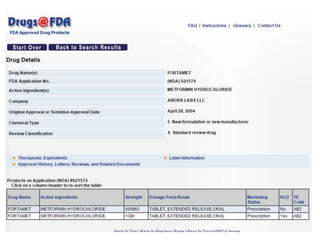
• Snapshots of FDA site
• Introduction
-US FDA-General Introduction
• FDA structure/organization
• Food Products
• Drugs
• Drug discovery & Drug development
INTRODUCTION
• The Food and Drug Administration (FDA) is an agency within the U.S.
Department of Health and Human Services. It consists of the Office of the
Commissioner and four directorates overseeing the core functions of the
agency: Medical Products and Tobacco, Foods and Veterinary
Medicine, Global Regulatory Operations and Policy, and Operations.
• FDA is responsible for protecting public health by:
-Safety -Dietary supplements
-Effectiveness -Regulating tobacco products
-Quality
-Security of Human
-Veterinary drugs
-Vaccines
-Other Biological products
-Medical devices
-Nation’s food supply
-All cosmetics
HEADQUARTERS
• The FDA has its headquarters at White Oak,Maryland.The
agency also has 223 field offices & 13 laboratories located
throughout the 50 states.
• In 2008,the FDA started opening offices in foreign countries
including China,India,Chile,Belgium & the United Kingdom.
US FDA-General Introduction
• U.S Department of Health & Human Services
Divisions of US FDA:
• Food
• Drugs
• Medical Devices
• Radiation-Emitting Products
• Vaccines,Blood & Biologics
• Animal & Veterinary
• Cosmetics
• Tobacco Products
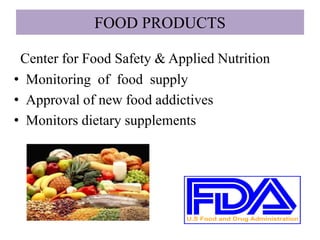
FOOD PRODUCTS
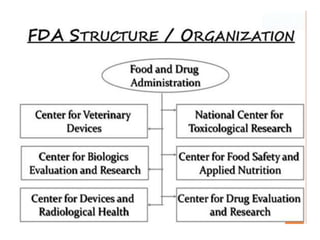
Center for Food Safety & Applied Nutrition
• Monitoring of food supply
• Approval of new food addictives
• Monitors dietary supplements
DRUGS
• The Center for Drug Evaluation and Research involves regulation of three main
drug product types:
New drugs
Generic drugs
Over-the-counter drugs
• It covers more than just medicines.
E.g. Fluoride toothpaste, antiperspirants, dandruff shampoos and sunscreens are all
considered "drugs."
New drugs
New drugs receive extensive scrutiny before FDA approval in a process called
a New Drug Application (NDA).New drugs are available only by prescription by
default.
Generic drugs
Generic drugs are chemical equivalents of name-brand
Approval is done by Food and Drug Administration (FDA)
Over-the-counter (OTC) drugs
FDA has a list of approximately 800 approved ingredients that are combined in
various ways to create more than 100,000 OTC drug products.
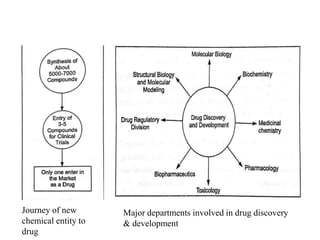
Journey of new
chemical entity to
drug
Major departments involved in drug discovery
& development
8
DEFINITION OF A NEW DRUG
• Any chemical or substance not previously used in humans for the
treatment of a disease
• Combinations of approved drugs or of old drugs even though the
individual components are not new drugs
• An approved drug employed for uses other than those approved
• A new dosage form of an approved drug
• Even a drug used in vitro as a diagnostic agent when its uses will
influence the diagnosis or treatment of disease in a human patient
DRUG DISCOVERY & DEVELOPMENT
• Drug Discovery Phase:
- Selection of Active Pharmaceutical Ingredients(API)
- Lead compound identification & optimization(SAR)
• Product Development Phase:
-Pharmaceutical development
-Non-clinical development
-Clinical development
-Regulatory
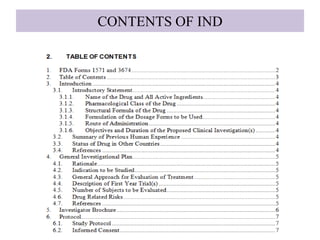
CONTENTS OF IND
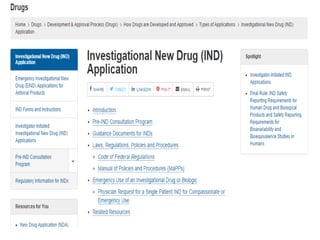
• Investigational new drug application (IND), as described in
title 21 of the Code of Federal Regulations, part 312 (21 CFR
part 312) (the IND regulations). This guidance describes when
an IND is required, specific situations in which an IND is not
required, and a range of issues that, in FDA’s experience, have
been the source of confusion or misperceptions about the
application of the IND regulations. This guidance addresses
only whether an IND is needed. If your study also involves the
use of a device, you should determine whether such use is
subject to 21 CFR part 812 (the IDE regulations).
INVESTIGATIONAL NEW DRUG
APPLICATION (IND)
• The IND submitted to the FDA contains the results of all preclinical
investigations carried out in animals, including complete toxicity data,
the full pharmacologic spectrum of the drug and any studies of
absorption, distribution, biotransformation and excretion. In addition, the
IND must provide the following information:
– Copies of all informational material supplied to each
investigator (the data sheets supplied to the investigator
incorporate the data supplied in the IND itself)
– An agreement from the sponsor to notify FDA and all
investigators of any adverse effects that arise during either the
continuing animal studies or human tests
– Agreement to submit annual progress reports
– Certification that "informed consent" will be obtained from the
subjects or patients to whom the drug will be given
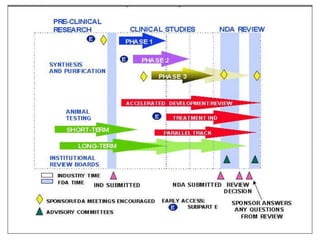
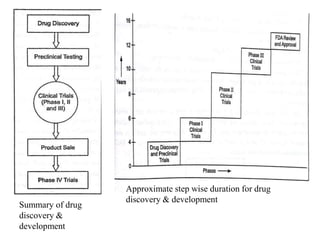
Summary of drug
discovery &
development
Approximate step wise duration for drug
discovery & development
PHASE I STUDIES
• Requires an FDA approved IND to commence .
• Conducted in normal healthy human volunteers
• Performed under carefully controlled conditions
• Toxicological and pharmacological data obtained by a
trained clinical pharmacologist
• Drug first administered at one tenth the ultimate projected
effective dose.
•Studies involve about 20 to 80 volunteers.
•Tests determine a drug's safety profile, including the safe
dosage ,absorbtion,distribution,metabolism and excretion and
duration of its action.
•Phase I trials take on the average 1 year.
PHASE II STUDIES
• Randomized control trials in patients with the disease for which the
drug is intended or as a pretreatment to prevent disease
• Trials involve 100 to 300 volunteer patients and are controlled in
design
• Doses are higher than those in Phase I
• Studies may last several months to two years
• Safety still an important concern, but efficacy is the major
emphasis
• Flexibility in the design of studies is very desirable at this stage
• Extremely slow metabolism of drug with accumulation of
subsequent doses and toxicity might require additional studies at
this point
•Changes in the original protocol require the submission of
amendments to IND and additional review by IRB’s
•This phase is designed to identify minimum and maximum doses.
•Phase II typically takes about 2 years.
PHASE III STUDIES
• Large-scale controlled studies
• Major objective is to develop data to permit the drug to be
marketed and used safely and effectively
• Multi-patient – multi-center study
• May involve as many as 150 clinicians, many of whom are
experienced clinical pharmacologists
• Usually involves 1500 to as many as 4000 patients
• Study generally lasts anywhere from 2 –10 years with an average
length of 5 years
• Study examines safety and effectiveness, but emphasizes proper
dose determination
• The following studies may be conducted at this stage:
– drug biotransformation
– capacity of drug to bind to plasma proteins
– to induce or inhibit enzymes
– to interact in various ways with other drugs
THE NEW DRUG APPLICATION (NDA)
• When the sponsor is convinced that the data obtained in Phase III
studies justify approval for safety and efficacy for the use(s)
intended, the NDA is submitted
• Usually, at least 5 years has elapsed since the drug was originally
screened
• The NDA contains all of the chemical, pharmacologic,
toxicologic., clinical and maufacturing data that have been
collected in the whole process
• The NDA also contains bioequivalence and bioavailability data
• If the NDA is deemed for some reason to be incomplete, the
sponsor is required to resubmit additional
• If there is a disagreement between FDA and the sponsor then a
hearing may be held and the outcome is appealable in Court
• Less than 25% of all new drugs for marketing are novel or new
molecular entities (NME’s). The rest are new salts, new
formulations, new indications or duplicates of drugs previously
approved for marketing
PHASE IV – POSTMARKETING
SURVEILLANCE
• Reports must include the following information about:
– quantity of drug distributed
– copies of mailing pieces and labeling
– examples of advertising for prescription drugs
• Immediate reports on unexpected side-effects, injury, toxic or
allergic reactions and failure of the drug to exert its expected
pharmacologic reaction
FDA Regulates…
Biologics:
• Vaccines
• Blood and blood products
• Cellular and gene therapy products
• Allergenic
Cosmetics including:
• color additives
• skin moisturizers and cleansers
• nail polish and perfume
Safe Blood Supply and Vaccine
Development
Biologics Evaluation and Research branch works on this..
Aims:
• Ensures safety of blood products supply and regulation of vaccine
products
• Addresses areas such as emergency operations, response to
emerging diseases, and updating of regulations.
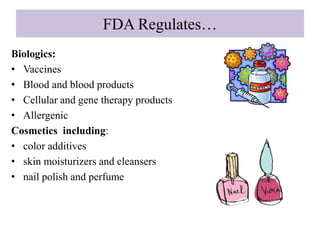
• Vaccine approval
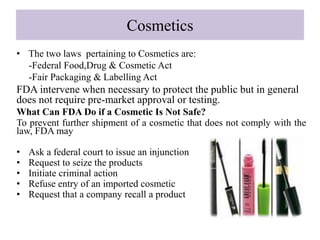
Cosmetics
• The two laws pertaining to Cosmetics are:
-Federal Food,Drug & Cosmetic Act
-Fair Packaging & Labelling Act
FDA intervene when necessary to protect the public but in general
does not require pre-market approval or testing.
What Can FDA Do if a Cosmetic Is Not Safe?
To prevent further shipment of a cosmetic that does not comply with the
law, FDA may
• Ask a federal court to issue an injunction
• Request to seize the products
• Initiate criminal action
• Refuse entry of an imported cosmetic
• Request that a company recall a product
Center for Devices and Radiological Health
deals with…..
Medical Devices:
• Simple items like tongue depressors
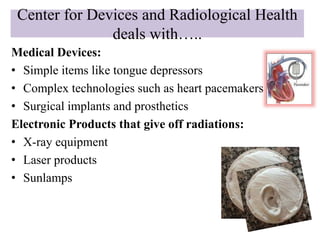
• Complex technologies such as heart pacemakers
• Surgical implants and prosthetics
Electronic Products that give off radiations:
• X-ray equipment
• Laser products
• Sunlamps
FDA also regulates…..
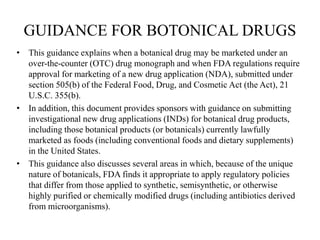
Veterinary Products including:
• livestock feeds
• veterinary drugs and devices
Tobacco Products:
• cigarette tobacco
• smokeless tobacco
GUIDANCE FOR BOTONICAL DRUGS
• This guidance explains when a botanical drug may be marketed under an
over-the-counter (OTC) drug monograph and when FDA regulations require
approval for marketing of a new drug application (NDA), submitted under
section 505(b) of the Federal Food, Drug, and Cosmetic Act (the Act), 21
U.S.C. 355(b).
• In addition, this document provides sponsors with guidance on submitting
investigational new drug applications (INDs) for botanical drug products,
including those botanical products (or botanicals) currently lawfully
marketed as foods (including conventional foods and dietary supplements)
in the United States.
• This guidance also discusses several areas in which, because of the unique
nature of botanicals, FDA finds it appropriate to apply regulatory policies
that differ from those applied to synthetic, semisynthetic, or otherwise
highly purified or chemically modified drugs (including antibiotics derived
from microorganisms).
REFERENCES
• https://www.accessdata.fda.gov/scripts/cder/drugsatfda/
• http://www.fda.gov/Drugs/default.htm
• http://www.fda.gov/drugs/developmentapprovalprocess/howdrugs
aredevelopedandapproved/approvalapplications/investigationalne
wdrugindapplication/default.htm
• http://www.fda.gov/downloads/Drugs/Guidances/UCM229175.pd
f
• http://www.fda.gov/downloads/drugs/guidancecomplianceregulat
oryinformation/guidances/ucm070491.pdf
Veena Sanjay Katoriya

Veena Sanjay Katoriya

  • 1.
    A Seminar on DRUGDEVELOPMENT & DRUG APPROVAL PROCESS Submited to Savitribai Phule , University of Pune In Partial fulifillment of Requirements for the Award of Degree of MASTER OF PHARMACY IN QUALITY ASSURANCE TECHNIQUES Presented by- Guided by- Miss.Veena.S.Katoriya Dr.Gitanjali S.Deokar M.Pharm(QAT)Sem III (M.Pharm,Ph.D) Bhujbal Knowledge City, MET’S Institute of Pharmacy, Adgaon,Nashik. 2015-2016 1
  • 2.
    CONTENTS • Snapshots ofFDA site • Introduction -US FDA-General Introduction • FDA structure/organization • Food Products • Drugs • Drug discovery & Drug development
  • 7.
    INTRODUCTION • The Foodand Drug Administration (FDA) is an agency within the U.S. Department of Health and Human Services. It consists of the Office of the Commissioner and four directorates overseeing the core functions of the agency: Medical Products and Tobacco, Foods and Veterinary Medicine, Global Regulatory Operations and Policy, and Operations. • FDA is responsible for protecting public health by: -Safety -Dietary supplements -Effectiveness -Regulating tobacco products -Quality -Security of Human -Veterinary drugs -Vaccines -Other Biological products -Medical devices -Nation’s food supply -All cosmetics
  • 8.
    HEADQUARTERS • The FDAhas its headquarters at White Oak,Maryland.The agency also has 223 field offices & 13 laboratories located throughout the 50 states. • In 2008,the FDA started opening offices in foreign countries including China,India,Chile,Belgium & the United Kingdom.
  • 9.
    US FDA-General Introduction •U.S Department of Health & Human Services Divisions of US FDA: • Food • Drugs • Medical Devices • Radiation-Emitting Products • Vaccines,Blood & Biologics • Animal & Veterinary • Cosmetics • Tobacco Products
  • 12.
    FOOD PRODUCTS Center forFood Safety & Applied Nutrition • Monitoring of food supply • Approval of new food addictives • Monitors dietary supplements
  • 13.
    DRUGS • The Centerfor Drug Evaluation and Research involves regulation of three main drug product types: New drugs Generic drugs Over-the-counter drugs • It covers more than just medicines. E.g. Fluoride toothpaste, antiperspirants, dandruff shampoos and sunscreens are all considered "drugs." New drugs New drugs receive extensive scrutiny before FDA approval in a process called a New Drug Application (NDA).New drugs are available only by prescription by default. Generic drugs Generic drugs are chemical equivalents of name-brand Approval is done by Food and Drug Administration (FDA) Over-the-counter (OTC) drugs FDA has a list of approximately 800 approved ingredients that are combined in various ways to create more than 100,000 OTC drug products.
  • 22.
    Journey of new chemicalentity to drug Major departments involved in drug discovery & development
  • 23.
  • 24.
    DEFINITION OF ANEW DRUG • Any chemical or substance not previously used in humans for the treatment of a disease • Combinations of approved drugs or of old drugs even though the individual components are not new drugs • An approved drug employed for uses other than those approved • A new dosage form of an approved drug • Even a drug used in vitro as a diagnostic agent when its uses will influence the diagnosis or treatment of disease in a human patient
  • 25.
    DRUG DISCOVERY &DEVELOPMENT • Drug Discovery Phase: - Selection of Active Pharmaceutical Ingredients(API) - Lead compound identification & optimization(SAR) • Product Development Phase: -Pharmaceutical development -Non-clinical development -Clinical development -Regulatory
  • 27.
  • 29.
    • Investigational newdrug application (IND), as described in title 21 of the Code of Federal Regulations, part 312 (21 CFR part 312) (the IND regulations). This guidance describes when an IND is required, specific situations in which an IND is not required, and a range of issues that, in FDA’s experience, have been the source of confusion or misperceptions about the application of the IND regulations. This guidance addresses only whether an IND is needed. If your study also involves the use of a device, you should determine whether such use is subject to 21 CFR part 812 (the IDE regulations).
  • 30.
    INVESTIGATIONAL NEW DRUG APPLICATION(IND) • The IND submitted to the FDA contains the results of all preclinical investigations carried out in animals, including complete toxicity data, the full pharmacologic spectrum of the drug and any studies of absorption, distribution, biotransformation and excretion. In addition, the IND must provide the following information: – Copies of all informational material supplied to each investigator (the data sheets supplied to the investigator incorporate the data supplied in the IND itself) – An agreement from the sponsor to notify FDA and all investigators of any adverse effects that arise during either the continuing animal studies or human tests – Agreement to submit annual progress reports – Certification that "informed consent" will be obtained from the subjects or patients to whom the drug will be given
  • 31.
    Summary of drug discovery& development Approximate step wise duration for drug discovery & development
  • 32.
    PHASE I STUDIES •Requires an FDA approved IND to commence . • Conducted in normal healthy human volunteers • Performed under carefully controlled conditions • Toxicological and pharmacological data obtained by a trained clinical pharmacologist • Drug first administered at one tenth the ultimate projected effective dose. •Studies involve about 20 to 80 volunteers. •Tests determine a drug's safety profile, including the safe dosage ,absorbtion,distribution,metabolism and excretion and duration of its action. •Phase I trials take on the average 1 year.
  • 33.
    PHASE II STUDIES •Randomized control trials in patients with the disease for which the drug is intended or as a pretreatment to prevent disease • Trials involve 100 to 300 volunteer patients and are controlled in design • Doses are higher than those in Phase I • Studies may last several months to two years • Safety still an important concern, but efficacy is the major emphasis • Flexibility in the design of studies is very desirable at this stage • Extremely slow metabolism of drug with accumulation of subsequent doses and toxicity might require additional studies at this point •Changes in the original protocol require the submission of amendments to IND and additional review by IRB’s •This phase is designed to identify minimum and maximum doses. •Phase II typically takes about 2 years.
  • 34.
    PHASE III STUDIES •Large-scale controlled studies • Major objective is to develop data to permit the drug to be marketed and used safely and effectively • Multi-patient – multi-center study • May involve as many as 150 clinicians, many of whom are experienced clinical pharmacologists • Usually involves 1500 to as many as 4000 patients • Study generally lasts anywhere from 2 –10 years with an average length of 5 years • Study examines safety and effectiveness, but emphasizes proper dose determination • The following studies may be conducted at this stage: – drug biotransformation – capacity of drug to bind to plasma proteins – to induce or inhibit enzymes – to interact in various ways with other drugs
  • 35.
    THE NEW DRUGAPPLICATION (NDA) • When the sponsor is convinced that the data obtained in Phase III studies justify approval for safety and efficacy for the use(s) intended, the NDA is submitted • Usually, at least 5 years has elapsed since the drug was originally screened • The NDA contains all of the chemical, pharmacologic, toxicologic., clinical and maufacturing data that have been collected in the whole process • The NDA also contains bioequivalence and bioavailability data • If the NDA is deemed for some reason to be incomplete, the sponsor is required to resubmit additional • If there is a disagreement between FDA and the sponsor then a hearing may be held and the outcome is appealable in Court • Less than 25% of all new drugs for marketing are novel or new molecular entities (NME’s). The rest are new salts, new formulations, new indications or duplicates of drugs previously approved for marketing
  • 36.
    PHASE IV –POSTMARKETING SURVEILLANCE • Reports must include the following information about: – quantity of drug distributed – copies of mailing pieces and labeling – examples of advertising for prescription drugs • Immediate reports on unexpected side-effects, injury, toxic or allergic reactions and failure of the drug to exert its expected pharmacologic reaction
  • 37.
    FDA Regulates… Biologics: • Vaccines •Blood and blood products • Cellular and gene therapy products • Allergenic Cosmetics including: • color additives • skin moisturizers and cleansers • nail polish and perfume
  • 38.
    Safe Blood Supplyand Vaccine Development Biologics Evaluation and Research branch works on this.. Aims: • Ensures safety of blood products supply and regulation of vaccine products • Addresses areas such as emergency operations, response to emerging diseases, and updating of regulations. • Vaccine approval
  • 39.
    Cosmetics • The twolaws pertaining to Cosmetics are: -Federal Food,Drug & Cosmetic Act -Fair Packaging & Labelling Act FDA intervene when necessary to protect the public but in general does not require pre-market approval or testing. What Can FDA Do if a Cosmetic Is Not Safe? To prevent further shipment of a cosmetic that does not comply with the law, FDA may • Ask a federal court to issue an injunction • Request to seize the products • Initiate criminal action • Refuse entry of an imported cosmetic • Request that a company recall a product
  • 40.
    Center for Devicesand Radiological Health deals with….. Medical Devices: • Simple items like tongue depressors • Complex technologies such as heart pacemakers • Surgical implants and prosthetics Electronic Products that give off radiations: • X-ray equipment • Laser products • Sunlamps
  • 41.
    FDA also regulates….. VeterinaryProducts including: • livestock feeds • veterinary drugs and devices Tobacco Products: • cigarette tobacco • smokeless tobacco
  • 42.
    GUIDANCE FOR BOTONICALDRUGS • This guidance explains when a botanical drug may be marketed under an over-the-counter (OTC) drug monograph and when FDA regulations require approval for marketing of a new drug application (NDA), submitted under section 505(b) of the Federal Food, Drug, and Cosmetic Act (the Act), 21 U.S.C. 355(b). • In addition, this document provides sponsors with guidance on submitting investigational new drug applications (INDs) for botanical drug products, including those botanical products (or botanicals) currently lawfully marketed as foods (including conventional foods and dietary supplements) in the United States. • This guidance also discusses several areas in which, because of the unique nature of botanicals, FDA finds it appropriate to apply regulatory policies that differ from those applied to synthetic, semisynthetic, or otherwise highly purified or chemically modified drugs (including antibiotics derived from microorganisms).
  • 43.
    REFERENCES • https://www.accessdata.fda.gov/scripts/cder/drugsatfda/ • http://www.fda.gov/Drugs/default.htm •http://www.fda.gov/drugs/developmentapprovalprocess/howdrugs aredevelopedandapproved/approvalapplications/investigationalne wdrugindapplication/default.htm • http://www.fda.gov/downloads/Drugs/Guidances/UCM229175.pd f • http://www.fda.gov/downloads/drugs/guidancecomplianceregulat oryinformation/guidances/ucm070491.pdf