PRESENTED BY
S.NIKHIL
DEPARTMENT OF PHARMACEUTICS
PE/2017/315
 INTRODUCTION
 AIMS OF PHARMACOVIGILANCE
 NEED FOR PHARMACOVIGILANCE
 APPLICATION OF PHARMACOVIGILANCE
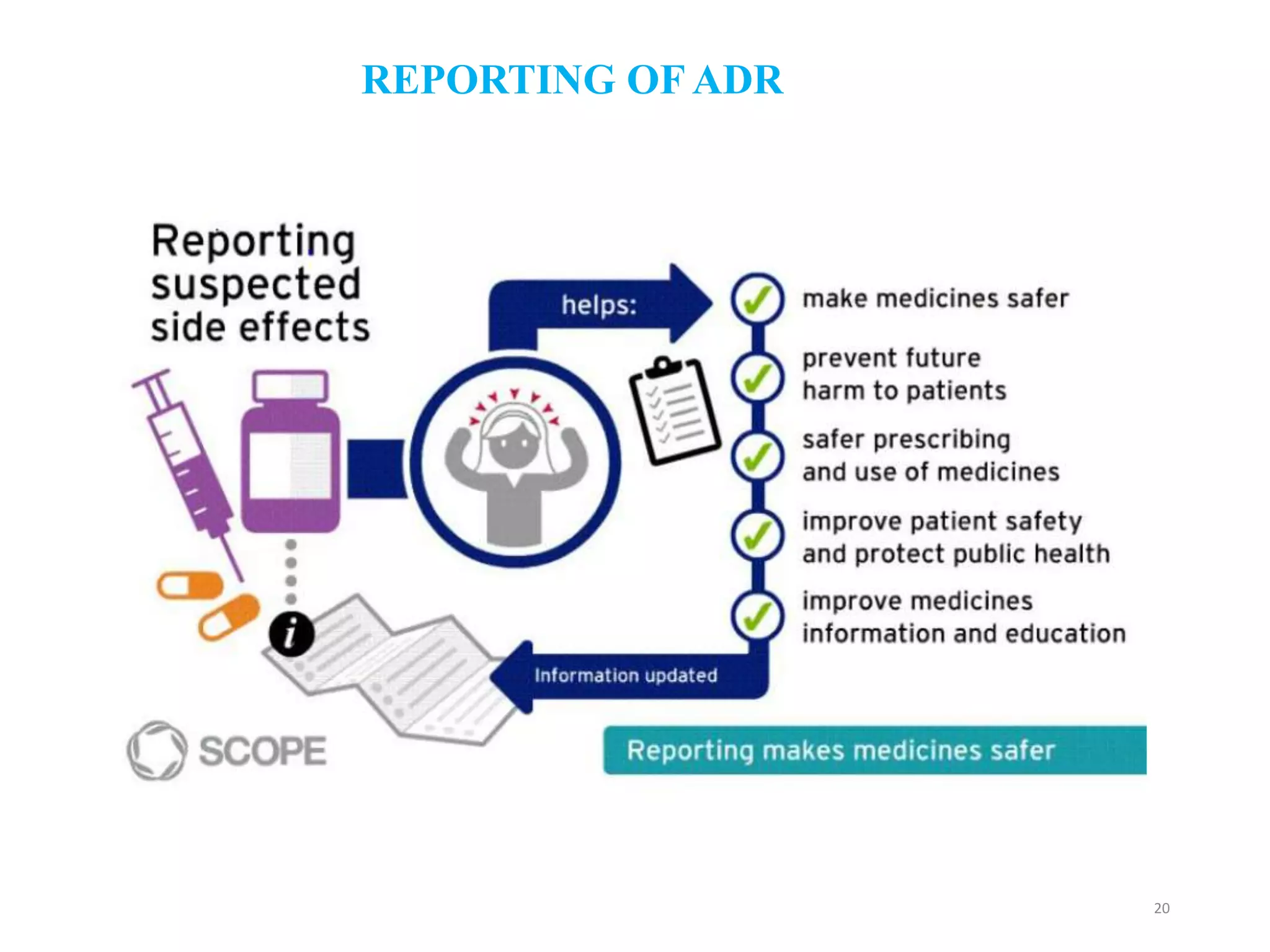
 REPORTING OF ADR
CONTENTS
2
Pharmacovigilance (PV) is defined as the science and activities relating
to the detection, assessment, understanding and prevention of adverse
effects or any other drug-related problem.
3
INTRODUCTION:
Pharmacovigilance starts from clinical stage and continues throughout the
product life cycle
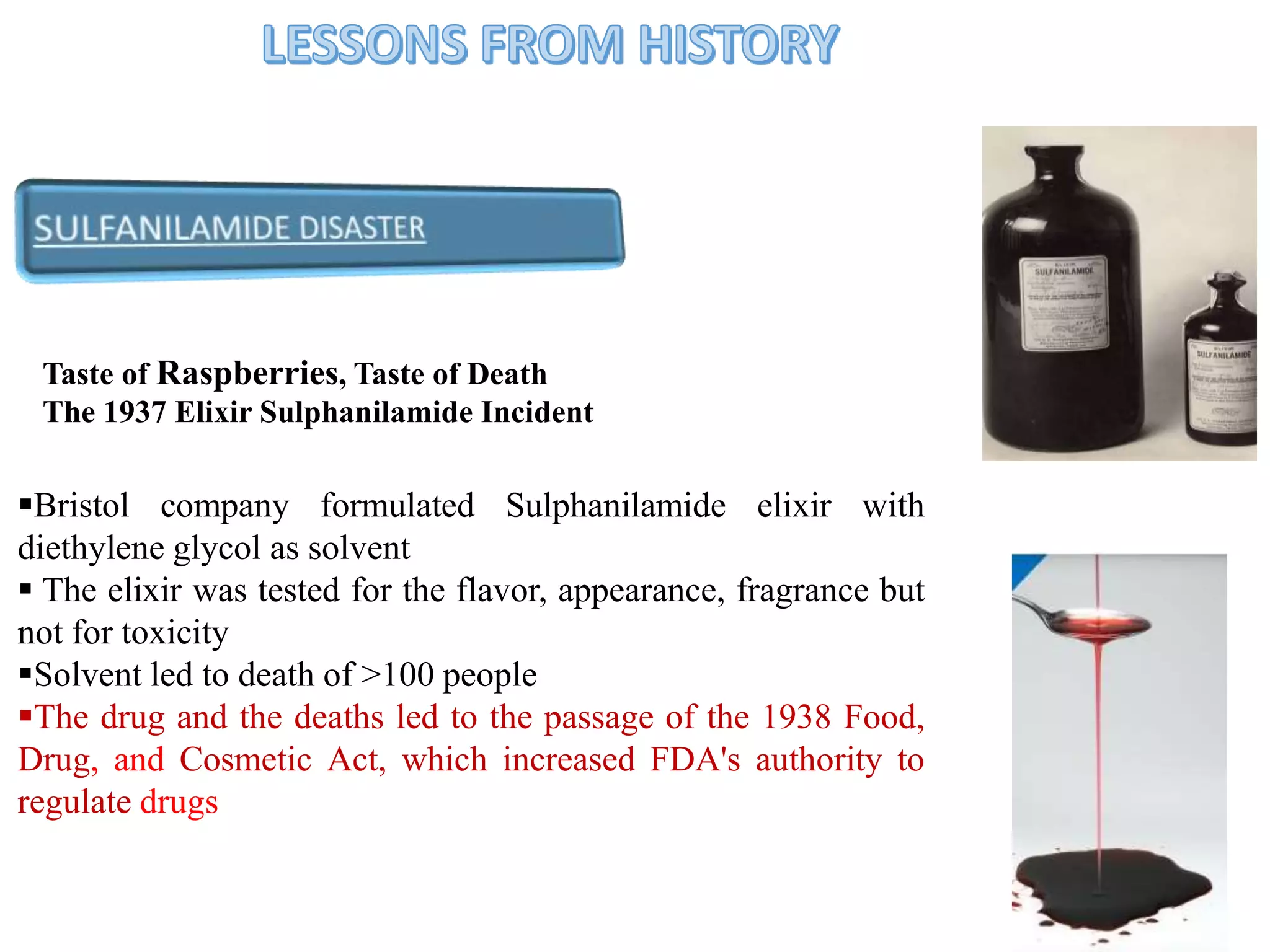
Taste of Raspberries, Taste of Death
The 1937 Elixir Sulphanilamide Incident
4
Bristol company formulated Sulphanilamide elixir with
diethylene glycol as solvent
 The elixir was tested for the flavor, appearance, fragrance but
not for toxicity
Solvent led to death of >100 people
The drug and the deaths led to the passage of the 1938 Food,
Drug, and Cosmetic Act, which increased FDA's authority to
regulate drugs
THE THALIDOMIDE TRAGEDY
 Use : Morning sickness
Medical disaster ever, where over 10,000 children
were born with malformations In 1961
5
6
16th world assembly adopted
a resolution.. New system
developed for detecting ADR
Science of
PHARMACOVIGILANCE
7
Clinical trials fail
to identify side-
effects that are
rare
side-effects do
not occur in the
context of clinical
trials
lack of a suitable
detection
techniques
Need
NEED FOR PHARMACOVIGILANCE
POPULATIONS NOT STUDIED IN THE PRE-APPROVAL
PHASE
• Children
• The elderly
• Pregnant or lactating women
• Patients with relevant co-morbidity
• Patients with disease severity different from that studied in clinical trials
• Patients of different races
8
9
10
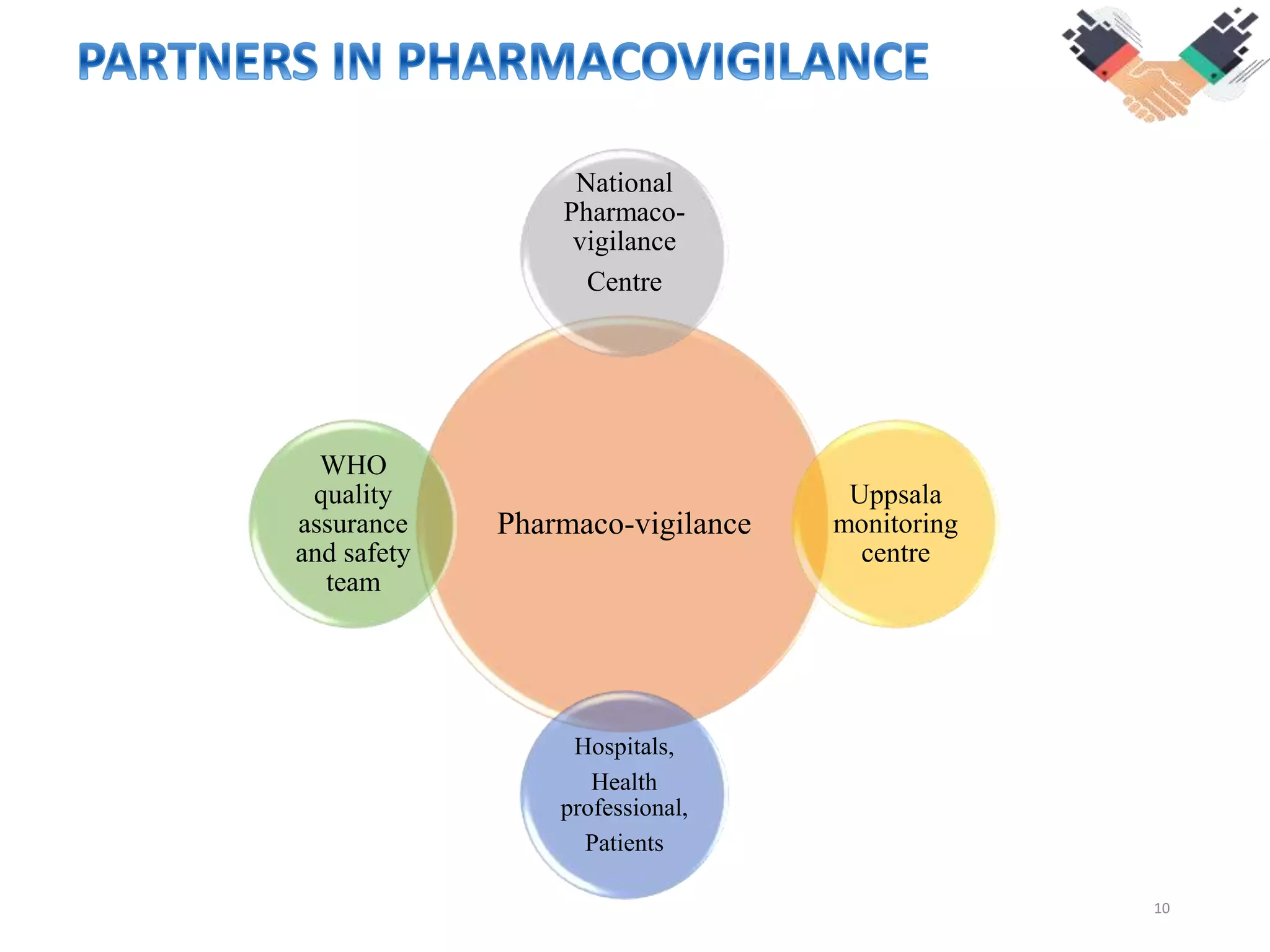
Pharmaco-vigilance
National
Pharmaco-
vigilance
Centre
Uppsala
monitoring
centre
Hospitals,
Health
professional,
Patients
WHO
quality
assurance
and safety
team
APPLICATION OF PHARMACOVIGILANCE
 PHARMACOVIGILANCE in drug regulation
 PHARMACOVIGILANCE in clinical practise
 PHARMACOVIGILANCE in international health
11
TERMINOLOGIES
Absolute risk Risk in a population (e.g. 1 in 1,000).
Adverse Event (AE) Any untoward medical occurrence that may present
during treatment with a pharmaceutical product but which does not necessarily
have a causal relationship with this treatment.
Adverse (Drug) Reaction (ADR) A response which is noxious and unintended,
and which occurs at doses normally used in humans for the prophylaxis,
diagnosis, or therapy of disease, or for the modification of physiological
function. (WHO, 1972).
Causal relationship A relationship between one phenomenon or event (A) and
another (B) in which A precedes and causes B. In pharmacovigilance; a
medicine causing an adverse reaction.
Causality assessment The evaluation of medicine was the causative agent of an
observed adverse reaction.
12
Efficacy
The ability of a drug to produce the intended effect as determined by
scientific methods, for example in pre-clinical research conditions
(opposite of hazard)
Harm
The nature and extent of actual damage that could be caused by a drug.
Not to be confused with risk
Periodic Safety Update Report (PSUR)
A systematic review of the global safety data which became available to the
manufacturer of a marketed drug during a specific time period
Cohort Event Monitoring
observational study of events that occur during the use of medicines
13
Relative risk
Ratio of the risk in an exposed population (absolute risk) and the risk in an unexposed
population (reference risk). Relative risk is the result of a relative comparison between
outcome frequency measurements, e.g. incidences.
Risk
The probability of harm being caused; the probability (chance, odds) of an
occurrence.
Serious Adverse Event or Reaction
A serious adverse event or reaction is any untoward medical occurrence that at any
dose:
 results in death
 requires inpatient hospitalization or prolongation of existing hospitalization
14
Signal
Reported information on a possible causal relationship between an adverse
event and a drug, the relationship being unknown or incompletely
documented previously
Summary of Product Characteristics (SPC)
A regulatory document attached to the marketing authorization which
forms the basis of the product information made available to prescribers
and patients
Spontaneous reporting
System whereby case reports of adverse drug events are voluntarily
submitted from health professionals and pharmaceutical manufacturers to
the national regulatory authority
15
• SUSAR
• A suspected unexpected serious adverse reaction (SUSAR) is any UAR
that at any dose:
• a. Results in death;
• b. Is life threatening (i.e. the subject was at risk of death at the time of the
event)
• c. Refer to an event which hypothetically might have caused death if it
were more severe
• d. Requires hospitalization or prolongation of existing hospitalization;
• e. Results in persistent or significant disability or incapacity;
• f. Is a congenital anomaly or birth defect.
16
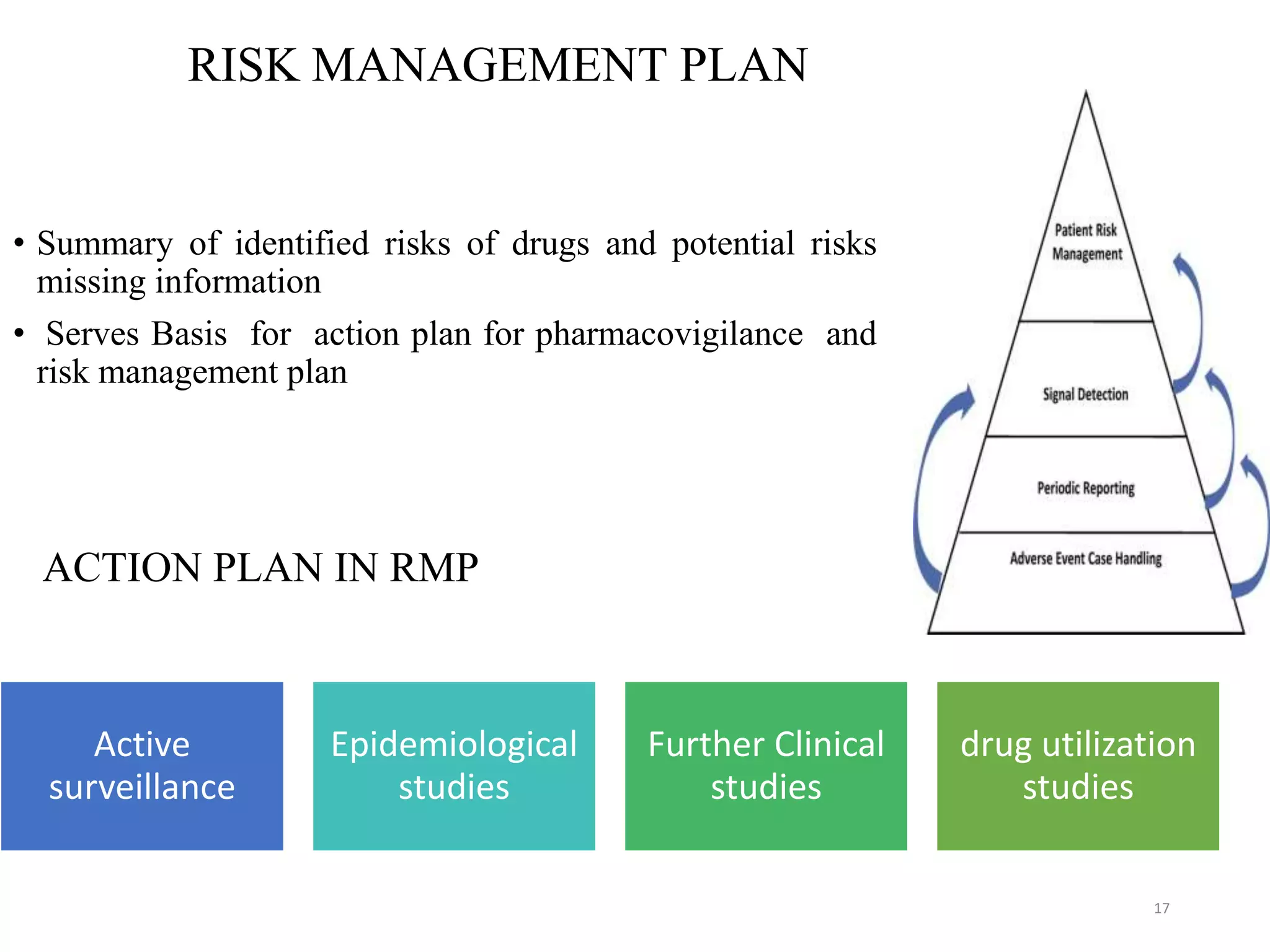
• Summary of identified risks of drugs and potential risks
missing information
• Serves Basis for action plan for pharmacovigilance and
risk management plan
Active
surveillance
Epidemiological
studies
Further Clinical
studies
drug utilization
studies
ACTION PLAN IN RMP
RISK MANAGEMENT PLAN
17
Additional educational material about the medicine and its use
Training programs
Restricted use of the medicine
18
If the action plan specifies additional risk minimization
activities, these could include
TYPES OFADR
19
REPORTING OF ADR
20
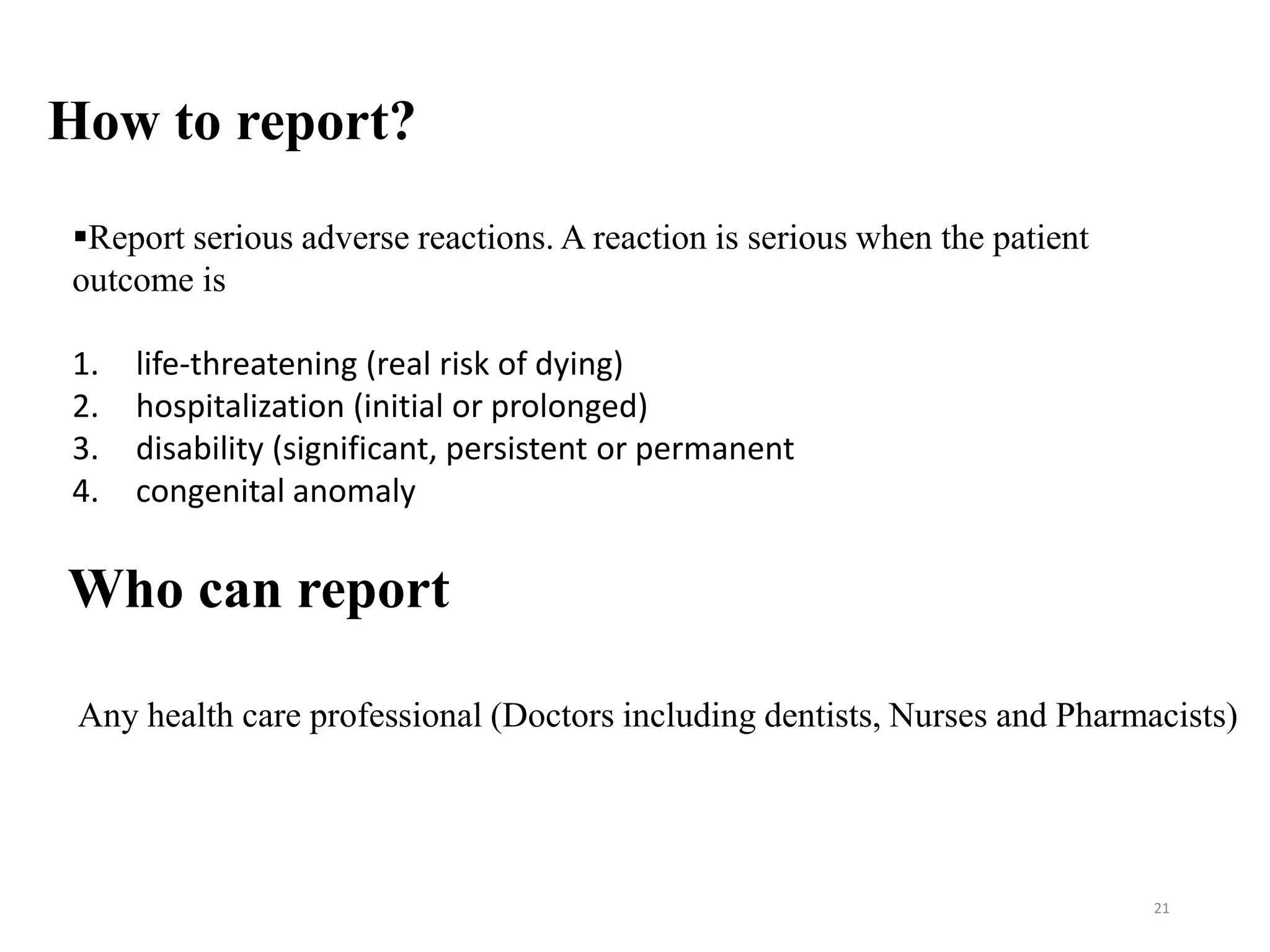
How to report?
21
Report serious adverse reactions. A reaction is serious when the patient
outcome is
1. life-threatening (real risk of dying)
2. hospitalization (initial or prolonged)
3. disability (significant, persistent or permanent
4. congenital anomaly
Who can report
Any health care professional (Doctors including dentists, Nurses and Pharmacists)
Where to report?
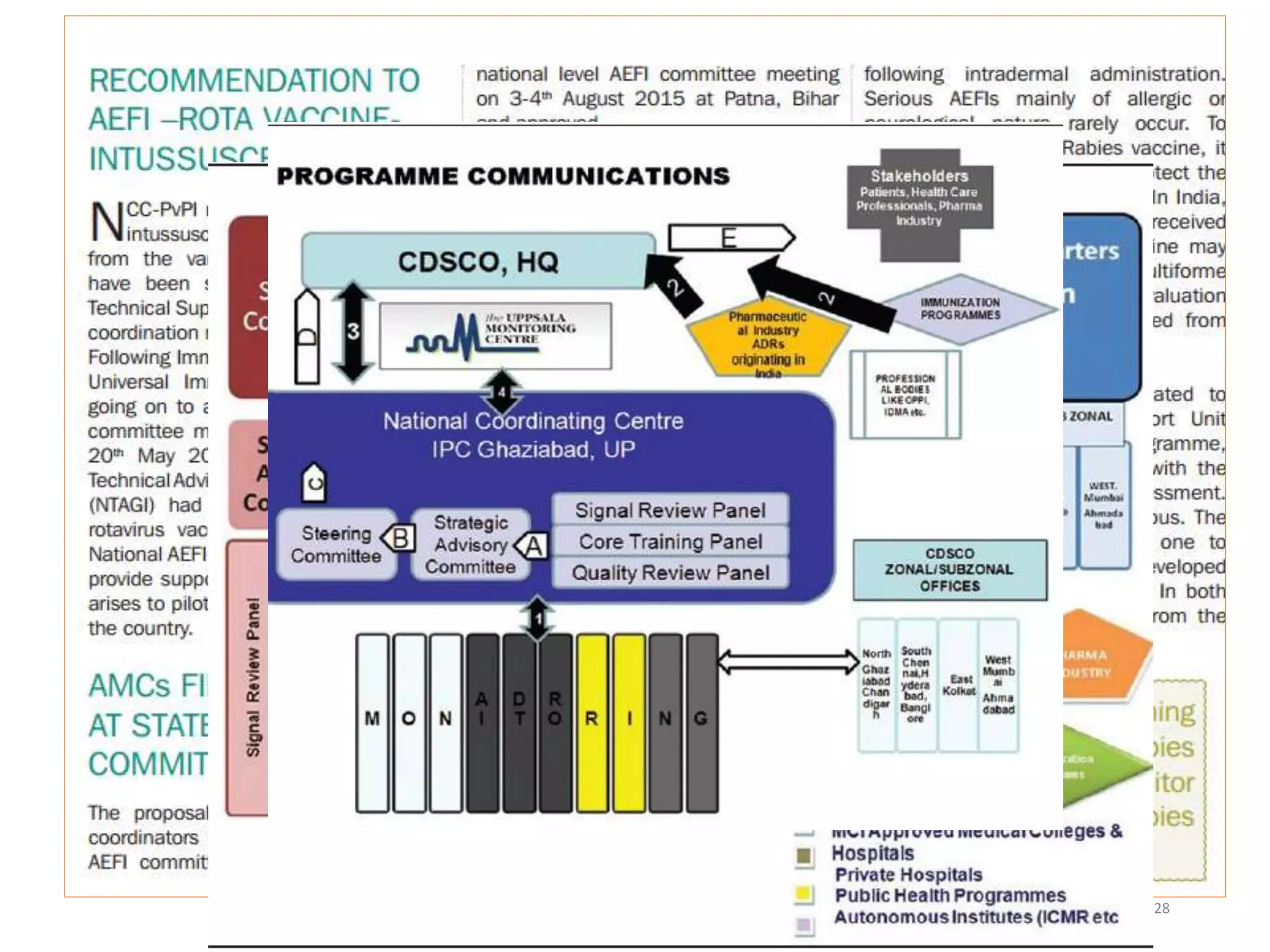
• Adverse drug reaction Monitoring Centre (AMC) or to
• National Coordinating Centre
22
What happens to submitted form?
 Causality assessment of medicines done in AMC WHO-UMC scale
 Analyzed report are sent to NCC through ADR database
Finally database analyzed and forwarded to global Pharmacovigilance
database (WHO UPPSALA centre in Sweden)
REPORTING OF ADR
• INDIA
• UK(Yellow card)
• US (Medwatch)
• AUSTRALIA(Blue card)
23
OUTCOMES OF PHARMACOVIGILANCE
• Reduces risk of ADR
• Rational use of medicines
• Assessing drug safety
• Label change(if necessary)
24
CASE STUDY
• 1980s pfizer developed drug for hypertension and angina efficacy was minimal
• Found erection in impotent male who are taking this treatment
• In jan 1997 they conducted study involving 3,000 subjects ages 19 to 87
• In march 1998 they got approval for oral therapy by FDA
• Despite wide spreading adoption caused small no.ofdeaths in 6months in 6millions
prescription dispensed
• FDA received deaths of 130 in that 77 are cardio related problems
• They found interaction with nitrates
• FDA ordered pfizer to amend label on this thing
• In july 2005 FDA received reported on small number men lost eye sight and label
was changed
25
NEW DRUG ALERTS
• UK
• INDIA
26
OUTCOME OF PHARMACOVIGILANCE PROGRAMME OF INDIA
SN.O DRUGS ADVERSE REACTION RECOMMENDATION OF
PVPI TO CDSCO
CDSCO INITIATIVE
1 Lamotrigine Steven johnson syndrome For label change In process
2 Ceftriaxone Steven johnson syndrome For label change In process
3 Betamethasone Photosensitivity reaction For label change In process
4 Surfactant Pulmonary hemorrhage For label change In process
5 Ranitidinde Cardiac arrest For label change In process
REGULATORY ACTION ON BASIS OF ADR REPORT
SN.O DRUG ADR CDSCO action
1 Carbmazepine Stevens johnson syndrome and toxic
epidermal necrolysis
CDSCO instructed marketing
authorizing holder(mah) to comply the
same
2 Mannitol Hypokalaemia Approved in subject expert
committee (SEC) of CDSCO
3 Rotavirus vaccine Intussusception Approved in SEC of CDSCO
4 Piperacillin & tazobactum Hypokalemia and bronchospasm CDSCO instructed to MAH comply
with the same
5 Anti rabies vaccine Erythema multiforme CDSCO instructed to MAH to comply
with the same
On the basis of PVPI recommendations CDSCO has taken action
27
28
CONCLUSION;
29
 Important for healthcare professional to know about each drug data
documentation , drug benefit ratio profile
 Knowing about every step of pharmaceutical management cycle
advantageous for health organization to educate patient clearly about every
drug
REFERENCES
 Amery, W. K. (1999). Why there is a need for
pharmacovigilance. Pharmacoepidemiology and drug safety, 8(1), 61-64.
 World Health Organization. (2002). The importance of pharmacovigilance
 http://www.ipc.gov.in/PvPI/pv_home.html
 Biswas, P. (2013). Pharmacovigilance in Asia. Journal of Pharmacology &
Pharmacotherapeutics, 4(Suppl1), S7–S19. Kumar, L. (2015).
 Lokesh ,.Pharmacovigilance/reporting adverse drug reactions: an approach to
enhance health surveillance and extending market share by minimizing the
chances of drug withdrawals. International Journal of Pharmacy and
Pharmaceutical Sciences, 7(9), 1-7.
 https://helix.northwestern.edu/.../thalidomide-tragedy-lessons-drug-safety-and-
regulati..
30
 https://www.fda.gov/aboutfda/whatwedo/history/.../sulfanilamidedisaster/
 www.fda.gov/safety/medwatch/howtoreport/downloadforms/default.
 uk.gov(drug safety updates)
 https://www.pfizer.com/files/health/.../22_What_is_a_Risk_Management_Plan
.pdf
31

importance of pharmcovigilance

  • 1.
    PRESENTED BY S.NIKHIL DEPARTMENT OFPHARMACEUTICS PE/2017/315
  • 2.
     INTRODUCTION  AIMSOF PHARMACOVIGILANCE  NEED FOR PHARMACOVIGILANCE  APPLICATION OF PHARMACOVIGILANCE  REPORTING OF ADR CONTENTS 2
  • 3.
    Pharmacovigilance (PV) isdefined as the science and activities relating to the detection, assessment, understanding and prevention of adverse effects or any other drug-related problem. 3 INTRODUCTION: Pharmacovigilance starts from clinical stage and continues throughout the product life cycle
  • 4.
    Taste of Raspberries,Taste of Death The 1937 Elixir Sulphanilamide Incident 4 Bristol company formulated Sulphanilamide elixir with diethylene glycol as solvent  The elixir was tested for the flavor, appearance, fragrance but not for toxicity Solvent led to death of >100 people The drug and the deaths led to the passage of the 1938 Food, Drug, and Cosmetic Act, which increased FDA's authority to regulate drugs
  • 5.
    THE THALIDOMIDE TRAGEDY Use : Morning sickness Medical disaster ever, where over 10,000 children were born with malformations In 1961 5
  • 6.
    6 16th world assemblyadopted a resolution.. New system developed for detecting ADR Science of PHARMACOVIGILANCE
  • 7.
    7 Clinical trials fail toidentify side- effects that are rare side-effects do not occur in the context of clinical trials lack of a suitable detection techniques Need NEED FOR PHARMACOVIGILANCE
  • 8.
    POPULATIONS NOT STUDIEDIN THE PRE-APPROVAL PHASE • Children • The elderly • Pregnant or lactating women • Patients with relevant co-morbidity • Patients with disease severity different from that studied in clinical trials • Patients of different races 8
  • 9.
  • 10.
  • 11.
    APPLICATION OF PHARMACOVIGILANCE PHARMACOVIGILANCE in drug regulation  PHARMACOVIGILANCE in clinical practise  PHARMACOVIGILANCE in international health 11
  • 12.
    TERMINOLOGIES Absolute risk Riskin a population (e.g. 1 in 1,000). Adverse Event (AE) Any untoward medical occurrence that may present during treatment with a pharmaceutical product but which does not necessarily have a causal relationship with this treatment. Adverse (Drug) Reaction (ADR) A response which is noxious and unintended, and which occurs at doses normally used in humans for the prophylaxis, diagnosis, or therapy of disease, or for the modification of physiological function. (WHO, 1972). Causal relationship A relationship between one phenomenon or event (A) and another (B) in which A precedes and causes B. In pharmacovigilance; a medicine causing an adverse reaction. Causality assessment The evaluation of medicine was the causative agent of an observed adverse reaction. 12
  • 13.
    Efficacy The ability ofa drug to produce the intended effect as determined by scientific methods, for example in pre-clinical research conditions (opposite of hazard) Harm The nature and extent of actual damage that could be caused by a drug. Not to be confused with risk Periodic Safety Update Report (PSUR) A systematic review of the global safety data which became available to the manufacturer of a marketed drug during a specific time period Cohort Event Monitoring observational study of events that occur during the use of medicines 13
  • 14.
    Relative risk Ratio ofthe risk in an exposed population (absolute risk) and the risk in an unexposed population (reference risk). Relative risk is the result of a relative comparison between outcome frequency measurements, e.g. incidences. Risk The probability of harm being caused; the probability (chance, odds) of an occurrence. Serious Adverse Event or Reaction A serious adverse event or reaction is any untoward medical occurrence that at any dose:  results in death  requires inpatient hospitalization or prolongation of existing hospitalization 14
  • 15.
    Signal Reported information ona possible causal relationship between an adverse event and a drug, the relationship being unknown or incompletely documented previously Summary of Product Characteristics (SPC) A regulatory document attached to the marketing authorization which forms the basis of the product information made available to prescribers and patients Spontaneous reporting System whereby case reports of adverse drug events are voluntarily submitted from health professionals and pharmaceutical manufacturers to the national regulatory authority 15
  • 16.
    • SUSAR • Asuspected unexpected serious adverse reaction (SUSAR) is any UAR that at any dose: • a. Results in death; • b. Is life threatening (i.e. the subject was at risk of death at the time of the event) • c. Refer to an event which hypothetically might have caused death if it were more severe • d. Requires hospitalization or prolongation of existing hospitalization; • e. Results in persistent or significant disability or incapacity; • f. Is a congenital anomaly or birth defect. 16
  • 17.
    • Summary ofidentified risks of drugs and potential risks missing information • Serves Basis for action plan for pharmacovigilance and risk management plan Active surveillance Epidemiological studies Further Clinical studies drug utilization studies ACTION PLAN IN RMP RISK MANAGEMENT PLAN 17
  • 18.
    Additional educational materialabout the medicine and its use Training programs Restricted use of the medicine 18 If the action plan specifies additional risk minimization activities, these could include
  • 19.
  • 20.
  • 21.
    How to report? 21 Reportserious adverse reactions. A reaction is serious when the patient outcome is 1. life-threatening (real risk of dying) 2. hospitalization (initial or prolonged) 3. disability (significant, persistent or permanent 4. congenital anomaly Who can report Any health care professional (Doctors including dentists, Nurses and Pharmacists)
  • 22.
    Where to report? •Adverse drug reaction Monitoring Centre (AMC) or to • National Coordinating Centre 22 What happens to submitted form?  Causality assessment of medicines done in AMC WHO-UMC scale  Analyzed report are sent to NCC through ADR database Finally database analyzed and forwarded to global Pharmacovigilance database (WHO UPPSALA centre in Sweden)
  • 23.
    REPORTING OF ADR •INDIA • UK(Yellow card) • US (Medwatch) • AUSTRALIA(Blue card) 23
  • 24.
    OUTCOMES OF PHARMACOVIGILANCE •Reduces risk of ADR • Rational use of medicines • Assessing drug safety • Label change(if necessary) 24
  • 25.
    CASE STUDY • 1980spfizer developed drug for hypertension and angina efficacy was minimal • Found erection in impotent male who are taking this treatment • In jan 1997 they conducted study involving 3,000 subjects ages 19 to 87 • In march 1998 they got approval for oral therapy by FDA • Despite wide spreading adoption caused small no.ofdeaths in 6months in 6millions prescription dispensed • FDA received deaths of 130 in that 77 are cardio related problems • They found interaction with nitrates • FDA ordered pfizer to amend label on this thing • In july 2005 FDA received reported on small number men lost eye sight and label was changed 25
  • 26.
    NEW DRUG ALERTS •UK • INDIA 26
  • 27.
    OUTCOME OF PHARMACOVIGILANCEPROGRAMME OF INDIA SN.O DRUGS ADVERSE REACTION RECOMMENDATION OF PVPI TO CDSCO CDSCO INITIATIVE 1 Lamotrigine Steven johnson syndrome For label change In process 2 Ceftriaxone Steven johnson syndrome For label change In process 3 Betamethasone Photosensitivity reaction For label change In process 4 Surfactant Pulmonary hemorrhage For label change In process 5 Ranitidinde Cardiac arrest For label change In process REGULATORY ACTION ON BASIS OF ADR REPORT SN.O DRUG ADR CDSCO action 1 Carbmazepine Stevens johnson syndrome and toxic epidermal necrolysis CDSCO instructed marketing authorizing holder(mah) to comply the same 2 Mannitol Hypokalaemia Approved in subject expert committee (SEC) of CDSCO 3 Rotavirus vaccine Intussusception Approved in SEC of CDSCO 4 Piperacillin & tazobactum Hypokalemia and bronchospasm CDSCO instructed to MAH comply with the same 5 Anti rabies vaccine Erythema multiforme CDSCO instructed to MAH to comply with the same On the basis of PVPI recommendations CDSCO has taken action 27
  • 28.
  • 29.
    CONCLUSION; 29  Important forhealthcare professional to know about each drug data documentation , drug benefit ratio profile  Knowing about every step of pharmaceutical management cycle advantageous for health organization to educate patient clearly about every drug
  • 30.
    REFERENCES  Amery, W.K. (1999). Why there is a need for pharmacovigilance. Pharmacoepidemiology and drug safety, 8(1), 61-64.  World Health Organization. (2002). The importance of pharmacovigilance  http://www.ipc.gov.in/PvPI/pv_home.html  Biswas, P. (2013). Pharmacovigilance in Asia. Journal of Pharmacology & Pharmacotherapeutics, 4(Suppl1), S7–S19. Kumar, L. (2015).  Lokesh ,.Pharmacovigilance/reporting adverse drug reactions: an approach to enhance health surveillance and extending market share by minimizing the chances of drug withdrawals. International Journal of Pharmacy and Pharmaceutical Sciences, 7(9), 1-7.  https://helix.northwestern.edu/.../thalidomide-tragedy-lessons-drug-safety-and- regulati.. 30
  • 31.
     https://www.fda.gov/aboutfda/whatwedo/history/.../sulfanilamidedisaster/  www.fda.gov/safety/medwatch/howtoreport/downloadforms/default. uk.gov(drug safety updates)  https://www.pfizer.com/files/health/.../22_What_is_a_Risk_Management_Plan .pdf 31