Fatigue
by Andrew Halfpenny
... between 80-90% of all structural failures
occur through a fatigue mechanism.
However, the adoption of fatigue prediction
in the finite element community, where
most structural engineering decisions are
made,hasbeenlimited.
Introduction
The Physics of Fatigue
According to independent
studies by Battelle in 1982,
between 80-90% of all
structural failures occur
through a fatigue mechanism,
with an estimated annual cost in
the US of about $1.5B.
Furthermore Battelle
concluded this could be
reduced by 29% by application
of current fatigue technology.
In this paper we overview the physical behaviour
responsible for fatigue from initiation to final
component failure.
Fatigue is defined as 'Failure under a repeated or
otherwise varying load, which never reaches a level
sufficient to cause failure in a single application.'
Fatigue cracks always develop as a result of cyclic
plastic deformation in a localised area. This plastic
deformation often arises, not due to theoretical
stresses in a perfect part, but rather due to the
presence of a small crack or pre-existing defect on
the surface of a component, which is practically
undetectable and clearly unfeasible to model using
traditional Finite Element techniques.
August Wöhler was the first to study fatigue and
propose an empirical approach. Between 1852 and
1870,Wöhler studied the progressive failure of
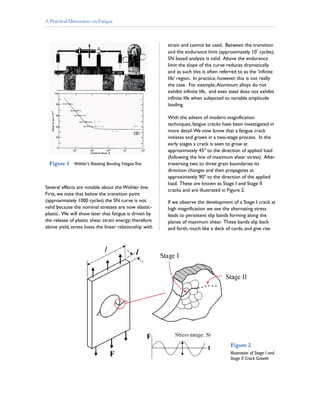
railway axles. He constructed the test rig shown in
Figure 1, which subjected 2 railway axles
simultaneously to a rotating bending test. Wöhler
plotted the nominal stress versus the number of
cycles to failure, which has become known as the
SN diagram. Each curve is still referred to as a
Wöhler line. The SN method is still the most
widely used today and a typical example of the
curve is shown in Figure 1.
Copyright © nCode International Ltd. All rights reserved.
on
Fatigue
A Practical Discussion
Managing Durability
nCode n
TP-0123
Several effects are notable about the Wöhler line.
First, we note that below the transition point
(approximately 1000 cycles) the SN curve is not
valid because the nominal stresses are now elastic-
plastic. We will show later that fatigue is driven by
the release of plastic shear strain energy; therefore
above yield, stress loses the linear relationship with
strain and cannot be used. Between the transition
and the endurance limit (approximately 10 cycles),
SN based analysis is valid. Above the endurance
limit the slope of the curve reduces dramatically
and as such this is often referred to as the 'infinite
life' region. In practice, however, this is not really
the case. For example,Aluminum alloys do not
exhibit infinite life, and even steel does not exhibit
infinite life when subjected to variable amplitude
loading.
With the advent of modern magnification
techniques, fatigue cracks have been investigated in
more detail.We now know that a fatigue crack
initiates and grows in a two-stage process. In the
early stages a crack is seen to grow at
approximately 45º to the direction of applied load
(following the line of maximum shear stress). After
traversing two to three grain boundaries its
direction changes and then propagates at
approximately 90º to the direction of the applied
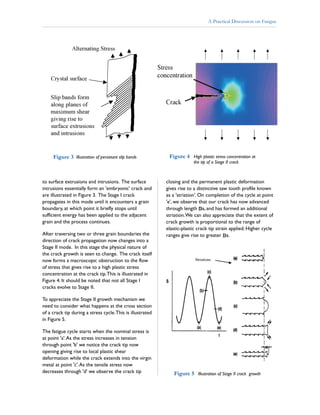
load. These are known as Stage I and Stage II
cracks and are illustrated in Figure 2.
If we observe the development of a Stage I crack at
high magnification we see the alternating stress
leads to persistent slip bands forming along the
planes of maximum shear. These bands slip back
and forth, much like a deck of cards, and give rise
7
A Practical Discussion on Fatigue
Illustration of Stage I and
Stage II Crack Growth
Figure 2
Wöhler's Rotating Bending FatigueTestFigure 1
to surface extrusions and intrusions. The surface
intrusions essentially form an 'embryonic' crack and
are illustrated in Figure 3. The Stage I crack
propagates in this mode until it encounters a grain
boundary, at which point it briefly stops until
sufficient energy has been applied to the adjacent
grain and the process continues.
To appreciate the Stage II growth mechanism we
need to consider what happens at the cross section
of a crack tip during a stress cycle.This is illustrated
in Figure 5.
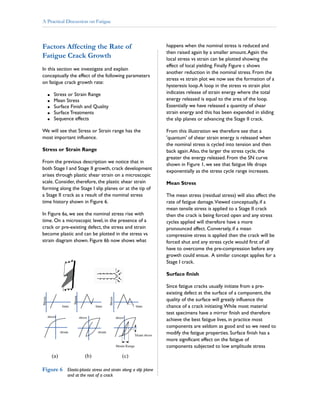
The fatigue cycle starts when the nominal stress is
at point 'a'.As the stress increases in tension
through point 'b' we notice the crack tip now
opening giving rise to local plastic shear
deformation while the crack extends into the virgin
metal at point 'c'.As the tensile stress now
decreases through 'd' we observe the crack tip
closing and the permanent plastic deformation
gives rise to a distinctive saw tooth profile known
as a 'striation'. On completion of the cycle at point
'e', we observe that our crack has now advanced
through length a, and has formed an additional
striation.We can also appreciate that the extent of
crack growth is proportional to the range of
elastic-plastic crack tip strain applied. Higher cycle
ranges give rise to greater a.After traversing two or three grain boundaries the
direction of crack propagation now changes into a
Stage II mode. In this stage the physical nature of
the crack growth is seen to change. The crack itself
now forms a macroscopic obstruction to the flow
of stress that gives rise to a high plastic stress
concentration at the crack tip.This is illustrated in
Figure 4. It should be noted that not all Stage I
cracks evolve to Stage II.
D
D
Figure 4 High plastic stress concentration at
the tip of a Stage II crack
A Practical Discussion on Fatigue
Figure 3 Illustration of persistant slip bands
Figure 5 Illustration of Stage II crack growth
Factors Affecting the Rate of
Fatigue Crack Growth
In this section we investigate and explain
conceptually the effect of the following parameters
on fatigue crack growth rate:
Stress or Strain Range
Mean Stress
Surface Finish and Quality
Surface Treatments
Sequence effects
We will see that Stress or Strain range has the
most important influence.
From the previous description we notice that in
both Stage I and Stage II growth, crack development
arises through plastic shear strain on a microscopic
scale. Consider, therefore, the plastic shear strain
forming along the Stage I slip planes or at the tip of
a Stage II crack as a result of the nominal stress
time history shown in Figure 6.
In Figure 6a, we see the nominal stress rise with
time. On a microscopic level, in the presence of a
crack or pre-existing defect, the stress and strain
become plastic and can be plotted in the stress vs
strain diagram shown. Figure 6b now shows what
happens when the nominal stress is reduced and
then raised again by a smaller amount.Again the
local stress vs strain can be plotted showing the
effect of local yielding. Finally Figure c shows
another reduction in the nominal stress. From the
stress vs strain plot we now see the formation of a
hysteresis loop.A loop in the stress vs strain plot
indicates release of strain energy where the total
energy released is equal to the area of the loop.
Essentially we have released a quantity of shear
strain energy and this has been expended in sliding
the slip planes or advancing the Stage II crack.
From this illustration we therefore see that a
'quantum' of shear strain energy is released when
the nominal stress is cycled into tension and then
back again.Also, the larger the stress cycle, the
greater the energy released. From the SN curve
shown in Figure 1, we see that fatigue life drops
exponentially as the stress cycle range increases.
The mean stress (residual stress) will also affect the
rate of fatigue damage.Viewed conceptually, if a
mean tensile stress is applied to a Stage II crack
then the crack is being forced open and any stress
cycles applied will therefore have a more
pronounced affect. Conversely, if a mean
compressive stress is applied then the crack will be
forced shut and any stress cycle would first of all
have to overcome the pre-compression before any
growth could ensue. A similar concept applies for a
Stage I crack.
Since fatigue cracks usually initiate from a pre-
existing defect at the surface of a component, the
quality of the surface will greatly influence the
chance of a crack initiating.While most material
test specimens have a mirror finish and therefore
achieve the best fatigue lives, in practice most
components are seldom as good and so we need to
modify the fatigue properties. Surface finish has a
more significant effect on the fatigue of
components subjected to low amplitude stress
!
!
!
!
!
Stress or Strain Range
Mean Stress
Surface finish
Figure 6 Elastic-plastic stress and strain along a slip plane
and at the root of a crack
A Practical Discussion on Fatigue
cycles.The effect of surface finish can be modelled
by multiplying the SN curve by the surface
correction parameter at the endurance limit.
Surface treatments can be applied to improve the
fatigue resistance of a component.These usually
work by inducing a residual compressive stress at
the surface. Under low amplitude cycles the
stresses at the surface are significantly lower or
even remain compressive.Therefore the fatigue life
is greatly improved.We note, however, that this
effect is only true for components subjected to low
amplitude stress cycles. If large amplitude cycles
were applied then these would start to overcome
the pre-compression and the benefit would be lost.
The effect of surface treatments can be modelled in
the same way as surface quality.
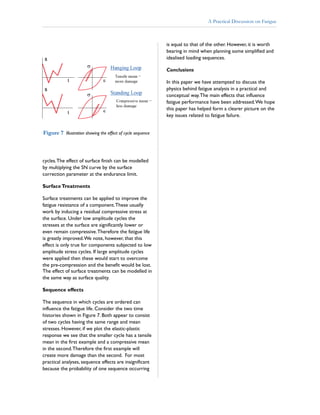
The sequence in which cycles are ordered can
influence the fatigue life. Consider the two time
histories shown in Figure 7. Both appear to consist
of two cycles having the same range and mean
stresses. However, if we plot the elastic-plastic
response we see that the smaller cycle has a tensile
mean in the first example and a compressive mean
in the second.Therefore the first example will
create more damage than the second. For most
practical analyses, sequence effects are insignificant
because the probability of one sequence occurring
is equal to that of the other. However, it is worth
bearing in mind when planning some simplified and
idealised loading sequences.
In this paper we have attempted to discuss the
physics behind fatigue analysis in a practical and
conceptual way.The main effects that influence
fatigue performance have been addressed.We hope
this paper has helped form a clearer picture on the
key issues related to fatigue failure.
SurfaceTreatments
Sequence effects
Conclusions
Figure 7 Illustration showing the effect of cycle sequence
A Practical Discussion on Fatigue

1533319843practical discussion-on-fatigue

  • 1.
    Fatigue by Andrew Halfpenny ...between 80-90% of all structural failures occur through a fatigue mechanism. However, the adoption of fatigue prediction in the finite element community, where most structural engineering decisions are made,hasbeenlimited. Introduction The Physics of Fatigue According to independent studies by Battelle in 1982, between 80-90% of all structural failures occur through a fatigue mechanism, with an estimated annual cost in the US of about $1.5B. Furthermore Battelle concluded this could be reduced by 29% by application of current fatigue technology. In this paper we overview the physical behaviour responsible for fatigue from initiation to final component failure. Fatigue is defined as 'Failure under a repeated or otherwise varying load, which never reaches a level sufficient to cause failure in a single application.' Fatigue cracks always develop as a result of cyclic plastic deformation in a localised area. This plastic deformation often arises, not due to theoretical stresses in a perfect part, but rather due to the presence of a small crack or pre-existing defect on the surface of a component, which is practically undetectable and clearly unfeasible to model using traditional Finite Element techniques. August Wöhler was the first to study fatigue and propose an empirical approach. Between 1852 and 1870,Wöhler studied the progressive failure of railway axles. He constructed the test rig shown in Figure 1, which subjected 2 railway axles simultaneously to a rotating bending test. Wöhler plotted the nominal stress versus the number of cycles to failure, which has become known as the SN diagram. Each curve is still referred to as a Wöhler line. The SN method is still the most widely used today and a typical example of the curve is shown in Figure 1. Copyright © nCode International Ltd. All rights reserved. on Fatigue A Practical Discussion Managing Durability nCode n TP-0123
  • 2.
    Several effects arenotable about the Wöhler line. First, we note that below the transition point (approximately 1000 cycles) the SN curve is not valid because the nominal stresses are now elastic- plastic. We will show later that fatigue is driven by the release of plastic shear strain energy; therefore above yield, stress loses the linear relationship with strain and cannot be used. Between the transition and the endurance limit (approximately 10 cycles), SN based analysis is valid. Above the endurance limit the slope of the curve reduces dramatically and as such this is often referred to as the 'infinite life' region. In practice, however, this is not really the case. For example,Aluminum alloys do not exhibit infinite life, and even steel does not exhibit infinite life when subjected to variable amplitude loading. With the advent of modern magnification techniques, fatigue cracks have been investigated in more detail.We now know that a fatigue crack initiates and grows in a two-stage process. In the early stages a crack is seen to grow at approximately 45º to the direction of applied load (following the line of maximum shear stress). After traversing two to three grain boundaries its direction changes and then propagates at approximately 90º to the direction of the applied load. These are known as Stage I and Stage II cracks and are illustrated in Figure 2. If we observe the development of a Stage I crack at high magnification we see the alternating stress leads to persistent slip bands forming along the planes of maximum shear. These bands slip back and forth, much like a deck of cards, and give rise 7 A Practical Discussion on Fatigue Illustration of Stage I and Stage II Crack Growth Figure 2 Wöhler's Rotating Bending FatigueTestFigure 1
  • 3.
    to surface extrusionsand intrusions. The surface intrusions essentially form an 'embryonic' crack and are illustrated in Figure 3. The Stage I crack propagates in this mode until it encounters a grain boundary, at which point it briefly stops until sufficient energy has been applied to the adjacent grain and the process continues. To appreciate the Stage II growth mechanism we need to consider what happens at the cross section of a crack tip during a stress cycle.This is illustrated in Figure 5. The fatigue cycle starts when the nominal stress is at point 'a'.As the stress increases in tension through point 'b' we notice the crack tip now opening giving rise to local plastic shear deformation while the crack extends into the virgin metal at point 'c'.As the tensile stress now decreases through 'd' we observe the crack tip closing and the permanent plastic deformation gives rise to a distinctive saw tooth profile known as a 'striation'. On completion of the cycle at point 'e', we observe that our crack has now advanced through length a, and has formed an additional striation.We can also appreciate that the extent of crack growth is proportional to the range of elastic-plastic crack tip strain applied. Higher cycle ranges give rise to greater a.After traversing two or three grain boundaries the direction of crack propagation now changes into a Stage II mode. In this stage the physical nature of the crack growth is seen to change. The crack itself now forms a macroscopic obstruction to the flow of stress that gives rise to a high plastic stress concentration at the crack tip.This is illustrated in Figure 4. It should be noted that not all Stage I cracks evolve to Stage II. D D Figure 4 High plastic stress concentration at the tip of a Stage II crack A Practical Discussion on Fatigue Figure 3 Illustration of persistant slip bands Figure 5 Illustration of Stage II crack growth
  • 4.
    Factors Affecting theRate of Fatigue Crack Growth In this section we investigate and explain conceptually the effect of the following parameters on fatigue crack growth rate: Stress or Strain Range Mean Stress Surface Finish and Quality Surface Treatments Sequence effects We will see that Stress or Strain range has the most important influence. From the previous description we notice that in both Stage I and Stage II growth, crack development arises through plastic shear strain on a microscopic scale. Consider, therefore, the plastic shear strain forming along the Stage I slip planes or at the tip of a Stage II crack as a result of the nominal stress time history shown in Figure 6. In Figure 6a, we see the nominal stress rise with time. On a microscopic level, in the presence of a crack or pre-existing defect, the stress and strain become plastic and can be plotted in the stress vs strain diagram shown. Figure 6b now shows what happens when the nominal stress is reduced and then raised again by a smaller amount.Again the local stress vs strain can be plotted showing the effect of local yielding. Finally Figure c shows another reduction in the nominal stress. From the stress vs strain plot we now see the formation of a hysteresis loop.A loop in the stress vs strain plot indicates release of strain energy where the total energy released is equal to the area of the loop. Essentially we have released a quantity of shear strain energy and this has been expended in sliding the slip planes or advancing the Stage II crack. From this illustration we therefore see that a 'quantum' of shear strain energy is released when the nominal stress is cycled into tension and then back again.Also, the larger the stress cycle, the greater the energy released. From the SN curve shown in Figure 1, we see that fatigue life drops exponentially as the stress cycle range increases. The mean stress (residual stress) will also affect the rate of fatigue damage.Viewed conceptually, if a mean tensile stress is applied to a Stage II crack then the crack is being forced open and any stress cycles applied will therefore have a more pronounced affect. Conversely, if a mean compressive stress is applied then the crack will be forced shut and any stress cycle would first of all have to overcome the pre-compression before any growth could ensue. A similar concept applies for a Stage I crack. Since fatigue cracks usually initiate from a pre- existing defect at the surface of a component, the quality of the surface will greatly influence the chance of a crack initiating.While most material test specimens have a mirror finish and therefore achieve the best fatigue lives, in practice most components are seldom as good and so we need to modify the fatigue properties. Surface finish has a more significant effect on the fatigue of components subjected to low amplitude stress ! ! ! ! ! Stress or Strain Range Mean Stress Surface finish Figure 6 Elastic-plastic stress and strain along a slip plane and at the root of a crack A Practical Discussion on Fatigue
  • 5.
    cycles.The effect ofsurface finish can be modelled by multiplying the SN curve by the surface correction parameter at the endurance limit. Surface treatments can be applied to improve the fatigue resistance of a component.These usually work by inducing a residual compressive stress at the surface. Under low amplitude cycles the stresses at the surface are significantly lower or even remain compressive.Therefore the fatigue life is greatly improved.We note, however, that this effect is only true for components subjected to low amplitude stress cycles. If large amplitude cycles were applied then these would start to overcome the pre-compression and the benefit would be lost. The effect of surface treatments can be modelled in the same way as surface quality. The sequence in which cycles are ordered can influence the fatigue life. Consider the two time histories shown in Figure 7. Both appear to consist of two cycles having the same range and mean stresses. However, if we plot the elastic-plastic response we see that the smaller cycle has a tensile mean in the first example and a compressive mean in the second.Therefore the first example will create more damage than the second. For most practical analyses, sequence effects are insignificant because the probability of one sequence occurring is equal to that of the other. However, it is worth bearing in mind when planning some simplified and idealised loading sequences. In this paper we have attempted to discuss the physics behind fatigue analysis in a practical and conceptual way.The main effects that influence fatigue performance have been addressed.We hope this paper has helped form a clearer picture on the key issues related to fatigue failure. SurfaceTreatments Sequence effects Conclusions Figure 7 Illustration showing the effect of cycle sequence A Practical Discussion on Fatigue